Cracking a skill-specific interview, like one for Operating Forestry Handling Equipment, requires understanding the nuances of the role. In this blog, we present the questions you’re most likely to encounter, along with insights into how to answer them effectively. Let’s ensure you’re ready to make a strong impression.
Questions Asked in Operating Forestry Handling Equipment Interview
Q 1. Describe your experience operating a skidder.
My experience operating a skidder spans over eight years, encompassing various terrains and timber types. A skidder is essentially a powerful tractor used to drag felled trees from the felling site to a landing area. I’ve operated both cable and grapple skidders. With cable skidders, I’ve mastered the art of precisely placing the choker chains around logs to secure them for efficient dragging. This requires careful judgment of log size, terrain, and the skidder’s capabilities to avoid damage to the machine or the logs themselves. Grapple skidders, on the other hand, offer greater flexibility and speed, requiring a keen eye for efficient log gathering and maneuvering through challenging terrain. I’m proficient in using both types, adapting my technique to different log sizes and forest conditions. For instance, in steep terrain, I utilize careful winch control and strategic log placement to maximize safety and efficiency. In dense stands, I adapt my approach to minimize damage to remaining trees.
One memorable experience involved navigating a particularly steep slope with a heavy load. By carefully controlling the winch and utilizing the skidder’s differential lock, I successfully extracted the logs without incident, showcasing my ability to handle challenging situations safely and effectively.
Q 2. Explain the process of felling a tree using a feller buncher.
Felling a tree with a feller buncher involves a precise sequence of actions prioritizing safety and efficiency. First, the operator positions the machine strategically, ensuring sufficient space for the falling tree and minimizing the risk of damage to surrounding trees or equipment. The feller buncher’s cutting head, which is essentially a large saw with powerful hydraulic arms, is then positioned against the tree trunk. The operator activates the cutting mechanism, severing the tree with a powerful and controlled cut. The feller buncher then utilizes its grapple to grasp the felled tree and process it either by delimbing (removing branches) or by simply placing it on the ground for further processing by a skidder or forwarder. The entire process, from positioning to felling and processing, is controlled from the well-protected cab of the feller buncher.
Proper technique involves understanding the tree’s lean, assessing potential hazards like hanging branches or nearby obstacles, and executing a smooth, controlled cut. For example, when felling a tree near a powerline, I would use extreme caution, employing additional safety measures like spotters and possibly choosing a different felling method. The feller buncher’s technology allows for high precision, but human judgement remains paramount.
Q 3. How do you ensure safety while operating forestry equipment?
Safety is paramount in operating forestry equipment. My safety protocols start with thorough pre-operational checks of the equipment – inspecting hydraulics, brakes, tires, and all safety systems. This is followed by a site assessment to identify potential hazards like unstable terrain, overhead power lines, and proximity to other equipment or personnel. Throughout operation, I maintain a clear line of sight, avoiding blind spots whenever possible. I always use the seatbelt and adhere to all speed limits. Communication is crucial; I use radios to coordinate with other operators and ground personnel, especially when working in close proximity.
I’ve been involved in safety training programs that emphasize hazard identification, risk assessment, and emergency response procedures. This training included hands-on simulations and practical exercises that reinforced safe operating practices. I’m also involved in regular safety meetings and actively participate in toolbox talks to address any potential safety concerns.
In short, my safety approach is a proactive, multi-layered strategy that combines thorough equipment checks, site awareness, safe operating practices, and consistent communication.
Q 4. What are the different types of harvesters and their applications?
Harvesters are machines that fell, delimb, and process trees in a single operation, significantly increasing efficiency compared to traditional methods. Several types exist, each suited to different applications.
- Cut-to-length harvesters: These machines cut the tree into pre-determined lengths, making it easier for transport and processing. They’re ideal for areas with limited space or challenging terrain.
- Full-tree harvesters: These harvesters fell, delimb, and bunch the entire tree, which is then transported to a central processing point. This is efficient for large-scale operations in relatively easy terrain.
- Processing heads: These are attachments that can be fitted to various carriers (like excavators or wheeled carriers) to perform the delimbing and cutting operations.
The choice depends on factors such as the type of timber being harvested, the terrain, the volume of timber, and the overall logging plan. For instance, in a densely populated area with limited access, a cut-to-length harvester is generally preferred for its maneuverability and ability to minimize damage to the surrounding environment.
Q 5. Describe your experience with pre-harvest planning and site preparation.
My experience with pre-harvest planning involves careful examination of the site’s topography, soil conditions, and the location of trees to be harvested. This includes assessing the potential for environmental damage, such as soil erosion, and planning mitigation strategies, such as using designated skid trails. I’m proficient in using GIS software and aerial imagery to create detailed maps that help plan efficient logging routes that minimize environmental impact. Furthermore, I work with foresters and environmental consultants to develop sustainable harvesting plans that adhere to all relevant regulations and environmental standards. Site preparation often includes creating access roads and landing areas. The process is vital for ensuring efficient and safe harvesting operations, protecting the environment, and reducing the overall cost of logging.
A recent project involved creating a detailed plan for harvesting in a sensitive wetland area. This required careful coordination with environmental specialists and the development of specialized techniques to minimize impact on the delicate ecosystem. Successful execution of the plan reduced the environmental footprint significantly.
Q 6. How do you maintain and troubleshoot a forwarder?
Maintaining and troubleshooting a forwarder requires a systematic approach. Routine maintenance involves daily checks of hydraulic fluids, tire pressure, brakes, and the general condition of the machine. Regular servicing includes changing oil and filters, lubricating moving parts, and inspecting the grapple and suspension system. I’m also adept at identifying and fixing minor issues, such as replacing hydraulic hoses or repairing minor electrical faults. For more significant problems, I know when to seek professional assistance.
Troubleshooting often involves using diagnostic tools to identify the source of the problem. For example, if the forwarder’s grapple fails to function correctly, I’ll first check the hydraulic lines for leaks or blockages. Then, I’ll proceed to check the hydraulic pump and control valves. Understanding the hydraulic and electrical systems is crucial for efficient troubleshooting. Documenting maintenance and repairs is also essential to track the forwarder’s performance and identify recurring problems.
Q 7. Explain the importance of proper log loading techniques.
Proper log loading techniques are essential for safety and efficiency. The goal is to create a stable and secure load that won’t shift during transport. This involves strategically placing logs to distribute weight evenly, ensuring the load center is balanced. Logs should be carefully secured using binders or chains, preventing them from shifting or falling during transport. The size and shape of the logs, along with the type of transportation vehicle, all need to be considered. Overloading is strictly avoided to prevent accidents and ensure the longevity of the equipment.
Unsafe loading practices can lead to accidents, including rollovers or dropped logs that could cause damage or injury. My experience has taught me to always prioritize safety when loading logs, and I never compromise on the proper use of safety equipment.
Q 8. What are the common safety hazards associated with operating forestry equipment?
Operating forestry equipment presents numerous safety hazards. These can be broadly categorized into:
- Machine-related hazards: These include rollovers (especially on slopes), being struck by falling trees or branches, entanglement in moving parts (like the grapple on a forwarder), and pinch points (areas where body parts can be compressed between moving components).
- Environmental hazards: Uneven terrain, poor visibility (due to weather or dense vegetation), and the presence of obstacles (rocks, stumps) contribute to accidents. Working near steep slopes or water bodies adds additional risk.
- Human factors: Fatigue, lack of training, inadequate safety procedures, and rushing can significantly increase the likelihood of accidents. Substance abuse also plays a major role.
For example, I once witnessed a near-miss where a colleague, due to fatigue, didn’t properly secure a load of logs on a skidder. The load shifted, causing a near rollover. This highlighted the importance of regular breaks and adherence to safe operating procedures.
Q 9. How do you handle challenging terrain while operating a skidder or forwarder?
Navigating challenging terrain with a skidder or forwarder requires a combination of skill, experience, and machine awareness. The key is to maintain control and anticipate problems.
- Slow and steady: Avoid sudden movements or jerky turns, especially on steep slopes. Reduce speed significantly when approaching obstacles or difficult terrain.
- Proper weight distribution: Ensure the load is evenly distributed to maintain stability. Overloading can drastically increase the risk of a rollover.
- Tire pressure: Adjust tire pressure according to the terrain. Lower pressure provides better traction on soft ground, while higher pressure improves stability on hard surfaces.
- Terrain assessment: Before starting work, carefully assess the area for potential hazards, such as hidden rocks or soft spots. Plan your route accordingly.
- Utilize machine features: Skidders and forwarders often have features like differential locks and hill-hold assist that can improve traction and stability on slopes. Learn how to use these features effectively.
In my experience, consistently assessing the terrain and adapting my driving style accordingly is crucial. For instance, I might choose a different route to avoid a particularly steep section, or use a different technique (like winching) to navigate an obstacle.
Q 10. Describe your experience with different types of forestry terrain.
My experience encompasses a wide variety of forestry terrains, including:
- Level ground: While seemingly straightforward, even level ground can present challenges such as soft soil or hidden obstacles.
- Slopes: Operating on slopes requires extra caution and skill, as the risk of rollovers is significantly higher. I have experience working on slopes with varying degrees of incline and different soil types.
- Swampy areas: These areas often require specialized equipment and techniques to prevent getting bogged down. Proper understanding of ground conditions and machine limitations are essential.
- Rocky terrain: Rocks can damage tires and equipment. Careful route planning and maneuverability are crucial to avoid damage and injury.
- Dense vegetation: Thick undergrowth can hinder visibility and maneuverability. Maintaining awareness of surroundings is particularly important in these areas.
Each terrain type demands a unique approach, adapting my techniques to maximize safety and efficiency. For example, when operating in swampy terrain, I would select a machine with wide tracks or utilize a different method to minimize ground pressure and avoid getting stuck.
Q 11. Explain the process of clearing and cleaning a logging site.
Clearing and cleaning a logging site is a crucial step to ensure safety and environmental responsibility. The process typically involves:
- Debris removal: This involves removing slash (branches, tops, and other logging residue) from the site. Techniques range from hand piling and burning (with appropriate permits) to using specialized equipment like grapple skidders.
- Road construction and maintenance: Maintaining access roads is vital for efficient logging operations. This includes grading, drainage management, and repairs.
- Site rehabilitation: This focuses on restoring the site to a stable and ecologically acceptable state. It may include replanting trees, erosion control measures, and minimizing soil disturbance.
- Waste management: Proper disposal of waste materials, like oil and fuel containers, is crucial for environmental protection.
- Final inspection: Before leaving the site, a thorough inspection is crucial to ensure everything is cleaned and there are no safety hazards left behind.
Careful planning and adherence to regulatory guidelines are essential to this process. I always emphasize minimizing environmental impact and leaving the site in a condition that allows for natural regeneration or future forestry operations.
Q 12. What are the different types of forestry equipment you are proficient with?
My proficiency extends to a variety of forestry equipment, including:
- Skidders: Both cable and grapple skidders, experienced in various makes and models.
- Forwarders: Proficient in loading, transporting, and unloading logs using different types of forwarders.
- Harvesters: Familiar with operating and maintaining different types of harvesters, including those equipped with different cutting heads and processing systems.
- Feller Bunchers: Experience in felling trees efficiently and creating manageable bunches for transport.
- Small loaders and excavators: Skilled in utilizing these machines for site preparation, debris removal and other tasks.
My experience covers a broad range of machines, allowing me to adapt effectively to different logging operations and environmental conditions.
Q 13. How do you ensure efficient fuel consumption while operating forestry equipment?
Efficient fuel consumption is critical for both economic and environmental reasons. My approach focuses on:
- Proper machine operation: Avoiding unnecessary idling, using appropriate gear selection, and maintaining consistent speed contribute significantly to fuel efficiency. Aggressive operation wastes fuel.
- Preventive maintenance: Regular maintenance, including air filter cleaning, ensures optimal engine performance and reduces fuel consumption. A well-maintained engine runs more efficiently.
- Load optimization: Carrying the appropriate load for the machine prevents strain on the engine and improves fuel economy. Overloading significantly impacts fuel consumption.
- Terrain awareness: Planning routes to minimize resistance from rough terrain reduces fuel usage. Choosing efficient routes avoids unnecessary engine strain.
- Driver skill: Experienced operators instinctively optimize fuel usage through smooth maneuvers and mindful operation. Practice and experience refine these skills.
For example, I track my fuel consumption over time to identify areas for improvement and to justify investment in equipment upgrades that might enhance fuel efficiency.
Q 14. Describe your experience with preventative maintenance on forestry equipment.
Preventative maintenance is paramount for ensuring the longevity and safety of forestry equipment. My approach involves a multi-faceted strategy:
- Regular inspections: Daily pre-operational checks are essential to identify potential issues early. This includes checking fluid levels, tire pressure, and the overall condition of the machine.
- Scheduled maintenance: Adhering to the manufacturer’s recommended maintenance schedule is crucial. This typically involves regular oil changes, filter replacements, and inspections of critical components.
- Lubrication: Proper lubrication of moving parts is essential for preventing wear and tear. I always use the appropriate lubricants recommended by the manufacturer.
- Component replacement: Replacing worn-out components promptly prevents further damage and potential breakdowns. This is a proactive approach to maintenance.
- Record keeping: Maintaining accurate records of all maintenance activities is vital for tracking the equipment’s history and identifying any recurring issues.
I treat preventative maintenance as an investment rather than an expense. By proactively addressing potential problems, I prevent costly breakdowns and ensure the safe and efficient operation of the equipment, reducing downtime and maximizing productivity.
Q 15. How do you handle equipment malfunctions or breakdowns in the field?
Handling equipment malfunctions begins with preventative maintenance – regular checks and proactive servicing are key. Think of it like a car; regular oil changes prevent bigger problems down the line. However, breakdowns happen. My first step is always safety. Secure the area, ensuring no one is at risk. Then, I’ll conduct a thorough assessment of the problem. This usually involves a visual inspection, checking for obvious damage or loose connections. I’ll consult the machine’s operational manual for troubleshooting guidance – this is my bible in the field! If it’s a minor issue I can fix myself, like a clogged fuel filter, I’ll do so using proper safety procedures. If it’s something beyond my skillset, I immediately contact the supervisor and/or maintenance team, providing a detailed description of the issue and its location. I document everything – the time, the problem, the steps taken, and any temporary fixes – for future reference and record-keeping. For example, once I had a hydraulic leak on a feller buncher. After securing the area, I identified the leak point, took pictures, and reported it immediately, preventing further damage and downtime.
Career Expert Tips:
- Ace those interviews! Prepare effectively by reviewing the Top 50 Most Common Interview Questions on ResumeGemini.
- Navigate your job search with confidence! Explore a wide range of Career Tips on ResumeGemini. Learn about common challenges and recommendations to overcome them.
- Craft the perfect resume! Master the Art of Resume Writing with ResumeGemini’s guide. Showcase your unique qualifications and achievements effectively.
- Don’t miss out on holiday savings! Build your dream resume with ResumeGemini’s ATS optimized templates.
Q 16. What is your experience with GPS and other technology used in forestry operations?
GPS technology is indispensable in modern forestry. We use it for precision harvesting, ensuring efficient timber extraction while minimizing damage to the surrounding environment. I have extensive experience with GPS-guided harvesting systems, where the machine’s position is constantly tracked and overlaid on a pre-planned harvesting map. This allows for precise cutting and reduces waste. Beyond GPS, I’m proficient with other technologies like onboard computers that monitor machine performance (fuel consumption, engine hours etc.), providing valuable data for maintenance scheduling and operational efficiency. In addition, I’m familiar with various software packages used for data analysis and reporting of harvested timber volumes and location. For instance, I once used GPS data to optimize the harvest route, minimizing travel time and fuel consumption by nearly 15% compared to previous methods.
Q 17. Describe your understanding of environmental regulations related to forestry.
Environmental regulations are paramount in forestry. My understanding encompasses a wide range, including regulations related to water quality (avoiding erosion and runoff), soil protection (minimizing compaction and habitat disruption), endangered species protection (adhering to guidelines for habitat preservation), and air quality (managing emissions from machinery). I’m familiar with the specific regulations for my operating area, and I ensure all my operations comply. This involves proper planning, using approved harvesting methods, and adhering to buffer zones around sensitive areas. We use specialized equipment and techniques, like directional felling, to minimize damage. For example, I carefully plan my feller buncher operations to avoid streams and wetlands, employing erosion control measures like straw bales where necessary. Non-compliance can lead to significant fines and reputational damage, so responsible operation is a top priority.
Q 18. How do you communicate effectively with your team and supervisors?
Effective communication is essential for a safe and productive work environment. With my team, I maintain open lines of communication, explaining tasks clearly and ensuring everyone understands safety procedures. I’m always available to answer questions and address concerns. I believe in a collaborative approach, encouraging feedback and actively listening to my team members’ input. With supervisors, my communication is concise and professional. I provide timely updates on progress, highlighting any challenges or potential issues. I use clear and unambiguous language in my reports, ensuring accurate and timely information. For example, I regularly brief my team before each operation, outlining the plan, emphasizing safety protocols, and answering any questions they might have. This collaborative approach ensures everyone is on the same page and reduces the potential for accidents or misunderstandings.
Q 19. How do you prioritize tasks and manage your time effectively during a work shift?
Prioritizing tasks and managing time effectively involves planning and organization. Before each shift, I review the work plan, identifying the most critical tasks and their dependencies. I prioritize tasks based on urgency and importance, focusing on safety-critical activities first. I break down large tasks into smaller, manageable steps to avoid feeling overwhelmed. Time management involves optimizing routes, minimizing non-productive time, and maintaining a consistent pace throughout the day. I use tools like checklists to ensure no steps are missed and efficiently track progress. For example, I’ll prioritize felling trees near the landing area to minimize skidder travel time, significantly enhancing efficiency. Consistent monitoring of my progress allows me to adjust my schedule if needed, ensuring timely completion of all assigned tasks within the available workday.
Q 20. Explain your understanding of different harvesting methods (clear-cut, selective cutting etc.)
Different harvesting methods are selected based on the specific objectives and characteristics of the forest.
- Clear-cutting involves removing all trees in a designated area. It’s efficient for establishing new stands but can have significant environmental impacts if not managed carefully.
- Selective cutting involves removing only specific trees, leaving the rest of the stand intact. It’s more environmentally friendly but less efficient in terms of timber yield.
- Shelterwood cutting involves removing trees in stages, leaving some mature trees to provide shade and protection for regenerating seedlings.
- Seed-tree cutting removes nearly all trees, leaving a few seed-producing trees to regenerate the stand.
Q 21. How do you adapt your operating techniques to different weather conditions?
Adapting to different weather conditions is crucial for safety and efficiency. In heavy rain, I reduce operating speed to maintain traction and control, and I pay extra attention to ground conditions to avoid causing damage. I might need to adjust my felling techniques to prevent trees from falling on unstable ground. In snowy or icy conditions, I might need to halt operations completely, as safety is paramount. Extreme heat can also impact efficiency; I might need to schedule breaks more frequently to avoid heatstroke. I always check weather forecasts before starting a shift and adjust my plans accordingly, always prioritizing safety. For example, if a strong wind is predicted, I’ll carefully select the felling direction to avoid tree blowdown, and I might avoid working on steep slopes to prevent accidents.
Q 22. Describe your experience working with different tree species.
My experience encompasses a wide range of tree species, from softwoods like pine and fir to hardwoods such as oak, maple, and birch. Understanding the specific characteristics of each species is crucial for safe and efficient harvesting. For instance, pine, with its relatively soft wood and straight grain, requires different harvesting techniques compared to oak, which is harder and often has more complex grain patterns. I adapt my operating techniques and choose appropriate cutting heads based on wood density, branch structure, and the intended end product (e.g., lumber, pulpwood). Working with hardwoods often involves more challenging situations due to their resistance and potential for hidden defects, requiring extra precision and careful assessment of the tree before felling.
For example, when working with brittle hardwoods like ash, I would adjust my cutting speed and approach to minimize the risk of shattering or splitting the wood, which can compromise timber quality and safety. In contrast, when dealing with flexible conifers like Douglas fir, a different technique might be used to control the direction of the fall and reduce the likelihood of the tree snagging on other trees.
Q 23. How do you comply with safety regulations and company policies?
Safety is paramount. My approach to complying with regulations and company policies is proactive and multifaceted. I always begin each day with a thorough pre-operational inspection of the equipment, checking all safety devices, hydraulics, and structural components. This is documented meticulously. I strictly adhere to all site-specific safety rules, which vary depending on terrain, weather conditions, and proximity to public areas. Regular training and refresher courses ensure my knowledge remains up-to-date. I’m also actively involved in reporting any potential hazards or safety concerns, both proactively identifying issues and responding to those identified by others. This includes near-miss reporting, fostering a culture of open communication. I never compromise safety for productivity. My personal safety and the safety of my colleagues are always my top priorities.
Q 24. What is your understanding of load capacity and stability of forestry equipment?
Understanding load capacity and stability is fundamental to safe operation. Every piece of forestry equipment has a maximum weight limit, clearly specified in the operator’s manual, that should never be exceeded. Overloading can lead to equipment failure, potentially causing serious injury or even death. I meticulously calculate the weight of each load before lifting, considering factors like the type of wood, moisture content, and the length of the logs. Stability is equally crucial. Terrain, ground conditions, and the distribution of the load within the machine all influence stability. For instance, operating on slopes requires extra caution, slowing speeds and reducing load sizes. I avoid operations in conditions with poor visibility or unstable ground. Always remaining mindful of the machine’s center of gravity and keeping it within its operational limits are key for maintaining stability and preventing accidents.
Q 25. How do you ensure the proper use of personal protective equipment (PPE)?
Proper PPE use is non-negotiable. This includes wearing hard hats, safety glasses, hearing protection, high-visibility clothing, steel-toed boots, and appropriate gloves, selecting the proper glove for the task at hand. The type of PPE worn depends on the specific job and potential hazards involved; for example, different types of eye protection are needed for different tasks. I always ensure all PPE is in good condition and correctly fitted before commencing any work. I regularly inspect my equipment, replacing worn or damaged items immediately. This isn’t just a matter of compliance, it’s a demonstration of my commitment to personal and workplace safety. I also encourage colleagues to adhere to PPE protocols, setting a positive example and ensuring everyone maintains the highest safety standards.
Q 26. Describe your experience with different types of cutting heads and attachments.
My experience spans a variety of cutting heads and attachments, from grapple saws and shear heads for harvesting pulpwood, to processing heads with delimbing and bucking capabilities for saw logs. Each attachment has its own advantages and disadvantages depending on the specific needs of the operation. A grapple saw, for instance, is ideal for harvesting smaller trees in dense stands, while a processing head is more suited for larger logs requiring precise cutting and delimbing. Understanding the capabilities and limitations of each attachment, and how to select the right tool for the job, is essential. I am adept at changing and maintaining these attachments, a skill built over years of experience.
For example, a shear head is best suited for smaller diameter trees and will efficiently process trees into manageable pieces, unlike a processing head that’s better when precision cutting and delimbing are more important.
Q 27. How do you contribute to a safe and productive work environment?
Contributing to a safe and productive work environment goes beyond following regulations. It’s about fostering a culture of teamwork, communication, and mutual respect. I actively participate in pre-job briefings and safety meetings. I take the initiative to report hazards, offer assistance to colleagues, and share my experience to improve overall safety performance. When working as part of a team, clear communication about tasks and potential risks is crucial. I believe in leading by example, showing diligence, and respecting the expertise of my fellow workers, ultimately enhancing efficiency and minimizing the likelihood of accidents. A team that works together safely is a team that works efficiently.
Q 28. What are your salary expectations?
My salary expectations are commensurate with my experience, skills, and the responsibilities associated with this role. I’m confident that my qualifications and track record justify a competitive compensation package. I’m happy to discuss this further and tailor my expectations based on a comprehensive understanding of the benefits and compensation structure offered.
Key Topics to Learn for Operating Forestry Handling Equipment Interview
- Equipment Operation & Maintenance: Understanding the mechanics, safety procedures, and preventative maintenance schedules for various forestry handling equipment (e.g., harvesters, forwarders, skidders).
- Safety Regulations & Procedures: Demonstrating knowledge of relevant safety regulations, emergency protocols, and best practices for operating equipment in diverse forestry environments.
- Harvesting Techniques & Best Practices: Understanding efficient and sustainable harvesting techniques, including felling, processing, and extraction methods, and their impact on forest health.
- Timber Measurement & Volume Calculation: Familiarity with methods for accurately measuring and calculating timber volume, ensuring efficient resource management.
- Environmental Considerations: Knowledge of environmental regulations and sustainable forestry practices, minimizing the environmental impact of harvesting operations.
- GPS & Technology Integration: Understanding the use of GPS systems and other technologies in forestry operations, including data collection and analysis.
- Troubleshooting & Problem-Solving: Demonstrating the ability to identify and resolve mechanical issues, optimize operational efficiency, and adapt to unexpected challenges in the field.
- Communication & Teamwork: Highlighting the importance of effective communication and collaboration within a team environment, including working safely alongside other operators and crew members.
Next Steps
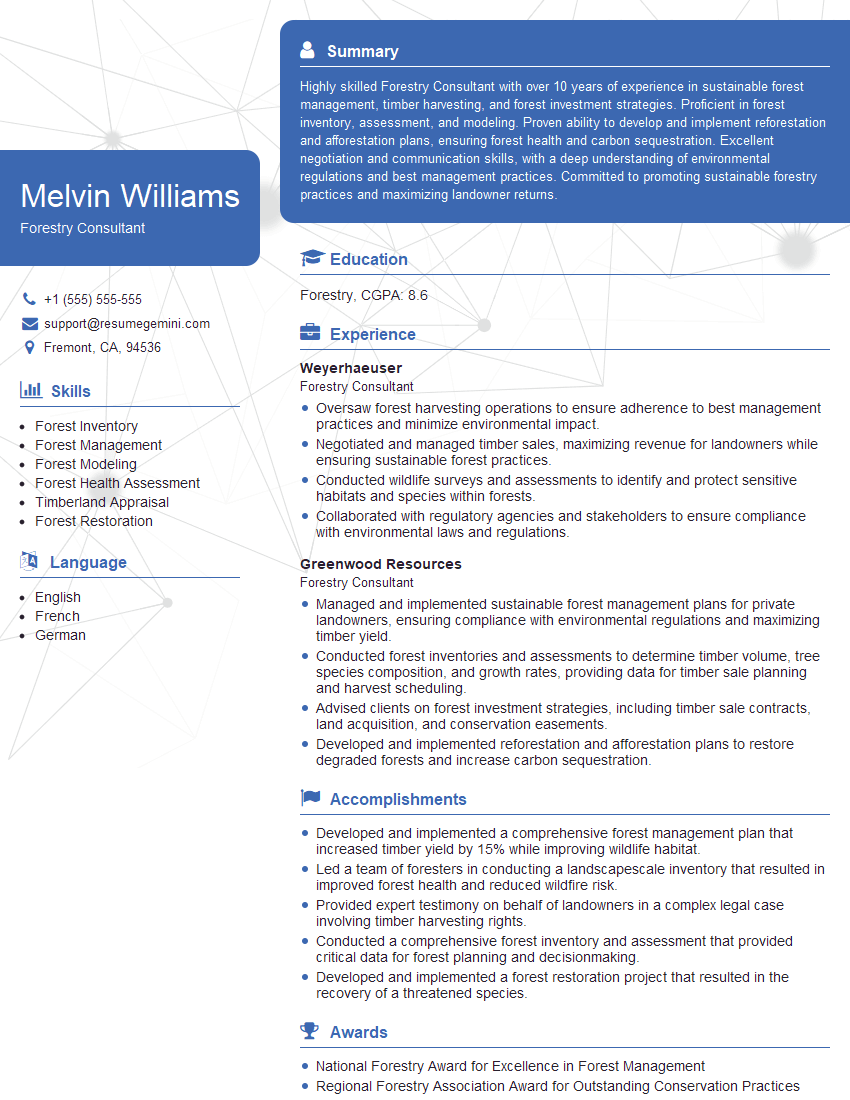
Mastering Operating Forestry Handling Equipment opens doors to rewarding and in-demand careers within the forestry industry. This specialized skillset is highly valued by employers seeking efficient and safety-conscious professionals. To maximize your job prospects, crafting an ATS-friendly resume is crucial. A well-structured resume helps your application stand out and get noticed by recruiters. We highly recommend using ResumeGemini to build a professional and impactful resume tailored to highlight your skills and experience. ResumeGemini provides examples of resumes specifically designed for Operating Forestry Handling Equipment professionals to help guide you in creating a compelling application.





Explore more articles
Users Rating of Our Blogs
Share Your Experience
We value your feedback! Please rate our content and share your thoughts (optional).
What Readers Say About Our Blog
Very informative content, great job.
good