Interviews are opportunities to demonstrate your expertise, and this guide is here to help you shine. Explore the essential Operating Sewing Machine with Precision interview questions that employers frequently ask, paired with strategies for crafting responses that set you apart from the competition.
Questions Asked in Operating Sewing Machine with Precision Interview
Q 1. What types of sewing machines have you operated?
Throughout my career, I’ve gained extensive experience operating a wide variety of sewing machines. This includes both industrial and domestic models, encompassing different functionalities and levels of automation. My expertise extends to mechanical machines, requiring manual adjustments, and computerized machines with digital controls and programmable stitch patterns. I’m proficient with single-needle machines for precise work, and multi-needle machines for high-volume production. For example, I’ve worked extensively with industrial lockstitch machines for durable seams on heavy fabrics like denim and with specialized machines for embroidery and quilting. I’ve also used several different brands, including Singer, Juki, and Brother, giving me a broad understanding of various machine mechanisms and features.
Q 2. Describe your experience with different stitch types and their applications.
My experience with stitch types is comprehensive. I’m familiar with a vast range, from basic straight stitches for construction to decorative stitches for embellishment. Understanding their applications is crucial for achieving the desired aesthetic and structural integrity. For instance:
- Straight Stitch: Used for seams, basting, and topstitching. Its versatility makes it a foundation for many sewing projects.
- Zigzag Stitch: Ideal for preventing fraying on raw edges, joining stretchy fabrics, and creating decorative effects. I’ve often used this stitch when working with knit fabrics to ensure flexibility and durability.
- Overlock/Serger Stitch: My experience with sergers involves finishing seams for a professional, clean look and to prevent unraveling – essential for garments and other high-quality projects.
- Blind Hem Stitch: Creates an almost invisible hem, particularly useful for professional-looking hems on skirts and trousers.
- Buttonhole Stitch: I’m skilled in creating various types of buttonholes, including keyhole and bound buttonholes, adapted to different fabric thicknesses and button sizes.
The choice of stitch type depends heavily on the fabric, project requirements, and desired outcome. For instance, a delicate silk blouse would necessitate a smaller stitch length and potentially a more delicate needle than a rugged canvas bag.
Q 3. How do you troubleshoot common sewing machine malfunctions?
Troubleshooting is a vital part of sewing machine operation. I approach malfunctions systematically, using a combination of experience and logical deduction. My troubleshooting process generally follows these steps:
- Identify the problem: Pinpoint the specific issue, such as skipped stitches, inconsistent tension, or jammed needles. Observing the machine’s behavior closely is key.
- Check the basics: This usually includes inspecting the bobbin, ensuring proper threading, and checking the needle for damage or incorrect placement. Many problems stem from these simple oversights.
- Systematic examination: If the issue persists, I meticulously check the tension settings, feed dogs, and other mechanisms. I might refer to the machine’s manual for guidance or consult online resources.
- Test each component: I’ll test each section of the machine individually to pinpoint the exact source of the malfunction.
- Professional maintenance: If I can’t resolve the issue, I know when to seek professional assistance from a qualified technician.
For example, if the stitches are consistently uneven, I would first check the tension settings, then the needle and thread, before moving on to more complex components. My experience enables me to quickly diagnose problems and find effective solutions.
Q 4. What is your experience with maintaining and cleaning sewing machines?
Regular maintenance is paramount for extending the life of a sewing machine and ensuring optimal performance. My routine includes:
- Daily cleaning: Removing lint and dust from the bobbin case, feed dogs, and other areas that accumulate debris. This is essential for preventing jams and ensuring smooth operation.
- Periodic lubrication: Applying lubricating oil to moving parts as recommended by the manufacturer to minimize friction and wear. I know which components require lubrication and the appropriate type of oil to use.
- Needle changes: Replacing needles regularly to avoid breakage and ensure consistent stitch quality. Different fabrics require specific needle types and sizes.
- Bobbin checks: Inspecting the bobbin for damage or improper winding to ensure consistent stitch formation.
- In-depth cleaning: At set intervals, I conduct more thorough cleaning, potentially involving disassembling certain parts for a deeper clean. This often involves compressed air to clear stubborn debris.
Proactive maintenance prevents costly repairs and downtime, ensuring the machine runs smoothly and produces high-quality work.
Q 5. What safety procedures do you follow while operating sewing machines?
Safety is my top priority when operating sewing machines. My safety procedures include:
- Proper machine setup: Ensuring the machine is stable and securely positioned on a flat surface.
- Clear workspace: Keeping the surrounding area free of obstructions to avoid accidents.
- Needle precautions: Handling needles carefully, and never leaving them loose or unattended.
- Finger guards: Utilizing finger guards or other safety devices provided by the machine.
- Machine maintenance: Never servicing or cleaning the machine while it’s switched on.
- Appropriate attire: Wearing appropriate clothing – avoiding loose clothing that could get caught in moving parts.
- Power cord safety: Ensuring the power cord is not damaged and is unplugged before cleaning or maintenance.
These precautions, learned through years of experience, have consistently protected me from injury while ensuring efficient work.
Q 6. How do you ensure consistent stitch quality and speed?
Consistent stitch quality and speed are achieved through a combination of factors. I always begin by ensuring the machine is properly maintained and lubricated. Attention to the following is critical:
- Correct tension settings: Adjusting the upper and lower tension dials for optimal balance. This is often specific to the type of fabric and thread used.
- Proper threading: Correctly threading the machine as per the manufacturer’s guidelines to avoid skipped stitches or broken threads.
- Appropriate needle and thread: Selecting the right needle and thread type for the fabric. For example, using a fine needle and thread for lightweight fabrics and a heavier needle and thread for heavier fabrics.
- Consistent speed: Controlling the sewing speed, avoiding excessive speed that can lead to poor stitch quality or breakage. It is often better to sew at a slower, steadier pace to maximize quality.
- Feed dog settings: Adjusting the feed dogs for optimal fabric movement based on the fabric type and project.
A combination of attention to detail and experience allows me to maintain a consistent pace and excellent stitch quality throughout my projects.
Q 7. Explain your experience with different sewing machine needles and threads.
My experience encompasses a wide variety of sewing machine needles and threads, understanding their critical role in achieving the desired results. Needle selection depends heavily on the type of fabric. For example:
- Universal Needles: Used for a variety of fabrics.
- Ballpoint Needles: Ideal for knit fabrics, preventing snags and skipped stitches.
- Jeans Needles: Specifically designed for heavy fabrics like denim.
- Microtex/Sharp Needles: Perfect for fine, delicate fabrics, minimizing fabric damage.
Similarly, thread selection is crucial. Different threads offer different strengths, finishes, and textures:
- Cotton Thread: Versatile, durable, and widely used.
- Polyester Thread: Strong, resistant to shrinkage, and suitable for various fabrics.
- Silk Thread: Elegant and lustrous, often used for decorative stitching.
- Embroidery Thread: Specifically designed for embroidery, offering excellent vibrancy and texture.
Understanding the relationship between needles and threads – matching them to fabric type and project needs – is vital for achieving professional-quality results.
Q 8. How do you handle fabric tension and feeding issues?
Fabric tension and feeding are crucial for consistent stitch quality. Think of it like a perfectly balanced three-legged stool: proper tension on the top thread, proper tension on the bobbin thread, and consistent fabric feed. If one is off, the whole thing wobbles.
Handling Tension Issues: Uneven stitches, skipped stitches, or thread breakage are common symptoms. First, I check the tension dials on both the top and bobbin. Each machine has its own optimal settings, often dependent on the fabric type. For instance, delicate fabrics like silk need lower tension than heavier fabrics like denim. I might start by adjusting the top tension dial (usually a small numbered dial) incrementally, testing after each small adjustment. If the problem persists, I examine the bobbin case for lint or damage and ensure the bobbin is correctly wound and seated.
Handling Feeding Issues: Uneven fabric feed results in puckers or gathers. This can be due to a dull needle, improperly set feed dogs (the teeth that move the fabric), or a build-up of lint under the needle plate. I address this by checking for needle damage – a bent or blunt needle needs immediate replacement. I clean the feed dogs and ensure they are properly aligned. Sometimes, slightly lowering the presser foot pressure can help if the fabric is particularly delicate or slippery. For very thick fabrics, I may adjust the feed dog speed or even use a walking foot attachment for better control.
- Example: When sewing a lightweight chiffon, I reduced both the top and bobbin tension significantly and used a slightly lower presser foot pressure to prevent puckering.
Q 9. Describe your experience with pattern matching and fabric placement.
Pattern matching and fabric placement are critical for a professional finish, especially with prints or directional fabrics. Imagine sewing a plaid shirt where the plaid doesn’t align – it would look amateurish! My approach starts with a careful examination of the pattern pieces and the fabric itself.
Pattern Matching: For patterns that require matching (e.g., plaids, stripes), I carefully pin and match the pattern pieces before stitching. I use tailor’s chalk or pins to mark the matching points. This can be particularly challenging with curved seams. I often use notches on the pattern pieces as guides to ensure seamless alignment.
Fabric Placement: The direction of the fabric is crucial. Some fabrics (e.g., corduroy, velvet) have a nap, and they need to be cut and sewn in the same direction for consistent color and texture. I carefully consider the fabric’s drape and grain lines (the lengthwise and crosswise yarns) when cutting and piecing. I always pay attention to the “grainline” indicated on the pattern.
- Example: Sewing a striped dress, I carefully aligned the stripes across the seams by matching the stripes at the seam allowances before stitching, ensuring a clean, professional look.
Q 10. How do you identify and correct sewing machine alignment problems?
Sewing machine alignment problems often manifest as uneven stitches, skipped stitches, or the needle hitting the needle plate. Troubleshooting involves systematic checks and adjustments.
Identifying the Problem: I start by inspecting the needle. Is it bent or damaged? A damaged needle can cause a multitude of problems. Then, I check the needle plate and throat plate for any debris or damage that might be interfering with the needle’s movement. I also inspect the timing of the machine’s mechanisms – the synchronization of the needle, hook, and feed dogs – by observing how the needle interacts with the hook during operation.
Correcting the Alignment: If the needle is bent or damaged, I replace it. For debris, a thorough cleaning is usually sufficient. If the timing is off, it usually requires a professional mechanic’s attention, as adjusting the timing can be very complex and requires specialized tools. Improperly tightened screws can also affect alignment; checking and tightening these screws as needed can be quite effective.
- Example: A customer brought in a machine that was consistently skipping stitches. After replacing the damaged needle and cleaning out lint and thread remnants from the hook area, the problem resolved.
Q 11. What is your experience with computerized sewing machines?
I have extensive experience with computerized sewing machines, having used several different models in both professional and personal settings. These machines offer advanced features that enhance speed, precision, and creativity.
My Experience: I’m proficient in programming stitch patterns, adjusting stitch parameters (length, width, density), and utilizing various automated functions. I’m also familiar with their built-in sensors, which can automatically adjust settings based on fabric thickness. Troubleshooting these machines involves understanding their digital interfaces and error codes, something I’ve become quite adept at.
Advantages of Computerized Machines: These machines offer precise control, reducing errors associated with manual adjustments. Their memory functions allow saving customized settings for different projects, saving time and effort. They are particularly useful for intricate projects requiring consistent stitch quality and repeatable stitch patterns.
- Example: I used a computerized machine to create a complex quilting design, utilizing its computerized pattern programming to generate and stitch the pattern consistently.
Q 12. How familiar are you with different types of sewing machine attachments?
I’m familiar with a wide range of sewing machine attachments, each designed for specialized tasks. These attachments are essentially tools that extend the machine’s capabilities beyond basic sewing. Think of them as power-ups for your sewing machine.
Common Attachments: I regularly use walking feet (for even feeding of multiple layers), zipper feet (for sewing neat zippers), buttonhole feet (for creating consistent buttonholes), rolled hem feet (for creating narrow rolled hems), and various types of presser feet for different fabrics. I am also knowledgeable about more specialized attachments such as blind hem feet, appliqué feet, and embroidery feet.
Practical Application: The choice of attachment depends entirely on the sewing project. A walking foot is essential for quilting multiple layers of fabric, while a zipper foot makes inserting zippers effortless. My experience allows me to select the appropriate attachment to achieve the desired result with precision and efficiency.
- Example: When sewing a delicate lace trim onto a silk garment, I used a special needle and a narrow presser foot to prevent the fabric from being damaged or stretched during sewing.
Q 13. How do you adjust stitch length and width to meet specific project requirements?
Adjusting stitch length and width is essential for achieving the desired aesthetic and structural integrity of a project. Stitch length controls the spacing between stitches, affecting the strength and look of the seam. Stitch width determines the width of the stitch, influencing the decorative effect.
Stitch Length: A shorter stitch length (e.g., 1.5-2 mm) is generally used for areas requiring strength, such as seams that bear weight or stress, or for fabrics that are prone to fraying. A longer stitch length (e.g., 3-4 mm) is used for basting (temporary stitching) or decorative stitches. The specific length depends on the fabric and the project’s requirements.
Stitch Width: Stitch width primarily affects the appearance of the stitch. Narrower widths are ideal for inconspicuous seams, whereas wider widths are used for decorative effects or specific stitches such as zig-zag stitches for securing edges.
Project-Specific Adjustments: For a sturdy seam on denim, a short, narrow zig-zag stitch provides both strength and neatness. For basting, a long, loose straight stitch allows easy removal later. I determine the appropriate stitch length and width by considering the fabric type, project’s function, and the desired aesthetic.
- Example: When sewing a tailored jacket, I used a short stitch length and a narrow straight stitch for the main seams to ensure durability. For topstitching, I used a longer stitch length and a slightly wider straight stitch for a more prominent visible seam.
Q 14. How do you measure and cut fabric accurately for sewing projects?
Accurate fabric measurement and cutting are foundational to successful sewing. It’s the base upon which you build your creation. Inaccurate cutting leads to ill-fitting garments or projects.
Measuring Techniques: I use a flexible tape measure to take accurate measurements, ensuring it’s held taut but not stretched. I measure twice and cut once to minimize errors. I use a ruler or cutting mat for precise cutting, aligning the fabric edges with the markings to guarantee straight cuts. For curved edges, I use dressmaker’s shears or rotary cutters for smooth cuts. I always account for seam allowances (the extra fabric added to seams).
Fabric Preparation: Before cutting, I thoroughly press the fabric to remove wrinkles that might distort measurements. I also check the fabric for flaws and plan my cuts accordingly to maximize fabric usage and minimize waste. I pay attention to the fabric’s grain and nap, ensuring that my cuts are aligned accordingly.
- Example: To cut out a skirt pattern, I carefully measure the fabric using my tape measure to ensure the skirt would be the correct length, then precisely align the pattern pieces with the fabric grain before cutting them with a rotary cutter.
Q 15. Describe your experience with industrial sewing machines.
My experience with industrial sewing machines spans over ten years, encompassing a wide range of models and applications. I’ve worked extensively with machines from leading manufacturers like Juki, Singer, and Durkopp Adler, mastering their unique functionalities and maintenance requirements. This includes proficiency in straight stitch, zigzag stitch, blind stitch, and overlock machines, as well as specialized machines for tasks like buttonhole stitching and decorative stitching. I’m adept at troubleshooting common issues and performing basic machine maintenance, ensuring optimal performance and minimizing downtime.
For example, in my previous role at Apparel Solutions, I was responsible for operating a bank of Juki high-speed machines for mass production. I consistently exceeded daily production quotas while maintaining a high level of stitch quality. I also assisted in training new operators, sharing my knowledge and expertise to enhance team performance.
Career Expert Tips:
- Ace those interviews! Prepare effectively by reviewing the Top 50 Most Common Interview Questions on ResumeGemini.
- Navigate your job search with confidence! Explore a wide range of Career Tips on ResumeGemini. Learn about common challenges and recommendations to overcome them.
- Craft the perfect resume! Master the Art of Resume Writing with ResumeGemini’s guide. Showcase your unique qualifications and achievements effectively.
- Don’t miss out on holiday savings! Build your dream resume with ResumeGemini’s ATS optimized templates.
Q 16. What is your experience with high-speed sewing machine operation?
Operating high-speed sewing machines demands precision, speed, and unwavering focus. My experience includes working with machines capable of stitching over 5,000 stitches per minute. This requires a deep understanding of machine settings, needle types, thread tension, and fabric handling to prevent breakage, skipped stitches, or inconsistent stitch quality. I’ve honed my skills to maintain optimal speed without compromising precision, even during long production runs.
Imagine sewing delicate silk at 4,000 stitches per minute; you need consistent, light foot pressure and perfect thread tension adjustment to avoid puckering. That’s the level of precision and control I possess. I’ve developed a system of regular checks and adjustments throughout the day to maintain consistency in speed and quality.
Q 17. How do you prioritize tasks to maintain production efficiency?
Prioritizing tasks for maximum production efficiency involves a combination of planning and adaptability. I usually begin by analyzing the production schedule, identifying order deadlines, and assessing the complexity of each task. I then prioritize orders based on urgency and required machine types. I often use a Kanban-style system – a visual workflow – to track progress and identify potential bottlenecks.
For instance, if I have a large order of simple garments due soon and a smaller, more complex order with a later deadline, I’ll focus my efforts on the large order first to meet the tight deadline. I will then allocate time to the more complex order, ensuring that both are completed on time and to specification.
Q 18. How do you handle urgent repairs or machine breakdowns during production?
Dealing with urgent repairs or machine breakdowns requires quick thinking and problem-solving skills. My approach involves a systematic troubleshooting process: First, I identify the problem by carefully examining the machine for obvious issues (e.g., broken needles, tangled thread, loose parts). If I can’t immediately identify the cause, I refer to the machine’s manual or contact a maintenance technician. While waiting for assistance, I may shift to a different machine to maintain production flow or focus on tasks that don’t require the malfunctioning machine.
For example, if a needle breaks, I’ll quickly replace it with a new one of the correct size and type. If the problem is more complex, I’ll document the issue and contact maintenance, prioritizing the repair based on the impact on production. I understand the importance of minimizing downtime and preventing costly delays.
Q 19. Describe your experience with quality control measures in sewing.
Quality control in sewing is paramount, and I’ve been trained in rigorous quality assurance methods. My experience includes performing regular inspections throughout the sewing process – checking stitch quality, seam strength, fabric alignment, and overall garment appearance. I’m adept at identifying defects like skipped stitches, uneven seams, and inconsistent tension. I use checklists and standardized quality control procedures to ensure consistency across all products.
For instance, I use a magnifying glass and a ruler to check stitch length and consistency, ensuring it meets the specified standards. I also inspect for any fraying, damage, or irregularities in the fabric. Any defects are immediately flagged and addressed before the product moves to the next stage of production.
Q 20. How do you maintain consistent quality while working at high speeds?
Maintaining consistent quality while working at high speeds is a challenge that requires both skill and discipline. This relies on a combination of factors: precise machine setup, correct needle and thread selection, regular maintenance checks, and a focused approach to sewing. I prioritize consistent posture, even foot pressure, and maintain a rhythm to avoid fatigue and errors that can impact quality. I also utilize pre-emptive measures to prevent common issues, like regularly cleaning the machine and lubricating moving parts.
One effective technique I use is to perform short, frequent quality checks during high-speed production runs, rather than only at the end. This allows me to catch and correct minor issues before they escalate, preventing major defects and reducing waste.
Q 21. What is your understanding of different fabric types and their sewing characteristics?
Understanding different fabric types and their sewing characteristics is crucial for efficient and quality production. My knowledge encompasses a broad range of fabrics, including wovens (cotton, linen, silk, denim), knits (jersey, rib, interlock), and non-wovens (felt, fleece). I understand how each fabric’s weight, drape, texture, and fiber content affect sewing speed, needle selection, stitch type, and thread tension. For example, delicate fabrics like silk require smaller needles, finer threads, and slower speeds to prevent damage, while durable fabrics like denim may require stronger needles and higher tension.
I regularly consult fabric specifications and test different settings to optimize stitching for each material. My experience with various fabrics extends to successfully managing intricate patterns on demanding materials such as leather and vinyl. This diverse experience allows me to adapt swiftly and precisely to the demands of different projects.
Q 22. How do you interpret sewing patterns and technical drawings?
Interpreting sewing patterns and technical drawings is fundamental to precise sewing. It’s like reading a map for a garment. The pattern pieces are the individual components, and the technical drawing shows how they fit together.
First, I carefully examine the pattern pieces, noting the grainlines (the direction of the fabric’s warp and weft), notches (small markings indicating matching points), and markings for darts, pockets, and other details. These markings are crucial for accurate assembly. Then, I consult the technical drawing, which provides a visual representation of the finished garment and the order of assembly. It might show seam allowances, types of seams (e.g., French seam, flat felled seam), and finishing techniques. I’ll often make notes or highlight key steps on the pattern pieces and drawings before starting to sew.
For example, if a pattern calls for a French seam, I know to sew the seam allowances with the wrong sides together first, then trim and press, before sewing again with the right sides together to encase the raw edges. The technical drawing would confirm this and might even show how to finish the seam allowances of the garment in a certain way.
Q 23. Explain your experience working within a team environment.
Teamwork is essential in garment production. In my previous role, I was part of a team responsible for producing high-end women’s wear. We collaborated closely, sharing knowledge and supporting each other to meet deadlines. I’ve worked with pattern makers, cutters, and other sewers, exchanging ideas and assisting when needed. For instance, I once helped a colleague troubleshoot a complex seam issue by suggesting a different technique based on my experience with similar fabrics. We also often worked with quality controllers, this part was crucial to check that the product was meeting quality specifications.
I am comfortable communicating effectively and actively participating in discussions regarding efficiency, problem-solving, and quality control. My approach is one of mutual respect and collaboration—a team environment thrives on sharing expertise and leveraging each individual’s strengths.
Q 24. How do you adapt to changing production requirements or deadlines?
Adaptability is crucial in the fast-paced fashion industry. When production requirements change, I prioritize understanding the new needs and adjusting my workflow accordingly. I’ve had experiences where urgent orders required me to adapt my schedule and focus on specific tasks to meet the tighter deadlines.
I approach these situations methodically. I first analyze the changes, assess their impact on my tasks, and prioritize accordingly. Effective time management and organization are key—sometimes, that means re-prioritizing my tasks to focus on the most pressing needs first, or even breaking down complex tasks into smaller, more manageable chunks. Open communication with my team and supervisor is also essential to ensure everyone is aligned and working effectively toward the revised goals.
Q 25. Describe your problem-solving skills in relation to sewing machine operation.
Problem-solving is an everyday aspect of sewing machine operation. For example, if a machine starts producing uneven stitches, I systematically troubleshoot the problem. I start by checking the needle, ensuring it’s the correct size and type for the fabric and thread. Next, I inspect the tension, checking the bobbin and the upper tension settings. If the problem persists, I examine the feed dogs and presser foot, ensuring they’re properly adjusted and clean.
I also consider the fabric itself – is it too thick or thin for the needle and thread combination? Or maybe the fabric is damaged or causing additional strain. I keep a detailed log of repairs and maintenance. This log helps me track recurring problems and learn to anticipate potential issues. This proactive approach prevents future breakdowns and saves valuable time. My systematic approach minimizes downtime and ensures consistent high-quality work.
Q 26. What is your experience with different types of seams and their construction?
My experience encompasses a wide range of seams, each chosen for its specific purpose and aesthetic effect. I’m proficient in constructing various seams like French seams, which are ideal for delicate fabrics as they encase the raw edges; flat-felled seams, durable and often used in workwear; and welt seams, which create a clean, tailored look. I’m also familiar with decorative stitches and techniques like topstitching, which enhances the overall look of a garment.
The choice of seam depends entirely on the garment and fabric. For example, a French seam would be inappropriate for a heavy-duty work jacket where a flat-felled seam’s durability is vital. Understanding the properties of different fabrics and the resulting challenges in sewing is integral to seam selection. Choosing the appropriate seam enhances the garment’s durability and appearance.
Q 27. How do you maintain a clean and organized workspace?
A clean and organized workspace is essential for efficiency and safety. I maintain a system where tools and materials are stored neatly and logically. This is especially critical with sewing machines and sharp tools; tidiness is crucial to avoid accidents. I clean my sewing machine regularly, including removing lint and debris from the bobbin case, hook, and feed dogs. I also make sure all my needles are in excellent condition, making sure to replace dull or bent ones to prevent snags.
My organizational system includes color-coded thread storage, labeled containers for notions, and a designated area for each project in progress. I believe a tidy work environment directly impacts production quality and minimizes wasted time searching for tools or materials. Regular cleaning is not only about safety, it also helps to ensure my machines run smoothly and perform their best.
Q 28. What are your career goals regarding sewing machine operation?
My career goal is to further develop my expertise in precision sewing and high-end garment construction. I aim to refine my skills in complex techniques such as intricate embroidery and advanced seam construction. I am interested in exploring opportunities in specialized areas, such as bridal wear or bespoke tailoring, where precision and attention to detail are paramount.
Long-term, I hope to contribute to the advancement of sewing techniques and potentially take on a leadership role, mentoring others and sharing my knowledge to elevate the standards of garment production. This includes keeping up with the latest technological advances in sewing machinery and the fashion industry at large.
Key Topics to Learn for Operating Sewing Machine with Precision Interview
- Machine Operation & Maintenance: Understanding different sewing machine types (industrial vs. domestic), their functionalities, and routine maintenance procedures (cleaning, lubrication, needle changes).
- Seam Types & Techniques: Mastering various seam types (e.g., straight stitch, zigzag stitch, overlock stitch) and their applications in different fabrics and garments. Practical experience demonstrating precision and speed is crucial.
- Fabric Handling & Selection: Knowledge of different fabric types, their properties (e.g., weight, drape, stretch), and appropriate needle and thread selection for optimal stitching results. Demonstrating understanding of how fabric choice impacts seam quality is key.
- Troubleshooting & Problem Solving: Identifying and resolving common sewing machine issues (e.g., skipped stitches, broken needles, tension problems). Being able to explain your troubleshooting process is vital.
- Safety Procedures & Best Practices: Adhering to safety guidelines, proper machine operation, and maintaining a clean and organized workspace. Highlighting your commitment to safety will impress interviewers.
- Production & Efficiency: Understanding production targets, optimizing workflow for speed and accuracy while maintaining quality. Quantifiable examples of your efficiency will strengthen your application.
- Quality Control & Inspection: Performing thorough quality checks on finished products, identifying defects, and understanding industry standards for quality. Demonstrate attention to detail and a commitment to producing high-quality work.
Next Steps
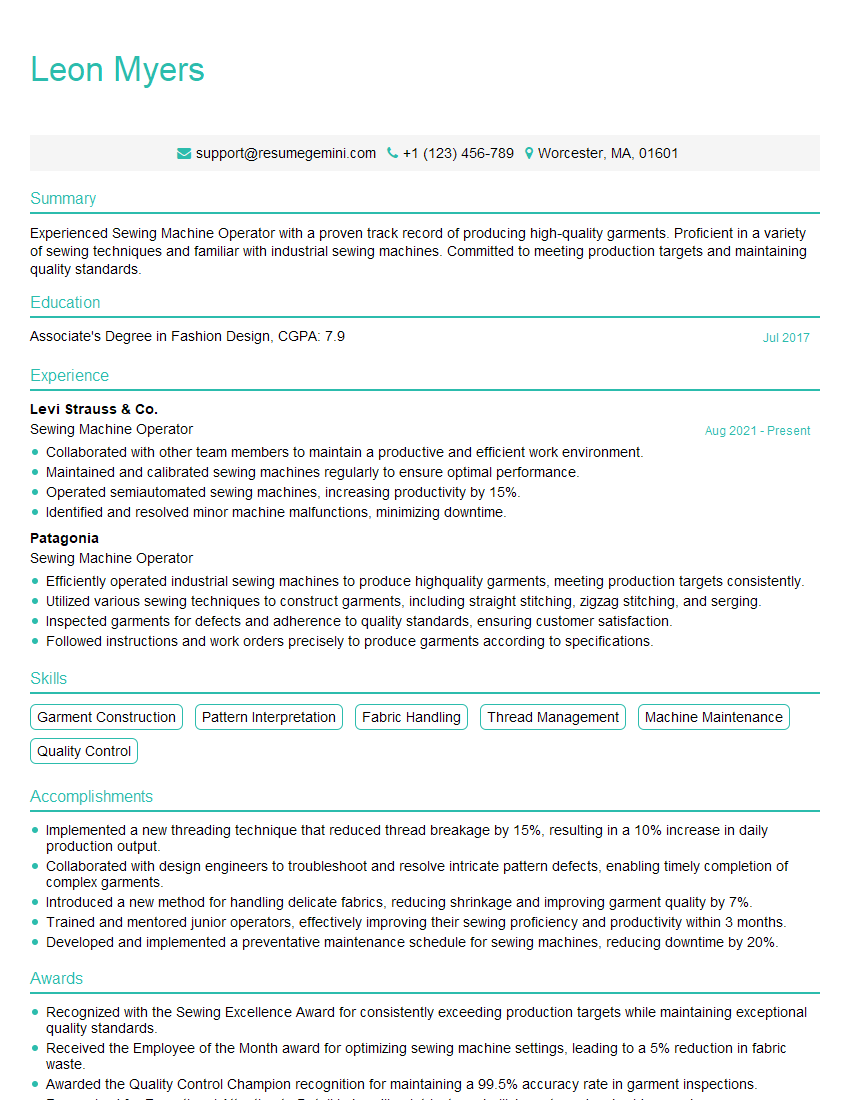
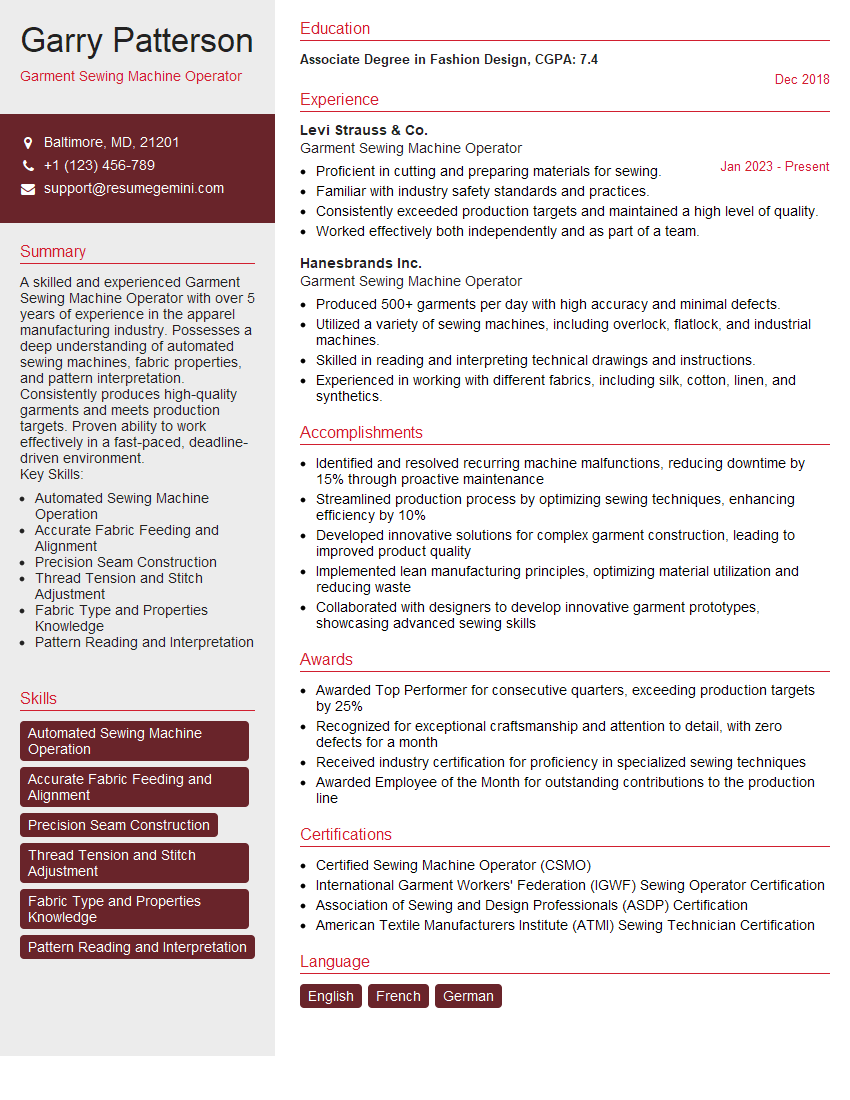
Mastering the operation of a sewing machine with precision is essential for career advancement in the garment industry, opening doors to specialized roles and higher earning potential. An ATS-friendly resume is crucial for maximizing your job prospects. It ensures your skills and experience are effectively communicated to potential employers. To create a powerful and effective resume that highlights your abilities in operating sewing machines with precision, we strongly encourage you to utilize ResumeGemini. ResumeGemini provides a user-friendly platform for building professional resumes, and examples of resumes tailored to Operating Sewing Machine with Precision are available to guide you.

Explore more articles
Users Rating of Our Blogs
Share Your Experience
We value your feedback! Please rate our content and share your thoughts (optional).
What Readers Say About Our Blog
Very informative content, great job.
good