The thought of an interview can be nerve-wracking, but the right preparation can make all the difference. Explore this comprehensive guide to Opto-Mechanical Engineering interview questions and gain the confidence you need to showcase your abilities and secure the role.
Questions Asked in Opto-Mechanical Engineering Interview
Q 1. Explain the concept of tolerancing in opto-mechanical design.
Tolerancing in opto-mechanical design is the process of specifying allowable variations in the dimensions and positions of components to ensure the system performs within its required specifications. Think of it like building a house – you wouldn’t expect every brick to be perfectly identical, but variations need to be small enough that the walls remain structurally sound and the doors and windows fit correctly. In optics, even tiny deviations can significantly impact the performance, leading to blurry images, misalignment, or even system failure.
We use tolerances to control these variations. These are expressed as limits (e.g., ±0.1 mm) or as statistical distributions (e.g., 3σ limits). These tolerances consider various factors including manufacturing capabilities, material properties, environmental influences (temperature, vibration), and the sensitivity of the optical system to these variations. A good tolerance analysis considers the impact of each tolerance on the final system performance and prioritizes tighter tolerances where critical.
For example, the tolerance on the spacing between lenses in a telescope needs to be very tight to maintain focus, whereas the tolerance on the housing material thickness might be less critical, as long as it provides adequate strength and stability.
Q 2. Describe different types of optical mounts and their applications.
Optical mounts are crucial for holding optical components in precise positions and orientations. Different applications demand different mount types. Some common ones include:
- Kinematic mounts: These use three points of contact to define the position and orientation of a component, offering high stability and repeatability. They’re ideal for precise positioning of critical optical elements like lenses or mirrors. Think of a tripod – three legs define its position and stability.
- Flexure mounts: These use flexible elements (like thin metal strips) to support the component, providing both stability and isolation from vibrations. These are often found in high-precision applications where vibration damping is crucial.
- Compliant mounts: These are similar to flexure mounts, but utilize other mechanisms such as springs or elastomers for compliance. They’re useful when there are thermal or mechanical stress concerns.
- Rigid mounts: These offer simple and robust support, ideal for less demanding applications where high precision isn’t paramount. They are usually less expensive than other mounts.
- Active mounts: These include actuators (e.g., piezo-electric or electromagnetic) that allow for precise adjustments of the component’s position and orientation, often used in alignment and stabilization systems.
The choice depends on the application’s requirements for precision, stability, cost, and environmental factors.
Q 3. How do you select appropriate materials for optical components and mounts?
Material selection for optical components and mounts is critical for performance and longevity. The choices depend heavily on the application’s environmental conditions and performance requirements.
For optical components (lenses, mirrors, etc.), we consider factors like:
- Transparency/Reflectivity: The material’s ability to transmit or reflect light at the desired wavelengths.
- Refractive index: How much the material bends light, crucial for lens design.
- Dispersion: How the refractive index changes with wavelength, impacting chromatic aberrations.
- Thermal stability: How the material’s properties change with temperature.
- Mechanical strength and hardness: Resistance to scratching and damage.
Common materials include glass (BK7, fused silica), crystals (calcium fluoride, zinc selenide), and polymers (PMMA, polycarbonate).
For mounts, factors like:
- Strength and stiffness: Ability to withstand loads and maintain stability.
- Thermal expansion coefficient: Matching the coefficient with the optical component minimizes stress due to temperature changes.
- Dimensional stability: Maintaining shape and size over time.
- Corrosion resistance: Crucial for long-term reliability.
Common mount materials include aluminum alloys, stainless steel, and Invar (a nickel-iron alloy with a low thermal expansion coefficient).
Q 4. What are the key considerations for thermal management in optical systems?
Thermal management is vital in optical systems, as temperature variations can lead to changes in refractive index, component dimensions, and alignment, impacting performance. Key considerations include:
- Heat sources: Identifying all sources of heat within the system (e.g., lasers, LEDs, electronics).
- Heat transfer mechanisms: Understanding how heat is transferred (conduction, convection, radiation).
- Thermal modeling and simulation: Using software (e.g., ANSYS) to predict temperature distributions and identify potential hotspots.
- Thermal control methods: Employing techniques like heat sinks, fans, thermoelectric coolers, or temperature-controlled enclosures to maintain a stable operating temperature.
- Material selection: Choosing materials with appropriate thermal properties (e.g., low thermal expansion coefficient).
- Thermal isolation: Minimizing heat transfer between components using thermal insulators.
For example, a high-power laser system might require a sophisticated cooling system to prevent overheating and damage to components. In space-based telescopes, passive thermal control might be sufficient using insulation and careful design to balance heat absorption and radiation.
Q 5. Explain the principles of optical alignment and testing procedures.
Optical alignment is the process of precisely positioning optical components to ensure the system functions correctly. It’s like aiming a telescope – you need to carefully adjust the mirrors and lenses to get a sharp image. This typically involves:
- Initial alignment: Using mechanical adjustments to roughly position the components.
- Fine alignment: Using precise adjustment mechanisms (e.g., micrometer screws) to achieve precise alignment.
- Alignment tools: Employing tools such as autocollimators, laser pointers, and interferometers to measure and adjust the alignment accurately.
Testing procedures verify that the system performs as designed after alignment. Common tests include:
- Measuring spot size and shape: Using a beam profiler to assess the quality of the light beam.
- Measuring optical power and transmission: Assessing the system’s efficiency in transmitting light.
- Measuring wavefront quality: Using interferometry to quantify imperfections in the wavefront, revealing aberrations and alignment issues.
- Image quality assessment: Evaluating the sharpness and clarity of the image (if applicable) through metrics like Modulation Transfer Function (MTF).
The choice of alignment and testing procedures depends on the system’s complexity, performance requirements, and available equipment.
Q 6. Describe your experience with optical simulation software (e.g., Zemax, Code V).
I have extensive experience with Zemax, utilizing it for various tasks including lens design, tolerance analysis, and system performance prediction. I’ve used Zemax to design and optimize imaging systems, including telescopes, microscopes, and camera lenses, and its powerful tools for non-sequential ray tracing have been instrumental in simulating complex optical systems such as illumination and laser beam delivery systems.
Specifically, my experience includes:
- Lens design optimization: Using Zemax’s optimization algorithms to achieve the desired performance metrics (e.g., minimizing aberrations, maximizing throughput).
- Tolerance analysis: Assessing the sensitivity of the optical system to manufacturing and environmental variations.
- Non-sequential ray tracing: Simulating complex optical systems with multiple components and scattering effects.
- Aberration correction: Identifying and mitigating aberrations such as spherical aberration, coma, and astigmatism.
I’m also familiar with Code V and understand its strengths in particular applications. The choice between Zemax and Code V usually depends on the specific needs of the project and my familiarity with the software.
Q 7. How do you ensure the stability and reliability of an opto-mechanical system?
Ensuring stability and reliability in opto-mechanical systems requires careful consideration of several factors throughout the design and manufacturing process:
- Robust mechanical design: Using appropriate materials and structures to withstand anticipated loads and environmental stresses (vibration, shock, temperature changes).
- Precise manufacturing and assembly: Maintaining tight tolerances during manufacturing and using appropriate assembly techniques to minimize alignment errors.
- Environmental protection: Protecting the system from dust, moisture, and other environmental factors using appropriate sealing and enclosures.
- Vibration and shock isolation: Minimizing the effects of external vibrations using vibration dampeners or isolation mounts.
- Thermal management: Controlling temperature variations to minimize stress and maintain component stability.
- Testing and validation: Conducting thorough testing to ensure the system meets its performance requirements under various conditions (temperature, vibration, shock).
- Redundancy and fail-safe mechanisms: Incorporating redundant components or fail-safe mechanisms to enhance reliability in critical applications.
For instance, in a space-based application, all these considerations become critical due to the harsh environment. Thorough testing under simulated space conditions is essential to ensure the system’s long-term stability and reliability.
Q 8. What are the common sources of error in opto-mechanical systems?
Opto-mechanical systems, combining precision optics and mechanics, are susceptible to various error sources. These errors can significantly impact system performance, leading to degraded image quality, reduced accuracy, or even system failure. Common sources can be broadly categorized into:
- Mechanical Errors: These include manufacturing tolerances (e.g., surface roughness, dimensional inaccuracies), thermal expansion mismatches between components leading to stress and deformation, vibration and shock induced displacements, and gravitational sag in long structures. For example, a slight misalignment of a lens due to manufacturing imperfections could drastically reduce the system’s resolution.
- Optical Errors: Aberrations (spherical, chromatic, coma, etc.) are inherent to lens design but can be exacerbated by mechanical misalignments or stress-induced changes in refractive index. Surface imperfections on optical components can also scatter light and reduce image quality. For instance, tiny dust particles on a lens can significantly impact imaging quality in high-precision applications.
- Environmental Errors: Temperature fluctuations cause changes in material dimensions and refractive indices. Humidity can affect the performance of certain optical coatings, leading to reduced transmission or increased scattering. Pressure changes can cause stress and deformation of components, affecting alignment. Imagine a telescope operating in varying outdoor temperatures – its performance would be significantly affected by thermal expansion.
- Assembly Errors: Improper assembly or insufficient bonding can lead to misalignments, stress concentrations, and loosening of components over time. For example, incorrectly tightening screws in a lens mount could induce stress birefringence and compromise the image quality.
Careful consideration of these error sources during design and manufacturing is crucial for achieving optimal performance in opto-mechanical systems. This often involves employing techniques like robust design, tolerance analysis, and FEA to mitigate their impact.
Q 9. Explain your understanding of different types of optical adhesives and their properties.
Optical adhesives are crucial in opto-mechanical assembly, providing secure bonding while minimizing stress and maintaining optical clarity. Several types exist, each with unique properties:
- UV-curable adhesives: These adhesives cure upon exposure to ultraviolet light, offering fast curing times and precise control over the curing process. They are ideal for applications requiring rapid assembly and are often low-viscosity, facilitating the filling of small gaps. However, they may be sensitive to UV degradation over extended periods.
- Epoxy adhesives: Epoxies offer good strength, chemical resistance, and versatility. They are available in various formulations with different curing times, viscosities, and stiffness. However, their curing process can be more time-consuming and may generate heat, potentially damaging sensitive optical components. Careful selection of an epoxy is crucial to minimize stress and ensure optical clarity.
- Silicone adhesives: Silicones are known for their flexibility and temperature stability, making them suitable for applications with significant thermal variations or vibration. They exhibit good shock absorption properties. The main drawback might be their lower strength compared to epoxies.
- Acrylic adhesives: Acrylic adhesives offer a good balance between strength, ease of use, and optical clarity. They are often used for bonding optical components with lower requirements for strength or temperature stability.
The choice of optical adhesive depends heavily on the specific application requirements, including the materials being bonded, the environmental conditions, required strength, and curing time constraints. Considerations include refractive index matching to minimize light scattering, low outgassing to prevent contamination of the optical components, and thermal and mechanical stability.
Q 10. How do you design for manufacturability in opto-mechanical systems?
Designing for manufacturability (DFM) in opto-mechanical systems is crucial for cost-effective and high-yield production. It involves optimizing the design to ensure efficient and reliable manufacturing processes. Key strategies include:
- Component Standardization: Utilizing readily available standard components minimizes custom fabrication costs and lead times. For example, selecting off-the-shelf lenses and mounts instead of custom-designed ones.
- Simplified Assembly: Employing simple and repeatable assembly procedures reduces labor costs and the risk of errors. This might involve designing parts with features that facilitate easy alignment and bonding. For instance, designing alignment features such as dowel pins or locating slots to minimize assembly complexity.
- Tolerance Analysis: Analyzing the impact of manufacturing tolerances on system performance helps to define realistic tolerances, avoiding over-specification and unnecessary costs. This frequently uses statistical methods like Monte Carlo simulations.
- Material Selection: Choosing easily machinable and readily available materials reduces fabrication costs and complexity. It’s also important to consider the material’s thermal and mechanical properties to ensure compatibility and stability.
- Modular Design: Breaking down the system into smaller, independent modules facilitates assembly, testing, and potential replacement of individual components. This approach makes repair and maintenance more straightforward.
A robust DFM process involves close collaboration between designers and manufacturing engineers to ensure the design is feasible, cost-effective, and meets the required performance specifications. Ignoring DFM can result in high manufacturing costs, long lead times, and a significant risk of failures during production.
Q 11. Discuss your experience with finite element analysis (FEA) in opto-mechanical design.
Finite Element Analysis (FEA) is an indispensable tool in opto-mechanical design. It allows for the prediction of stress, strain, and deformation within complex structures under various loading conditions. My experience with FEA in opto-mechanical design involves:
- Stress Analysis: Using FEA to analyze stress concentrations in critical areas, such as around lens mounts or bonding interfaces, is crucial to ensure the structural integrity of the system and prevent failures. This enables informed material selection and optimization of component geometry to minimize stress.
- Thermal Analysis: FEA helps in predicting the thermal effects on the system’s performance, considering temperature gradients and material expansion coefficients. This is essential for designing thermally stable systems that maintain their alignment and performance over a range of temperatures.
- Vibration and Shock Analysis: FEA is used to assess the system’s response to dynamic loads, predicting resonant frequencies and identifying potential points of failure. This allows for the design of vibration isolation measures and the selection of appropriate damping materials.
- Modal Analysis: This FEA technique identifies the natural frequencies and mode shapes of the system, which is critical for avoiding resonance and ensuring stability under dynamic loading. It enables informed decisions on structural stiffening or damping adjustments.
I have used commercial FEA software such as ANSYS and COMSOL to model and analyze a wide range of opto-mechanical systems, including microscopes, telescopes, and laser systems. The results from FEA simulations provide valuable insights that directly inform design iterations and help to improve the robustness and reliability of the final product.
Q 12. Explain the concept of stress-induced birefringence and how it affects optical performance.
Stress-induced birefringence is an effect where the application of mechanical stress to an optically isotropic material (like glass or plastic) causes it to become birefringent. This means the material’s refractive index becomes dependent on the polarization of light passing through it. In other words, the material exhibits different refractive indices for light polarized along different axes.
This phenomenon arises from the alteration of the material’s molecular structure due to stress. The stress changes the material’s polarizability, creating an anisotropic refractive index. Consequently, light passing through the stressed region experiences different phase velocities for different polarization components. This can lead to phase retardation, polarization changes, and ultimately, image degradation.
In optical systems, stress-induced birefringence can significantly affect optical performance by introducing:
- Polarization changes: Linearly polarized light can become elliptically or circularly polarized.
- Image distortion: The variation in refractive index across the stressed region can cause wavefront distortion, resulting in blurred or distorted images.
- Reduced contrast: The polarization changes can lead to reduced contrast and resolution.
Minimizing stress in optical components is therefore critical for optimal performance. This involves careful design considerations, material selection, appropriate bonding techniques, and stress-relief measures.
Q 13. How do you handle vibration and shock in opto-mechanical design?
Handling vibration and shock is paramount in opto-mechanical design, especially for portable or field-deployable systems. Effective strategies involve a multi-pronged approach:
- Vibration Isolation: This aims to minimize the transmission of vibrations from the environment to the optical system. Techniques include using vibration isolation mounts (e.g., elastomeric mounts, pneumatic isolators), designing compliant structures, and employing damping materials.
- Structural Stiffening: Increasing the stiffness of the optical system’s structure reduces its susceptibility to vibrations. This might involve using stronger materials, optimizing component geometries, or adding structural reinforcements. However, over-stiffening can lead to increased stress and other problems.
- Damping: Damping materials absorb vibrational energy, reducing the amplitude of vibrations. Common damping materials include constrained layer damping (CLD), viscoelastic materials, and tuned mass dampers.
- Shock Absorption: Protecting the system from sudden impacts requires incorporating shock-absorbing mechanisms. This can involve using cushioning materials (e.g., foam, elastomers) or designing the system with features that distribute the impact forces. Often this involves careful consideration of the structure’s geometry and material selection to prevent brittle fracture.
- Modal Analysis (FEA): As mentioned before, FEA plays a critical role in identifying resonant frequencies and mode shapes, enabling the design of structures that avoid resonance and minimize the impact of vibrations.
The specific strategies employed depend on the severity of the anticipated vibration and shock environments, the system’s sensitivity to these disturbances, and the overall design constraints. A balanced approach, often combining several of these techniques, is usually necessary to achieve adequate protection.
Q 14. Describe your experience with optical metrology techniques.
Optical metrology techniques are essential for characterizing and verifying the performance of opto-mechanical systems. My experience encompasses various techniques:
- Interferometry: Interferometry, including Fizeau and Twyman-Green interferometry, provides highly accurate measurements of surface figure, optical aberrations, and wavefront quality. This is crucial for assessing the quality of optical components and the overall performance of the optical system. I have used interferometry to assess lens quality, measure flatness of mirrors and to check wavefront quality in assembled optical systems.
- Autocollimation: Autocollimation uses a collimated beam to measure angles and alignments with high precision. This technique is vital for verifying the alignment of optical components in opto-mechanical assemblies. I have used this technique for precisely aligning multiple optical elements in laser systems and imaging systems.
- Profilometry: Techniques such as confocal microscopy and coherence scanning interferometry allow for 3D surface profile measurements with high resolution. This is essential for assessing the surface roughness and topography of optical components and their effect on system performance.
- Scatterometry: Scatterometry measures the amount of light scattered by a surface, which is indicative of its roughness and defects. It is useful for evaluating the quality of optical surfaces and coatings.
- Optical coherence tomography (OCT): OCT provides high-resolution cross-sectional imaging of optical components and systems. This is valuable for non-destructive evaluation of internal structures and identifying potential flaws or defects that are not visible on the surface.
The selection of appropriate metrology techniques depends on the specific parameters being measured, the required accuracy, and the available resources. Effective metrology ensures the system meets its performance specifications and aids in identifying and resolving any issues during design, assembly, and testing phases.
Q 15. How do you ensure the cleanliness of optical components during assembly?
Maintaining cleanliness is paramount in opto-mechanical assembly because even microscopic dust particles can severely degrade optical performance. Think of it like trying to take a clear photograph with a smudged lens – the image is ruined. We employ a multi-layered approach:
- Cleanroom Environment: Assembly takes place within a controlled cleanroom environment, classified according to ISO standards (e.g., ISO class 5 or higher), minimizing airborne particles.
- Proper Clothing and Procedures: Personnel wear cleanroom garments including bunny suits, gloves, and masks. We follow strict protocols such as using ionizers to neutralize static electricity which attracts dust, and regularly cleaning surfaces.
- Specialized Cleaning Tools and Techniques: We use isopropyl alcohol (IPA), compressed air (filtered to remove particles), and lint-free wipes to clean components. For delicate optics, specialized brushes and swabs might be necessary. The cleaning method is determined by the component’s material and coating.
- Optical Component Handling: We use tweezers with soft tips or vacuum tools to handle optical components, preventing scratches or contamination from fingerprints.
- Inspection: Post-cleaning inspection is crucial, using microscopes or other non-contact measurement techniques to verify cleanliness and detect any defects.
For example, in assembling a high-precision laser interferometer, meticulous cleaning is essential to avoid scattered light which would significantly affect measurement accuracy.
Career Expert Tips:
- Ace those interviews! Prepare effectively by reviewing the Top 50 Most Common Interview Questions on ResumeGemini.
- Navigate your job search with confidence! Explore a wide range of Career Tips on ResumeGemini. Learn about common challenges and recommendations to overcome them.
- Craft the perfect resume! Master the Art of Resume Writing with ResumeGemini’s guide. Showcase your unique qualifications and achievements effectively.
- Don’t miss out on holiday savings! Build your dream resume with ResumeGemini’s ATS optimized templates.
Q 16. What are the key performance indicators (KPIs) for an opto-mechanical system?
Key Performance Indicators (KPIs) for an opto-mechanical system vary depending on the specific application. However, some common KPIs include:
- Optical Performance: This includes parameters like transmission, reflection, scattering, wavefront error, and resolution. For instance, in a telescope, resolution would be a primary KPI.
- Mechanical Stability: This refers to the system’s ability to maintain its alignment and structural integrity under various environmental conditions (temperature, vibration, shock). For example, a satellite-based optical system needs exceptional mechanical stability.
- Environmental Robustness: The system’s ability to function reliably under challenging environmental conditions (temperature extremes, humidity, pressure). This is critical in outdoor applications.
- System Throughput/Efficiency: The rate at which the system processes data or performs its function. In a high-speed optical communication system, this is crucial.
- Repeatability and Accuracy: The ability of the system to consistently produce the same results under the same conditions. This is especially important in precision measurement applications.
- Reliability and MTBF (Mean Time Between Failures): This indicator reflects the system’s lifespan and failure rate. A longer MTBF indicates better reliability.
- Cost-Effectiveness: Balancing performance with manufacturing and operational costs. This involves careful consideration of materials, processes, and assembly techniques.
We often use a combination of these KPIs, weighted according to the specific needs of the project.
Q 17. Explain your experience with different types of optical coatings.
My experience encompasses a wide range of optical coatings, each designed to optimize specific optical properties. These coatings are typically thin layers of dielectric or metallic materials deposited on optical surfaces.
- Anti-Reflection (AR) Coatings: These minimize reflections at specific wavelengths, maximizing transmission. Single-layer and multi-layer AR coatings are common, with the latter providing broader bandwidth performance. I’ve worked with AR coatings on lenses for cameras and microscopes.
- High-Reflection (HR) Coatings: These maximize reflection at specific wavelengths, crucial for mirrors and resonators in lasers and interferometers. Different designs achieve different reflectivity levels and bandwidths. I’ve been involved in projects using HR coatings for high-power laser applications.
- Dichroic Coatings: These selectively reflect or transmit different wavelengths, used in filters for spectral separation. For example, dichroic mirrors are essential in many optical instruments.
- Metal Coatings: Such as aluminum or gold, enhance reflectivity across a broad spectrum. Aluminum coatings are common for mirrors, while gold provides better reflectivity in the infrared. I’ve used these in projects involving thermal imaging.
The selection of an appropriate coating depends heavily on the application’s requirements. For example, a high-power laser system may require coatings with high damage thresholds, while a broadband imaging system needs coatings with high transmission across a wide wavelength range.
Q 18. How do you select appropriate fasteners for opto-mechanical assemblies?
Choosing the right fasteners is critical for ensuring the stability and performance of opto-mechanical assemblies. The wrong fastener can lead to stress, misalignment, and even damage to optical components. My selection process considers:
- Material Compatibility: The fastener material must not react chemically or galvanically with the materials of the optical components or the mounting structure. For example, stainless steel is often preferred due to its corrosion resistance.
- Strength and Stiffness: Fasteners should be strong enough to withstand the applied loads and stiff enough to prevent vibrations or deformations that could misalign the optical components. Calculations based on finite element analysis (FEA) are often used.
- Size and Thread Type: The fastener size should be appropriately chosen to avoid over-tightening, which can damage components. Fine threads are usually preferred for delicate components to better control torque and reduce damage risks.
- Vibration Damping: For applications with vibration, damping materials or techniques might be necessary. This could involve using vibration-isolating washers or choosing fasteners that inherently damp vibrations. The right material can reduce the transmission of vibrations to the optical components.
- Thermal Expansion: Different materials expand at different rates with temperature changes. The fastener and its surrounding materials should have similar coefficients of thermal expansion to minimize stress induced by temperature variations. Invar, a low-expansion alloy, is sometimes used in critical applications.
For instance, in assembling a sensitive optical bench, we might use titanium screws with low thermal expansion and fine threads to minimize stress on delicate components.
Q 19. Explain your understanding of different types of optical sensors.
Optical sensors are devices that convert light into electrical signals, providing information about various physical parameters. Different types exist, each tailored for specific applications.
- Photodiodes: These semiconductor devices convert light into current, commonly used in light detection and ranging (LiDAR) systems, and optical communication.
- Phototransistors: Similar to photodiodes but with integrated amplification, offering higher sensitivity. They find use in various sensing applications where low light conditions are encountered.
- Charge-Coupled Devices (CCDs) and Complementary Metal-Oxide-Semiconductor (CMOS) Sensors: These are imaging sensors which capture spatial information in addition to light intensity, used in cameras, spectroscopy, and many other imaging applications.
- Position Sensors: These measure the position or displacement of an object using light. Examples include linear encoders and optical mice.
- Fiber Optic Sensors: These utilize changes in light propagation within optical fibers to sense various parameters such as temperature, pressure, or strain. These sensors are advantageous due to their immunity to electromagnetic interference.
- Spectrometers: Analyze the spectral composition of light sources to identify chemical compounds or other physical parameters.
My experience involves selecting and integrating different optical sensors based on factors such as sensitivity, accuracy, resolution, operating wavelength, dynamic range, and cost.
Q 20. How do you design for electromagnetic compatibility (EMC) in opto-mechanical systems?
Electromagnetic Compatibility (EMC) is vital in opto-mechanical systems to prevent electromagnetic interference (EMI) from affecting performance. EMI can originate from both internal and external sources.
- Shielding: Metallic enclosures or conductive coatings shield sensitive optical components from external EMI. Careful design ensures good grounding and minimizes gaps or openings that could compromise shielding effectiveness.
- Grounding and Bonding: Proper grounding ensures a low-impedance path for stray currents, minimizing interference. All conductive parts should be effectively bonded to avoid voltage differentials that could create EMI.
- Filtering: Filters can reduce EMI by attenuating specific frequency bands. This could involve adding inductors and capacitors to power supplies or signal lines.
- Cable Management: Proper cable routing and shielding minimizes EMI coupling between different parts of the system. Twisted-pair or shielded cables are often used to reduce the risk of noise interference.
- Component Selection: Choosing components with inherently low EMI emissions is crucial. Selecting components certified to meet relevant EMC standards (e.g., CISPR, FCC) reduces risks.
- Testing and Verification: EMC testing according to relevant standards (e.g., radiated and conducted emissions, susceptibility testing) verifies the design’s robustness to EMI.
For example, in a laser-based measurement system, careful grounding and shielding are crucial to prevent external electromagnetic fields from affecting the precision of the laser and its sensor.
Q 21. Describe your experience with CAD software for opto-mechanical design (e.g., SolidWorks, Creo).
I’m proficient in several CAD software packages, primarily SolidWorks and Creo Parametric, for opto-mechanical design. My experience includes the entire design process, from conceptualization and modeling to detailed drawings and analysis.
- SolidWorks: I use SolidWorks extensively for 3D modeling, assembly design, finite element analysis (FEA), and generating detailed manufacturing drawings. I find its intuitive interface and extensive library of features beneficial for creating complex opto-mechanical assemblies.
- Creo Parametric: I leverage Creo for its powerful simulation capabilities, particularly for stress analysis and thermal simulations. The software’s ability to handle large assemblies and complex geometries is invaluable in designing robust and reliable opto-mechanical systems.
- Simulation and Analysis: I regularly use the integrated simulation tools within these packages to analyze stress, vibration, and thermal effects on the system. This helps to ensure the structural integrity of the design and prevent potential failures.
- Tolerance Analysis: Understanding and managing tolerances is crucial in opto-mechanical design. I use CAD software to perform tolerance stack-up analysis to ensure that the system meets its performance requirements.
- Design for Manufacturing (DFM): I consider DFM principles throughout the design process, optimizing the design for efficient and cost-effective manufacturing.
For instance, in designing a high-precision optical scanner, I used SolidWorks to create the 3D model and perform FEA to verify the structural integrity of the moving parts, ensuring the system’s stability and accuracy.
Q 22. Explain the concept of diffraction and its impact on optical system performance.
Diffraction is a wave phenomenon where light bends around obstacles or spreads out after passing through a narrow aperture. Imagine throwing a pebble into a calm pond; the waves don’t just travel straight, they spread out. Similarly, light waves spread when encountering an edge or passing through a small opening. This spreading causes blurring and reduces the sharpness of the image in an optical system.
In optical systems, diffraction limits the resolution, meaning it determines the smallest detail we can distinguish. The smaller the aperture (like the pupil of a lens), the more significant the diffraction effect, leading to a wider Airy disk – the central bright spot of the diffraction pattern. This directly impacts image quality; a larger Airy disk results in a less sharp image. For example, in telescopes, diffraction limits the ability to resolve distant stars; we can’t distinguish two stars that are too close together because their Airy disks overlap.
We mitigate diffraction’s impact by using larger aperture lenses or mirrors, which reduce the size of the Airy disk and increase resolution. However, there’s always a trade-off. Larger apertures often mean larger and more expensive systems.
Q 23. How do you address issues related to optical distortion and aberration?
Optical distortion and aberrations are imperfections in an optical system that cause light rays to not converge perfectly at a single point, leading to blurred or distorted images. Distortion refers to the geometrical deformation of the image, while aberrations are deviations from perfect image formation due to imperfections in lens design or manufacturing. These are not interchangeable terms!
Addressing these issues involves a multi-pronged approach:
- Careful lens design: Employing sophisticated optical design software (like Zemax or Code V) to optimize lens shapes, spacing, and materials to minimize aberrations. This often involves using multiple lens elements with different refractive indices and curvatures to compensate for each other’s aberrations.
- High-precision manufacturing: Manufacturing lenses to extremely tight tolerances is crucial. Any deviation from the designed shape or surface quality can introduce aberrations. Advanced techniques like diamond turning and polishing are employed.
- Aberration correction techniques: Specific lens designs (e.g., aspheric lenses) or additional optical elements (e.g., field flatteners, Schmidt plates) can actively correct for certain aberrations like chromatic aberration (color fringing) or coma (distortion at the edges of the field of view).
- Software-based correction: In digital imaging systems, software algorithms can partially correct for certain types of distortion and aberration after image capture. This is a post-processing approach.
For instance, a common aberration is chromatic aberration, where different wavelengths of light focus at slightly different points, resulting in color fringing. This is often corrected using achromatic doublets, which combine lenses made from different types of glass to minimize the color dispersion.
Q 24. Describe your experience with different types of optical fibers.
My experience encompasses various optical fiber types, each with unique characteristics tailored for specific applications. These include:
- Single-mode fibers: These fibers have a very small core diameter, typically around 9 microns, which allows only one mode of light propagation. This results in low signal dispersion and is ideal for long-distance, high-bandwidth communication systems, like those used in internet infrastructure. I’ve worked extensively on systems utilizing single-mode fibers for high-speed data transmission.
- Multi-mode fibers: With larger core diameters (50-100 microns), multi-mode fibers support multiple modes of light propagation. This leads to higher signal dispersion over long distances, limiting their use to shorter distances or applications where bandwidth requirements are less demanding. I’ve used these in industrial sensing applications where short-distance transmission is sufficient.
- Polarization-maintaining fibers: These fibers preserve the polarization state of light, which is crucial for certain sensing and communication applications that are sensitive to polarization changes. I’ve integrated these into interferometric sensors for precise strain measurement.
- Specialty fibers: This category includes fibers with specialized designs for specific applications, such as photonic crystal fibers (for enhanced nonlinear effects) or hollow-core fibers (for high-power laser delivery). I’ve explored their application in high-precision laser machining systems.
Choosing the right fiber type depends heavily on the application’s requirements. Factors such as transmission distance, bandwidth, and cost must be carefully considered.
Q 25. What are the key challenges in designing high-precision opto-mechanical systems?
Designing high-precision opto-mechanical systems presents several significant challenges:
- Maintaining alignment stability: Sub-micron or even sub-nanometer alignment precision is often required. Environmental factors like temperature fluctuations, vibrations, and gravitational forces can easily disrupt this alignment, necessitating robust mechanical design and potentially active stabilization systems.
- Minimizing thermal effects: Temperature changes affect the dimensions of optical components and their refractive indices, causing alignment drift and performance degradation. Careful material selection, thermal management techniques (e.g., use of Invar or Zerodur), and thermal compensation designs are crucial.
- Vibration isolation: External vibrations can severely affect optical alignment and image quality. Effective vibration isolation measures, including isolation mounts and damping materials, are essential.
- Stress-induced birefringence: Mechanical stress in optical components can induce birefringence, altering the polarization state of light and degrading system performance. Careful component selection and mounting techniques are necessary.
- Tolerance management: Maintaining tight manufacturing tolerances across all components is vital for achieving the desired system precision. This requires meticulous design and rigorous quality control processes.
One specific example I encountered involved designing a laser interferometer for precision displacement measurement. The system needed sub-nanometer accuracy, which demanded exceptional attention to thermal management, vibration isolation, and component mounting techniques to ensure long-term stability.
Q 26. How do you ensure the long-term stability and reliability of optical alignment?
Ensuring long-term stability and reliability of optical alignment is paramount. Strategies include:
- Robust mechanical design: Using stiff, low-expansion materials and minimizing the number of moving parts reduces susceptibility to environmental changes. Finite element analysis (FEA) is often used to optimize the structural design.
- Passive stabilization techniques: Incorporating features like kinematic mounts, which provide precise and stable support points, and using vibration-damping materials minimizes environmental impacts on alignment.
- Active stabilization systems: In demanding applications, active feedback control systems continuously monitor and correct for alignment drifts using sensors and actuators. For example, piezoelectric actuators can precisely adjust the position of optical components in response to detected changes.
- Environmental control: Maintaining a stable temperature and humidity environment significantly reduces thermal and hygroscopic effects on alignment. This might involve temperature-controlled chambers or enclosures.
- Regular calibration and maintenance: Periodic calibration checks and maintenance procedures are necessary to ensure the system remains aligned and performs optimally over its lifetime.
In a recent project involving a high-power laser system, we implemented an active stabilization system with temperature sensors and piezoelectric actuators to compensate for thermal expansion and maintain precise beam alignment even during prolonged operation.
Q 27. Describe your experience with optical system integration and testing.
My experience with optical system integration and testing is extensive. The process generally involves:
- Component selection and procurement: Careful selection of optical components (lenses, mirrors, filters, detectors) based on the system’s specifications and performance requirements. This includes considering factors such as tolerance, spectral range, and environmental conditions.
- Assembly and alignment: Precise assembly and alignment of optical components using appropriate techniques and tools. This often involves iterative adjustment procedures to achieve the desired alignment precision.
- Environmental testing: Subjecting the integrated system to various environmental conditions (temperature, humidity, vibration) to assess its stability and robustness.
- Performance testing: Measuring the system’s performance characteristics (e.g., resolution, image quality, throughput, signal-to-noise ratio) using appropriate instrumentation and testing methods.
- Calibration and characterization: Calibrating the system against known standards and characterizing its performance parameters under various operating conditions.
- Documentation and reporting: Detailed documentation of the integration and testing process, including design specifications, testing procedures, and results.
I’ve successfully integrated numerous optical systems, ranging from compact imaging systems for industrial inspection to large-scale interferometers for scientific research. Rigorous testing is vital to ensure that the integrated system meets the required performance specifications and functions reliably in its intended environment. This often involves both theoretical analysis and practical measurements to verify correct functioning.
Q 28. Explain your understanding of different types of optical lenses and their properties.
Optical lenses are essential components in many opto-mechanical systems, and they come in various types, each with distinct properties:
- Spherical lenses: The simplest form of lenses with spherical surfaces. They are relatively inexpensive to manufacture but suffer from various aberrations, especially at larger apertures and field angles.
- Aspheric lenses: Have non-spherical surfaces, enabling better aberration correction compared to spherical lenses. They are more challenging to manufacture but offer superior image quality.
- Achromatic lenses: Designed to minimize chromatic aberration (color fringing) by combining lenses made of different types of glass with different refractive indices.
- Diffractive lenses: Use diffraction gratings to focus light. They offer advantages in compactness and weight reduction but can suffer from limitations in efficiency and spectral range.
- Cylindrical lenses: Focus light in only one dimension, often used for line-scanning applications.
- Fresnel lenses: Have a stepped surface profile, reducing weight and thickness compared to conventional lenses. They are often used in applications where compactness is essential, such as projectors and magnifiers.
The choice of lens type depends on several factors, including the desired image quality, cost, size, and weight constraints, and the application’s spectral range. Understanding these properties is crucial for designing effective optical systems.
Key Topics to Learn for Opto-Mechanical Engineering Interview
- Optical Design Principles: Understanding ray tracing, lens design, aberration correction, and optical tolerances. Consider practical applications like designing a high-precision optical system for a medical imaging device.
- Mechanical Design for Optics: Mastering concepts of stress analysis, vibration damping, thermal management, and precision machining as applied to optical components and systems. Think about how to design a stable mount for a sensitive interferometer.
- Material Selection for Optical Systems: Knowing the properties of various optical materials (glass, crystals, polymers) and their impact on system performance. Explore case studies of material choices in different optical applications, such as telescopes or microscopes.
- Optical Metrology and Testing: Familiarize yourself with techniques for measuring optical properties (e.g., surface roughness, wavefront error) and aligning optical components. Consider how these techniques ensure the quality of manufactured optical systems.
- Tolerance Analysis and Design: Understanding how to analyze and manage tolerances in optical and mechanical systems to ensure performance within specifications. Explore how tolerance stack-up affects the final system performance.
- Finite Element Analysis (FEA): Develop proficiency in using FEA software for simulating stress, strain, and thermal behavior in optical components and assemblies. Think about how FEA can predict and prevent potential failures.
- Assembly and Integration Techniques: Understand the practical aspects of assembling and integrating optical and mechanical components, including cleanliness, alignment procedures, and bonding techniques.
Next Steps
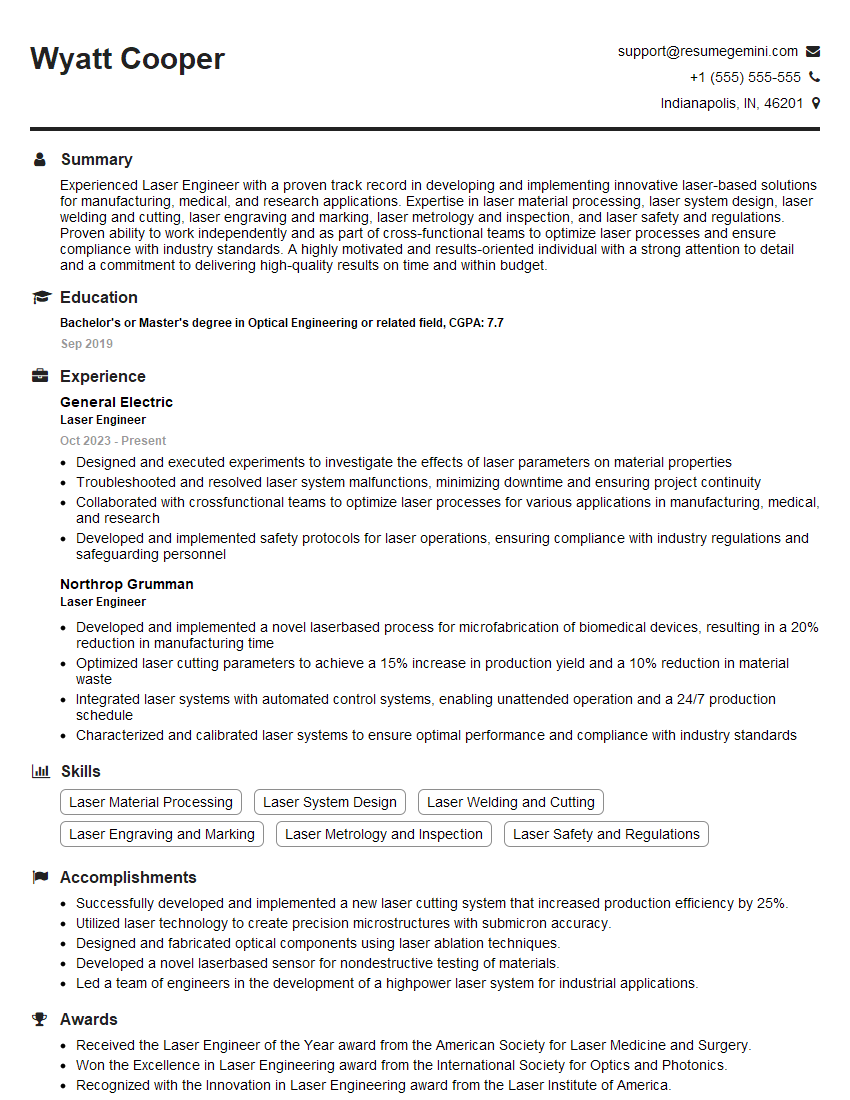
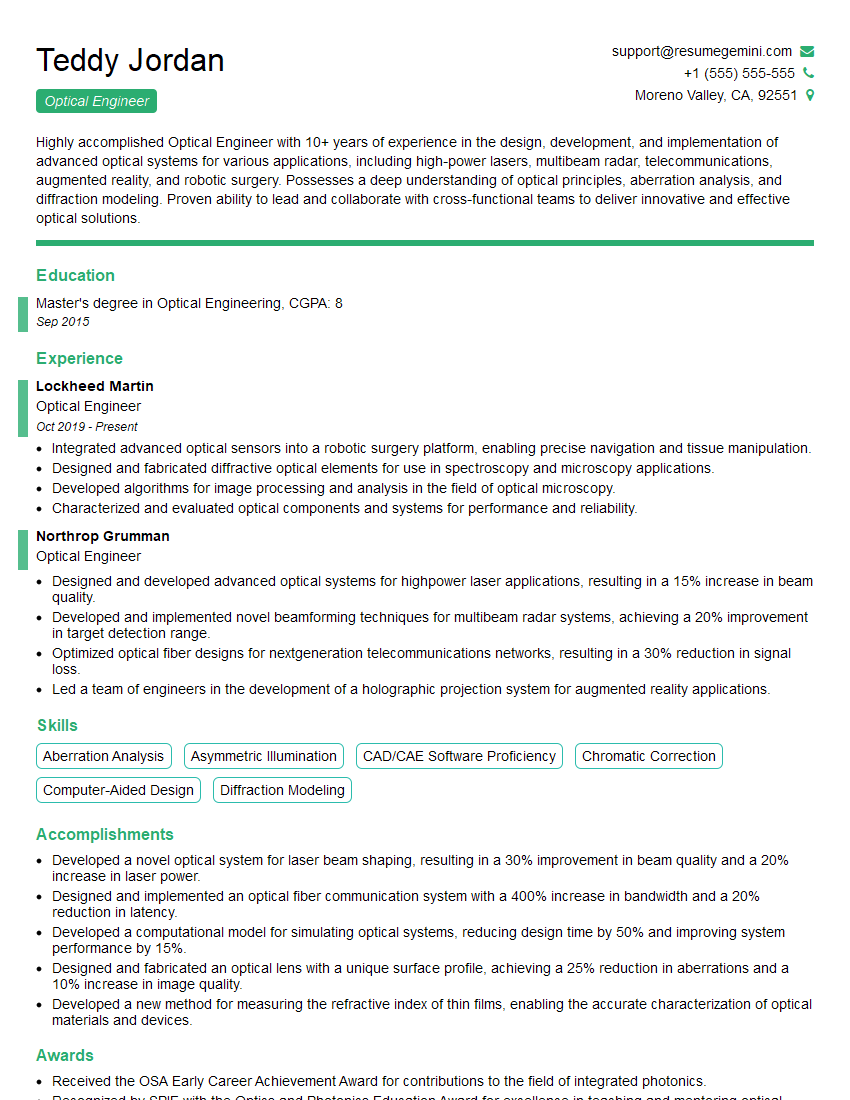
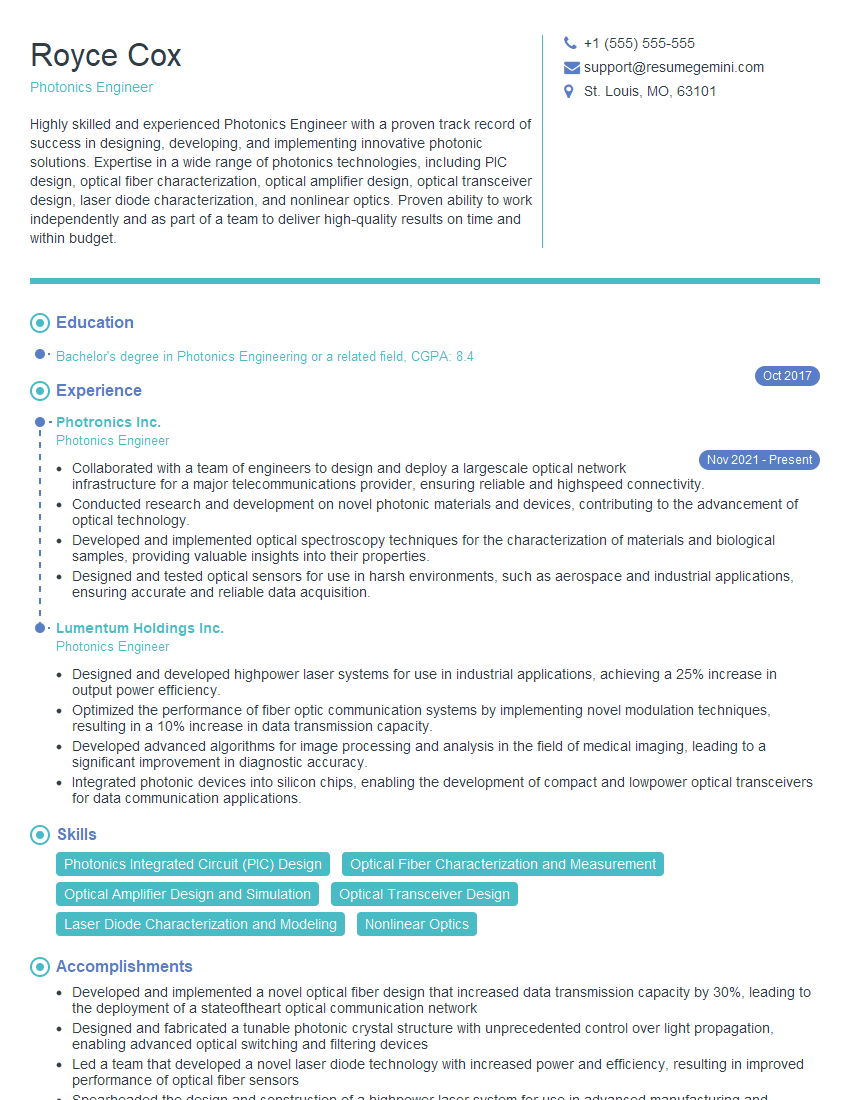
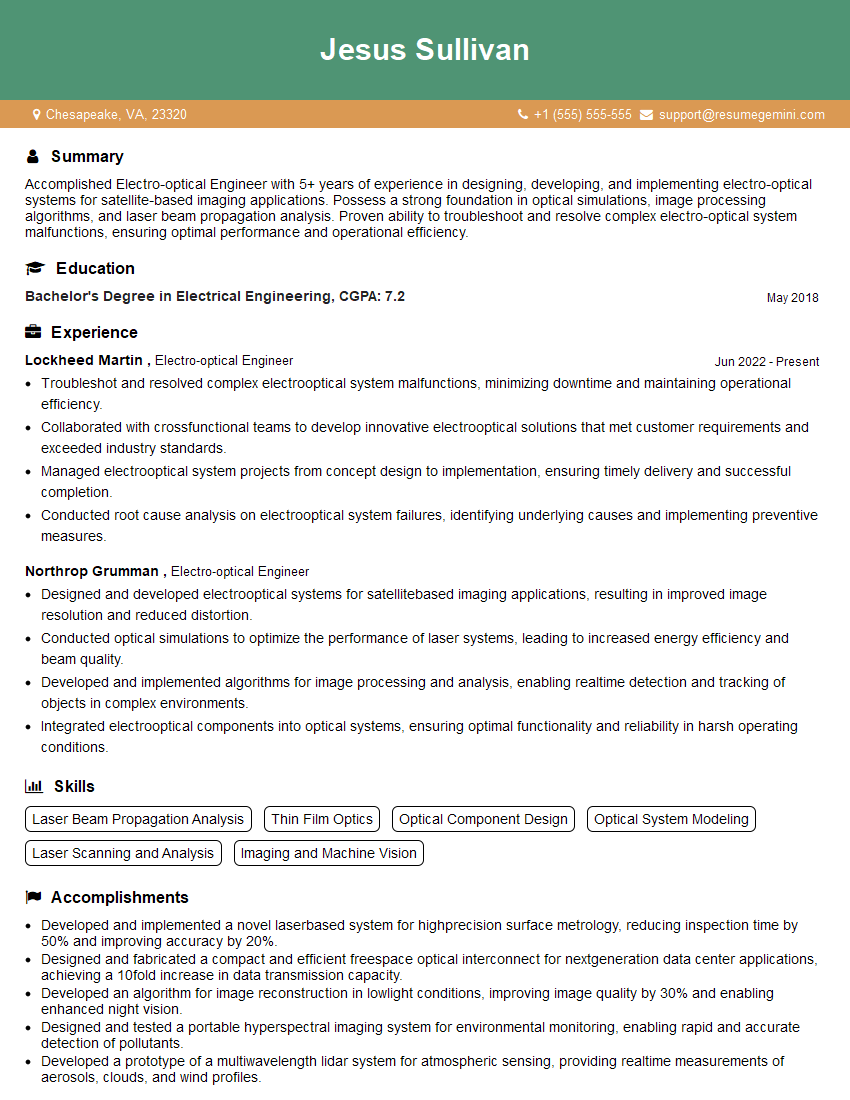
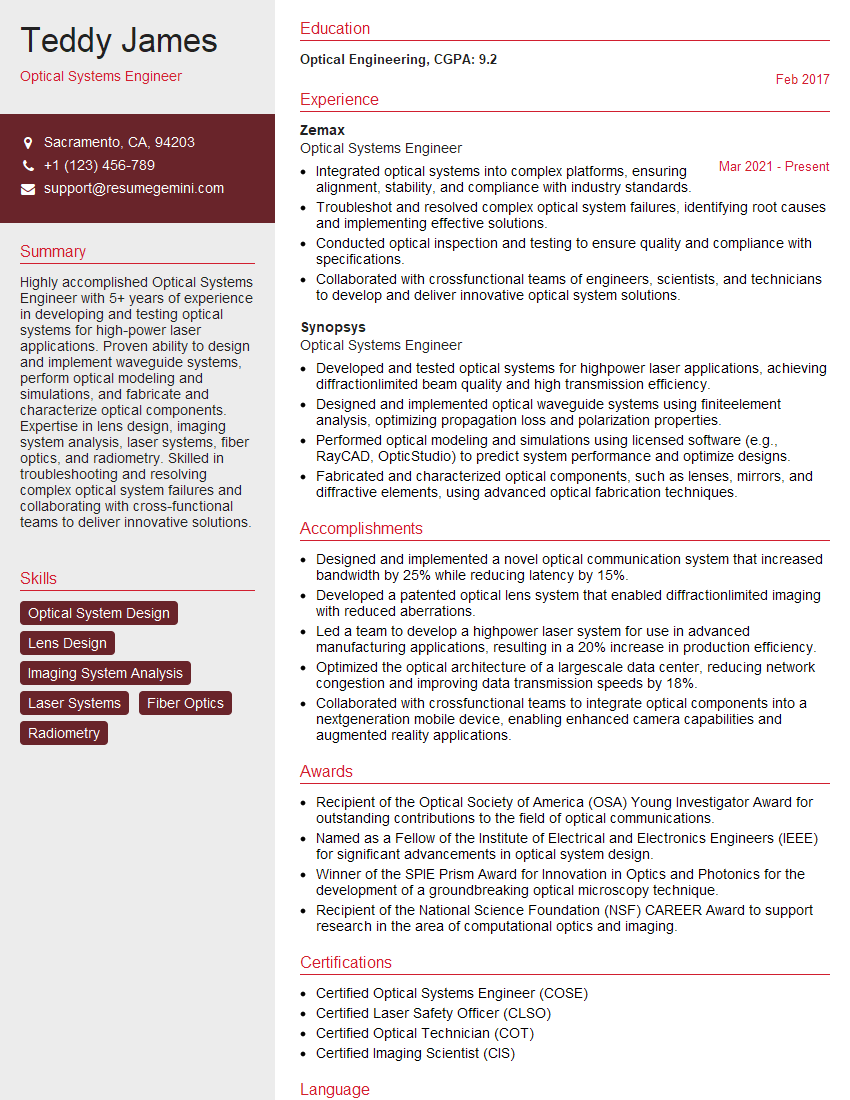
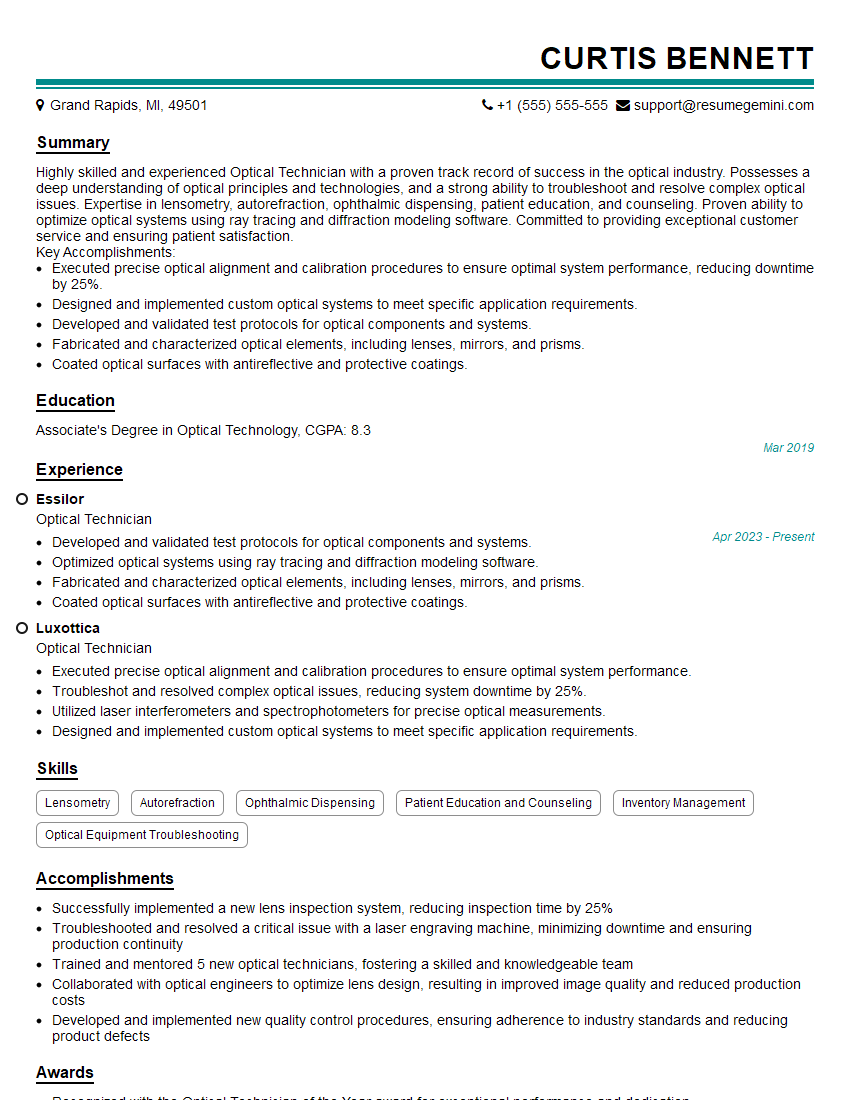
Mastering Opto-Mechanical Engineering opens doors to exciting and impactful careers in various industries, from aerospace and defense to healthcare and telecommunications. To maximize your job prospects, it’s crucial to present your skills effectively. Creating a well-structured, ATS-friendly resume is paramount. ResumeGemini is a trusted resource that can help you build a professional and impactful resume, ensuring your qualifications stand out. They provide examples of resumes tailored to Opto-Mechanical Engineering to help guide you. Invest time in crafting a compelling resume—it’s your first impression and a critical step towards your dream career.
Explore more articles
Users Rating of Our Blogs
Share Your Experience
We value your feedback! Please rate our content and share your thoughts (optional).
What Readers Say About Our Blog
Very informative content, great job.
good