The right preparation can turn an interview into an opportunity to showcase your expertise. This guide to Optoelectronics interview questions is your ultimate resource, providing key insights and tips to help you ace your responses and stand out as a top candidate.
Questions Asked in Optoelectronics Interview
Q 1. Explain the principle of operation of a p-n junction diode.
A p-n junction diode is a fundamental semiconductor device formed by joining p-type and n-type semiconductor materials. Its operation relies on the built-in potential barrier created at the junction.
Principle of Operation: The p-type material has an abundance of holes (positive charge carriers), while the n-type material has an abundance of electrons (negative charge carriers). When these materials are joined, electrons from the n-side diffuse across the junction into the p-side, and holes diffuse from the p-side to the n-side. This diffusion leaves behind immobile ionized acceptor and donor atoms, creating a depletion region devoid of free charge carriers. This depletion region establishes an electric field that opposes further diffusion, reaching equilibrium.
Forward Bias: Applying a positive voltage to the p-side and a negative voltage to the n-side reduces the built-in potential barrier. This allows electrons to flow from the n-side to the p-side, and holes to flow in the opposite direction, resulting in a significant current flow. Think of it like pushing water uphill; once you provide enough force, the water will flow.
Reverse Bias: Applying a negative voltage to the p-side and a positive voltage to the n-side widens the depletion region and increases the potential barrier. This inhibits current flow, resulting in only a small leakage current. This is like trying to push water downhill— it’s much harder, and only a small amount may drip down.
Applications: p-n junction diodes are ubiquitous in electronics, used as rectifiers, switches, and in various other applications. They form the basis of more complex devices like transistors and integrated circuits.
Q 2. Describe the different types of LEDs and their applications.
Light-Emitting Diodes (LEDs) are semiconductor devices that convert electrical energy into light energy. Different types of LEDs exist, categorized by material composition, wavelength of emitted light, and packaging.
- Visible LEDs: These are the most common, producing light in the visible spectrum (red, green, blue, amber, etc.). They are widely used in displays, indicators, and lighting applications. The color is determined by the bandgap energy of the semiconductor material; e.g., gallium arsenide phosphide (GaAsP) for red, gallium nitride (GaN) for blue and green.
- Infrared (IR) LEDs: These emit light in the infrared region, invisible to the human eye. They find applications in remote controls, optical communication systems, and night vision devices. Often made of materials like gallium aluminum arsenide (GaAlAs).
- Ultraviolet (UV) LEDs: These LEDs emit ultraviolet light, used in sterilization, curing, and fluorescence applications. Aluminum gallium nitride (AlGaN) is a common material for UV LEDs.
- Organic LEDs (OLEDs): These LEDs use organic materials as the light-emitting layer. OLEDs are known for their high efficiency, flexibility, and vibrant colors. Used extensively in smartphone displays and high-end TVs.
Applications: The range of applications is vast, spanning from simple indicator lights to high-tech display screens and lighting systems. The choice of LED type depends on the specific application requirements regarding color, power efficiency, and wavelength.
Q 3. What are the advantages and disadvantages of different fiber optic cables?
Fiber optic cables transmit information using light pulses. Different types of fiber optic cables exist, each with advantages and disadvantages.
- Single-Mode Fiber: This type of fiber has a small core diameter, allowing only a single mode of light propagation. This results in low signal attenuation and high bandwidth, making it ideal for long-distance communication and high-speed data transmission. However, it requires precise alignment and coupling of light sources.
- Multi-Mode Fiber: This type of fiber has a larger core diameter, allowing multiple modes of light propagation. It’s easier and cheaper to connect but has higher signal attenuation and lower bandwidth compared to single-mode fiber. It is well-suited for shorter distances and lower bandwidth applications.
Advantages and Disadvantages Summary:
| Feature | Single-Mode Fiber | Multi-Mode Fiber |
|---|---|---|
| Bandwidth | High | Low |
| Attenuation | Low | High |
| Cost | High | Low |
| Distance | Long | Short |
| Connection | Difficult | Easy |
The choice of fiber type depends on the specific application requirements. Single-mode fiber is preferable for long-haul communication networks, while multi-mode fiber is suitable for local area networks or shorter distance links.
Q 4. Explain the concept of optical gain in semiconductor lasers.
Optical gain in a semiconductor laser refers to the amplification of light within the laser cavity. It’s the process by which the stimulated emission of photons exceeds the absorption of photons, leading to an exponential increase in the number of photons.
Concept: Semiconductor lasers utilize population inversion, where a higher number of electrons are excited to a higher energy level than the lower energy level. When a photon with energy equal to the energy difference between the levels interacts with an excited electron, it stimulates the emission of another photon with the same energy, phase, and direction. This process generates a cascading effect, leading to an exponential increase in the number of photons.
Factors Affecting Optical Gain: The optical gain is influenced by several factors, including the material properties of the semiconductor, the carrier concentration (number of electrons and holes), the wavelength of light, and the temperature.
Threshold Gain: For laser action to occur, the optical gain must exceed the losses within the laser cavity (due to absorption and reflection). This minimum required gain is called the threshold gain.
Practical Significance: Optical gain is crucial for laser operation. A sufficient gain ensures the generation of coherent and intense laser light. The higher the gain, the lower the threshold current required for lasing action.
Q 5. How does a photodetector work?
A photodetector is an optoelectronic device that converts light into an electrical signal. Different types of photodetectors exist, each utilizing different mechanisms for light detection.
Principle of Operation: When light strikes a photodetector, it interacts with the material, generating electron-hole pairs (in semiconductors) or altering the conductivity (in other materials). This change in charge carrier concentration or conductivity is then converted into an electrical current or voltage, representing the intensity of the incident light.
Common Types and Mechanisms:
- Photodiodes: These rely on the photovoltaic effect, generating a voltage proportional to light intensity when light falls on a p-n junction.
- Phototransistors: These are essentially transistors with light-sensitive base regions, offering current amplification compared to simple photodiodes.
- Photomultiplier tubes (PMTs): These highly sensitive devices employ the photoelectric effect and a series of dynodes to amplify the signal, ideal for very low light levels.
- Photoresistors (LDRs): Their resistance changes with light intensity.
Applications: Photodetectors have countless applications, including optical communication systems, image sensors (cameras, scanners), environmental monitoring, and medical instruments.
Q 6. Describe different modulation techniques used in optical communication systems.
Modulation techniques are essential in optical communication to encode information onto an optical carrier signal. The carrier is typically a laser beam with a constant frequency (or wavelength).
Common Modulation Techniques:
- Intensity Modulation (IM): This is the most common method, where the intensity of the optical carrier is varied according to the information signal. Think of it like turning a lightbulb brighter or dimmer to represent 1s and 0s. Direct Modulation (directly modulating the laser current) and External Modulation (using a separate modulator) are common variations.
- Phase Modulation (PM): This technique involves varying the phase of the optical carrier. It’s less susceptible to certain types of noise and offers better spectral efficiency.
- Frequency Modulation (FM): This changes the optical carrier frequency according to the information signal. It provides good noise immunity, but is more complex to implement.
- Polarization Modulation (PolM): This varies the polarization state (linear or circular) of the light. It’s useful for certain specialized applications like fiber-optic sensors.
Choice of Technique: The optimal modulation technique depends on several factors, including bandwidth requirements, noise characteristics of the channel, and the complexity of the system. Intensity modulation is popular due to its relative simplicity, while phase and frequency modulation offer advantages in terms of noise immunity and spectral efficiency.
Q 7. What are the key parameters used to characterize an optical fiber?
Several key parameters characterize an optical fiber’s performance and suitability for specific applications.
- Attenuation: The loss of optical power as the light signal travels through the fiber. Measured in decibels per kilometer (dB/km). Lower attenuation is better.
- Dispersion: The spreading of the light pulse as it travels through the fiber, limiting the data rate. There are several types: Chromatic dispersion (caused by different wavelengths traveling at different speeds) and Modal dispersion (caused by different light paths in multi-mode fiber).
- Numerical Aperture (NA): A measure of the light-gathering ability of the fiber. A higher NA indicates more light can be coupled into the fiber.
- Core Diameter: The diameter of the central region of the fiber where light propagates. Impacts the number of modes that can propagate (single-mode vs. multi-mode).
- Cutoff Wavelength: The wavelength below which only the fundamental mode can propagate in a single-mode fiber.
- Bandwidth: The range of frequencies the fiber can transmit without significant distortion. Expressed in MHz·km. Higher bandwidth is better.
Importance of Characterization: Understanding these parameters is critical in selecting the appropriate fiber for a given application. For long-haul, high-bandwidth systems, low attenuation and dispersion are essential. For shorter distances, multi-mode fiber with a higher NA might be suitable.
Q 8. Explain the concept of optical losses in fiber optic systems.
Optical losses in fiber optic systems refer to the reduction in the power of an optical signal as it travels through the fiber. These losses are crucial because they limit the transmission distance and ultimately the system’s performance. Think of it like water flowing through a pipe – some water is lost due to friction and leaks along the way. Similarly, light signals lose intensity as they travel through the fiber.
- Absorption: This is the conversion of light energy into heat within the fiber material. Impurities and imperfections in the fiber’s glass structure absorb light at specific wavelengths. This is like a sponge absorbing water.
- Scattering: Light scattering occurs due to microscopic variations in the fiber’s refractive index. This causes light to deviate from its original path, leading to power loss. Imagine light bouncing off tiny imperfections inside the fiber.
- Bending Losses: Sharp bends in the fiber cause light to leak out of the core. This is analogous to water spilling out of a bent pipe.
- Coupling Losses: These occur at the interfaces between different optical components, such as the fiber and a connector or laser. Imperfect alignment and mismatch in refractive indices lead to light not being efficiently coupled into the next component. This is akin to imperfectly connecting two water pipes – some water might spill.
Minimizing these losses is critical for long-haul communication and high-bandwidth applications. Techniques include using high-quality fibers with low attenuation, careful fiber splicing, and employing optical amplifiers to boost the signal along the way.
Q 9. Describe different types of optical amplifiers and their applications.
Optical amplifiers boost the power of an optical signal without the need for optoelectronic conversion (unlike repeaters). This preserves the signal’s quality and allows for longer transmission distances. There are several types:
- Erbium-doped fiber amplifiers (EDFAs): These are the most commonly used amplifiers, particularly in long-haul telecommunications. They use erbium ions doped into a silica fiber to amplify light around the 1550 nm wavelength, a crucial wavelength for optical communication. Imagine tiny erbium particles within the fiber absorbing weak light and re-emitting it at a higher intensity.
- Raman amplifiers: These rely on the Raman scattering effect, where light interacts with the molecules in the fiber, causing a shift in the light’s frequency and amplification. They offer a broader amplification bandwidth compared to EDFAs, but generally have lower gain.
- Semiconductor optical amplifiers (SOAs): These are based on semiconductor materials and offer advantages in terms of size and integration. However, they often exhibit higher noise levels compared to EDFAs. They work similarly to semiconductor lasers but operate in a linear amplification regime.
Applications vary depending on the amplifier type and requirements. EDFAs are the backbone of undersea and long-haul terrestrial communication systems. Raman amplifiers are used in applications requiring wider bandwidths, while SOAs find their niche in shorter-reach systems and integrated optical circuits.
Q 10. How do you design an optical system for a specific application?
Designing an optical system involves a systematic process of defining the requirements, selecting components, and optimizing performance. This is a multi-disciplinary effort requiring knowledge of optics, photonics, and the specific application needs.
- Define the application requirements: What are the input and output signals? What is the desired transmission distance? What is the required bandwidth? What environmental conditions will the system operate under?
- Select the light source: This depends on the application. Lasers are used where high power and coherence are needed (e.g., optical communication, laser scanning), while light-emitting diodes (LEDs) are preferred for lower cost and simpler systems (e.g., fiber optic sensors).
- Choose the optical components: This includes fibers, lenses, mirrors, filters, and detectors. The choice depends on factors such as wavelength, power, and size constraints.
- Design the optical path: The path must minimize losses and ensure proper alignment. Computer-aided design (CAD) tools are commonly used for this purpose.
- Perform simulations and testing: Simulations help to predict the system’s performance. Extensive testing is essential to verify the design and optimize the system’s performance.
- Optimize the system: This involves adjusting parameters such as the power levels, fiber lengths, and component selection to achieve the desired performance.
For example, designing an optical system for a medical imaging application would involve different considerations compared to designing a system for long-haul telecommunications. The former would prioritize high resolution and low power, whereas the latter would prioritize high bandwidth and long-distance transmission.
Q 11. Explain the concept of diffraction and its impact on optical systems.
Diffraction is the bending of light waves as they pass through an aperture or around an obstacle. Imagine water waves bending as they pass through a narrow opening – the same principle applies to light. The amount of bending depends on the wavelength of light and the size of the aperture.
In optical systems, diffraction limits the resolution and focusing ability. It causes blurring of images and spreading of the light beam. This is especially important in high-resolution imaging systems like microscopes and telescopes.
For example, in a telescope, diffraction limits the minimum angular separation between two points that can be resolved. This limitation is described by the Rayleigh criterion, which states that two points are resolvable if the central maximum of the diffraction pattern of one point falls on the first minimum of the diffraction pattern of the other point. The smaller the aperture of the telescope, the larger the diffraction effects, and the lower the resolution.
Diffraction also plays a crucial role in optical devices like diffraction gratings, which are used to separate light into its constituent wavelengths. These devices are based on the principle of constructive and destructive interference of diffracted light waves.
Q 12. What are different methods for optical signal detection?
Optical signal detection involves converting an optical signal (light) into an electrical signal that can be processed by electronic circuits. Several methods exist:
- Photodiodes: These are semiconductor devices that generate a current proportional to the incident light intensity. They are widely used in various applications due to their simplicity, speed, and relatively low cost.
- Photomultiplier tubes (PMTs): These are highly sensitive detectors that use a series of dynodes to amplify the signal generated by incident photons. They are capable of detecting extremely weak light signals, making them suitable for applications such as fluorescence microscopy and astronomy.
- Avalanche photodiodes (APDs): These are similar to photodiodes but exhibit internal gain due to the avalanche multiplication process. This allows them to detect weaker signals compared to ordinary photodiodes.
- Phototransistors: These are semiconductor devices that combine the functions of a photodiode and a transistor. They are useful in applications requiring high gain and low power consumption.
The choice of detection method depends on factors such as the required sensitivity, speed, and cost. Photodiodes are a good general-purpose choice, while PMTs are preferred for low-light applications, and APDs are a good compromise between sensitivity and speed.
Q 13. Describe different types of optical sensors and their applications.
Optical sensors use light to measure physical or chemical properties. A wide variety of optical sensors exist, each tailored to a specific application:
- Fiber optic sensors: These utilize optical fibers to transmit and receive light, allowing for remote sensing and harsh environment applications. Examples include temperature sensors, pressure sensors, and displacement sensors.
- Photoelectric sensors: These detect the presence or absence of an object by interrupting a beam of light. They are commonly used in industrial automation, robotics, and counting applications.
- Spectroscopic sensors: These measure the spectral characteristics of light, which provide information about the composition of a material. Examples include gas sensors, chemical sensors, and biomedical sensors.
- Laser-based sensors: These use lasers as a light source, providing high accuracy and precision. Examples include laser range finders, laser velocimeters, and laser-induced breakdown spectroscopy (LIBS) sensors.
Applications are numerous and span various industries, including manufacturing, healthcare, environmental monitoring, and aerospace. For example, fiber optic sensors are used to monitor the structural health of bridges and buildings, while spectroscopic sensors are employed in medical diagnostics and environmental pollution monitoring.
Q 14. Explain the working principle of a photomultiplier tube.
A photomultiplier tube (PMT) is an extremely sensitive light detector that converts incident photons into an amplified electrical signal. It works on the principle of photoemission and secondary electron multiplication.
- Photocathode: When a photon strikes the photocathode (a photosensitive material), it ejects an electron through the photoelectric effect. This is the initial conversion of light into an electrical signal.
- Dynodes: The emitted electron is accelerated towards a series of dynodes, which are electrodes held at increasingly higher potentials. Each dynode emits several secondary electrons when struck by an incoming electron.
- Electron Multiplication: This process of secondary electron emission is repeated at each dynode, leading to a substantial amplification of the initial electron. The gain of a PMT can reach 106 or even higher.
- Anode: Finally, the amplified electron pulse is collected at the anode, producing an electrical signal proportional to the initial number of incident photons.
The high sensitivity of PMTs makes them suitable for detecting very weak light signals, such as those produced by bioluminescence, scintillation, or astronomical observations. However, PMTs are relatively bulky and require high voltage supplies.
Q 15. How do you measure the optical power of a laser?
Measuring the optical power of a laser involves using a power meter, also known as an optical power meter. These devices employ a photodetector that converts the light energy into an electrical signal, which is then processed to display the power in units such as milliwatts (mW) or microwatts (µW).
There are different types of power meters, each suited to different wavelengths and power levels. For instance, a thermal power meter is generally preferred for high-power lasers as it’s less sensitive to wavelength variations. A photodiode-based power meter is suitable for lower power measurements and specific wavelengths. The measurement process generally involves connecting the power meter to the laser output via an appropriate optical fiber or free-space connector. The power meter then displays the measured optical power. It’s crucial to calibrate the power meter regularly to ensure accurate measurements, and always follow the manufacturer’s instructions for proper usage and safety.
For example, in a telecommunications setting, we might use a calibrated power meter to measure the optical power transmitted through a fiber optic cable to ensure signal integrity. In a laser cutting application, a power meter would help monitor the consistency of the laser’s output power, critical for maintaining the cutting quality.
Career Expert Tips:
- Ace those interviews! Prepare effectively by reviewing the Top 50 Most Common Interview Questions on ResumeGemini.
- Navigate your job search with confidence! Explore a wide range of Career Tips on ResumeGemini. Learn about common challenges and recommendations to overcome them.
- Craft the perfect resume! Master the Art of Resume Writing with ResumeGemini’s guide. Showcase your unique qualifications and achievements effectively.
- Don’t miss out on holiday savings! Build your dream resume with ResumeGemini’s ATS optimized templates.
Q 16. Explain different types of optical filters and their applications.
Optical filters selectively transmit or block certain wavelengths of light. They are crucial components in numerous optoelectronic systems. Several types exist, each with specific applications:
Bandpass filters: These transmit light within a specific wavelength range and block light outside that range. Think of them as letting only specific colors through. They are widely used in spectroscopy and laser systems to isolate specific wavelengths.
Band-reject (or notch) filters: These block a specific wavelength range while transmitting the rest. Imagine removing a particular color from a spectrum. They are essential for removing unwanted wavelengths, like noise or interference, in various applications.
Longpass filters: These transmit wavelengths longer than a specified cutoff wavelength. Analogy: letting only colors above a certain point on the rainbow pass through. They’re useful in fluorescence microscopy where the excitation light needs to be blocked while letting the longer-wavelength fluorescence light pass.
Shortpass filters: These transmit wavelengths shorter than a specified cutoff wavelength. Conversely, they only allow colors below a certain point in the spectrum to pass. Useful in imaging systems to separate different color channels.
Neutral density (ND) filters: These attenuate light intensity across a wide wavelength range without altering the spectral distribution. This is like dimming all the colors equally. They are used to reduce the intensity of strong light sources in various applications.
Applications span diverse fields, including medical imaging (removing unwanted scattering in optical coherence tomography), telecommunications (isolating specific wavelengths in optical communication systems), and astronomy (reducing stray light in telescopes).
Q 17. What are the safety precautions related to working with lasers?
Laser safety is paramount. The level of precaution required depends on the laser’s class, which is determined by its output power and potential for causing eye or skin damage. General safety precautions include:
Eye protection: Always wear appropriate laser safety eyewear designed for the specific laser wavelength and power level. This is crucial to protect your eyes from potential damage.
Skin protection: For high-power lasers, skin protection might be needed to prevent burns. Appropriate clothing may be necessary.
Environmental controls: The laser should be housed in a controlled environment to prevent accidental exposure, with appropriate warning signs and safety interlocks in place.
Proper training: Only trained personnel should operate lasers, as improper use can lead to serious injuries.
Beam path management: The laser beam path should be carefully managed to prevent accidental exposure. Using beam blockers and enclosures is essential.
Emergency procedures: Emergency procedures and appropriate first aid measures should be established and known by all personnel.
Ignoring these precautions can lead to severe eye damage, burns, or even fires.
Q 18. Describe different types of optical lenses and their applications.
Optical lenses refract (bend) light to focus or diverge it. Different types exist, each serving specific purposes:
Convex lenses (positive lenses): These lenses are thicker in the middle than at the edges. They converge light rays, focusing them to a point. Used in magnifying glasses, cameras, and eyeglasses for farsightedness.
Concave lenses (negative lenses): These lenses are thinner in the middle than at the edges. They diverge light rays, spreading them out. Used in eyeglasses for nearsightedness and some optical systems to correct aberrations.
Aspheric lenses: These lenses have non-spherical surfaces, offering superior image quality compared to standard spherical lenses by reducing aberrations. Frequently used in high-performance imaging systems.
Achromatic lenses: These lenses are designed to minimize chromatic aberration (color fringing), improving the sharpness and clarity of images. They’re crucial in microscopes and telescopes.
Diffractive lenses: These lenses use diffraction gratings to focus light. They can be very compact and lightweight but may have limitations in terms of image quality.
The choice of lens depends on the application. For instance, a high-resolution camera might use aspheric lenses to minimize aberrations, while a simple magnifying glass would use a simple convex lens.
Q 19. Explain the concept of optical coherence.
Optical coherence refers to the correlation between the phases of two light waves. Light waves have a phase, which essentially represents a point in their oscillation cycle. If the phases of two waves are the same, they are coherent. If they differ, they are incoherent. High coherence means the waves maintain a consistent phase relationship over a longer time and distance; low coherence means the phase relationship changes quickly.
Imagine two perfectly synchronized waves on a lake, representing high coherence. They’ll create a consistent pattern. Now imagine waves generated by many random sources; these are incoherent, creating an irregular pattern. The degree of coherence impacts many optical phenomena, including interference and diffraction. Optical coherence is essential in technologies like optical coherence tomography (OCT), which uses the interference of light waves to create high-resolution images of biological tissues.
Q 20. How do you characterize the performance of an optical system?
Characterizing an optical system involves assessing several key performance metrics:
Resolution: This indicates the system’s ability to distinguish between closely spaced objects. Higher resolution means the ability to see finer details.
Magnification: The extent to which the system enlarges the image of an object. It’s expressed as a ratio.
Field of view (FOV): The area that can be observed through the system.
Transmission/Loss: The percentage of light that passes through the system without being absorbed or scattered.
Aberrations: Imperfections in the image formed by the system, such as chromatic aberration (color fringing) and spherical aberration (blurriness).
Modulation Transfer Function (MTF): A measure of the system’s ability to reproduce fine details, often used to characterize imaging systems.
Techniques used for characterization include interferometry (measuring wavefront errors), optical testing (evaluating lens performance), and image analysis (assessing image quality).
For example, in designing a telescope, we would characterize its resolution to determine its ability to resolve distant stars, its transmission to ensure maximum light gathering, and its aberrations to minimize image defects.
Q 21. Describe different types of optical imaging systems.
Optical imaging systems employ lenses and other optical components to form images of objects. Several types exist:
Refractive imaging systems: These systems use lenses to refract (bend) light and form images. Most cameras and microscopes fall into this category.
Reflective imaging systems: These systems use mirrors to reflect light and form images. Telescopes often employ reflective imaging systems.
Catadioptric imaging systems: These systems use a combination of lenses and mirrors to form images, often to correct aberrations and improve image quality. Some telephoto lenses utilize this design.
Microscopy systems: These systems are designed for high-resolution imaging of small objects, including bright-field, dark-field, phase-contrast, and fluorescence microscopy.
Endoscopy systems: These systems use flexible optical fibers to image internal organs and cavities. They’re used in medical procedures.
Optical coherence tomography (OCT) systems: These systems use low-coherence interferometry to create high-resolution cross-sectional images of tissues.
The choice of imaging system depends on the application and the size, nature and resolution required for the object being imaged. For instance, astronomical observations require large reflective telescopes to gather faint light and obtain high resolution, while medical endoscopy uses fiber optics to allow visualization of internal organs.
Q 22. What is the role of optoelectronics in modern telecommunications?
Optoelectronics plays a pivotal role in modern telecommunications, forming the backbone of high-speed data transmission. At its heart lies the fiber optic cable, which uses light pulses to transmit information over vast distances far more efficiently than traditional copper wires. This is because light signals experience significantly less attenuation (signal loss) than electrical signals.
Specifically, optoelectronic devices like lasers and LEDs generate and modulate the light signals, while photodetectors receive and convert the light back into electrical signals. Optical amplifiers boost the signal strength along the fiber, overcoming attenuation and extending transmission range. The entire system relies on the precise control and manipulation of light, a hallmark of optoelectronics. Think of it like replacing a slow, leaky water pipe with a high-pressure, low-friction pipeline for information.
For example, the internet, long-distance phone calls, and even cable television rely heavily on fiber optic communication enabled by optoelectronic technologies. The speed and capacity of these systems are constantly increasing as advancements in optoelectronics continue to push the boundaries of data transmission.
Q 23. Explain the principles of optical spectroscopy.
Optical spectroscopy is the study of the interaction between light and matter. It involves analyzing the absorption, emission, or scattering of light by a sample to determine its properties, such as its chemical composition, structure, and physical state. Different types of spectroscopy utilize different regions of the electromagnetic spectrum, each providing unique information about the sample.
The fundamental principle is that atoms and molecules have specific energy levels. When light interacts with these atoms/molecules, photons of specific energies (corresponding to the energy differences between these levels) can be absorbed or emitted, resulting in characteristic spectral features – peaks or dips in the intensity of light at specific wavelengths. Analyzing these spectral features allows us to identify the substances present and understand their molecular structure.
For instance, Atomic Absorption Spectroscopy (AAS) is used to determine the concentration of metallic elements in a sample, while Infrared (IR) Spectroscopy identifies functional groups in organic molecules based on their vibrational modes. These techniques are vital tools in various fields such as analytical chemistry, materials science, and environmental monitoring.
Q 24. Describe different types of optical materials and their properties.
Optical materials are substances that interact with light in specific ways, and are crucial in optoelectronic devices. Their properties dictate how light is transmitted, reflected, refracted, or absorbed. The choice of material often depends on the specific application.
- Crystalline materials like silicon (Si) and gallium arsenide (GaAs) are widely used in semiconductor lasers and detectors due to their ability to precisely control light emission and detection. Their crystalline structure allows for efficient energy transfer and predictable optical properties.
- Amorphous materials such as silica glass (SiO2) are excellent for optical fibers due to their high transparency in the near-infrared region, minimizing signal loss during transmission. The lack of long-range order in their structure makes them suitable for forming long, thin fibers.
- Polymeric materials such as polymers doped with organic dyes are used in LEDs and optical waveguides. Their flexibility and low cost make them attractive for certain applications, although their performance may not match that of crystalline materials in all aspects.
- Liquid crystals are used in LCD displays, exploiting their unique ability to change their optical properties when an electric field is applied, allowing for light modulation.
Each material exhibits distinct properties like refractive index (how much light bends when passing through it), transparency, and absorption coefficient (how much light is absorbed). Careful selection of materials is essential for optimal device performance.
Q 25. What are the challenges in designing high-power laser systems?
Designing high-power laser systems presents several significant challenges. The primary concern is managing the heat generated by the laser’s operation. High-power lasers convert a substantial amount of electrical energy into light, resulting in a considerable amount of waste heat. This heat can damage the laser components and degrade its performance.
Other challenges include:
- Thermal management: Efficient cooling systems are crucial to dissipate the waste heat and maintain the laser’s operational temperature. This often involves sophisticated heat sinks, thermoelectric coolers, and liquid cooling systems.
- Beam quality: High-power lasers need to maintain good beam quality, meaning a well-defined, low-divergence beam. Aberrations and distortions in the beam can reduce its intensity and efficacy.
- Material limitations: High-power lasers demand materials that can withstand high optical intensities and thermal stresses without damage or degradation.
- Nonlinear effects: At high power levels, nonlinear optical effects can occur, causing distortions and losses in the beam. These effects need to be carefully mitigated.
- Safety: High-power lasers pose significant safety hazards and require rigorous safety protocols to prevent accidents.
Overcoming these challenges requires careful engineering, material selection, and advanced cooling techniques. For example, the development of efficient heat sinks and new laser materials with better thermal conductivity are crucial research areas.
Q 26. Explain the role of optoelectronics in medical applications.
Optoelectronics plays a crucial role in various medical applications, contributing to advancements in diagnostics, treatment, and surgical procedures. Its ability to precisely control and manipulate light makes it invaluable in this field.
- Optical coherence tomography (OCT): This technique uses low-coherence interferometry to create high-resolution images of internal structures, providing valuable information for ophthalmology, cardiology, and dermatology.
- Laser surgery: Lasers are used for precise cutting and coagulation of tissues, minimizing collateral damage and improving surgical outcomes. Different laser wavelengths are selected based on their interaction with specific tissues.
- Endoscopy: Optoelectronic devices enable minimally invasive surgical procedures through endoscopes, allowing for examination and treatment of internal organs with minimal trauma.
- Fluorescence microscopy: This technique uses fluorescent markers to visualize specific molecules and structures within cells, providing insights into biological processes and disease states.
- Photodynamic therapy (PDT): This cancer treatment uses a photosensitizing drug activated by light to destroy cancer cells.
The development of new optoelectronic devices and techniques continues to improve the accuracy, effectiveness, and safety of medical treatments. For example, advancements in fiber optics allow for the delivery of light to hard-to-reach areas within the body, while new laser systems offer enhanced precision and control.
Q 27. Describe the latest trends and future prospects in optoelectronics.
Optoelectronics is a dynamic field experiencing rapid growth and innovation. Several key trends shape its future prospects:
- Silicon photonics: Integrating photonic devices onto silicon chips promises to revolutionize data communication and computing by enabling faster and more energy-efficient data processing and transmission.
- Miniaturization and integration: The trend towards smaller, more integrated optoelectronic devices leads to increased functionality and reduced costs in applications ranging from consumer electronics to high-performance computing.
- Advanced materials: The development of new materials with improved optical and electronic properties opens up possibilities for creating more efficient and versatile optoelectronic devices.
- Artificial intelligence (AI) and machine learning (ML): AI and ML are playing an increasingly important role in the design, optimization, and control of optoelectronic systems, leading to improved performance and automation.
- Quantum optoelectronics: Exploring the quantum properties of light and matter offers the potential for groundbreaking advances in areas such as quantum computing and quantum communication.
These trends suggest that optoelectronics will play an even more significant role in shaping future technologies, impacting various sectors from telecommunications and healthcare to computing and sensing.
Q 28. How do you troubleshoot problems in an optical system?
Troubleshooting an optical system involves a systematic approach to identify and resolve issues affecting its performance. The process usually involves a combination of visual inspection, measurements, and systematic testing.
A step-by-step approach would be:
- Visual inspection: Carefully examine the entire optical system for any physical damage, misalignment, or contamination (dust, debris). Check for loose connections, damaged fibers, or cracked lenses.
- Power and signal checks: Verify that all power supplies are operating correctly and that signal levels are within the expected range. Use appropriate meters and oscilloscopes to measure power and signal integrity.
- Alignment verification: Check the alignment of optical components, particularly in systems with multiple lenses, mirrors, or fibers. Misalignment can significantly impact performance. A laser pointer can be helpful in verifying alignment.
- Loss measurements: Measure optical power at various points in the system to identify locations with excessive loss. An optical power meter is essential for this step.
- Spectral analysis: If spectral characteristics are critical, use a spectrometer to analyze the light’s wavelength and bandwidth. This can reveal issues with light sources, filters, or other components affecting the spectrum.
- Component testing: If specific components are suspected, they can be tested individually to confirm whether they are functioning correctly. Replacement or repair may be needed.
Troubleshooting optical systems requires specialized knowledge and tools. Detailed documentation, schematics, and a systematic approach are crucial for effective problem-solving.
Key Topics to Learn for your Optoelectronics Interview
- Semiconductor Physics: Understanding bandgaps, doping, and carrier transport is fundamental. Consider exploring concepts like p-n junctions and their behavior under illumination.
- Optical Sources & Detectors: Familiarize yourself with the principles of operation, characteristics (e.g., efficiency, response time), and applications of LEDs, lasers, photodiodes, and phototransistors.
- Fiber Optics: Grasp the concepts of light propagation in optical fibers, including attenuation, dispersion, and different fiber types (single-mode, multi-mode). Explore applications in telecommunications and sensing.
- Optical Modulation & Demodulation Techniques: Understand various methods for encoding information onto light waves and extracting it at the receiver end. This includes intensity modulation, phase modulation, and their respective demodulation schemes.
- Optical Spectroscopy: Learn the principles behind various spectroscopic techniques used for material characterization and analysis relevant to optoelectronic devices. Consider exploring techniques like absorption, emission, and Raman spectroscopy.
- Design and Fabrication: Gain an understanding of the processes involved in designing and fabricating optoelectronic devices, including material selection, device architectures, and fabrication techniques like lithography and epitaxy. Be prepared to discuss practical challenges.
- Applications in specific fields: Depending on the role, you might need in-depth knowledge of applications like optical communication, biomedical imaging, sensing, or displays. Tailor your preparation accordingly.
Next Steps
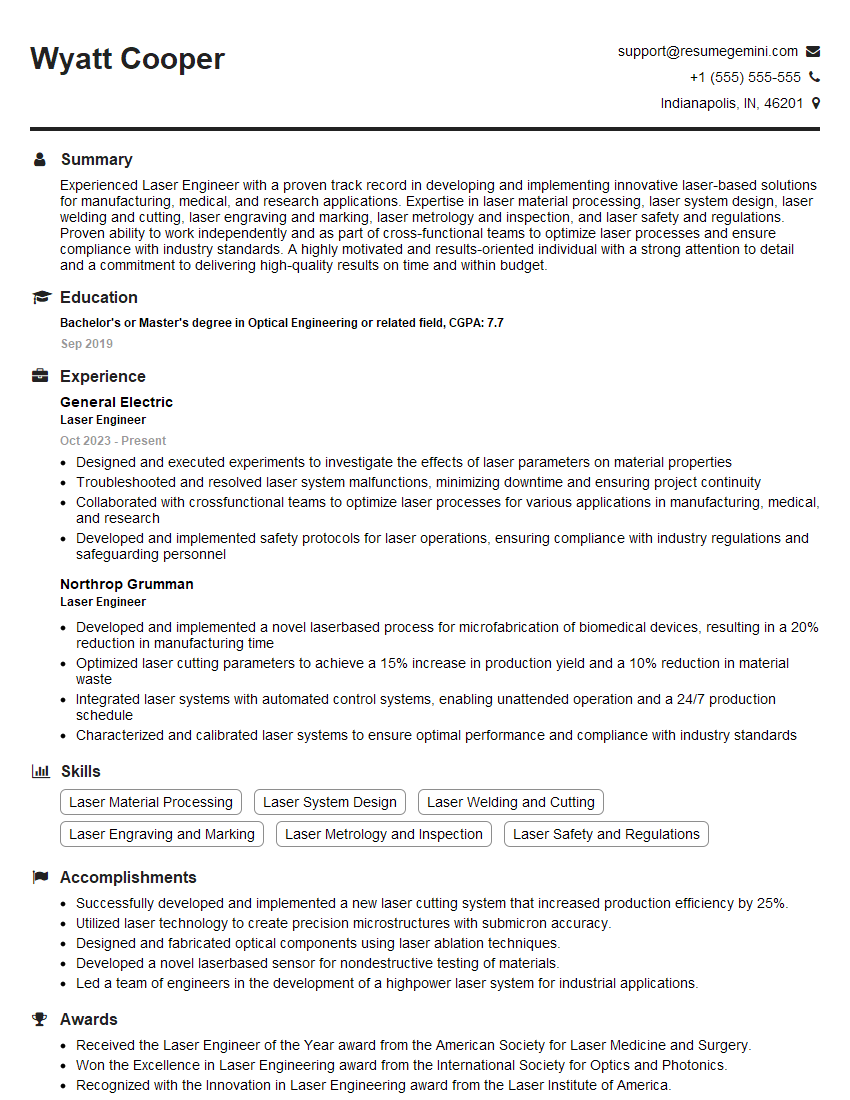
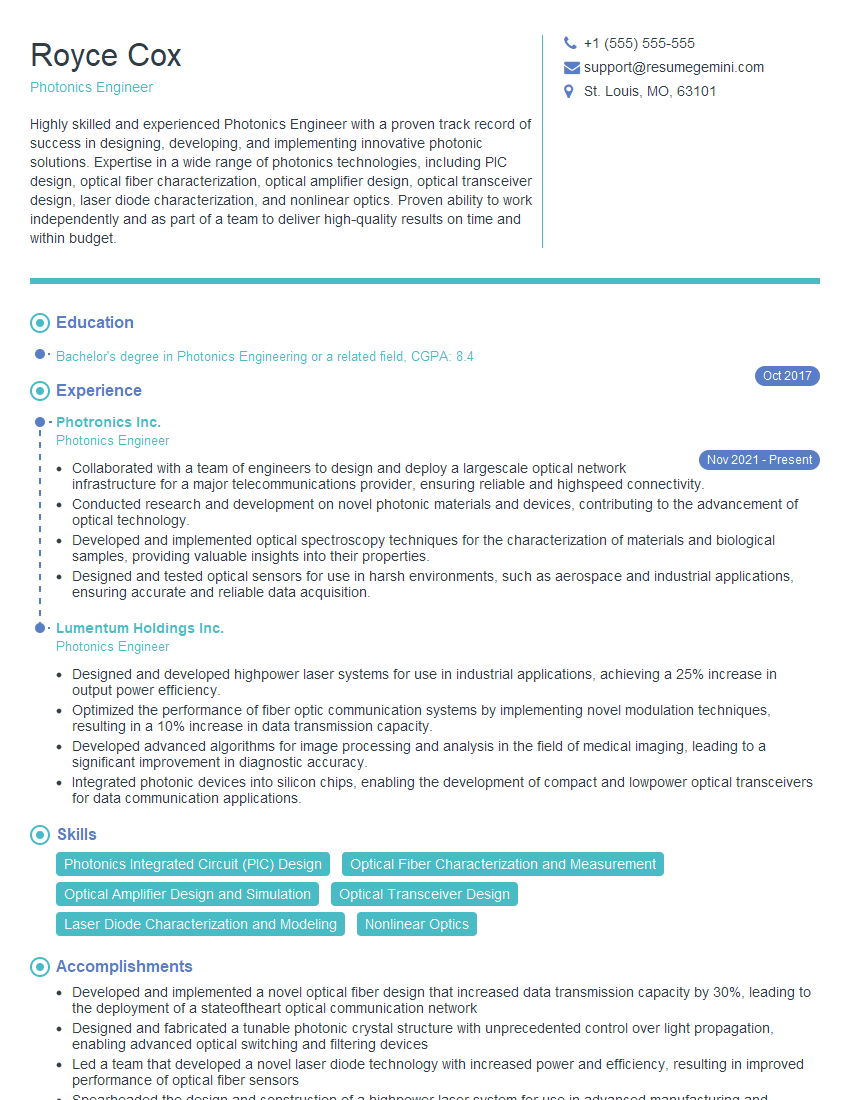
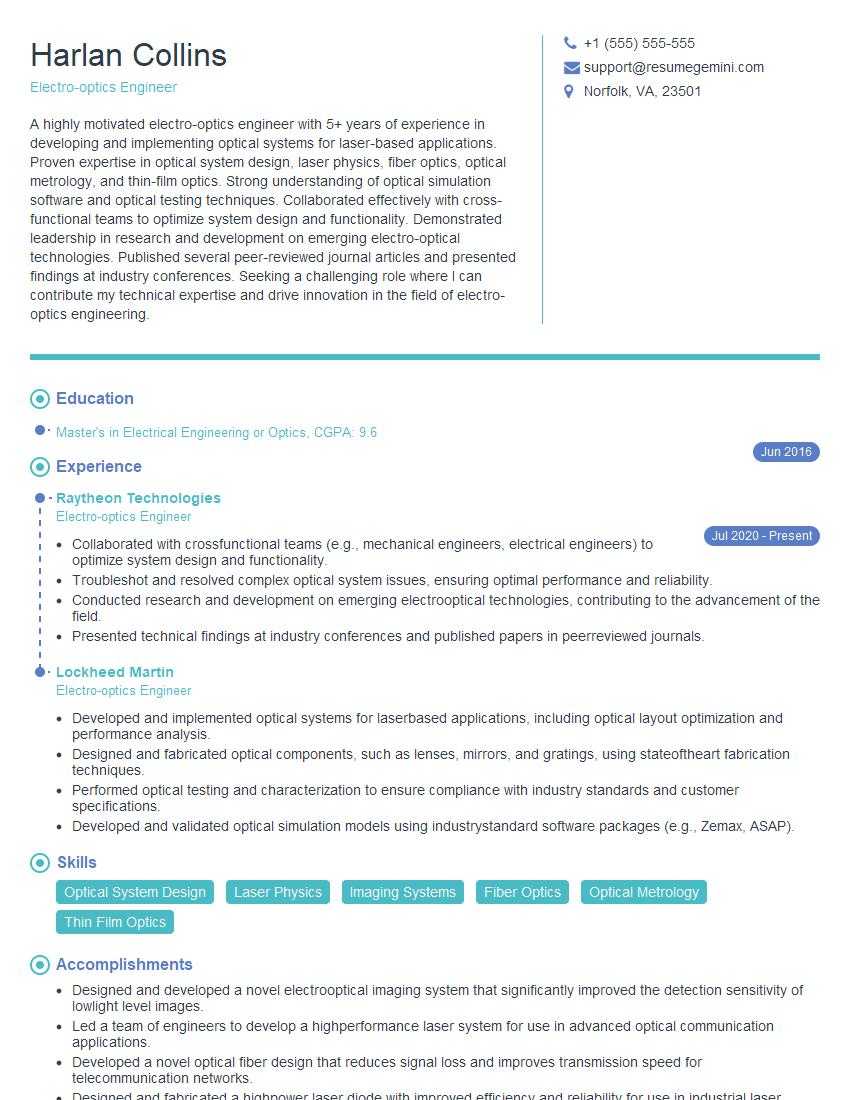
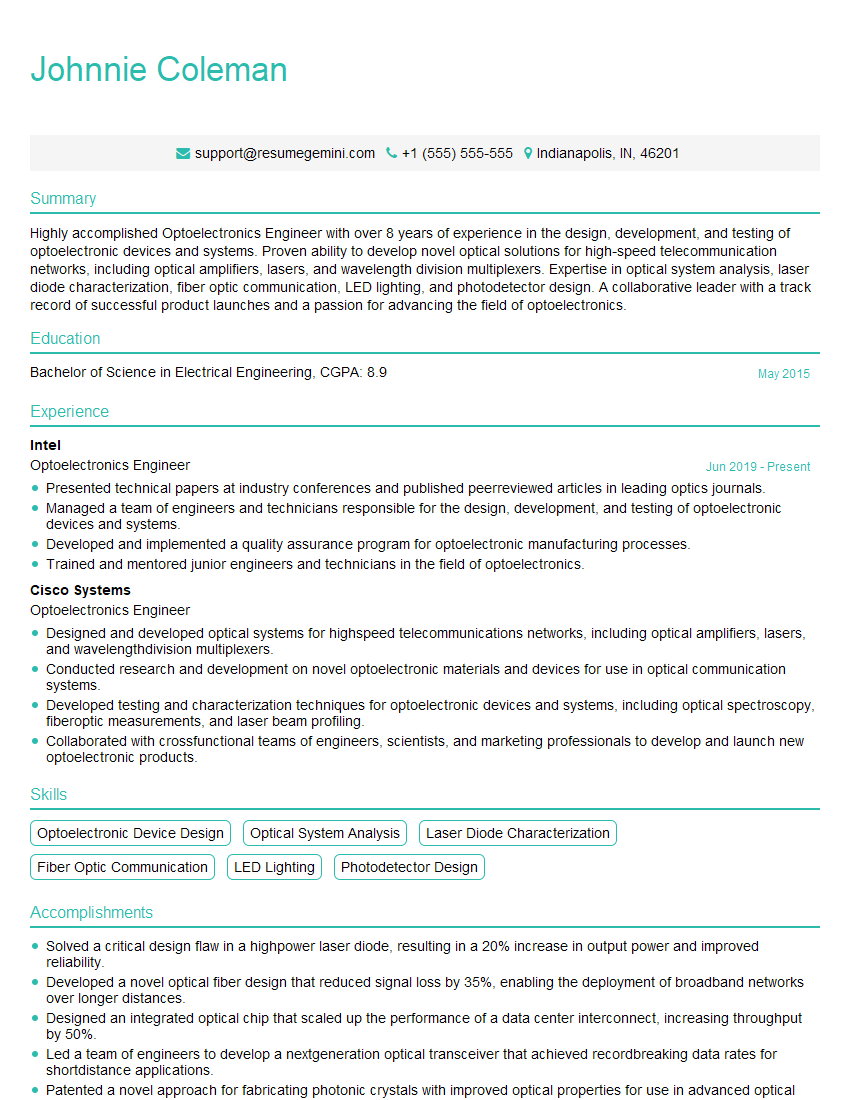
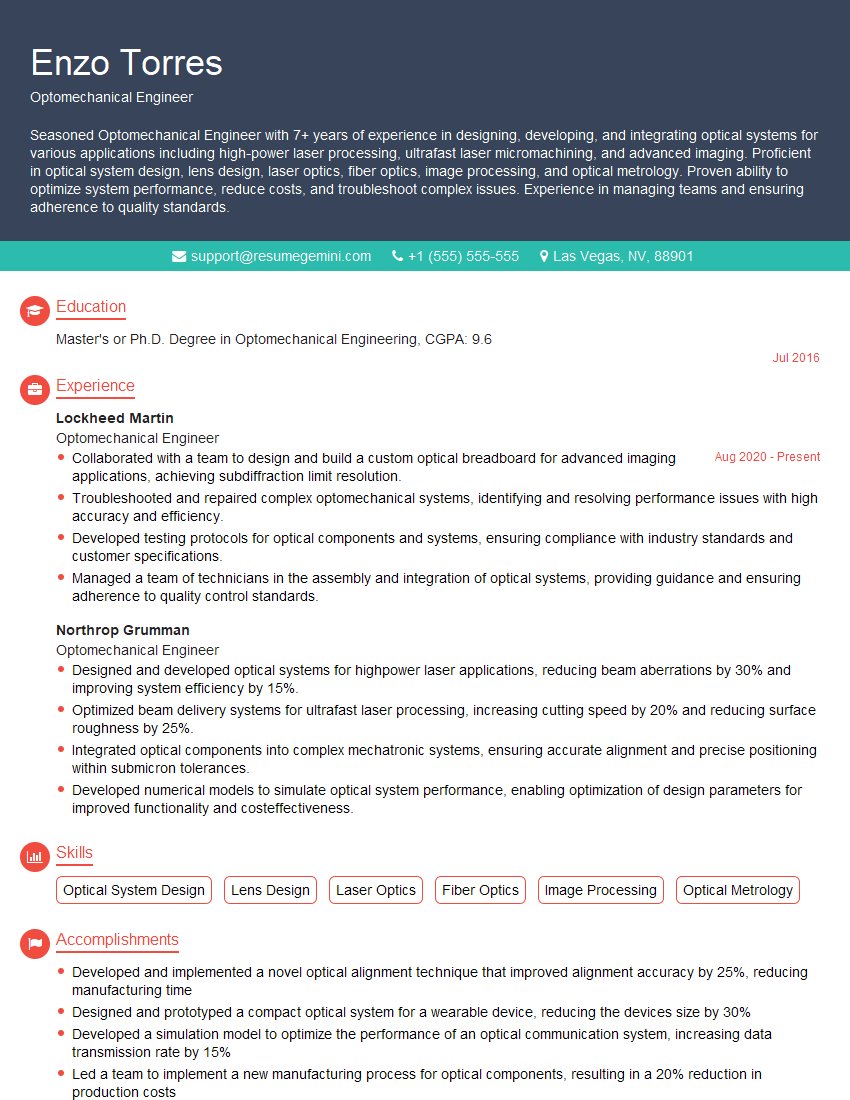
Mastering Optoelectronics opens doors to exciting and innovative careers in a rapidly evolving field. To maximize your job prospects, a strong, ATS-friendly resume is crucial. ResumeGemini can help you craft a compelling resume that highlights your skills and experience effectively. We offer examples of Optoelectronics-focused resumes to help you showcase your qualifications. Invest the time to create a resume that stands out – it’s your first impression with potential employers.



Explore more articles
Users Rating of Our Blogs
Share Your Experience
We value your feedback! Please rate our content and share your thoughts (optional).
What Readers Say About Our Blog
Very informative content, great job.
good