Cracking a skill-specific interview, like one for OSHA 29 CFR 1910 Subpart S Electrical, requires understanding the nuances of the role. In this blog, we present the questions you’re most likely to encounter, along with insights into how to answer them effectively. Let’s ensure you’re ready to make a strong impression.
Questions Asked in OSHA 29 CFR 1910 Subpart S Electrical Interview
Q 1. Explain the requirements for lockout/tagout procedures under Subpart S.
Lockout/Tagout (LOTO) procedures under OSHA 29 CFR 1910 Subpart S are crucial for preventing accidental energization of electrical equipment during maintenance or repair. The core principle is to ensure that energy sources are isolated and rendered incapable of releasing hazardous energy. This isn’t just about turning off a switch; it’s about a systematic process to guarantee safety.
Subpart S mandates that employers must establish an energy control program, including the following steps:
- Energy Isolation: Identify all energy sources (electrical, mechanical, hydraulic, pneumatic, etc.) that must be isolated.
- Lockout Devices: Use lockout devices (locks, chains, etc.) to physically prevent the re-energization of the equipment.
- Tagout Devices: Use tagout devices (warning tags) to provide additional warning that the equipment is locked out.
- Verification of Isolation: Before starting work, verify that the energy source is completely isolated using appropriate testing methods (e.g., voltage testing).
- Release of Lockout/Tagout: Only authorized personnel who installed the LOTO devices can remove them after verifying that all work is complete and the equipment is safe to re-energize.
- Training: Comprehensive training must be provided to all authorized and affected employees about LOTO procedures.
Example: Imagine a maintenance worker needs to replace a motor. Before touching any part of the electrical system, they must follow a strict LOTO procedure. This includes shutting off the breaker, locking it out, placing a tagout clearly indicating the equipment is locked out and the reason, and verifying zero voltage before commencing work.
Q 2. Describe the permissible exposure limits for electrical hazards according to Subpart S.
Subpart S doesn’t directly specify permissible exposure limits (PELs) for electrical hazards in the same way it does for chemical exposure. Instead, it focuses on preventing exposure to hazardous electrical energy through engineering controls, work practices, and PPE. The permissible exposure to electrical hazards is effectively zero. Any exposure that leads to electrical shock, arc flash, or electrocution is unacceptable and needs to be prevented.
The emphasis is on controlling hazards at the source. This means implementing things like proper grounding, using appropriate electrical equipment, and adhering to safe work practices. The absence of a specific PEL emphasizes that electrical hazards are inherently dangerous, and any level of exposure that could result in an incident is unacceptable.
Q 3. What are the requirements for grounding and bonding of electrical equipment?
Grounding and bonding are fundamental electrical safety practices aimed at preventing dangerous electrical shocks and equipment damage. Grounding connects a non-current-carrying metallic part of equipment to the earth, providing a low-resistance path for fault current to flow to the ground, preventing dangerous voltages from appearing on the equipment’s surface. Bonding connects two or more metallic parts to provide electrical continuity and equalize potential, preventing voltage differences that could cause a shock or arc flash.
- Grounding: Ensures that in the event of a fault, current flows to the ground, preventing dangerous voltages on equipment.
- Bonding: Equalizes voltage potential between metallic parts, preventing voltage differences that might cause sparks or shocks.
Requirements: Subpart S requires that employers ensure that all electrical equipment and systems are properly grounded and bonded according to the National Electrical Code (NEC) and other applicable standards. This involves using appropriate grounding conductors, grounding electrodes, and bonding jumpers. Regular inspections are crucial to maintain the effectiveness of grounding and bonding systems.
Example: A metal enclosure of electrical equipment must be grounded to prevent the enclosure from becoming energized in case of a fault. Multiple pieces of metallic equipment in a panel must be bonded to prevent voltage differences between them. Failure to properly ground and bond can have catastrophic results.
Q 4. How do you identify and mitigate arc flash hazards?
Arc flash hazards are a significant concern in electrical work, arising from a short circuit or other electrical fault. These flashes can produce intense heat, light, and pressure, resulting in severe burns and even death. Mitigation involves a multi-faceted approach.
- Identification: Arc flash hazard analysis, usually conducted by a qualified electrician, determines the incident energy levels and the appropriate personal protective equipment (PPE) needed.
- Mitigation:
- Engineering Controls: This is the most effective method, including reducing available fault current, using arc flash reduction equipment (like arc flash relays), and improving the design of electrical systems.
- Administrative Controls: This includes establishing safe work practices, lockout/tagout procedures, and restricting access to energized equipment.
- Personal Protective Equipment (PPE): Using appropriate PPE, such as arc flash suits, face shields, and gloves, is crucial to protect workers. The level of PPE is determined by the incident energy level from the arc flash analysis.
Example: Before working on a switchgear, a qualified electrician would perform an arc flash hazard analysis, determining the incident energy. Based on this, the worker would then select the appropriate arc flash suit and other PPE rated for that energy level.
Q 5. What are the different classes of electrical equipment and their respective safety requirements?
Subpart S doesn’t explicitly categorize electrical equipment into classes in the same way some other standards do (e.g., Class I, II, III). However, it addresses various types of equipment and their specific safety requirements based on their function and voltage levels. The requirements depend greatly on the application and potential hazards involved.
For example, requirements vary greatly between low-voltage equipment (such as hand-held power tools) and high-voltage equipment (such as switchgear). Low-voltage equipment might only require a ground fault circuit interrupter (GFCI), while high-voltage equipment may necessitate extensive grounding, bonding, and arc flash mitigation measures.
Specific requirements are detailed throughout Subpart S and generally follow the National Electrical Code (NEC) standards. These standards cover everything from wiring methods, to the type of equipment used, to installation procedures. The critical aspect is aligning the safety measures with the potential hazards inherent in a specific piece of equipment and its voltage class, all aimed at minimizing risks.
Q 6. Explain the requirements for personal protective equipment (PPE) when working with electricity.
Personal Protective Equipment (PPE) is crucial when working with electricity. The type and level of PPE required depends on the specific hazards involved, determined through a risk assessment. This assessment takes into account voltage levels, potential for arc flash, and other electrical hazards.
- Insulated tools: Tools with insulated handles are necessary to prevent electrical shock.
- Rubber insulating gloves: Must be tested regularly to ensure their insulation properties are intact. Often worn in conjunction with leather protectors to help prevent cuts and abrasion damage to the gloves.
- Arc flash suits: These specialized suits provide protection from the thermal energy of an arc flash. The required rating is determined by the arc flash hazard analysis.
- Safety glasses or face shields: Protect the eyes from flying debris and intense light produced by an arc flash.
- Hearing protection: Arc flashes can generate loud noises that can damage hearing.
- Footwear: Insulated footwear can provide additional protection from electrical shock.
Example: A worker working on high-voltage equipment would require a complete arc flash suit with a specific rating based on incident energy analysis, along with insulated gloves, safety glasses, and hearing protection. A worker using low-voltage hand tools might only require insulated gloves and safety glasses.
Q 7. What are the requirements for training employees on electrical safety?
OSHA 29 CFR 1910 Subpart S mandates comprehensive training for all employees who work with or around electricity. The training must cover the hazards of electricity, safe work practices, and the proper use of PPE. The level and type of training will depend on the employee’s job responsibilities and the potential hazards they face.
- Hazard Awareness: Employees must be aware of the potential hazards of electricity, including shock, burns, and fires.
- Safe Work Practices: Training should cover lockout/tagout procedures, proper grounding techniques, and safe work practices specific to the tasks being performed.
- Use of PPE: Employees need training on how to properly select, use, inspect, and maintain the necessary PPE.
- Emergency Procedures: Training must include procedures to follow in case of an electrical emergency.
- Competent Person Supervision: Employees should be supervised by a competent person familiar with electrical safety practices.
Example: An electrician working on high-voltage equipment would require extensive training in arc flash safety, LOTO procedures, and the proper use of arc flash suits. A maintenance worker who occasionally works near electrical equipment might only require basic training in hazard awareness and safe work practices.
The training must be documented, and records should be retained by the employer.
Q 8. How do you conduct a thorough electrical safety inspection?
A thorough electrical safety inspection isn’t a cursory glance; it’s a systematic process ensuring compliance with OSHA 29 CFR 1910 Subpart S. Think of it like a medical checkup for your electrical system. It involves a visual inspection, testing, and documentation.
Visual Inspection: This includes checking for damaged insulation, loose connections, overloaded circuits (imagine too many appliances plugged into one outlet – a fire hazard!), improper grounding, and signs of overheating (like scorch marks). We look for frayed cords, exposed wires, and anything that doesn’t look right.
Testing: We use specialized equipment like multimeters to test voltage levels, continuity (ensuring a complete electrical path), insulation resistance (checking for leaks), and ground continuity (verifying a safe path to earth). Imagine these tests as vital signs for your electrical system.
Documentation: Every finding, both positive and negative, is meticulously recorded. Photos and detailed descriptions are crucial for demonstrating compliance and identifying areas needing improvement. This detailed record is your proof of due diligence.
For example, a recent inspection revealed a loose connection in a panelboard that could have led to arcing and a fire. The loose connection was documented with photos, and immediate corrective action was taken.
Q 9. What are the different types of electrical shock and their potential effects?
Electrical shock is caused by the flow of electricity through the body. The severity depends on factors like current (amount of electricity), voltage (electrical pressure), path through the body, duration of contact, and frequency (AC vs. DC). Think of it like water flowing through a pipe – higher pressure (voltage) and a wider pipe (current) mean more damage.
Macro-shock: This involves contact with a higher voltage, often from a power source. It can cause anything from a mild tingle to severe burns, muscle spasms (potentially leading to falls from heights), cardiac arrest, and death. Imagine accidentally touching a live high-voltage wire.
Micro-shock: This involves contact with lower voltage, typically in medical settings. It can disrupt the heart’s rhythm, potentially leading to fibrillation (irregular heartbeat) and even death, particularly in delicate situations like during surgery. This is why medical professionals follow strict electrical safety protocols.
The effects are cumulative. Even seemingly minor shocks can lead to cumulative damage if not addressed. Think of it like sunburn; repeated exposures lead to significant harm.
Q 10. Describe the process for investigating an electrical accident.
Investigating an electrical accident involves a multi-faceted approach prioritizing safety, fact-finding, and prevention. It’s a critical process, not just about assigning blame, but about ensuring it never happens again.
Secure the Scene: The foremost priority is securing the area to prevent further injury and damage. De-energize the equipment if safe to do so.
Witness Interviews: Gather statements from witnesses, focusing on what they observed before, during, and after the incident.
Evidence Collection: This includes photographing the scene, collecting damaged equipment, and documenting the conditions. It’s crucial to meticulously note the details and the exact chain of events.
Equipment Analysis: The equipment involved needs thorough testing to identify the root cause of the failure. We might involve qualified electricians and other experts as needed.
Root Cause Analysis: This involves using techniques such as the ‘5 Whys’ to determine the underlying reason behind the accident. For example, if a worker received a shock from a faulty tool, the ‘5 Whys’ might reveal inadequate inspection procedures, lack of training, and so on.
Corrective Actions: Based on the investigation, implement changes to procedures, equipment, and training to prevent future incidents. This could include new safety protocols, improved maintenance practices, or additional training for personnel.
For instance, an investigation of a shock incident might reveal a deficiency in the lockout/tagout procedure, leading to a complete overhaul of the company’s safety protocols related to electrical work.
Q 11. Explain the requirements for working near energized electrical equipment.
Working near energized electrical equipment is inherently risky, thus stringent precautions are necessary. Think of it as working near a loaded weapon – utmost care and adherence to safety measures are mandatory.
Lockout/Tagout (LOTO): This crucial procedure involves de-energizing equipment and applying locks and tags to prevent accidental re-energization during maintenance or repairs. It’s the most effective method to ensure safety.
Personal Protective Equipment (PPE): Workers must use appropriate PPE, including insulated tools, rubber gloves, and safety glasses. This acts as a barrier against potential electrical hazards. Imagine these as a suit of armor.
Insulated Tools: Using insulated tools provides an extra layer of protection against electric shock. This helps isolate the worker from the electrical current, acting as a shield.
Safe Working Distance: Maintaining a safe working distance from energized equipment minimizes the risk of accidental contact. The distance depends on the voltage level and specific circumstances.
Trained Personnel: Only trained and qualified personnel should work on or near energized equipment. Proper training ensures that they understand the risks and the necessary safety precautions.
For example, working on an energized circuit breaker requires specialized skills, insulated tools, and adherence to strict LOTO procedures.
Q 12. What are the requirements for the installation and maintenance of electrical wiring systems?
The installation and maintenance of electrical wiring systems are governed by the National Electrical Code (NEC) and OSHA standards. It’s crucial to ensure safe and reliable electrical power distribution, akin to building a strong foundation for a house.
Proper Wiring Methods: Wiring must be installed according to NEC guidelines, using appropriate conduits, boxes, and fittings. This prevents short circuits, overheating, and fire hazards.
Grounding: All electrical systems must be properly grounded to provide a safe path for fault currents to earth. This acts as a safety valve, preventing electric shock.
Overcurrent Protection: Circuit breakers and fuses must be properly sized and installed to protect circuits from overload and short circuits. This safeguards against potential fires.
For example, improper grounding can lead to electric shock and fire hazards, whereas a properly grounded system significantly mitigates these risks.
Q 13. What are the requirements for using electrical tools and equipment?
Using electrical tools and equipment safely is paramount. Think of these tools as extensions of your body; their safety is your safety.
Insulated Tools: Always use tools with insulated handles to prevent shock. The insulation acts as a barrier against the electrical current.
Ground Fault Circuit Interrupters (GFCIs): These devices protect against electrical shocks by detecting imbalances in the current and quickly interrupting the power. It’s like a safety net.
Regular Inspection and Maintenance: Tools should be inspected regularly for damage to cords, plugs, and insulation. Damaged tools should be repaired or replaced. Preventative maintenance extends the life of the tool and enhances safety.
Proper Use: Tools should be used according to the manufacturer’s instructions. This ensures proper operation and reduces the risk of accidents.
For example, using a damaged extension cord can lead to a shock or fire, highlighting the importance of regular inspection and replacement.
Q 14. What are the requirements for electrical safety in hazardous locations?
Electrical safety in hazardous locations, such as those containing flammable gases or dust, requires specialized equipment and procedures. It’s crucial to prevent ignition from electrical sparks or arcing. Think of this as heightened security measures in a high-risk environment.
Explosion-Proof Equipment: In areas with flammable materials, explosion-proof equipment is needed to prevent ignition. This equipment is designed to withstand explosions and contain internal sparks.
Proper Wiring Methods: Special wiring methods, such as conduit sealing, are needed to prevent the entry of flammable materials into electrical enclosures.
Classification of Hazardous Locations: Areas are classified according to the type and extent of the hazard, influencing the type of equipment that can be used. This is similar to assigning different security levels to areas.
Specialized Training: Personnel working in hazardous locations require specialized training to understand the risks and proper safety procedures.
For example, using standard electrical equipment in a Class I, Division 1 hazardous location (where flammable gases are present) could result in a catastrophic explosion.
Q 15. What are the different types of grounding systems?
Grounding systems are crucial for electrical safety, providing a path for fault currents to safely return to the source, preventing dangerous voltage buildup. There are several types:
- System Grounding: This connects the electrical system’s neutral point to the earth. It’s the primary grounding method, providing a low-impedance path for fault currents.
- Equipment Grounding: This connects non-current-carrying metal parts of equipment to the earth, preventing dangerous voltages from appearing on these parts. Think of the green ground wire on most appliances.
- Grounding Electrodes: These are conductors buried in the earth, providing a connection point for the grounding system. Common examples include ground rods and buried metal water pipes (though water pipes should only be used as a supplementary grounding electrode, and not the sole grounding electrode).
Imagine a faulty appliance: if it’s properly grounded, the fault current will flow through the ground wire to the earth, tripping the breaker and preventing shock. Without grounding, that faulty current could electrify the appliance’s metal casing, posing a severe shock hazard.
Career Expert Tips:
- Ace those interviews! Prepare effectively by reviewing the Top 50 Most Common Interview Questions on ResumeGemini.
- Navigate your job search with confidence! Explore a wide range of Career Tips on ResumeGemini. Learn about common challenges and recommendations to overcome them.
- Craft the perfect resume! Master the Art of Resume Writing with ResumeGemini’s guide. Showcase your unique qualifications and achievements effectively.
- Don’t miss out on holiday savings! Build your dream resume with ResumeGemini’s ATS optimized templates.
Q 16. Explain the importance of using qualified personnel for electrical work.
Using qualified personnel for electrical work is paramount because working with electricity is inherently dangerous. OSHA 1910 Subpart S emphasizes this. A qualified person is defined as someone with the knowledge, skills, and experience necessary to perform the work safely. This includes understanding electrical theory, recognizing hazards, and applying appropriate safety measures.
Think of it like this: you wouldn’t perform brain surgery without extensive training. Similarly, electrical work demands specialized expertise. Unqualified personnel are more likely to make mistakes leading to electrical shocks, fires, or even fatalities. Qualified electricians understand things like arc flash hazards, proper lockout/tagout procedures, and the nuances of different electrical systems. They possess the necessary training and certifications to work safely and efficiently, protecting themselves and others.
Improper electrical work can lead to significant financial losses from equipment damage, facility downtime, and even legal liabilities. Using qualified personnel is a cost-effective way to avoid these issues.
Q 17. How do you interpret electrical schematics and diagrams?
Interpreting electrical schematics and diagrams is crucial for understanding the layout and function of an electrical system. They use standardized symbols to represent components like switches, breakers, motors, and wiring.
I start by looking at the legend to understand the symbols used. Then I trace the flow of electricity, starting from the power source and following the wires to various components. I analyze the circuit’s configuration (series, parallel, etc.), identifying the relationships between components. Understanding the different types of diagrams, such as single-line diagrams, wiring diagrams, and ladder diagrams is essential. For example, a single-line diagram provides a simplified overview of the system, while a wiring diagram shows the detailed connections. I always refer to relevant standards and codes, such as the NEC, to ensure my interpretation aligns with best practices.
Imagine troubleshooting a faulty circuit. A clear understanding of the schematic allows me to quickly pinpoint the problem by visually tracing the pathway and identifying any potential points of failure.
Q 18. What are the requirements for electrical safety in temporary workplaces?
Electrical safety in temporary workplaces, such as construction sites, requires meticulous attention to detail because the environment is often dynamic and potentially hazardous. OSHA 1910 Subpart S, and other applicable OSHA standards, dictates specific requirements that must be followed.
Key aspects include proper grounding and bonding, use of GFCIs on all 125-volt, single-phase, 15- and 20-ampere receptacles, appropriate use of extension cords (never overloaded or run through pathways where they can be damaged), clear marking of electrical hazards, and effective lockout/tagout procedures during maintenance or repair. Temporary wiring must be protected from physical damage and environmental conditions. All work must be performed by qualified personnel.
Failing to adhere to these guidelines in a temporary workplace can lead to serious injury or even death for workers. The temporary nature of these sites sometimes leads to compromises in safety, making strict adherence to OSHA standards even more vital.
Q 19. What are the common causes of electrical accidents?
Electrical accidents stem from a variety of causes, often a combination of factors. Some of the most common include:
- Improper grounding: Lack of grounding or faulty grounding systems allows dangerous voltages to appear on equipment casings.
- Overloaded circuits: Drawing excessive current from a circuit can cause overheating, leading to fires.
- Damaged insulation: Worn or damaged insulation exposes live wires, increasing the risk of shock.
- Faulty equipment: Malfunctioning switches, receptacles, or other equipment can create dangerous conditions.
- Lack of lockout/tagout procedures: Failure to properly de-energize equipment before working on it.
- Working on energized circuits: Contact with live wires is a primary cause of electrocution.
- Ignoring safety precautions: Neglecting safety procedures, such as wearing appropriate personal protective equipment (PPE).
Each of these factors underscores the importance of following safety regulations, using proper equipment, and receiving adequate training before working with electricity.
Q 20. Describe the difference between a GFCI and an AFCI.
Both Ground Fault Circuit Interrupters (GFCIs) and Arc Fault Circuit Interrupters (AFCIs) are safety devices that protect against electrical hazards, but they do so in different ways.
GFCIs detect imbalances in the current flowing through the hot and neutral conductors. A small current leakage to ground (even as low as a few milliamps) will trigger a GFCI to shut off power, protecting against electric shock. They are commonly found in bathrooms, kitchens, and outdoor locations where the risk of ground faults is higher.
AFCIs, on the other hand, are designed to protect against arc faults, which are dangerous electrical arcs that can cause fires. They detect these arcing conditions, even if the leakage current is too small for a GFCI to detect, and interrupt the circuit to prevent fires.
In short: GFCIs protect against shock, while AFCIs protect against fires caused by arcing faults. They are not mutually exclusive; many circuits benefit from having both a GFCI and an AFCI for comprehensive protection.
Q 21. What are the requirements for the use of extension cords?
Extension cords provide temporary power but must be used safely and responsibly. OSHA regulations dictate several requirements:
- Proper gauge: The cord must have sufficient amperage capacity to handle the load. Using a cord that is too thin can lead to overheating and fire.
- Good condition: Inspect cords regularly for damage such as cuts, fraying, or exposed wires. Damaged cords should be replaced immediately.
- Correct usage: Extension cords should only be used temporarily and never as a permanent wiring solution.
- Protected from damage: Avoid running cords under rugs, through doorways, or in other areas where they may be damaged.
- Grounded cords: Use only three-prong grounded cords for grounded appliances.
- Avoid overloading: Do not plug too many appliances into a single extension cord, as this can lead to overheating and fire. The total amperage draw of all appliances plugged into the extension cord should not exceed the cord’s rating.
Improper use of extension cords can lead to dangerous situations, emphasizing the need to follow these guidelines for safe and reliable temporary power solutions.
Q 22. How do you calculate the arc flash boundary?
Calculating the arc flash boundary requires a risk assessment using specialized software or engineering calculations based on incident energy. It’s not a simple calculation you can do with a basic formula. The process considers several factors:
- Available Fault Current: This is the amount of current that would flow during a short circuit. It’s determined from the electrical system’s short-circuit study.
- Impedance: The resistance to current flow in the circuit. This includes the impedance of the conductors, transformers, and other equipment.
- Working Distance: The distance from the energized equipment where a worker might be exposed.
- Arc Flash Boundary Calculation Software: Specialized software programs use these inputs and apply established industry standards like IEEE 1584 to calculate the incident energy at various distances. This software considers many more factors than I can list here, and its use is crucial for accuracy.
The result is an arc flash boundary, a defined distance beyond which the incident energy is below a safe level. This boundary is typically marked with warning signs and labels to alert workers to the potential hazard. Remember, this is not a DIY calculation; it requires professional expertise.
Example: Imagine a panel with a high available fault current. The software might determine that the arc flash boundary is 3 feet. Any worker closer than 3 feet requires appropriate PPE, such as arc flash suits.
Q 23. What are the requirements for electrical safety in confined spaces?
Electrical safety in confined spaces presents unique challenges due to limited space, potential for accumulation of flammable gases, and restricted access for emergency response. OSHA 1910 Subpart S and other relevant standards emphasize several key aspects:
- Permit-Required Confined Space Program: A comprehensive program is mandatory, including atmospheric testing before entry, continuous monitoring during work, and a designated attendant.
- Lockout/Tagout (LOTO): Rigorous LOTO procedures are critical to ensure electrical equipment is completely de-energized before entry.
- Ventilation: Adequate ventilation must be provided to prevent the buildup of flammable gases or oxygen-deficient atmospheres.
- Grounding and Bonding: Proper grounding and bonding procedures are crucial to prevent electrical hazards.
- Explosion-Proof Equipment: In areas with flammable materials, all electrical equipment must be certified as intrinsically safe or explosion-proof.
- Emergency Escape Procedures: Clear and well-rehearsed escape plans, including readily available emergency exits and rescue equipment, are essential.
Example: Working on electrical equipment inside a manhole requires a permit, atmospheric testing to ensure sufficient oxygen and absence of flammable gases, LOTO, appropriate PPE, and a designated attendant outside to monitor conditions and assist in an emergency.
Q 24. Explain the requirements for emergency response procedures for electrical accidents.
Emergency response to electrical accidents demands a swift, coordinated effort to minimize injuries and prevent further harm. Key requirements include:
- Emergency Response Plan: A detailed plan should outline procedures for various electrical emergencies, including arc flash incidents, electrocution, and fires.
- Trained Personnel: Designated personnel must receive training in CPR, first aid, and emergency response procedures specifically tailored to electrical accidents.
- Equipment and Supplies: Readily available emergency equipment, such as fire extinguishers (appropriate class for electrical fires), first-aid kits, and insulated rescue tools, is essential.
- Emergency Shutdown Procedures: Clear procedures for safely de-energizing the electrical system involved in the accident must be defined and readily accessible.
- Communication and Notification: Immediate notification of emergency services and relevant personnel is crucial.
- Post-Incident Investigation: A thorough investigation into the cause of the accident should be conducted to identify contributing factors and prevent future incidents.
Example: In an arc flash incident, the emergency response team would immediately de-energize the equipment, provide first aid to the injured worker, contact emergency services, and investigate the cause of the arc flash, potentially involving a review of the arc flash risk assessment and PPE selection.
Q 25. How do you ensure the safe operation of electrical equipment?
Safe operation of electrical equipment hinges on several key principles:
- Proper Training: All personnel working with electrical equipment must receive adequate training on safe operating procedures, hazard recognition, and emergency response.
- Regular Inspection and Maintenance: Regular inspections and preventive maintenance are essential to identify and address potential hazards before they cause accidents. This includes checking for insulation damage, loose connections, and overheating.
- Lockout/Tagout (LOTO): Before any work is performed on electrical equipment, LOTO procedures must be followed to prevent accidental energization.
- Grounding and Bonding: Proper grounding and bonding procedures help prevent electrical shocks and protect equipment from damage.
- Use of Appropriate PPE: Workers must use appropriate personal protective equipment (PPE), such as insulated tools, gloves, and eye protection, as determined by the risk assessment.
- Following Manufacturer’s Instructions: Always follow the manufacturer’s instructions for installation, operation, and maintenance of electrical equipment.
Example: Before replacing a light bulb, a worker would follow LOTO procedures to de-energize the circuit, use an insulated ladder, and wear appropriate eye protection.
Q 26. What are the requirements for the marking and labeling of electrical equipment?
Marking and labeling of electrical equipment are crucial for safety. OSHA requires clear and easily understood markings indicating:
- Voltage: The nominal voltage of the circuit.
- Hazards: Warnings about potential hazards, such as high voltage, arc flash, and shock.
- Disconnecting Means: Clear indication of the location of disconnecting means for the equipment.
- Special Instructions: Any special instructions required for safe operation or maintenance.
- Arc Flash Labels (where applicable): Arc flash labels provide incident energy levels and required PPE categories based on professional arc flash hazard calculations.
Markings should be durable, legible, and located in a readily visible position. They serve as a constant reminder of potential hazards and the necessary precautions.
Example: A panelboard would be labeled with its voltage (e.g., 480V), arc flash hazard warnings, and the location of its main disconnect.
Q 27. What are the requirements for the testing and inspection of electrical equipment?
Testing and inspection of electrical equipment are vital to prevent accidents. The frequency and type of testing depend on the equipment, its use, and the level of hazard.
- Visual Inspections: Regular visual inspections are necessary to identify damage, corrosion, overheating, or loose connections.
- Insulation Resistance Tests: Tests measure the insulation resistance to detect insulation degradation.
- Grounding Resistance Tests: Tests verify the effectiveness of grounding systems.
- Circuit Continuity Tests: Tests verify the integrity of wiring and circuits.
- Thermal Imaging: Thermal imaging can detect overheating components that may indicate impending failure.
- Testing by Qualified Personnel: All electrical testing must be performed by qualified and competent personnel trained in proper testing procedures and safety precautions.
Records of all testing and inspection activities should be meticulously maintained to demonstrate compliance.
Example: A regular inspection of a motor control center would involve visual inspection of wiring and connections, testing the grounding resistance, and potentially, thermal imaging to check for hot spots.
Q 28. Describe your experience with OSHA 1910 Subpart S compliance programs.
Throughout my career, I’ve been deeply involved in developing and implementing OSHA 1910 Subpart S compliance programs across various industrial settings. My experience includes:
- Risk Assessments: Conducting thorough arc flash risk assessments, identifying hazards, and implementing control measures to mitigate risks.
- LOTO Program Development and Implementation: Developing and implementing effective LOTO programs to ensure the safe de-energization of electrical equipment before maintenance or repair.
- Electrical Safety Training: Developing and delivering training programs for employees on safe work practices, hazard recognition, and emergency procedures.
- Inspections and Audits: Conducting regular inspections and audits to ensure compliance with OSHA regulations and company safety policies.
- Incident Investigations: Investigating electrical accidents, identifying root causes, and implementing corrective actions to prevent future incidents.
- Development of Safe Work Procedures: Creating detailed safe work procedures (SWPs) for all electrical work tasks to ensure consistency and compliance.
I have a proven track record of successfully implementing programs that reduce electrical hazards and improve workplace safety. I’m adept at working with multi-disciplinary teams, including engineers, supervisors, and line workers, to foster a strong safety culture.
Example: In one project, I identified deficiencies in an existing arc flash program. I worked with engineers to update the risk assessments, revised the company’s arc flash safety procedures, and conducted extensive employee training on proper PPE selection and use, resulting in a significant reduction in arc flash-related incidents.
Key Topics to Learn for OSHA 29 CFR 1910 Subpart S Electrical Interview
- Electrical Safety Program Requirements: Understand the core components of a comprehensive electrical safety program, including training, hazard analysis, and lockout/tagout procedures.
- Lockout/Tagout (LOTO): Master the procedures and best practices for controlling hazardous energy sources during maintenance and repair activities. Be prepared to discuss different types of energy sources and appropriate control measures.
- Electrical Wiring Methods and Protection: Demonstrate knowledge of various wiring methods (e.g., conduit, cable trays) and the purpose of safety devices such as circuit breakers, fuses, and ground fault circuit interrupters (GFCIs).
- Hazardous Locations: Understand the classification of hazardous locations (Class I, II, III) and the special considerations for electrical installations in these areas. Be prepared to discuss appropriate equipment and installation techniques.
- Personal Protective Equipment (PPE): Familiarize yourself with the necessary PPE for electrical work, including insulated tools, arc flash PPE, and safety footwear. Be able to explain the selection criteria for appropriate PPE based on the task and hazard.
- Arc Flash Hazard Analysis and Mitigation: Understand arc flash hazards, the importance of arc flash risk assessments, and the implementation of appropriate mitigation strategies, including personal protective equipment (PPE) selection and safe work practices.
- Electrical Safety Training: Know the requirements for electrical safety training, including the frequency, content, and documentation needed to comply with OSHA regulations. Be ready to discuss different training methods and their effectiveness.
- Inspections and Maintenance: Understand the importance of regular inspections and maintenance of electrical equipment and systems to prevent hazards. Be prepared to discuss inspection procedures and record-keeping requirements.
- Emergency Procedures: Familiarize yourself with emergency response procedures for electrical incidents, including reporting procedures, first aid, and emergency shutdown procedures.
- Practical Application & Problem Solving: Be ready to discuss real-world scenarios and apply your knowledge to solve hypothetical electrical safety problems. Consider case studies or past experiences to illustrate your understanding.
Next Steps
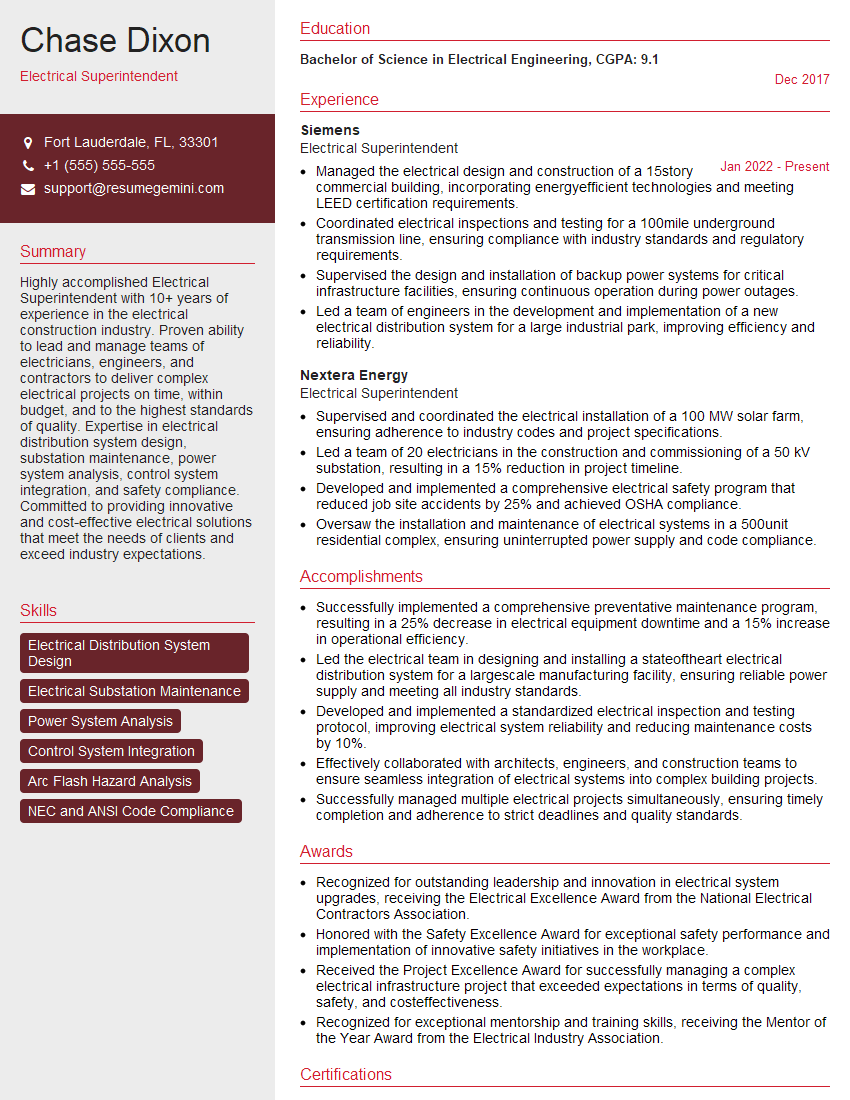
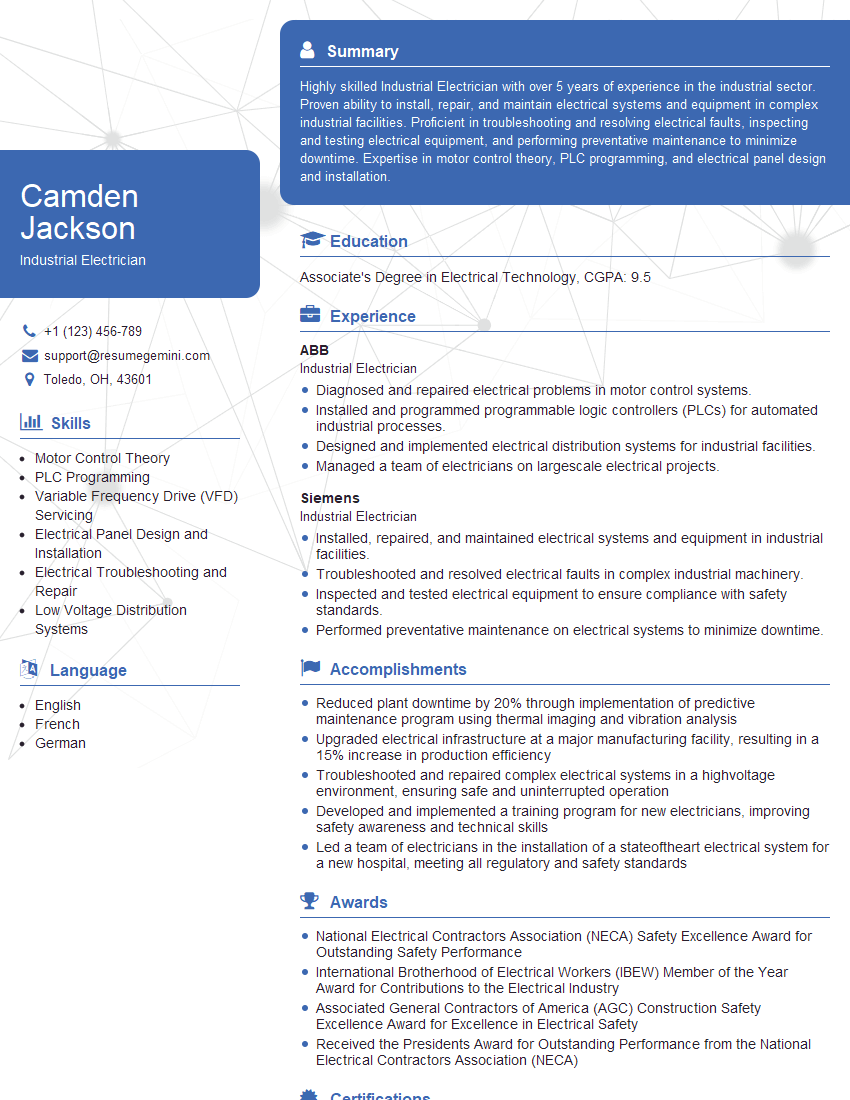
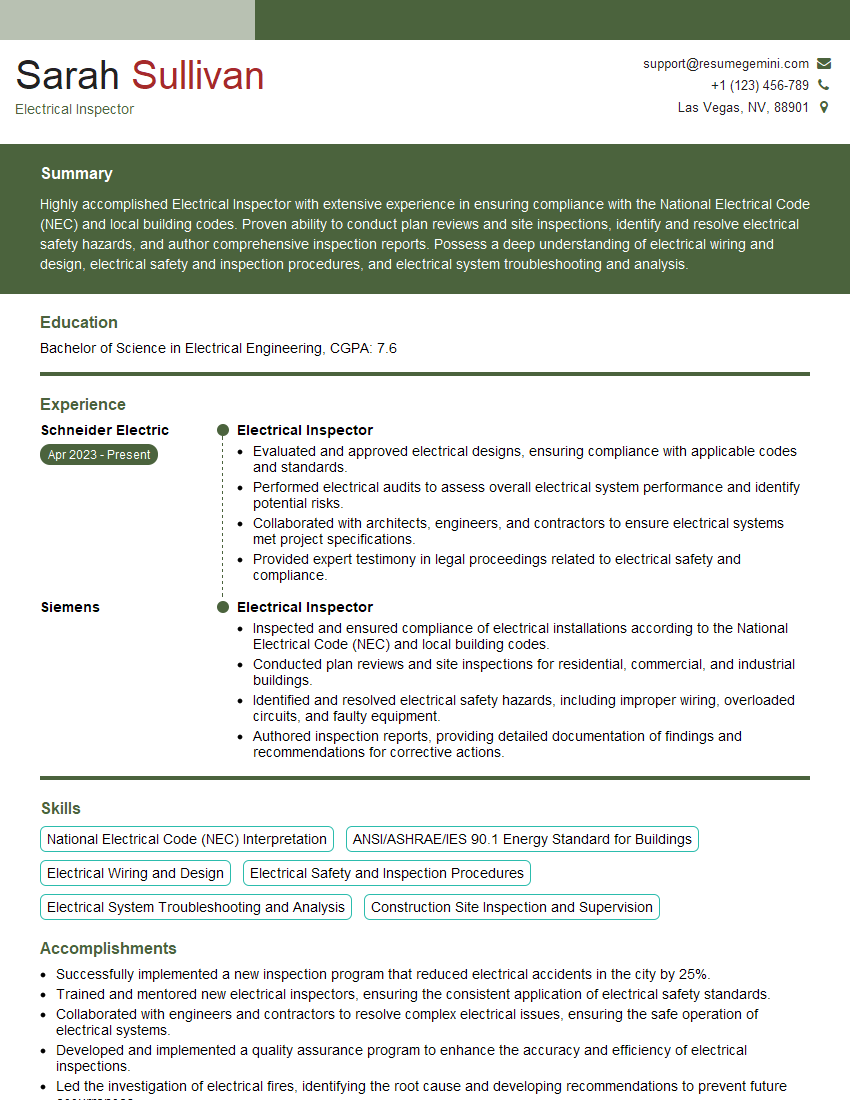
Mastering OSHA 29 CFR 1910 Subpart S Electrical demonstrates a crucial commitment to safety and significantly enhances your career prospects in electrical work and related fields. A strong, ATS-friendly resume is essential for showcasing your skills and experience effectively to potential employers. Use ResumeGemini to craft a professional resume that highlights your qualifications. ResumeGemini offers examples of resumes tailored to OSHA 29 CFR 1910 Subpart S Electrical to help you get started. Invest in your future – create a resume that makes you stand out!


Explore more articles
Users Rating of Our Blogs
Share Your Experience
We value your feedback! Please rate our content and share your thoughts (optional).
What Readers Say About Our Blog
Very informative content, great job.
good