Preparation is the key to success in any interview. In this post, we’ll explore crucial Pantograph Operation interview questions and equip you with strategies to craft impactful answers. Whether you’re a beginner or a pro, these tips will elevate your preparation.
Questions Asked in Pantograph Operation Interview
Q 1. Explain the function of a pantograph.
A pantograph is a crucial component of electric railway systems, acting as the interface between the overhead catenary wire (the power line) and the train’s electrical system. Its primary function is to collect the electrical current from the overhead line and transfer it to the train, powering its motors and other onboard systems. Think of it as a sophisticated, constantly moving electrical plug that seamlessly connects the train to its power source.
Q 2. Describe the different types of pantographs used in railway systems.
Several types of pantographs exist, each designed to optimize performance under specific conditions. Common types include:
- Single-arm pantographs: Simpler in design and generally used on lower-speed lines. They are lighter and less expensive but may not be as reliable at high speeds.
- Double-arm pantographs: These offer improved stability and current collection at higher speeds, making them the preferred choice for high-speed rail lines. The dual arms provide redundancy and better contact force distribution.
- Frame-type pantographs: These utilize a robust frame structure for enhanced stability and increased current collection capacity. They’re often found in applications requiring high power transfer.
The choice of pantograph type depends heavily on factors like the speed of the train, the design of the overhead line, and the power requirements of the train itself.
Q 3. What are the key components of a pantograph?
A pantograph’s key components work together to achieve reliable current collection. These include:
- Frame: Provides the structural support for the entire pantograph.
- Lifting mechanism: Raises and lowers the pantograph, typically using pneumatic or hydraulic systems.
- Contact strip (or shoe): The component that makes direct contact with the overhead line, typically made of carbon or a carbon-graphite composite for excellent conductivity and wear resistance.
- Insulators: Protect the train from electrical shock by isolating the current-carrying parts from the pantograph frame and the train itself.
- Control system: Monitors and adjusts the pantograph’s position and contact force to maintain optimal performance.
- Suspension system: Allows the pantograph to adapt to the unevenness of the overhead line, maintaining constant contact.
Q 4. How does a pantograph maintain contact with the overhead line?
Maintaining contact with the overhead line is critical for reliable power delivery. The pantograph achieves this through a combination of:
- Spring mechanisms: These provide a consistent upward force, pressing the contact strip against the overhead line.
- Articulated joints: Allow the pantograph to adapt to the variations in the overhead line’s height and alignment, preventing loss of contact due to irregularities or track curves.
- Hydraulic or pneumatic systems: Assist in adjusting the contact force and maintaining optimal pressure against the catenary, adapting to changes in speed and line tension.
This combination of features allows the pantograph to move smoothly and maintain contact even at high speeds and across varying track conditions.
Q 5. Explain the principle of current collection in a pantograph.
Current collection relies on the principle of direct contact between the pantograph’s contact strip and the overhead catenary wire. The contact strip, made from highly conductive material, creates a low-resistance electrical path. When the pantograph is raised, the contact strip establishes a connection with the energized overhead wire. The current flows from the overhead wire, through the contact strip, down the pantograph’s frame, and into the train’s electrical system. The amount of current collected depends on the voltage of the overhead line and the load demands of the train.
Q 6. Describe the safety procedures for operating a pantograph.
Safety is paramount in pantograph operation. Key procedures include:
- Proper training: Personnel must undergo comprehensive training on pantograph operation, maintenance, and safety procedures.
- Pre-operation checks: Before each trip, a thorough visual inspection of the pantograph is essential to ensure its integrity and proper functionality. This includes verifying the condition of the contact strip and the integrity of the suspension system.
- Emergency procedures: Knowing how to lower the pantograph in case of emergencies is crucial to prevent accidents and damage.
- Adherence to speed limits: Exceeding speed limits can lead to pantograph instability and arcing.
- Regular maintenance: Scheduled maintenance is critical for identifying and addressing potential issues before they lead to malfunctions or failures.
Following these procedures significantly minimizes risks associated with pantograph operation.
Q 7. What are the common problems encountered with pantographs?
Common problems with pantographs include:
- Contact strip wear and tear: This is a natural consequence of continuous contact with the overhead line. Regular inspection and timely replacement are essential.
- Arcing: This occurs when the contact between the pantograph and the overhead line is intermittent, leading to sparks and potential damage. It is often caused by insufficient contact pressure, poor contact strip condition, or contamination on the line.
- Mechanical failures: Failures in the lifting mechanism, suspension system, or other mechanical components can prevent proper operation.
- Inadequate current collection: This can result from issues with the contact strip, the overhead line, or the pantograph’s contact pressure.
Effective preventative maintenance and timely repairs are essential to avoid these problems and ensure the reliable operation of the pantograph.
Q 8. How do you troubleshoot a pantograph that is not making proper contact?
Troubleshooting a pantograph with poor contact involves a systematic approach. First, we need to identify the nature of the problem. Is it intermittent contact, complete loss of contact, or arcing? This helps narrow down the potential causes.
- Visual Inspection: Start with a thorough visual check. Look for obvious signs of damage like worn-out contact strips, misalignment of the pantograph head, or debris on the overhead line. A simple example would be noticing a bent or broken current collector shoe.
- Check for Obstructions: Anything obstructing the pantograph’s movement, such as ice buildup, bird nests, or foreign objects on the overhead line, needs immediate attention. We’d check for this both on the pantograph and the overhead line itself.
- Electrical Testing: Use specialized equipment to measure the voltage and current at the pantograph. Low voltage or high resistance indicates a contact problem, potentially due to dirty or worn contact strips. We might employ a multimeter to check for continuity.
- Mechanical Checks: Ensure the pantograph’s mechanical components, including springs, linkages, and lifting mechanism, are functioning correctly. A faulty spring might lead to inconsistent contact pressure.
- Overhead Line Inspection (if possible): If the problem seems related to the overhead line, a check of its condition is necessary – looking for wear, sagging, or misalignment.
The troubleshooting process is iterative. We’d start with the most straightforward checks and proceed to more complex investigations based on the initial findings. For instance, if visual inspection reveals nothing obvious, we’d then proceed to electrical testing.
Q 9. What are the regular maintenance tasks required for a pantograph?
Regular maintenance for a pantograph is crucial for safety and reliability. It’s typically a scheduled process, with frequency depending on operating conditions and the type of pantograph. Common tasks include:
- Visual Inspection: Daily checks for any signs of damage, wear, or loose connections are essential. This is often the first line of defense.
- Contact Strip Cleaning and Inspection: Regular cleaning of the contact strips removes dirt and grime, maintaining conductivity and preventing arcing. The condition of the strips—wear and tear—is assessed and replacement is scheduled when necessary.
- Lubrication: Moving parts of the pantograph, like hinges and linkages, need regular lubrication to reduce friction and ensure smooth operation. Over-lubrication can be equally detrimental, attracting dirt.
- Tightening Bolts and Fasteners: Loose fasteners can compromise structural integrity. Regular tightening ensures the pantograph stays stable and aligned.
- Air Pressure Check (for pneumatic systems): In systems using air pressure for operation, checking and maintaining the correct air pressure is vital for proper functioning. Low pressure can impact performance.
- Functional Testing: Periodic functional testing under various speeds and conditions ensures the pantograph works as intended.
A well-maintained pantograph reduces the risk of unexpected malfunctions and enhances the safety of the entire train operation.
Q 10. How do you inspect a pantograph for wear and tear?
Inspecting a pantograph for wear and tear involves a meticulous examination of various components.
- Contact Strips: Check for excessive wear, grooves, pitting, or burning. The thickness of the strips is an important indicator; significant reduction requires replacement.
- Pantograph Head: Inspect the head for cracks, deformation, or damage to the insulators. Any structural weakness compromises its ability to maintain contact.
- Lifting Mechanism: Assess the springs, linkages, and other mechanical parts for wear, tear, damage, or stiffness. A malfunctioning lifting mechanism affects contact pressure.
- Insulators: Inspect insulators for cracks, damage, or signs of electrical breakdown. Compromised insulators could lead to electrical failures.
- Frame and Structure: Check the pantograph’s frame and structure for any signs of bending, deformation, or corrosion. Structural integrity is paramount.
Detailed records of wear and tear observations, including photographic documentation, help track deterioration over time and allow for predictive maintenance planning. This is crucial for preventing major issues and maintaining operational efficiency.
Q 11. What are the safety regulations related to pantograph operation?
Safety regulations concerning pantograph operation are stringent and vary depending on location and governing bodies but generally include:
- Lockout/Tagout Procedures: Before any maintenance or repair work, lockout/tagout procedures must be strictly followed to prevent accidental energization.
- Personal Protective Equipment (PPE): Appropriate PPE, such as insulated gloves, safety glasses, and protective clothing, is mandatory during any inspection or maintenance activity.
- Trained Personnel: Only trained and qualified personnel should perform maintenance, inspections, or repairs.
- Safe Working Practices: Strict adherence to safe working practices around energized overhead lines is essential. Understanding the risks of high voltage is crucial.
- Emergency Procedures: Clear emergency procedures must be in place to handle any pantograph malfunction or accident.
- Regular Inspections and Maintenance: Regular inspections and maintenance schedules are mandated to ensure the pantograph is in safe operating condition.
These regulations minimize the risk of accidents and fatalities related to pantograph operation and maintenance, protecting both personnel and the integrity of the train system.
Q 12. Explain the role of the pantograph in ensuring train safety.
The pantograph plays a vital role in ensuring train safety by providing the crucial link between the train’s electrical system and the overhead lines. Without a reliable connection, the train cannot receive power, leading to a variety of safety risks:
- Power Failure: Loss of power can cause the train to stop unexpectedly, potentially leading to derailment or collision, especially in critical areas like tunnels or junctions.
- Electrical Arcing: Poor contact can lead to arcing, which poses a fire hazard to both the train and the overhead line infrastructure.
- System Instability: Intermittent contact can disrupt the train’s electrical systems, leading to malfunctions and other safety concerns.
- Reduced Braking Capacity: Modern trains often rely on electricity for braking systems. Poor pantograph contact compromises braking performance, reducing safety.
A reliable pantograph ensures consistent and safe power delivery, preventing these potentially catastrophic scenarios.
Q 13. Describe the process of replacing a worn-out pantograph component.
Replacing a worn-out pantograph component is a precise procedure demanding skilled technicians and specialized tools.
- De-energization: The overhead line section must be completely de-energized and locked out before any work begins. Safety is paramount.
- Component Removal: The worn-out component, for example, a contact strip, is carefully removed using the appropriate tools. This might involve removing fasteners or disassembling sections of the pantograph.
- Component Inspection: A visual inspection of the area is done to ensure no other components require replacement or repair.
- New Component Installation: The new component is installed precisely according to the manufacturer’s specifications and the pantograph’s design. Accurate installation is crucial for optimal performance.
- Functionality Test: After installation, a thorough functionality test verifies proper operation and contact pressure. The pantograph is cycled through its entire range of motion.
- Re-energization: The overhead line is re-energized after successful testing and verification.
Throughout the process, meticulous attention to detail and adherence to safety regulations are paramount. Detailed records of the replacement are kept for maintenance and tracking purposes.
Q 14. How do you handle emergency situations involving a pantograph malfunction?
Handling emergency situations involving pantograph malfunctions requires swift and decisive action.
- Immediate Power Cut-off: The first priority is to cut off power to the pantograph and the affected section of the overhead line. This often involves an emergency shut-off switch on the train itself or communication with control center personnel.
- Assess the Situation: A quick assessment of the situation determines the extent of the malfunction, the potential risks, and the necessary actions. Is there arcing? Is there a fire risk?
- Evacuation (if necessary): If there’s a significant risk of fire or other hazards, passengers might need to be evacuated from the train according to the pre-defined emergency procedure.
- Emergency Services: Contact emergency services if required—fire department, rescue services, or the train’s maintenance crew.
- Reporting and Documentation: All incidents must be meticulously documented, including the type of malfunction, the actions taken, and the resulting damage. This data informs future safety improvements and preventative measures.
Effective emergency response plans and rigorous training of personnel are crucial to minimizing the impact of pantograph malfunctions and ensuring the safety of passengers and staff.
Q 15. What are the different types of pantograph failures and their causes?
Pantograph failures can significantly disrupt train operations. They range from minor issues causing temporary service interruptions to major failures leading to complete system shutdowns. These failures can be categorized into several types, each with its own set of causes.
- Mechanical Failures: These include broken springs, worn-out contact strips, damaged insulators, or issues with the pantograph’s lifting mechanism. Causes can be wear and tear from continuous operation, fatigue due to vibrations, or collisions with obstacles like overhead line equipment.
- Electrical Failures: These might involve faulty wiring, short circuits, or problems with the current collection system. Causes range from poor maintenance to damage from lightning strikes or extreme weather.
- Hydraulic Failures (for hydraulically-assisted pantographs): Leaks in the hydraulic system, malfunctioning pumps or valves, or low hydraulic fluid levels can compromise the pantograph’s ability to raise and lower smoothly. Causes include leaks, component wear, or inadequate maintenance.
- Software Failures (for pantographs with electronic control systems): Software glitches or malfunctions in the control system can cause improper operation, leading to unpredictable movements or complete failure. Causes could be programming errors, software bugs, or issues with data communication.
Identifying the root cause of a pantograph failure is crucial for implementing effective preventative measures and ensuring operational safety. A thorough investigation involving visual inspections, diagnostic testing, and analysis of operational data is often required.
Career Expert Tips:
- Ace those interviews! Prepare effectively by reviewing the Top 50 Most Common Interview Questions on ResumeGemini.
- Navigate your job search with confidence! Explore a wide range of Career Tips on ResumeGemini. Learn about common challenges and recommendations to overcome them.
- Craft the perfect resume! Master the Art of Resume Writing with ResumeGemini’s guide. Showcase your unique qualifications and achievements effectively.
- Don’t miss out on holiday savings! Build your dream resume with ResumeGemini’s ATS optimized templates.
Q 16. How do environmental factors affect pantograph performance?
Environmental factors play a significant role in pantograph performance, often impacting its reliability and longevity. Think of it like this: a pantograph is constantly battling the elements to maintain a stable connection with the overhead line.
- Ice and Snow: Accumulation of ice or snow on the contact strip significantly reduces the contact area and can lead to arcing and increased wear. This can even cause the pantograph to lose contact completely.
- Wind: High winds can exert considerable force on the pantograph, causing vibrations and potentially impacting its ability to maintain consistent contact with the overhead line. Imagine trying to hold a pencil steady in a strong wind – the same principle applies here.
- Rain and Fog: While not as immediately disruptive as ice or snow, rain and fog can lead to reduced contact quality and increased wear due to the increased conductivity and potential for arcing.
- Temperature Extremes: Extreme heat can cause thermal expansion in the pantograph components, affecting their alignment and function. Conversely, extreme cold can make materials brittle and prone to cracking.
- Pollution: Dust, dirt, and other pollutants can accumulate on the pantograph and overhead line, degrading contact quality and leading to increased wear.
Effective pantograph design and maintenance procedures must consider these environmental factors to ensure optimal performance and reliability in diverse weather conditions.
Q 17. Explain the importance of regular lubrication for pantograph components.
Regular lubrication is paramount for maintaining the smooth and reliable operation of a pantograph. It’s like oiling the hinges on a door – without it, the components would quickly wear out and malfunction. Lubrication reduces friction between moving parts, preventing wear, and ensuring efficient energy transfer.
- Reduced Friction and Wear: Lubrication minimizes friction between moving parts, reducing wear and tear and extending the lifespan of the components. This leads to lower maintenance costs and fewer breakdowns.
- Improved Efficiency: Reduced friction leads to more efficient energy transfer, reducing energy consumption and optimizing pantograph performance.
- Prevention of Corrosion: Certain lubricants provide corrosion protection, safeguarding the metal components from environmental factors such as rain and salt spray.
- Enhanced Smooth Operation: Proper lubrication ensures smoother operation of the pantograph, reducing noise and vibration, and improving the stability of the contact with the overhead line.
A dedicated lubrication schedule, tailored to the specific pantograph design and operating conditions, is crucial for preventing premature wear and maximizing the system’s operational life.
Q 18. Describe the impact of speed on pantograph performance.
Speed significantly impacts pantograph performance. As speed increases, so do the demands on the pantograph’s ability to maintain contact with the overhead line. Imagine trying to keep a broom steady while running – the faster you run, the harder it is to control.
At higher speeds, the pantograph experiences increased aerodynamic forces and vibrations. This can lead to:
- Increased Wear and Tear: Higher speeds result in increased friction and wear on the contact strips and other moving parts, reducing their lifespan.
- Reduced Contact Quality: The increased vibrations and forces can compromise the stability of the contact between the pantograph and the overhead line, leading to intermittent contact and arcing.
- Increased Risk of Failure: The combined effects of increased wear, vibration, and forces can significantly increase the risk of pantograph failure at higher speeds.
Pantograph design and control systems must be optimized to accommodate the specific speed range of the train and the characteristics of the overhead line system to ensure consistent and reliable performance across the entire operating speed range.
Q 19. How do you ensure the correct tension and pressure on the pantograph?
Maintaining the correct tension and pressure on the pantograph is crucial for ensuring reliable contact with the overhead line. It’s a delicate balance; too much pressure can cause excessive wear, while too little can lead to poor contact and arcing.
Tension and pressure are usually adjusted through:
- Spring Adjustment: Many pantographs use springs to provide the necessary upward force. Adjusting the spring tension allows fine-tuning of the contact pressure.
- Hydraulic Systems (where applicable): Hydraulic systems allow for precise control of the contact force and can compensate for variations in the overhead line height.
- Electronic Control Systems: Advanced pantographs utilize electronic control systems that continuously monitor and adjust the tension and pressure based on real-time feedback.
Regular inspections and adjustments, guided by the manufacturer’s specifications and operational data, are crucial for maintaining optimal tension and pressure. Incorrect adjustments can lead to reduced contact quality, increased wear, and premature failure.
Q 20. What is the significance of pantograph monitoring systems?
Pantograph monitoring systems are critical for ensuring the safe and reliable operation of electric trains. They provide real-time data on various aspects of pantograph performance, allowing for early detection of potential problems and preventive maintenance.
The significance of these systems lies in their ability to:
- Improve Safety: Early detection of anomalies can prevent accidents caused by pantograph failures.
- Reduce Maintenance Costs: Predictive maintenance based on monitoring data can reduce downtime and extend the lifespan of pantograph components.
- Enhance Operational Efficiency: Real-time monitoring allows for quick identification and resolution of issues, minimizing disruptions to train services.
- Optimize Pantograph Performance: Data analysis can help fine-tune the pantograph’s operation, improving contact quality and reducing energy consumption.
Modern systems often include sensors measuring contact force, lift height, speed, and current, providing a comprehensive picture of the pantograph’s performance.
Q 21. How do you interpret data from pantograph monitoring systems?
Interpreting data from pantograph monitoring systems requires a thorough understanding of the system’s parameters and the normal operating characteristics of the pantograph. It’s like reading a patient’s vital signs – you need to know what’s normal and what indicates a problem.
Common parameters include:
- Contact Force: Consistently low or high contact force can indicate problems with spring tension, wear, or other mechanical issues.
- Lift Height: Variations in lift height can suggest problems with the lifting mechanism or irregularities in the overhead line.
- Current: High current values can indicate poor contact quality, leading to arcing and increased wear.
- Vibration: Excessive vibration can signal mechanical problems or issues with the overhead line.
Data analysis involves comparing the measured parameters with pre-defined thresholds and identifying any deviations from the norm. Statistical methods and machine learning algorithms are increasingly used for more sophisticated data analysis to predict potential failures.
Experienced personnel trained in interpreting this data are essential for making informed decisions regarding maintenance and repairs.
Q 22. Describe the process of aligning the pantograph with the overhead line.
Aligning a pantograph with the overhead line is a critical process ensuring consistent power transfer. It involves several stages. First, the pantograph is raised using its pneumatic or hydraulic system, depending on the type. As it rises, sensors monitor its position relative to the contact wire. These sensors, often employing optical or ultrasonic technology, provide real-time feedback to the control system. The control system then makes minute adjustments to the pantograph’s position – this could involve altering the head pressure or the suspension system’s tension to maintain optimal contact. This process demands precision, as inconsistent contact can lead to arcing, sparking, and ultimately, power disruptions. Think of it like a precise dance between the pantograph and the wire, a continuous feedback loop striving for the perfect embrace to ensure uninterrupted current flow. For instance, during high-speed train operation, maintaining this alignment is paramount to prevent any momentary loss of contact which can cause significant power fluctuations. Any deviation beyond acceptable tolerances triggers an alarm and may cause the train to reduce speed.
Q 23. Explain the difference between pneumatic and hydraulic pantograph systems.
Pneumatic and hydraulic pantograph systems differ primarily in the power source they utilize for lifting and controlling the head. Pneumatic systems use compressed air to drive actuators that raise and lower the pantograph. They are generally simpler, lighter, and less expensive than hydraulic systems, but have lower lifting force and can be prone to leaks which will negatively impact performance. Hydraulic systems, conversely, utilize pressurized oil. They offer superior lifting capacity and smoother operation, allowing for better contact maintenance, particularly at higher speeds and on uneven lines. Imagine a pneumatic system like a bicycle pump: relatively simple, but with limitations on power output. A hydraulic system is more akin to a car’s braking system: powerful, precise, and offering greater control. The choice between the two often depends on the specific application, train speed and the characteristics of the overhead line.
Q 24. What are the advantages and disadvantages of different pantograph designs?
Various pantograph designs exist, each with its own advantages and disadvantages. Single-arm pantographs are simple and lightweight, making them suitable for lower speed applications. However, they offer limited contact force, especially at high speeds. Double-arm pantographs provide greater stability and contact force, particularly beneficial for high-speed rail, but they are heavier and more complex. The frame design, whether a single-frame or multiple-frame, impacts the overall stability and dynamic behavior. For example, single-frame designs are typically lighter but potentially less resistant to oscillations caused by variations in the overhead line. A specific design I worked with extensively was the ‘bow’ type of pantograph, which exhibits excellent current collection capabilities but may require more stringent maintenance procedures. The choice of design must be based on a tradeoff between factors such as weight, cost, operating speed, and environmental considerations, always with a primary focus on maintaining consistent contact with the overhead line.
Q 25. How do you ensure the proper grounding of a pantograph system?
Proper grounding of a pantograph system is crucial for safety and to prevent electrical shocks. This involves several key steps. Firstly, a dedicated grounding connection is made between the pantograph frame and the train’s chassis. This connection, usually a low-resistance path, provides a path for any stray currents to earth. The pantograph itself should be designed to electrically isolate the high-voltage current from the rest of the train’s internal structure. Regular inspections verify the integrity of the grounding connection, checking for corrosion or damage. In addition, the train’s entire electrical system should have its own comprehensive grounding system. A failure in the grounding system can result in dangerous electrical shocks and malfunctions. Regular testing and maintenance are performed to check the efficiency of this ground path, using specialized electrical equipment, to maintain a very low resistance path to the earth. Consider it like a safety valve in a pressure cooker; it prevents harmful electrical pressure from building up.
Q 26. Describe your experience with different types of pantograph control systems.
Throughout my career, I’ve worked with various pantograph control systems, ranging from simple mechanical systems with manual adjustment to sophisticated microprocessor-controlled systems with real-time feedback. Older systems relied on purely mechanical components for adjustment and control. Modern systems utilize sensors, microprocessors, and sophisticated algorithms to dynamically adjust the pantograph’s position, maintaining optimal contact with the overhead line regardless of speed or line variations. These newer systems also include diagnostics features, allowing for remote monitoring and early detection of potential issues such as excessive wear or mechanical failures. One particular system I worked with incorporated GPS data to anticipate line variations ahead and pre-adjust the pantograph for smoother operation. This level of automation considerably reduces maintenance and enhances safety by minimizing arcing events. The move towards increasingly automated systems reflects the industry’s focus on improving reliability and reducing maintenance needs.
Q 27. How do you maintain accurate records related to pantograph maintenance and operation?
Accurate record-keeping is paramount for efficient pantograph maintenance and operation. We utilize a computerized maintenance management system (CMMS) to track all aspects of pantograph operation and maintenance. This system allows us to log each inspection, maintenance task, component replacement, and any detected issues. Key data points such as current collection efficiency, wear levels of contact strips, and the results of periodic functional tests are meticulously recorded. This data is used not only to schedule timely preventative maintenance but also for trend analysis which is crucial for predicting potential failures and proactively addressing them. Additionally, compliance with safety and regulatory requirements is ensured by using a standardized reporting format that documents all findings and actions taken. This detailed approach ensures efficient maintenance and helps to prevent failures, minimizing downtime and enhancing overall reliability.
Q 28. Explain your understanding of the latest advancements in pantograph technology.
Recent advancements in pantograph technology are primarily focused on improving energy efficiency, increasing reliability, and enhancing overall performance. There’s increasing use of lightweight composite materials in the pantograph construction, leading to reduced weight and improved energy efficiency. Advanced control systems utilizing machine learning algorithms dynamically adapt to varying overhead line conditions, optimizing contact pressure and reducing wear. The integration of sensors and smart monitoring systems facilitates predictive maintenance, allowing for early detection of potential issues, minimizing disruptions. Additionally, research into improved contact strip materials continues to enhance current collection efficiency and reduce wear. For example, carbon-based composites are emerging as promising alternatives to conventional copper strips. These advancements reflect the industry’s continual effort to improve the reliability and sustainability of pantograph technology for high-speed rail and other demanding applications.
Key Topics to Learn for Pantograph Operation Interview
- Pantograph Mechanics: Understanding the fundamental principles of pantograph design, including its components (e.g., frames, insulators, contact strips) and their interaction.
- Electrical Contact and Current Collection: Analyzing the process of current transfer from the overhead line to the pantograph and the factors affecting contact quality and reliability (e.g., speed, pressure, wear).
- Pantograph Control Systems: Familiarizing yourself with different control systems used to maintain optimal pantograph performance, including pneumatic, hydraulic, and electronic systems and their troubleshooting.
- Maintenance and Inspection Procedures: Understanding routine maintenance tasks, preventative measures, and the importance of regular inspections to ensure safe and efficient operation.
- Troubleshooting and Diagnostics: Developing problem-solving skills to identify and rectify common malfunctions, including arc formation, excessive wear, and loss of contact.
- Safety Regulations and Procedures: Understanding relevant safety standards and regulations related to pantograph operation and maintenance, emphasizing personal safety and risk mitigation.
- Types of Pantographs: Gaining familiarity with various pantograph designs and their applications across different railway systems and speed ranges.
- Impact of Environmental Factors: Understanding how weather conditions (e.g., ice, snow, rain) and environmental contaminants affect pantograph performance and require specific operational adjustments.
Next Steps
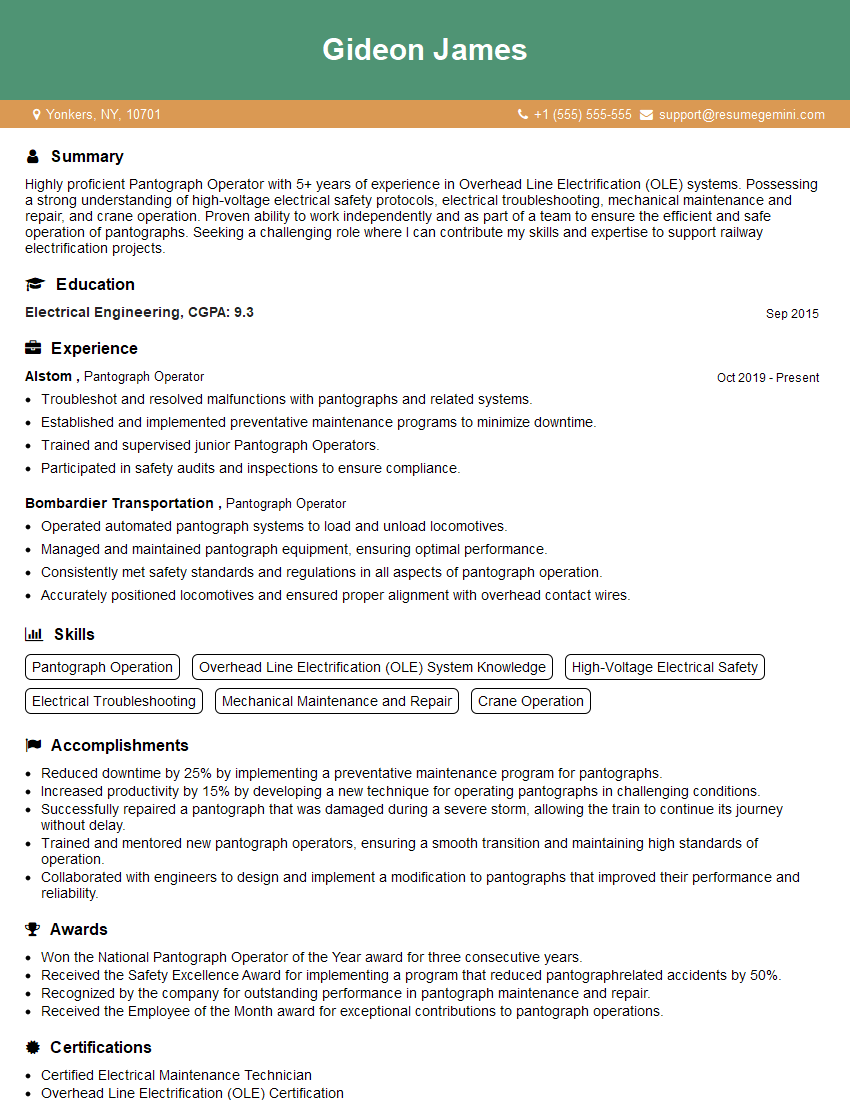
Mastering Pantograph Operation opens doors to rewarding careers in railway engineering and maintenance, offering opportunities for specialization and advancement. A strong resume is crucial for showcasing your skills and experience to potential employers. To maximize your job prospects, create an ATS-friendly resume that highlights your relevant qualifications and achievements. ResumeGemini is a trusted resource that can help you build a professional, impactful resume. Examples of resumes tailored to Pantograph Operation are available to guide your resume creation.
Explore more articles
Users Rating of Our Blogs
Share Your Experience
We value your feedback! Please rate our content and share your thoughts (optional).
What Readers Say About Our Blog
Very informative content, great job.
good