The right preparation can turn an interview into an opportunity to showcase your expertise. This guide to Partial Differential Equation Modeling interview questions is your ultimate resource, providing key insights and tips to help you ace your responses and stand out as a top candidate.
Questions Asked in Partial Differential Equation Modeling Interview
Q 1. Explain the difference between elliptic, parabolic, and hyperbolic PDEs.
Elliptic, parabolic, and hyperbolic partial differential equations (PDEs) are classified based on the characteristics of their solutions and the type of problems they model. Think of it like categorizing different types of waves.
- Elliptic PDEs: These describe steady-state phenomena, like the temperature distribution in a heated plate. Their solutions are smooth and influenced by the entire domain. A classic example is Laplace’s equation: ∇²u = 0. Imagine a perfectly still pond; the water level is determined by the overall shape of the pond’s bottom, not just one specific point.
- Parabolic PDEs: These model diffusion or heat transfer processes where time is a crucial factor. The solution evolves over time, spreading out like heat dissipating from a hot spot. The heat equation is a prime example: ∂u/∂t = α∇²u. Think of a drop of ink diffusing in water – the ink spreads over time, influenced by its initial concentration and diffusion rate.
- Hyperbolic PDEs: These describe wave propagation phenomena, like sound or light waves. They involve the interplay of changes in time and space with information propagating at a finite speed. The wave equation is a representative example: ∂²u/∂t² = c²∇²u. Imagine dropping a pebble in a pond; ripples propagate outwards at a specific speed.
The classification is determined by the type of second-order derivatives in the equation. The mathematical criteria involve analyzing the discriminant of the characteristic equation associated with the PDE. However, the physical interpretation of steady-state, diffusion, and wave propagation often provides a more intuitive understanding.
Q 2. Describe the method of characteristics and when it’s applicable.
The method of characteristics is a powerful technique for solving first-order PDEs and some special types of higher-order PDEs. It leverages the idea that solutions often propagate along specific curves, called characteristic curves. Think of these curves as pathways that the solution follows.
It’s applicable when the PDE can be written in a form that allows for the definition of characteristic curves along which the PDE simplifies significantly. Essentially, we transform the problem from solving the PDE in the xy-plane (or higher dimensions) into solving a system of ordinary differential equations (ODEs) along these characteristic curves. Once we solve these ODEs, we can reconstruct the solution to the original PDE.
For example, consider the first-order linear PDE: a(x,y)∂u/∂x + b(x,y)∂u/∂y = c(x,y). The characteristic curves are defined by the system of ODEs: dx/dt = a(x,y), dy/dt = b(x,y). Solving this system gives us the characteristic curves, and along these curves, the original PDE simplifies, making it easier to solve.
This method is particularly useful for solving hyperbolic PDEs, where the solutions exhibit wave-like behavior, as the characteristic curves often represent the paths of these waves.
Q 3. Explain the finite difference method and its order of accuracy.
The finite difference method approximates the derivatives in a PDE using difference quotients. Imagine replacing a smooth curve with a series of connected straight line segments – the slope of each segment approximates the derivative at a point. We discretize the spatial and temporal domains into a grid of points, and at each point, we replace the derivatives with finite difference approximations.
For example, a common approximation for the first derivative is the central difference: ∂u/∂x ≈ (u(x+Δx) – u(x-Δx)) / (2Δx). The order of accuracy refers to how quickly the error decreases as the grid spacing (Δx, Δt) decreases. The above central difference is second-order accurate, meaning the error is proportional to (Δx)². Other approximations, like forward or backward differences, are typically first-order accurate.
The order of accuracy significantly impacts the computational cost and the accuracy of the solution. Higher-order methods generally require more computational effort but produce more accurate solutions for a given grid size. The choice of the method depends on the desired balance between accuracy and computational efficiency.
Q 4. What are the advantages and disadvantages of finite element methods?
Finite element methods (FEM) are another powerful technique for solving PDEs. Unlike finite difference methods that approximate derivatives directly, FEM approximates the solution itself using piecewise polynomial functions over small subdomains (elements). Think of it as fitting many small, flexible pieces together to approximate the overall shape of the solution.
- Advantages:
- Handles complex geometries exceptionally well, accommodating irregular shapes and boundaries.
- Naturally handles boundary conditions of various types.
- Can achieve high accuracy with relatively coarse meshes in some cases (especially for smooth solutions).
- Adaptable to different types of PDEs.
- Disadvantages:
- Can be more complex to implement than finite difference methods.
- Requires more extensive pre-processing to create the mesh.
- Computational cost can be high for very large problems, although efficient solvers and parallel computing can mitigate this.
- Mesh refinement strategies are crucial for accuracy and efficiency.
The choice between FEM and finite difference methods often depends on the specific problem: FEM excels with complex geometries, while finite difference methods are often simpler to implement for simpler domains.
Q 5. How do you handle boundary conditions in numerical solutions of PDEs?
Boundary conditions are crucial in PDE solutions as they specify the behavior of the solution at the boundaries of the domain. They provide the necessary constraints to obtain a unique solution. In numerical methods, we must incorporate these conditions accurately.
Several ways exist to handle them:
- Direct substitution: For Dirichlet boundary conditions (u = g on the boundary), we directly substitute the given values into the discrete equations at boundary points.
- Ghost points: For Neumann boundary conditions (∂u/∂n = g on the boundary), we introduce ‘ghost’ points outside the domain and use finite difference approximations to relate the values at these ghost points to the boundary conditions. Then, we solve for the values at the actual boundary points using these relationships.
- Penalty methods: This technique incorporates boundary conditions into the discrete equations using penalty terms, adding a constraint to the numerical scheme.
The choice of method depends on the specific boundary conditions and the chosen numerical method. Accuracy is crucial, as inaccurate implementation can lead to significant errors in the solution.
Q 6. Explain the concept of well-posedness for a PDE.
Well-posedness for a PDE is a crucial concept ensuring that the problem is physically meaningful and solvable. A well-posed problem has three key properties:
- Existence: A solution exists.
- Uniqueness: The solution is unique.
- Stability: The solution depends continuously on the initial and boundary conditions. Small changes in the input shouldn’t drastically change the output.
If any of these properties are not satisfied, the PDE problem is considered ill-posed. Ill-posed problems are often difficult or impossible to solve numerically because small numerical errors can lead to wildly inaccurate or unstable solutions. This can arise from issues like an improperly defined physical model or incorrect boundary conditions.
Checking well-posedness is essential before attempting any numerical solution, as it verifies whether the problem has a physically meaningful and numerically tractable answer.
Q 7. Describe different types of boundary conditions (Dirichlet, Neumann, Robin).
Boundary conditions specify the behavior of the solution at the boundaries of the domain. There are three main types:
- Dirichlet boundary conditions: These specify the value of the solution directly at the boundary. For example, u(x,y) = g(x,y) on the boundary. Imagine fixing the temperature at the edges of a metal plate.
- Neumann boundary conditions: These specify the value of the normal derivative of the solution at the boundary. For example, ∂u/∂n = g(x,y) on the boundary. This corresponds to specifying the flux (e.g., heat flux) across the boundary.
- Robin boundary conditions: These are a combination of Dirichlet and Neumann conditions, involving a linear relationship between the solution and its normal derivative at the boundary. For example, αu + β∂u/∂n = g(x,y) on the boundary. This can represent heat transfer with both conduction and convection.
The choice of boundary condition depends on the specific problem being modeled. For instance, if we know the temperature of a surface (Dirichlet), or if we know the heat flow across a surface (Neumann), or a combination of both (Robin).
Q 8. What are the challenges in solving nonlinear PDEs?
Solving nonlinear PDEs presents significantly more challenges than their linear counterparts. The primary difficulty stems from the lack of superposition principles. In linear PDEs, you can superpose solutions to construct more complex solutions. This doesn’t hold true for nonlinear equations. This means we cannot leverage the powerful analytical techniques available for linear systems, forcing us to rely heavily on numerical methods.
Another major hurdle is the potential for multiple solutions, bifurcations, and chaotic behavior. A small change in initial conditions or parameters can lead to dramatically different solutions, making accurate prediction and numerical stability very challenging. Consider the Navier-Stokes equations, which govern fluid flow. Their nonlinearity leads to complex phenomena like turbulence, making accurate numerical simulations computationally expensive and requiring sophisticated techniques.
Furthermore, the development of robust and efficient numerical schemes for nonlinear PDEs is an active area of research. Many standard methods designed for linear equations struggle to maintain accuracy and stability when applied to nonlinear problems. This often requires specialized techniques, such as iterative methods with adaptive time stepping or sophisticated nonlinear solvers, to ensure convergence and accuracy.
Q 9. Explain the concept of stability and convergence in numerical methods for PDEs.
Stability and convergence are crucial concepts in numerical methods for PDEs, ensuring the reliability and accuracy of our solutions. Think of it like building a house: convergence is getting the right answer, and stability is ensuring the structure doesn’t collapse during the construction.
Convergence refers to the numerical solution’s ability to approach the true solution of the PDE as the discretization parameters (like grid size or time step) approach zero. We want the error to decrease as we refine our numerical scheme. For example, in the finite difference method, reducing the grid spacing should lead to a more accurate approximation.
Stability, on the other hand, refers to the method’s resistance to the amplification of errors during computation. An unstable method will magnify small errors, leading to completely wrong results regardless of how fine the discretization is. Imagine a slight imperfection during construction; a stable building will tolerate it, but an unstable one will crumble. A classic example is the explicit Euler method, which can be unstable for certain PDEs and step sizes.
It’s vital that a numerical method is both stable and convergent to produce reliable results. The Lax equivalence theorem states that for linear PDEs, consistency (the numerical scheme approximating the PDE) plus stability is equivalent to convergence.
Q 10. How do you choose an appropriate numerical method for a given PDE?
Choosing the appropriate numerical method for a given PDE is a multifaceted decision, depending on several factors. There’s no one-size-fits-all answer; it’s a bit like selecting the right tool for a job.
- Type of PDE: Elliptic, parabolic, or hyperbolic PDEs require different approaches. Elliptic problems (like Poisson’s equation) often benefit from methods like finite element or finite difference methods. Parabolic problems (like the heat equation) are often tackled using finite difference or finite volume methods. Hyperbolic problems (like the wave equation) need methods that handle wave propagation accurately.
- Equation’s Properties: Linearity, nonlinearity, and the presence of discontinuities or singularities significantly impact method selection. Nonlinear problems often necessitate iterative schemes, while discontinuities might necessitate specialized techniques like shock-capturing schemes.
- Domain Geometry: Complex geometries are often better suited to the flexibility of finite element methods, whereas simpler geometries might be better handled with finite difference methods. Finite volume methods excel in fluid dynamics with complex boundary conditions.
- Accuracy Requirements: High-accuracy requirements demand higher-order methods, which, although more computationally expensive, offer more precision.
- Computational Resources: The computational cost of a method must be considered in relation to the available resources. Higher-order methods or adaptive mesh refinement can improve accuracy but increase computational time.
Often, a combination of methods or adaptive techniques is needed. For example, you might use a high-order finite difference method in regions where the solution is smooth and switch to a shock-capturing method near discontinuities.
Q 11. Describe the process of verifying and validating a PDE model.
Verifying and validating a PDE model is crucial for ensuring its reliability and trustworthiness. It’s a two-step process akin to rigorously testing a piece of software.
Verification focuses on ensuring that the numerical implementation of the model is correct. This involves checking for errors in the code, discretization schemes, and boundary conditions. Techniques include:
- Code review: Careful examination of the code by other experts.
- Unit testing: Testing individual components of the code.
- Order of accuracy studies: Checking whether the numerical method achieves its expected order of accuracy.
- Grid convergence studies: Refining the grid size and checking whether the solution converges to a stable value.
Validation, on the other hand, confirms that the model accurately represents the real-world phenomenon. This involves comparing the model’s predictions to experimental data or observations. Techniques include:
- Comparison with experimental data: Comparing model results to real-world measurements.
- Benchmarking against established solutions: Comparing results to solutions from well-validated models or analytical solutions.
- Sensitivity analysis: Determining the influence of input parameters on the model’s output.
Both verification and validation are essential for building confidence in the model’s predictions. A model can be perfectly verified (code is correct), yet invalid (does not represent reality). Similarly, an unverified model cannot be trusted even if it seems to fit experimental data.
Q 12. How do you handle singularities in PDE solutions?
Singularities in PDE solutions, points where the solution becomes unbounded or non-differentiable, pose significant challenges for numerical methods. Handling them requires careful consideration and often specialized techniques.
One approach is to use adaptive mesh refinement. This technique refines the mesh around the singularity, concentrating computational resources where they are most needed. This allows for accurate resolution of the solution’s behavior near the singularity without excessive computational cost across the entire domain.
Another strategy involves singular perturbation methods. These methods exploit the structure of the problem near the singularity to obtain approximate solutions that capture the essential features of the solution’s behavior. These are often analytic approximations rather than numerical ones.
Specialized numerical techniques designed to handle singularities are also used. These methods may include modifying the numerical scheme near the singularity or using coordinate transformations to remove the singularity. For example, boundary integral methods excel in dealing with singular solutions by reformulating the problem in terms of boundary integrals.
In some cases, it’s necessary to regularize the problem by introducing a small parameter that smooths the singularity. This introduces a small artificial error, but often allows the application of standard numerical methods that would otherwise fail near the singularity.
Q 13. Explain the concept of mesh refinement and its importance in FEM.
Mesh refinement in the Finite Element Method (FEM) is a powerful technique to increase solution accuracy by adapting the mesh density based on the solution’s characteristics. Imagine trying to map a highly detailed terrain – you’d need more detail in areas with sharp changes in elevation, while flat areas require less.
In FEM, the mesh consists of elements that cover the computational domain. Mesh refinement involves locally refining the mesh, creating smaller elements in regions where the solution exhibits rapid variations or high gradients. This improves the accuracy in those regions while keeping the computational cost manageable in smoother areas.
Several strategies exist for mesh refinement:
- h-refinement: Reduces element size (h) locally.
- p-refinement: Increases the polynomial degree (p) of the approximation within elements.
- r-refinement: Moves existing nodes to better suit the solution.
- Adaptive refinement: Combines these strategies, refining the mesh based on an error indicator, often driven by the residual of the solution.
The importance of mesh refinement lies in its ability to balance accuracy and efficiency. Without refinement, a uniform coarse mesh might miss important details of the solution, leading to inaccurate results. Conversely, a uniformly fine mesh across the entire domain would be computationally expensive and unnecessary in regions with smooth solutions. Adaptive mesh refinement allows us to strategically improve accuracy where needed without unnecessarily increasing the computational burden.
Q 14. What are some common iterative methods for solving linear systems arising from PDE discretization?
Discretizing PDEs often leads to large, sparse linear systems of the form Ax = b, which require efficient iterative solvers. Direct methods (like Gaussian elimination) become impractical for very large systems.
Common iterative methods include:
- Jacobi method: A simple method that updates each component of the solution vector based on the previous iteration’s values. It’s easy to implement but converges slowly.
- Gauss-Seidel method: Similar to Jacobi, but it uses the most recently computed values, leading to faster convergence.
- Successive Over-Relaxation (SOR): An enhancement of Gauss-Seidel that introduces a relaxation parameter to accelerate convergence. The optimal relaxation parameter depends on the system matrix and is often difficult to determine.
- Conjugate Gradient (CG) method: A powerful method for symmetric positive definite matrices. It converges much faster than Jacobi or Gauss-Seidel but requires more memory.
- Generalized Minimal Residual (GMRES) method: A versatile method for general non-symmetric matrices. It’s more robust than CG but can be computationally more expensive.
- Multigrid methods: These methods solve the problem on a hierarchy of grids, efficiently handling different scales of the solution, resulting in very fast convergence.
The choice of iterative solver depends on factors such as the system’s size, sparsity, matrix properties (symmetry, definiteness), and desired accuracy. Often, preconditioners are used to improve the convergence rate of iterative methods by modifying the system matrix to make it easier to solve.
Q 15. Discuss the role of PDEs in fluid dynamics.
Partial Differential Equations (PDEs) are the cornerstone of fluid dynamics, describing the motion and behavior of fluids like liquids and gases. They capture the interplay between forces, pressure, and velocity within the fluid. The most fundamental equations are the Navier-Stokes equations, a set of nonlinear PDEs that govern the flow of viscous fluids. These equations consider conservation of mass, momentum, and energy. Imagine trying to predict the weather – the swirling patterns of air masses, the formation of clouds, and the movement of storms are all governed by these equations, albeit with incredibly complex solutions requiring sophisticated numerical methods.
Simpler models like the Euler equations are used for inviscid (frictionless) flows, providing a useful approximation in certain situations, like modeling high-speed airflow around an aircraft. The specific PDE used depends heavily on the fluid’s properties (viscosity, compressibility), the flow regime (laminar or turbulent), and the problem’s geometry. Solving these equations, even numerically, can be computationally intensive, requiring powerful supercomputers for realistic simulations.
For example, engineers use CFD (Computational Fluid Dynamics) software, which relies on solving the Navier-Stokes equations numerically, to design efficient aircraft wings minimizing drag or optimizing the flow of blood in artificial heart valves. The accuracy of these simulations directly impacts the success and safety of these designs.
Career Expert Tips:
- Ace those interviews! Prepare effectively by reviewing the Top 50 Most Common Interview Questions on ResumeGemini.
- Navigate your job search with confidence! Explore a wide range of Career Tips on ResumeGemini. Learn about common challenges and recommendations to overcome them.
- Craft the perfect resume! Master the Art of Resume Writing with ResumeGemini’s guide. Showcase your unique qualifications and achievements effectively.
- Don’t miss out on holiday savings! Build your dream resume with ResumeGemini’s ATS optimized templates.
Q 16. Describe the application of PDEs in heat transfer.
Heat transfer, the movement of thermal energy, is governed by PDEs that describe how temperature changes over time and space. The most common is the heat equation, a parabolic PDE that relates the rate of temperature change to the heat flux (the flow of heat). This equation, in its simplest form, assumes a homogeneous, isotropic material with constant thermal properties.
∂u/∂t = α∇²u
Where ‘u’ is temperature, ‘t’ is time, ‘α’ is thermal diffusivity, and ∇² is the Laplacian operator (representing the second-order spatial derivatives). The equation dictates that heat diffuses from hotter to colder regions, and the rate of diffusion is proportional to the temperature gradient. More complex scenarios may require modifications to include heat sources or sinks, variable thermal properties, or convective and radiative heat transfer.
Think about designing a computer chip: managing heat dissipation is crucial to prevent overheating. Engineers employ PDE solvers to simulate the temperature distribution within the chip under different operating conditions, helping them optimize the cooling system and ensure reliable performance. Similarly, understanding heat transfer in buildings is crucial for energy-efficient design; PDE models are used to predict temperature variations within buildings and optimize insulation strategies.
Q 17. How are PDEs used in financial modeling?
PDEs play a crucial role in financial modeling, particularly in the pricing of derivatives (financial instruments whose value depends on an underlying asset). The Black-Scholes equation, a parabolic PDE, is a landmark achievement in this field. It describes the price evolution of a European-style option, taking into account factors like the underlying asset’s price, volatility, time to maturity, risk-free interest rate, and the option’s strike price.
∂V/∂t + 1/2σ²S²∂²V/∂S² + rS∂V/∂S - rV = 0
Where ‘V’ is the option price, ‘S’ is the underlying asset’s price, ‘t’ is time, ‘σ’ is volatility, and ‘r’ is the risk-free interest rate. This equation is solved using numerical techniques, like finite difference methods, to obtain the option’s fair price. Extensions of the Black-Scholes model are used to price more complex derivatives, incorporating features like jumps in asset prices or stochastic volatility.
The accuracy of these models is critical to managing risk and setting appropriate prices in financial markets. Furthermore, PDEs are also used in other areas of financial modeling, such as modeling interest rate movements or credit risk.
Q 18. Explain the use of PDEs in image processing.
PDEs are employed in image processing for various tasks, often involving smoothing, denoising, or edge detection. One common approach is to model images as solutions to PDEs, with the equation’s parameters controlled to achieve desired effects. For example, the Perona-Malik equation is a nonlinear PDE used for anisotropic diffusion, meaning it preferentially smooths within a region while preserving sharp edges.
These methods work by iteratively evolving the image based on the solution of the PDE. The approach uses spatial derivatives to detect image features and adjust the smoothing accordingly. It can enhance image quality by reducing noise while retaining important details like edges and textures. Other PDE-based techniques are used for image segmentation, inpainting (filling in missing parts of an image), and registration (aligning multiple images).
A practical example is medical imaging. Denoising techniques based on PDEs can improve the clarity of MRI scans, allowing for better diagnoses. PDE-based methods also aid in the analysis of satellite imagery, allowing better recognition of features in the processed image.
Q 19. What are some common software packages used for solving PDEs?
Several powerful software packages are available for solving PDEs, each with its strengths and weaknesses. The choice depends on the specific PDE, the desired accuracy, the computational resources available, and the user’s expertise. Here are a few examples:
- COMSOL Multiphysics: A commercial finite element analysis (FEA) software with extensive capabilities for solving various types of PDEs across diverse applications.
- FEniCS: An open-source FEA software built on Python, providing flexibility and customization options for research and development.
- MATLAB: A widely used numerical computing environment with built-in functions and toolboxes for solving PDEs using various numerical methods, including finite difference and finite element methods.
- FreeFem++: An open-source software focused on the finite element method, particularly useful for complex geometries.
- OpenFOAM: An open-source CFD toolbox widely used for fluid dynamics simulations.
Many other specialized packages exist depending on the specific application, such as those focused on seismic modeling or weather prediction.
Q 20. Describe your experience with parallel computing for solving PDEs.
Parallel computing is essential for solving large-scale PDE problems. The computational cost of solving complex PDEs often scales exponentially with problem size. Parallel computing allows us to distribute the computational workload across multiple processors, significantly reducing the solution time. My experience involves using MPI (Message Passing Interface) and OpenMP for parallelizing PDE solvers.
For example, I’ve worked on projects involving large-scale CFD simulations of turbulent flows, where the computational domain was divided into smaller subdomains, each processed by a separate processor. MPI facilitated communication and data exchange between the processors to ensure the accuracy of the overall solution. For iterative methods, OpenMP has been used to efficiently parallelize the individual iterations. The choice between MPI and OpenMP depends on the specific problem and the architecture of the parallel computing system. In many cases, a hybrid approach using both techniques can lead to optimal performance.
Efficient parallel implementation requires careful consideration of data structures, communication patterns, and load balancing to minimize computational overhead and maximize speedup. Profiling and optimization are also crucial to identify bottlenecks and improve performance.
Q 21. How do you handle complex geometries in finite element analysis?
Handling complex geometries in finite element analysis (FEA) is a significant challenge. Standard FEA relies on meshing the domain into smaller elements, and complex geometries require sophisticated mesh generation techniques to ensure accuracy and efficiency. Several approaches exist:
- Structured Meshing: Suitable for simple geometries. Elements are arranged in a regular pattern, simplifying the computation. However, it is not ideal for complex shapes.
- Unstructured Meshing: Offers greater flexibility for handling complex geometries. Elements can have arbitrary shapes and sizes, adapting to the geometry’s contours. However, it introduces complexities in data structures and algorithms.
- Adaptive Mesh Refinement (AMR): Dynamically refines the mesh in regions where the solution exhibits high gradients or rapid changes, increasing accuracy in critical areas while maintaining efficiency.
- Boundary Element Method (BEM): An alternative approach that discretizes only the boundary of the domain, reducing the computational cost for problems with infinite or semi-infinite domains.
- Isogeometric Analysis (IGA): Uses CAD (Computer-Aided Design) geometry representations directly in the FEA process, improving accuracy and reducing the need for complex mesh generation.
The optimal approach depends on the complexity of the geometry, the accuracy requirements, and the available computational resources. Often, a combination of these techniques is used. For instance, unstructured meshing might be used for the complex regions, while structured meshing is employed for simpler parts of the domain.
Q 22. Explain the concept of weak solutions for PDEs.
Classical solutions to Partial Differential Equations (PDEs) require the solution to satisfy the equation at every point in the domain. However, many real-world problems lead to PDEs that don’t have such smooth solutions. This is where the concept of weak solutions comes in. A weak solution satisfies the PDE in an average sense, integrated over the domain, rather than pointwise. This allows us to consider solutions that might be discontinuous or have only weak derivatives.
We achieve this by multiplying the PDE by a test function (a smooth function that vanishes at the boundary), integrating over the domain, and then using integration by parts to transfer derivatives from the solution to the test function. This process essentially weakens the requirements on the solution’s smoothness. Consider the following example: Imagine trying to solve the heat equation with a point source of heat – a classical solution would require infinite temperature at the source, which is physically unrealistic. A weak solution allows us to model this realistically by considering the integrated effect of the heat source.
In essence, weak solutions provide a broader framework for solving PDEs, enabling us to address a wider range of problems, including those involving discontinuities and singularities, which are common in many physical phenomena.
Q 23. What are some common techniques for error estimation in numerical solutions of PDEs?
Error estimation in numerical solutions of PDEs is crucial for assessing the accuracy and reliability of our results. Several techniques exist, each with its strengths and weaknesses. A common approach is to use a priori error analysis, where we derive bounds on the error based on the properties of the numerical method and the solution itself. This often involves analyzing the truncation error, which represents the error introduced by approximating the continuous PDE with a discrete scheme.
Another powerful technique is a posteriori error estimation. Here, the error is estimated based on the computed solution itself. One example is the residual-based error estimation, where the residual (the amount by which the computed solution fails to satisfy the PDE) is used to estimate the error. Adaptive mesh refinement techniques leverage a posteriori error estimation by refining the mesh in regions where the error is large, improving accuracy where it’s most needed. Furthermore, techniques like Richardson extrapolation, where solutions with different mesh sizes are combined to estimate the error, are commonly used. Finally, comparing the numerical solution to an exact or known approximate solution, when available, offers a straightforward error assessment.
Q 24. Describe your experience with different types of discretization schemes (e.g., finite volume).
I have extensive experience with various discretization schemes for PDEs. Finite volume methods, in particular, have been a staple in my work, especially for conservation laws. In finite volume methods, the domain is divided into control volumes, and the PDE is integrated over each volume. This approach naturally ensures the conservation of quantities like mass, momentum, or energy. I’ve applied this extensively to fluid dynamics simulations, where ensuring conservation properties is critical.
Beyond finite volume methods, I’m also proficient in finite difference methods, which approximate derivatives using difference quotients at discrete grid points. These methods are relatively straightforward to implement but can struggle with complex geometries. Furthermore, I’ve worked with finite element methods, which are particularly well-suited for complex geometries and offer a high degree of flexibility in choosing basis functions. The choice of method often depends on the specific PDE, the problem’s geometry, and the desired accuracy and computational efficiency.
Q 25. How do you choose an appropriate time step for a time-dependent PDE?
Choosing an appropriate time step for a time-dependent PDE is crucial for stability and accuracy. The time step is often constrained by the stability criterion of the chosen numerical scheme. For explicit methods like forward Euler, this is dictated by the Courant-Friedrichs-Lewy (CFL) condition, which essentially states that the numerical domain of dependence must contain the analytical domain of dependence. The CFL condition typically involves a relationship between the time step, the spatial step size, and the wave speed in the system.
For example, in a simple advection equation, the CFL condition might look like Δt ≤ Δx / c, where Δt is the time step, Δx is the spatial step size, and c is the wave speed. Violating the CFL condition can lead to numerical instability, resulting in oscillations and inaccurate solutions. Implicit methods, on the other hand, are often unconditionally stable, meaning that they don’t have such strict time step restrictions. However, they can be computationally more expensive. The optimal time step is usually a trade-off between accuracy, stability, and computational cost. Adaptive time stepping techniques dynamically adjust the time step based on the solution’s behavior, allowing for efficiency while maintaining accuracy.
Q 26. Explain the concept of conservation laws and their importance in PDE modeling.
Conservation laws represent fundamental principles in physics and engineering, stating that certain quantities remain constant over time. In PDE modeling, these laws are expressed as conservation equations. For example, the conservation of mass, momentum, and energy are represented by equations that state that the rate of change of these quantities within a control volume is equal to the net flux across its boundaries. A critical aspect is that these equations are formulated in a way that guarantees the conservation of these quantities, even in the discrete numerical approximation.
The importance of conservation laws lies in their ability to model physical systems accurately. In fluid dynamics, for instance, ensuring mass conservation is paramount for obtaining physically meaningful results. Similarly, conservation laws are essential for accurate simulations of heat transfer, chemical reactions, and other phenomena involving the transport and transformation of physical quantities. Violation of conservation can lead to spurious numerical artifacts that might render the simulation useless.
Q 27. How do you deal with stiff systems of ODEs arising from the discretization of PDEs?
Stiff systems of ODEs often arise from the discretization of PDEs, particularly those with widely varying time scales. These systems are challenging to solve numerically because explicit methods require extremely small time steps to maintain stability, making the computation very expensive. Implicit methods are better suited for stiff systems, as they are often unconditionally stable. However, solving implicit systems requires solving a system of algebraic equations at each time step, which can be computationally demanding.
Several techniques can effectively deal with stiff systems. Implicit methods like backward Euler or trapezoidal rule are popular choices. Advanced methods like diagonally implicit Runge-Kutta (DIRK) methods offer a balance between stability and computational efficiency. Furthermore, specialized ODE solvers designed for stiff systems, available in many scientific computing libraries (like those in MATLAB or Python’s SciPy), are commonly used. The choice of method depends on factors such as the size of the system, the desired accuracy, and the available computational resources. The solution often involves a careful balance between stability and computational efficiency, based on the characteristics of the specific stiff system.
Q 28. Describe your experience with model calibration and parameter estimation.
Model calibration and parameter estimation are crucial steps in applying PDE models to real-world problems. The process usually involves adjusting model parameters to best fit available experimental or observational data. This might involve a wide range of techniques, from simple least-squares fitting to more advanced Bayesian approaches. My experience includes using both frequentist and Bayesian methods for parameter estimation. Frequentist approaches often involve minimizing a cost function (e.g., sum of squared errors) to find the best-fitting parameters.
Bayesian methods offer a more comprehensive approach by incorporating prior knowledge about the parameters and providing a probability distribution over the parameter space, allowing for quantification of uncertainty. I’ve used Markov Chain Monte Carlo (MCMC) methods extensively to sample from the posterior distribution of model parameters. This provides not only the best-fitting parameters but also uncertainty quantification, which is particularly critical in complex models. The success of calibration heavily relies on the quality and quantity of data. Careful experimental design and data processing are essential steps to ensure meaningful results.
Key Topics to Learn for Partial Differential Equation Modeling Interview
- Classification of PDEs: Understand the distinctions between elliptic, parabolic, and hyperbolic PDEs and their implications for solution methods and physical interpretations. This is fundamental to selecting the appropriate modeling approach.
- Analytical Solution Techniques: Master techniques like separation of variables, Fourier transforms, and Laplace transforms. Knowing when and how to apply these methods is crucial.
- Numerical Methods: Familiarize yourself with finite difference, finite element, and finite volume methods. Be prepared to discuss their strengths, weaknesses, and applicability to different PDE types and boundary conditions. Practical experience with numerical solvers is a significant advantage.
- Boundary and Initial Conditions: A deep understanding of how boundary and initial conditions influence the solution and its physical interpretation is essential. Be able to discuss different types of boundary conditions and their implications.
- Well-Posedness of Problems: Understand the concepts of existence, uniqueness, and stability of solutions. This demonstrates a strong theoretical foundation.
- Applications in Relevant Fields: Prepare examples showcasing your understanding of PDE applications in areas like fluid dynamics, heat transfer, wave propagation, or your specific area of interest. Being able to connect theory to real-world applications is highly valued.
- Software Proficiency: Highlight your experience with relevant software packages for solving PDEs (e.g., MATLAB, Python with numerical libraries). Showcase specific projects where you’ve utilized these tools.
Next Steps
Mastering Partial Differential Equation Modeling opens doors to exciting career opportunities in various scientific and engineering fields, offering the chance to tackle complex real-world challenges. To significantly boost your job prospects, crafting a strong, ATS-friendly resume is vital. This ensures your skills and experience are effectively communicated to potential employers.
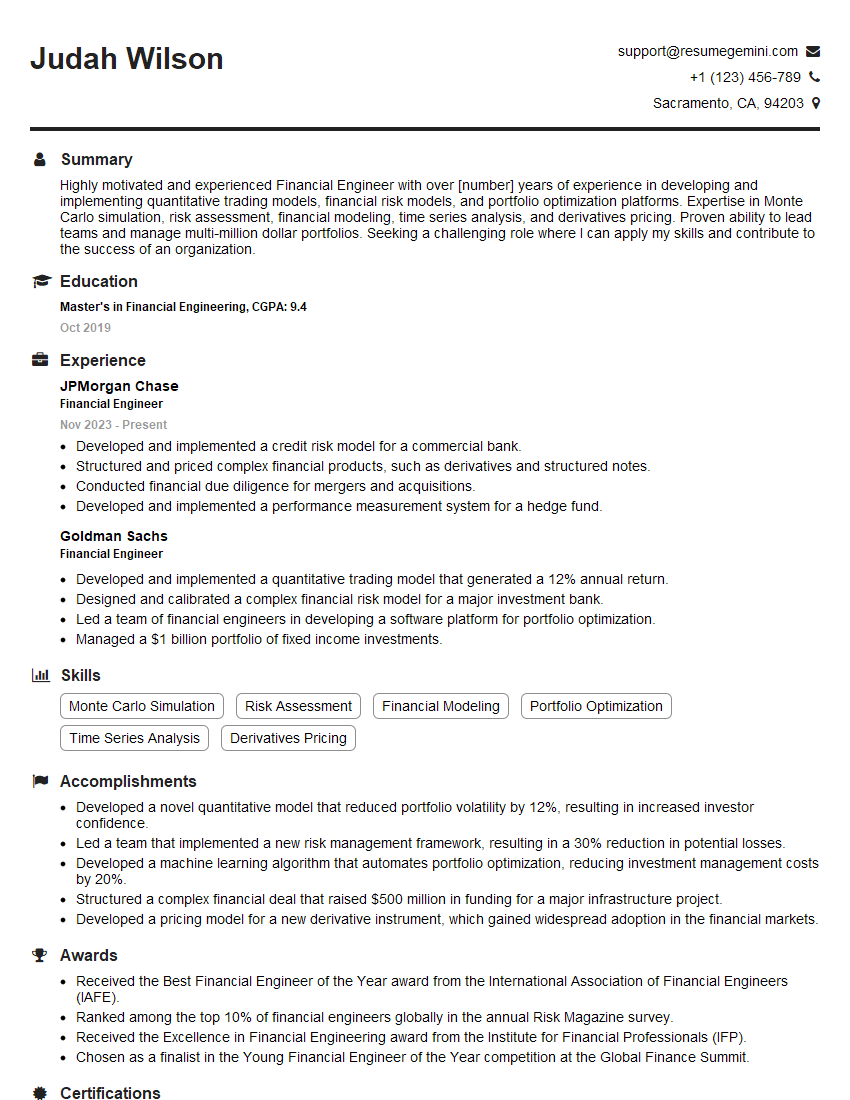
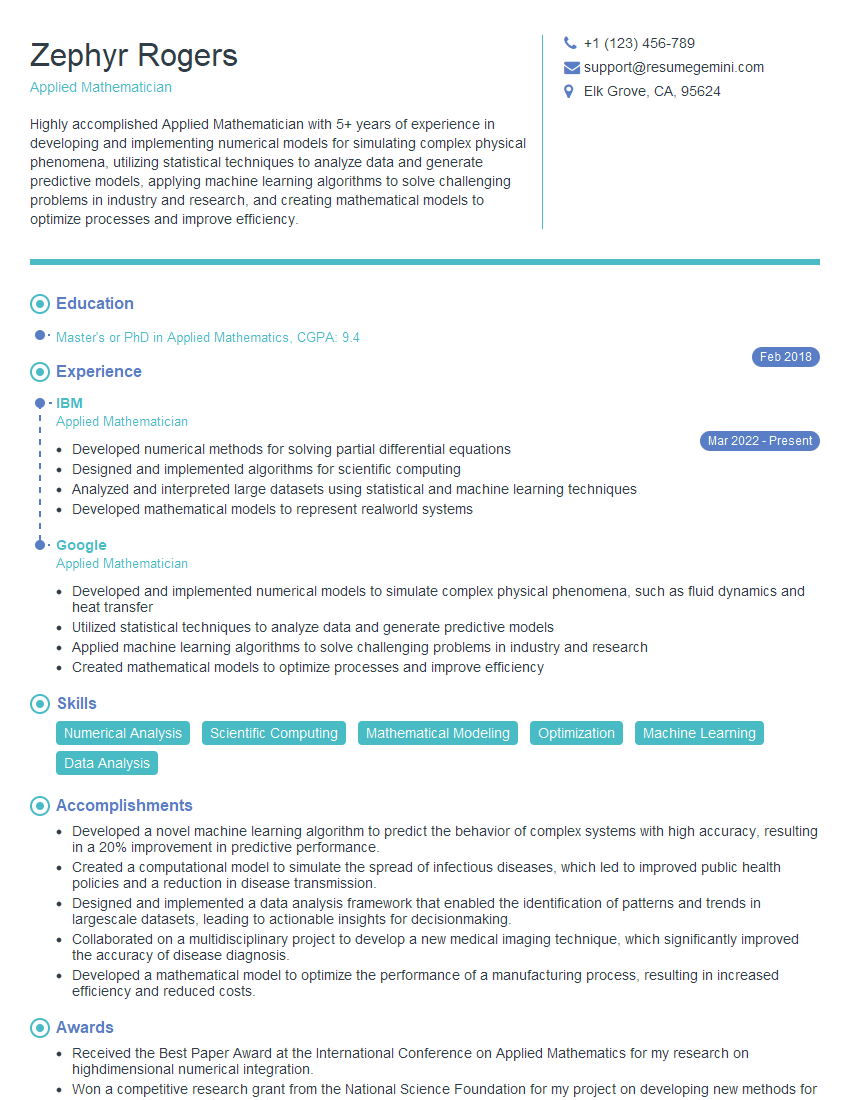
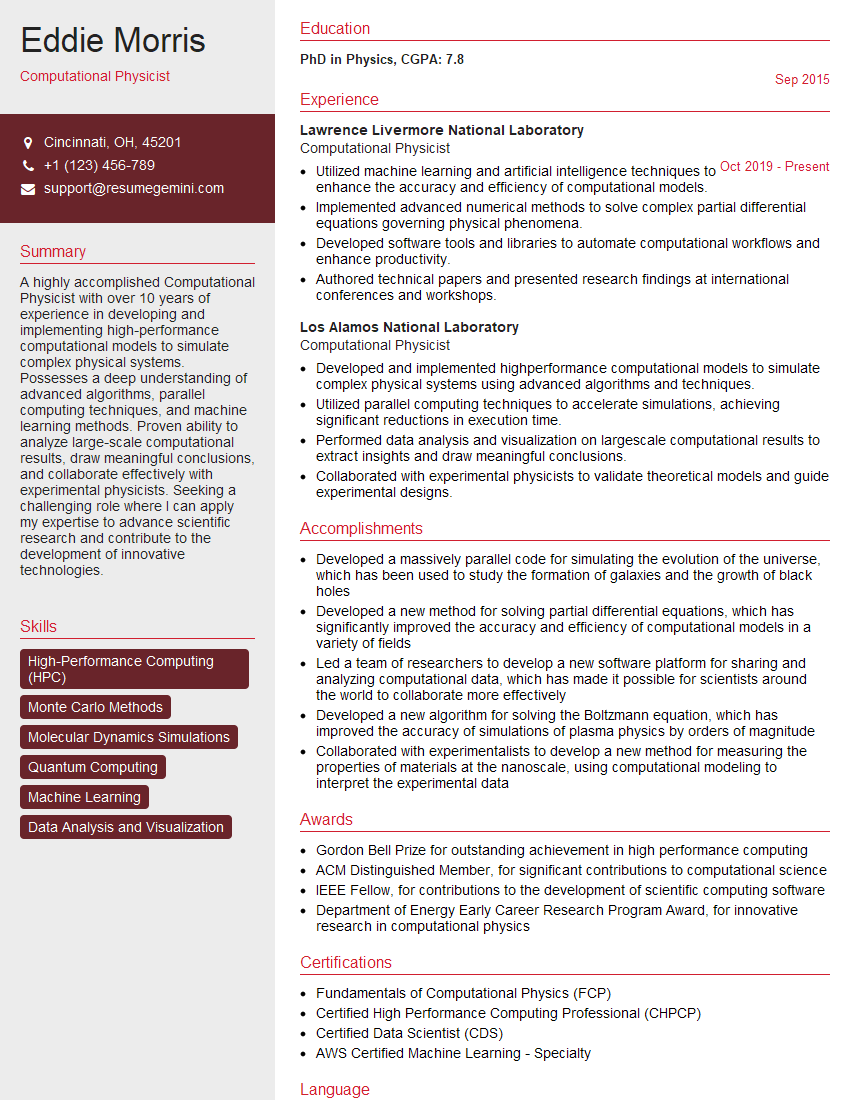
We highly recommend using ResumeGemini to build a professional and impactful resume. ResumeGemini provides a streamlined process and valuable tools to create a document that highlights your accomplishments effectively. Examples of resumes tailored specifically to Partial Differential Equation Modeling professionals are available to guide you.
Explore more articles
Users Rating of Our Blogs
Share Your Experience
We value your feedback! Please rate our content and share your thoughts (optional).
What Readers Say About Our Blog
Hello,
we currently offer a complimentary backlink and URL indexing test for search engine optimization professionals.
You can get complimentary indexing credits to test how link discovery works in practice.
No credit card is required and there is no recurring fee.
You can find details here:
https://wikipedia-backlinks.com/indexing/
Regards
NICE RESPONSE TO Q & A
hi
The aim of this message is regarding an unclaimed deposit of a deceased nationale that bears the same name as you. You are not relate to him as there are millions of people answering the names across around the world. But i will use my position to influence the release of the deposit to you for our mutual benefit.
Respond for full details and how to claim the deposit. This is 100% risk free. Send hello to my email id: [email protected]
Luka Chachibaialuka
Hey interviewgemini.com, just wanted to follow up on my last email.
We just launched Call the Monster, an parenting app that lets you summon friendly ‘monsters’ kids actually listen to.
We’re also running a giveaway for everyone who downloads the app. Since it’s brand new, there aren’t many users yet, which means you’ve got a much better chance of winning some great prizes.
You can check it out here: https://bit.ly/callamonsterapp
Or follow us on Instagram: https://www.instagram.com/callamonsterapp
Thanks,
Ryan
CEO – Call the Monster App
Hey interviewgemini.com, I saw your website and love your approach.
I just want this to look like spam email, but want to share something important to you. We just launched Call the Monster, a parenting app that lets you summon friendly ‘monsters’ kids actually listen to.
Parents are loving it for calming chaos before bedtime. Thought you might want to try it: https://bit.ly/callamonsterapp or just follow our fun monster lore on Instagram: https://www.instagram.com/callamonsterapp
Thanks,
Ryan
CEO – Call A Monster APP
To the interviewgemini.com Owner.
Dear interviewgemini.com Webmaster!
Hi interviewgemini.com Webmaster!
Dear interviewgemini.com Webmaster!
excellent
Hello,
We found issues with your domain’s email setup that may be sending your messages to spam or blocking them completely. InboxShield Mini shows you how to fix it in minutes — no tech skills required.
Scan your domain now for details: https://inboxshield-mini.com/
— Adam @ InboxShield Mini
Reply STOP to unsubscribe
Hi, are you owner of interviewgemini.com? What if I told you I could help you find extra time in your schedule, reconnect with leads you didn’t even realize you missed, and bring in more “I want to work with you” conversations, without increasing your ad spend or hiring a full-time employee?
All with a flexible, budget-friendly service that could easily pay for itself. Sounds good?
Would it be nice to jump on a quick 10-minute call so I can show you exactly how we make this work?
Best,
Hapei
Marketing Director
Hey, I know you’re the owner of interviewgemini.com. I’ll be quick.
Fundraising for your business is tough and time-consuming. We make it easier by guaranteeing two private investor meetings each month, for six months. No demos, no pitch events – just direct introductions to active investors matched to your startup.
If youR17;re raising, this could help you build real momentum. Want me to send more info?
Hi, I represent an SEO company that specialises in getting you AI citations and higher rankings on Google. I’d like to offer you a 100% free SEO audit for your website. Would you be interested?
Hi, I represent an SEO company that specialises in getting you AI citations and higher rankings on Google. I’d like to offer you a 100% free SEO audit for your website. Would you be interested?
good