Are you ready to stand out in your next interview? Understanding and preparing for Patent Application Writing interview questions is a game-changer. In this blog, we’ve compiled key questions and expert advice to help you showcase your skills with confidence and precision. Let’s get started on your journey to acing the interview.
Questions Asked in Patent Application Writing Interview
Q 1. Explain the difference between a provisional and a non-provisional patent application.
A provisional patent application is like a placeholder, giving you a year to fully develop your invention and decide if you want to pursue a full patent. It’s simpler, cheaper, and faster to file. A non-provisional application, on the other hand, is the full, formal patent application that, if successful, leads to a granted patent. Think of it as the polished, final submission after the initial exploration.
The key difference lies in their completeness: a provisional application requires a written description of your invention and drawings, but doesn’t need the strict claim language or formal examination procedures. A non-provisional application is much more rigorous and demands detailed claims defining the scope of your invention, a comprehensive description, and meticulous adherence to legal requirements.
For example, imagine you’ve invented a new type of widget. You could file a provisional application quickly to secure an early filing date while you continue testing and refining your widget. After a year, having gathered more data and perfected your design, you’d file a non-provisional application, containing more detailed claims that accurately reflect the final invention.
Q 2. Describe the process of claim drafting and its importance.
Claim drafting is the art of precisely defining the boundaries of your invention in legal terms. These claims are what determine the scope of protection your patent provides—essentially, they tell the world what you have a monopoly over. Its importance can’t be overstated; poorly drafted claims can render your patent worthless, while well-crafted claims can provide robust protection.
The process involves carefully analyzing your invention, identifying its novel and non-obvious aspects, and translating those features into clear, concise, and legally sound claim language. This requires a deep understanding of patent law and the nuances of claim construction. The claims should be specific enough to differentiate your invention from the prior art, but not so narrow as to exclude variations within the spirit of your innovation.
For example, instead of claiming broadly ‘a device for improving efficiency,’ a strong claim might specify ‘a device comprising a heat exchanger with a novel fin design and a control algorithm for optimizing energy transfer, resulting in a 20% increase in efficiency compared to prior art devices.’
Q 3. What are the key elements of a strong patent specification?
A strong patent specification serves as a detailed manual for your invention. It needs to enable someone skilled in the art to make and use your invention without undue experimentation. Key elements include:
- Detailed Description: This section explains your invention in detail, including its structure, operation, and any relevant background information.
- Drawings: Clear and concise drawings are crucial for visualizing the invention’s structure and workings. These act as visual aids to complement the written description.
- Claims: As discussed earlier, these define the legal scope of your protection.
- Abstract: A concise summary of the invention’s purpose and key features.
- Background of the Invention: Explains the problem your invention solves and the prior art relevant to your invention.
Imagine a recipe for a cake. The specification is like providing a detailed recipe with illustrations, including the ingredients, steps, possible variations, and the expected result. A poorly written specification is like having a vague recipe – it might not help someone recreate the cake successfully.
Q 4. How do you ensure clarity and avoid ambiguity in patent claims?
Clarity and precision are paramount in patent claims. Ambiguity can lead to unexpected limitations or even invalidate your patent. Here’s how to ensure clarity:
- Use precise language: Avoid vague terms. Instead of ‘about,’ specify a range or numerical value.
- Define terms: Clearly define any technical terms or jargon used in the claims.
- Use consistent terminology: Maintain consistency in the terminology used throughout the claims and specification.
- Structure claims logically: Organize claims in a hierarchical manner (independent and dependent claims), ensuring a clear flow of information.
- Review and revise: Multiple revisions by different professionals can ensure clarity.
For instance, instead of claiming ‘a substantially improved widget,’ claim ‘a widget having an improved XYZ component with dimensions of A x B x C, resulting in a 15% increase in efficiency.’ This is much more specific and leaves less room for interpretation.
Q 5. Explain the concept of prior art and its relevance in patent applications.
Prior art refers to any information that existed before your invention’s conception date. This includes published patents, publications, products, and other forms of public disclosure. Its relevance in patent applications is crucial because a patent can only be granted for an invention that is novel (new) and non-obvious (not an obvious modification of existing technology).
A thorough prior art search is essential to determine the patentability of your invention. If your invention is already disclosed in prior art, it is not considered novel and is therefore unpatentable. If your invention is an obvious variation of existing technology, it may not be considered non-obvious and therefore might not be patentable.
Think of it as building a house – if someone has already built an identical house (prior art), you can’t claim ownership of that design. If you make only minor improvements to an existing house (obvious), the improvements might not warrant a new patent.
Q 6. How do you conduct a thorough prior art search?
Conducting a thorough prior art search involves a systematic approach combining various tools and techniques:
- Patent Databases: Searching major patent databases like Google Patents, Espacenet, and USPTO’s website using relevant keywords and classification codes.
- Scientific Literature: Searching scientific journals, conference proceedings, and technical publications for relevant information.
- Online Search Engines: Using search engines like Google to find relevant information, including product descriptions, news articles, and websites.
- Expert Consultation: Consulting with experienced patent attorneys and search professionals.
The search needs to be comprehensive, considering various search terms and approaches, to ensure that all relevant prior art is identified. The key is to be thorough and methodical, leaving no stone unturned.
Q 7. What are the different types of patent claims (e.g., independent, dependent)?
Patent claims are typically categorized as independent or dependent:
- Independent claims: These are standalone claims that define the broadest aspects of the invention. Each independent claim stands alone and defines a separate invention. They’re like the main points of your invention.
- Dependent claims: These claims are narrower than independent claims and depend on an independent claim for their support. They add limitations or modifications to an independent claim, essentially narrowing the scope of protection. They’re like sub-points that elaborate on the main points.
For example, an independent claim might be: ‘A method for improving fuel efficiency in an internal combustion engine.’ A dependent claim might be: ‘The method of claim 1, further comprising a step of adjusting the air-fuel mixture.’ The dependent claim relies on the independent claim for its existence.
Q 8. Describe your experience with patent prosecution.
My experience in patent prosecution spans over 10 years, encompassing all stages from initial client consultation and invention disclosure to drafting and filing patent applications, responding to office actions from patent examiners, and managing appeals. I’ve successfully prosecuted hundreds of patent applications across diverse technological fields, including software, medical devices, and mechanical engineering. I’ve worked with both large corporations and individual inventors, developing tailored strategies to achieve their intellectual property goals. A significant portion of my work involves navigating the complexities of the USPTO examination process, anticipating potential objections, and crafting compelling arguments to overcome them. I’m proficient in various patent application drafting styles, ensuring clarity, precision, and compliance with all relevant regulations. My success rate in obtaining allowance reflects my deep understanding of patent law and my ability to effectively communicate complex technical information to patent examiners.
Q 9. How do you handle rejections from a patent examiner?
Handling rejections from a patent examiner is a crucial part of patent prosecution. My approach is systematic and strategic. First, I thoroughly analyze the rejection, identifying the specific grounds for each objection. This involves understanding the cited prior art and the examiner’s reasoning. Then, I carefully review the claims and specifications of the patent application to determine the best course of action. This could involve amending the claims to overcome the rejection, arguing that the examiner’s interpretation of the prior art is incorrect, or providing new evidence to support patentability. For example, if the rejection is based on a lack of novelty, I might focus on differentiating the claimed invention from the cited prior art by highlighting unique features or functionalities. If the rejection is based on obviousness, I might emphasize the unexpected results or synergistic effects of the invention. I also consider the merits of appealing a rejection if all other options are exhausted. Throughout this process, effective communication with the examiner is paramount, ensuring a clear understanding of my arguments and facilitating a positive and efficient resolution.
Q 10. Explain the concept of patentable subject matter.
Patentable subject matter refers to the types of inventions that are eligible for patent protection. Not everything is patentable. The key is that the invention must fall within one of the statutory categories: processes, machines, manufactures, compositions of matter, or any new and useful improvement thereof. However, certain subject matter is explicitly excluded, such as laws of nature, physical phenomena, and abstract ideas. The line can be blurry, particularly with software and business methods. For instance, a simple mathematical algorithm is generally not patentable, but a novel and non-obvious application of that algorithm in a specific technological context might be. Think of it this way: discovering gravity (a law of nature) isn’t patentable, but inventing a new type of parachute that uses a novel understanding of gravity to improve safety is potentially patentable. The key is the practical application and its novelty. Examining the claim language carefully is essential to ensure it’s directed to patentable subject matter and not merely an abstract idea or naturally occurring phenomenon.
Q 11. What is the difference between novelty and non-obviousness?
Novelty and non-obviousness are two distinct but related requirements for patentability. Novelty means that the invention must be new and not previously known or used by others. This is often assessed by a prior art search to determine if the invention is already disclosed in public literature or prior inventions. For example, if someone invents a new type of widget that is already described in a published patent, it lacks novelty. Non-obviousness, also known as inventive step, goes beyond novelty. Even if an invention is new, it might still be obvious to a person of ordinary skill in the art. This means that the invention doesn’t involve an unexpected or inventive leap forward. The question is: would a person skilled in the relevant field have considered it obvious to make this invention based on the prior art? For example, making a minor modification to an existing product might be obvious, even if that specific modified product wasn’t previously known. The evaluation of non-obviousness often considers the differences between the claimed invention and prior art, the motivation to combine elements of prior art, and the unexpected results achieved. Both novelty and non-obviousness are critical for obtaining a valid patent.
Q 12. How do you determine the best patent strategy for a given invention?
Determining the best patent strategy requires a thorough understanding of the invention, the competitive landscape, and the client’s business goals. First, I conduct a comprehensive patentability analysis, including a thorough prior art search. Then, I assess the commercial viability of the invention and its potential market value. This informs the decision on whether to pursue a patent application at all and, if so, in which jurisdictions. Factors to consider include the novelty and non-obviousness of the invention, the cost of obtaining and maintaining patents, and the potential return on investment. Strategic considerations also include the type of patent application (e.g., utility, design, plant) and the scope of protection desired. A strong patent portfolio is often built strategically by focusing on core inventions and filing divisional applications to protect different aspects of the invention. For example, a company might pursue a broad patent covering a core technology and then file narrower patents covering specific applications or improvements of that technology. The ultimate goal is to develop a robust and cost-effective IP portfolio that maximizes protection and supports the client’s business objectives.
Q 13. Describe your experience working with inventors.
Working with inventors is a rewarding part of my work. It’s crucial to build a strong rapport based on trust and open communication. I start by actively listening to the inventor, understanding the technical details of their invention, and grasping their vision. Often, inventors are passionate about their work, but they might not be familiar with the intricacies of patent law. My role involves bridging this gap, explaining complex legal concepts in a clear and accessible manner. I guide them through the patent application process, helping them to clearly articulate their invention and to understand the potential scope of protection. I also manage expectations, providing realistic assessments of the chances of obtaining a patent and the overall timeframe. Furthermore, I encourage collaboration and involvement from the inventors throughout the process, ensuring their input is incorporated and their questions are answered promptly. This collaborative approach ensures a successful outcome and strengthens the relationship with the inventor. I always aim to be a trusted advisor, not just a legal technician.
Q 14. Explain your understanding of the different patent application procedures.
My understanding of patent application procedures is extensive. I’m familiar with the various types of patent applications, including utility, design, and plant patents. I’m proficient in navigating the different filing procedures in various jurisdictions, including the USPTO (United States Patent and Trademark Office) and international patent offices (e.g., EPO, WIPO). I understand the requirements for drafting a complete and enabling specification, including claims, drawings, and an abstract. I’m also experienced in handling different stages of prosecution, such as responding to office actions, amendments, appeals, and re-examinations. I am familiar with the different pathways available, including the standard process, the accelerated examination program, and the Patent Prosecution Highway (PPH). My knowledge also extends to post-grant procedures such as re-examination, inter partes review (IPR), and post-grant review (PGR). Moreover, I understand the importance of complying with strict deadlines and regulations throughout the entire process, ensuring efficient and successful patent prosecution.
Q 15. How do you ensure compliance with patent regulations?
Ensuring compliance with patent regulations is paramount. It involves a meticulous approach, starting with a deep understanding of the specific jurisdiction’s patent laws. This includes knowing the requirements for patentability (novelty, non-obviousness, utility), claim drafting rules, and formal filing procedures.
For example, in the US, compliance necessitates adhering to the rules of the United States Patent and Trademark Office (USPTO), including specific formatting requirements for the application, claim limitations, and the information disclosed in the specification. Failing to meet these requirements can lead to delays, rejections, or even the abandonment of the application.
My process involves a rigorous checklist and continuous cross-referencing against the relevant legal framework. I also leverage regularly updated resources and legal databases to stay abreast of any changes or interpretations of the law. Finally, I collaborate closely with patent attorneys to ensure all legal and regulatory aspects are fully addressed.
Career Expert Tips:
- Ace those interviews! Prepare effectively by reviewing the Top 50 Most Common Interview Questions on ResumeGemini.
- Navigate your job search with confidence! Explore a wide range of Career Tips on ResumeGemini. Learn about common challenges and recommendations to overcome them.
- Craft the perfect resume! Master the Art of Resume Writing with ResumeGemini’s guide. Showcase your unique qualifications and achievements effectively.
- Don’t miss out on holiday savings! Build your dream resume with ResumeGemini’s ATS optimized templates.
Q 16. What software or tools are you familiar with for patent drafting?
I’m proficient in several software tools essential for efficient and accurate patent drafting. These include:
- Patent drafting software: Applications like PatBase, Anaqua, and Innography help manage patent portfolios, conduct prior art searches, and assist in claim drafting. They provide features for formatting, managing references, and generating reports.
- Word processing software: Microsoft Word remains a critical tool, especially for fine-tuning the language and formatting of the patent application to meet specific office requirements. Mastering advanced features such as styles and macros dramatically improves efficiency.
- Citation management software: Tools like Mendeley and Zotero are essential for organizing and referencing prior art, scientific publications, and other relevant documents cited within the patent application, ensuring accuracy and consistency in citations.
Choosing the right tool often depends on the project’s size and complexity, as well as client preferences. The key is to leverage technology to optimize the drafting process and minimize errors.
Q 17. How do you manage multiple patent applications simultaneously?
Managing multiple patent applications simultaneously requires robust organizational skills and a structured approach. I employ a project management methodology that incorporates:
- Prioritization: Assigning deadlines and prioritizing applications based on urgency, strategic importance, and client deadlines.
- Task Breakdown: Dividing each application into smaller, manageable tasks (e.g., literature review, claim drafting, specification writing, filing).
- Dedicated Time Blocks: Allocating specific time slots for working on each application to avoid multitasking and ensure focused attention.
- Centralized Tracking System: Utilizing project management software (like Asana or Trello) or spreadsheets to monitor progress, deadlines, and outstanding tasks for each application. This helps maintain a clear overview of the entire portfolio.
- Regular Review Meetings: Scheduling regular reviews with clients and internal teams to discuss progress, address challenges, and ensure alignment on strategy.
This structured approach ensures that each application receives the necessary attention while maintaining a balanced workflow.
Q 18. Describe your experience with PCT applications.
I have extensive experience with Patent Cooperation Treaty (PCT) applications. I understand the intricacies of the PCT system, including the international filing phase, the national phase entry, and the various legal considerations involved. This includes preparing international applications that comply with PCT regulations, managing the international search and examination reports, and guiding clients through the process of entering the national phase in multiple countries.
For instance, I’ve handled PCT applications where we needed to adapt the claims to align with the requirements of various national patent offices while maintaining the overall scope of protection. This requires careful consideration of the different national laws and examination practices, and involves close collaboration with foreign associates.
My understanding extends to the strategic aspects of PCT filings, such as determining which countries to designate based on market analysis and client objectives.
Q 19. What is your understanding of the Doctrine of Equivalents?
The Doctrine of Equivalents is a crucial legal concept in patent litigation. It allows a patentee to claim infringement even if the accused device doesn’t literally infringe the claims, but performs substantially the same function in substantially the same way to achieve substantially the same result.
Think of it like this: if you have a patent on a ‘square wheel’ for a particular function, a ‘slightly irregular square wheel’ might not literally infringe your claim for a perfectly square wheel. However, under the Doctrine of Equivalents, the ‘irregular square wheel’ could still infringe if it performs the same function in essentially the same manner.
It’s important to note that the application of the Doctrine of Equivalents can be complex and highly fact-specific, involving detailed analysis of the patent claims, the accused device, and the prior art. During patent drafting, we consider the Doctrine of Equivalents to write claims that are both broad enough to cover potential variations of the invention and narrow enough to avoid invalidity challenges.
Q 20. How familiar are you with different patent classifications systems?
I’m familiar with various patent classification systems, primarily the Cooperative Patent Classification (CPC) system used by many patent offices worldwide, including the USPTO and the European Patent Office (EPO). I also have experience with the International Patent Classification (IPC) system. Understanding these systems is vital for effective patent searching and analysis. A thorough understanding helps in identifying relevant prior art and avoiding conflicting classifications.
For example, when drafting a patent application, I utilize these classification systems to accurately categorize the invention, ensuring that patent searches are comprehensive and efficient. Accurate classification also assists examiners in their review process.
My experience also extends to understanding how the different systems are structured, their respective strengths and weaknesses, and how to translate classifications between systems if needed.
Q 21. How do you handle conflicting claims?
Conflicting claims arise when claims within the same patent application contradict each other, limiting the scope of protection. This often stems from trying to claim too broadly or from a lack of clear understanding of the invention’s scope.
Handling conflicting claims requires a careful analysis of each claim, identifying the areas of conflict, and revising the claims to eliminate the contradictions. Strategies involve:
- Re-examining the invention’s scope: Clearly defining the invention’s core features and limitations.
- Narrowing the scope of broader claims: Adding limitations to the broadest claims to remove overlaps with narrower claims.
- Deleting or amending conflicting claims: Removing conflicting claims altogether or modifying them to achieve consistency.
- Prioritizing claims: Determining the most important aspects of the invention and focusing on protecting those with the strongest claims.
Resolving claim conflicts ensures a coherent and legally sound patent application, maximizing the chances of allowance.
Q 22. Describe your experience with amendments to patent applications.
Amendments to patent applications are crucial for strengthening a patent’s claims and addressing objections raised by the patent office during prosecution. This process involves carefully crafting responses to office actions, which are communications from the examiner outlining reasons for rejecting claims. My experience encompasses a wide range of amendment types, including:
- Claim Amendments: Narrowing or broadening claims to address issues of novelty, non-obviousness, or enablement. For instance, I’ve successfully amended claims to overcome rejections based on prior art by adding limitations that distinguish the invention from the cited references. This often involves careful analysis of the prior art and a deep understanding of the invention’s features.
- Specification Amendments: Clarifying or adding supporting evidence to the specification to better explain the invention’s functionality or advantages. This might involve adding figures, examples, or further description of the invention’s operation.
- Argumentation Amendments: Providing persuasive arguments to counter objections raised by the examiner. This requires a strong understanding of patent law and the ability to articulate technical information clearly and concisely. For example, I have successfully argued for the patentability of an invention by highlighting the unexpected results achieved and demonstrating that the invention solves a real-world problem.
I have a proven track record of successfully navigating the amendment process, resulting in the allowance of numerous patent applications. I understand the importance of strategic amendment planning, ensuring the claims remain strong and protectable while addressing the examiner’s concerns effectively.
Q 23. How do you manage deadlines in patent prosecution?
Managing deadlines in patent prosecution is critical for success. It’s a juggling act that requires meticulous planning and effective time management. My approach involves:
- Detailed Calendaring: I utilize a sophisticated calendaring system to track all deadlines, including response deadlines, information disclosure statements (IDS), and office action responses. This system sends me timely reminders, ensuring I never miss a crucial date.
- Prioritization: I prioritize tasks based on urgency and impact. For example, responding to an office action with a short response deadline takes precedence over a less urgent task.
- Proactive Communication: I maintain open communication with clients and the patent office to manage expectations and ensure timely responses. This may include requesting extensions if needed and providing updates on progress.
- Contingency Planning: I always build buffer time into my schedule to account for unexpected delays or complications. This allows flexibility in managing workloads and prevents rushing, leading to errors.
This proactive, multi-faceted approach ensures that I consistently meet all deadlines and avoid any negative consequences related to late filings. I treat missed deadlines as completely unacceptable, as they can significantly impact the strength of the patent and its overall value.
Q 24. How do you collaborate with other members of an IP team?
Collaboration is essential in a successful IP team. My approach centers around clear communication, mutual respect, and a shared understanding of goals. I actively participate in team meetings, providing updates on my progress and seeking input from colleagues.
- Information Sharing: I readily share relevant information with team members, including technical documents, legal precedents, and strategic insights. This promotes transparency and informed decision-making.
- Constructive Feedback: I provide and receive constructive feedback openly and professionally. This helps ensure the quality of our work and fosters a culture of continuous improvement.
- Leveraging Expertise: I leverage the expertise of other team members, recognizing that each individual brings unique skills and knowledge to the table. For example, I might consult with a senior attorney on a complex legal issue or a technical expert on a challenging technical question.
- Technology Use: We use shared document management systems and project management software to ensure that everyone is on the same page, and that documents are updated and easily accessible.
This collaborative approach fosters a productive and supportive work environment, resulting in stronger patent applications and overall success. I believe that a collaborative team produces better outcomes than an individual working in isolation.
Q 25. Describe a situation where you had to overcome a challenge during patent prosecution.
During the prosecution of a patent application for a novel medical device, we faced a significant challenge when the examiner cited a seemingly relevant prior art reference that we hadn’t initially considered. This reference raised serious doubts about the novelty of our invention.
To overcome this, I systematically analyzed the cited reference alongside our patent specification. I identified subtle, yet critical, distinctions between the claimed invention and the prior art. These distinctions focused on specific functional limitations and unique design elements that were not explicitly described in the prior art.
Next, I meticulously prepared an amendment, incorporating these distinctions into the claims and the specification. I supported the amendment with a detailed argument, explaining why the differences were significant and overcame the examiner’s objections. I also included additional evidence and experiments to further demonstrate the non-obviousness of our invention. This response was carefully crafted, taking into account the nuances of patent law and the examiner’s past decisions.
Ultimately, our persuasive arguments and compelling evidence convinced the examiner. The application was allowed, resulting in a strong patent protecting our client’s innovative medical device. This experience highlighted the importance of meticulous research, critical thinking, and persuasive writing in overcoming challenges during patent prosecution.
Q 26. What are your strengths and weaknesses in patent application writing?
My strengths in patent application writing lie in my ability to:
- Clearly and concisely articulate complex technical information: I can effectively translate highly technical concepts into language that is understandable to both technical and non-technical audiences, ensuring that the claims are clear, precise, and legally sound.
- Conduct thorough prior art searches and analysis: I am adept at identifying relevant prior art, critically analyzing it, and crafting arguments to overcome potential rejections based on this art.
- Develop strategic claim drafting strategies: I understand the importance of balancing broad protection with the requirements of patentability, resulting in claims that are both strong and defensible.
My primary weakness, which I am actively working to improve, is my time management skills when dealing with multiple, simultaneous high-priority projects. While I have systems in place, I am actively seeking training in project management methodologies to optimize my workflow and enhance my ability to manage competing demands effectively.
Q 27. What are your salary expectations?
My salary expectations are commensurate with my experience and skills, and are in line with the market rate for a patent attorney with my qualifications and proven track record of success. I’m open to discussing this further based on the specifics of the role and the company’s compensation structure.
Key Topics to Learn for Patent Application Writing Interview
- Understanding Patent Law Fundamentals: Grasp the core principles of patentability, including novelty, non-obviousness, and utility. Practice applying these concepts to various invention scenarios.
- Claim Drafting Techniques: Master the art of writing clear, concise, and legally sound claims that define the scope of the invention. Explore different claim types (independent, dependent) and their strategic implications.
- Specification Writing: Learn to create a detailed and comprehensive specification that fully discloses the invention and its operation. Practice structuring the specification logically and using appropriate terminology.
- Prior Art Searching and Analysis: Develop proficiency in identifying and analyzing prior art to assess the patentability of an invention. Understand how to use different search databases and effectively present your findings.
- Patent Prosecution Strategies: Familiarize yourself with the patent application process, including filing procedures, responding to office actions, and negotiating with patent examiners. Consider the nuances of different patent offices (e.g., USPTO, EPO).
- Ethical Considerations in Patent Writing: Understand the importance of honesty and integrity in patent applications. Learn to avoid misrepresentation and maintain ethical standards throughout the process.
- Practical Application: Practice writing patent applications for diverse technological fields, focusing on clear communication and precise language. Consider mock scenarios and critique your own work.
Next Steps
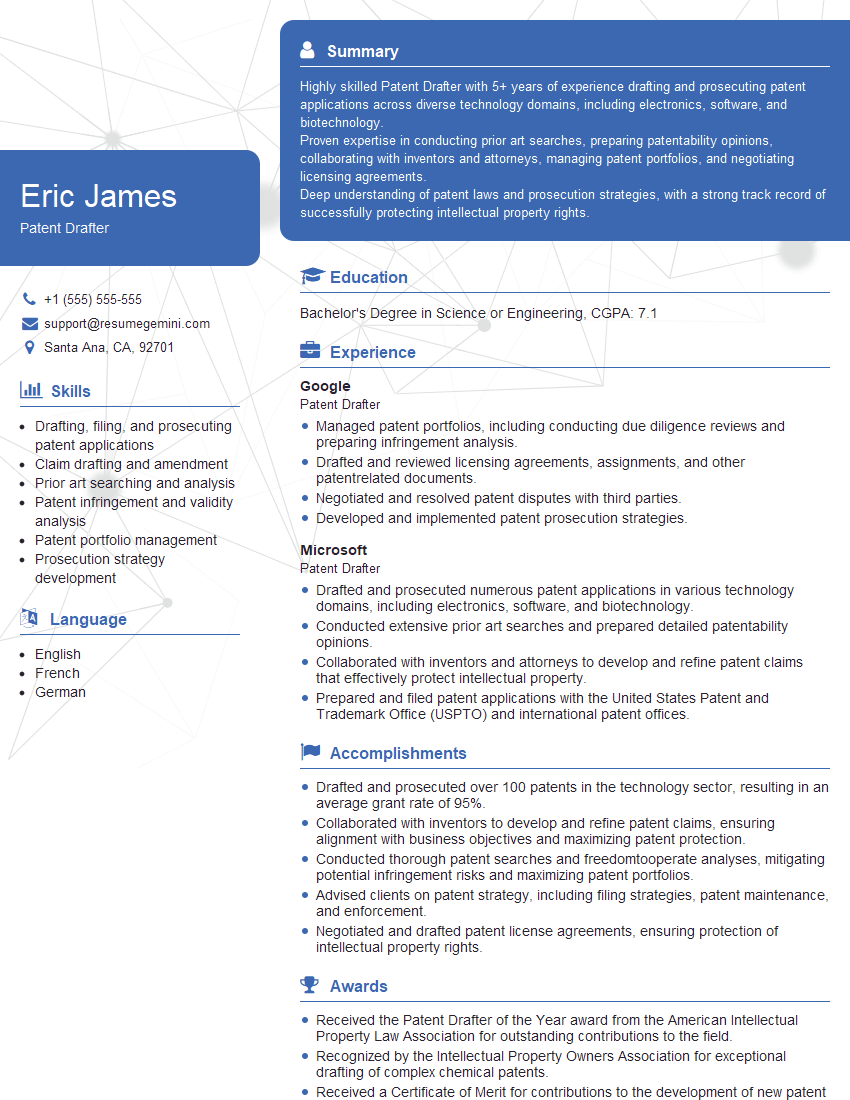
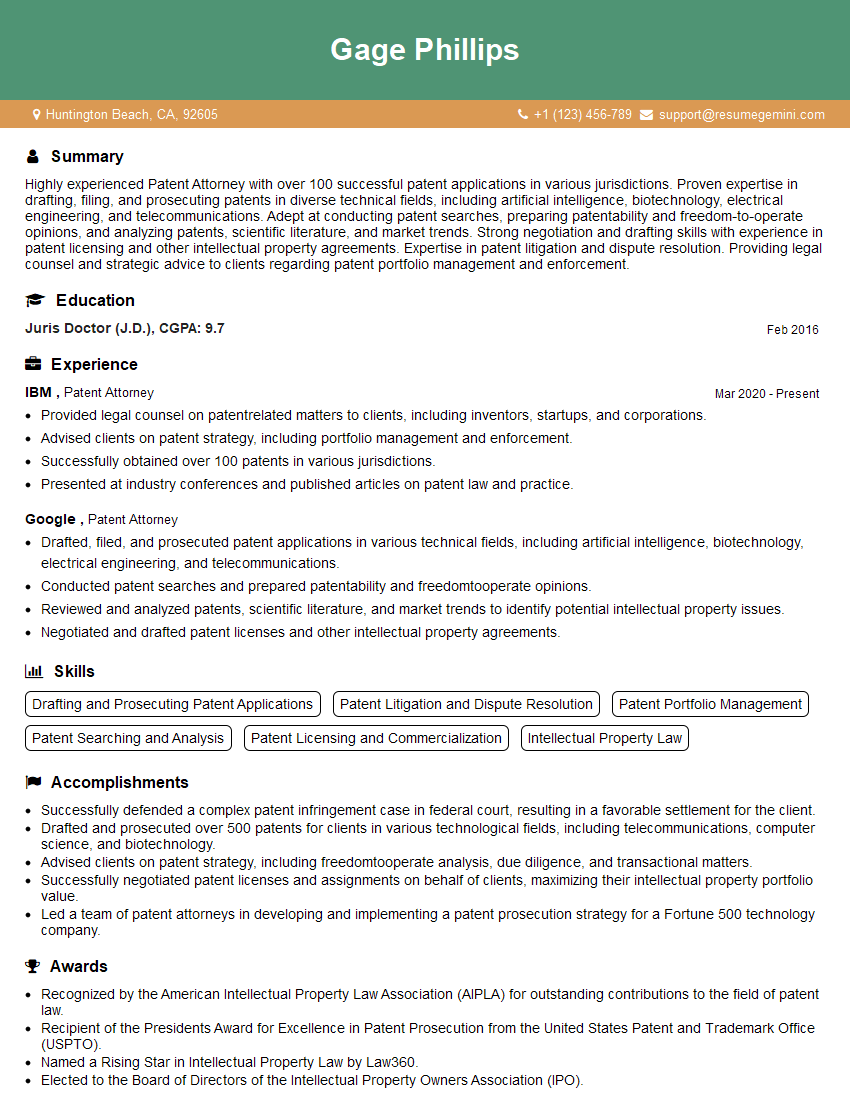
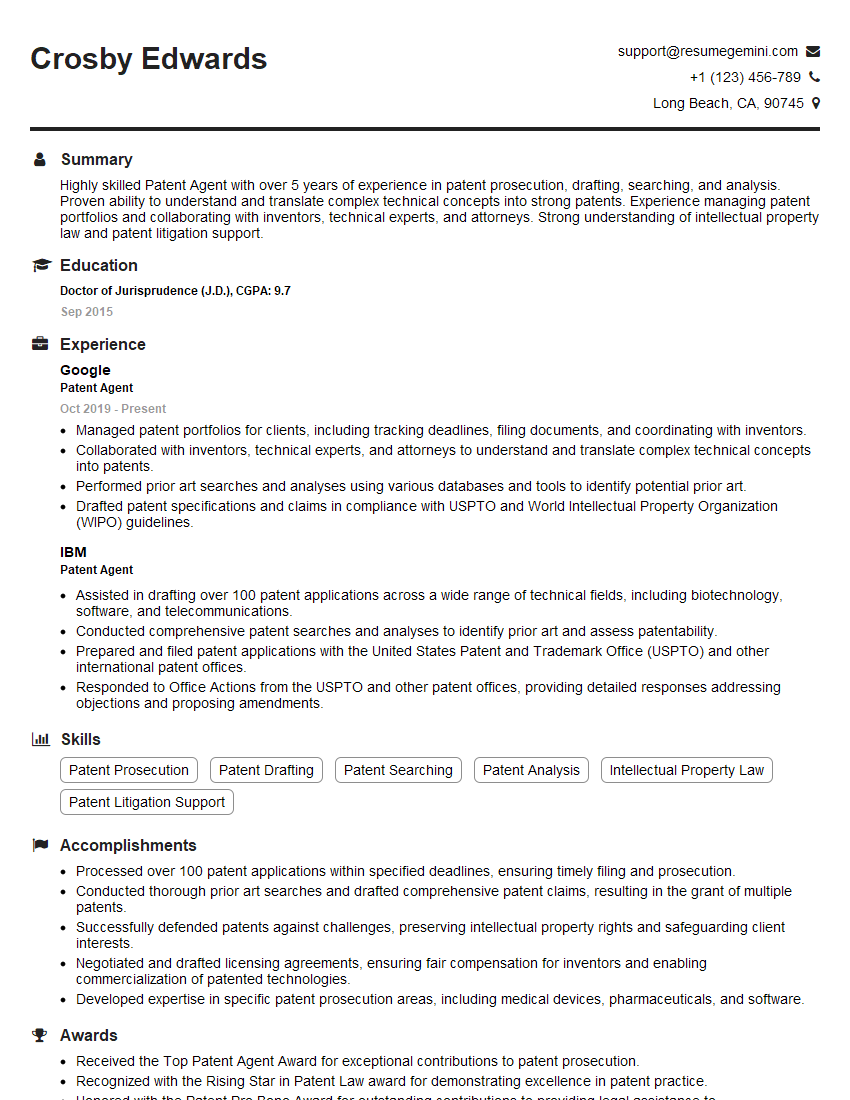
Mastering patent application writing is crucial for a successful career in intellectual property. It opens doors to rewarding roles in law firms, corporations, and government agencies. To significantly increase your job prospects, it’s vital to create a compelling and ATS-friendly resume that highlights your skills and experience effectively. ResumeGemini is a trusted resource that can help you build a professional resume tailored to the specific requirements of patent application writing positions. Examples of resumes optimized for this field are available to guide you through the process.
Explore more articles
Users Rating of Our Blogs
Share Your Experience
We value your feedback! Please rate our content and share your thoughts (optional).
What Readers Say About Our Blog
Very informative content, great job.
good