Interviews are opportunities to demonstrate your expertise, and this guide is here to help you shine. Explore the essential Patent Research and Development interview questions that employers frequently ask, paired with strategies for crafting responses that set you apart from the competition.
Questions Asked in Patent Research and Development Interview
Q 1. Explain the difference between a utility patent, design patent, and plant patent.
The three types of patents – utility, design, and plant – protect different aspects of invention. Think of them as protecting different ‘things’ you create.
- Utility Patents: These are the most common type, protecting the functionality of an invention. This could be a new machine, a process, a manufacture, a composition of matter, or an improvement to any of these. For example, a utility patent might protect a new type of engine or a novel software algorithm. They cover the ‘how’ and ‘what’ the invention does.
- Design Patents: These protect the ornamental design of an invention. Think of the aesthetic look, the visual appeal. This doesn’t cover functionality. For instance, a design patent might protect the unique shape of a chair, the pattern on a fabric, or the exterior design of a smartphone. They cover the ‘look’ of the invention.
- Plant Patents: These protect new and distinct, invented or discovered asexually reproduced plants. This means plants that are not produced from seeds, but rather through cuttings, grafting, or other asexual methods. An example might be a new variety of rose created through tissue culture.
The key difference lies in what each patent protects: function (utility), appearance (design), or a new plant variety (plant).
Q 2. Describe the process of conducting a prior art search.
A prior art search is crucial for determining the novelty and non-obviousness of an invention before filing a patent application. It involves systematically searching for existing information that is publicly known or used before the invention’s claimed priority date. Imagine it as a thorough investigation into the existing landscape of your invention.
The process typically involves these steps:
- Define the invention: Clearly articulate the invention’s technical features and functionality.
- Identify keywords: Select relevant keywords and search terms based on the invention’s core aspects.
- Search databases: Use patent databases (discussed later) and other relevant scientific and technical literature databases.
- Analyze results: Carefully review the identified documents to determine if they disclose similar inventions or prior art.
- Document findings: Maintain meticulous records of all searched databases, keywords, and the results obtained.
A well-conducted prior art search minimizes the risk of patent rejection due to lack of novelty or obviousness. It allows you to identify potential challenges and inform the claim scope strategically. For example, you might refine your invention based on findings, or you might identify a niche aspect not covered by prior art for a stronger patent.
Q 3. What databases do you use for patent research, and why?
Several databases are invaluable for patent research. The choice depends on the invention’s technological area and geographical scope.
- Google Patents: A freely accessible database offering a broad range of patents globally. It’s a great starting point for initial searches due to its ease of use and extensive coverage. However, the search algorithm is not as sophisticated as paid databases.
- Espacenet: A comprehensive database maintained by the European Patent Office (EPO), providing access to patents from around the world. It offers sophisticated search functionalities and is a favorite among patent professionals.
- USPTO’s Patent Application Information Retrieval (PAIR): This is the official website for the United States Patent and Trademark Office (USPTO). It is essential for searching US patents and accessing application documents. It’s very detailed but can be complex to navigate.
- WIPO Patentscope: The World Intellectual Property Organization’s database provides access to a significant number of international patent documents. It’s a valuable resource for international patent research.
I often use a combination of these databases, starting with a broader search on Google Patents or Patentscope and then refining my search using the more specialized tools of Espacenet or PAIR depending on the specific patent office(s) relevant to the invention.
Q 4. How do you assess the novelty and non-obviousness of an invention?
Assessing novelty and non-obviousness is fundamental to patent eligibility. Novelty means the invention is new and not previously known or used. Non-obviousness means the invention is not an obvious variation of existing technology to a person skilled in the art.
Novelty is determined by comparing the invention to the prior art. If the invention contains any element that is not found in the prior art, it is considered novel. A good prior art search is critical here.
Non-obviousness is a more subjective assessment. It considers whether the invention would have been obvious to a person having ordinary skill in the relevant technical field, given the prior art. This involves analyzing whether the combination of known elements in the invention was predictable or would have been an obvious step to a skilled artisan. Judges often consider the ‘teaching, suggestion, or motivation’ (TSM) test to determine obviousness.
For example, a slight modification of a known device might be obvious, while a groundbreaking combination of technologies might be non-obvious. The determination often involves detailed technical analysis and legal interpretation, and is often subject to debate.
Q 5. Explain the concept of claim drafting and its importance in patent protection.
Claim drafting is the process of precisely defining the scope of protection sought for an invention within a patent application. It’s the most critical part of patent protection. Think of claims as the legally binding fences around your intellectual property, defining exactly what is protected.
Each claim is a numbered paragraph that specifically and concisely describes a protected aspect of the invention. Claims define the boundaries of what’s protected; anything outside those boundaries is fair game for others. Broader claims cover a wider range of embodiments, but are more vulnerable to prior art challenges. Narrower claims provide more specific protection but might be easier to obtain.
Importance:
- Defines the scope of protection: Claims are the only part of the patent application that define the exact subject matter protected by the patent. They are what is enforced in court if infringement occurs.
- Determines enforceability: Poorly drafted claims can render the patent unenforceable or weaken its value.
- Impacts licensing: The claim scope influences how broadly the invention can be licensed to others.
Effective claim drafting requires a thorough understanding of the invention, the prior art, and patent law. It is generally handled by experienced patent attorneys.
Q 6. What is the difference between a claim and a specification in a patent application?
The specification and claims are both essential components of a patent application, but they serve different purposes:
- Specification: This section provides a detailed description of the invention, including its background, functionality, construction, and operation. It’s the ‘how-to’ manual, explaining your invention in detail. It supports and enables the claims. Think of it as the narrative explaining your invention.
- Claims: These are numbered statements precisely defining the metes and bounds of the invention’s protection. They are the legal definition of what is protected. They are the concise, legally binding summary of what the patent covers.
The specification supports the claims by providing a detailed explanation of the invention, ensuring the claims are understandable and supported by the disclosure. A judge will refer to the specification to interpret the meaning and scope of the claims if necessary. The claims define what is protected, the specification helps to interpret what the claim encompasses.
Q 7. How do you handle conflicting prior art during a patent search?
Handling conflicting prior art during a patent search is a critical aspect of patent prosecution. It requires careful analysis and strategic decision-making.
Here’s how to approach it:
- Careful analysis: Assess the extent of the conflict. Does the prior art completely anticipate the invention, or only disclose some aspects? Determine the relevance of the conflicting documents.
- Assess the claim scope: The identified prior art influences how to craft patent claims, particularly if the invention is not fully novel. Amendments may be needed.
- Distinguish over prior art: Identify aspects of the invention that are not disclosed in the prior art. This difference needs to be highlighted in the patent application to show the claimed invention is patentable.
- Argumentation: If a conflict exists, arguments demonstrating the invention’s non-obviousness, despite the prior art, need to be carefully articulated in the patent application.
- Amendments: Narrowing the claims might be necessary to overcome the identified prior art. This involves changing the wording of the claims to exclude the aspects covered by the prior art.
- Consult with a patent attorney: Dealing with conflicting prior art requires expertise; a patent attorney can provide crucial guidance on navigating these challenges and determining the best course of action.
The goal is to either overcome the objections raised by the prior art or to adjust the patent strategy to address them effectively. This often involves a delicate balance between obtaining broad protection and mitigating the risk of patent rejection.
Q 8. Describe your experience with patent prosecution.
Patent prosecution is the process of obtaining a patent from a patent office. It involves drafting and filing a patent application, responding to office actions (rejections or objections from the examiner), and ultimately securing the grant of a patent. My experience spans over [Number] years, encompassing all phases of prosecution, from initial client consultation and invention disclosure to final patent issuance. I’ve handled hundreds of applications across various technological fields, including [mention specific fields, e.g., software, biotechnology, mechanical engineering]. I’m proficient in navigating the complexities of various patent offices globally, including the USPTO, EPO, and other regional offices. A recent successful prosecution involved securing a patent for a novel [briefly describe invention] technology, overcoming a challenging rejection based on prior art using a persuasive argument highlighting the inventive step.
- Client Interaction: Working closely with inventors to understand their invention and translate it into a clear and concise patent application.
- Application Drafting: Preparing detailed patent applications, including claims, specifications, and drawings, that fully protect the invention.
- Office Action Response: Strategically responding to rejections from patent examiners, amending claims and specifications to overcome objections.
- Appeal & Litigation (if necessary): Representing clients in appeals before the Patent Trial and Appeal Board (PTAB) or in patent litigation.
Q 9. Explain the concept of patent infringement.
Patent infringement occurs when someone makes, uses, sells, offers to sell, or imports an invention without the permission of the patent holder. Think of it like trespassing on someone’s property – the patent is the property right, and infringement is the unauthorized entry. To prove infringement, it must be shown that the infringing product or process meets each and every element of at least one valid claim of the patent. This is often done through a claim chart comparing the features of the patent claims to the features of the accused product.
For example, if a patent claims a ‘widget with a red button and a blue light,’ any widget with a red button and a blue light would likely infringe. However, a widget with only a red button would not, as it does not meet all the claimed elements. The analysis can get very complex, involving detailed comparisons of technical features and consideration of the doctrine of equivalents (where a slight variation from the claimed element may still infringe).
Q 10. What is a freedom-to-operate (FTO) analysis, and how is it conducted?
A Freedom-to-Operate (FTO) analysis is a critical step before launching a new product or technology. It’s essentially a legal risk assessment that determines whether your product or process is likely to infringe on existing patents. The goal is to identify any potential patent risks before investing significant resources in development and commercialization.
The process involves a thorough search of relevant patent databases (like Google Patents, Espacenet, USPTO) focusing on patents related to the technology or product. This search should be comprehensive and cover various jurisdictions, depending on the intended market. Once relevant patents are identified, each patent is reviewed to determine if any claims are likely to be infringed by the proposed product or process. This analysis requires careful examination of the patent claims and a thorough understanding of the technology.
A well-conducted FTO analysis should provide a clear picture of the risks, helping to inform business decisions. It might suggest design alterations to avoid infringement or highlight licensing opportunities. Imagine developing a new type of coffee maker. An FTO analysis would identify patents on brewing methods, heating elements, and other relevant technologies, determining whether your design infringes on any existing patents.
Q 11. How do you evaluate the strength of a patent?
Evaluating patent strength involves assessing the likelihood of the patent surviving a legal challenge. Several factors contribute to this evaluation:
- Claim Scope: Broader claims generally offer greater protection but are more vulnerable to invalidation. Narrower claims might be easier to defend but offer less protection.
- Prior Art: The existence of prior art (publications, products, etc. that anticipate the invention) weakens a patent. A patent with minimal prior art is generally considered stronger.
- Claim Clarity and Enablement: Claims must be clear, concise, and enable a person skilled in the art to make and use the invention. Ambiguous or unclear claims can be grounds for invalidation.
- Novelty and Non-Obviousness: The invention must be new and not obvious to someone skilled in the art at the time of invention. These are central requirements for patentability.
- Commercial Success: While not a direct measure of strength, commercial success of the patented product can suggest that the invention was non-obvious.
Often, a quantitative approach isn’t possible, and a qualitative assessment, incorporating legal expertise and experience, is vital.
Q 12. What are some common pitfalls to avoid in patent research?
Common pitfalls in patent research include:
- Incomplete Search Strategies: Failing to use a comprehensive search strategy, leading to missed relevant patents. This requires meticulous keyword selection, classification code analysis, and potentially manual searching.
- Insufficient Prior Art Review: Superficial review of identified patents leading to an inaccurate assessment of novelty and non-obviousness.
- Overlooking Foreign Patents: Focusing only on patents from a single jurisdiction, neglecting relevant international patents.
- Ignoring Non-Patent Literature: Failing to consider publications and other documents that might anticipate the invention.
- Misunderstanding Claim Scope: Incorrect interpretation of claim language leading to an inaccurate assessment of infringement or validity.
A thorough approach, utilizing advanced search techniques and incorporating legal expertise, is essential to avoid these pitfalls.
Q 13. How do you stay up-to-date on changes in patent law and technology?
Staying current in patent law and technology requires a multifaceted approach:
- Monitoring Legal Updates: Regularly reviewing legal publications, journals, and online resources dedicated to patent law changes and case law developments.
- Attending Conferences and Workshops: Participating in industry events, conferences, and workshops to hear from experts and network with colleagues.
- Professional Development: Engaging in continuing legal education courses and workshops focusing on patent law and relevant technologies.
- Reading Industry Publications: Keeping abreast of technological advancements in relevant fields through specialized journals, trade publications, and industry news sources.
- Using Patent Databases Effectively: Maintaining proficiency in using advanced search tools and techniques in major patent databases.
A proactive and continuous learning process is crucial to staying relevant in this dynamic field.
Q 14. Describe your experience with patent portfolio management.
Patent portfolio management is the strategic planning, development, and maintenance of a company’s collection of patents. This is crucial for maximizing the value of IP assets. My experience includes developing and implementing strategies for:
- Portfolio Assessment: Evaluating the strength, scope, and commercial value of existing patents, identifying gaps and potential weaknesses.
- Portfolio Building: Developing a comprehensive strategy for acquiring new patents through prosecution, licensing, and acquisitions.
- Portfolio Maintenance: Ensuring that patents are properly maintained and renewed, preventing lapse and loss of protection.
- Portfolio Monetization: Exploring various strategies for maximizing the commercial value of the patent portfolio, including licensing, sale, or enforcement.
- Freedom-to-Operate analysis: Regularly assessing and managing potential infringement risks.
Successful portfolio management is vital for innovation, competitive advantage, and long-term business growth. For example, I helped a client restructure their portfolio, focusing on core technologies and licensing out less critical patents, resulting in increased efficiency and revenue generation.
Q 15. How do you analyze competitive landscapes using patent information?
Analyzing competitive landscapes using patent information involves a systematic approach to understanding the technological advancements and intellectual property strategies of competitors. It’s like conducting thorough reconnaissance before launching a new product or technology.
My approach involves several key steps:
- Identifying Key Players: First, I pinpoint the major players in the relevant technological field. This involves researching market reports, industry publications, and competitor websites.
- Keyword Search & Boolean Operators: Next, I use patent databases like Espacenet, Google Patents, and USPTO to perform comprehensive searches using strategically chosen keywords and Boolean operators (AND, OR, NOT) to refine results. For example, searching for “lithium-ion battery AND fast charging OR solid-state” would provide patents related to advancements in lithium-ion battery technology focusing on fast charging or solid-state innovations.
- Patent Family Analysis: I identify patent families – sets of patents protecting the same invention in different jurisdictions. This reveals the global reach and strategic importance of a competitor’s technology.
- Citation Analysis: Analyzing citations (patents that reference other patents) helps understand the technological lineage and evolution of inventions. This allows me to identify key innovations and potential future directions of competitor’s R&D efforts.
- Assignee Analysis: Examining the assignees (companies or individuals) owning the patents reveals who is actively developing and commercializing the technologies. This helps understand the competitive landscape’s players and their strategic partnerships.
- Claim Analysis: A crucial step involves closely examining the claims of each patent, as these define the scope of the protection. This analysis helps determine the breadth and depth of a competitor’s intellectual property.
- Gap Analysis: By identifying white spaces (unpatented areas) in the competitive landscape, I can identify opportunities for innovation and potentially develop proprietary technologies with less risk of infringement.
For instance, in the field of renewable energy, I recently analyzed patent filings from several solar panel manufacturers. By comparing their patent portfolios, I identified a significant gap in the market for a specific type of high-efficiency solar cell, suggesting a lucrative opportunity for innovation.
Career Expert Tips:
- Ace those interviews! Prepare effectively by reviewing the Top 50 Most Common Interview Questions on ResumeGemini.
- Navigate your job search with confidence! Explore a wide range of Career Tips on ResumeGemini. Learn about common challenges and recommendations to overcome them.
- Craft the perfect resume! Master the Art of Resume Writing with ResumeGemini’s guide. Showcase your unique qualifications and achievements effectively.
- Don’t miss out on holiday savings! Build your dream resume with ResumeGemini’s ATS optimized templates.
Q 16. Explain your understanding of the Patent Cooperation Treaty (PCT).
The Patent Cooperation Treaty (PCT) is an international treaty administered by the World Intellectual Property Organization (WIPO). It provides a streamlined process for filing patent applications in multiple countries simultaneously. Think of it as a one-stop shop for international patent filings.
It works by allowing applicants to file a single ‘international’ application (PCT application) which acts as a placeholder for national patent applications in numerous countries. This significantly reduces the costs and complexities associated with individual national filings, offering a cost-effective and time-efficient approach.
The process typically involves:
- Filing a PCT application: This application must contain a description of the invention, claims defining the invention, drawings (where appropriate), and an abstract.
- International Search and Preliminary Examination: WIPO conducts an international search to identify prior art, and optionally, a preliminary examination of the application’s patentability.
- National Phase Entry: After a certain period (typically 30-32 months), the applicant can enter the national phase, filing corresponding applications in the countries of their choice. This requires paying national fees and complying with national regulations in each country.
The PCT doesn’t grant patents directly; rather, it offers a period of grace for applicants to assess the global marketability of their invention before committing to individual national patent filings.
Q 17. What is the importance of proper documentation in patent research and development?
Proper documentation is paramount in patent research and development, providing a strong foundation for successful patent prosecution and future commercialization efforts. Imagine trying to build a skyscraper without blueprints – it’s simply impossible.
The importance stems from several factors:
- Protecting Intellectual Property: Comprehensive documentation meticulously records the conception, development, and testing phases of an invention. This forms a strong defense against challenges to the patent’s validity.
- Facilitating Patent Prosecution: Meticulous records enable patent attorneys to draft accurate and robust patent applications, maximizing the chances of patent grant.
- Supporting Commercialization: Thorough documentation aids in technology transfer, licensing agreements, and marketing materials, clearly outlining the invention’s features and advantages.
- Ensuring Reproducibility: Detailed records enable others to reproduce the invention, demonstrating its viability and facilitating commercialization efforts.
- Collaboration and Knowledge Transfer: Proper documentation facilitates seamless collaboration amongst research teams and ensures a smooth transition of knowledge within and across organizations.
This documentation might include laboratory notebooks, research reports, design specifications, test results, emails, and meeting minutes. A well-maintained and organized system for managing these documents is vital.
Q 18. How do you handle ambiguous or incomplete patent documentation?
Handling ambiguous or incomplete patent documentation presents a significant challenge but requires a methodical approach. It’s like piecing together a puzzle with missing pieces.
My strategy involves:
- Contextual Analysis: I begin by analyzing the available information to understand the context and the invention’s overall purpose. This might involve examining related patents or publications.
- Gap Identification: I identify the specific missing information or ambiguities hindering a comprehensive understanding. This often involves looking for inconsistencies or missing diagrams.
- Inferential Reasoning: Based on the existing information and technical knowledge, I attempt to infer the missing pieces, taking care not to speculate excessively.
- Expert Consultation: If the ambiguity is critical and cannot be resolved internally, I consult experts in the relevant field to help interpret the incomplete information.
- Additional Research: I conduct supplementary searches in patent databases and scientific literature to find additional information that might clarify the ambiguous points.
- Alternative Interpretations: Sometimes, there might be multiple valid interpretations of the ambiguous passages. I document all possible interpretations and their implications.
For example, I once encountered a patent with incomplete diagrams. By examining the patent’s claims and cross-referencing it with similar patents, I was able to reconstruct a plausible representation of the missing components, which proved crucial for a freedom-to-operate analysis.
Q 19. Describe your experience with using patent search software.
I have extensive experience using various patent search software, including commercial platforms like Derwent Innovation, Questel Orbit, and free resources like Google Patents and Espacenet. Each platform has its strengths and weaknesses.
My experience encompasses:
- Developing Search Strategies: I’m proficient in developing effective search strategies using keywords, classifications (IPC, CPC), Boolean operators, and wildcard characters to retrieve relevant patent documents.
- Advanced Search Techniques: I use advanced search techniques such as proximity searching and field-specific searching to refine results and improve search accuracy. For instance, using the proximity operator NEAR to find patents where two specific keywords appear close together.
- Classification Systems: I understand and effectively use both the International Patent Classification (IPC) and the Cooperative Patent Classification (CPC) systems for targeted searching within specific technological areas.
- Data Analysis: I’m skilled in analyzing the retrieved data to extract meaningful insights and identify key trends and technologies.
- Software Specific Features: I’m familiar with the unique features of different platforms, leveraging each one’s strengths for optimal search results. For example, Derwent Innovation’s family trees are particularly useful for tracking the global evolution of a given patent.
My proficiency in these tools allows me to efficiently navigate vast patent databases and extract critical information for competitive intelligence and freedom-to-operate studies.
Q 20. How do you communicate complex technical information to a non-technical audience?
Communicating complex technical information to a non-technical audience requires careful planning and adaptation. It’s like translating scientific jargon into everyday language.
My approach involves:
- Audience Analysis: Before communicating, I identify the audience’s level of technical understanding and their specific needs. This determines the level of detail and the type of language I use.
- Simplifying Technical Jargon: I avoid using technical jargon whenever possible, replacing it with clear and concise language that everyone can understand. I use analogies and metaphors to illustrate complex concepts.
- Visual Aids: I incorporate visual aids such as diagrams, charts, and graphs to aid comprehension and make the information more engaging. A picture is often worth a thousand words.
- Storytelling: I frame the information as a story, making it more relatable and memorable. Stories are a powerful tool for communication.
- Interactive Communication: I encourage questions and feedback throughout the communication process to check for understanding and address any doubts.
- Focus on Key Messages: I prioritize the key messages and avoid overwhelming the audience with unnecessary details.
For example, when explaining a complex algorithm to a group of investors, I used a simple analogy comparing it to a recipe for a delicious cake, highlighting the different steps and their importance in achieving the desired outcome.
Q 21. How do you prioritize tasks and manage multiple projects in patent research?
Prioritizing tasks and managing multiple projects in patent research requires a well-defined strategy and strong organizational skills. It’s like managing a complex orchestra, ensuring all instruments play in harmony.
My approach is built around:
- Project Prioritization: I prioritize projects based on factors such as urgency, impact, and resource availability. I use tools like Eisenhower Matrix (urgent/important) to categorize tasks.
- Time Management Techniques: I utilize time management techniques like time blocking, Pomodoro technique, and task chunking to effectively manage my time and ensure consistent progress.
- Project Management Tools: I leverage project management software like Asana or Trello to track tasks, deadlines, and progress across multiple projects.
- Regular Reviews and Adjustments: I regularly review my progress and adjust my schedule based on unforeseen challenges or changes in priorities. Flexibility is key.
- Delegation: When appropriate, I delegate tasks to team members to increase efficiency and free up time for higher-priority tasks.
- Clear Communication: I maintain clear and consistent communication with stakeholders to ensure everyone is informed about project status and any potential roadblocks.
For example, I recently managed three simultaneous patent research projects – a competitive landscape analysis, a freedom-to-operate study, and a patent portfolio assessment. By meticulously tracking each project’s milestones using a project management tool and prioritizing tasks based on deadlines, I successfully completed all three projects on time and within budget.
Q 22. Explain your understanding of different patent claim types (e.g., independent, dependent).
Patent claims are the heart of a patent application, defining the invention’s scope and what the inventor is legally protecting. They’re essentially a precise legal definition of the invention. There are two main types: independent and dependent claims.
- Independent Claims: These stand alone and broadly define the invention. They don’t rely on any other claims for their meaning. Think of them as the main points of your invention, the core features that make it novel and useful. A strong independent claim is crucial for broad protection. For example, an independent claim for a new type of bicycle might be: “A bicycle comprising a frame, two wheels, a handlebar, and pedals.”
- Dependent Claims: These claims depend on a preceding independent claim (or another dependent claim) and add limitations or features to it. They narrow the scope of protection but can provide fallback positions if the independent claim is challenged. For instance, a dependent claim related to the bicycle example could be: “The bicycle of claim 1, further comprising a suspension system.” This claim relies on the features defined in claim 1 and adds a specific feature (suspension).
Understanding the nuances of claim drafting is vital. Too broad, and your claim may be invalid; too narrow, and your protection might be insufficient. A skilled patent attorney will help you carefully craft a balanced set of claims that provide robust protection without being overly restrictive.
Q 23. Describe a situation where you had to overcome a challenge in patent research.
I once faced a significant challenge while researching a patent for a novel medical device. The prior art search was incredibly difficult because the relevant technology spanned multiple unrelated fields – biomedical engineering, material science, and even microfluidics. The sheer volume of patents and publications was overwhelming.
To overcome this, I implemented a multi-stage strategy. First, I meticulously defined keywords and search terms, breaking down the invention into its core components. I then used a combination of advanced search techniques on patent databases like Google Patents and Espacenet, employing Boolean operators (AND, OR, NOT) and wildcard characters to refine my searches. I also utilized classification codes to focus on relevant technology areas. Finally, I employed a forward citation search from key patents to find more recent developments. This systematic approach, combined with close collaboration with the inventor, allowed me to identify the most relevant prior art and produce a comprehensive prior art analysis. It ultimately resulted in a well-protected patent application.
Q 24. How do you ensure accuracy and thoroughness in your patent research?
Accuracy and thoroughness are paramount in patent research. A single missed piece of prior art can invalidate a patent. My approach is multi-faceted:
- Systematic Search Strategy: I utilize a structured approach, starting with broad searches and gradually narrowing the scope based on findings. This ensures that no relevant information is overlooked.
- Multiple Databases: I never rely on a single database. I cross-reference my findings across several international patent databases (e.g., USPTO, EPO, WIPO) and scientific literature databases (e.g., Web of Science, Scopus).
- Expert Search Techniques: I’m proficient in advanced search techniques, including Boolean logic, wildcard searches, and classification code searches. This allows me to effectively filter and refine my search results.
- Critical Evaluation of Results: I don’t just passively collect information. I critically assess each document’s relevance, carefully comparing its features to the invention being researched. This involves understanding the claims and specifications of each patent, not just the abstract.
- Peer Review (where applicable): When working on complex or high-value cases, I often seek peer review from other experienced patent researchers to ensure the thoroughness of my analysis.
This rigorous approach minimizes the risk of error and ensures a comprehensive understanding of the prior art landscape.
Q 25. What are some common strategies for protecting intellectual property?
Protecting intellectual property (IP) requires a multi-pronged strategy. Patent protection is just one piece of the puzzle. Other vital strategies include:
- Patents: Grants exclusive rights to an invention for a limited time.
- Trademarks: Protects brand names, logos, and other identifying marks to prevent consumer confusion.
- Copyrights: Protects original creative works, including literature, music, and software.
- Trade Secrets: Protects confidential information that provides a competitive edge, such as formulas, processes, or designs. This requires strong non-disclosure agreements and security measures.
- Non-Disclosure Agreements (NDAs): Essential for protecting confidential information shared with others, like potential investors or collaborators.
- Copyright Notices: Clearly marking copyrighted works with copyright symbols and ownership information can deter infringement.
- Registration: Formally registering your IP with relevant authorities provides stronger legal protection and potentially greater enforcement powers.
The best strategy depends on the nature of the IP and the business goals. Often, a combination of these methods offers the most comprehensive protection.
Q 26. How familiar are you with different types of intellectual property (e.g., trademarks, copyrights)?
I am very familiar with the various forms of intellectual property. Beyond patents, my understanding encompasses:
- Trademarks: I understand the different classes of trademarks, the registration process, and the legal implications of trademark infringement. I know how to conduct trademark searches and assess the likelihood of success in obtaining registration.
- Copyrights: I’m aware of the automatic copyright protection afforded to original works and the benefits of registration. I can advise on issues relating to copyright infringement and fair use.
- Trade Secrets: I understand the importance of maintaining confidentiality and the legal protections afforded to trade secrets. I can help businesses develop strategies for protecting valuable confidential information.
- Design Patents: Protecting the ornamental design of an article of manufacture. I’m familiar with the requirements and limitations of this type of IP protection.
This broad understanding of various IP types is crucial for providing holistic advice to clients and ensuring that all valuable aspects of their innovation are adequately protected.
Q 27. Describe your experience with preparing patent applications.
I have extensive experience in preparing patent applications, from initial invention disclosure to filing with the patent office. My process typically involves:
- Initial Consultation: Meeting with the inventor to understand the invention’s technical details, its advantages, and the intended market.
- Prior Art Search: Conducting a thorough prior art search to identify existing technologies that might affect patentability.
- Patentability Analysis: Assessing the invention’s novelty, non-obviousness, and utility to determine its patentability.
- Claim Drafting: Carefully drafting independent and dependent claims that define the scope of the invention’s protection.
- Specification Writing: Preparing a detailed written description of the invention, including drawings, figures, and examples.
- Application Filing: Submitting the application to the appropriate patent office, ensuring adherence to all formal requirements.
- Prosecution Support: Assisting with responding to office actions from the patent examiner.
I’m proficient in using various patent drafting software and am familiar with the specific requirements of different patent offices globally. I pride myself on creating clear, concise, and legally robust patent applications that maximize the chances of grant.
Q 28. What are your salary expectations?
My salary expectations are commensurate with my experience and expertise in patent research and development. Considering my extensive knowledge, proven track record, and the value I bring to your organization, I am targeting a salary range of [Insert Salary Range Here]. I am, however, open to discussing this further based on a comprehensive understanding of the role’s responsibilities and the overall compensation package.
Key Topics to Learn for Patent Research and Development Interview
- Patent Searching Strategies: Understanding different search databases (e.g., USPTO, Espacenet), Boolean logic, classification systems (CPC, IPC), and effective search strategies for finding relevant prior art.
- Patent Analysis and Interpretation: Deconstructing patent claims, identifying key features and limitations, understanding the scope of protection, and comparing patents for novelty and non-obviousness.
- Intellectual Property (IP) Law Fundamentals: A foundational understanding of patent law principles, including patentability criteria (novelty, utility, non-obviousness), different types of patents (utility, design, plant), and the patent application process.
- Patent Drafting and Prosecution: While not always required for research roles, a basic understanding of claim drafting principles and the patent prosecution process can be beneficial.
- Competitive Landscape Analysis: Using patent data to analyze the competitive landscape, identify technology trends, and assess the strength of competitors’ IP portfolios.
- Freedom-to-Operate (FTO) Analysis: Conducting FTO searches to identify potential infringement risks associated with new technologies and products.
- Technology Assessment and Forecasting: Identifying emerging technologies and trends relevant to your organization’s R&D focus, assessing their potential impact, and integrating patent information into technology roadmaps.
- Data Analysis and Visualization: Using data analysis techniques to interpret large datasets of patent information and visualize key findings (e.g., using charts and graphs) for clear communication.
Next Steps
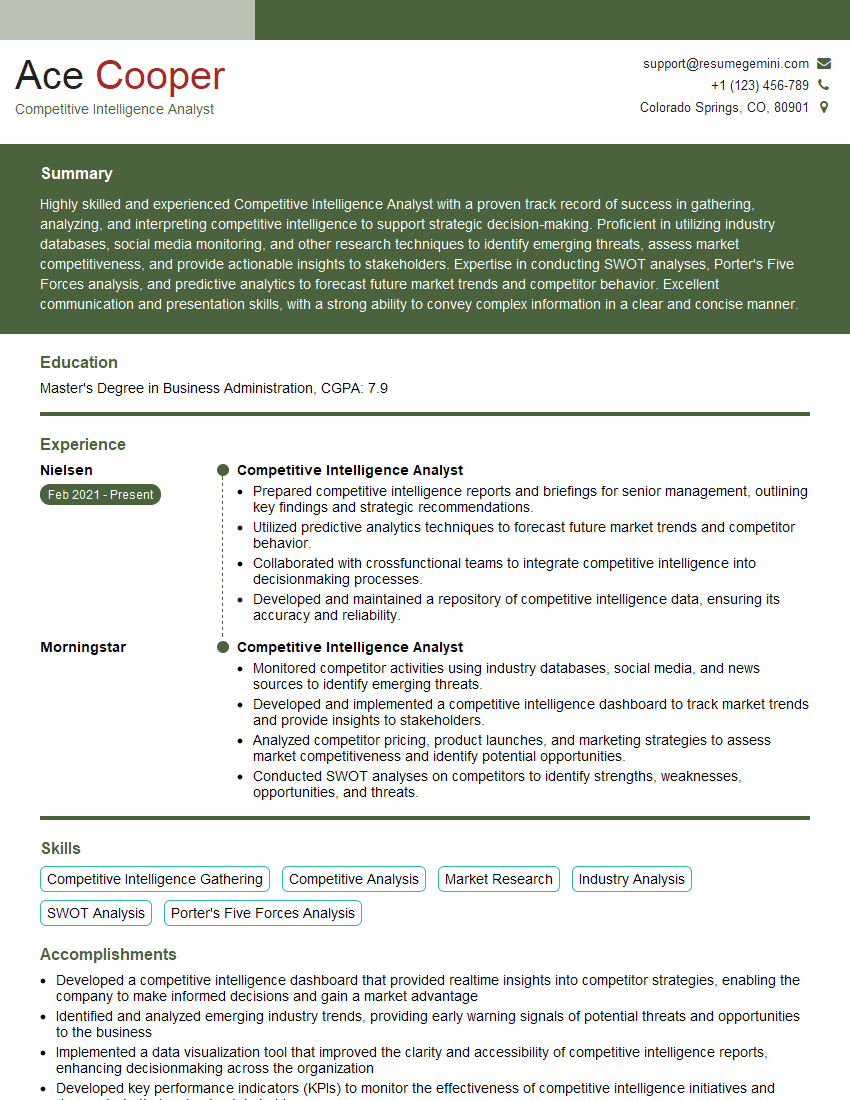
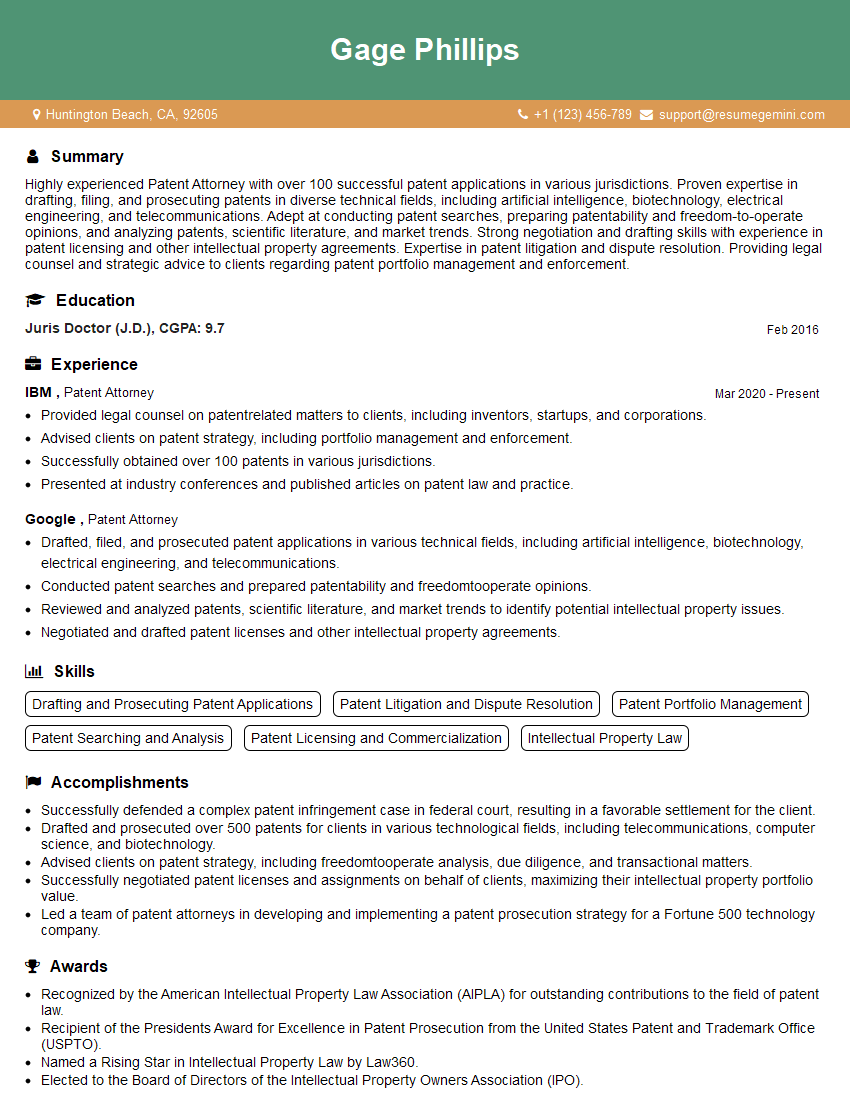
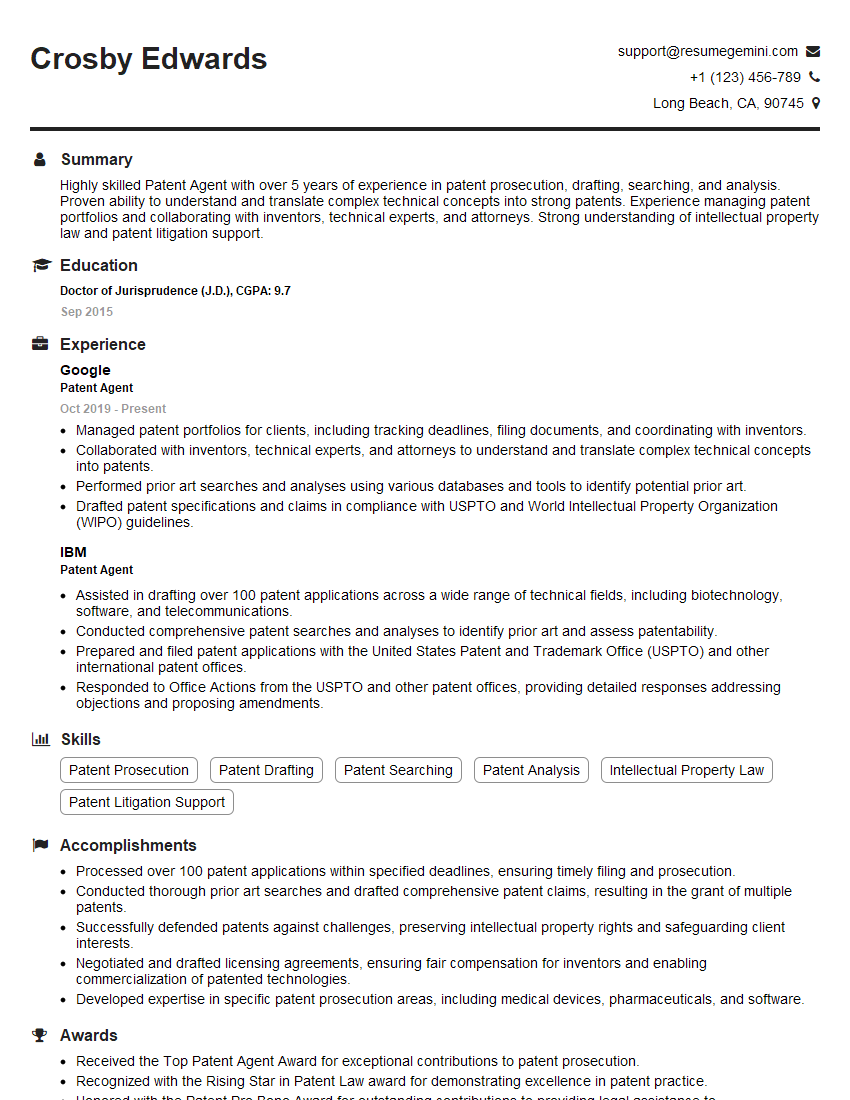
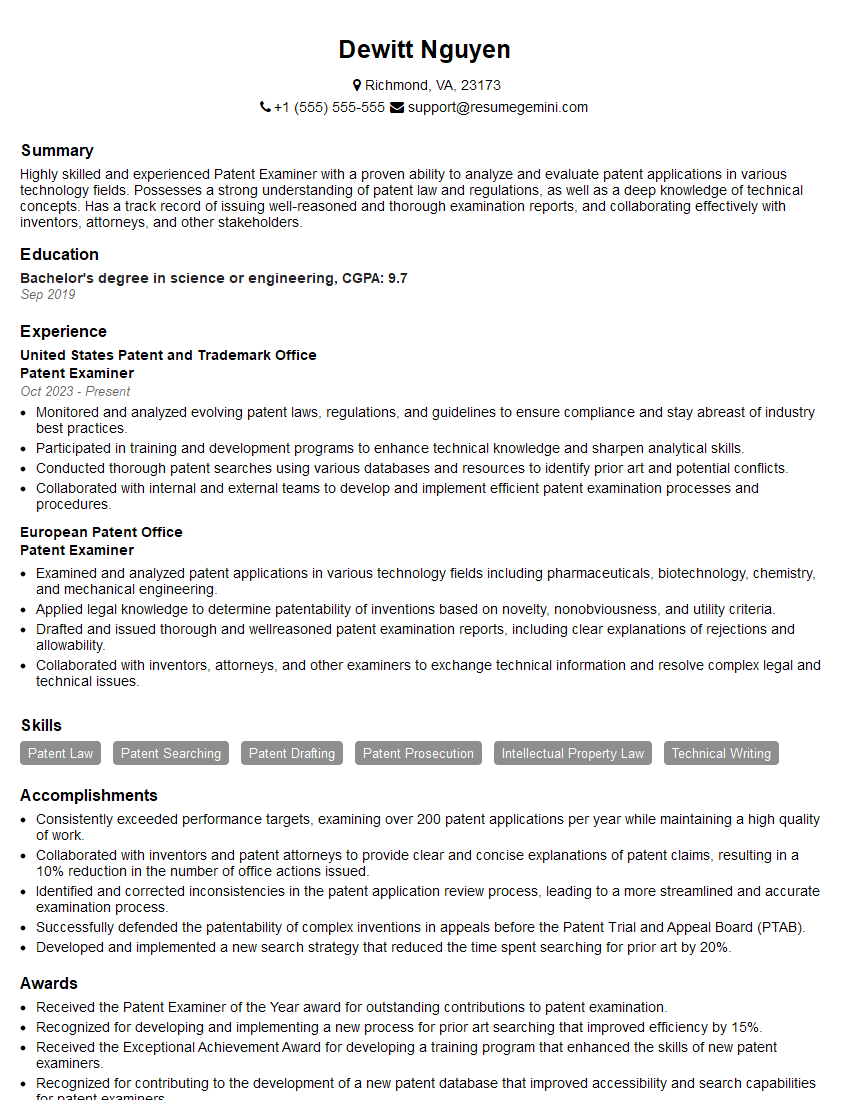
Mastering Patent Research and Development significantly enhances your career prospects within the innovation ecosystem. It opens doors to exciting opportunities in diverse industries and positions you as a valuable asset in driving innovation and protecting intellectual property. Building a strong and ATS-friendly resume is crucial for showcasing your skills and experience effectively to potential employers. To maximize your chances, leverage ResumeGemini, a trusted resource for crafting professional resumes. ResumeGemini provides examples of resumes specifically tailored to Patent Research and Development roles to help you present your qualifications compellingly. This will ensure your application stands out and helps you secure your desired position.
Explore more articles
Users Rating of Our Blogs
Share Your Experience
We value your feedback! Please rate our content and share your thoughts (optional).
What Readers Say About Our Blog
Very informative content, great job.
good