Unlock your full potential by mastering the most common Pattern Layout and Grading interview questions. This blog offers a deep dive into the critical topics, ensuring you’re not only prepared to answer but to excel. With these insights, you’ll approach your interview with clarity and confidence.
Questions Asked in Pattern Layout and Grading Interview
Q 1. Explain the difference between pattern layout and pattern grading.
Pattern layout and pattern grading are distinct but interconnected processes in apparel design. Pattern layout refers to arranging the pattern pieces efficiently on a fabric spread to minimize waste and maximize yield. It’s like a puzzle where you strategically place the pieces to get the most out of your fabric. Pattern grading, on the other hand, involves systematically increasing or decreasing the size of a pattern to accommodate different body measurements. Think of it as scaling a blueprint – you maintain the proportions but adjust the overall dimensions.
For example, a well-executed layout might involve mirroring pattern pieces to utilize symmetrical fabric properties, whereas grading ensures a size small bodice maintains the same shape and proportions as a size large bodice, only larger.
Q 2. Describe your experience with various pattern-making software.
Throughout my career, I’ve extensively used several pattern-making software packages. My experience includes working with industry-standard programs like Pattern Design System (PDS) and Optitex. I’m proficient in using their grading and nesting capabilities, as well as their ability to generate marker layouts. I’ve also worked with simpler CAD (Computer-Aided Design) software like Adobe Illustrator, which is useful for intricate design details and initial pattern sketching before transferring to a dedicated pattern-making program. Each program offers unique features; for instance, Optitex excels in 3D visualization, while PDS boasts robust grading algorithms. My experience allows me to adapt quickly to various software depending on project needs and client preferences.
Q 3. How do you ensure accuracy in pattern grading?
Accuracy in pattern grading is paramount. I employ several methods to ensure precision. First, I use established grading rules and industry standards (more on this in a later answer). Second, I always cross-check my graded patterns against original specifications and body measurement charts. Third, I use a combination of manual and software grading to verify the results. For instance, I might manually check critical points like armholes and necklines for smooth curves and consistent proportions. I also regularly use test garments in different sizes to validate the fit and make adjustments as needed. The iterative process of testing and refinement is crucial for guaranteeing accurate grading.
Q 4. What are the different methods for creating a basic bodice block?
Several methods exist for creating a basic bodice block (the foundational pattern for various garments). The most common methods include:
- Drafting from measurements: This involves calculating dimensions based on body measurements and using mathematical formulas to construct the block. It’s a precise method requiring strong mathematical understanding and experience.
- Using slopers: Slopers are basic pattern pieces that serve as a starting point. They are adjusted based on individual measurements and style requirements. This approach is often favored for its speed and adaptability.
- Draping: This technique involves manipulating fabric on a dress form to achieve the desired shape. The draped fabric is then transferred to paper to create the pattern. This method is more intuitive and visual, allowing for greater flexibility in design.
My preference often depends on the project’s complexity and time constraints. For quick prototyping, slopers are efficient. For complex designs needing a unique fit, draping offers more control.
Q 5. Explain your process for adjusting a pattern for different body types.
Adjusting patterns for different body types involves a multi-step process. First, I analyze the specific body type’s deviations from the standard block. This includes considering factors like bust, waist, hip circumference, shoulder width, and posture. Then, I make adjustments to the pattern pieces to accommodate these differences. For instance, a full-bust adjustment might involve adding width to the front bodice and making changes to the armhole. Similarly, a swayback adjustment requires shaping the back bodice to match the curve of the spine. Finally, I create a fitting prototype, make any necessary adjustments based on the fit of the prototype and iterate until the desired fit is achieved. This iterative process ensures the final pattern provides a comfortable and well-fitting garment regardless of the body shape.
Q 6. How do you handle complex design details during pattern making?
Handling complex design details during pattern making often involves breaking down the design into smaller, manageable components. For example, a garment with intricate darts, pleats, or ruffles would be approached by creating separate pattern pieces for each detail. These pieces are then integrated with the base bodice block, paying careful attention to seam lines and alignment. I leverage CAD software to simulate the construction of the complex garment and ensure all components work harmoniously. This includes careful consideration of fabric drape and how the fabric interacts with the added design elements. Testing and refinement are crucial here, ensuring each detail complements the overall design and produces the desired effect.
Q 7. What are the common grading rules and standards you follow?
Common grading rules and standards I follow ensure consistency across sizes. These rules often involve applying specific incremental increases or decreases to key measurements like bust, waist, hip, and shoulder width. These increments are determined by industry standards or client-specific requirements. For example, a standard increase might be 5/8” for each size increment across the bust, waist, and hip for women’s wear. However, these increments can vary depending on the garment type and style. Furthermore, I maintain consistent proportions between sizes; the shape of the pattern remains relatively unchanged, simply scaling up or down. Accuracy is achieved through the use of grading software, manual checks and the production of test garments to fine-tune any discrepancies.
Q 8. How do you identify and correct fitting issues in a garment?
Identifying and correcting fitting issues requires a systematic approach. It starts with careful observation of the garment on the wearer. Look for areas of pulling, bagginess, gaping, or tightness. These visual cues pinpoint problem areas. For example, pulling at the bust might indicate the bust dart is too shallow or misplaced. Bagginess in the back could mean excess ease or an incorrectly drafted back yoke.
Next, I use a combination of techniques to diagnose the cause. This might involve measuring the garment on the body, comparing it to the original measurements, or even creating a ‘fit sheet’ by marking directly on the garment where adjustments are needed. These markings are then transferred to the pattern pieces.
Corrections involve adjusting the pattern pieces. For example, a tight sleeve might need a small increase in the sleeve cap height. A gaping neckline could require adjusting the neckline curve or adding a facing. I often make small adjustments, test them on a muslin (a test garment made from inexpensive fabric), and iterate until the fit is ideal. It’s an iterative process; sometimes multiple adjustments are necessary to achieve a perfect fit.
Q 9. Describe your experience with different fabric types and their impact on pattern design.
My experience encompasses a wide range of fabrics, from lightweight silks and delicate laces to heavy-weight wools and sturdy denim. Each fabric type dictates design considerations. Lightweight fabrics drape differently than heavier ones and require different techniques to manage their flow. For example, a flowing silk dress needs less structure and fewer seams than a tailored wool jacket. Heavier fabrics might require additional support, like interfacing, to maintain their shape.
The drape and stability of the fabric also affect ease allowances. A stable fabric needs less ease than one that drapes significantly. Pattern design for a highly elastic fabric (like jersey knit) is very different from designing for a non-stretchy fabric, because the design must account for the fabric’s inherent stretch and recovery. I always consider the fabric’s properties—weight, drape, stretch, texture, and fiber content—when making design decisions, ensuring the final garment looks and fits perfectly.
Q 10. How do you use measurement charts to grade patterns?
Measurement charts are essential for grading patterns. They provide a set of incremental measurements for different sizes, allowing me to systematically scale the pattern. These charts usually contain measurements like bust, waist, hip, shoulder width, and sleeve length. Grading involves adjusting each pattern piece based on the difference between consecutive sizes in the chart.
The process can be manual or computer-aided. Manual grading involves making precise adjustments using a ruler and other tools. For example, to grade from a size 8 to a size 10, I would measure the difference between the size 8 and 10 bust measurements on the chart, then add that difference to the bust point of the pattern piece. I repeat this for all relevant measurements and points across all pattern pieces. Computerized grading software can automate this process, speeding up the work, allowing for complex grading operations and ensuring greater accuracy.
Q 11. What are some common challenges in pattern making and how do you overcome them?
Pattern making presents several challenges. One common issue is achieving consistent proportions across different sizes. Another is ensuring adequate ease (the extra fabric added to the pattern for comfort and movement). Incorrect ease can lead to ill-fitting garments. Also, dealing with different fabric types and their unique draping characteristics can be tricky.
I overcome these challenges by meticulously documenting every step of the process. I also use several tools and techniques. Creating muslins to test fit is crucial for identifying and correcting fit issues early. I meticulously check the accuracy of my measurements and pattern grading. Using grading software enhances accuracy and saves time. Finally, I maintain a detailed record of my work to troubleshoot potential problems in future projects.
Q 12. How do you ensure consistent sizing across different garment styles?
Consistent sizing across different garment styles is critical for brand recognition and customer satisfaction. I achieve this by using a standardized block (a basic pattern) as the foundation for all designs. This block is meticulously drafted and graded to ensure consistent sizing. Each new design is then drafted relative to this base block, maintaining proportional relationships throughout. For example, if I’m designing a shirt and a dress, both would stem from the same standardized bodice block, just adapted for the unique design details of each garment.
Thorough testing on various body types during the design process is also crucial to catch discrepancies and guarantee a consistent fit across various styles and sizes. Regular quality checks and feedback contribute to maintaining consistent sizing across the board.
Q 13. Explain your experience with different grading methods (e.g., proportional, numerical).
I’m experienced with both proportional and numerical grading methods. Proportional grading scales pattern pieces based on ratios derived from a base size. For example, a 10% increase from size 8 to 10 might be applied across all measurements. This method is quicker but may not always yield perfect fit. Numerical grading involves using precise measurements from a measurement chart to adjust each pattern piece individually. This is more accurate but more time-consuming.
The choice of method depends on the specific project and the desired level of precision. For simpler designs or when time is a factor, proportional grading might be sufficient. However, for complex designs or when precise fit is paramount, numerical grading is preferred. I often use a combination of both methods, using numerical grading for critical areas and proportional grading for less critical ones.
Q 14. How do you incorporate ease into your patterns?
Ease is crucial for garment comfort and fit. It’s the extra fabric added to the pattern to account for the wearer’s body movement and shape. I incorporate ease strategically at different points in the pattern, considering the fabric type and garment style. For example, I’d add more ease to the bust and waist areas for a close-fitting garment and less for a loose-fitting garment. Ease is added as a percentage or specific measurement depending on the design and fabric.
The amount of ease varies depending on the style, fabric, and fit. A fitted dress requires less ease than a loose-fitting shirt. Stretchy fabrics also need less ease than non-stretchy fabrics. I carefully calculate ease allowances based on experience, industry standards, and fit tests. Incorrect ease can result in garments that are too tight or too baggy.
Q 15. Describe your process for creating a pattern from a sketch or design.
Transforming a sketch into a functional pattern involves a methodical approach. I begin by analyzing the design sketch, noting key features like neckline, sleeve style, and overall silhouette. This informs my initial measurements and proportions. I then draft a basic block – a foundational pattern that serves as the starting point – tailored to the specific size and body type intended. This block might be a sloper (a very basic, close-fitting pattern) or a more advanced base pattern. Next, I manipulate the block, adding design elements from the sketch. For example, if the sketch features a flared skirt, I would add width and adjust the curves accordingly. I use various techniques like adding seam allowances (the extra fabric needed for stitching), creating darts (triangular folds that shape the garment), or manipulating existing seams (like princess seams or side seams) to achieve the desired shape and fit. Throughout this process, I constantly refer back to the sketch to maintain accuracy and consistency. Finally, I would create a test garment (muslin) to refine the fit before creating the final pattern.
For instance, if the design features a fitted bodice with a dropped waistline, I would start by modifying my bodice block to include shaping darts at the bust and waist, then adjust the waistline to the lower position specified in the design.
Career Expert Tips:
- Ace those interviews! Prepare effectively by reviewing the Top 50 Most Common Interview Questions on ResumeGemini.
- Navigate your job search with confidence! Explore a wide range of Career Tips on ResumeGemini. Learn about common challenges and recommendations to overcome them.
- Craft the perfect resume! Master the Art of Resume Writing with ResumeGemini’s guide. Showcase your unique qualifications and achievements effectively.
- Don’t miss out on holiday savings! Build your dream resume with ResumeGemini’s ATS optimized templates.
Q 16. How familiar are you with different types of pattern pieces (e.g., princess seams, darts)?
I am very familiar with a wide range of pattern pieces. I frequently work with princess seams, darts (bust, waist, shoulder), set-in sleeves, raglan sleeves, yokes, collars (various types), and pockets (patch, welt, inseam). Understanding how each piece functions within the overall garment is critical. For example, princess seams offer a more fitted silhouette than side seams; darts provide shaping; and the choice of sleeve type drastically impacts the garment’s overall look and ease of construction. I also have experience with more specialized pattern pieces, such as those required for tailored jackets or structured garments. Each piece requires a unique approach to ensure proper fit and function.
My experience extends to understanding how these pieces interact. For instance, I know that properly positioned darts are essential for a good fit, and that princess seams need to be carefully graded to ensure proper balance and prevent unwanted puckering. The selection of pattern pieces depends heavily on the design and desired aesthetic.
Q 17. Explain your experience with muslin fitting and adjustments.
Muslin fitting is an essential part of my process, allowing me to identify and correct fit issues before cutting into the final fabric. I typically create a muslin garment using a lightweight, inexpensive fabric. This allows for easy adjustments and alteration. I then fit the muslin on a dress form or a live model, making notations of areas needing alteration. Common adjustments involve easing fullness, taking in or letting out seams, raising or lowering the armhole, adjusting the neckline, or altering the length. These adjustments are meticulously transferred back to the pattern. This iterative process ensures a garment that is well-fitting and flattering.
For example, during a recent project, a client’s muslin revealed a tight fit across the shoulders. By carefully examining the muslin and the pattern, I identified the need to adjust the shoulder seam by adding a small amount of ease. This simple adjustment significantly improved the final fit.
Q 18. How do you manage multiple projects simultaneously in a fast-paced environment?
In a fast-paced environment, effective time management and organization are crucial. I utilize project management software to track multiple projects simultaneously. This software helps me prioritize tasks based on deadlines and dependencies. Each project has a dedicated folder with detailed notes, sketches, patterns, and measurement charts. I also employ a colour-coded system for my physical files to facilitate quick retrieval. Furthermore, I’m adept at breaking down large projects into smaller, manageable tasks, allowing me to maintain focus and efficiency. Clear communication with clients and team members is vital to ensure timely updates and address any unforeseen challenges.
I’ve found that setting realistic timelines and sticking to them, along with proactive communication about potential delays, is key to managing multiple projects without sacrificing quality.
Q 19. How do you incorporate client feedback into the pattern-making process?
Client feedback is invaluable. I actively solicit feedback at various stages of the process. I begin by thoroughly understanding their needs and expectations during the initial consultation. After the first muslin fitting, I discuss the client’s observations and make the necessary adjustments to the pattern. Post-fitting, I may have a further conversation to gather feedback. This iterative feedback loop ensures the final garment aligns with the client’s vision. I maintain detailed notes of all client feedback to track progress and ensure accuracy.
For example, a client might comment that the neckline is too high. I would then adjust the neckline on the pattern, create a new muslin, and check for fit again before proceeding with the final garment. The process is collaborative; client input is vital.
Q 20. What are your preferred methods for documenting your pattern-making process?
My documentation methods are comprehensive and adaptable. I utilize both physical and digital methods. For physical documentation, I meticulously label all my patterns and store them in a well-organized system. I use clear, concise notations on the patterns themselves, indicating any adjustments or alterations made. Digitally, I employ CAD software for pattern design and storage. This allows for easy pattern grading and manipulation. I also maintain detailed digital records, including sketches, client communication, measurements, fitting notes, and any technical specifications. This comprehensive approach ensures that any project can be easily revisited and replicated if needed.
This ensures reproducibility and allows for easy reference in the future, even after years have passed.
Q 21. Explain your experience with quality control in pattern making.
Quality control is integrated throughout my process. I meticulously check measurements at every stage – from the initial block creation to the final garment. I use quality control checklists to ensure consistent accuracy and minimize errors. During the muslin fitting stage, I thoroughly inspect for any imperfections in fit or construction. I also regularly calibrate my equipment and utilize precision tools to maintain accuracy. Finally, a final inspection of the completed garment ensures it meets the highest standards before delivery to the client. This rigorous approach ensures the creation of high-quality patterns and garments.
For instance, I regularly check my measuring tape for accuracy and use a pattern ruler to ensure precise seam allowances. This careful attention to detail contributes to the overall quality of the final product.
Q 22. How do you stay up-to-date with the latest trends and techniques in pattern making?
Staying current in pattern making requires a multi-pronged approach. It’s not just about knowing the latest software; it’s about understanding the evolving design aesthetics and technical innovations. I actively engage in several key strategies:
- Industry Publications and Blogs: I regularly read trade magazines like Threads and Drapers Record, and follow influential blogs and online forums dedicated to pattern making and garment construction. This keeps me abreast of new techniques, software updates, and emerging trends in fabric technology.
- Conferences and Workshops: Attending industry conferences and workshops allows me to network with other professionals, learn from leading experts through hands-on training, and discover the latest tools and techniques. For example, I recently attended a workshop on advanced digital pattern making using CAD software.
- Continuing Education: I actively seek out online courses and webinars to expand my skillset. Platforms like Skillshare and Udemy offer excellent courses on specialized techniques like draping, pattern grading for plus sizes, and innovative approaches to pattern design.
- Observing Market Trends: I pay close attention to runway shows, fashion publications, and retail trends to understand the shapes, silhouettes, and construction methods gaining popularity. This allows me to anticipate future demands and adapt my skills accordingly.
This holistic approach ensures I remain at the forefront of pattern making, blending traditional skills with the latest technological advancements.
Q 23. What are your strengths and weaknesses as a pattern maker?
My strengths lie in my meticulous attention to detail and my problem-solving abilities. I excel at translating complex design concepts into accurate, functional patterns. I’m proficient in both traditional and digital pattern making techniques, allowing me to adapt to various project requirements and deadlines. My experience in grading patterns for a wide range of sizes ensures a consistent fit across different body types. I’m also adept at using industry-standard software, such as Adobe Illustrator and CAD software.
However, like everyone, I have areas for improvement. While I am proficient in many pattern making techniques, I am always striving to enhance my expertise in draping, particularly with unconventional fabrics. I also aim to improve my speed in creating patterns for very complex garments, focusing on streamlining my workflow through better organization and time management.
Q 24. How do you collaborate effectively with other team members (e.g., designers, sewers)?
Effective collaboration is crucial in the fashion industry. My approach centers on clear communication and proactive teamwork. I believe in open dialogue with designers to fully understand their creative vision. I ask clarifying questions, such as the desired fit, fabric drape, and construction details, to ensure I translate the design accurately into a pattern. This might involve discussing details like seam allowances, ease, or specific design elements that need to be accommodated.
With sewers, I ensure the patterns are clearly marked, with comprehensive instructions and any necessary notes about fabric handling or special construction techniques. This might involve creating detailed technical sketches alongside the patterns. I’m always available to answer questions and address any concerns they may have during the production process. By prioritizing clear communication and shared understanding, I contribute to a collaborative and efficient workflow.
Q 25. Describe a time you had to solve a challenging pattern-making problem.
One challenging project involved creating a pattern for a complex, asymmetrical draped dress with multiple layers of contrasting fabrics. The designer’s vision was very specific, demanding an unusual silhouette that incorporated both structured and flowing elements. Initially, I tried to create the pattern using traditional methods, but the asymmetry and layering proved difficult to manage accurately.
To overcome this, I switched to a digital approach using CAD software. This allowed me to manipulate the pattern pieces more easily, experiment with different draping effects, and make precise adjustments. I utilized the software’s simulation capabilities to predict how the fabrics would drape and interact, helping me refine the pattern before physically cutting and sewing a sample. This iterative process, combining digital precision with my experience, led to a successful outcome, exceeding the client’s expectations.
Q 26. How do you utilize technology to enhance your efficiency in pattern making?
Technology plays a vital role in enhancing my efficiency and accuracy. I leverage several tools to optimize my workflow:
- CAD Software: Software like
Pattern Design Softwareallows for precise pattern creation, manipulation, and grading. This eliminates the need for tedious manual adjustments and reduces errors. It also facilitates seamless collaboration with designers and other team members. - Digital Pattern Cutting: Using a digital cutter significantly reduces the time spent physically cutting patterns, especially for large production runs. It also ensures consistent accuracy across all pattern pieces.
- 3D Modeling Software: Some projects benefit from 3D modeling to visualize the garment’s fit and drape before production, reducing the need for costly and time-consuming revisions. This allows for better planning and collaboration with designers.
- Spreadsheets and Databases: I use spreadsheets to manage pattern grading, measurements, and other crucial data. Databases can be used to store and manage pattern files, facilitating efficient retrieval and reuse of patterns.
By integrating these technologies into my workflow, I can create complex patterns more quickly and accurately, enabling me to focus on the creative aspects of design and problem-solving.
Q 27. Describe your experience with creating patterns for various garment types (e.g., dresses, pants, jackets).
My experience encompasses a broad range of garment types. I’ve created patterns for:
- Dresses: From simple A-line designs to complex, structured gowns, including various sleeve styles, necklines, and fitting details. I have experience with both woven and knit fabrics.
- Pants: I’ve developed patterns for various styles, including jeans, trousers, leggings, and skirts, paying close attention to fit and construction details like pockets and closures.
- Jackets: This includes blazers, coats, and jackets with various levels of structure and complexity, incorporating features such as linings, interfacings, and closures.
- Other Garments: My experience also extends to creating patterns for tops, shirts, shorts, and other garments. I am comfortable with various construction techniques and fabric types.
My approach to each garment type involves thorough consideration of design specifications, fabric selection, and the intended fit. I employ different methods depending on the project’s needs, ranging from flat pattern drafting to draping, always ensuring the final product is both aesthetically pleasing and well-constructed.
Key Topics to Learn for Pattern Layout and Grading Interview
- Understanding Garment Construction: Grasping the fundamental principles of how garments are constructed is crucial. This includes understanding seam allowances, ease, and different types of closures.
- Pattern Design Principles: Familiarize yourself with the key elements of effective pattern design, including balance, proportion, and silhouette. Consider how these principles translate into practical grading.
- Grading Techniques: Master various grading methods, both manual and digital. Understand the differences between proportional and non-proportional grading and when to apply each.
- Software Proficiency: Demonstrate familiarity with industry-standard pattern making and grading software. Be prepared to discuss your experience and skills with specific programs.
- Understanding Fabric Properties: Knowing how different fabric types behave during the grading process is essential. Be prepared to discuss draping, stretch, and grainline considerations.
- Problem-Solving and Adjustments: Interviewers will assess your ability to identify and correct pattern issues. Practice troubleshooting common grading problems and demonstrate your problem-solving skills.
- Quality Control and Accuracy: Highlight your attention to detail and your ability to ensure consistent accuracy throughout the grading process. This is a crucial aspect of the role.
- Industry Standards and Best Practices: Stay up-to-date on current industry standards and best practices related to pattern making and grading. Show your commitment to continuous learning.
Next Steps
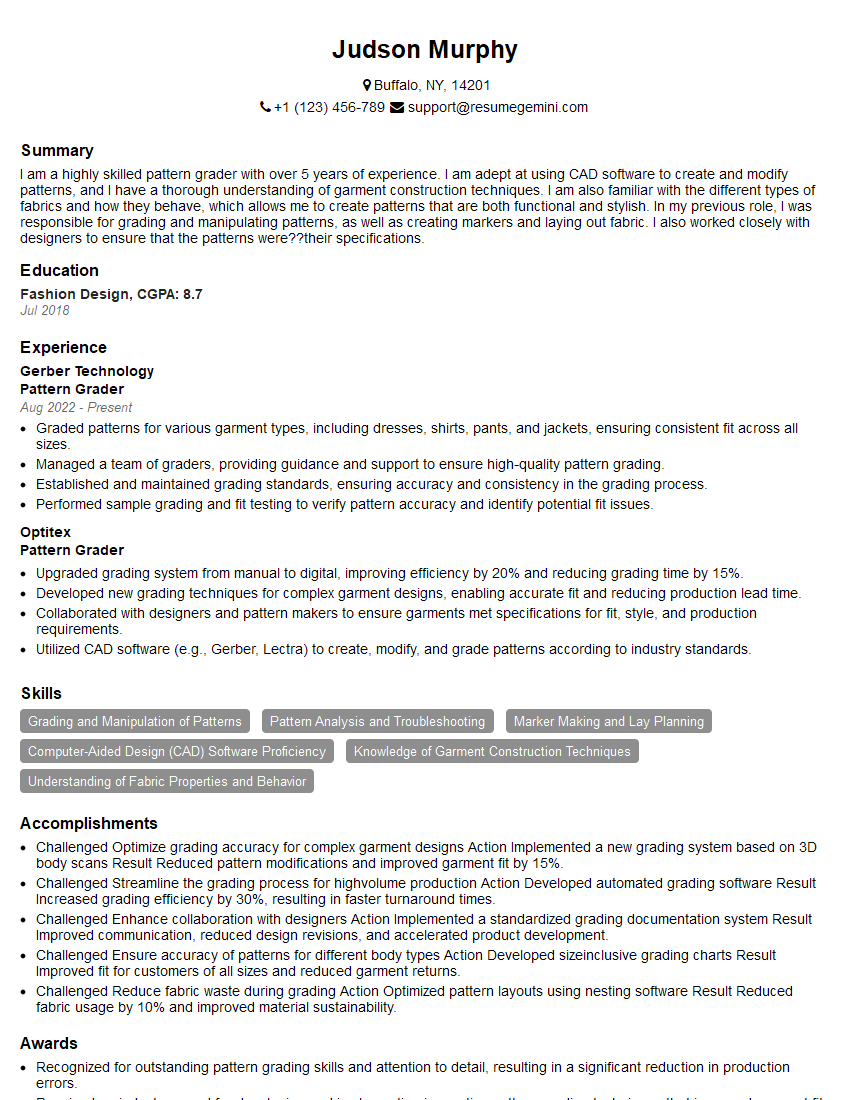
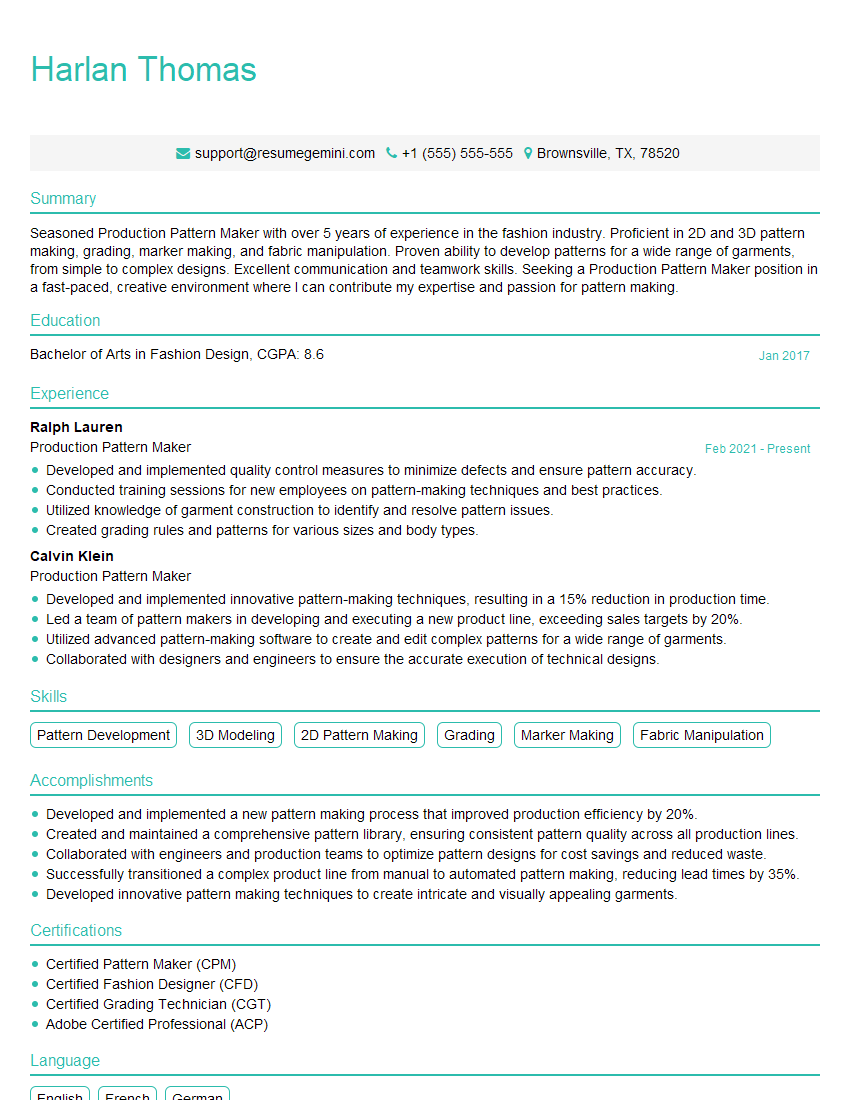
Mastering Pattern Layout and Grading opens doors to exciting opportunities in the fashion and apparel industry, offering career growth and diverse roles. To maximize your job prospects, crafting a strong, ATS-friendly resume is paramount. ResumeGemini is a trusted resource that can help you build a professional resume that highlights your skills and experience effectively. Examples of resumes tailored to Pattern Layout and Grading positions are available to guide you. Invest time in creating a compelling resume – it’s your first impression on potential employers.
Explore more articles
Users Rating of Our Blogs
Share Your Experience
We value your feedback! Please rate our content and share your thoughts (optional).
What Readers Say About Our Blog
Hello,
we currently offer a complimentary backlink and URL indexing test for search engine optimization professionals.
You can get complimentary indexing credits to test how link discovery works in practice.
No credit card is required and there is no recurring fee.
You can find details here:
https://wikipedia-backlinks.com/indexing/
Regards
NICE RESPONSE TO Q & A
hi
The aim of this message is regarding an unclaimed deposit of a deceased nationale that bears the same name as you. You are not relate to him as there are millions of people answering the names across around the world. But i will use my position to influence the release of the deposit to you for our mutual benefit.
Respond for full details and how to claim the deposit. This is 100% risk free. Send hello to my email id: [email protected]
Luka Chachibaialuka
Hey interviewgemini.com, just wanted to follow up on my last email.
We just launched Call the Monster, an parenting app that lets you summon friendly ‘monsters’ kids actually listen to.
We’re also running a giveaway for everyone who downloads the app. Since it’s brand new, there aren’t many users yet, which means you’ve got a much better chance of winning some great prizes.
You can check it out here: https://bit.ly/callamonsterapp
Or follow us on Instagram: https://www.instagram.com/callamonsterapp
Thanks,
Ryan
CEO – Call the Monster App
Hey interviewgemini.com, I saw your website and love your approach.
I just want this to look like spam email, but want to share something important to you. We just launched Call the Monster, a parenting app that lets you summon friendly ‘monsters’ kids actually listen to.
Parents are loving it for calming chaos before bedtime. Thought you might want to try it: https://bit.ly/callamonsterapp or just follow our fun monster lore on Instagram: https://www.instagram.com/callamonsterapp
Thanks,
Ryan
CEO – Call A Monster APP
To the interviewgemini.com Owner.
Dear interviewgemini.com Webmaster!
Hi interviewgemini.com Webmaster!
Dear interviewgemini.com Webmaster!
excellent
Hello,
We found issues with your domain’s email setup that may be sending your messages to spam or blocking them completely. InboxShield Mini shows you how to fix it in minutes — no tech skills required.
Scan your domain now for details: https://inboxshield-mini.com/
— Adam @ InboxShield Mini
Reply STOP to unsubscribe
Hi, are you owner of interviewgemini.com? What if I told you I could help you find extra time in your schedule, reconnect with leads you didn’t even realize you missed, and bring in more “I want to work with you” conversations, without increasing your ad spend or hiring a full-time employee?
All with a flexible, budget-friendly service that could easily pay for itself. Sounds good?
Would it be nice to jump on a quick 10-minute call so I can show you exactly how we make this work?
Best,
Hapei
Marketing Director
Hey, I know you’re the owner of interviewgemini.com. I’ll be quick.
Fundraising for your business is tough and time-consuming. We make it easier by guaranteeing two private investor meetings each month, for six months. No demos, no pitch events – just direct introductions to active investors matched to your startup.
If youR17;re raising, this could help you build real momentum. Want me to send more info?
Hi, I represent an SEO company that specialises in getting you AI citations and higher rankings on Google. I’d like to offer you a 100% free SEO audit for your website. Would you be interested?
Hi, I represent an SEO company that specialises in getting you AI citations and higher rankings on Google. I’d like to offer you a 100% free SEO audit for your website. Would you be interested?
good