Unlock your full potential by mastering the most common Performance and Weight Analysis interview questions. This blog offers a deep dive into the critical topics, ensuring you’re not only prepared to answer but to excel. With these insights, you’ll approach your interview with clarity and confidence.
Questions Asked in Performance and Weight Analysis Interview
Q 1. Explain the difference between static and dynamic weight analysis.
Static weight analysis considers the weight of a component or assembly at a specific point in time, typically without considering dynamic effects like acceleration or vibration. Think of it like weighing a car on a scale – you get a single, unchanging weight. Dynamic weight analysis, on the other hand, considers how the weight of a component affects its performance under various operating conditions and dynamic loads. This is like understanding how the car’s weight affects its handling during cornering or acceleration. The weight itself might remain constant, but its *impact* is variable.
For example, a static analysis might simply calculate the total weight of a car’s chassis. A dynamic analysis would consider how the chassis’ weight contributes to the car’s overall inertia, affecting acceleration and braking performance, or how weight distribution impacts handling and stability during maneuvers.
Q 2. Describe your experience with Finite Element Analysis (FEA) for weight optimization.
I have extensive experience using Finite Element Analysis (FEA) for weight optimization. FEA allows us to virtually model a component or assembly and subject it to various loads and boundary conditions. This enables us to identify areas of high stress and strain concentration. By understanding these stress patterns, we can strategically remove material from areas with lower stress, reducing weight without compromising structural integrity. I’ve used FEA software like ANSYS and Abaqus to analyze everything from automotive chassis components to aerospace structures.
For instance, in a recent project optimizing an aircraft wing, we used FEA to simulate flight loads. The analysis highlighted regions where material could be removed without significant strength reduction. This led to a 15% weight reduction in the wing, resulting in improved fuel efficiency.
Q 3. How do you identify and prioritize areas for weight reduction in a design?
Identifying and prioritizing areas for weight reduction requires a systematic approach. It starts with a thorough understanding of the design’s requirements and functionality. I typically begin by creating a weight breakdown structure, analyzing each component’s contribution to the overall weight. This allows me to pinpoint major weight contributors. Next, I assess the criticality of each component to the overall performance. Components with less stringent performance requirements are prioritized for weight reduction.
- Material Selection: Substituting heavier materials with lighter alternatives (e.g., aluminum for steel) can be a significant factor.
- Design Optimization: Employing topology optimization within FEA to remove unnecessary material while maintaining structural integrity.
- Geometric Changes: Modifying shapes to reduce material usage without affecting performance. For example, hollowing out components where possible.
Prioritization often uses a weighted scoring system, considering both weight savings potential and performance impact. This helps in making informed decisions about where to focus resources.
Q 4. What are the common methods used for performance and weight analysis?
Common methods for performance and weight analysis include:
- Finite Element Analysis (FEA): As mentioned previously, this method is crucial for structural analysis and weight optimization.
- Computational Fluid Dynamics (CFD): Used to analyze fluid flow around components, essential for aerodynamic optimization, which indirectly impacts weight by reducing drag.
- Multibody Dynamics (MBD): Simulates the movement and interactions of multiple components in a system, critical for understanding dynamic loads and their impact on weight.
- Experimental Testing: Physical testing provides validation data for simulations and helps identify unforeseen issues.
- Empirical Methods: Using historical data and established relationships to estimate weight and performance.
The choice of method depends on the specific application and complexity of the design. Often, a combination of these methods provides the most comprehensive and accurate results.
Q 5. Explain the concept of Pareto optimization in the context of weight and performance.
Pareto optimization, also known as multi-objective optimization, is a crucial concept in balancing performance and weight. Imagine a graph where one axis represents weight and the other represents performance. A Pareto optimal solution is a point on the graph where you cannot improve performance without increasing weight, or reduce weight without sacrificing performance. Any improvement in one metric requires a compromise in the other.
In the context of a car design, a Pareto optimal solution might represent a balance between fuel efficiency (performance) and overall vehicle weight. You might find a point on the graph where reducing weight further requires a significant drop in fuel efficiency, indicating you’ve reached a Pareto optimal point.
Q 6. How do you balance performance requirements with weight constraints?
Balancing performance requirements with weight constraints involves iterative design and analysis. It’s a trade-off. You need to clearly define the performance targets (e.g., strength, stiffness, speed, fuel efficiency) and the weight limits. A common approach uses optimization algorithms that explore the design space, searching for solutions that meet the performance criteria while staying within weight constraints.
For instance, in designing a racing bicycle, you might need to balance the stiffness of the frame (performance) with its weight to minimize the overall weight of the bike without sacrificing the rider’s ability to efficiently transfer power. This would involve multiple simulations and iterations using FEA, along with careful material selection.
Q 7. Describe your experience with Computational Fluid Dynamics (CFD) in weight optimization.
I have significant experience using Computational Fluid Dynamics (CFD) in weight optimization, particularly in aerodynamic design. CFD allows us to simulate airflow around a component, enabling the identification of areas of high drag. By modifying the design to reduce drag, we can indirectly reduce weight because less structural material is needed to withstand lower aerodynamic loads.
In one project involving the design of a race car, we utilized CFD to optimize the car’s body shape. The analysis revealed areas of high pressure drag. Subsequent design iterations, guided by CFD results, led to a streamlined body, reducing drag by 10%. This allowed us to reduce the weight of the car’s chassis and other components without compromising its overall performance.
Q 8. What software packages are you proficient in for performance and weight analysis?
My proficiency in software for performance and weight analysis spans several leading packages. I’m highly experienced with ANSYS Mechanical, particularly for finite element analysis (FEA) to assess structural performance and optimize for weight. I’m also adept at using Abaqus, which offers advanced capabilities for complex material models and nonlinear analysis crucial for accurate weight prediction. For topology optimization, I frequently utilize Altair OptiStruct and ANSYS Topology Optimization. Finally, I’m proficient in CAD software like SolidWorks and Autodesk Inventor, which are essential for creating and modifying the models used in these analyses.
Beyond these specific packages, I possess a strong understanding of the underlying principles of FEA and optimization algorithms, allowing me to adapt to new software as needed and interpret results effectively.
Q 9. How do material properties influence weight and performance?
Material properties are paramount in determining both weight and performance. Imagine designing a car: using steel makes it strong but heavy, while using aluminum provides comparable strength with less weight, impacting fuel efficiency (performance). However, aluminum might not be as strong as steel in certain applications, requiring thicker sections to maintain the needed performance level, thus increasing weight.
Specifically, factors like density (mass per unit volume) directly impacts weight. Lower density materials, like aluminum or titanium, result in lighter designs. Young’s modulus (stiffness) influences structural performance; a higher modulus material resists deformation better under load. Yield strength and ultimate tensile strength define the material’s ability to withstand stress before yielding or failing, affecting the design’s safety and durability. Poisson’s ratio (the ratio of lateral strain to axial strain) also plays a crucial role in stress analysis. Finally, the material’s fatigue properties affect its lifespan under cyclical loading.
The selection process involves careful trade-offs between these properties to achieve optimal performance and weight. For instance, a high-performance aircraft might prioritize high strength-to-weight ratio materials like carbon fiber composites, even though they are more expensive.
Q 10. Explain your understanding of design for manufacturing (DFM) in relation to weight reduction.
Design for Manufacturing (DFM) is critically important in weight reduction. It’s about designing parts not just for functionality but also for efficient and cost-effective manufacturing. Weight reduction efforts can be undermined by designs that are difficult or expensive to produce.
For instance, a complex part requiring intricate machining might be lighter, but the cost and time involved negate the benefits. DFM principles encourage simpler geometries, standardized components, and manufacturing processes that minimize material waste. This could involve using features like ribs for stiffness instead of solid sections, thereby reducing weight without compromising structural integrity. Employing techniques like injection molding for plastics or casting for metals allows for efficient mass production and weight optimization within the chosen material.
Close collaboration with manufacturing engineers during the design phase is key to successfully integrating DFM for weight reduction. This ensures the design is not only lighter but also manufacturable at scale and within budget.
Q 11. How do you handle conflicting performance and weight requirements?
Conflicting performance and weight requirements are common in engineering design. Resolving these conflicts requires a systematic approach, often involving iterative design and analysis. A common strategy is to utilize a multi-objective optimization technique. This involves defining both performance metrics (like stiffness or strength) and weight as objectives, often with assigned weighting factors to reflect their relative importance.
I typically employ Pareto optimization, where I seek solutions that represent a trade-off between these conflicting goals. The Pareto front identifies a set of optimal solutions—none of which is strictly superior to another—offering a range of choices balancing performance and weight. The final decision often depends on other factors such as cost, manufacturability, and other relevant constraints.
For example, in designing a bicycle frame, we might balance stiffness (performance) with weight. The Pareto front would show designs ranging from very stiff (and heavy) to lighter but less stiff frames. The choice depends on whether the bicycle is designed for racing or casual riding.
Q 12. Describe your experience with topology optimization.
Topology optimization is a powerful tool for achieving significant weight reduction while maintaining performance. It’s essentially an algorithm that determines the optimal material layout within a given design space to satisfy specified performance constraints.
My experience with topology optimization involves using software like Altair OptiStruct and ANSYS Topology Optimization to create designs with complex, organically-shaped structures. These designs often look very different from conventionally designed parts, leading to significant weight savings. The process starts with a defined design space and boundary conditions, followed by specifying performance targets (e.g., minimum stiffness or stress constraints). The software then iteratively removes material from areas of low stress, leaving behind an optimal structure that meets the specified criteria.
A real-world example I worked on involved optimizing a car chassis. By using topology optimization, we reduced the weight by 20% without compromising its strength. However, it’s important to remember that the resulting shapes often need to be post-processed and refined for manufacturability.
Q 13. What are some common challenges in performing performance and weight analysis?
Several challenges commonly arise in performance and weight analysis. One major challenge is the complexity of real-world systems. Accurately modeling all relevant physical phenomena, material behaviors, and boundary conditions can be extremely difficult. This can lead to inaccuracies in the analysis results.
Another challenge is computational cost. Complex models, especially those involving nonlinear behavior or large numbers of elements, can require significant computational resources and time. This necessitates careful model simplification and efficient solution techniques.
Furthermore, validating the analysis results with experimental data can be expensive and time-consuming. The need to balance the accuracy of the model with the cost and feasibility of validation is a constant challenge. Lastly, managing and interpreting large datasets generated during simulation requires effective data management strategies and analysis techniques.
Q 14. How do you validate your performance and weight analysis results?
Validating performance and weight analysis results is crucial to ensure their reliability. This typically involves a multi-pronged approach combining different validation methods.
First, I perform model verification to ensure the numerical model is correctly implemented and free of errors. This might involve comparing results with simpler analytical solutions or checking convergence of the numerical solution. Then, experimental validation involves comparing simulation results with actual measurements from physical prototypes or tests. Discrepancies between simulation and experiment need careful investigation. This might involve refining the model, checking material properties, or accounting for other factors not initially included in the model.
Sensitivity analysis helps assess how changes in input parameters affect the results, helping to identify sources of uncertainty and improve model accuracy. Finally, benchmarking against industry standards and previously validated results provides further confidence in the analysis results. A combination of these methods provides a robust validation process.
Q 15. Explain your approach to documenting and presenting your analysis findings.
Documenting and presenting analysis findings requires a structured approach to ensure clarity and impact. My process begins with a clear executive summary highlighting key findings and recommendations. This is followed by a detailed report including the methodology employed, assumptions made, and a comprehensive presentation of the results. Visualizations are paramount – I utilize charts, graphs, and 3D models to present complex data in an accessible manner. For example, a weight reduction analysis might be presented with a bar chart showing weight savings per component and a 3D model highlighting areas of significant weight reduction. Finally, I always conclude with actionable recommendations, clearly outlining next steps and potential risks/opportunities.
Specific tools I frequently use include Microsoft Excel for data analysis and presentation, MATLAB for complex calculations and simulations, and CAD software (such as SolidWorks or CATIA) for 3D modeling and visualization. I always strive to tailor my communication to the audience – a technical report for engineers will differ significantly from a presentation to senior management. My goal is to ensure the audience not only understands the results but also appreciates their implications and can utilize them effectively in decision-making.
Career Expert Tips:
- Ace those interviews! Prepare effectively by reviewing the Top 50 Most Common Interview Questions on ResumeGemini.
- Navigate your job search with confidence! Explore a wide range of Career Tips on ResumeGemini. Learn about common challenges and recommendations to overcome them.
- Craft the perfect resume! Master the Art of Resume Writing with ResumeGemini’s guide. Showcase your unique qualifications and achievements effectively.
- Don’t miss out on holiday savings! Build your dream resume with ResumeGemini’s ATS optimized templates.
Q 16. Describe a time you had to optimize a design for both weight and performance.
During a project designing a lightweight robotic arm for a space mission, we faced the challenge of optimizing for both weight and performance (payload capacity and speed). Initially, the design focused heavily on lightweighting, using carbon fiber composites extensively. However, this resulted in reduced stiffness and structural integrity, impacting performance. We addressed this using a multi-objective optimization approach. This involved using Finite Element Analysis (FEA) to simulate various designs, incorporating both weight and stiffness constraints. We iteratively refined the design, adjusting the layup of the carbon fiber composite and exploring different geometries. The solution involved strategically reinforcing high-stress areas, slightly increasing the material usage in these critical locations while maintaining overall weight reduction compared to the initial design. The final design achieved a significant weight reduction (approximately 15%) without compromising the required payload capacity and operational speed. This project exemplified the importance of iterative design and the need for considering performance implications during the lightweighting process.
Q 17. What are the key considerations for lightweighting in different materials (e.g., metals, composites)?
Lightweighting strategies vary significantly depending on the material. For metals, techniques include:
- Material Selection: Using higher-strength-to-weight ratio alloys like aluminum alloys or titanium.
- Topology Optimization: Using software to remove material from areas with low stress, creating a lighter yet structurally sound part.
- Thin-Walling: Reducing the thickness of components where feasible.
Composites offer more diverse possibilities:
- Fiber Orientation: Optimizing the fiber orientation to maximize stiffness in critical directions while minimizing material usage.
- Layup Optimization: Strategically varying the number of plies and their orientation to achieve optimal weight and performance.
- Sandwich Structures: Utilizing a core material with high strength-to-weight ratio, sandwiched between thin face sheets.
Each material requires a distinct approach, and the optimal strategy often depends on factors like cost, manufacturing capabilities, and specific performance requirements. Understanding these material-specific nuances is critical for effective lightweighting.
Q 18. How do you account for uncertainties and tolerances in your analysis?
Uncertainties and tolerances are inevitable in engineering design. To account for these, I employ several strategies:
- Probabilistic Analysis: Instead of using deterministic values, I incorporate statistical distributions to represent uncertainties in material properties, dimensions, and loads. This allows for a more realistic assessment of the design’s performance under varying conditions.
- Monte Carlo Simulation: This technique involves running numerous simulations with randomly sampled input parameters from their probability distributions. This gives a statistical distribution of the outputs, such as stress or deflection, enabling the identification of potential failure modes and quantification of risk.
- Factor of Safety: A factor of safety is applied to the design to account for uncertainties not explicitly modeled. This ensures that the design is robust enough to withstand unexpected variations.
For example, when designing a structural component, I would use FEA software to model the structure and then run a Monte Carlo simulation, varying the material yield strength and applied loads within specified tolerances. The resulting data helps determine the probability of failure and to make informed decisions about design modifications.
Q 19. Explain your understanding of design trade-offs in relation to weight and performance.
Design trade-offs between weight and performance are inherent in almost every engineering project. Improving one often comes at the expense of the other. Consider the example of a car chassis: a lighter chassis improves fuel efficiency (performance), but it might reduce strength and crashworthiness. This necessitates a balanced approach. Techniques like Pareto optimization help to identify the optimal trade-off point. This involves plotting multiple design solutions on a graph with weight on one axis and performance (e.g., stiffness, strength) on the other. The Pareto front represents the set of designs where improvement in one attribute requires a sacrifice in the other – the optimal design lies on this front. The specific choice along the Pareto front depends on the priorities of the project. For a racing car, performance might be prioritized over weight, whereas for a fuel-efficient vehicle, the opposite might be true. The decision-making process should involve careful consideration of the relative importance of weight and performance within the specific application.
Q 20. What are some innovative lightweighting techniques you are familiar with?
Several innovative lightweighting techniques are currently transforming design:
- Additive Manufacturing (3D Printing): Allows for the creation of complex, lattice structures with high strength-to-weight ratios, impossible to achieve with traditional manufacturing methods.
- Bio-inspired Design: Mimicking the lightweight and high-strength structures found in nature, such as the honeycomb structure of beehives or the intricate designs of bone.
- Functionally Graded Materials (FGMs): Materials with varying composition and properties throughout their volume, enabling tailored performance and improved weight reduction.
- Topology Optimization Software: Advanced software tools allowing engineers to refine designs based on optimal material distribution to decrease weight while maintaining structural integrity.
These techniques represent a paradigm shift in lightweighting, enabling the creation of highly optimized structures with significantly reduced weight and improved performance.
Q 21. Describe your experience with multidisciplinary optimization (MDO).
Multidisciplinary Optimization (MDO) is crucial for complex systems where multiple disciplines (e.g., aerodynamics, structures, thermal management) interact and influence each other. My experience with MDO involves using integrated optimization techniques to balance competing objectives across these disciplines. This often involves using specialized software packages that can manage the interactions between different analysis tools (e.g., CFD for aerodynamics, FEA for structures). For instance, in designing an aircraft wing, MDO would simultaneously optimize the wing’s aerodynamics for lift and drag, while ensuring the structural integrity and minimizing its weight. Techniques like collaborative optimization or hierarchical optimization are commonly used to solve these complex problems. The key is to effectively manage the interactions between the different disciplines, iteratively refining the design until an optimal balance is achieved. My expertise allows me to efficiently utilize MDO to find optimized design solutions which are often superior to those achieved through a sequential or disciplinary optimization approach.
Q 22. How do you ensure the accuracy and reliability of your weight and performance predictions?
Ensuring accuracy and reliability in weight and performance predictions is paramount. It’s a multi-faceted process that begins with meticulous data acquisition. We rely on high-fidelity Computer-Aided Engineering (CAE) tools, like finite element analysis (FEA) for structural analysis and computational fluid dynamics (CFD) for aerodynamic studies. The accuracy of these predictions hinges on the quality of the input data – accurate geometry models, material properties, and boundary conditions.
We also employ validation techniques. This involves comparing our predictions against experimental data from physical testing. Discrepancies are carefully analyzed to identify sources of error. This could range from refining the CAE model to improving the accuracy of material properties, or even identifying previously unaccounted-for factors. For instance, in predicting the weight of a car component, we might initially underestimate the weight of the welds. Experimental validation allows us to refine our models and improve future predictions. Regular calibration of our tools and methodologies is also critical to maintain long-term accuracy and reliability. Finally, uncertainty quantification plays a key role; we don’t just provide a single prediction, but also an estimate of the uncertainty associated with it, giving a realistic picture of the prediction’s confidence level.
Q 23. What are the limitations of the different analysis methods used in performance and weight optimization?
Various analysis methods exist for performance and weight optimization, each with its limitations. For instance, FEA, while powerful for structural analysis, can be computationally expensive for very large and complex models, and its accuracy depends heavily on mesh quality and material models. Simplifications in the model, necessary to manage computational cost, can introduce errors. Similarly, CFD simulations can be computationally intensive, requiring significant resources and expertise to set up and interpret correctly. Assumptions about turbulence modeling and boundary conditions can affect the accuracy of the results. Empirical methods, relying on historical data and correlations, can be quick and relatively inexpensive, but they lack the predictive power of CAE methods and are limited to similar designs and operating conditions. Finally, simplified analytical methods, like hand calculations, are useful for initial estimations, but are generally less accurate for complex geometries and load cases.
Q 24. How do you stay updated on the latest advancements in performance and weight analysis?
Staying current in this rapidly evolving field is crucial. I actively participate in industry conferences and workshops, such as those hosted by SAE International and ASME. These events provide opportunities to learn about the latest software, methodologies, and research findings. I subscribe to leading journals like the International Journal of Vehicle Design and the Journal of Materials Processing Technology. Regularly reviewing technical papers helps me understand new advancements in material science, simulation techniques, and optimization algorithms. Online platforms like researchgate and engineering.com also provide valuable insights. Furthermore, I maintain a professional network of colleagues and peers within the industry, engaging in discussions and knowledge sharing. This holistic approach ensures that my knowledge and skills remain at the forefront of this dynamic field.
Q 25. Explain your understanding of life-cycle assessment related to weight optimization.
Life-cycle assessment (LCA) is crucial for holistic weight optimization. It’s not enough to just reduce weight in the design phase; we need to consider the environmental impact throughout the entire product lifecycle. This includes material extraction, manufacturing, transportation, usage, and end-of-life disposal. For example, using a lighter but less recyclable material might initially reduce vehicle weight and improve fuel efficiency but could lead to increased environmental burden due to higher energy consumption during manufacturing or more difficult recycling. A comprehensive LCA helps us evaluate the trade-offs between different design options, ensuring that weight reduction strategies align with broader sustainability goals. We consider factors like energy consumption, greenhouse gas emissions, and resource depletion in our analysis, using software tools specifically designed for LCA, to make informed decisions about material selection and design optimization.
Q 26. Describe your experience with experimental validation of performance and weight analysis results.
I have extensive experience in experimental validation. In a recent project involving the design of a lightweight aircraft component, we used FEA to predict the component’s stiffness and strength. We then fabricated prototypes using different materials and conducted physical tests like tensile and fatigue tests to validate our predictions. The experimental data allowed us to fine-tune our FEA model, improving its accuracy and reliability. We discovered that initial predictions slightly underestimated the material’s fatigue strength; this discrepancy was traced back to a simplification in the FEA model. The experimental data enabled us to refine the model, leading to more accurate predictions in subsequent iterations. We documented this process thoroughly, providing clear evidence of how we used experimental data to improve our analysis and design choices. This iterative approach of analysis, prototyping, testing, and refinement is essential for ensuring that our predictions are robust and reliable.
Q 27. How do you collaborate with other engineers in a performance and weight optimization project?
Collaboration is essential in performance and weight optimization. I work closely with design engineers, materials engineers, and manufacturing engineers throughout the project lifecycle. Effective communication is key. We use collaborative tools like project management software and version control systems to share data and updates. Regular meetings are held to discuss progress, challenges, and potential solutions. For example, in a project to optimize the weight of an automotive chassis, I worked closely with the design team to identify areas for potential weight reduction. We then collaborated with materials engineers to explore suitable lightweight materials, considering factors like cost, availability, and manufacturability. Finally, with the manufacturing team, we ensured that the design was feasible to produce with existing equipment and processes. This multidisciplinary approach is crucial for achieving optimal performance and weight targets while considering all aspects of the design and manufacturing process.
Q 28. What is your approach to troubleshooting discrepancies between predicted and actual performance/weight?
Troubleshooting discrepancies between predicted and actual performance/weight requires a systematic approach. First, I carefully review the input data for errors. This could involve checking the accuracy of geometry models, material properties, and boundary conditions used in the simulation. Next, I examine the assumptions made in the analysis. Simplifications or idealizations in the model can lead to significant errors. For example, neglecting manufacturing tolerances or assuming perfectly smooth surfaces can affect the results. Then, I investigate the experimental setup. Were the tests performed under conditions that accurately reflect the intended operating environment? Was the measurement equipment calibrated correctly? If inconsistencies remain, I might conduct further simulations using more refined models, incorporating more detail or employing advanced analysis techniques. Finally, I might consider conducting additional experiments, using alternative testing methods if necessary. A thorough investigation, combining simulation and experimental data, is needed to identify the root cause and suggest improvements for future predictions. Documenting this process is crucial for learning and improving future analyses.
Key Topics to Learn for Performance and Weight Analysis Interview
- Fundamentals of Weight Estimation: Understanding different methods for estimating the weight of components and assemblies, including top-down and bottom-up approaches. Consider factors like material selection and manufacturing processes.
- Performance Metrics & Optimization: Learn to identify key performance indicators (KPIs) relevant to your field. Explore techniques for analyzing and optimizing performance, considering trade-offs between weight, cost, and functionality. Practical application includes analyzing the impact of design changes on performance.
- Material Selection & Properties: Develop a strong understanding of material properties (strength, stiffness, density) and their impact on both weight and performance. Be prepared to discuss the selection criteria for materials in various engineering applications.
- Finite Element Analysis (FEA) Applications: Familiarize yourself with the application of FEA for weight and performance analysis. Understand how to interpret FEA results and use them to inform design decisions.
- Design for Manufacturing (DFM): Learn how manufacturing processes influence both weight and performance. Understand the implications of different manufacturing techniques on the final product.
- Data Analysis & Interpretation: Develop strong data analysis skills to interpret results from simulations, experiments, and testing. Be ready to discuss statistical methods and data visualization techniques.
- Weight Reduction Strategies: Explore various techniques for reducing weight without compromising performance, such as topology optimization and material substitution. Be prepared to discuss the advantages and limitations of different approaches.
Next Steps
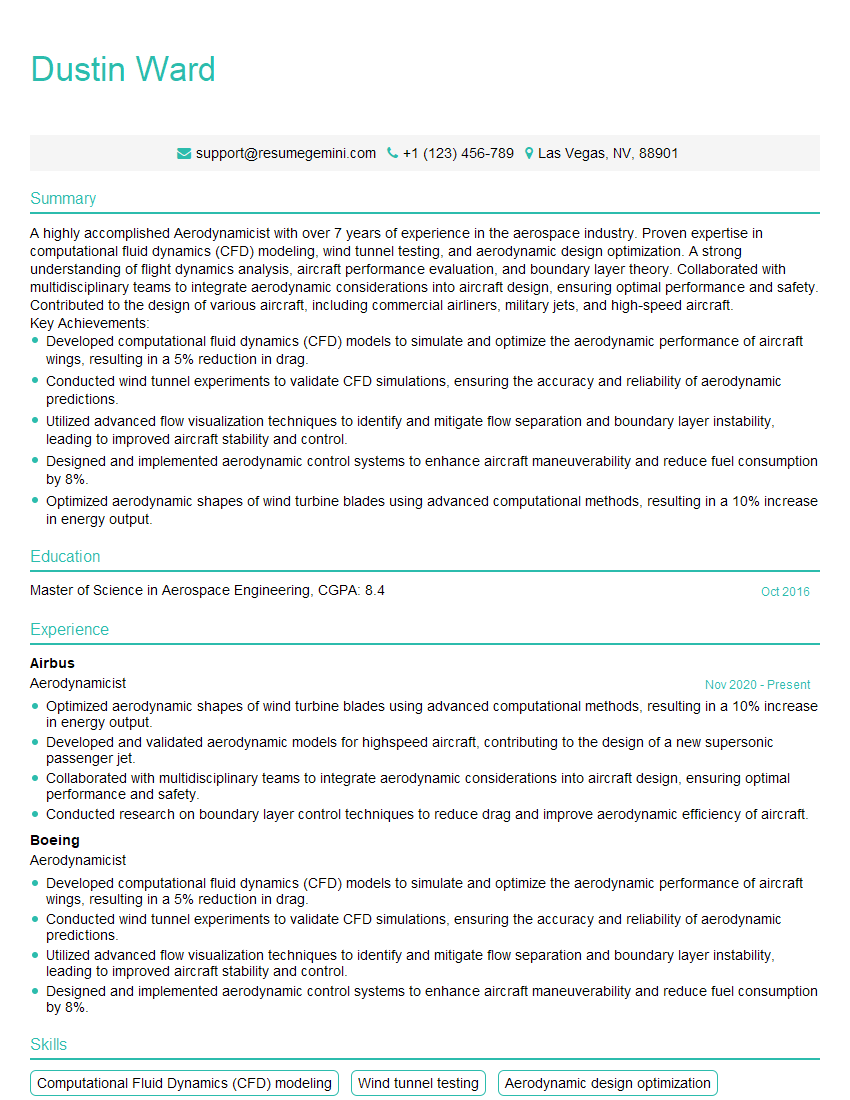
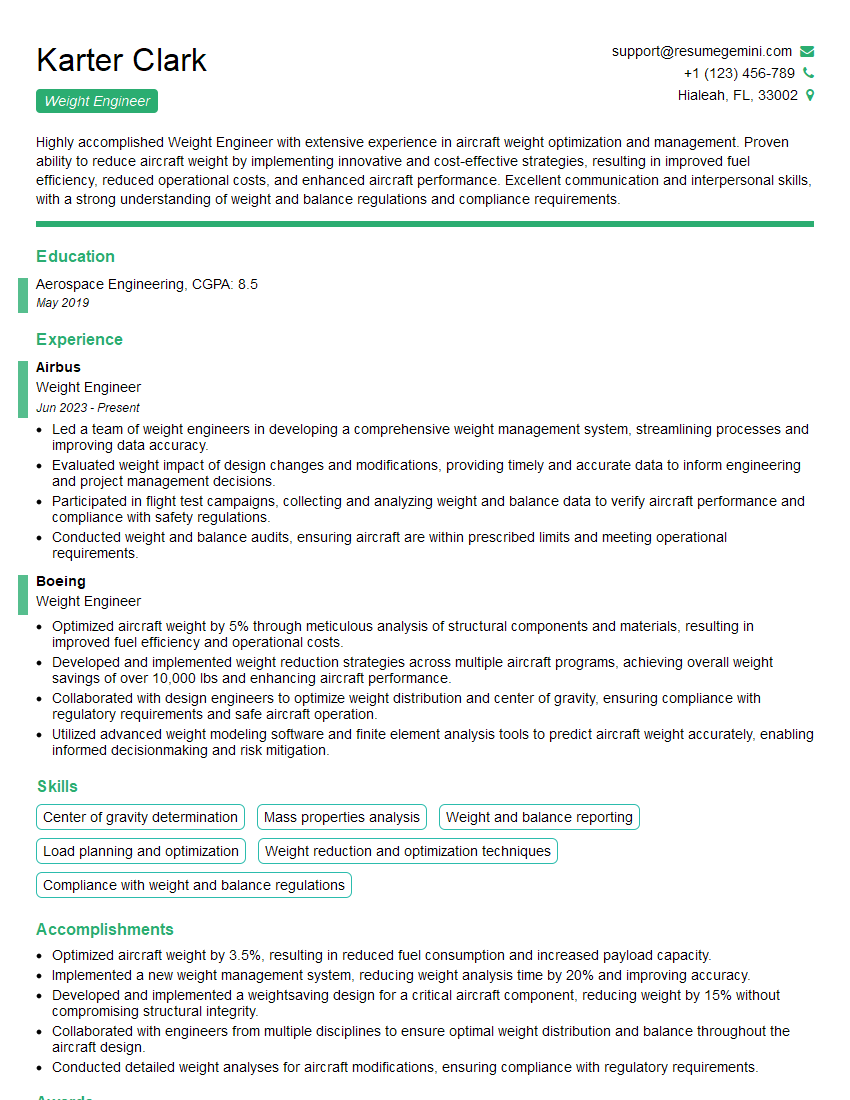
Mastering Performance and Weight Analysis is crucial for career advancement in many engineering disciplines. It demonstrates a deep understanding of design principles and a commitment to optimizing product performance. To enhance your job prospects, creating a strong, ATS-friendly resume is essential. ResumeGemini is a trusted resource for building professional resumes that highlight your skills and experience effectively. Examples of resumes tailored to Performance and Weight Analysis are available to help you craft a compelling application that showcases your expertise.

Explore more articles
Users Rating of Our Blogs
Share Your Experience
We value your feedback! Please rate our content and share your thoughts (optional).
What Readers Say About Our Blog
Very informative content, great job.
good