Interviews are opportunities to demonstrate your expertise, and this guide is here to help you shine. Explore the essential Personnel Airdrop Operations interview questions that employers frequently ask, paired with strategies for crafting responses that set you apart from the competition.
Questions Asked in Personnel Airdrop Operations Interview
Q 1. Describe the different types of personnel airdrop systems.
Personnel airdrop systems are categorized primarily by the method of delivery and the type of parachute used. The most common systems include:
- Static Line System: This is the simplest system. A static line connects the aircraft to the parachute, automatically deploying it upon exiting the aircraft. It’s reliable and requires minimal training, making it ideal for large-scale drops or less experienced jumpers. Imagine it like a giant bungee cord ensuring immediate parachute deployment.
- Freefall System (HALO/HAHO): High Altitude Low Opening (HALO) and High Altitude High Opening (HAHO) involve jumpers exiting the aircraft at extremely high altitudes. They freefall for a considerable time before deploying their parachutes, allowing for long distances and covert operations. Think of this as a controlled, extended freefall before deploying the parachute.
- Ram-Air Parachute System: These steerable parachutes allow for greater precision in landing, crucial in confined areas or specific target points. These parachutes are more sophisticated and require specialized training. Imagine them as paragliders, offering better maneuverability compared to traditional round parachutes.
- Container Delivery System: Instead of directly deploying personnel, this system delivers supplies and equipment contained in specialized containers that deploy parachutes separately. These are often used in conjunction with personnel drops to provide immediate support.
Q 2. Explain the procedures for calculating airdrop release points.
Calculating airdrop release points is a complex process that requires careful consideration of various factors. It’s not just about dropping something from the sky; it involves precise calculations to ensure safe and accurate landing. Here’s a breakdown:
- Determine Ground Speed and Drift: This is crucial and involves accounting for wind speed and direction. Wind affects the horizontal movement of the aircraft and the parachutist after deployment.
- Calculate Air Speed: The speed at which the aircraft is moving is essential. This needs to be factored in to adjust the release point based on the trajectory of the jumpers.
- Factor in Parachute Descent Rate: Different parachutes have different descent rates. The time it takes for the parachute to reach the ground must be included in the calculation.
- Use specialized equipment and software: Modern airdrop operations rely on advanced computers and navigational systems to calculate precise drop points, including GPS data and wind sensor readings. These tools minimize errors and enhance safety.
- Consider terrain: Obstacles such as mountains, rivers, or buildings must be considered in the location of the drop zone.
- Conduct multiple calculations and refine: This is a crucial step to refine the drop zone coordinates to ensure that it is within acceptable parameters before conducting the drop.
Often, this involves using specialized software or charts that incorporate these variables, allowing for precise calculation of the release point. A slight error in calculation can result in a significant distance between the intended and actual landing point.
Q 3. What are the safety considerations for personnel airdrops?
Safety is paramount in personnel airdrops. Numerous factors need careful consideration:
- Properly Packed and Inspected Parachutes: This is the foundational safety measure. A malfunctioning parachute can be catastrophic. Rigorous inspection protocols are essential.
- Accurate Drop Zone Selection: Choosing an appropriate drop zone free from obstacles and hazards is critical. Environmental factors like terrain and weather need thorough assessment.
- Weather Conditions: Strong winds, low visibility, or storms can render an airdrop unsafe and should be avoided. The jumpmaster has the final decision to halt an airdrop due to adverse weather conditions.
- Jumpmaster Competence: The jumpmaster is responsible for the safety of the jumpers. Their training, experience, and judgment are crucial to mission success and avoiding mishaps. Their role is similar to that of an air traffic controller ensuring proper procedures are followed.
- Emergency Procedures: Jumpers should be fully briefed on emergency procedures, including malfunctioning equipment and ground hazards. This training ensures that the jumpers are prepared for contingencies.
- Equipment Maintenance: Regular inspection and maintenance of all equipment, including aircraft, parachutes, and other gear is an absolute necessity to avoid unexpected failures.
Safety procedures are layered and overlap, with each element contributing to a successful and safe operation. Any lapse in safety protocols can have serious consequences.
Q 4. How do you account for wind speed and direction during an airdrop?
Wind speed and direction are critical factors in personnel airdrop calculations. They significantly impact the trajectory of both the aircraft and the parachutist after deployment. Here’s how they’re accounted for:
- Wind Measurement: Accurate wind speed and direction are obtained using various instruments, including anemometers on the ground and sometimes onboard the aircraft. Sophisticated weather forecasting models also provide critical inputs.
- Drift Calculation: This involves estimating the lateral displacement (drift) of the parachutist due to wind. This is a key component in determining the release point, compensating for the wind’s influence on the jumper’s trajectory. The faster and more unpredictable the wind the more pronounced the need for drift correction.
- Release Point Adjustment: The release point must be adjusted to counter the predicted drift, ensuring the jumper lands as close as possible to the target zone. The jumpmaster must have the expertise to adjust for this drift, even in dynamic weather conditions.
- Constant Monitoring: Throughout the operation, wind conditions are constantly monitored, and adjustments can be made if significant changes occur. Real-time monitoring is essential in ensuring the safety of the operation, especially during inclement weather.
Ignoring wind factors can lead to jumpers landing far from the intended drop zone, potentially putting them in danger. The precise calculation and continuous monitoring of wind speed and direction are integral parts of a safe and successful airdrop.
Q 5. What are the different types of parachutes used in personnel airdrops?
Several types of parachutes are employed in personnel airdrops, each with its characteristics and applications:
- Round Parachutes: These are the most common type, known for their simplicity and reliability. They provide a relatively stable descent but offer limited maneuverability. These are often used in static-line systems due to their ease of deployment and reliability.
- Ram-Air Parachutes: These steerable parachutes allow for controlled descent and directional adjustments, making them suitable for precision landings in confined spaces. This requires more extensive training, and their capabilities are a significant benefit for more precise mission objectives.
- Parafoils: These rectangular parachutes offer greater maneuverability and speed control compared to round parachutes, though they can be more sensitive to wind conditions. Their enhanced maneuverability is well-suited to specialized airdrop situations.
- Reserve Parachutes: Every jumper carries a reserve parachute as a backup, in case of main parachute malfunction. This critical piece of safety equipment offers a failsafe in case of an emergency. The reserve chute offers a crucial level of redundency for the operation.
The choice of parachute depends on the mission requirements, jumper experience, and environmental conditions. Each type is specifically engineered for certain performance parameters, safety factors, and mission profiles.
Q 6. Describe the process of packing and inspecting a parachute.
Packing and inspecting a parachute are critical steps, demanding meticulous attention to detail. A poorly packed parachute can be catastrophic. The process involves:
- Careful Unfolding and Inspection: The parachute is meticulously unfolded and thoroughly inspected for any damage, tears, or wear and tear. This initial inspection is crucial to ensure that the parachute is fit for use.
- Systematic Packing: The parachute is packed according to strict procedures, ensuring that all components are correctly folded and placed in the parachute container. This is a step-by-step process that is strictly followed, often using checklists and visual aids to ensure uniformity of packing standards.
- Harness and Container Check: The harness and container are carefully inspected for any damage or defects. The connection points between the harness and container must be secured correctly and tightly to ensure the parachute’s functionality and deployment.
- Rigorous Quality Control: After packing, the parachute undergoes a rigorous quality control check, often by a designated rigger or jumpmaster. This final review ensures adherence to proper packing standards.
- Documentation: Packing details including date, rigger’s signature, and serial numbers are documented. This documentation provides traceability of the equipment and its serviceability, and it is extremely important for operational safety.
Improper packing can lead to parachute malfunction, highlighting the necessity of precision and adherence to standards. The rigger’s proficiency and meticulousness are crucial in ensuring parachute integrity.
Q 7. Explain the role of a jumpmaster during an airdrop operation.
The jumpmaster is the pivotal figure in a personnel airdrop operation, responsible for the safety and success of all jumpers. Their duties are multifaceted and critical:
- Pre-Flight Briefing: The jumpmaster conducts thorough briefings to the jumpers before the mission, covering procedures, safety protocols, emergency actions, and weather conditions. This ensures that all personnel are clear on the mission parameters.
- Equipment Check: The jumpmaster verifies the proper functioning of the jumpers’ parachutes, harnesses, and other essential equipment. This is a crucial step in ensuring a safe and reliable drop.
- Aircraft Procedures: The jumpmaster oversees the aircraft loading and ensures that all jumpers are properly seated and secured within the aircraft. The jumpmaster is also responsible for confirming proper aircraft procedures during the approach to the drop zone.
- Timing and Release: During the airdrop, the jumpmaster manages the timing of the jump, giving commands for the jumpers’ exits from the aircraft. This timing is essential to ensure that the jumpers’ landing area is within the target drop zone.
- Post-Airdrop Assessment: After the airdrop, the jumpmaster oversees the recovery of the jumpers and assesses the overall operation, identifying any areas for improvement. This post-mission assessment is essential for improving future operational safety and effectiveness.
The jumpmaster’s role is not merely supervisory; it’s a highly skilled position demanding extensive training, experience, and decisive judgment to ensure the safety and successful completion of the operation. They are the final decision-makers in the event of any unforeseen circumstances.
Q 8. How do you manage risk during personnel airdrop operations?
Managing risk in personnel airdrops is paramount. It’s a multifaceted process involving meticulous planning and execution. We use a systematic approach, starting with a thorough risk assessment identifying potential hazards like weather conditions, terrain difficulties, equipment malfunctions, and human error. This assessment uses a combination of quantitative and qualitative methods, drawing upon historical data, weather forecasts, and expert judgment.
Mitigation strategies are then developed and implemented. This might involve selecting alternate drop zones, employing specialized equipment (like GPS-guided parachutes), implementing stringent pre-flight checks, and providing comprehensive training to personnel. Regular briefings and rehearsals reinforce procedures and build team cohesion, reducing the likelihood of errors under pressure. For instance, if we anticipate high winds, we might adjust the drop altitude or choose a more sheltered drop zone. Continuous monitoring throughout the operation allows for adjustments based on real-time conditions. Post-mission debriefings are crucial for identifying areas for improvement and incorporating lessons learned into future operations.
Q 9. What are the communication protocols used during an airdrop?
Communication protocols during an airdrop are critical for a successful and safe operation. We rely on a layered approach utilizing multiple communication channels to ensure redundancy and minimize the impact of potential failures. Primary communication typically involves secure radio frequencies, both between the aircraft and the ground control team, and between the aircraft and the jumpers themselves. Pre-determined codes and standard phrases are employed to streamline communication and eliminate ambiguity in high-stress situations.
Visual signals, like smoke markers or pre-arranged ground-to-air signals, also play a crucial role, especially in areas with poor radio reception. For instance, a specific colored flare could indicate an emergency situation or a change of the drop zone. Detailed briefing sheets outlining communication protocols and contingency plans are provided to all personnel well in advance of the operation, and rehearsals are conducted to ensure everyone understands their role and the communication procedures.
Q 10. How do you handle emergencies during an airdrop?
Handling emergencies during an airdrop requires swift, decisive action based on pre-determined procedures and clear communication. The first step is accurate assessment of the situation. Is it a parachute malfunction, equipment failure, or a ground-related issue? This assessment dictates the response.
Our training emphasizes emergency procedures, including proper parachute handling techniques, emergency equipment deployment (like reserve parachutes and survival kits), and effective communication with ground control and other aircrew. A dedicated emergency response team is always on standby, ready to deploy to the location if needed. The aircrew plays a vital role by providing immediate support, assessing the situation from the air, and coordinating rescue efforts. For instance, if a jumper experiences a parachute malfunction, the aircraft may deploy emergency flares to mark the location for the ground crew while the aircrew remains vigilant for further potential problems. Post-incident debriefings are meticulously conducted to analyze the situation, determine the root causes, and improve future safety protocols.
Q 11. Describe the process of conducting a post-airdrop assessment.
A post-airdrop assessment is a thorough evaluation of the entire operation, from planning to execution. It’s a crucial step to identify successes, areas needing improvement, and lessons learned. This assessment involves several key steps:
- Personnel Accountability: Verifying all personnel have safely landed and accounted for.
- Equipment Check: Inspecting the condition of all parachutes, equipment, and supplies.
- Data Analysis: Reviewing flight data, communication logs, and weather reports.
- Debriefing: Conducting a comprehensive debriefing session involving all personnel involved to discuss the operation’s successes and challenges.
- Report Generation: Creating a detailed report documenting all aspects of the airdrop, including findings and recommendations.
This report is reviewed by command and serves as valuable input for improving future operations. This systematic approach helps maintain a high standard of safety and effectiveness in future personnel airdrops.
Q 12. What are the regulations and guidelines for personnel airdrops?
Regulations and guidelines for personnel airdrops are stringent and vary depending on the country and governing body. They cover all aspects of the operation, from pre-mission planning to post-mission analysis. Key areas of regulation include:
- Safety Standards: Strict adherence to safety procedures, equipment maintenance, and personnel training.
- Environmental Considerations: Minimizing environmental impact at the drop zone.
- Weather Limitations: Defining acceptable weather parameters for safe airdrop execution.
- Aircraft Certification: Ensuring the aircraft is appropriately certified for airdrop operations.
- Personnel Qualification: Requiring jumpers to undergo rigorous training and certification.
These regulations are crucial to ensure the safety of personnel and the success of the operation. Non-compliance can result in severe consequences, including accidents, injuries, or even fatalities.
Q 13. What is your experience with different types of aircraft used for airdrops?
My experience encompasses a range of aircraft used in personnel airdrops, including C-130 Hercules, C-17 Globemaster III, and CH-47 Chinook helicopters. Each aircraft presents unique characteristics and capabilities, influencing the planning and execution of airdrops.
The C-130 Hercules, for instance, excels in high-altitude, low-opening (HALO) jumps, while the C-17 Globemaster III offers greater cargo capacity and versatility. Helicopters, particularly the CH-47 Chinook, are ideal for low-level insertions and extraction in challenging terrains. Selecting the appropriate aircraft depends on factors like the mission objectives, terrain conditions, the number of personnel to be airdropped, and the required accuracy of the drop. My experience helps me leverage the strengths of each aircraft type to maximize operational efficiency and safety.
Q 14. How do you ensure the accuracy of airdrop delivery?
Ensuring the accuracy of airdrop delivery is critical for the mission’s success. This involves a combination of technological advancements and meticulous planning. We use advanced GPS systems both on the aircraft and within the parachutes themselves to pinpoint the drop zone accurately. Real-time weather data is integrated to adjust the drop parameters to account for wind speed and direction.
Detailed maps and terrain analysis are crucial for selecting appropriate drop zones. Ground-based navigation and communication systems are employed to guide the aircraft and ensure the jump is executed within acceptable parameters. Pre-drop rehearsals and detailed briefings ensure all personnel are fully aware of the procedures and contingency plans. The combined use of technology and meticulous planning minimizes the margin of error, improving the precision and accuracy of airdrop deliveries.
Q 15. How do you adapt airdrop plans to changing weather conditions?
Adapting airdrop plans to changing weather conditions is crucial for mission success and personnel safety. We use a layered approach, starting with pre-mission planning that incorporates weather forecasts and contingency plans. For example, we might plan for multiple drop zones (DZs) – a primary and several alternates – each suited to different weather scenarios. As the mission progresses, real-time weather data informs our decisions. If high winds are predicted, we might delay the drop, select an alternate DZ with less wind exposure, or adjust the airdrop technique to compensate for the wind. Heavy rain or low visibility might require delaying the operation until conditions improve, or using specialized navigational aids to ensure accurate drop zone targeting. Imagine it like planning a road trip – you have a primary route, but you also plan for detours in case of road closures (bad weather) or traffic jams (unexpected complications). We constantly assess risks and adjust the plan accordingly, sometimes minute-by-minute. This involves close coordination with meteorological personnel and aircrew.
Career Expert Tips:
- Ace those interviews! Prepare effectively by reviewing the Top 50 Most Common Interview Questions on ResumeGemini.
- Navigate your job search with confidence! Explore a wide range of Career Tips on ResumeGemini. Learn about common challenges and recommendations to overcome them.
- Craft the perfect resume! Master the Art of Resume Writing with ResumeGemini’s guide. Showcase your unique qualifications and achievements effectively.
- Don’t miss out on holiday savings! Build your dream resume with ResumeGemini’s ATS optimized templates.
Q 16. Describe your experience with airdrop equipment maintenance.
Equipment maintenance is paramount in personnel airdrop operations. Neglecting this can lead to catastrophic consequences. My experience encompasses regular inspections of parachutes (both personnel and cargo), harnesses, containers, and aircraft loading systems. This includes visual checks for wear and tear, stress fractures, and proper functionality of all release mechanisms. We adhere strictly to manufacturer’s guidelines and conduct rigorous scheduled maintenance, often exceeding minimum requirements. We also conduct post-mission inspections to identify any issues that may have arisen during the drop. For example, after a particularly challenging drop in mountainous terrain, we meticulously checked all equipment for damage related to impact or abrasion. Regular training ensures our maintenance team is proficient in identifying and resolving potential problems. We keep detailed maintenance logs, ensuring complete traceability and compliance with regulations.
Q 17. How do you train personnel for airdrop operations?
Personnel airdrop training is a rigorous process, blending classroom instruction with extensive practical exercises. It begins with ground school, covering parachute theory, emergency procedures, and DZ procedures. This is followed by simulator training, allowing trainees to practice critical skills in a safe environment. Finally, they progress to live jump training, starting with static line jumps and gradually progressing to more challenging scenarios, including high-altitude, low-opening (HALO) jumps. Throughout the training, emphasis is placed on teamwork, communication, and problem-solving skills. For instance, trainees practice emergency procedures such as malfunction drills and canopy control in various weather conditions. We use a phased approach, regularly evaluating trainee performance and providing feedback to ensure they meet the required standards for safety and proficiency. The ultimate goal is to develop confident, competent personnel capable of performing airdrops under various conditions.
Q 18. What are the limitations of personnel airdrops?
Personnel airdrops, while effective for certain missions, do have limitations. First, they are highly dependent on favorable weather conditions. Strong winds, low visibility, or inclement weather can significantly hinder or prevent an airdrop. Secondly, the accuracy of the drop is limited by factors such as wind drift and aircraft navigation. This means that the drop zone must be sufficiently large to accommodate potential deviations. Thirdly, airdrops pose significant risks to personnel; injuries can occur during landing, especially in challenging terrain. Finally, the operation is resource intensive, requiring specialized equipment, trained personnel, and considerable logistical planning. For instance, a night-time HALO jump requires significantly more advanced equipment and training than a daytime static line jump from low altitude. Understanding these limitations is key to making informed decisions on whether to utilize this method.
Q 19. How do you coordinate with ground support during an airdrop?
Coordination with ground support is absolutely critical for successful personnel airdrops. Before the drop, we establish clear communication channels and pre-determined signals. We use maps, GPS coordinates, and radio communication to ensure the ground team knows the precise drop zone, the expected time of arrival, and the number of personnel to expect. During the airdrop, ground support personnel mark the DZ, secure the landing area, provide first aid if needed, and assist with equipment retrieval. After the drop, they confirm the safe arrival and condition of all personnel. This coordination extends to post-drop activities such as extraction or rendezvous points. We regularly conduct joint exercises to refine our procedures and ensure seamless collaboration between air and ground teams. A recent operation involved using smoke signals to mark the DZ in a situation where radio communications were unreliable – demonstrating the importance of redundancy in planning.
Q 20. What are the environmental factors that affect airdrop operations?
Environmental factors significantly impact airdrop operations. Wind speed and direction are paramount, influencing the accuracy of the drop and the safety of the personnel landing. High winds can cause significant drift, leading to inaccurate landings and potential injuries. Temperature and humidity can also affect equipment performance, especially parachutes. Terrain features such as mountains, forests, or bodies of water must be carefully considered to select a safe and suitable DZ. Visibility is crucial for both air and ground teams, particularly during night operations. Precipitation (rain, snow) can reduce visibility and hamper parachute performance. In addition, extreme temperatures (both hot and cold) can impact the physical capabilities of personnel and equipment. Effective planning must anticipate and mitigate the risks posed by these environmental variables.
Q 21. Describe your experience with airdrop planning software.
My experience with airdrop planning software includes proficiency with several leading systems. These tools allow for detailed modeling of airdrop parameters, including aircraft trajectory, wind conditions, and parachute performance. We use these tools to optimize drop profiles and predict the dispersion of personnel. They also assist in planning emergency procedures and alternate DZs. The software provides a visual representation of the airdrop, allowing us to identify potential hazards and refine the plan. For example, we can simulate different wind scenarios to determine the optimal drop altitude and time. The software also integrates with meteorological data, providing real-time updates on weather conditions and enabling dynamic adjustments to the airdrop plan. The capacity to conduct ‘what-if’ analyses is invaluable in evaluating risk and improving mission safety and effectiveness.
Q 22. How do you ensure the safety of personnel during an airdrop?
Ensuring personnel safety during an airdrop is paramount and relies on a multi-layered approach. It begins long before the aircraft even leaves the ground. We meticulously plan every detail, from selecting the appropriate drop zone based on terrain analysis and weather conditions, to rigorously inspecting all equipment—parachutes, containers, and personnel gear.
During the mission, precise aircrew coordination is crucial. The airdrop navigator calculates the correct release point and ensures the aircraft maintains the necessary altitude and airspeed. We also employ rigorous communication protocols between the aircrew, ground personnel, and the individuals being airdropped. Post-drop, ground teams are ready to provide immediate assistance, ensuring safe landing and immediate medical attention if required. Regular training and drills, including emergency procedures, are critical for building proficiency and preparedness for unexpected scenarios.
For example, during a recent mission in mountainous terrain, we carefully selected a drop zone with a minimal slope and sufficient space for parachute deployment. Real-time weather updates helped us adapt our approach and ensure a safe landing in potentially hazardous conditions. This preparedness ensured all personnel landed safely and reached their designated location without incident.
Q 23. What are the different types of airdrop containers used?
A variety of airdrop containers are used, each designed for specific purposes and payloads. The choice depends on factors like the weight and fragility of the cargo, the operational environment, and the required level of protection.
- Standard cargo containers: These are typically large, robust containers made of metal or high-density materials, ideal for transporting heavier and less fragile items. They’re often employed for supplies and equipment.
- Personnel containers: These are specialized containers designed to safely carry individuals. They’re usually equipped with suspension systems to minimize impact on landing. Their design focuses on passenger safety and comfort during the airdrop.
- Lightweight containers: These are used for lighter items, prioritizing efficient transport rather than maximum protection. They are typically employed for smaller, less sensitive supplies.
- Specialized containers: These are built for specific needs, like transporting hazardous materials or sensitive equipment that require additional protection and handling procedures.
Selection of the correct container is a crucial aspect of mission planning, ensuring efficient and safe delivery of the cargo, whether personnel or equipment.
Q 24. How do you handle equipment malfunctions during an airdrop?
Equipment malfunctions during an airdrop are a serious concern, necessitating immediate and decisive action. Our training emphasizes preparedness for a range of contingencies.
Our procedures involve a detailed pre-flight inspection of all equipment. However, if a malfunction occurs, the aircrew’s training allows for prompt assessment of the situation. This includes immediate communication with ground control, potentially leading to an aborted mission, or employing contingency plans. The type of malfunction dictates the response: for example, a parachute malfunction may require the use of reserve parachutes, while a container failure might necessitate an emergency landing and alternative delivery methods.
We practice various malfunction scenarios during training, simulating both equipment failures and sudden environmental changes. This helps build our situational awareness and decision-making skills, ensuring we are equipped to handle such events effectively and safely.
Q 25. Explain your understanding of airdrop trajectory calculations.
Airdrop trajectory calculations are complex, involving a number of interdependent factors. We utilize specialized software and ballistic models to accurately predict the trajectory of the airdrop container from release to landing. These models consider factors such as aircraft speed and altitude, wind speed and direction, air density, parachute deployment characteristics, and the weight of the cargo.
The calculations must account for the dynamic nature of the atmosphere and potential changes in wind speed and direction during the descent. Advanced algorithms are used to simulate different scenarios and optimize the release parameters to achieve the desired landing point. Accurately predicting trajectory ensures a precise airdrop, which is critical for achieving mission success and personnel safety. Even small deviations from the calculated trajectory can significantly affect the outcome. Therefore, careful consideration of all parameters is essential.
Q 26. What is your experience with night airdrop operations?
Night airdrop operations present unique challenges, demanding a high level of skill and precision. Visibility is significantly reduced, necessitating the use of advanced night vision equipment and sophisticated navigation systems. The increased risk is mitigated through extensive training, meticulous planning, and enhanced communication protocols.
I have extensive experience in night airdrops. In one specific operation, we used infrared technology and GPS-guided parachutes to deliver supplies to a remote location under the cover of darkness. This required careful coordination between the aircrew, ground personnel, and the special forces on the ground using NVGs (Night Vision Goggles). Successful execution of the mission relied heavily on precise calculations for trajectory and timing to account for the lack of visual cues. The successful completion of such missions highlights the importance of specialized training and advanced technologies in night airdrop operations.
Q 27. How do you conduct a pre-flight briefing for an airdrop mission?
A pre-flight briefing for an airdrop mission is a critical step that ensures mission success and safety. It involves a detailed review of all aspects of the operation, ensuring all personnel are fully informed and prepared. The briefing includes:
- Mission objectives: Clearly outlining the goals and purpose of the airdrop.
- Drop zone details: Thorough description of the drop zone, including its location, terrain characteristics, potential hazards, and landing zones.
- Weather conditions: A comprehensive review of the prevailing and forecasted weather, its potential impact on the mission, and contingency plans for adverse conditions.
- Equipment and procedures: A detailed inspection of all equipment and a thorough review of emergency procedures.
- Communication protocols: Establishing clear communication channels and procedures among aircrew, ground teams, and any personnel involved.
- Contingency plans: Addressing potential problems such as equipment malfunction, adverse weather, or unexpected ground conditions.
The briefing fosters clear communication and understanding, ensuring everyone is on the same page and prepared for any challenges.
Key Topics to Learn for Personnel Airdrop Operations Interview
- Airdrop Planning & Mission Execution: Understanding the entire lifecycle of a personnel airdrop mission, from initial planning and risk assessment to execution and post-mission analysis.
- Airborne Equipment & Procedures: Familiarity with various parachute systems, cargo containers, and associated equipment; proficiency in pre-flight checks and safety procedures.
- Navigation & Communication: Mastering techniques for accurate navigation during airdrops, including utilizing GPS and communication protocols for coordination with ground teams.
- Safety Regulations & Emergency Procedures: In-depth knowledge of all relevant safety regulations and protocols; proficiency in handling emergency situations and contingency planning.
- Human Factors & Crew Resource Management: Understanding the impact of human factors on mission success and applying principles of crew resource management to improve teamwork and decision-making.
- Logistics & Supply Chain Management: Knowledge of the logistical aspects of personnel airdrops, including supply chain management, resource allocation, and inventory control.
- Data Analysis & Reporting: Ability to analyze mission data, identify areas for improvement, and generate comprehensive reports for post-mission debriefing.
- Weather Considerations & Impact Assessment: Understanding the influence of weather conditions on airdrop operations and adapting strategies accordingly.
- Technological Advancements in Airdrop Systems: Familiarity with modern technologies and innovations used in personnel airdrop operations.
Next Steps
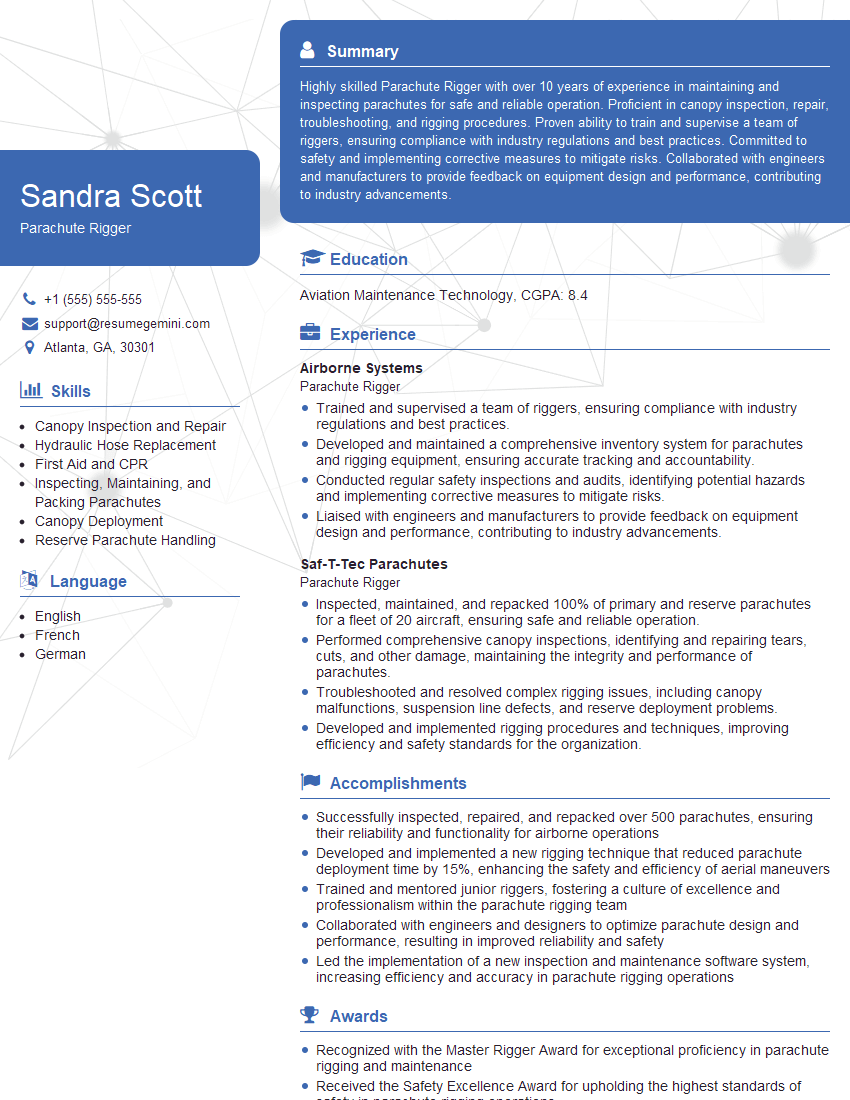
Mastering Personnel Airdrop Operations opens doors to exciting and impactful careers, offering opportunities for growth and advancement within the field. A strong resume is crucial for showcasing your skills and experience to potential employers. Creating an ATS-friendly resume significantly increases your chances of getting your application noticed. ResumeGemini is a trusted resource that can help you build a professional and effective resume tailored to the specific requirements of Personnel Airdrop Operations jobs. Examples of resumes tailored to this field are available within ResumeGemini to guide your creation process. Invest the time to build a compelling resume – it’s an investment in your future success.

Explore more articles
Users Rating of Our Blogs
Share Your Experience
We value your feedback! Please rate our content and share your thoughts (optional).
What Readers Say About Our Blog
Very informative content, great job.
good