The right preparation can turn an interview into an opportunity to showcase your expertise. This guide to Photographic Editing and Retouching interview questions is your ultimate resource, providing key insights and tips to help you ace your responses and stand out as a top candidate.
Questions Asked in Photographic Editing and Retouching Interview
Q 1. Explain your experience with different retouching software (e.g., Photoshop, Lightroom).
My experience with retouching software spans over a decade, encompassing both Adobe Photoshop and Lightroom. Photoshop is my primary tool for intricate retouching tasks like blemish removal, compositing, and advanced masking, while Lightroom excels at non-destructive editing, color grading, and batch processing. I’m proficient in utilizing layers, masks, adjustment layers, and various tools within both applications to achieve desired results. For example, I frequently use Photoshop’s healing brush and clone stamp tools for blemish removal, and Lightroom’s HSL adjustments for subtle color refinements. My skills extend to utilizing plugins like Topaz Denoise AI for advanced noise reduction.
I understand the strengths of each program and strategically use them in my workflow to maximize efficiency and quality. For instance, I might perform initial color correction and basic adjustments in Lightroom before moving to Photoshop for more detailed retouching. This non-destructive workflow in Lightroom allows for easy adjustments later on without affecting the original image.
Q 2. Describe your workflow for retouching a product image for e-commerce.
My workflow for retouching e-commerce product images prioritizes consistency and brand alignment. It typically involves these steps:
- Initial Assessment: I examine the image for lighting inconsistencies, color casts, blemishes, and background issues.
- Background Removal/Enhancement: I use techniques like the pen tool, quick selection, or magic wand in Photoshop to isolate the product and create a clean background, sometimes using a layer mask for precision. I might replace the background with a more suitable one from a stock image library.
- Color Correction & Enhancement: Utilizing Lightroom’s tools, I address any color casts or imbalances ensuring accurate color representation.
- Retouching: In Photoshop, I meticulously remove any dust, scratches, or imperfections on the product itself using tools like the spot healing brush and clone stamp. I pay close attention to maintaining natural textures.
- Lighting Refinements: If needed, I might subtly adjust the lighting using tools like curves and dodge & burn to highlight details and enhance visual appeal.
- Sharpness & Output: I sharpen the image subtly using Unsharp Mask in Photoshop to enhance detail without introducing artifacts. Finally, I save the image in appropriate formats like JPEG or PNG, optimized for web use, adhering to the client’s specific requirements (size, resolution, etc.).
Throughout this process, maintaining a consistent look across all product images is paramount. This often involves creating a set of presets or actions in Lightroom and consistent retouching techniques in Photoshop.
Q 3. How do you handle color correction and color grading in your workflow?
Color correction and color grading are distinct yet interconnected processes. Color correction aims to restore the original colors of an image, correcting inaccuracies introduced by the camera or lighting conditions. Color grading, on the other hand, is a more stylistic approach where I manipulate the colors to achieve a specific mood or aesthetic.
In my workflow, I typically begin with color correction in Lightroom, using the White Balance tool, HSL panel, and the tone curve to achieve a neutral and accurate color representation. After this, I might move to Photoshop for more specific adjustments. For color grading, I can leverage Lightroom’s color grading panel or utilize adjustment layers in Photoshop such as Color Balance, Photo Filter, or Curves to create a particular look. I often use split toning to add a subtle color cast to highlights and shadows, enhancing the mood and visual appeal. For example, a warm tone in the highlights and cool tone in shadows could create a dramatic and cinematic look.
Q 4. What are your preferred methods for removing blemishes and wrinkles from portraits?
My preferred methods for removing blemishes and wrinkles from portraits are non-destructive and focus on preserving natural textures. I leverage Photoshop’s healing brush, clone stamp, and patch tools, carefully selecting sample areas that closely match the surrounding skin tone and texture. I avoid over-retouching, aiming for a natural and refined look rather than an artificial smoothing effect. For wrinkles, I might use frequency separation, a more advanced technique that allows for separate adjustment of texture and color information; this helps to reduce the appearance of wrinkles without losing the underlying skin texture. This technique involves separating the image into two layers – one for detail/texture and one for color/tones – making edits easier and more precise.
Ultimately, the goal isn’t to erase imperfections completely, but to subtly diminish them for a natural, improved appearance. Each individual’s skin is unique, and I adjust my technique according to their complexion and the overall style desired.
Q 5. Explain your approach to dealing with challenging image issues like motion blur or noise.
Dealing with challenging image issues like motion blur and noise requires specialized techniques. Motion blur, often caused by slow shutter speeds, is difficult to completely remove, but I can mitigate its effects in Photoshop by using tools like the Content-Aware Fill or applying selective sharpening to areas with less blur. I might also try to use masking techniques to focus sharpening on areas of less blur. For significant motion blur, the only option could be to reshoot the photo.
Noise, a common problem in low-light photography, can be reduced using noise reduction tools in both Lightroom and Photoshop. I prefer tools like Topaz Denoise AI or other advanced noise reduction plugins for superior results. The key is to balance noise reduction with preserving image detail; excessive noise reduction can lead to a loss of sharpness and texture. It’s crucial to consider the type of noise (luminance or chroma noise) when selecting noise reduction techniques.
Q 6. How do you ensure consistency in retouching across multiple images?
Consistency in retouching across multiple images is achieved through several strategies. First, I use Lightroom presets to apply consistent color grading and adjustments to batches of images. Then, within Photoshop, I carefully maintain consistency in my brush settings and retouching techniques; I create custom brushes, if needed. For example, I might establish a standardized set of brush opacity and flow settings for blemish removal and create action for common adjustments such as sharpening or resizing.
Creating a style guide or reference sheet illustrating the desired retouching style, including examples of blemish removal, color grading and sharpness levels, helps maintain consistency. By adhering to these guidelines, I ensure a unified and professional look throughout the entire image set.
Q 7. Describe your experience with high-resolution image editing.
My experience with high-resolution image editing is extensive. I regularly work with images exceeding 50 megapixels, understanding the computational demands and file management strategies required. Working with such large files necessitates the use of powerful hardware and software optimized for high-resolution processing. I use techniques like memory management and layer compression to efficiently handle the large files. Furthermore, maintaining a non-destructive workflow is crucial to avoid losing data or introducing artifacts during the editing process.
When editing high-resolution images, I often downsample to a more manageable size for preliminary edits, then upsample to the desired resolution for final output and avoiding image degradation. This optimization of workflow reduces computation time and resources without compromising image quality.
Q 8. What techniques do you use to enhance detail and sharpness in images?
Enhancing detail and sharpness involves a multi-faceted approach. It’s not just about cranking up the sharpness slider; it’s about understanding the image’s inherent qualities and applying techniques strategically. A blurry image, for instance, can’t be magically sharpened, but a slightly soft image can be significantly improved.
Unsharp Mask: This classic technique analyzes contrast changes in the image and amplifies them. It’s like highlighting the edges. In Photoshop, you’d adjust the Amount, Radius, and Threshold settings carefully. Too much Amount can lead to halos, while too small a Radius won’t be effective. The Threshold setting helps prevent noise amplification.
High-Pass Filtering: This involves creating a high-pass filtered copy of your image (essentially isolating the details) and blending it with the original. This is a non-destructive way to add sharpness, allowing for better control.
Noise Reduction: Before sharpening, I often reduce noise (grain). Noise can interfere with the sharpening process and create unwanted artifacts. Careful noise reduction preserves detail and prevents a muddy look.
Smart Sharpening: Modern software offers ‘Smart Sharpening’ algorithms. These are often adaptive, meaning they adjust the sharpening based on the image content. This produces more natural results compared to applying a uniform sharpening effect.
Lens Corrections: Often, softness is caused by lens imperfections. Many editing programs offer lens correction profiles that can automatically correct for distortion, vignetting, and chromatic aberration which can greatly improve sharpness.
For example, I recently worked on a landscape photo where the mountains in the distance were slightly soft. By carefully applying a combination of unsharp mask and high-pass filtering, I was able to significantly improve the details and create a more impactful image without introducing harsh artifacts. The key is subtle adjustments and iterative refinement.
Q 9. How do you manage large image files efficiently?
Managing large image files efficiently is crucial for workflow and storage. I employ several strategies:
Non-Destructive Editing: I always work in layers and utilize adjustment layers. This avoids permanently altering the original image data, allowing for greater flexibility and saving disk space.
File Formats: I use lossless formats like TIFF or PSD for editing, especially for high-resolution images. These preserve maximum image quality. Once the editing is complete, I convert to a lossy format like JPEG only for final delivery, balancing quality and file size.
ProRes or similar: When dealing with video, I prefer using formats like Apple ProRes for editing. They provide excellent quality with manageable file sizes.
External Hard Drives: I store my images on fast external hard drives, often in RAID configurations for redundancy and speed. Cloud storage is also useful for backups and collaboration.
Organized File Structure: I maintain a well-organized folder structure, making it easy to locate and manage files. I typically use date and project-based naming conventions.
Image Optimization: When preparing images for the web, I use tools to optimize them for different screen sizes and resolutions, reducing file sizes without sacrificing visual quality.
For instance, a recent project involved hundreds of high-resolution RAW files. By utilizing a combination of external drives, efficient file management, and non-destructive editing techniques, I managed the project effectively without encountering storage or performance issues.
Q 10. What is your understanding of color spaces (e.g., RGB, CMYK)?
Color spaces define the range of colors a device can display or print. RGB (Red, Green, Blue) is additive and used for screen display, while CMYK (Cyan, Magenta, Yellow, Key/Black) is subtractive and used for print. Understanding the differences is paramount for accurate color reproduction.
RGB: Used for monitors, TVs, and web images. Each color channel has a value from 0 to 255, with 0 representing the absence of that color and 255 representing its full intensity. It offers a wider gamut of colors compared to CMYK.
CMYK: Used for print. These are the inks used by printers. It has a smaller gamut, meaning some colors that appear on a screen won’t be accurately reproduced on paper. This can be a challenge when designing for print.
Color Management: Proper color management involves setting up color profiles for your monitor, printer, and editing software to ensure consistency across different devices. Mismatched profiles can lead to significant color shifts.
Color Conversion: Converting between color spaces (e.g., RGB to CMYK) can result in color shifts, especially when converting from a larger gamut (RGB) to a smaller one (CMYK). Accurate color conversion requires careful consideration and often involves manual adjustments.
In my workflow, I typically edit images in RGB, ensuring my monitor is properly calibrated. Only when preparing images for print, do I convert to CMYK, making adjustments to compensate for the color gamut differences and ensuring the printed result aligns closely with the on-screen preview.
Q 11. Explain your experience with masking and layer techniques.
Masking and layer techniques are fundamental to non-destructive editing. They allow for precise control over image manipulation, avoiding permanent changes to the original image.
Layer Masks: These act like stencils, hiding or revealing portions of a layer. They allow for gradual transitions and precise selections. I often use them to blend elements seamlessly, retouch blemishes, or isolate areas for specific adjustments.
Vector Masks: These are created using vector shapes, offering sharp, scalable edges. This is particularly useful for precise selections of objects or areas with defined boundaries.
Adjustment Layers: These allow you to apply adjustments (brightness, contrast, color balance, etc.) to a layer without altering the underlying pixels. This allows for greater flexibility and control.
Clipping Masks: These link an adjustment layer to a layer below, applying the adjustments only to that specific layer. This is very useful for isolating adjustments to particular elements within a complex image.
For instance, to remove a distracting element from a photo, I would create a layer mask to conceal it, gradually feathering the edges to create a seamless blend with the surrounding area. For selective color adjustments, I would use an adjustment layer with a clipping mask to target specific elements.
Q 12. How do you handle client feedback and revisions?
Handling client feedback is a crucial part of the process. I strive for clear communication and efficient revision management.
Clear Communication: I begin by ensuring I have a clear understanding of the client’s vision and desired outcome before starting the project. Regular check-ins during the process help to maintain alignment.
Version Control: I maintain organized versions of the image, clearly labeled, and make sure to explain changes I made. This makes it easy to review and revert to earlier versions if needed.
Organized Feedback: I encourage clients to provide feedback in writing, which helps prevent misunderstandings. I then systematically address each point, creating separate layers or versions for each revision request.
Proofing: I always provide clients with proofs of the final image under various lighting and display conditions.
In a recent project, a client requested a significant color adjustment. Instead of making the change directly, I created a new adjustment layer, clearly labeled with the revision number and the client’s notes. This enabled me to easily compare versions, understand the adjustments made, and ultimately deliver a final image that met the client’s expectations.
Q 13. Describe your experience with batch processing images.
Batch processing saves immense time when dealing with large numbers of images requiring similar edits. I use actions and scripts for automation.
Actions (Photoshop): Actions record a sequence of steps, allowing you to apply the same edits to multiple images with a single click. This is invaluable for tasks like resizing, sharpening, or color correction.
Scripts: More advanced tasks often require custom scripts. For example, I might write a script to rename files automatically or to apply more complex image manipulations consistently across a set of images.
Third-Party Software: Several applications specialize in batch processing, offering features like bulk renaming, conversion, and basic image adjustments.
I recently processed over 200 product photos for an e-commerce client. I created a Photoshop action to resize, sharpen, and apply a consistent color profile to all images, drastically reducing the time required for this task. The consistent application of the action guaranteed a uniform look for the final product.
Q 14. What is your understanding of image compression and its impact on quality?
Image compression reduces file size, but it impacts quality. There are two main types: lossy and lossless.
Lossless Compression: Algorithms like PNG and TIFF reduce file size without discarding any image data. This ensures perfect reconstruction of the original image, but the resulting file sizes are larger.
Lossy Compression: JPEG is the most common lossy compression. It removes some image data to drastically reduce file size. The degree of compression determines the level of quality loss. Higher compression results in smaller files but more visible artifacts and loss of detail.
Compression Artifacts: These are visible imperfections introduced by lossy compression. They can manifest as blockiness, blurring, or color banding. The level of visibility depends on the compression level and the image’s complexity.
Choosing the Right Compression: The choice of compression depends on the intended use. Lossless compression is best for archiving or situations where perfect fidelity is crucial. Lossy compression is suitable for web images or situations where file size is paramount and some quality loss is acceptable. The balance between file size and quality needs careful consideration.
For web images, I typically use JPEG with a compression level that strikes a balance between file size and visual quality. For print, I would often use TIFF or other lossless formats to preserve as much detail as possible.
Q 15. How do you ensure the ethical use of retouching techniques?
Ethical retouching is paramount. It’s about enhancing, not deceiving. My approach centers on maintaining the integrity of the image and respecting the subject. I avoid making unrealistic changes that misrepresent the person or product. For example, I might subtly reduce blemishes or even out skin tone, but I wouldn’t completely alter someone’s facial features or body shape. Transparency is key; if a client requests significant alterations, I discuss the potential ethical implications and the impact on the final image’s believability. I always strive for a natural look, aiming for enhancement that is believable and subtle, rather than a dramatically altered reality.
Think of it like makeup: a skilled makeup artist enhances features, not masks them. My goal is the photographic equivalent of this – subtle improvements that boost the overall aesthetic, without crossing the line into misleading representation.
Career Expert Tips:
- Ace those interviews! Prepare effectively by reviewing the Top 50 Most Common Interview Questions on ResumeGemini.
- Navigate your job search with confidence! Explore a wide range of Career Tips on ResumeGemini. Learn about common challenges and recommendations to overcome them.
- Craft the perfect resume! Master the Art of Resume Writing with ResumeGemini’s guide. Showcase your unique qualifications and achievements effectively.
- Don’t miss out on holiday savings! Build your dream resume with ResumeGemini’s ATS optimized templates.
Q 16. What are some common pitfalls in photo editing and how do you avoid them?
Common pitfalls include over-sharpening (resulting in a harsh, unnatural look), excessive noise reduction (leading to a loss of detail and a muddy appearance), and color casts that make the image look unnatural or unprofessional. Another frequent mistake is neglecting proper layering and using destructive editing techniques. I avoid these by working non-destructively (using layers in Photoshop, for instance), regularly checking my work against the original image, and using color correction tools carefully. I also routinely zoom in to 100% to check for artifacts or unwanted effects. Pre-planning the edit, such as outlining the necessary steps, also minimizes mistakes and helps maintain a workflow. For instance, instead of randomly adjusting contrast, I would first identify the specific areas needing attention (shadows, highlights, midtones) and adjust accordingly.
Q 17. Explain your familiarity with different file formats (e.g., RAW, TIFF, JPEG).
I’m proficient with various file formats, understanding their strengths and limitations. RAW files, like .CR2 (Canon) or .NEF (Nikon), contain the most image data, offering maximum flexibility for adjustments during post-processing. This allows for considerable latitude in exposure correction, white balance adjustments, and color grading without significant loss of quality. TIFF (.tif or .tiff) files are also lossless, ideal for archiving and high-quality printing; they’re larger than JPEGs but preserve image fidelity. JPEG (.jpg or .jpeg) files are lossy, meaning data is compressed, resulting in smaller file sizes but a potential loss of quality with each save. I choose the appropriate format based on the project needs; RAW for maximum flexibility, TIFF for archival purposes or high-quality printing and JPEG for web use or situations where file size is crucial.
Q 18. How do you stay updated with the latest trends and technologies in photo editing?
Staying current is essential in this rapidly evolving field. I actively participate in online communities, attend webinars and workshops, and subscribe to relevant publications and blogs. Following prominent photographers and retouchers on social media platforms such as Instagram and Behance also exposes me to new techniques and software updates. I also experiment with new software and plugins to see how they enhance my workflow and artistic capabilities. For example, I recently explored the use of AI-powered upscaling tools to enhance the resolution of older images; it’s all about continuous learning and adapting to emerging trends and technologies.
Q 19. What is your understanding of image resolution and its importance?
Image resolution, measured in pixels (e.g., 3000 x 2000 pixels), is crucial. It determines the level of detail and sharpness in an image. A higher resolution provides more detail, allowing for larger prints or crops without significant quality loss. For print media, a minimum resolution of 300 pixels per inch (ppi) is generally recommended for sharp, clear images. Lower resolution images, like those optimized for web use, might only need 72 ppi. Understanding resolution requirements for different output methods – print, web, or digital display – is crucial to ensure a professional and high-quality final product. I always confirm the intended use of the image with my client to choose the appropriate resolution for the output.
Q 20. How do you handle difficult clients or unrealistic expectations?
Handling difficult clients requires patience, clear communication, and a professional approach. I start by actively listening to their needs and expectations, even if unrealistic. I then explain the technical limitations and possibilities, providing examples and offering alternative solutions. If their requests are beyond the scope of ethical or technically feasible retouching, I’ll firmly yet respectfully explain why, offering a revised approach that meets a realistic standard. It’s about managing expectations and setting realistic boundaries while providing the best possible service within those parameters. Documentation – detailed email correspondence outlining agreed-upon edits – is crucial to prevent misunderstandings.
Q 21. Describe your experience with restoring damaged or old photographs.
Restoring damaged or old photographs is a passion of mine. It combines technical skill with artistic sensitivity. The process often involves several steps: initial scanning at high resolution, blemish removal using tools like the clone stamp and healing brush in Photoshop, color correction to adjust faded or discolored areas, and potentially sharpening to enhance lost details. Advanced techniques might include frequency separation for detailed retouching without impacting texture, or utilizing AI-powered tools for inpainting or upscaling. Each image presents unique challenges, requiring a tailored approach. For example, I recently restored a severely faded family portrait from the 1920s. The process involved significant color correction, careful removal of scratches and tears, and a subtle sharpening process to bring back the image’s life and detail. The result was a treasured family heirloom revitalized for future generations.
Q 22. Explain your experience with creating composite images.
Creating composite images involves seamlessly merging multiple photographs to create a single, unified image. It’s like being a digital photo surgeon, carefully stitching together different elements to achieve a desired outcome. My experience spans various techniques, from simple layering and masking to advanced techniques like frequency separation for detailed retouching within composite elements.
- Masking: I expertly use layer masks to isolate specific areas of images, allowing for precise control over blending and integration. For example, I might mask out a sky from one image and seamlessly blend it with a landscape from another, creating a completely new scene.
- Color Matching and Blending Modes: I use color correction tools and blending modes (like Soft Light, Overlay, and Multiply) to ensure the colors and lighting of different elements harmonize perfectly, creating a natural and believable composite. For instance, I’ll adjust the color balance and exposure of an object to match the overall mood and lighting of the main image.
- Frequency Separation: For complex composites requiring high-detail retouching, I employ frequency separation. This technique separates the image into two layers: one for texture and one for color and tone, allowing for precise retouching without affecting the image’s overall texture. This ensures a natural look.
I’ve worked on everything from simple product composites for e-commerce websites to complex artistic compositions for advertising campaigns, consistently delivering high-quality results.
Q 23. How do you optimize images for different platforms (web, print)?
Optimizing images for different platforms requires understanding the specific requirements of each medium. Web images need to load quickly and look good on various screen sizes, while print images must be high-resolution for sharp output.
- Web Optimization: For the web, I typically reduce the file size using lossy compression (like JPEG) while maintaining acceptable quality. I resize images to appropriate dimensions, using responsive design techniques to ensure they look good on different devices. I also optimize for color profiles, using sRGB for web compatibility.
- Print Optimization: Print requires high resolution (300 DPI is standard) and a larger file size. I usually use lossless compression (like TIFF) to maintain image quality. I ensure the color profile is CMYK, and I consider the printing method and paper type for optimal results. I always create print-ready files with appropriate bleed and crop marks.
Think of it like this: a web image is like a quick sketch—it needs to be easily accessible. A print image is like a meticulously painted masterpiece—it needs to be detailed and perfect.
Q 24. What is your process for creating a before-and-after presentation of your retouching work?
Creating a before-and-after presentation is crucial for showcasing the impact of my retouching. I aim to highlight the improvements made clearly and concisely.
- Side-by-Side Comparison: I often use a simple side-by-side layout, with the ‘before’ and ‘after’ images clearly labeled. This provides a direct comparison and makes the transformation immediately apparent.
- Zoom Functionality: For detailed work, I often include zoom functionality, allowing viewers to see subtle improvements more closely. This is particularly useful for showcasing things like skin retouching or blemish removal.
- Annotations (Optional): If necessary, I might add annotations to the before-and-after images to highlight specific areas where retouching was performed, explaining the techniques used. This increases transparency and builds trust.
The goal is to create a visual narrative that demonstrates my skill, making the difference easily understandable, even for clients who aren’t familiar with image editing terminology.
Q 25. Describe your experience with working on a team.
I thrive in collaborative environments. My experience working on teams has been invaluable. I’ve learned to communicate effectively with designers, photographers, and marketing professionals to achieve a shared creative vision.
- Effective Communication: I believe in clear and consistent communication. I actively participate in project planning meetings, contribute my expertise, and actively listen to the input of others.
- Workflow Management: I’m adept at managing my workload within a larger team project, ensuring I meet deadlines and deliver high-quality work within agreed-upon timelines.
- Constructive Feedback: I readily provide and receive constructive feedback, always seeking ways to improve my work and the team’s overall efficiency. I value the diverse perspectives and skills of other team members.
For example, on a recent advertising campaign, I worked closely with a design team to ensure the retouched images perfectly integrated with the overall branding and aesthetic of the campaign. This collaborative approach ensured consistent quality across all deliverables.
Q 26. What is your experience with using plugins or extensions in your editing software?
I’m proficient in using various plugins and extensions to enhance my workflow and access specialized tools in Adobe Photoshop and Lightroom. These tools significantly improve efficiency and expand my creative possibilities.
- Retouching Plugins: I regularly use plugins for tasks like frequency separation, advanced skin retouching, and noise reduction. These specialized plugins often offer features not readily available in the core software.
- Workflow Automation: I use plugins to automate repetitive tasks, such as batch processing, watermarking, and exporting images in various formats. This dramatically reduces processing time.
- Creative Effects Plugins: I also use plugins to add creative effects, filters, and textures, expanding my range of artistic options. These tools allow me to experiment with different styles and achieve unique visual results.
For instance, I use a specific plugin for automated skin smoothing that provides more natural-looking results than manual techniques. This speeds up my workflow significantly while maintaining a high standard of quality.
Q 27. How do you prioritize tasks when working on multiple projects simultaneously?
Prioritizing tasks when juggling multiple projects involves a structured approach. I employ a system that combines project urgency, client deadlines, and complexity.
- Project Prioritization Matrix: I utilize a simple matrix prioritizing projects based on urgency (high/low) and importance (high/low). High-urgency, high-importance tasks get immediate attention.
- Time Blocking: I allocate specific time blocks for different projects. This prevents task-switching and improves focus, leading to better efficiency and reduced errors.
- Detailed Task Lists: For each project, I create a detailed task list, breaking down larger tasks into smaller, manageable steps. This makes the overall project less daunting and provides a clear roadmap.
Think of it like this: Imagine you’re a conductor leading an orchestra. You need to ensure each instrument section plays its part at the right time to create a harmonious whole. Similarly, I need to orchestrate my tasks, ensuring all projects are addressed with the necessary attention and timeliness.
Q 28. Describe a time when you had to troubleshoot a complex image editing problem.
During a recent project involving a complex architectural composite, I encountered a significant challenge with lighting inconsistencies between the different elements. The various images were taken under different lighting conditions, creating visible seams and unnatural transitions.
Troubleshooting Steps:
- Careful Analysis: I first carefully analyzed the lighting discrepancies using various histograms and color analysis tools. This helped pinpoint the specific areas needing adjustments.
- Targeted Color Correction: I used selective color correction techniques, adjusting curves and levels for each element to bring them closer to a unified lighting scheme. I carefully masked specific areas to avoid unwanted side effects.
- Graduated Filters and Adjustment Layers: To further refine the lighting, I employed graduated filters and adjustment layers to create smooth transitions and subtle lighting variations that matched the overall scene.
- Iterative Refinement: The process was iterative, with continuous adjustments and comparisons to ensure a seamless blend. I saved various versions to maintain flexibility.
Through a systematic approach combining analytical assessment, targeted adjustments, and iterative refinement, I successfully resolved the lighting inconsistencies, producing a natural-looking composite. This experience underscored the importance of systematic troubleshooting and patience in handling complex image editing challenges.
Key Topics to Learn for Your Photographic Editing and Retouching Interview
- Color Correction and Grading: Understanding color theory, white balance adjustments, and mastering color grading techniques for various moods and styles. Practical application: Demonstrate your ability to correct color casts, enhance vibrancy, and create cohesive color palettes in different photographic scenarios.
- Retouching and Restoration: Skin retouching, blemish removal, and advanced techniques like removing unwanted objects or restoring damaged photos. Practical application: Showcase your proficiency in subtly enhancing images while maintaining a natural look, and highlight your skills in repairing historical photographs.
- Image Manipulation and Compositing: Working with layers, masks, and blending modes to create seamless composites and manipulate images for specific effects. Practical application: Explain your experience with creating photorealistic composites, manipulating light and shadow, and achieving specific artistic effects.
- Software Proficiency: Demonstrate mastery of industry-standard software like Adobe Photoshop, Lightroom, and potentially Capture One. Practical application: Be prepared to discuss your workflow, preferred tools, and your ability to adapt to different software environments.
- Understanding File Formats and Resolution: Knowledge of various image formats (JPEG, TIFF, RAW) and the implications of resolution on print and web applications. Practical application: Explain your understanding of choosing appropriate file formats and resolutions for different purposes and clients.
- Workflow and Efficiency: Discuss your approach to organizing files, managing projects, and optimizing your editing workflow for speed and accuracy. Practical application: Be ready to discuss time management strategies and techniques for streamlining your retouching process.
- Image Sharpening and Noise Reduction: Mastering techniques to enhance image sharpness while minimizing noise and artifacts. Practical application: Explain your understanding of different sharpening methods and how to apply them effectively without introducing unwanted artifacts.
Next Steps
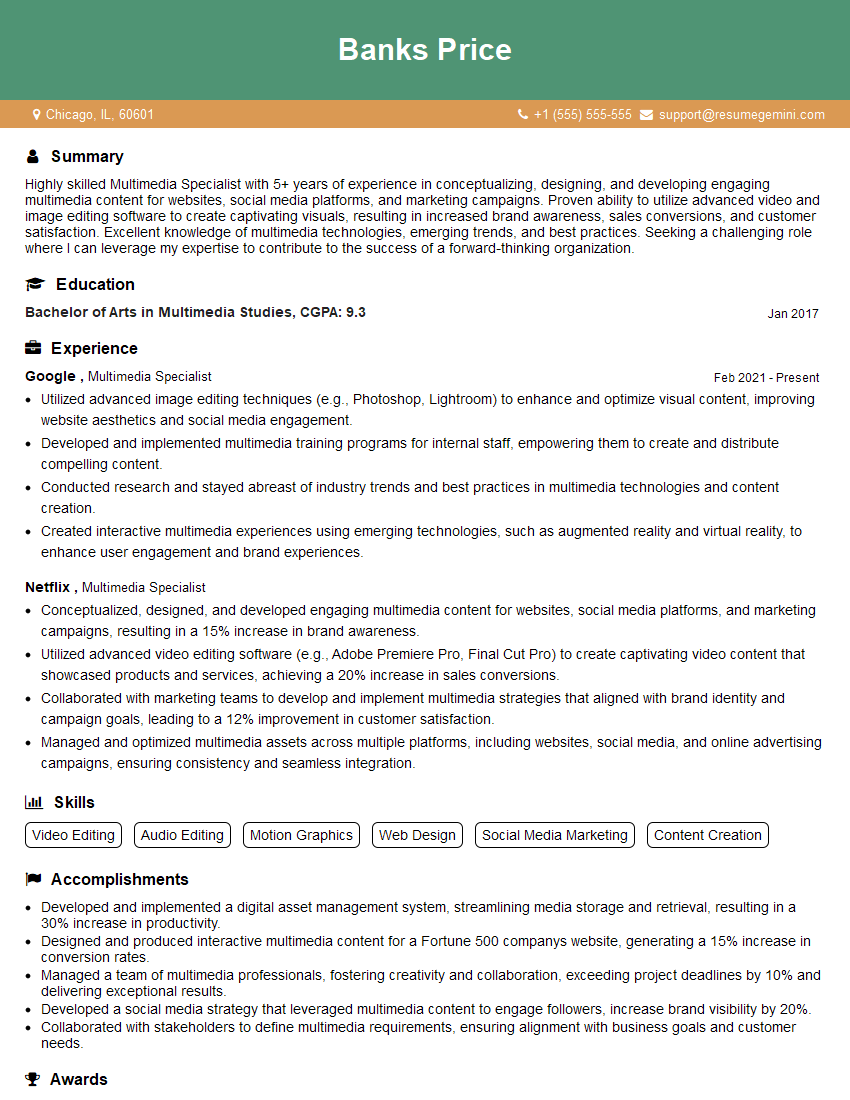
Mastering photographic editing and retouching is crucial for career advancement in a highly competitive field. A strong portfolio is essential, but equally important is presenting your skills effectively through a well-crafted resume. An ATS-friendly resume increases your chances of getting your application noticed by recruiters and hiring managers. ResumeGemini is a trusted resource to help you build a professional and impactful resume that highlights your key skills and experience. We offer examples of resumes tailored specifically to Photographic Editing and Retouching professionals to guide you.
Explore more articles
Users Rating of Our Blogs
Share Your Experience
We value your feedback! Please rate our content and share your thoughts (optional).
What Readers Say About Our Blog
Very informative content, great job.
good