Cracking a skill-specific interview, like one for Physics Knowledge, requires understanding the nuances of the role. In this blog, we present the questions you’re most likely to encounter, along with insights into how to answer them effectively. Let’s ensure you’re ready to make a strong impression.
Questions Asked in Physics Knowledge Interview
Q 1. Explain the concept of quantum superposition.
Quantum superposition is a fundamental concept in quantum mechanics stating that a quantum system can exist in multiple states simultaneously until measured. Imagine a coin spinning in the air – it’s neither heads nor tails until it lands. Similarly, a quantum particle, like an electron, can be in multiple locations or states at once. This isn’t just a lack of knowledge; the particle genuinely exists in all possible states until a measurement forces it to ‘choose’ one.
For example, an electron can be in a superposition of spin up and spin down, represented by a linear combination of the two states. This is described mathematically using wave functions. Only when we measure the spin will we find it to be definitively up or down. The act of measurement collapses the superposition into a single, definite state. This principle is crucial for quantum computing, where qubits leverage superposition to perform computations far beyond the capabilities of classical computers.
A simple analogy is a blurry photo: before focusing, the picture represents a superposition of many possible sharp images. The act of focusing (measurement) collapses the superposition to a single, clear image.
Q 2. Describe the difference between Newtonian and Einsteinian gravity.
Newtonian gravity and Einsteinian gravity (general relativity) differ fundamentally in their descriptions of gravity. Newtonian gravity treats gravity as a force of attraction between objects with mass, acting instantaneously across distance. This works remarkably well for most everyday situations, like calculating the trajectory of a ball. The force is directly proportional to the product of the masses and inversely proportional to the square of the distance between them (Newton’s Law of Universal Gravitation).
Einstein’s general relativity, however, describes gravity not as a force but as a curvature of spacetime caused by the presence of mass and energy. Imagine a bowling ball placed on a stretched rubber sheet; the ball creates a dip, and objects rolling nearby will curve towards it. Similarly, massive objects warp spacetime, causing other objects to follow curved paths. This explains phenomena Newtonian gravity can’t, like the precession of Mercury’s orbit and gravitational lensing (the bending of light around massive objects).
In essence, Newtonian gravity is an approximation of general relativity that works well in weak gravitational fields and at low speeds. General relativity is a more accurate and comprehensive theory that’s necessary for understanding strong gravitational fields, like those near black holes, or when dealing with very high speeds approaching the speed of light.
Q 3. What are the fundamental forces of nature?
The fundamental forces of nature are the interactions that govern how particles and objects interact with each other. Currently, physicists recognize four fundamental forces:
- Strong Nuclear Force: This is the strongest force, responsible for holding protons and neutrons together within the atomic nucleus, overcoming the electrostatic repulsion between the positively charged protons.
- Electromagnetic Force: This force governs interactions between electrically charged particles. It’s responsible for phenomena like light, electricity, and magnetism, and is significantly weaker than the strong force but stronger than the weak and gravitational forces at atomic distances.
- Weak Nuclear Force: This force is responsible for radioactive decay, specifically beta decay. It’s weaker than the electromagnetic force and plays a vital role in nuclear processes within stars.
- Gravitational Force: This is the weakest force but acts over vast distances. It governs the attraction between objects with mass or energy, shaping the large-scale structure of the universe.
There are ongoing efforts in physics to unify these forces, particularly through theories like string theory, which aims to describe them all as manifestations of a single underlying force.
Q 4. Explain the photoelectric effect.
The photoelectric effect is the emission of electrons from a material when light shines on it. Crucially, the effect only occurs if the light’s frequency exceeds a certain threshold frequency, specific to the material. Below this threshold, no electrons are emitted, regardless of the light’s intensity. Above the threshold, the number of emitted electrons increases with the intensity, but their maximum kinetic energy depends only on the light’s frequency.
This phenomenon couldn’t be explained by classical wave theory, which predicted that higher intensity light should always eject electrons, regardless of frequency. Einstein explained this effect by proposing that light comes in discrete packets of energy called photons. The energy of a photon is proportional to its frequency (E = hf, where h is Planck’s constant and f is the frequency). If a photon’s energy exceeds the material’s work function (the minimum energy needed to free an electron), it can eject an electron. The excess energy goes into the kinetic energy of the emitted electron.
The photoelectric effect has significant practical applications, including photomultiplier tubes used in medical imaging and light meters used in photography.
Q 5. Describe the principles of thermodynamics.
Thermodynamics is the study of heat and its relation to other forms of energy and work. Its principles govern energy transfer and transformation, and they can be summarized as follows:
- Zeroth Law of Thermodynamics: If two thermodynamic systems are each in thermal equilibrium with a third, then they are in thermal equilibrium with each other. This establishes the concept of temperature.
- First Law of Thermodynamics (Conservation of Energy): Energy cannot be created or destroyed, only transformed from one form to another. The total energy of an isolated system remains constant.
- Second Law of Thermodynamics (Entropy): The total entropy of an isolated system can only increase over time or remain constant in ideal cases where the system is in a steady state or undergoing a reversible process. Entropy is a measure of disorder or randomness.
- Third Law of Thermodynamics: The entropy of a perfect crystal at absolute zero temperature is zero. This means that it is impossible to reach absolute zero temperature.
These laws have broad implications in various fields, including engineering (designing efficient engines), chemistry (understanding chemical reactions), and cosmology (studying the evolution of the universe).
Q 6. What is the uncertainty principle?
The Heisenberg Uncertainty Principle states that there’s a fundamental limit to the precision with which certain pairs of physical properties of a particle, like position and momentum, can be known simultaneously. The more accurately we know one property, the less accurately we can know the other. This isn’t a limitation of our measurement tools; it’s an inherent property of the universe at the quantum level.
Mathematically, it’s expressed as ΔxΔp ≥ ħ/2, where Δx is the uncertainty in position, Δp is the uncertainty in momentum, and ħ is the reduced Planck constant. This means the product of the uncertainties in position and momentum must be greater than or equal to a certain minimum value.
The principle has profound implications for quantum mechanics, highlighting the probabilistic nature of quantum systems and the limitations of deterministic predictions at the subatomic level. It doesn’t mean we can’t make predictions at all, but rather that our predictions are inherently probabilistic.
Q 7. Explain the concept of wave-particle duality.
Wave-particle duality is the concept that every quantum entity, such as photons (light particles) and electrons, exhibits properties of both waves and particles. It’s not that they are sometimes waves and sometimes particles; they possess both characteristics simultaneously. This dual nature is a fundamental aspect of quantum mechanics and defies classical intuition, where objects are typically considered either waves or particles.
Light, for example, can exhibit wave-like properties like diffraction and interference, as demonstrated by the double-slit experiment. However, it also exhibits particle-like properties, as shown by the photoelectric effect where light interacts with matter as discrete packets of energy (photons). Similarly, electrons, while typically considered particles, can exhibit wave-like behavior, such as diffraction patterns when passed through a crystal lattice.
This duality is a consequence of the quantum mechanical description of nature, where particles are represented by wave functions that describe the probability of finding the particle in a particular state or location. The wave-like behavior manifests in the interference and diffraction patterns, while the particle-like behavior appears when the wave function collapses during a measurement.
Q 8. Describe the structure of an atom.
At the heart of everything lies the atom, the fundamental building block of matter. It’s a tiny, complex system composed primarily of three subatomic particles: protons, neutrons, and electrons.
Protons and neutrons reside in the atom’s nucleus, a dense central core. Protons carry a positive electrical charge, while neutrons are electrically neutral. The number of protons defines the element; for example, an atom with one proton is hydrogen, while an atom with six is carbon.
Electrons, which possess a negative charge, orbit the nucleus in shells or energy levels. These shells are not fixed paths but rather regions of probability where electrons are most likely to be found. The attraction between the positively charged nucleus and the negatively charged electrons holds the atom together.
Think of it like a miniature solar system: the nucleus is the sun, and the electrons are planets orbiting it. However, the electron’s behavior is governed by quantum mechanics, a realm far different from the classical mechanics governing planets.
- Nucleus: Contains protons and neutrons.
- Protons: Positively charged particles.
- Neutrons: Neutral particles.
- Electrons: Negatively charged particles orbiting the nucleus.
Q 9. What are Maxwell’s equations and what do they describe?
Maxwell’s equations are a set of four fundamental equations that describe how electric and magnetic fields behave and interact. They are cornerstones of classical electromagnetism and unify electricity, magnetism, and light as different manifestations of the same phenomenon – the electromagnetic force.
- Gauss’s law for electricity: Describes the relationship between electric charge and the resulting electric field. It essentially states that electric charges are the source of electric fields.
- Gauss’s law for magnetism: States that there are no magnetic monopoles (isolated north or south poles). Magnetic fields always form closed loops.
- Faraday’s law of induction: Describes how a changing magnetic field creates an electric field. This is the principle behind electric generators.
- Ampère-Maxwell’s law: Describes how both electric currents and changing electric fields create magnetic fields. The addition of the changing electric field term by Maxwell was crucial, predicting the existence of electromagnetic waves.
These equations have far-reaching consequences, explaining phenomena such as light, radio waves, and the workings of many electrical devices. Maxwell’s synthesis was a monumental achievement in physics, demonstrating the interconnectedness of seemingly disparate forces.
Q 10. Explain the concept of special relativity.
Special relativity, developed by Albert Einstein, revolutionized our understanding of space and time. It’s based on two postulates:
- The laws of physics are the same for all observers in uniform motion. This means that no matter how fast you’re moving at a constant speed in a straight line, the laws of physics will remain unchanged.
- The speed of light in a vacuum is the same for all observers, regardless of the motion of the light source. This is counterintuitive, but it’s been experimentally verified.
These postulates have surprising consequences. One is time dilation: time passes slower for objects moving at high speeds relative to a stationary observer. Another is length contraction: objects moving at high speeds appear shorter in the direction of motion to a stationary observer. These effects are only significant at speeds approaching the speed of light.
A famous consequence is the mass-energy equivalence, expressed by the equation E=mc², where E is energy, m is mass, and c is the speed of light. This equation shows that mass and energy are interchangeable – a small amount of mass can be converted into a tremendous amount of energy, as seen in nuclear reactions.
Special relativity has profound implications for GPS technology, particle physics, and our understanding of the universe at large.
Q 11. Describe the Doppler effect.
The Doppler effect describes the change in frequency or wavelength of a wave (such as sound or light) for an observer who is moving relative to the source of the wave. Imagine a police siren: as it approaches, the sound waves are compressed, resulting in a higher pitch, and as it moves away, the waves are stretched, resulting in a lower pitch.
This happens because the relative speed between the observer and the source affects the number of wave crests that reach the observer per unit time. If the source and observer are moving towards each other, the frequency increases (blue shift for light, higher pitch for sound). If they are moving away from each other, the frequency decreases (red shift for light, lower pitch for sound).
The Doppler effect is used in many applications, including:
- Radar guns: Measure the speed of vehicles by detecting the Doppler shift of radio waves reflected from them.
- Astronomy: Determine the velocities of stars and galaxies by analyzing the Doppler shift of their light.
- Medical ultrasound: Measure blood flow by detecting the Doppler shift of ultrasound waves reflected from blood cells.
The formula for the Doppler effect depends on whether the source, observer, or both are moving, and whether the wave is sound or light.
Q 12. What is the difference between scalar and vector quantities?
Scalar quantities are physical quantities that are fully described by a single numerical value (magnitude) and a unit. Examples include mass (5 kg), temperature (25°C), and energy (100 J).
Vector quantities, on the other hand, are described by both a magnitude and a direction. Examples include velocity (5 m/s north), force (10 N at 30 degrees above the horizontal), and displacement (20 meters east).
The key difference is that vectors have direction, while scalars do not. This means vector addition and subtraction must account for the directions of the vectors, unlike scalar addition and subtraction which are straightforward.
Imagine pushing a box across a floor: the force you apply is a vector (it has both a magnitude and a direction), while the work done is a scalar (it’s just the magnitude of the energy transferred). Understanding this difference is vital in many areas of physics, from mechanics to electromagnetism.
Q 13. Explain the concept of angular momentum.
Angular momentum is a measure of an object’s rotational motion. It’s a vector quantity, meaning it has both magnitude and direction. The direction of the angular momentum vector is given by the right-hand rule: if you curl the fingers of your right hand in the direction of rotation, your thumb points in the direction of the angular momentum vector.
The magnitude of angular momentum depends on the object’s moment of inertia (how its mass is distributed relative to the axis of rotation) and its angular velocity (how fast it’s rotating). The formula is typically given as L = Iω, where L is angular momentum, I is moment of inertia, and ω is angular velocity.
Angular momentum is a conserved quantity in the absence of external torques (rotational forces). This means that if no external torques act on a system, its total angular momentum remains constant. This principle is fundamental in many areas of physics, such as the stability of spinning tops, the motion of planets, and the behavior of atomic particles.
For example, a figure skater spins faster when they pull their arms closer to their body because they decrease their moment of inertia, and since angular momentum is conserved, their angular velocity must increase to compensate.
Q 14. Describe the workings of a simple pendulum.
A simple pendulum consists of a mass (bob) suspended from a fixed point by a light, inextensible string or rod. When displaced from its equilibrium position, the pendulum swings back and forth in a periodic motion.
The motion is governed by gravity. When the pendulum is displaced, gravity exerts a restoring force that pulls the bob back towards its equilibrium position. However, due to inertia, the bob overshoots its equilibrium position, and the process repeats, resulting in oscillatory motion.
The period (time for one complete oscillation) of a simple pendulum depends only on its length (l) and the acceleration due to gravity (g):
T = 2π√(l/g)
This equation shows that the period is independent of the mass of the bob and the amplitude (maximum displacement) of the swing, provided the amplitude is small (less than about 15 degrees). This is a classic example of simple harmonic motion.
Simple pendulums have practical applications in clocks and metronomes, where their predictable period is used for timekeeping. Understanding their motion is crucial in fields such as mechanics and dynamics.
Q 15. Explain the concept of resonance.
Resonance is a phenomenon where a system vibrates with maximum amplitude at a specific frequency, known as its resonant frequency. Think of pushing a child on a swing – you push at just the right time (the resonant frequency) to make the swing go the highest. If you push at irregular intervals, the swing won’t reach its full potential. This is because the system’s natural frequency matches the driving frequency.
More formally, resonance occurs when the frequency of an external force matches the natural frequency of a vibrating object or system. This leads to a significant amplification of the amplitude of the vibration. This amplification can be beneficial or detrimental depending on the context.
- Example 1 (Beneficial): Musical instruments utilize resonance. The strings on a guitar vibrate at their natural frequencies, and the soundboard amplifies these vibrations, producing a louder and richer sound.
- Example 2 (Detrimental): The Tacoma Narrows Bridge collapse in 1940 is a classic example of resonance gone wrong. Wind gusts excited the bridge’s natural frequency, causing catastrophic oscillations that led to its collapse. This highlights the importance of understanding and designing for resonance in engineering applications.
Understanding resonance is crucial in various fields like acoustics, mechanical engineering, electrical engineering, and even medical imaging (e.g., MRI).
Career Expert Tips:
- Ace those interviews! Prepare effectively by reviewing the Top 50 Most Common Interview Questions on ResumeGemini.
- Navigate your job search with confidence! Explore a wide range of Career Tips on ResumeGemini. Learn about common challenges and recommendations to overcome them.
- Craft the perfect resume! Master the Art of Resume Writing with ResumeGemini’s guide. Showcase your unique qualifications and achievements effectively.
- Don’t miss out on holiday savings! Build your dream resume with ResumeGemini’s ATS optimized templates.
Q 16. What are the different types of radioactive decay?
Radioactive decay is the spontaneous breakdown of an unstable atomic nucleus, resulting in the emission of particles and/or energy. There are several types:
- Alpha Decay: An alpha particle (two protons and two neutrons, essentially a helium nucleus) is emitted. This reduces the atomic number by 2 and the mass number by 4. Alpha particles are relatively large and heavy, so they don’t penetrate matter easily.
- Beta Decay: A beta particle (a high-energy electron or positron) is emitted. Beta minus decay involves the conversion of a neutron into a proton, electron, and antineutrino. Beta plus decay involves the conversion of a proton into a neutron, positron, and neutrino. Beta decay changes the atomic number by 1 but not the mass number significantly.
- Gamma Decay: A gamma ray (high-energy photon) is emitted. Gamma decay doesn’t change the atomic number or mass number; it simply releases excess energy from the nucleus. Gamma rays are very penetrating.
- Electron Capture: The nucleus captures an inner electron, converting a proton into a neutron and emitting a neutrino. This decreases the atomic number by 1 but doesn’t change the mass number.
The type of decay an unstable nucleus undergoes depends on its specific composition and energy levels. Understanding these decay types is crucial in nuclear physics, medicine (radioactive tracers), and geology (radiometric dating).
Q 17. Describe the process of nuclear fission.
Nuclear fission is the process where a heavy atomic nucleus splits into two or more lighter nuclei, releasing a tremendous amount of energy. This energy comes from the conversion of a small amount of mass into energy, as described by Einstein’s famous equation, E=mc².
The process typically starts with bombarding a heavy nucleus (like Uranium-235 or Plutonium-239) with a neutron. This neutron absorption makes the nucleus unstable, causing it to undergo fission. The fission process produces two or more smaller nuclei (fission fragments), several neutrons, and a large amount of energy in the form of kinetic energy of the fragments and gamma rays.
The released neutrons can then trigger further fission reactions in other nuclei, leading to a chain reaction. This chain reaction is the basis of nuclear reactors and atomic bombs. The rate of the chain reaction is controlled in reactors to produce a sustained, controllable release of energy. In bombs, the chain reaction is uncontrolled, resulting in a rapid, explosive release of energy.
Fission is a powerful energy source, but it also produces radioactive waste, which requires careful handling and disposal.
Q 18. Explain the concept of black holes.
Black holes are regions of spacetime where gravity is so strong that nothing, not even light, can escape. They are formed when massive stars collapse at the end of their life cycle. The immense gravitational pull of a black hole comes from the extreme concentration of matter into an incredibly small volume.
A black hole is characterized by its singularity (a point of infinite density at the center) and its event horizon. The event horizon is the boundary beyond which nothing can escape. Anything that crosses the event horizon is inevitably pulled into the singularity.
Black holes are not just theoretical constructs; they’ve been observed indirectly through their effects on surrounding matter and light. For instance, astronomers observe the gravitational effects of black holes on stars orbiting them, and they detect the intense X-rays emitted by matter as it heats up and falls into a black hole.
Black holes play a significant role in galactic evolution and are areas of active research in astrophysics.
Q 19. What is the Big Bang theory?
The Big Bang theory is the prevailing cosmological model for the universe. It suggests that the universe originated from an extremely hot, dense state approximately 13.8 billion years ago and has been expanding and cooling ever since.
The theory is supported by several lines of evidence, including:
- Redshift of galaxies: The light from distant galaxies is stretched, shifting towards the red end of the spectrum. This redshift is interpreted as evidence of the expansion of the universe.
- Cosmic microwave background radiation: This faint radiation permeates the universe and is considered the afterglow of the Big Bang.
- Abundance of light elements: The observed ratios of hydrogen, helium, and other light elements in the universe align well with predictions based on the Big Bang model.
The Big Bang theory doesn’t explain the very beginning of the universe (the singularity) or certain aspects like dark matter and dark energy, which are still under investigation. Nevertheless, it’s the most comprehensive model we have to explain the origin and evolution of the universe.
Q 20. Describe the different types of lasers.
Lasers are devices that produce a coherent and highly directional beam of light. Different types of lasers are categorized based on several factors, including the lasing medium, the wavelength of light produced, and the pumping mechanism.
- Gas lasers (e.g., Helium-Neon laser): Use a mixture of gases as the lasing medium. They are often used in barcode scanners and laser pointers.
- Solid-state lasers (e.g., Nd:YAG laser): Use a solid crystal or glass doped with rare-earth ions as the lasing medium. These lasers are used in various applications, including laser cutting, material processing, and medical procedures.
- Dye lasers: Use organic dyes dissolved in a liquid solvent as the lasing medium. They can be tuned to emit light over a wide range of wavelengths.
- Semiconductor lasers (e.g., diode lasers): Use a semiconductor material as the lasing medium. These lasers are compact, efficient, and widely used in optical communication, laser printers, and CD players.
- Excimer lasers: Use a mixture of inert gases and halogens as the lasing medium. They emit ultraviolet light and are used in microelectronics and laser eye surgery.
The choice of laser type depends on the specific application. Factors such as wavelength, power, beam quality, and cost all play a role in the selection process.
Q 21. Explain the principles of optics.
Optics is the branch of physics that deals with the behavior and properties of light. The fundamental principles include:
- Reflection: The bouncing back of light when it strikes a surface. The angle of incidence equals the angle of reflection.
- Refraction: The bending of light as it passes from one medium to another (e.g., from air to water). The amount of bending depends on the refractive indices of the two media.
- Diffraction: The spreading out of light waves as they pass through an aperture or around an obstacle. This phenomenon limits the resolution of optical instruments.
- Interference: The superposition of two or more light waves, resulting in constructive or destructive interference patterns. This is the basis of many optical techniques.
- Polarization: The restriction of the oscillation of light waves to a particular direction. Polarized light is used in sunglasses and liquid crystal displays.
These principles are used extensively in various technologies, including cameras, telescopes, microscopes, eyeglasses, fiber optics, and laser systems. Understanding the principles of optics is crucial in designing and optimizing these devices.
Q 22. What is the difference between conductors, insulators, and semiconductors?
Conductors, insulators, and semiconductors differ fundamentally in how readily they allow electric current to flow through them. This difference stems from the behavior of electrons within their atomic structures.
Conductors: These materials have loosely bound electrons in their outer shells, allowing electrons to move freely throughout the material when an electric field is applied. This free movement constitutes electric current. Examples include metals like copper and silver, which are excellent conductors due to their ‘sea’ of delocalized electrons.
Insulators: Insulators, on the other hand, have tightly bound electrons that are not easily freed from their atoms. Thus, they strongly resist the flow of electric current. Examples include rubber, glass, and plastics. These materials are crucial for safety in electrical systems, preventing short circuits.
Semiconductors: Semiconductors exhibit intermediate behavior between conductors and insulators. Their conductivity can be significantly altered by temperature, doping (adding impurities), or the application of an electric field. Silicon and germanium are common examples. This controlled conductivity is the basis for modern electronics, enabling the creation of transistors and integrated circuits.
Think of it like this: a conductor is a wide-open highway for electrons; an insulator is a road completely blocked; and a semiconductor is a road that can be dynamically adjusted, sometimes open, sometimes closed, depending on external conditions.
Q 23. Describe the concept of capacitance.
Capacitance is the ability of a system to store electrical energy in an electric field. It’s essentially a measure of how much charge a capacitor can store for a given voltage. A capacitor consists of two conductive plates separated by an insulator (dielectric). When a voltage is applied across the plates, charge accumulates on them, creating an electric field in the dielectric.
The capacitance (C) is directly proportional to the area (A) of the plates and the dielectric constant (κ) of the insulator, and inversely proportional to the distance (d) between the plates:
C = κε₀A/dwhere ε₀ is the permittivity of free space. A larger capacitance means more charge can be stored for the same voltage, or equivalently, a lower voltage is required to store a given amount of charge. Capacitors are vital components in many electronic circuits, used for filtering, timing, energy storage, and signal processing.
Imagine a water tank: the tank’s capacity is analogous to capacitance, the amount of water stored is analogous to the charge, and the water pressure is analogous to the voltage. A larger tank (higher capacitance) can store more water (charge) for the same pressure (voltage).
Q 24. Explain the principles of electromagnetism.
Electromagnetism describes the fundamental interaction between electricity and magnetism. It’s based on the observation that electric and magnetic fields are interconnected and can influence each other. Key principles include:
Moving charges create magnetic fields: An electric current (moving charges) generates a magnetic field around it. The strength and direction of the field depend on the current’s magnitude and direction (as described by Ampere’s Law).
Changing magnetic fields induce electric fields: A time-varying magnetic field induces an electromotive force (voltage) in a conductor, causing a current to flow (Faraday’s Law of Induction). This principle is fundamental to electric generators and transformers.
Maxwell’s equations: These four equations elegantly summarize the relationships between electric and magnetic fields, providing a complete and unified description of electromagnetism. They predict the existence of electromagnetic waves, which travel at the speed of light.
Electromagnetism is the foundation of many technologies, from electric motors and generators to radio waves and wireless communication. The interaction between electricity and magnetism allows us to convert electrical energy into mechanical energy and vice versa.
Q 25. Describe the workings of a simple electric circuit.
A simple electric circuit consists of a power source (e.g., battery), a load (e.g., light bulb), and connecting wires. The power source provides the electromotive force (voltage) that drives the flow of electrons through the circuit. The load consumes electrical energy, converting it into other forms (e.g., light, heat). The connecting wires provide a low-resistance path for the electrons to flow.
Consider a simple circuit with a battery and a light bulb connected by wires. The battery creates a potential difference (voltage) between its terminals. This voltage drives the electrons from the negative terminal of the battery, through the light bulb’s filament (which offers resistance to the flow, causing heat and light), and back to the positive terminal of the battery. The flow of electrons constitutes the electric current.
Circuit diagrams use symbols to represent these components, enabling clear visualization of the circuit’s structure. The flow of current is typically shown using arrows. Understanding simple circuits is essential for grasping more complex electrical systems.
Q 26. What are the different types of waves?
Waves are disturbances that transfer energy from one point to another without the net movement of matter. There are various types of waves, classified based on their properties:
Mechanical waves: These waves require a medium to propagate (e.g., sound waves traveling through air, water waves). Examples include longitudinal waves (like sound) where the particle motion is parallel to the wave propagation direction, and transverse waves (like ripples on water) where particle motion is perpendicular to the wave propagation direction.
Electromagnetic waves: These waves do not require a medium and can travel through a vacuum. They are transverse waves consisting of oscillating electric and magnetic fields perpendicular to each other and to the direction of propagation. Examples include radio waves, microwaves, infrared radiation, visible light, ultraviolet radiation, X-rays, and gamma rays.
Matter waves: This concept from quantum mechanics postulates that particles, like electrons and protons, also exhibit wave-like behavior. Their wavelength is inversely proportional to their momentum (de Broglie wavelength).
The difference in wave types primarily lies in the nature of the disturbance and the mechanism of propagation. Understanding wave types is crucial in various fields, from acoustics and optics to quantum physics.
Q 27. Explain the concept of diffraction.
Diffraction is the bending or spreading of waves as they pass through an aperture (opening) or around an obstacle. This phenomenon is a consequence of Huygens’ principle, which states that every point on a wavefront can be considered as a source of secondary spherical wavelets. When waves encounter an obstacle or aperture comparable in size to their wavelength, the wavelets interfere, causing the wave to spread out.
The amount of diffraction depends on the wavelength of the wave and the size of the obstacle or aperture. Larger wavelengths result in greater diffraction, while smaller apertures cause more pronounced spreading. Diffraction is responsible for the blurring of images in telescopes and microscopes, but it is also used in applications like X-ray crystallography to determine the structure of materials.
Imagine throwing pebbles into a calm pond. The waves will spread out in circular patterns. If you place a barrier in the water, the waves will bend around the barrier, demonstrating diffraction. This same phenomenon applies to light and sound waves.
Q 28. Describe the principles of fluid mechanics.
Fluid mechanics is the branch of physics that studies fluids (liquids and gases) and their behavior under various conditions. Key principles include:
Fluid statics: This deals with fluids at rest, focusing on pressure, buoyancy, and Pascal’s principle (pressure applied to a confined fluid is transmitted equally throughout the fluid).
Fluid dynamics: This examines fluids in motion, including concepts like viscosity (resistance to flow), turbulence, and Bernoulli’s principle (pressure decreases as fluid velocity increases). Important equations include the Navier-Stokes equations which describe fluid motion mathematically.
Conservation laws: Fluid mechanics heavily relies on the conservation of mass, momentum, and energy principles. These laws are applied to analyze and predict fluid behavior in various scenarios.
Fluid mechanics has numerous practical applications, such as designing aircraft, predicting weather patterns, understanding blood flow in the human body, and optimizing pipelines for efficient fluid transport. Understanding fluid behavior is crucial in various engineering disciplines and scientific research.
Key Topics to Learn for Your Physics Knowledge Interview
Ace your upcoming interview by focusing on these essential areas of Physics. Remember, a deep understanding of the underlying principles is key, not just rote memorization.
- Classical Mechanics: Newton’s Laws of Motion, energy conservation, momentum, rotational motion. Consider practical applications like designing mechanical systems or analyzing projectile trajectories.
- Electromagnetism: Coulomb’s Law, Gauss’s Law, Faraday’s Law, Ampere’s Law. Think about applications in electrical engineering, medical imaging (MRI), or even designing efficient power grids.
- Thermodynamics: Laws of thermodynamics, heat transfer, entropy. Explore applications in energy production, material science, or climate modeling.
- Quantum Mechanics: Wave-particle duality, Schrödinger equation, atomic structure. This foundational area is crucial for many modern technologies, from semiconductors to lasers.
- Optics: Wave nature of light, reflection, refraction, diffraction, interference. Consider its application in optical instruments, fiber optics, or even medical imaging.
- Problem-Solving Techniques: Develop your skills in applying fundamental principles to solve complex problems. Practice deriving equations, interpreting data, and analyzing results.
- Experimental Design and Data Analysis: Understand the scientific method, error analysis, and data interpretation techniques crucial for experimental physics.
Next Steps: Launch Your Physics Career
Mastering these Physics concepts significantly enhances your career prospects in research, academia, industry, and beyond. A strong foundation in Physics opens doors to exciting and challenging opportunities.
To maximize your chances of landing your dream job, it’s vital to present your skills and experience effectively. An ATS-friendly resume is essential for getting past applicant tracking systems and into the hands of hiring managers. Use ResumeGemini to craft a professional and impactful resume that showcases your expertise in Physics. ResumeGemini offers examples of resumes tailored to Physics Knowledge to help you get started.

Research Scientist Resume Sample

Computational Physicist Resume Sample

Medical Physicist Resume Sample
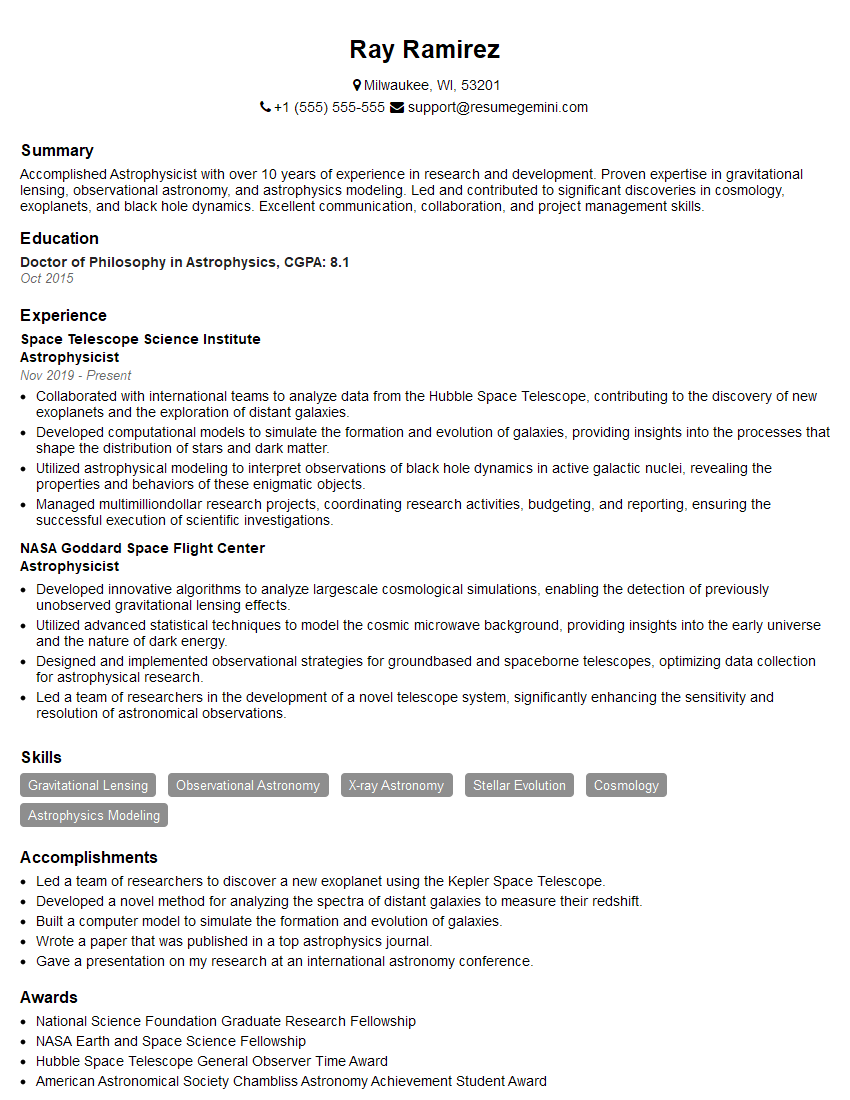
Astrophysicist Resume Sample

Physics Professor Resume Sample

Atmospheric Physicist Resume Sample

Nuclear Physicist Resume Sample
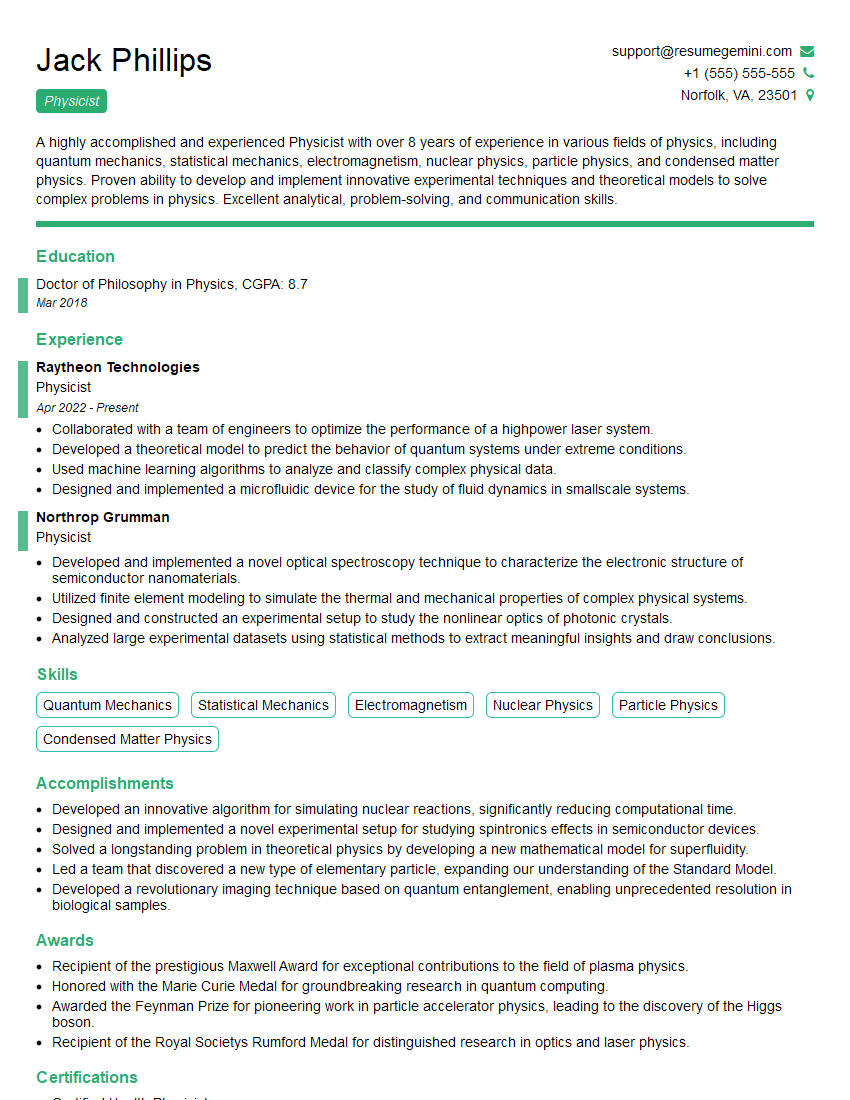
Physicist Resume Sample
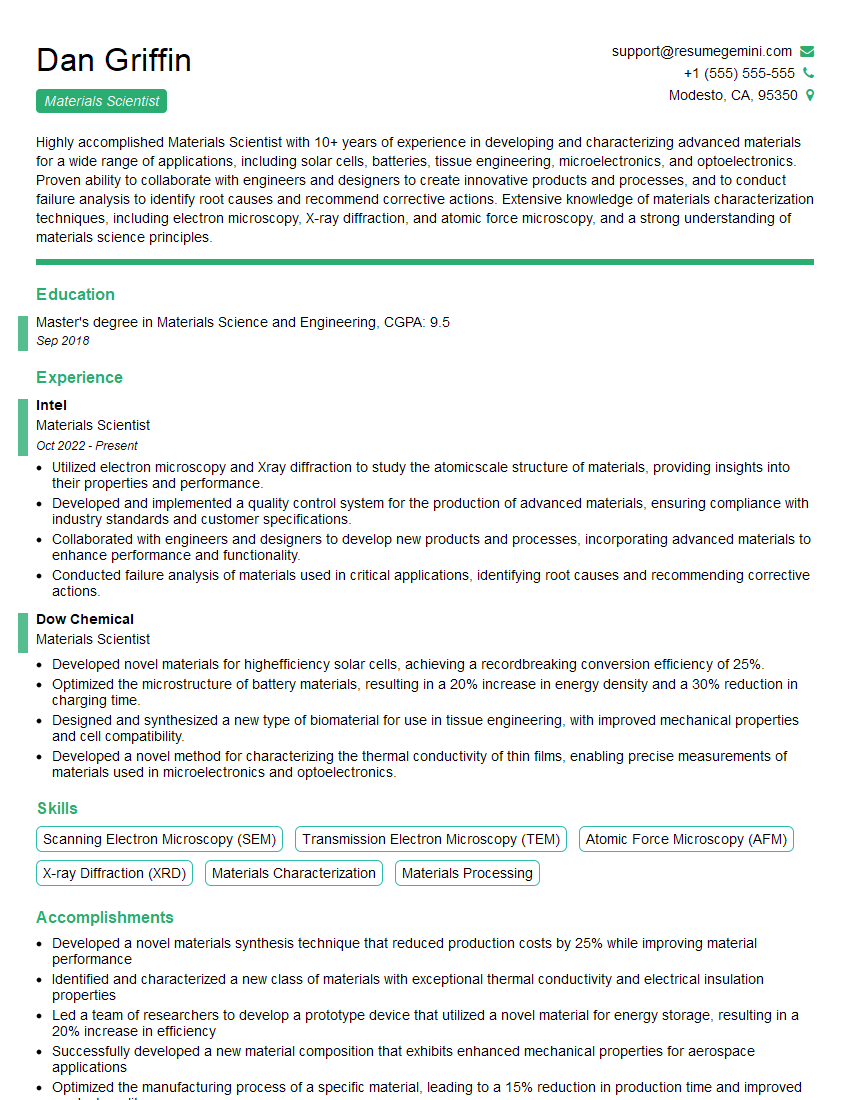
Materials Scientist Resume Sample

Geophysicist Resume Sample
Explore more articles
Users Rating of Our Blogs
Share Your Experience
We value your feedback! Please rate our content and share your thoughts (optional).
What Readers Say About Our Blog
Very informative content, great job.
good