Interviews are opportunities to demonstrate your expertise, and this guide is here to help you shine. Explore the essential Piano Restoration and Repair interview questions that employers frequently ask, paired with strategies for crafting responses that set you apart from the competition.
Questions Asked in Piano Restoration and Repair Interview
Q 1. Describe the process of regulating a piano action.
Regulating a piano action is like fine-tuning a complex machine to ensure each key plays precisely and consistently. It involves adjusting numerous parts to achieve perfect hammer alignment, escapement, and repetition. This meticulous process ensures the piano plays evenly across the entire keyboard, with consistent touch and response.
- Hammer Alignment: We carefully adjust the hammers to strike the strings squarely, preventing uneven tone and volume. Imagine a perfectly thrown baseball – that’s the ideal hammer alignment. Misalignment can result in a weak or muffled sound.
- Let-off: This adjustment determines how much the hammer moves away from the string after striking, allowing for repetition of notes. It’s like the rebound of a basketball after a bounce – we want a responsive but controlled movement.
- Escapement: This crucial step sets the ‘catch’ point for the hammer. The escapement mechanism ensures the hammer can quickly repeat a note without sticking. Think of a well-oiled hinge – smooth and responsive.
- Depth of Touch: We regulate the distance the key travels before the hammer strikes the string, affecting the weight and responsiveness of the keys. It’s like calibrating the sensitivity of a joystick – we want it perfectly balanced for the player’s comfort and skill.
The entire process requires specialized tools and a deep understanding of the intricate mechanics of the piano action. It’s a time-consuming but essential part of piano restoration, improving playability and ensuring years of enjoyable music-making.
Q 2. Explain the different types of piano finishes and their restoration techniques.
Piano finishes range from simple to elaborate, each requiring specialized restoration techniques. Common finishes include:
- Polished Ebony or Mahogany: These high-gloss finishes require careful cleaning, polishing, and potentially French polishing to restore their luster. Scratches and minor imperfections can be buffed out, but significant damage may need filling and refinishing.
- Satin or Matte Finishes: These finishes offer a more subdued look, but still require careful cleaning and light polishing to remove grime and restore their original beauty. Over-polishing can ruin the intended finish.
- Lacquer Finishes: Lacquer finishes are durable but susceptible to chipping and cracking. Repair requires careful color matching and blending techniques. Severe damage may necessitate stripping and re-lacquering.
- Painted Finishes: Painted pianos offer a wide variety of colors and decorative elements. Restoring a painted piano involves touching up chips and scratches with specialized paints and carefully cleaning the surface. Any repaint requires meticulous preparation to prevent defects.
Restoration of a piano finish always begins with careful assessment of the damage, selection of appropriate materials, and meticulous application of techniques specific to that finish type. A poorly executed restoration can irreversibly damage a piano’s finish.
Q 3. How do you identify and address problems with a piano’s soundboard?
The soundboard is the heart of the piano, amplifying the vibrations of the strings. Problems with the soundboard significantly impact the piano’s tone and projection. Common issues include cracks, warping, and loose bracing.
- Identifying Problems: Cracks are visually apparent; warping is often detected by inconsistencies in string height or tone. Loose bracing can lead to buzzing noises and tonal imbalance. A skilled technician uses a combination of visual inspection, tapping (to detect loose areas), and sometimes even X-ray to diagnose problems.
- Addressing Problems: Cracks are usually repaired using specialized glues and techniques. Depending on the severity, this may involve gluing from the back or front, and the addition of reinforcing patches. Warping often requires advanced techniques including humidification or even replacing the soundboard in severe cases. Loose bracing is repaired by regluing and sometimes replacing the broken braces.
Soundboard repair is extremely specialized, often requiring advanced woodworking skills and a deep understanding of acoustics. A badly repaired soundboard can irreparably damage the piano.
Q 4. What are the common issues with piano hammers and how are they repaired or replaced?
Piano hammers are crucial for tone production. Common issues include hardening, wearing down, or becoming misaligned.
- Hardening: Over time, hammers harden, resulting in a harsh, bright tone. This is often addressed by needling, a process of gently pricking the felt to soften it and restore a more balanced tone.
- Wearing Down: Uneven wear on hammers leads to inconsistent volume and tone. In minor cases, needling might suffice, but significant wear requires reshaping and possibly re-covering the hammers.
- Misalignment: If hammers are misaligned, they might strike the strings unevenly, causing tonal imbalances. This usually requires careful regulation and adjustment of the piano action.
Hammer replacement is a significant undertaking, involving careful selection of appropriately sized and weighted replacement hammers, followed by precise installation and voicing to match the rest of the set.
Q 5. Explain the process of voicing piano hammers.
Voicing piano hammers is a highly skilled art, shaping the tonal characteristics of the instrument. It’s an iterative process of carefully manipulating the felt to adjust the piano’s tone.
Techniques include needling (to soften the hammers), shaving (to subtly alter the shape and therefore the tone), and even using chemicals to subtly modify the felt’s density. Voicing requires a skilled ear and a delicate touch, as the process impacts the entire tonal balance of the instrument. Each hammer is individually voiced, creating a harmonious blend of tone across the entire keyboard. It’s a bit like a sculptor meticulously shaping clay—each touch affects the overall form. The goal is to achieve a balanced, resonant, and expressive sound across the entire range of the piano.
Q 6. Describe the different types of piano keys and their repair methods.
Piano keys are typically made of wood (usually spruce or basswood) with an ivory or plastic covering. Different types have different repair needs.
- Ivory Keys: These require careful cleaning and polishing. Cracks or chips can be repaired using specialized ivory filler and restoration techniques.
- Plastic Keys: These are generally more durable, but they can still chip or crack. Repair may involve careful filling and refinishing. Yellowing can sometimes be improved with specialized cleaning products.
- Key-Tops: The key-top is the part that you actually touch when you play. Worn or damaged key-tops can often be replaced. They can be restored by refitting the ivory or plastic keytops or by repairing/cleaning existing ones.
Key repairs often involve intricate work, ensuring proper alignment and function within the keyboard mechanism. A damaged key can affect the feel and playability of the entire keyboard.
Q 7. How do you identify and repair cracks in a piano’s case?
Identifying and repairing cracks in a piano’s case depends on the type of crack and the material of the case (usually wood). Cracks are often caused by changes in humidity and temperature.
- Identifying Cracks: Cracks can vary in size, location, and severity. Some are hairline fractures, others are large separations. A thorough visual inspection is crucial.
- Repairing Cracks: Small cracks can be repaired using wood glue and clamping. Larger cracks may require additional reinforcement, such as wooden dowels or specialized wood filler. The repair must be carefully sanded and finished to match the surrounding area. For significant damage, it might need professional wood repair and refinishing.
Case repairs are often intricate woodworking projects, requiring specialized tools and a keen eye for detail. The goal is to restore the structural integrity of the case while maintaining its aesthetic appeal. A poorly repaired case can compromise the structural integrity of the piano and create further damage.
Q 8. What are the common problems with piano strings and how are they addressed?
Piano strings, the heart of the instrument’s sound, face several common issues. The most prevalent is broken strings, usually due to age, corrosion, or excessive tension. This requires careful removal of the broken section and replacement with a matching string, often involving precise tuning and voicing afterward. Another common problem is string breakage near the tuning pins, often caused by fatigue or improper winding. This necessitates not only string replacement but also potential attention to the tuning pins themselves, ensuring a secure grip. Lastly, corrosion, often caused by humidity fluctuations, can weaken strings over time, affecting their tone and making them prone to breakage. This necessitates careful cleaning and potentially replacing affected strings.
Addressing these problems requires specialized tools and a keen ear. For example, when replacing a string, it’s crucial to match the gauge and material precisely. Furthermore, the process of winding the new string onto the tuning pin must be done with care to avoid damaging the pin or causing uneven tension. Finally, the entire process culminates in carefully voicing the newly installed string to blend harmoniously with the rest of the instrument’s tone.
Q 9. Explain the importance of humidity control in piano maintenance and restoration.
Humidity is the silent enemy of pianos. Wood, the primary material of a piano’s construction, is hygroscopic – it absorbs and releases moisture from the surrounding air. Fluctuations in humidity cause the wood to expand and contract, leading to several problems. Excessive humidity can cause the soundboard to swell, potentially cracking the wood or hindering its vibration. Conversely, low humidity can cause the soundboard to shrink, resulting in cracks and a loss of resonance. This affects the piano’s tuning stability, tone quality, and overall structural integrity. Even the action parts can be affected, leading to sticking keys or unresponsive mechanisms.
Proper humidity control is paramount. Ideally, the humidity should be maintained between 40% and 60%. This is often achieved using a humidifier or dehumidifier, alongside monitoring with a hygrometer. In restoration, this often involves carefully assessing the current state of the wood and addressing any damage caused by past humidity extremes. This might include repairing cracks, stabilizing the soundboard, or meticulously cleaning and re-gluing affected parts.
Q 10. Describe your experience with different piano brands and their unique restoration challenges.
My experience spans numerous brands, each presenting unique challenges. Steinway & Sons pianos, for example, are known for their intricate construction and high-quality materials, but restoration can be expensive due to the specialized parts needed. Finding replacement parts for older models can be a significant undertaking. Mason & Hamlin pianos, on the other hand, possess a distinct tone and voicing that requires a deep understanding of their construction methods for successful restoration. Baldwin pianos often present different challenges related to their specific designs and materials used throughout different production periods. Each brand’s historical context and manufacturing techniques influence the restoration process, demanding adaptable approaches and meticulous attention to detail.
For instance, I once restored a late 19th-century Steinway with severely cracked soundboard. The repair involved painstakingly stabilizing the cracks, meticulously gluing the damaged sections, and ensuring the structural integrity was restored without impacting the soundboard’s resonance. The meticulousness and precision required is significant across brands, but each requires a different set of problem-solving skills and historical knowledge.
Q 11. How do you assess the value of an antique piano?
Assessing the value of an antique piano is a complex process, requiring a blend of art and science. Several factors are considered, including the make and model, condition, age, rarity, originality, and provenance. The maker’s reputation and historical significance heavily influence value, with renowned brands like Steinway & Sons commanding higher prices than lesser-known manufacturers. Condition is paramount; a well-preserved piano with its original parts fetches more than one with extensive modifications or repairs.
Age is another crucial aspect, with older pianos often holding more value. However, age alone doesn’t guarantee high value; a poorly maintained antique is worth far less than a carefully preserved newer instrument. Rarity and originality enhance value significantly. If the piano has a unique feature or is one of a limited edition, its price may increase substantially. Finally, provenance—the history of ownership and any notable past—contributes to value. Appraisals by experienced piano experts and consultation of auction records or specialist databases can greatly assist in determining a piano’s fair market value. It’s an intricate process, requiring expertise in both piano mechanics and antiques valuation.
Q 12. What are your preferred methods for cleaning and polishing piano finishes?
Cleaning and polishing piano finishes requires a delicate touch and the right products to avoid damage. I begin with a gentle cleaning using a soft, lint-free cloth slightly dampened with distilled water. This removes dust and surface grime. For more stubborn marks, I might use a specialized piano cleaning solution, ensuring it’s compatible with the finish type. Avoid harsh chemicals or abrasive cleaners that could scratch or dull the finish. After cleaning, polishing is done using a high-quality piano polish applied in thin, even coats using a soft cloth.
I prefer using products specifically designed for piano finishes, as they’re formulated to protect and enhance the original lustre without harming the underlying layers. The process requires patience and attention to detail. I work in sections, ensuring each area is thoroughly cleaned and polished before moving on. For heavily damaged finishes, more intensive restoration might be needed, involving repair of scratches or chips and potentially a full refinishing process. The method selection always depends on the finish type and the extent of the damage.
Q 13. What tools and equipment are essential for piano restoration?
Piano restoration demands a range of specialized tools and equipment. Essential tools include various screwdrivers (including specialized ones for piano actions), pliers, wrenches, hammers (various weights and types), chisels, sandpaper (various grits), files, measuring tools (calipers, rulers), and specialized action regulation tools (such as damper regulation tools, hammer voicing tools, and key leveling tools). Equipment often includes a piano tuning hammer, tuning wrench, voicing tools (for shaping and modifying the hammers), vacuum cleaner (with soft brush attachments), and specialized cleaning solutions.
In addition to these, clamps, various glues, and protective gear (such as eye protection and dust masks) are crucial. The exact tools and equipment needed will depend on the specific restoration task. For example, refinishing a piano may require additional tools like spray guns and finishing materials. A good restoration workshop requires a carefully curated collection of tools and equipment suitable for all potential needs. Maintaining these tools in perfect working order is also an important part of the process.
Q 14. Describe your experience with piano action regulation tools and techniques.
Piano action regulation involves adjusting the various components of the action to ensure proper playing feel and tone production. This requires a deep understanding of the action’s mechanics and the use of specialized tools. My experience encompasses various techniques, including key leveling (ensuring all keys are at the same height and depth), regulation of the hammers (adjusting hammer height and distance from the strings), damper regulation (adjusting the dampers to ensure they silence the strings promptly), and let-off adjustment (adjusting the escapement mechanism to achieve the correct escapement point for a responsive playing experience).
For instance, key leveling often involves using shims to adjust the key height, whilst hammer regulation may use felt punches to adjust hammer alignment and height. These procedures often require precise measurements and adjustments. Advanced action regulation might necessitate the use of specialized tools such as hammer voicing tools to modify the hammers to achieve a particular tonal character or repair worn hammers. The skills are refined through years of practice and close observation, making it a core aspect of advanced piano restoration expertise.
Q 15. How do you troubleshoot and repair a sticking or unresponsive piano key?
A sticking or unresponsive piano key is a common problem often stemming from friction or damage within the action mechanism. Troubleshooting begins with careful observation. First, I’d determine if the problem is in the key itself, the key bushings (where the key sits), the whippen (the lever connecting the key to the hammer), or the hammer itself.
- Visual Inspection: I carefully examine the key for any visible obstructions, cracks, or damage. I look for any signs of build-up of dirt, old glue, or other debris.
- Action Mechanism Check: I gently depress the key and feel for resistance. A sticking key often feels stiff or catches midway. I then trace the movement of the whippen and hammer, looking for binding or obstructions.
- Key Adjustment: If the problem is minor, I may adjust the key’s height and alignment using specialized tools. This often resolves minor sticking issues. Sometimes, adding a small amount of appropriate lubricant to the key bushing can also work wonders.
- Component Replacement: If the problem persists or involves more serious damage to the key, bushings, or whippen, I’ll carefully replace the faulty component. Matching the old parts to the appropriate replacement is crucial for maintaining the integrity of the instrument.
For example, I once encountered a piano where the key’s touch point was blocked by a small piece of felt. A simple clean resolved the issue, showcasing that thorough inspection is key. In another case, a damaged whippen required replacement, a more complex process involving precise measurement and careful fitting.
Career Expert Tips:
- Ace those interviews! Prepare effectively by reviewing the Top 50 Most Common Interview Questions on ResumeGemini.
- Navigate your job search with confidence! Explore a wide range of Career Tips on ResumeGemini. Learn about common challenges and recommendations to overcome them.
- Craft the perfect resume! Master the Art of Resume Writing with ResumeGemini’s guide. Showcase your unique qualifications and achievements effectively.
- Don’t miss out on holiday savings! Build your dream resume with ResumeGemini’s ATS optimized templates.
Q 16. Explain your experience with repairing or replacing piano pedals.
Piano pedal repair and replacement require a deep understanding of the mechanism’s intricate workings. The pedals are connected to the damper mechanism, which controls the sustain, and in grand pianos, to the soft pedal and sostenuto.
- Diagnosis: I start by assessing the problem. Is the pedal sticking, unresponsive, or making noise? Is the problem with the pedal itself, the linkage, or the damper mechanism? I carefully inspect all the moving parts, looking for wear and tear, broken parts, or misalignment.
- Repair or Replacement: Minor issues, such as lubrication or minor adjustments of linkage, can often be resolved with repair. However, worn-out or broken components often necessitate replacement. For example, I might replace the felt or leather on the pedal’s linkage to restore smooth operation. Broken pedal rods or springs require careful replacement, matching the size and type for correct function.
- Regulation: After the repair or replacement, it’s crucial to carefully regulate the pedal action to ensure consistent response and feel. The distance between the pedals and their engagement points should be precisely adjusted.
Recently, I worked on a grand piano where the sustain pedal was extremely sluggish. I discovered the problem was with a corroded connecting rod. After replacing the rod and thoroughly lubricating the linkage, the pedal functioned smoothly. This underscores the importance of meticulous attention to detail.
Q 17. Describe your understanding of piano construction, including the different parts and their functions.
A piano is a marvel of engineering, comprising hundreds of meticulously crafted parts working together in harmony. Understanding its construction is fundamental to effective restoration and repair.
- Soundboard: The heart of the piano, the soundboard is a large, carefully braced piece of wood that vibrates to produce sound. Its condition is critical to the instrument’s tone quality.
- Bridge: The bridge transfers vibrations from the strings to the soundboard. Its precise placement and condition are paramount for optimal sound projection.
- Strings: Made of high-tensile steel wire, the strings vary in length and thickness to produce different pitches. The tension on these strings is enormous.
- Tuning Pins: These wooden pins hold the strings at the proper tension. They are located in the pin block.
- Action: This is the complex mechanism that transfers energy from the key to the hammer, causing it to strike the strings. It includes the keys, whippens, hammers, and various regulating parts.
- Plate: The metal frame that supports the entire structure and endures the immense string tension. Cracks in the plate can be catastrophic.
- Cabinet: The outer case, often made of wood, protects the internal mechanisms. Its condition impacts the aesthetics and value of the instrument.
Understanding how these parts interact is essential. For instance, a damaged soundboard can lead to significant tonal issues, requiring careful repair or, in extreme cases, replacement. Similarly, a misaligned bridge can drastically alter the instrument’s sound. A thorough understanding allows for effective diagnosis and repair.
Q 18. How do you handle unexpected problems or challenges during a restoration project?
Restoration projects often present unexpected challenges. My approach focuses on methodical problem-solving and a willingness to adapt.
- Thorough Assessment: Begin by thoroughly assessing the extent of the damage. Often, hidden problems become apparent as work progresses. Accurate initial assessment is critical.
- Research & Consultation: When confronted with an unusual problem, I conduct research, consulting books, online resources, and experienced colleagues when necessary. Often, discussions with other professionals offer innovative solutions.
- Creative Solutions: Sometimes, finding original replacement parts is impossible. This necessitates creative solutions, such as crafting custom parts or employing alternative materials that meet the necessary specifications. I’ve had to create custom parts from wood and metal, utilizing my skills in woodworking and metalworking.
- Documentation: Maintaining thorough documentation of every step is essential. This helps in troubleshooting issues and allows me to track progress effectively. Detailed photography and notes are critical.
For example, I once encountered a piano with a severely damaged soundboard. After careful research, I decided to use a modern composite material to reinforce it, instead of attempting a traditional repair. This approach ensured structural integrity while maintaining the piano’s original aesthetic.
Q 19. What are your preferred sources for piano parts and supplies?
Reliable sources for piano parts are crucial for quality restoration. I rely on a combination of sources.
- Specialized Suppliers: I work with reputable piano parts suppliers who offer high-quality components. These suppliers often provide parts for various piano makes and models. Their expertise and knowledge are invaluable.
- Antique Dealers and Auctions: For antique pianos or rare parts, I sometimes source from reputable antique dealers and auctions, carefully vetting the authenticity and condition of the parts.
- Online Marketplaces: While used with caution, online marketplaces can provide access to less common parts, though careful inspection and verification are vital before purchasing.
- Local Craftspeople: When necessary, I collaborate with skilled woodworkers and metalworkers to fabricate or repair specific parts, particularly when original parts are unavailable.
Building relationships with these suppliers and craftspeople is key to securing high-quality parts and ensuring a successful restoration. I prioritize those with a proven track record and a commitment to quality.
Q 20. Explain your experience with different types of piano tuning pins and their maintenance.
Piano tuning pins are crucial for maintaining the instrument’s pitch. Different types exist, each with specific characteristics.
- Material: Most tuning pins are made of hardwood, such as maple or beech, due to their strength, resilience, and resistance to moisture. The grain direction is crucial for stability.
- Size and Shape: Tuning pins vary in size and shape to fit different pinblocks and string gauges. Precise fit is essential for proper tension and stability.
- Maintenance: Proper pin maintenance involves ensuring they are properly seated in the pinblock and free of any damage. Regular tuning can help detect early signs of wear or damage. Lubricating the pins periodically reduces friction and can extend their life.
- Issues: Loose tuning pins indicate wear or damage within the pinblock and require attention. Stripped tuning pins present a significant challenge that needs careful assessment and potentially replacing sections of the pinblock.
I have experienced situations where poorly maintained pins lead to tuning instability. In these cases, I carefully assess the pinblock’s condition and replace the affected pins. Sometimes it’s necessary to replace entire sections of the pinblock. Preventive maintenance, including regular tuning and pin lubrication, is crucial to prolong the lifespan of tuning pins and the piano itself.
Q 21. How do you prepare a piano for shipping or transport?
Preparing a piano for shipping requires careful attention to detail to prevent damage during transport.
- Internal Protection: I begin by internally protecting the piano’s most vulnerable parts. This often includes wrapping the hammers, action, and other sensitive components with padding or specialized blankets. The soundboard often receives additional support.
- External Protection: The piano’s exterior is protected with a sturdy case or by wrapping it in heavy-duty moving blankets. This ensures protection against scratches and impacts.
- Tuning: Before shipping, I generally tune the piano. While tuning won’t prevent some slight changes during transit, it provides the best possible starting point once it reaches its destination.
- Transportation Method: The choice of transportation method greatly impacts the preparation. For local moves, a specialized piano moving company might be suitable. For long-distance transport, a climate-controlled container may be essential to prevent damage from extreme temperatures and humidity.
- Documentation: Comprehensive documentation including photographs of the piano before and after preparation, as well as a detailed packing list, is essential in case of any disputes or damage claims.
I’ve always emphasized careful preparation, leading to successful transportation for many pianos. Overlooking these steps can easily lead to significant damage that is both costly and time-consuming to repair. Prioritizing preparation ensures the instrument arrives at its destination safely and in optimal condition.
Q 22. How do you maintain accurate records of your work and restoration materials?
Maintaining accurate records is paramount in piano restoration. It’s not just about remembering what you did; it’s about ensuring the longevity and value of the instrument and protecting myself legally. I utilize a comprehensive system combining digital and physical records. For each piano, I create a dedicated file folder, both physical and digital.
- Physical Folder: Contains original client communication, photos of the piano’s initial condition, detailed written notes on each stage of the restoration process (including dates, materials used, and specific techniques employed), receipts for materials, and finally, before and after photos.
- Digital File: This mirrors the physical file, offering additional organization. I use a project management software to track progress, deadlines, and materials, creating a timeline of the restoration. High-resolution images and videos are also stored here, providing a visual record.
This dual system ensures redundancy and easy access to all relevant information, regardless of unforeseen circumstances. Imagine needing to refer to a specific repair years later – this meticulous system makes it effortless.
Q 23. Describe your experience working with different types of piano finishes (e.g., French polish, lacquer).
Piano finishes are a crucial aspect of restoration. My experience spans a range of finishes, each with its own unique characteristics and challenges.
- French Polish: This traditional method involves applying multiple thin layers of shellac, creating a deep, lustrous finish. It’s labor-intensive but yields an unparalleled depth and warmth, ideal for restoring antique pianos. I’ve worked on several 19th-century instruments where reviving the original French polish was a significant part of the project. It’s a delicate process requiring patience and precision.
- Lacquer: Lacquer finishes are more durable and easier to apply than French polish, offering a hard, protective layer. Modern pianos often utilize lacquer. Refinishing with lacquer often requires careful removal of the old finish to ensure proper adhesion and a consistent sheen. I’ve had experience with both nitrocellulose and acrylic lacquers, choosing the appropriate type depending on the specific needs of the piano.
Understanding the properties of each finish, including their age, condition, and compatibility with other materials is critical to achieving a successful outcome. It’s essential to consider the aesthetic and historical aspects of the instrument to determine the best approach.
Q 24. How do you ensure the safety and structural integrity of a piano during restoration?
Ensuring the safety and structural integrity of a piano during restoration is non-negotiable. It requires careful planning and execution.
- Support Structures: I always begin by carefully assessing the piano’s structural soundness. Often, this involves using specialized supports to prevent warping or damage to the soundboard and case during disassembly and reassembly.
- Careful Disassembly: The process is methodical and documented. Each part is carefully labeled and documented photographically to ensure correct reassembly. I avoid brute force, always employing appropriate tools and techniques to minimize the risk of damage.
- Glueing and Repair: For structural repairs, I use high-quality animal-hide glue (for historical instruments) or modern wood glues as appropriate, ensuring proper clamping and drying time to maintain integrity.
Essentially, it’s like building a complex structure. One misstep can affect the overall stability. I prioritize precision at every stage to prevent future problems.
Q 25. What are your skills in identifying and treating woodworm or other infestations in a piano?
Identifying and treating woodworm infestations is a crucial skill. Neglecting this can lead to irreversible damage.
- Inspection: I start with a thorough inspection, checking for exit holes, frass (woodworm droppings), and any signs of active infestation. A magnifying glass and a fine probe often reveal hidden damage.
- Treatment: Treatment depends on the severity of the infestation. For minor infestations, I might use localized insecticide treatments. For more severe cases, I might employ fumigation under controlled conditions. This requires specialized equipment and adherence to strict safety regulations.
- Prevention: Once the infestation is treated, preventative measures are taken to prevent future infestations. This might include using protective coatings and ensuring proper humidity control.
It’s vital to understand different woodworm species and the most effective treatment methods for each. Delaying treatment can compromise the structure and potentially result in total loss of the piano.
Q 26. Explain your experience with working on historical or rare pianos.
Restoring historical or rare pianos is both a privilege and a significant responsibility. It demands a deeper understanding of historical construction techniques, materials, and aesthetics.
I’ve worked on several Broadwood pianos from the late 1800s and an early Steinway, each requiring a meticulous approach. These projects involve extensive research to understand the original construction methods and materials. It’s not just about making it functional; it’s about preserving the history and artistry embedded in the instrument. Working with these instruments involves consulting with experts, researching historical documentation, and using traditional techniques to ensure authenticity and preservation. It requires a keen eye for detail and an unwavering commitment to historical accuracy.
Q 27. Describe your process for documenting the restoration process, including photography and written records.
Documentation is as important as the restoration itself. I meticulously document the entire process, creating a comprehensive historical record for the instrument.
- Photography: High-resolution photographs are taken at every stage – from the initial assessment to the final polishing. Images capture details that written words cannot convey. This creates a visual timeline of the restoration process.
- Written Records: Detailed written notes are maintained, documenting all procedures, materials used (with lot numbers when relevant), and any challenges or unusual findings. This information is invaluable for future reference and troubleshooting.
- Digital Archives: All photographic and written records are stored digitally and backed up, ensuring the longevity of the documentation. I often create a final presentation for the client, summarizing the restoration process, using photographs and a detailed account of the work performed.
Imagine a future restorer needing to understand a specific repair. This detailed documentation provides critical insights, making future maintenance simpler and more informed.
Q 28. How do you communicate effectively with clients regarding the restoration process and costs?
Clear communication is key to a successful restoration project. I strive to keep clients informed at every stage.
- Initial Consultation: A thorough initial consultation involves explaining the restoration process, potential challenges, and estimated costs in detail. I emphasize transparency, avoiding jargon and providing clear, concise information.
- Progress Updates: Regular progress updates are provided, either through email or in-person meetings, keeping the client aware of the restoration’s status. Photos and videos can visually demonstrate the progress.
- Cost Management: Any unforeseen issues or changes in the scope of work are immediately communicated to the client, along with a revised cost estimate. I obtain prior approval before proceeding with any changes to avoid surprises.
Open and honest communication builds trust and ensures a positive experience for the client. It’s about partnership, not just a transaction.
Key Topics to Learn for Piano Restoration and Repair Interview
- Action & Regulation: Understanding hammer voicing, key regulation, and escapement mechanics. Practical application: Diagnosing and resolving playing issues like sticking keys or uneven touch.
- Soundboard Repair: Identifying and repairing cracks, patching, and understanding the importance of humidity control. Practical application: Assessing soundboard damage and selecting appropriate repair techniques.
- Casework Restoration: Techniques for refinishing, polishing, veneer repair, and understanding different wood types and finishes. Practical application: Restoring the aesthetic appeal and structural integrity of the piano case.
- Pinblock Repair: Understanding pinblock condition assessment, repair techniques, and the importance of pin stability. Practical application: Determining the need for pinblock replacement or repair and executing the process.
- Tuning & Temperament: Mastering various tuning methods and understanding equal temperament. Practical application: Accurately tuning a piano and addressing pitch issues.
- Historical Styles & Techniques: Understanding the construction and restoration techniques of different piano eras (e.g., square pianos, early uprights). Practical application: Approaching restoration projects with an understanding of historical context.
- Diagnosis & Troubleshooting: Developing a systematic approach to identifying and resolving complex piano problems. Practical application: Effectively using diagnostic tools and techniques to pinpoint the source of mechanical or tonal issues.
- Health and Safety: Proper handling of tools, materials, and awareness of potential hazards during the restoration process. Practical application: Maintaining a safe working environment and using appropriate safety equipment.
Next Steps
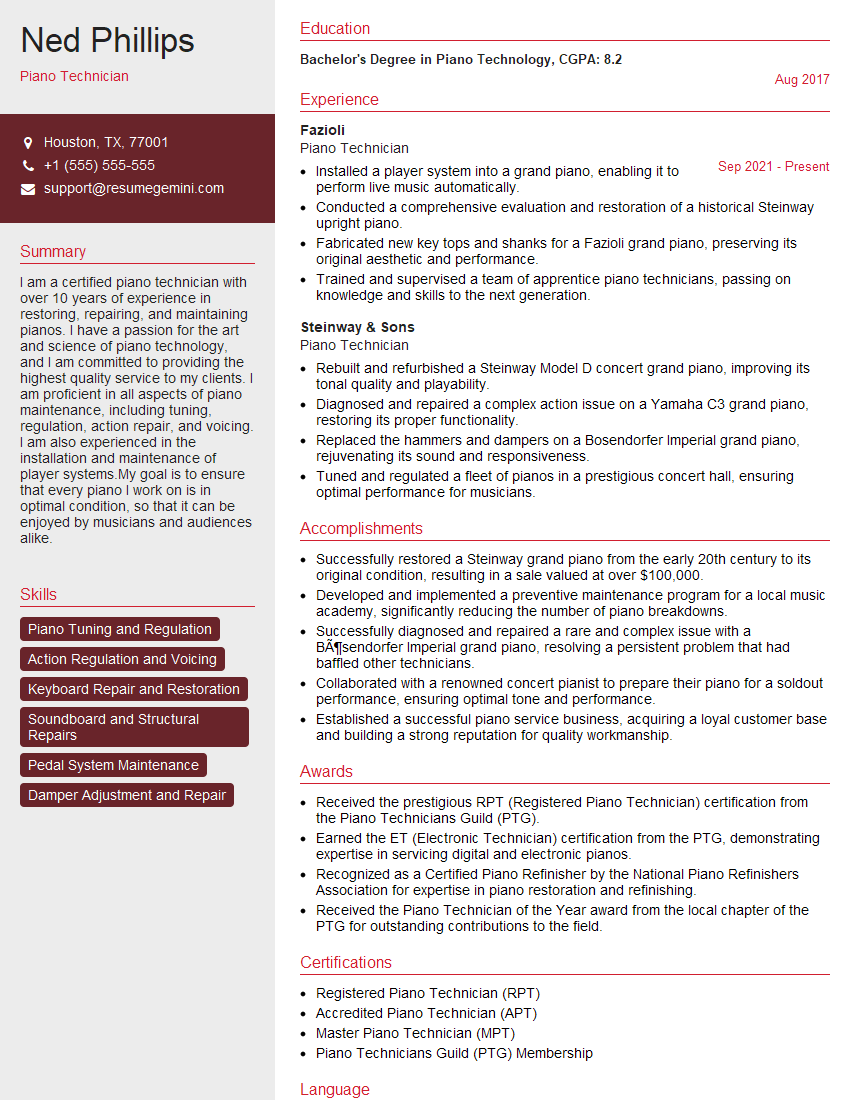
Mastering Piano Restoration and Repair opens doors to a fulfilling and rewarding career, offering opportunities for independent work, specialized expertise, and contributing to the preservation of musical heritage. To maximize your job prospects, it’s crucial to create a compelling, ATS-friendly resume that highlights your skills and experience. ResumeGemini is a trusted resource that can help you build a professional resume designed to get noticed. They offer examples of resumes tailored specifically to the Piano Restoration and Repair field, ensuring your qualifications are presented in the best possible light. Invest time in crafting a strong resume—it’s your first impression with potential employers.

Explore more articles
Users Rating of Our Blogs
Share Your Experience
We value your feedback! Please rate our content and share your thoughts (optional).
What Readers Say About Our Blog
Very informative content, great job.
good