Interviews are opportunities to demonstrate your expertise, and this guide is here to help you shine. Explore the essential Piping and Valve Handling interview questions that employers frequently ask, paired with strategies for crafting responses that set you apart from the competition.
Questions Asked in Piping and Valve Handling Interview
Q 1. Explain the different types of pipe fittings and their applications.
Pipe fittings are components used to connect, terminate, change direction, or branch pipe sections. They are crucial for building complex piping systems. Choosing the right fitting depends on factors like pressure, temperature, fluid type, and system requirements.
- Elbows: Change the direction of the pipe flow. Common types include 45° and 90° elbows. Think of them as the corners in your plumbing at home.
- Tees: Allow for branching of the pipeline, providing multiple flow paths. Picture a road intersection – the tee allows flow to continue straight or branch off.
- Reducers/Enlargers: Connect pipes of different diameters, ensuring smooth transition and minimizing flow disruption. Like an adapter between different sized hoses.
- Couplings: Join two pipes of the same diameter end-to-end. These are like connectors to extend a string of lights.
- Caps: Close or seal the end of a pipe, preventing leaks or unwanted flow. Similar to a plug sealing a hole.
- Unions: Allow for the disconnection and reconnection of pipes without needing to cut or weld. Think of them as easily removable joints in a system.
- Crosses: Allow for flow in four directions – perfect for complex pipeline intersections.
The material of the fitting, such as cast iron, steel, PVC, or CPVC, will also be selected to match the pipe and the working conditions of the system.
Q 2. Describe the various types of valves and their operating principles.
Valves are control devices that regulate, direct, or stop the flow of fluids (liquids, gases) within a piping system. Different valve types offer unique functionality and operating mechanisms.
- Gate Valves: Open and close by lifting a gate out of the flow path. They’re ideal for fully open or fully closed operations, offering minimal resistance to flow when fully open. Think of a sliding door – fully open or fully closed.
- Globe Valves: Regulate flow using a disc that moves up and down within the valve body. They provide excellent throttling capabilities but can have greater pressure drop compared to gate valves. Imagine a regulator on a water hose, controlling flow.
- Ball Valves: Employ a rotating ball with a hole to control flow. They’re quick-acting, simple to operate, and offer a good seal when closed. Think of a tap or faucet with a rotating handle.
- Butterfly Valves: Use a disc rotating within a circular housing. They’re compact, cost-effective, and good for throttling. Imagine the flap in a ventilation system.
- Check Valves: Allow fluid to flow in only one direction, preventing backflow. Essential for safety and system integrity. Like a one-way valve in a heart.
- Safety Relief Valves (PRVs): Automatically release excess pressure to prevent system overpressure, crucial for safety. Like a pressure release valve in a boiler.
Operating principles vary from manual (handwheel) to automated (electric/pneumatic actuators) depending on the application’s requirements and complexity.
Q 3. What are the common materials used in piping systems and their suitability for different applications?
Pipe materials are selected based on factors such as pressure, temperature, fluid compatibility, cost, and required lifespan. The wrong material can lead to leaks, corrosion, or even catastrophic failures.
- Carbon Steel: Strong, versatile, and cost-effective, suitable for many applications but prone to corrosion in certain environments. Common in industrial settings.
- Stainless Steel: Highly corrosion-resistant, ideal for aggressive chemicals or high-purity applications. More expensive than carbon steel.
- Copper: Excellent corrosion resistance, commonly used in plumbing and low-pressure systems. Good thermal conductivity.
- PVC (Polyvinyl Chloride): Lightweight, corrosion-resistant, and cost-effective for low-pressure applications like water distribution. Not suitable for high temperatures.
- CPVC (Chlorinated Polyvinyl Chloride): Similar to PVC but with a higher temperature rating, making it suitable for hot water applications.
- Ductile Iron: Very strong, resistant to corrosion, commonly used in water and wastewater systems.
For example, choosing stainless steel for a pharmaceutical piping system ensures product purity and prevents contamination, whereas carbon steel might suffice for a less critical water line. The selection process involves careful consideration of all the factors involved in the specific application.
Q 4. How do you determine the appropriate pipe size for a given application?
Determining the correct pipe size is critical to ensure adequate flow rate while minimizing pressure loss and energy consumption. It’s a balance between cost and system performance. The process involves several steps:
- Flow Rate Determination: Calculate the required flow rate (gallons per minute or cubic meters per hour) based on the application’s needs.
- Fluid Properties: Determine the fluid’s viscosity and density. These factors affect friction losses within the pipe.
- Pressure Drop Calculation: Use appropriate formulas (like the Hazen-Williams or Darcy-Weisbach equations) or specialized software to calculate the acceptable pressure drop along the pipe length.
- Pipe Material Selection: The material’s roughness coefficient affects friction losses and influences the final pipe size selection.
- Pipe Schedule: Choose an appropriate pipe schedule (wall thickness) based on the operating pressure.
- Valve Considerations: Account for pressure losses across valves and fittings.
Engineering handbooks, software like Pipe-Flow Expert, and industry standards (like ASME B31) provide resources and tools for accurate pipe sizing calculations.
Q 5. Explain the importance of proper pipe support and its impact on system integrity.
Proper pipe support is essential for maintaining the structural integrity of a piping system and preventing failures. Inadequate support leads to excessive stress on the pipes, potentially causing sagging, vibrations, and ultimately, leaks or ruptures.
- Preventing Sagging: Supports prevent the pipe from sagging under its own weight or the weight of the fluid, avoiding stress concentration at low points.
- Reducing Vibrations: Proper supports dampen vibrations caused by pumps, compressors, or fluid flow, preventing fatigue and failure. Think of shock absorbers on a car.
- Thermal Expansion Accommodation: Supports need to account for thermal expansion and contraction of pipes due to temperature changes. Otherwise, stresses can develop causing pipe failure.
- Earthquake Resistance: In seismic zones, special supports are needed to withstand earthquake loads.
A poorly supported system can lead to costly repairs, production downtime, and even safety hazards. Proper design using suitable support types (hangers, brackets, guides, etc.) is crucial. Design codes like ASME B31 provide guidelines for pipe support spacing and design.
Q 6. What are the different types of pipe joints and their advantages/disadvantages?
Pipe joints are crucial for joining pipes together securely and reliably. The type of joint depends on factors such as pressure, temperature, fluid type, and accessibility.
- Threaded Joints: Pipes are joined using threaded fittings. Relatively easy to assemble and disassemble, suitable for low- to moderate-pressure applications. However, threads can weaken under high pressure or vibration.
- Flanged Joints: Pipes are connected using flanges bolted together with a gasket. Robust and suitable for high-pressure applications. More expensive and time-consuming to assemble compared to threaded joints.
- Welded Joints: Pipes are joined using welding techniques (butt, socket, fillet welds). Strongest and most leak-proof option, suitable for high-pressure and critical applications. Requires skilled welders and inspection to ensure quality.
- Compression Joints: Use compression fittings to create a seal. Easy to assemble and disassemble, suitable for low-pressure applications. Can be less reliable for high pressure.
- Solvent Weld Joints: Used for thermoplastic pipes, using a solvent to melt and fuse the pipe ends together. Creates a strong and leak-proof joint.
Choosing the right joint type requires considering the system’s requirements, including pressure, temperature, accessibility, and cost. For example, a high-pressure steam line may require welded joints, while a low-pressure water line might use threaded or compression fittings.
Q 7. Describe the process of hydrostatic testing of piping systems.
Hydrostatic testing is a critical procedure used to verify the integrity of piping systems by pressurizing them with water to a specific pressure and holding it for a set period.
- System Preparation: Isolate the piping system section to be tested. Ensure all valves are closed except for the test section. Blind flanges can be used to seal off non-test sections.
- Pressure Medium: Water is the most common pressure medium, chosen for its ease of handling and safety (compared to air).
- Pressurization: The system is slowly pressurized using a water pump or compressed air (if used with a proper bladder). Pressure gauges are used to monitor pressure during testing.
- Pressure Hold: Once the test pressure is reached, it is held for a specified duration (typically 30 minutes to several hours), allowing for pressure stabilization and potential leak detection.
- Pressure Measurement: The pressure is monitored continuously during the test period. Any significant pressure drop might indicate a leak.
- Leak Detection: Visual inspection of welds and joints is done. Leak detection devices such as soap solution might be used.
- Pressure Release: After the test period, the pressure is slowly released to avoid water hammer damage.
- Documentation: All aspects of the test, including pressures, duration, and results, are carefully documented.
Hydrostatic testing is crucial for ensuring the safety and reliability of the piping system, preventing future leaks or failures. The test pressure is usually higher than the system’s operating pressure to simulate the stresses imposed on the system.
Q 8. Explain the concept of pipe stress analysis and its importance.
Pipe stress analysis is the process of determining the forces and moments acting on piping systems due to various factors like pressure, weight, temperature changes, and seismic activity. It’s crucial because understanding these stresses prevents failures like leaks, cracks, and even catastrophic ruptures. Imagine a long pipe carrying hot steam – expansion and contraction due to temperature changes can create significant stresses, potentially leading to a dangerous situation. Pipe stress analysis helps engineers design piping systems that can withstand these loads safely and reliably.
The analysis uses software and engineering principles to model the piping system and simulate the effects of these loads. This allows engineers to optimize the design for safety, minimize material usage, and ensure compliance with industry standards and regulations (like ASME B31.1 or B31.3). The output often involves stress reports showing the maximum stress levels in various components, enabling targeted reinforcement or design modifications where needed.
For instance, in a refinery, improperly designed piping for high-pressure and temperature processes could lead to significant safety risks. Stress analysis helps predict and mitigate such risks, thereby ensuring the safety of personnel and the protection of equipment.
Q 9. How do you identify and address potential piping system leaks?
Identifying and addressing piping system leaks involves a multi-step approach, starting with visual inspection. Look for obvious signs like dripping water, wet patches, or unusual sounds (hissing or spraying). Pressure testing is a crucial technique; by isolating sections of the piping system and pressurizing them, we can detect pressure drops indicating leaks. Ultrasonic leak detection uses sound waves to locate leaks, even hidden ones, within walls or underground. Dye penetrant testing can be employed for detecting very small cracks or leaks in metal pipes.
Once a leak is located, the appropriate repair method is determined. This could range from simple tightening of a loose fitting, replacing a damaged gasket or section of pipe, to more complex repairs such as welding or specialized epoxy patching. For persistent leaks, more extensive work might be needed, including replacing larger pipe sections or even redesigning parts of the system.
In a hospital setting, a leak in a medical gas line could pose a serious risk to patients. Rapid leak detection and repair are crucial to maintaining patient safety and preventing disruptions to critical services.
Q 10. What are the safety precautions to be followed while working with piping systems?
Safety is paramount when working with piping systems. A few fundamental precautions include:
- Lockout/Tagout (LOTO): Before working on any pipe, ensure that the system is completely isolated and depressurized using LOTO procedures to prevent accidental energization. This is vital for preventing injuries due to unexpected pressure releases.
- Personal Protective Equipment (PPE): This includes safety glasses, gloves, safety shoes, and possibly respirators depending on the contents of the pipe. Choosing the right PPE helps protect workers from potential hazards like chemical spills, sharp edges, or hot surfaces.
- Confined Space Entry Procedures: If working inside a pipe or confined space, proper entry procedures, atmospheric testing, and rescue plans are required to prevent asphyxiation or exposure to hazardous substances.
- Hot Work Permits: Welding or cutting on piping systems requires strict adherence to hot work permit procedures to prevent fires or explosions.
- Proper Lifting Techniques: Heavy pipes and valves must be handled using appropriate lifting equipment and techniques to prevent injuries.
Failure to follow these precautions can lead to serious accidents, including injuries and fatalities. A clear safety plan and proper training are essential for ensuring safe operations.
Q 11. Explain the different types of valve actuators and their applications.
Valve actuators are mechanisms used to open or close valves remotely or automatically. Common types include:
- Pneumatic Actuators: Powered by compressed air, these are robust and reliable, often used in hazardous environments due to the non-sparking nature of air. They’re commonly found in oil and gas refineries.
- Electric Actuators: Powered by electricity, they offer precise control and are ideal for applications requiring automated control sequences. They’re frequently used in process control systems.
- Hydraulic Actuators: Employ hydraulic fluid for power, providing high force outputs. They are suitable for large valves and high-pressure applications, such as those in hydroelectric power plants.
- Manual Actuators: These are the simplest type, operated by hand using a wheel, lever, or handwheel. They are used in situations requiring direct and simple control, but are not suitable for large or remote valves.
The choice of actuator depends on factors such as the valve size, operating pressure, power availability, control requirements, and environmental conditions. For example, in a nuclear power plant, where safety is paramount, redundant systems with both pneumatic and electric actuators are often used to ensure fail-safe operation.
Q 12. Describe the process of valve selection and sizing.
Valve selection and sizing are critical steps to ensure proper system operation. Factors considered include:
- Fluid Properties: Temperature, pressure, viscosity, and corrosiveness of the fluid influence the valve material and design.
- Flow Rate: The required flow rate determines the valve’s size and capacity. Incorrect sizing can lead to excessive pressure drop or insufficient flow.
- Pressure Rating: The valve must withstand the system’s maximum operating pressure.
- Valve Type: Different valve types (ball, gate, globe, butterfly, etc.) have different characteristics and suitability for various applications. Globe valves are excellent for throttling flow while ball valves are best for quick on/off operations.
- Material Compatibility: The valve material must be compatible with the fluid to prevent corrosion or degradation.
Sizing is often done using specialized software or calculation methods based on fluid mechanics principles. An undersized valve may lead to excessive pressure drop and reduced efficiency, while an oversized valve could lead to poor control and increased cost. In a water distribution system, for example, correctly sizing valves ensures adequate water pressure and flow to all consumers.
Q 13. How do you troubleshoot common valve problems?
Troubleshooting valve problems begins with a thorough inspection. Check for obvious issues like leaks, blockages, or damage to the valve body or stem. If the valve is not operating correctly, check the actuator for proper functionality. For pneumatic actuators, ensure sufficient air pressure. For electric actuators, check the power supply and wiring. Listen for unusual sounds that may indicate internal problems, such as grinding or binding.
Systematic troubleshooting involves isolating the problem. If a leak is detected, determine its source – is it the packing, the valve body, or the bonnet? If the valve is sticking or difficult to operate, lubrication may be required or there could be internal damage. If all else fails, a complete valve disassembly and inspection might be necessary. Accurate record-keeping during the process is essential for future maintenance and troubleshooting.
In a chemical processing plant, a malfunctioning valve could lead to a hazardous spill or process upset. Efficient troubleshooting is critical for minimizing downtime and ensuring safety.
Q 14. What are the different types of valve packing and their maintenance requirements?
Valve packing is a sealing material used to prevent leakage around the valve stem. Common types include:
- PTFE (Polytetrafluoroethylene): Excellent chemical resistance, good temperature range, and low friction. However, it can be prone to extrusion under high pressure.
- Graphite: Good chemical resistance and sealing properties. Often used in high-temperature applications. Can be less resistant to abrasion than PTFE.
- Asbestos (deprecated): Though once widely used, asbestos is now largely avoided due to its health hazards.
- Compressed Fiber: Relatively inexpensive and readily available. Less durable and chemically resistant than PTFE or graphite.
Maintenance of valve packing involves regular inspection for leaks and wear. If leakage is detected, repacking may be necessary. This involves removing the old packing, cleaning the packing gland, and installing new packing following manufacturer instructions. Proper packing installation is crucial to prevent stem damage and ensure a leak-free seal. Neglecting packing maintenance can lead to costly leaks, environmental damage, and safety hazards. Regular scheduled maintenance on valves is a critical component of preventative maintenance for a piping system.
Q 15. Explain the importance of valve calibration and its procedures.
Valve calibration is crucial for ensuring the safe and efficient operation of piping systems. Inaccurate valve operation can lead to leaks, process upsets, and even safety hazards. The process involves verifying that a valve opens and closes to the required specifications at the correct pressure and temperature. This ensures proper flow control and prevents equipment damage or process failures.
Calibration Procedures: A typical calibration procedure includes the following steps:
- Preparation: Gather necessary tools, including calibration equipment (e.g., pressure gauges, torque wrenches, and flow meters), documentation (e.g., valve data sheets and calibration procedures), and personal protective equipment (PPE).
- Inspection: Visually inspect the valve for any damage or leaks. Check the valve tag and verify the valve type and specifications.
- Testing: Operate the valve manually or using an actuator to check its functionality. Measure the actual operating parameters (e.g., opening/closing time, pressure drop, flow rate) and compare them to the specified values.
- Adjustment (if needed): If the measured values deviate significantly from the specifications, adjustments are made. This may involve adjusting packing glands, replacing worn parts, or recalibrating actuators.
- Documentation: Record all calibration data, including date, time, valve identification, measured values, adjustments made, and the technician’s signature.
Example: Imagine a control valve in a chemical processing plant regulating the flow of a corrosive fluid. Regular calibration ensures this valve opens and closes precisely, maintaining the correct flow rate and preventing spills or equipment damage. Without proper calibration, the flow could become erratic, leading to inefficient production or safety hazards.
Career Expert Tips:
- Ace those interviews! Prepare effectively by reviewing the Top 50 Most Common Interview Questions on ResumeGemini.
- Navigate your job search with confidence! Explore a wide range of Career Tips on ResumeGemini. Learn about common challenges and recommendations to overcome them.
- Craft the perfect resume! Master the Art of Resume Writing with ResumeGemini’s guide. Showcase your unique qualifications and achievements effectively.
- Don’t miss out on holiday savings! Build your dream resume with ResumeGemini’s ATS optimized templates.
Q 16. How do you interpret piping and instrumentation diagrams (P&IDs)?
Piping and Instrumentation Diagrams (P&IDs) are schematic drawings providing a comprehensive overview of a process plant’s piping and instrumentation. They’re essential for design, construction, operation, and maintenance.
Interpretation: Interpreting P&IDs involves understanding the symbols and conventions used. These diagrams show the layout of pipes, valves, instruments (e.g., pressure gauges, temperature transmitters, flow meters), and equipment. Line numbers and tags identify specific components. The flow of materials is indicated by arrows, and instrument loops show how instruments are connected to control systems.
For example, a line might be labelled PT-101 (Pressure Transmitter 101). This line would be connected to a pressure gauge symbol indicating pressure monitoring at that point. Understanding the specific instruments and their locations in the diagram is crucial to understanding the process and troubleshooting any issues.
I approach P&ID interpretation systematically:
- Identify the process: Understand the overall purpose of the system illustrated.
- Trace the flow: Follow the lines to understand how materials move throughout the system.
- Identify key components: Pinpoint the role of pumps, valves, and instrumentation in regulating the process.
- Analyze loops: Understand how controllers and instruments interact to maintain process parameters.
Real-world Application: P&IDs are used throughout a plant’s lifecycle, from initial design to decommissioning. They’re essential during troubleshooting, maintenance planning, and safety reviews, enabling efficient operation and providing critical data for informed decision making.
Q 17. What are the common codes and standards used in piping design?
Several codes and standards govern piping design, ensuring safety, reliability, and consistency. The specific standards used depend on the industry, application, and geographical location. Some of the most common include:
- ASME B31.1: Power Piping – covers piping systems in power generation plants.
- ASME B31.3: Process Piping – a widely used standard for process plants and refineries.
- ASME B31.4: Liquid Petroleum Transportation Piping Systems – applies to pipelines transporting liquid petroleum products.
- API 650: Welded Tanks for Oil Storage – used for the design and construction of welded storage tanks.
- MSS Standards: The Manufacturer’s Standardization Society of the Valve and Fittings Industry publishes standards for various components.
These standards cover aspects like material selection, design pressure, stress calculations, fabrication, inspection, and testing. Adhering to these standards is crucial for ensuring the structural integrity, safety, and longevity of piping systems.
Example: Choosing the correct pipe material according to ASME B31.3 is vital for handling corrosive chemicals. Using a material that isn’t resistant to the process fluid would lead to rapid corrosion and potential failure of the piping system. Similarly, proper pressure rating selection (as defined in standards) prevents over-pressurization, ensuring safe operation.
Q 18. Explain the concept of pipe flow and pressure drop calculations.
Pipe flow and pressure drop calculations are fundamental to piping system design. They determine the appropriate pipe size, pump selection, and energy requirements. Pressure drop is the reduction in pressure as fluid flows through a pipe due to friction and other factors.
Calculations: These calculations often involve the Darcy-Weisbach equation, which relates pressure drop to pipe characteristics (length, diameter, roughness), fluid properties (density, viscosity), and flow rate. There are also simpler methods, such as using friction factor charts or online calculators.
ΔP = f (L/D) (ρV²/2)
Where:
ΔP= pressure dropf= friction factorL= pipe lengthD= pipe diameterρ= fluid densityV= fluid velocity
Other factors influencing pressure drop include fittings (elbows, valves), changes in elevation, and the presence of any obstructions. Accurate calculation ensures adequate flow and pressure throughout the system.
Real-world Application: Insufficient pressure drop calculation may lead to inadequate flow rates in a system or increased pump energy consumption. On the other hand, overestimating pressure drop can result in oversized piping, increasing project costs. Therefore, meticulous calculations and consideration of all contributing factors are essential for efficient and cost-effective design.
Q 19. Describe the different types of pipe insulation and their applications.
Pipe insulation is crucial for maintaining process temperatures, conserving energy, and preventing condensation or frost formation. Several types are available, each with specific applications:
- Fiberglass Insulation: Common, cost-effective, and available in various thicknesses. Suitable for a wide range of temperatures but can be brittle.
- Calcium Silicate Insulation: High-temperature applications and good resistance to moisture. Often used in high-pressure steam lines.
- Polyurethane Foam Insulation: Excellent thermal insulation properties, lightweight, and easily applied. Used for both cold and hot piping.
- Mineral Wool Insulation: Good thermal insulation, fire-resistant, and commonly used in high-temperature applications and fire-rated systems.
- Aerogel Insulation: Very high thermal insulation properties, extremely lightweight, and used where space is limited or high insulation is needed.
Application Considerations: The choice of insulation depends on factors like operating temperature, environmental conditions, chemical compatibility, and cost. For example, calcium silicate is ideal for high-temperature steam lines, while polyurethane foam might be better suited for cold water lines in outdoor settings.
Example: In a chemical processing plant, maintaining the temperature of a reactor feed line is crucial. Applying appropriate insulation, considering the chemical compatibility of the material and the operating temperatures, ensures efficient heat retention and prevents potential process upsets and energy waste.
Q 20. How do you handle different types of pipe corrosion?
Pipe corrosion is a significant concern in piping systems, leading to leaks, reduced lifespan, and potential safety hazards. Different types of corrosion require specific mitigation strategies:
- Uniform Corrosion: Even corrosion across the entire pipe surface. Mitigated using corrosion-resistant materials, protective coatings, or cathodic protection.
- Pitting Corrosion: Localized corrosion forming pits. Can be addressed through material selection (more corrosion-resistant alloys) and improved water treatment.
- Galvanic Corrosion: Occurs when two dissimilar metals are in contact in an electrolyte. Prevented by using compatible materials or isolating dissimilar metals.
- Stress Corrosion Cracking: Combination of stress and corrosive environment. Mitigated through proper stress relief during fabrication, selecting suitable materials and reducing stress levels.
Corrosion Management Strategies: These include material selection (using stainless steel, duplex stainless steel, or other corrosion-resistant alloys), protective coatings (e.g., epoxy, polyurethane), cathodic protection (applying a protective current), and water treatment (controlling pH, dissolved oxygen, and other factors).
Example: In a pipeline transporting seawater, using corrosion-resistant materials such as duplex stainless steel is crucial to prevent pitting and crevice corrosion. Regular inspection and maintenance, including cathodic protection systems where appropriate, are essential for managing corrosion effectively.
Q 21. What is the role of a pressure relief valve in a piping system?
A pressure relief valve (PRV), also known as a safety relief valve (SRV), is a safety device designed to automatically release excess pressure from a piping system to prevent over-pressurization. This prevents potential equipment damage, process upsets, and catastrophic failures.
Function: When the system pressure exceeds a preset value, the PRV opens, releasing fluid until the pressure falls below the set point. Then, it automatically reseats, preventing further leakage.
Types: Different types of PRVs exist, including spring-loaded, pilot-operated, and balanced bellows types, each suitable for various applications and pressure ranges.
Importance: PRVs are critical safety devices, protecting personnel, equipment, and the environment. Regular testing and inspection are mandatory to ensure their proper functionality.
Real-world Example: A pressure vessel containing a flammable gas would absolutely require a pressure relief valve. If the pressure inside the vessel increases beyond a safe limit (e.g., due to overheating), the PRV vents the gas to atmosphere, preventing a potential explosion or fire.
Q 22. Explain the different types of piping supports and their design considerations.
Piping supports are critical for maintaining the structural integrity and operational efficiency of a piping system. They prevent excessive stress, vibration, and movement, ensuring the system’s longevity and safety. Different support types cater to varied pipe sizes, materials, and operating conditions.
- Rigid Supports: These restrict both vertical and lateral movement. Think of a pipe firmly fixed to a wall using a strong clamp. Design considerations include ensuring the support can handle the pipe’s weight and thermal expansion/contraction forces. Improper design can lead to pipe stress and failure.
- Spring Supports: These allow for some movement in response to thermal expansion. Imagine a spring acting as a buffer, absorbing the forces generated by temperature changes. Proper spring stiffness selection is crucial to prevent excessive movement while still accommodating thermal growth. Incorrect sizing can lead to either over-constraint (stress) or excessive movement (vibration).
- Anchors: These restrict pipe movement in one or more directions, typically used to prevent longitudinal movement. They’re like anchors holding a ship in place. They are vital for controlling pipe stress caused by pressure and thermal expansion.
- Variable Spring Supports: These adjust their support force based on temperature changes, providing consistent support across a wider temperature range. They are sophisticated and crucial for systems with large temperature fluctuations.
- Hangers: These supports primarily limit vertical movement, often used to suspend horizontal pipes from above. Incorrect hanger placement can lead to sagging and excessive stress on the pipe.
Design considerations for ALL support types include: material selection (to withstand corrosion, temperature, and pressure), proper spacing based on pipe size and material, accurate load calculations (considering weight, pressure, thermal expansion, and seismic activity), and compliance with relevant codes and standards (ASME B31.1, B31.3, etc.).
Q 23. Describe your experience with different types of valve testing.
Valve testing is crucial to ensure proper functionality and safety. My experience encompasses various testing methods, depending on the valve type and application.
- Leak Testing: This verifies the valve’s sealing capability. Methods include pressure testing (applying pressure and observing for leaks) and helium leak detection (a very sensitive method for detecting even minute leaks). I’ve used both pneumatic and hydraulic pressure testing, selecting the appropriate method based on the valve’s design and operating pressure.
- Functional Testing: This evaluates the valve’s ability to open and close fully and smoothly. I’ve used both manual and automated testing methods, and often include cycle testing to determine the valve’s lifespan and durability.
- Pressure Testing: This assesses the valve’s ability to withstand the design pressure without failure. This is often done to verify the integrity of the valve body and internal components.
- Non-Destructive Testing (NDT): Techniques such as ultrasonic testing, radiography, and magnetic particle testing are used to detect internal flaws or defects before installation. I’ve personally overseen the use of these methods to ensure the quality and reliability of critical valves.
For each type of testing, detailed documentation is maintained, including test procedures, results, and any corrective actions taken.
Q 24. How do you ensure the integrity of a piping system during operation?
Maintaining the integrity of a piping system during operation requires a multifaceted approach involving regular inspection, monitoring, and preventative maintenance.
- Regular Inspections: Visual inspections are crucial, checking for signs of corrosion, leakage, or damage. More advanced methods such as vibration analysis and acoustic emission monitoring are also used to detect subtle issues before they escalate into major problems. These techniques can detect impending failures.
- Monitoring: Pressure, temperature, and flow rate sensors provide real-time data on system performance. This data is crucial for early warning of potential problems and helps in predictive maintenance strategies.
- Preventative Maintenance: A planned program of maintenance activities, such as lubrication, valve testing, and cleaning, keeps the system running efficiently and prevents premature failure. This includes scheduled inspections and cleaning of critical components like filters and strainers.
- Emergency Shutdown Systems (ESD): Properly functioning ESD systems are vital to prevent catastrophic failures. They’re designed to automatically shut down the system in case of an emergency, preventing damage and injury.
A well-defined and documented maintenance plan, incorporating relevant safety procedures, is paramount for ensuring system integrity.
Q 25. What are the common causes of piping system failures?
Piping system failures can stem from various factors, often interrelated. Understanding these causes is crucial for preventative measures.
- Corrosion: A major cause, particularly in aggressive environments. Material selection is critical, and corrosion protection measures (coatings, cathodic protection) are essential. For instance, improper selection of carbon steel in a corrosive environment can lead to rapid failure.
- Erosion: High-velocity fluids can erode pipe walls, particularly in bends and fittings. Proper fluid velocity calculations and the use of erosion-resistant materials are crucial.
- Fatigue: Cyclic loading (pressure fluctuations, vibrations) can lead to fatigue cracking over time. Proper stress analysis and appropriate design factors are critical.
- Stress Corrosion Cracking (SCC): This occurs when a combination of tensile stress and a corrosive environment leads to cracking. Selecting materials resistant to SCC or implementing stress-relieving measures is necessary.
- Improper Installation: Incorrect welding, inadequate support, or poor alignment can induce stress and lead to failure. Strict adherence to installation procedures and quality control is vital. One example is using the wrong type of weld or using inappropriate welding procedures.
- External Factors: Physical damage from external forces (earthquakes, impacts) can also lead to failures.
A thorough root cause analysis is essential after any failure to identify the underlying cause and prevent recurrence.
Q 26. Explain your experience with different types of piping materials (e.g., carbon steel, stainless steel, PVC).
Material selection is a cornerstone of piping system design. My experience encompasses a wide range of materials, each with its strengths and limitations.
- Carbon Steel: Widely used due to its strength and cost-effectiveness, suitable for many applications. However, it’s susceptible to corrosion, limiting its use in aggressive environments. Proper corrosion protection is crucial.
- Stainless Steel: Offers excellent corrosion resistance, making it ideal for harsh environments. Different grades (304, 316, etc.) offer varying levels of corrosion resistance and strength. The choice depends on the specific corrosive agents present.
- PVC: A lightweight, corrosion-resistant plastic suitable for lower-pressure applications. Its limited temperature and pressure capabilities restrict its use in high-temperature or high-pressure systems. It is commonly used for water distribution.
- Ductile Iron: Offers excellent strength and ductility, making it suitable for underground pipelines and applications requiring high pressure and resistance to impact damage. Its cost-effectiveness and corrosion resistance makes it widely used.
Material selection always considers factors such as pressure, temperature, fluid compatibility, corrosion resistance, cost, and regulatory requirements.
Q 27. Describe your experience with different types of valve configurations (e.g., globe, gate, ball).
Valve selection is critical for controlling fluid flow. My experience includes working with various valve configurations.
- Globe Valves: Provide excellent throttling control, but can experience higher pressure drop than other valve types due to the flow restriction. Suitable for applications needing precise flow regulation.
- Gate Valves: Primarily used for on/off service due to their minimal pressure drop when fully open. Not ideal for throttling because of potential erosion and damage when partially open.
- Ball Valves: Provide quick on/off operation with low pressure drop. Well-suited for high-pressure applications due to their simple design. However, they’re generally less suitable for throttling applications compared to globe valves.
- Butterfly Valves: Offer compact design and quick operation, suitable for large-diameter pipelines and on/off service. They’re generally less precise for throttling than globe valves.
- Check Valves: Prevent backflow in piping systems. Various types exist, including swing check, ball check, and lift check valves. Selection depends on the specific application and fluid properties.
Valve selection considers factors like pressure, temperature, fluid characteristics, flow rate, required control, and maintenance requirements. Understanding the strengths and limitations of each type ensures the right valve is chosen for the job.
Q 28. How do you manage piping projects within budget and on schedule?
Managing piping projects within budget and on schedule requires meticulous planning, execution, and monitoring.
- Detailed Project Planning: This includes a thorough scope definition, accurate cost estimating, realistic scheduling, and resource allocation. Utilizing project management software (like Primavera P6) is essential for tracking progress and managing resources effectively. Regular updates to the project schedule are essential.
- Effective Procurement: Timely procurement of materials and equipment is crucial. This requires developing detailed specifications, obtaining competitive bids, and managing supplier relationships. This helps in avoiding costly delays.
- Efficient Construction Management: Employing experienced contractors and skilled workers is critical. Strict adherence to safety regulations and quality control procedures is paramount throughout the construction process. The use of prefabrication or modular construction can often shorten the time on site.
- Regular Monitoring and Reporting: Tracking progress against the schedule and budget is essential. Regular meetings with the project team and stakeholders ensure early identification and resolution of any issues. Early warnings of potential cost or schedule overruns are crucial.
- Change Management: A robust process for managing changes to the scope or design is essential to avoid cost and schedule overruns. Thorough documentation and impact assessments are crucial to managing any change requests.
Utilizing Earned Value Management (EVM) techniques can provide a comprehensive overview of project performance, allowing for proactive adjustments to maintain the project within budget and on schedule.
Key Topics to Learn for Piping and Valve Handling Interview
- Piping Systems Design: Understanding different piping materials, their properties, and selection criteria based on application requirements (pressure, temperature, fluid type). Consider practical applications like designing a piping system for a chemical plant or refinery.
- Valve Selection and Operation: Knowledge of various valve types (gate, globe, ball, check, etc.), their functionalities, and appropriate selection for specific process needs. Think about troubleshooting scenarios involving malfunctioning valves in a real-world setting.
- Fluid Mechanics Principles: Applying fundamental concepts like fluid flow, pressure drop calculations, and Bernoulli’s principle to piping system design and analysis. Consider practical examples like calculating pressure losses in a long pipeline.
- Piping Codes and Standards: Familiarity with relevant industry standards (e.g., ASME B31.1, B31.3) and their implications for piping design, installation, and maintenance. Prepare to discuss compliance requirements in your answers.
- Instrumentation and Control: Understanding the role of pressure gauges, flow meters, and control valves in monitoring and regulating fluid flow within a piping system. Explore practical applications such as automated control systems in a process plant.
- Safety and Regulations: Knowledge of safety procedures, risk assessments, and regulatory compliance related to piping systems. Discuss practical safety considerations and potential hazards associated with piping and valve handling.
- Troubleshooting and Maintenance: Understanding common piping and valve problems, their causes, and effective troubleshooting techniques. Prepare examples demonstrating your problem-solving skills in real-world scenarios.
- Piping Fabrication and Installation: Basic understanding of welding techniques, pipe fitting, and installation procedures. Consider the practical aspects of on-site installation and potential challenges.
Next Steps
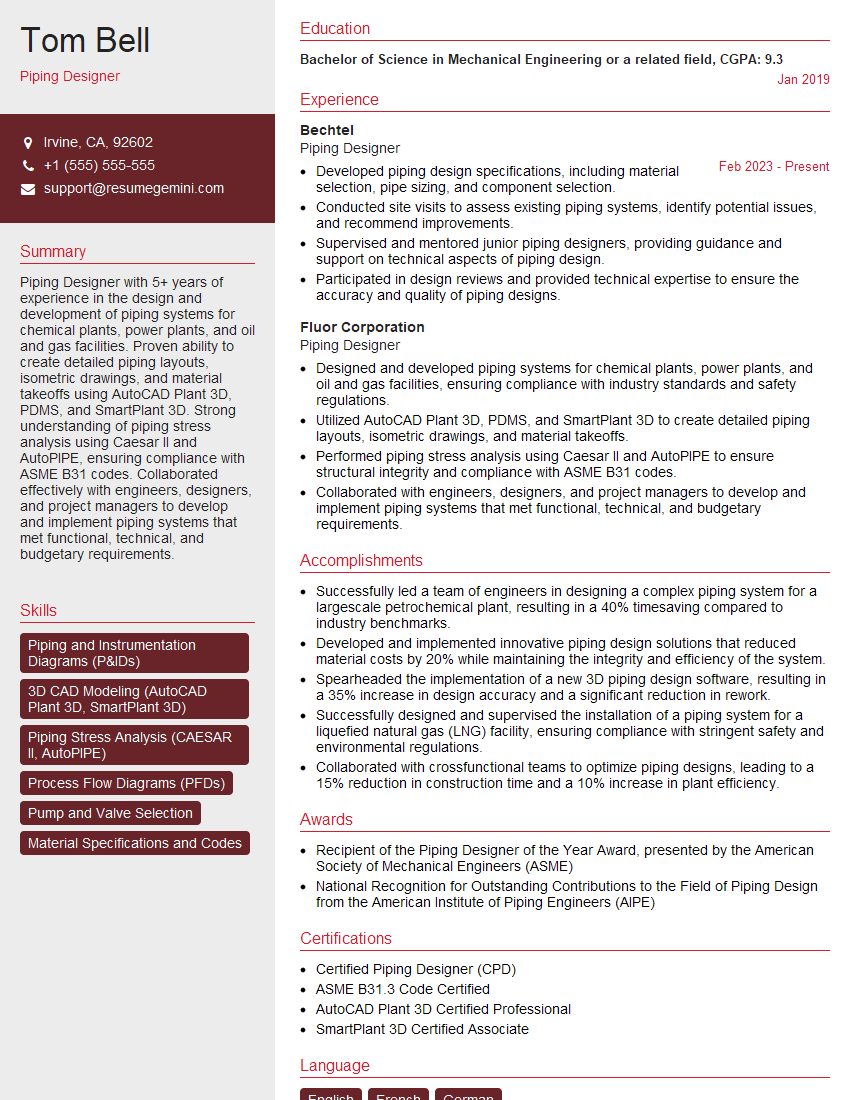
Mastering Piping and Valve Handling opens doors to exciting career opportunities in various industries, offering excellent growth potential and competitive salaries. To maximize your job prospects, crafting a strong, ATS-friendly resume is crucial. ResumeGemini is a trusted resource that can help you build a professional and impactful resume, ensuring your skills and experience shine. We offer examples of resumes tailored to Piping and Valve Handling to give you a head start. Take the next step towards your dream job – build a winning resume with ResumeGemini today!
Explore more articles
Users Rating of Our Blogs
Share Your Experience
We value your feedback! Please rate our content and share your thoughts (optional).
What Readers Say About Our Blog
Very informative content, great job.
good