Are you ready to stand out in your next interview? Understanding and preparing for Piping System Installation interview questions is a game-changer. In this blog, we’ve compiled key questions and expert advice to help you showcase your skills with confidence and precision. Let’s get started on your journey to acing the interview.
Questions Asked in Piping System Installation Interview
Q 1. Explain the different types of pipe fittings and their applications.
Pipe fittings are essential components connecting pipes, changing direction, or altering the flow path. They come in various types, each suited for specific applications. Think of them as the joints and connectors in a plumbing system.
- Elbows: Used to change the direction of the pipe flow. We have 45-degree, 90-degree, and other angled elbows. Imagine a road changing direction – the elbow guides the flow accordingly.
- Tees: Create a branch connection, allowing the fluid to flow in three directions. Think of it like a traffic intersection, allowing flow to continue straight or branch off.
- Reducers/Enlargers: Used to change the diameter of the pipe. This is crucial for pressure regulation and compatibility with various equipment. A reducer is like a funnel, decreasing the size. An enlarger does the opposite.
- Couplings: Join two pipes of the same diameter end-to-end. They’re like a simple connector, making it easy to extend pipe lengths.
- Caps: Seal the end of a pipe, preventing leakage or providing a termination point. Like a stopper closing a container.
- Flanges: Provide a large surface area for joining pipes, often using bolts. They are very strong and ideal for high-pressure applications. Think of a large, bolted-on lid for a pipe end.
- Unions: Allow for easy disconnection and reconnection of pipes. They provide flexibility during maintenance. They’re like a quick-disconnect coupling.
The selection of fitting depends on factors like pipe material, pressure, temperature, and the specific application. For example, high-pressure steam systems require robust fittings like flanges, while low-pressure water systems might utilize simpler couplings.
Q 2. Describe the process of pipe sizing and selection.
Pipe sizing and selection is critical to ensure the system operates efficiently and safely. It’s like choosing the right size road for the volume of traffic. We need to consider several factors:
- Fluid properties: Viscosity, density, and temperature affect flow rates and pressure drops.
- Flow rate: The required volume of fluid to be transported per unit time determines the necessary pipe diameter.
- Pressure drop: The pressure loss due to friction within the pipe needs to be minimized for optimal efficiency. This is often calculated using the Hazen-Williams or Darcy-Weisbach equations.
- Pipe material: Different materials have varying roughness factors affecting pressure drop. Steel has different properties than PVC.
- System layout: The length, number of fittings, and elevation changes influence pressure drop.
- Future expansion: Always consider future capacity requirements. It’s better to oversize a little to allow for expansion.
We usually start with calculating the required flow rate and then use appropriate equations and charts to determine the minimum acceptable pipe diameter. Software tools can also simplify this process, taking into account all relevant parameters. We always verify our calculations with industry standards and codes to ensure safety and compliance.
Q 3. What are the common methods for pipe joining?
Several methods are available for joining pipes, each with its advantages and disadvantages:
- Welding: A permanent joining method suitable for high-pressure applications. Different welding techniques (like arc welding, TIG, MIG) are used depending on the pipe material. It requires skilled welders and precise control to avoid defects.
- Threaded connections: Relatively simple and quick to install, ideal for smaller diameter pipes. However, threading can weaken the pipe. It’s less suitable for high-pressure applications.
- Flanged connections: Robust and suitable for high-pressure applications. Flanges are bolted together, providing a strong and reliable seal. They allow for easy disassembly for maintenance, but require more space and are typically more expensive than other methods.
- Solvent welding (for PVC): A chemical welding technique for thermoplastic pipes like PVC. A solvent is applied to clean and melt the pipe surfaces, creating a strong chemical bond. Fast, clean, but limited to specific materials.
- Compression fittings: Use compression rings to create a tight seal on the pipe. Easy to assemble, often used for smaller pipes, but not suitable for high-pressure or high-temperature applications.
The choice of method depends on factors like pipe material, pressure, temperature, accessibility, and budget. For instance, welding is preferred for large-diameter high-pressure lines, while compression fittings are used for smaller pipes in less demanding applications.
Q 4. How do you ensure proper pipe support and alignment?
Proper pipe support and alignment are crucial to prevent stress, vibration, and potential failures. Imagine a long rope – if it’s not supported properly, it will sag and eventually break. Similarly, pipes need support at regular intervals.
- Supports: These prevent sagging and ensure pipes stay aligned. Types include hangers, clamps, and cradles, selected based on pipe size, weight, and material.
- Anchors: These provide fixed points to restrict movement and absorb thermal expansion. They are essential to prevent misalignment and potential damage from pipe movement due to pressure, temperature changes or vibrations.
- Alignment: Pipes must be aligned properly to minimize stress and ensure smooth fluid flow. Misalignment can cause turbulence and pressure loss, increasing system wear and tear.
- Expansion loops or expansion joints: These accommodate thermal expansion and contraction, preventing stress buildup in the pipes. Think of a spring providing flexbility – this allows the pipe to expand and contract without damaging itself.
Supporting structures should be designed according to industry standards and codes, considering factors such as pipe weight, operating temperature, and potential vibrations. Regular inspections are also vital to detect and correct any misalignments or inadequate support before it leads to failures.
Q 5. What are the safety precautions involved in piping system installation?
Safety is paramount in piping system installation. Failing to adhere to safety procedures can lead to serious injuries or fatalities.
- Lockout/Tagout procedures: Ensure that all valves and equipment are properly locked out and tagged out before starting any work to prevent accidental energy release.
- Personal Protective Equipment (PPE): Appropriate PPE such as safety glasses, hard hats, safety shoes, gloves, and respirators must be worn at all times. The type of PPE depends on the specific tasks and hazards.
- Confined space entry procedures: If work involves entering confined spaces, proper procedures must be followed, including atmospheric monitoring and rescue plans.
- Hot work permits: If welding or other hot work is involved, a hot work permit must be obtained, and fire safety precautions must be implemented. This includes fire extinguishers being readily available.
- Fall protection: Workers working at heights must use appropriate fall protection measures such as harnesses and safety nets.
- Hazard Communication: Workers must be properly trained on potential hazards and safe work practices. Proper labeling of hazardous materials is essential.
Strict adherence to safety regulations and company procedures is crucial. Regular safety training and toolbox talks emphasize the importance of safety protocols and prevent accidents.
Q 6. Explain the importance of pipe insulation and its different types.
Pipe insulation is crucial for several reasons: it reduces energy loss, prevents condensation, protects personnel from burns, and controls the temperature of the fluid within the pipe. Think of it as a coat for the pipe, keeping it at the desired temperature.
- Energy conservation: Insulation reduces heat loss in hot pipes and heat gain in cold pipes, resulting in significant energy savings. This is especially important for large-diameter pipes carrying hot fluids.
- Condensation prevention: Insulation on cold pipes prevents condensation, reducing corrosion and maintaining a clean and dry environment. Condensation can lead to rust, leaks, and damage to equipment.
- Personnel safety: Insulation on hot pipes protects personnel from burns. This is particularly important in areas with high traffic.
- Temperature control: Insulation maintains the temperature of the fluid being transported, ensuring the fluid remains at the optimal temperature for its intended purpose.
Different insulation materials exist, including fiberglass, mineral wool, calcium silicate, polyurethane foam, and polyethylene. The choice of material depends on factors like temperature, environmental conditions, and cost. For example, high-temperature applications require materials with a high temperature rating. Proper installation, ensuring there are no gaps or air pockets, is crucial for optimal performance.
Q 7. How do you identify and address potential pipe stress issues?
Pipe stress is caused by various factors such as thermal expansion, pressure, weight, and seismic activity. Excessive stress can lead to leaks, cracks, and even pipe failure. It’s like too much tension on a rope, eventually leading to a break.
Identifying potential stress issues involves:
- Stress analysis: Engineering calculations and software simulations can predict stress levels under various conditions. This helps determine the need for stress mitigation measures like expansion loops.
- Visual inspection: Regularly checking for signs of stress, such as sagging, misalignment, or corrosion, is crucial. This involves observing the whole piping system for signs of stress or deformation.
- Vibration analysis: Excessive vibrations can also cause stress. Vibration monitoring helps identify sources of vibration and implement mitigation strategies.
Addressing stress issues can involve several approaches:
- Adding supports: Improving pipe support can reduce stress from weight and vibration.
- Installing expansion joints or loops: These components absorb thermal expansion and contraction, reducing stress from temperature changes.
- Stress relieving: In certain cases, stress-relieving techniques might be required to reduce residual stresses in the pipe material. This often involves controlled heating and cooling processes.
- Pipe rerouting: In some cases, rerouting a pipe may be necessary to reduce stress, which can be complex and costly.
Preventing stress issues involves careful design, proper installation, and regular inspection. Using appropriate software tools for design and stress analysis is crucial for a safer and more efficient system.
Q 8. Describe your experience with different piping materials (e.g., steel, PVC, HDPE).
My experience encompasses a wide range of piping materials, each selected based on the specific application’s demands for pressure, temperature, chemical resistance, and cost. Let’s look at three common examples:
- Steel: Carbon steel is a workhorse in high-pressure, high-temperature applications like steam lines and process piping in refineries and power plants. Its strength and durability are unmatched, but it’s susceptible to corrosion, requiring protective coatings or specialized alloys like stainless steel in corrosive environments. I’ve worked extensively with schedule 40 and 80 carbon steel pipes in industrial settings, ensuring proper welding and insulation.
- PVC (Polyvinyl Chloride): PVC is ideal for lower-pressure applications where chemical resistance is crucial, like wastewater systems or chemical processing plants handling non-aggressive chemicals. It’s lightweight, easy to install, and relatively inexpensive, but it’s not suitable for high temperatures or high pressures. I’ve overseen several projects involving PVC piping for irrigation systems and building drainage.
- HDPE (High-Density Polyethylene): HDPE is a fantastic choice for applications needing excellent chemical resistance, flexibility, and durability, often seen in underground water distribution systems and natural gas pipelines. It’s relatively easy to join using fusion welding, offering excellent leak-free joints. I have experience with HDPE pipeline installation, specifically focusing on the fusion welding process and ensuring proper ground preparation to prevent damage.
Choosing the right material is critical; a mismatched material can lead to costly failures and safety hazards. My experience allows me to make informed decisions based on a comprehensive risk assessment.
Q 9. What are the different types of pipe hangers and their applications?
Pipe hangers are essential for supporting piping systems, preventing stress and ensuring structural integrity. They come in various types, each designed for specific loads and installation conditions:
- Rigid Hangers: These provide fixed support, preventing movement. They’re suitable for short pipe runs or where minimal movement is allowed. Think of a simple clamp attached directly to a support structure.
- Spring Hangers: These compensate for thermal expansion and contraction, allowing the pipe to move without putting undue stress on the system. The spring absorbs the movement. These are commonly used in long runs of piping where temperature fluctuations are significant.
- Variable Spring Hangers: Similar to spring hangers, but the spring tension can be adjusted to accommodate various loads and pipe sizes. This allows for flexibility during installation and operational changes.
- Constant Support Hangers: Maintain a constant support force regardless of pipe movement. They’re frequently used in vertical piping systems.
- Snubbers: These limit the speed and distance of pipe movement during seismic events or other dynamic loads. They act as a safety device to prevent damage.
Selecting the appropriate hanger type depends on factors like pipe size, material, operating temperature, and anticipated movement. Incorrect hanger selection can cause pipe stress, leaks, or even catastrophic failure. I always adhere to relevant codes and standards (like ASME B31.1) to ensure correct hanger specification and installation.
Q 10. How do you interpret piping and instrumentation diagrams (P&IDs)?
P&IDs (Piping and Instrumentation Diagrams) are the blueprints for a piping system. They show the arrangement of pipes, valves, instruments, and equipment, along with the flow of fluids. My interpretation process involves several steps:
- Understanding the Process: First, I thoroughly understand the overall process the piping system supports. This helps me interpret the symbols and flow directions accurately.
- Symbol Recognition: P&IDs use standardized symbols for pipes, valves (gate, globe, check, ball), instruments (pressure gauges, temperature sensors, flow meters), pumps, and other equipment. A strong grasp of these symbols is essential. I frequently refer to ISA (Instrument Society of America) standards for symbol clarification.
- Tracing Flow Paths: I carefully trace the flow paths of the fluids through the system, identifying the direction of flow and any branch lines or loops.
- Identifying Equipment and Instruments: I note the location and type of each piece of equipment and instrument, understanding its function within the system. This includes understanding instrumentation tags and their corresponding data sheets.
- Verifying Line Sizes and Materials: P&IDs usually specify pipe sizes and materials. I verify these specifications against the project requirements.
By systematically following this process, I can accurately understand the system’s functionality, anticipate potential issues, and develop effective installation plans.
Q 11. Explain your experience with different welding techniques for piping.
My welding experience covers various techniques for piping, each chosen based on the pipe material and project requirements. Safety and quality are paramount in all my welding activities.
- Shielded Metal Arc Welding (SMAW): Also known as stick welding, SMAW is a versatile technique used for various materials. It’s suitable for field work where access to electricity is available but potentially limited. I’ve used it extensively for carbon steel piping.
- Gas Metal Arc Welding (GMAW): Often called MIG welding, GMAW is known for its high deposition rate and smooth welds. It’s widely used for steel pipes, offering good quality and efficiency. My experience includes GMAW on stainless steel and other alloy pipes.
- Gas Tungsten Arc Welding (GTAW): Also known as TIG welding, GTAW is preferred for high-quality welds requiring precision and cleanliness. It’s often used for thinner materials or applications requiring a visually appealing weld. I have used this extensively for stainless steel and other specialized alloys in critical applications.
Beyond the techniques, I meticulously follow welding procedures, including pre-weld cleaning, post-weld heat treatments (if required), and non-destructive testing (NDT) to ensure weld integrity and compliance with relevant codes like ASME Section IX.
Q 12. How do you ensure the proper pressure testing of a piping system?
Proper pressure testing is critical for verifying the integrity of a piping system before commissioning. The process involves several key steps:
- Pre-test Inspection: A thorough visual inspection of the entire piping system is conducted to identify any visible flaws or imperfections.
- System Isolation: The piping system is isolated from other systems, ensuring that the test pressure is applied only to the designated section.
- Pressure Medium Selection: The choice of pressure medium (water or air) depends on the system’s design and materials. Water is generally preferred for its safety and ability to reveal leaks easily. Air is used sometimes but demands careful monitoring to prevent over-pressurization or potential hazards.
- Pressure Application: The system is slowly pressurized to the test pressure specified in the design documents, typically 1.5 times the maximum operating pressure. A pressure gauge is used for accurate monitoring. This requires slow increases to avoid creating stress concentration during the process.
- Pressure Holding: The system is held at the test pressure for a predetermined period (usually several hours) to allow any potential leaks to manifest.
- Leak Detection: The system is carefully inspected for any leaks during the pressure holding period. Leaks can be detected by visual inspection, pressure drop monitoring, or specialized leak detection equipment.
- Pressure Release: After the test period, the pressure is slowly released to avoid water hammer or other damage.
- Post-Test Inspection: A final inspection is conducted after pressure release to verify no damage has occurred during the test.
Detailed records, including pressure readings, leak detection findings, and personnel involved, are maintained throughout the testing process.
Q 13. Describe your experience with hydro-testing and pneumatic testing procedures.
Hydro-testing and pneumatic testing are both pressure testing methods, but they differ in the pressure medium used.
- Hydro-testing: Uses water as the pressure medium. It’s generally safer, easier to detect leaks, and better suited for identifying smaller leaks. However, it can be messy and require more preparation and cleanup.
- Pneumatic testing: Uses air or nitrogen as the pressure medium. It’s faster and can reach higher pressures. However, it requires strict adherence to safety procedures to prevent potential hazards from rapid pressure changes and air leaks. Pneumatic testing usually involves monitoring the pressure for a certain period and looking for drops to detect leaks. It can miss smaller leaks and often requires specialized equipment.
In my experience, I’ve performed both hydro-testing and pneumatic testing, selecting the most appropriate method based on the project requirements and system design. Safety is always the top priority, and I follow strict safety protocols and utilize appropriate safety equipment in both procedures.
Q 14. What are the common causes of piping system leaks?
Piping system leaks can stem from various causes, often linked to design, installation, or material issues.
- Corrosion: This is a common cause, particularly in steel pipes exposed to corrosive environments. Proper material selection, coatings, and cathodic protection can mitigate this.
- Erosion: High-velocity fluid flow can erode pipe walls over time, especially at bends or fittings. Proper pipe sizing and flow control measures can reduce erosion.
- Improper Welding: Poorly executed welds are a major source of leaks. Rigorous quality control during welding, including NDT, is essential.
- Flange Leaks: Leaks at flange connections can result from improper bolting, gasket issues, or misalignment. Careful attention to tightening torques and gasket selection is needed.
- Expansion and Contraction: Thermal expansion and contraction can put stress on piping systems, leading to leaks at weak points. Proper expansion loops and supports are essential.
- Improper Installation: Mechanical damage during installation, improper support, or inadequate grounding can create weaknesses and lead to leaks.
- Material Defects: Manufacturing defects in pipes or fittings can cause leaks.
Identifying and addressing the root cause of a leak is crucial for effective remediation. I always conduct thorough investigations to pinpoint the cause, ensuring a sustainable and safe solution.
Q 15. How do you troubleshoot and repair leaks in a piping system?
Troubleshooting and repairing leaks in a piping system requires a systematic approach. First, safety is paramount – isolate the affected section by closing valves to prevent further leaks and potential hazards. Then, we need to pinpoint the leak’s location. This often involves visual inspection, listening for hissing sounds, or using leak detection tools like ultrasonic detectors or dye penetrants. Once located, the repair method depends on the type of leak, pipe material, and system pressure.
For minor leaks in threaded connections, tightening or replacing the sealant might suffice. For larger leaks or those in welded joints, more extensive repairs are necessary, potentially involving cutting out the damaged section and welding in a new piece. Consider these examples:
- Minor Leak in a Flanged Joint: Tightening the bolts may resolve the leak. If not, applying a suitable gasket sealant or replacing the gasket is the next step.
- Leak in a Welded Joint: This usually necessitates cutting out the flawed section using a cutting torch or abrasive wheel, preparing the edges for welding (beveling), and then welding a new section in place. Post-weld inspection is crucial to ensure a robust repair.
- Leak in a Plastic Pipe: These can sometimes be repaired using specialized epoxy or PVC pipe repair clamps.
After the repair, a pressure test is essential to verify the integrity of the system and ensure the leak is fully resolved. Throughout the process, we always adhere to relevant safety regulations and industry best practices.
Career Expert Tips:
- Ace those interviews! Prepare effectively by reviewing the Top 50 Most Common Interview Questions on ResumeGemini.
- Navigate your job search with confidence! Explore a wide range of Career Tips on ResumeGemini. Learn about common challenges and recommendations to overcome them.
- Craft the perfect resume! Master the Art of Resume Writing with ResumeGemini’s guide. Showcase your unique qualifications and achievements effectively.
- Don’t miss out on holiday savings! Build your dream resume with ResumeGemini’s ATS optimized templates.
Q 16. Explain your experience with different types of pipe valves and their functions.
My experience encompasses a wide range of pipe valves, each designed for specific functions within a piping system. Here are a few key types:
- Gate Valves: These are primarily used for on/off service. Their simple design and reliability make them suitable for various applications, but they are not ideal for throttling (regulating flow).
- Globe Valves: Excellent for throttling, globe valves offer precise flow control. However, they tend to have more pressure drop than gate valves, which is something to consider.
- Ball Valves: Known for their quick on/off operation and compact design, ball valves are suitable for many applications, and are often used for isolating sections of piping.
- Check Valves: These automatically prevent reverse flow in the piping system. They are essential for protecting pumps and other equipment from backflow.
- Butterfly Valves: Similar to ball valves in terms of ease of operation, butterfly valves are frequently used in large diameter piping where flow regulation or isolation is required.
In my work, selecting the appropriate valve type involves considering factors like the fluid being transported, operating pressure and temperature, flow requirements, and the need for throttling capabilities. For instance, in a high-pressure steam system, I’d likely use a robust gate or globe valve with appropriate pressure ratings. Conversely, a simple ball valve might be sufficient for a low-pressure water line.
Q 17. What is your experience with pipe cutting and beveling techniques?
Pipe cutting and beveling are critical for creating strong, leak-proof joints. The techniques used depend heavily on the pipe’s material and diameter. For smaller diameter pipes, a pipe cutter or hacksaw might be suitable. For larger diameters, I commonly use abrasive cutting wheels or, for certain materials, a plasma cutter or torch. Proper beveling is vital for achieving a sound weld. The bevel angle and preparation depend on the pipe material and welding process.
Methods I utilize include:
- Abrasive Cutting Wheels: Versatile for various materials, but requires careful control to avoid damage.
- Plasma Cutting: Very effective for cutting thick metal pipes, offering precise and clean cuts.
- Oxy-fuel Cutting: Suitable for many metals, offering fast cuts; however, it can cause heat-affected zones that need to be considered.
My experience includes using various specialized tools to ensure accurate beveling. I ensure consistent bevel angles and smooth surfaces for proper weld penetration and minimize the chance of defects during welding. The quality of the cut and bevel significantly impacts the strength and longevity of the pipe joint.
Q 18. Describe your understanding of ASME B31.1 and other relevant piping codes.
ASME B31.1, Power Piping, is a fundamental code that governs the design, fabrication, erection, testing, and operation of power piping systems. My understanding of this code is thorough and practical, encompassing its requirements for material selection, stress analysis, pressure testing, and inspection. I am also familiar with other relevant codes such as ASME B31.3 (Process Piping), which applies to many industrial settings, and relevant national and international standards. These codes set minimum standards for safety and reliability.
The codes cover various aspects, including:
- Material Specifications: Choosing the correct pipe materials based on pressure, temperature, and fluid compatibility.
- Stress Analysis: Ensuring the piping system can withstand operating stresses and pressures.
- Welding Procedures: Following specific welding procedures to ensure the quality and integrity of the welds.
- Inspection and Testing: Conducting regular inspections and pressure tests to detect and correct any issues.
Adherence to these codes is not just a matter of compliance; it’s crucial for ensuring the safety and reliability of piping systems. Non-compliance can lead to serious accidents and costly repairs.
Q 19. What are the key considerations for installing piping in hazardous environments?
Installing piping in hazardous environments demands extra vigilance and adherence to stringent safety protocols. This requires specialized training and understanding of the specific hazards present. Key considerations include:
- Material Selection: Using materials resistant to corrosion, chemical attack, or extreme temperatures as per the specific hazards in the environment.
- Explosion-Proof Equipment: Employing explosion-proof lighting, electrical components, and tools to minimize the risk of ignition in flammable environments.
- Elevated Safety Measures: Implementing additional safety measures such as specialized fire suppression systems, gas detection systems, and personal protective equipment (PPE) for workers.
- Specialized Welding Techniques: Utilizing welding techniques that minimize the risk of sparks or hot work permits, and implementing appropriate fire prevention measures while working in flammable environments.
- Regulatory Compliance: Strictly adhering to all relevant safety regulations, industry codes, and permit-to-work systems specific to hazardous environments.
For example, when installing piping in a refinery environment, I would prioritize corrosion-resistant materials like stainless steel or specialized alloys. We would use appropriate PPE including flame-resistant clothing and respirators, and strictly follow lockout/tagout procedures to isolate equipment before working on it.
Q 20. How do you manage and track material usage during a piping project?
Material tracking is crucial for efficient project management and cost control. We employ a combination of methods, including:
- Detailed Material Takeoffs: Accurate initial material lists are generated based on project plans and specifications. These ensure we order enough material without excessive surplus.
- Inventory Management System: We use a computerized inventory system to track materials received, used, and remaining on-site. This allows real-time monitoring of inventory levels.
- Barcodes and RFID Tags: Barcodes or RFID tags are often used to track materials throughout the project, enhancing traceability and reducing errors in material identification.
- Regular Inventory Audits: Regular physical audits verify the inventory system’s accuracy. Discrepancies are investigated and corrected.
- Waste Management: We actively manage material waste to minimize losses and environmental impact. This includes proper disposal and recycling practices.
This systematic approach helps to avoid costly delays due to material shortages or overstocking, and also enhances accountability for material use on the project.
Q 21. Describe your experience with using various piping tools and equipment.
My experience extends to a broad range of piping tools and equipment. This includes:
- Cutting Tools: Pipe cutters, hacksaws, abrasive wheels, plasma cutters, and oxy-fuel torches for various pipe materials and diameters.
- Welding Equipment: Various welding machines (MIG, TIG, stick) for different materials and joint configurations.
- Bending Tools: Pipe benders (manual and hydraulic) for shaping pipes.
- Threading Tools: Die stocks and pipe threaders for creating threads on pipe ends.
- Flaring Tools: Tools for flaring copper or other soft metal pipes.
- Lifting Equipment: Chain hoists, cranes, and other lifting equipment for moving heavy pipe sections.
- Testing Equipment: Pressure gauges, pressure testers, and leak detection equipment.
I’m proficient in using these tools safely and efficiently, adhering to all safety regulations. My experience also involves regular maintenance and calibration of this equipment to ensure their reliable performance. For example, proper maintenance of welding equipment ensures consistent weld quality, impacting the entire project’s safety and longevity.
Q 22. Explain your understanding of pipe expansion and contraction.
Pipe expansion and contraction is a crucial aspect of piping system design and installation. It refers to the change in length of a pipe due to temperature variations. As the temperature increases, the pipe expands, and conversely, it contracts when the temperature decreases. This phenomenon can cause significant stress on the pipe and its components if not properly accounted for, leading to leaks, failures, and potential safety hazards.
Consider a long pipeline carrying hot oil. As the oil heats the pipe, the pipe will lengthen considerably. Without proper expansion loops or expansion joints, this expansion could cause significant stress on the pipe, potentially leading to a rupture. Conversely, in cold climates, the pipe contracting could cause significant stress.
To mitigate these effects, engineers utilize several methods, including:
- Expansion Loops: These are strategically placed bends in the pipeline that allow the pipe to expand and contract without putting undue stress on straight sections.
- Expansion Joints: These are mechanical devices installed in the pipeline that accommodate expansion and contraction. They usually consist of bellows or other flexible elements.
- Anchors and Supports: These are used to properly restrain the pipe and guide its movement during expansion and contraction, preventing excessive stress.
The design process involves carefully calculating the expected temperature variations and the resulting expansion and contraction, selecting appropriate materials, and implementing the correct mitigation strategies. Failure to adequately address this phenomenon can result in costly repairs and even catastrophic failures.
Q 23. How do you ensure the proper cleanliness and hygiene of a piping system?
Maintaining the cleanliness and hygiene of a piping system is paramount, especially in industries like food processing, pharmaceuticals, and healthcare. Contamination can lead to product spoilage, health risks, and operational inefficiencies.
Our approach involves a multi-stage process:
- Pre-Installation Cleaning: Before installation, pipes and fittings are thoroughly cleaned to remove any debris, manufacturing residues, or welding spatter. This often involves methods like high-pressure water jetting, chemical cleaning, or compressed air blasting.
- During Installation Cleanliness: We maintain a strict clean work environment during installation. This includes using clean tools and protective coverings to prevent contamination from entering the system.
- Post-Installation Flushing: After installation, the entire system undergoes a thorough flushing process to remove any remaining debris or contaminants. This usually involves circulating clean water or a suitable cleaning solution through the system.
- Sterilization (if required): For systems requiring stringent hygiene standards, we employ sterilization techniques such as steam sterilization or chemical disinfection to eliminate any microorganisms.
- Regular Maintenance Cleaning: Ongoing maintenance includes periodic cleaning and inspection to prevent the build-up of contaminants and ensure the system remains hygienic.
The specific cleaning methods are tailored to the application and the nature of the fluid being transported. For example, a pharmaceutical piping system will require a more stringent cleaning and sterilization protocol than a water distribution system.
Q 24. Describe your experience with working on large-scale piping projects.
I’ve been fortunate to participate in several large-scale piping projects, including a major petrochemical plant expansion and a large-scale water treatment facility upgrade. In the petrochemical project, we installed over 10 kilometers of high-pressure pipelines, requiring meticulous planning, coordination, and execution. This involved managing a large team, coordinating with other contractors, and ensuring adherence to strict safety protocols and quality standards. The water treatment project presented unique challenges, requiring careful consideration of material selection, corrosion prevention, and the integration of advanced control systems.
These projects required the application of advanced engineering principles including detailed hydraulic calculations, stress analysis, and the use of sophisticated software for pipe routing and support design. My role involved overseeing all aspects of the installation, from the initial design review to the final commissioning and testing. Successfully managing these complex projects strengthened my leadership skills and honed my expertise in problem-solving and project management.
Q 25. How do you handle unexpected challenges during a piping installation?
Unexpected challenges are inevitable in piping installation projects. My approach involves a combination of proactive planning, rigorous quality control, and effective problem-solving techniques.
When faced with an unexpected challenge, I follow a systematic approach:
- Assess the Situation: Thoroughly investigate the problem, identifying its root cause and potential impact on the project timeline and budget.
- Develop Solutions: Brainstorm multiple solutions and evaluate their feasibility, considering safety, cost, and time constraints.
- Consult and Collaborate: Seek input from experienced colleagues, engineers, and subcontractors to ensure the best course of action is selected.
- Implement the Solution: Execute the chosen solution, carefully documenting each step and ensuring compliance with safety regulations.
- Review and Learn: After the issue is resolved, conduct a thorough post-incident review to identify lessons learned and implement preventative measures to avoid similar situations in the future.
For example, on one project, we encountered unexpected soil conditions that impacted the foundation of a crucial pipe support. Instead of proceeding with the original plan, we quickly assessed the situation, designed an alternative support structure, and obtained necessary approvals before proceeding. This proactive approach minimized delays and prevented potential damage.
Q 26. What are your experience with different types of pipe supports and anchors?
I have extensive experience with various types of pipe supports and anchors, selecting the appropriate type depends on factors such as pipe size, material, operating pressure, temperature, and environmental conditions.
Some common types I’ve worked with include:
- Rigid Supports: These provide fixed points of support and are typically used for smaller pipes or in locations where movement is restricted. Examples include weld-on supports and bolted clamps.
- Flexible Supports: These allow for some degree of pipe movement, accommodating thermal expansion and contraction. Examples include spring supports and constant support hangers.
- Anchors: These are used to restrain pipe movement in specific directions, preventing excessive stress on the system. They can be designed for various loading conditions and can be either fixed or adjustable.
- Guides: These prevent lateral movement of the pipe, keeping it aligned.
- Variable Spring Hangers: These automatically adjust their support force to compensate for changes in pipe weight due to fluid content or temperature variations.
The selection of appropriate supports and anchors is crucial for ensuring the structural integrity and operational safety of the piping system. Incorrect selection can lead to pipe stress, vibration, and even failure.
Q 27. Explain your understanding of the importance of proper pipe alignment.
Proper pipe alignment is critical for several reasons: it ensures smooth fluid flow, minimizes stress on the pipe and its components, prevents premature wear and tear, and improves the overall efficiency and lifespan of the system. Misalignment can cause turbulence, increase pressure drop, and lead to vibrations and noise.
In practice, we use various tools and techniques to ensure accurate alignment:
- Laser Alignment Tools: These provide precise alignment measurements, facilitating accurate positioning of pipes and fittings.
- Optical Alignment Tools: These tools allow visual verification of alignment.
- Transit and Level Instruments: These are used to establish reference points and ensure proper vertical and horizontal alignment.
- Alignment Checks: Regular checks throughout the installation process ensure that any deviations are detected and corrected early.
The consequences of poor alignment can be significant. For instance, in high-pressure systems, misalignment can cause concentrated stress points leading to potential leaks or failures. In more complex systems with multiple bends and fittings, accurate alignment becomes even more crucial to maintain efficiency and avoid costly repairs.
Q 28. How do you ensure compliance with relevant safety regulations during installation?
Safety is the top priority in all our piping installation projects. We strictly adhere to all relevant safety regulations, including OSHA (Occupational Safety and Health Administration) standards and industry best practices. This commitment begins with the initial planning phase and continues throughout the entire process.
Our safety measures include:
- Risk Assessment: A comprehensive risk assessment is performed before the commencement of any work to identify potential hazards and develop mitigation strategies.
- Permit-to-Work System: A formal permit-to-work system is used to control hazardous activities, ensuring that all necessary precautions are taken before starting work.
- Lockout/Tagout Procedures: Strict lockout/tagout procedures are followed to isolate energy sources before working on any equipment.
- Personal Protective Equipment (PPE): Appropriate PPE, including safety helmets, gloves, safety glasses, and fall protection equipment, is provided and used by all personnel.
- Safety Training: All personnel receive comprehensive safety training before commencing any work on site.
- Regular Inspections: Regular inspections are conducted to ensure compliance with safety standards and to identify any potential hazards.
By consistently prioritizing safety, we ensure a safe working environment for our team and minimize the risk of accidents and injuries.
Key Topics to Learn for Piping System Installation Interview
- Piping System Design & Specifications: Understanding blueprints, P&IDs (Piping and Instrumentation Diagrams), material selection criteria (e.g., material compatibility, pressure ratings), and code compliance (e.g., ASME B31.1, B31.3).
- Installation Methods & Techniques: Familiarize yourself with various joining methods (e.g., welding, threading, flanging), pipe support systems, and best practices for minimizing stress and ensuring structural integrity. Consider practical applications like pipe alignment, slope considerations, and expansion loop design.
- Safety Procedures & Regulations: Mastering lockout/tagout procedures, confined space entry protocols, and understanding relevant OSHA regulations is crucial for demonstrating a commitment to safety. Be prepared to discuss incident prevention and response strategies.
- Testing & Commissioning: Understand the importance of pressure testing, leak detection methods, and the overall commissioning process to ensure the system’s functionality and adherence to design specifications. Practical knowledge of testing equipment and procedures is valuable.
- Troubleshooting & Problem-Solving: Be ready to discuss common piping system issues (e.g., leaks, corrosion, vibrations) and your approaches to identifying and resolving them effectively. Highlight your experience with diagnostic tools and techniques.
- Project Management Aspects: Even as a technician, understanding scheduling, resource allocation, and adhering to project timelines is important. Showcase your ability to contribute to efficient project execution.
Next Steps
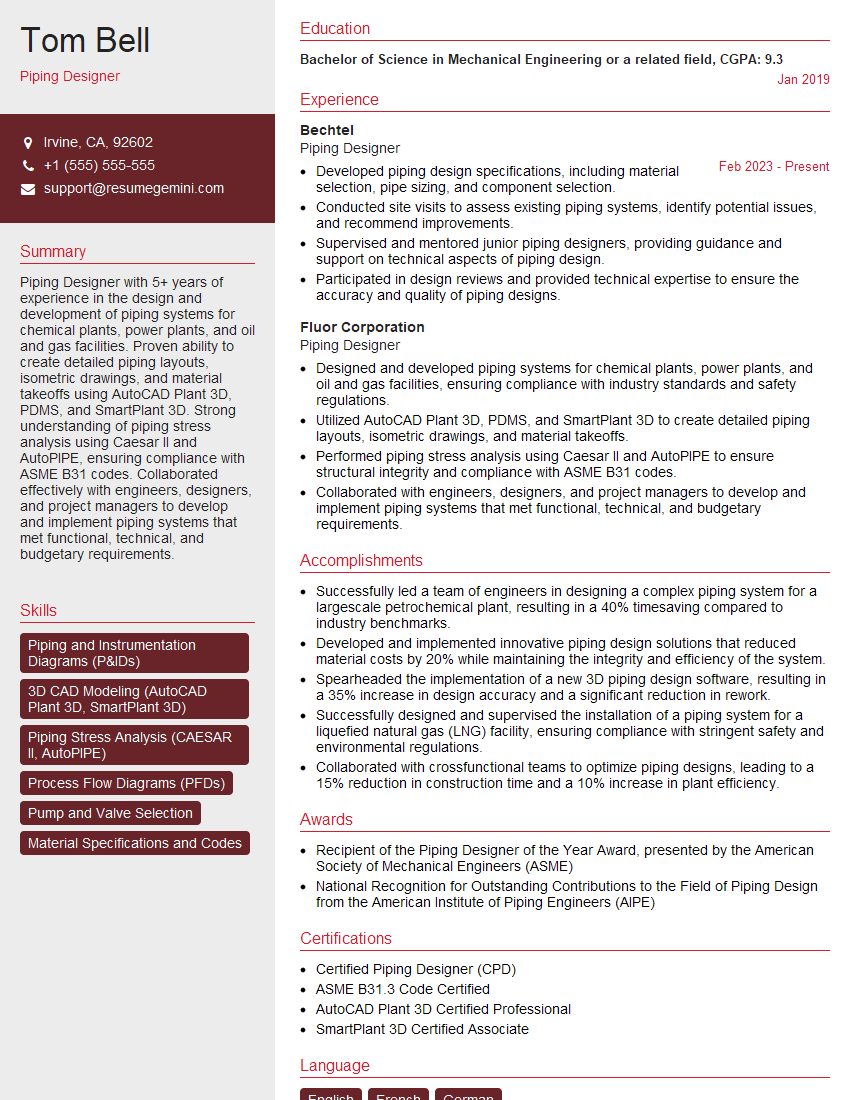
Mastering Piping System Installation opens doors to exciting career opportunities, offering growth potential and specialization within the industry. A strong resume is your key to unlocking these opportunities. Creating an ATS-friendly resume is vital for getting your application noticed by recruiters. To help you build a compelling and effective resume, we recommend using ResumeGemini. ResumeGemini provides a user-friendly platform to create professional resumes, and we offer examples of resumes tailored to the Piping System Installation field to help you get started.
Explore more articles
Users Rating of Our Blogs
Share Your Experience
We value your feedback! Please rate our content and share your thoughts (optional).
What Readers Say About Our Blog
Very informative content, great job.
good