Interviews are opportunities to demonstrate your expertise, and this guide is here to help you shine. Explore the essential Planning and Preparing Judo Lessons interview questions that employers frequently ask, paired with strategies for crafting responses that set you apart from the competition.
Questions Asked in Planning and Preparing Judo Lessons Interview
Q 1. Describe your approach to creating a Judo lesson plan for beginners.
Creating a Judo lesson plan for beginners requires a structured approach focusing on foundational skills and building a strong base. I start with a warm-up that includes dynamic stretches and light cardio to prepare the body for training. The main part of the lesson introduces fundamental concepts like ukemi (breakfalls) – crucial for safety and a smooth transition to more advanced techniques. We then move to basic stances (shisei) and grips (kumi-kata), emphasizing proper posture and grip strength. Finally, I introduce a simple throw, like seoi-nage (shoulder throw), breaking it down into small, manageable steps. The lesson concludes with a cool-down and review of the day’s material.
For instance, teaching ukemi, I’ll start with the forward roll, ensuring students understand the proper body mechanics and how to protect their head and neck. We gradually progress to backward rolls and then side rolls, building confidence and competence. Each step is meticulously explained, demonstrated, and practiced before moving to the next. The lesson is designed to be engaging and fun, making the learning process enjoyable for everyone.
Q 2. How do you adapt Judo lessons for students with different skill levels?
Adapting Judo lessons for different skill levels involves careful planning and differentiation. For beginners, the focus is on fundamental techniques, safety, and building a solid foundation. Intermediate students work on refining their techniques, learning more complex throws, and developing strategic thinking. Advanced students focus on advanced techniques, competitive strategies, and randori (free practice). I achieve this through tiered instruction – breaking down techniques into levels of complexity, allowing each student to work at their own pace and challenge themselves appropriately. For example, when teaching ippon-seoi-nage, beginners might focus solely on the grip and basic movement, while advanced students might explore variations and counters.
I also use different training methods. Beginners might benefit from more partner drills and repetition, while advanced students may engage in more challenging randori sessions to refine their skills. This allows all students to be challenged appropriately while ensuring a safe and supportive learning environment.
Q 3. What safety procedures do you implement during Judo classes?
Safety is paramount in Judo. My safety procedures start with a thorough warm-up to prepare students’ bodies for physical activity. I insist on proper ukemi practice from the very first lesson, emphasizing the importance of protecting the head and neck. Students are instructed to tap out immediately if they feel any discomfort or pain. During partner drills, I closely monitor students’ actions, correcting any unsafe practices immediately. The mats are regularly inspected for any hazards, and adequate space is maintained to prevent collisions. I also emphasize respect and courtesy towards training partners, ensuring a positive and supportive environment.
Furthermore, I regularly reinforce the importance of correct technique to prevent injuries. For example, I highlight the importance of maintaining a stable base during throws to avoid falls and injuries. I’ll constantly remind students to control their movements and to react to their partners’ actions appropriately, rather than trying to force the technique.
Q 4. How do you assess student progress in Judo?
Assessing student progress in Judo involves a multi-faceted approach. I observe their technique during drills and randori, looking for improvements in execution, efficiency, and control. I also assess their understanding of Judo principles, such as Kuzushi (breaking balance), Tsukuri (application of technique), and Kake (execution of the throw). Regular quizzes and tests can assess their knowledge of techniques and Judo etiquette. Finally, I monitor their overall participation, enthusiasm, and commitment to training.
I utilize grading systems that reflect their skill development, promoting a sense of achievement and motivating students to improve further. These assessments are not solely about technical proficiency but also about their attitude, sportsmanship, and understanding of Judo’s values.
Q 5. Explain your method for teaching basic Judo throws (e.g., Ippon-Seoi-Nage).
Teaching Ippon-Seoi-Nage (one-hand shoulder throw) involves a progressive breakdown of the technique. First, I introduce the grip, emphasizing a firm but controlled hold. Next, I demonstrate and explain the Kuzushi (breaking balance) – how to unsettle the opponent’s balance. We practice this separately, focusing on the appropriate timing and leverage. Then, we work on the Tsukuri (setup) – how to create the correct position to execute the throw. Finally, we combine all elements to execute the full throw, starting slowly and gradually increasing the speed. Throughout, emphasis is placed on proper posture, balance, and control.
I use visual aids, such as diagrams and videos, to reinforce understanding. We practice the technique in slow motion, focusing on each step before progressing to full speed. I provide personalized feedback and corrections, adjusting my instruction to the student’s individual learning style and needs. Safety is always prioritized, and students are reminded to control their movements and tap if necessary.
Q 6. How do you incorporate drills and exercises into your Judo lessons?
Drills and exercises are integral to Judo training. They help students develop muscle memory, improve coordination, and enhance their understanding of techniques. These include repetitive drills focusing on individual aspects of a technique (e.g., grip, Kuzushi, Tsukuri), partner drills practicing the complete technique, and specific drills targeting weaknesses. For example, for ippon-seoi-nage, a drill could involve repeatedly practicing the Kuzushi part with a partner, while another might focus on maintaining the grip while moving. Incorporating various partner drills increases engagement and promotes efficient learning.
Furthermore, I use resistance training and flexibility exercises to improve overall fitness and prevent injuries, ensuring the holistic development of students’ judo abilities. These exercises are designed to be challenging yet tailored to different fitness levels, encouraging progression within a safe and encouraging environment.
Q 7. Describe your technique for providing constructive feedback to students.
Providing constructive feedback is key to student improvement. I use the sandwich method – starting with positive reinforcement, highlighting what they did well, then offering specific and actionable suggestions for improvement, and ending with another positive statement to boost their confidence. For example, instead of saying ‘Your grip was bad,’ I’d say, ‘Your grip was strong initially, but you lost it during the Kuzushi. Try focusing on maintaining a firm grip throughout the entire movement.’ I focus on observable behaviors, avoiding vague or overly critical statements.
I also tailor my feedback to the individual student’s learning style and experience level. I use visual demonstrations and adjustments when needed, ensuring they understand the corrections. Regular feedback throughout the lesson, not just at the end, promotes continuous improvement and helps address issues promptly. The goal is to build confidence and encourage self-correction, fostering a positive learning environment.
Q 8. How do you manage disruptive behavior in a Judo class?
Managing disruptive behavior in a Judo class requires a proactive and consistent approach. It’s about preventing disruptions before they happen, and addressing them effectively when they do. My strategy is built on three pillars: establishing clear expectations, positive reinforcement, and addressing misbehavior constructively.
Clear Expectations: From the first lesson, I clearly outline the rules of the dojo—respect for oneself, partners, and the instructor; attention during instruction; and safe practice. These aren’t just rules; they’re principles of Judo itself, emphasizing respect and self-control.
Positive Reinforcement: I focus on rewarding positive behavior through praise, encouragement, and recognition. This might be a simple ‘good job’ for attentive participation or a more formal acknowledgement of improved technique. Positive reinforcement shapes behavior far more effectively than punishment.
Constructive Addressing: When disruptions occur, I address them privately, calmly, and constructively. Instead of reprimanding, I focus on understanding the root cause of the behavior. Is the student tired? Frustrated? Perhaps the technique is too challenging, and a modification is needed. Sometimes, a short break can help reset their focus. In severe cases, a parent may need to be contacted.
For instance, a student consistently chatting during instruction might receive a private reminder about focusing, followed by positive reinforcement when they demonstrate improved attention. This approach fosters a respectful learning environment where students feel supported and understood.
Q 9. How do you address injuries or accidents during a Judo session?
Safety is paramount in Judo. Addressing injuries and accidents requires a combination of preventative measures and swift, effective response. My approach focuses on preparedness, immediate action, and follow-up care.
Prevention: Warm-ups are crucial to prepare muscles and joints, and I meticulously teach proper techniques, emphasizing control and safety throughout. I also supervise students closely, particularly during higher-level practices, intervening to correct unsafe forms. The dojo should be free of obstacles.
Immediate Action: In case of an injury, I immediately halt the activity. My first priority is assessing the severity of the injury. Minor injuries, like scrapes, are treated with first aid. For more serious injuries, I call emergency services and follow the established protocol. We have a designated first-aid kit, and I’m certified in basic first aid and CPR.
Follow-Up Care: I always follow up with the student and their parents after an injury, providing updates and advice on recovery. Depending on the injury, I might suggest a visit to a doctor or physical therapist. I maintain a log of all injuries and incidents to continually improve safety protocols within the dojo.
For example, if a student sprains their ankle, I immediately stop the class, assess the injury, apply first aid, and contact their parents. We then discuss modifications to accommodate any limitations during recovery.
Q 10. What resources do you use to stay current with Judo techniques and teaching methods?
Staying current in Judo requires continuous learning and engagement with the broader Judo community. I utilize a multi-faceted approach, combining practical experience with formal and informal learning resources.
Seminars and Workshops: I regularly attend Judo seminars and workshops led by renowned instructors, both nationally and internationally. These events offer insights into cutting-edge techniques, teaching methodologies, and the latest research in Judo pedagogy.
Professional Journals and Publications: I subscribe to relevant journals and publications focusing on Judo, sports science, and physical education. These resources provide in-depth analysis of techniques, training strategies, and injury prevention.
Online Resources and Communities: I actively participate in online Judo communities and forums, engaging in discussions with other instructors and experts. This facilitates the exchange of knowledge and ideas, keeping me abreast of current trends and best practices.
Mentorship and Collaboration: I maintain ongoing connections with experienced Judo instructors, exchanging teaching experiences and seeking advice on challenging situations. This collaborative approach is invaluable for professional development.
For instance, recently I attended a seminar on the latest research in injury prevention, implementing new warm-up techniques and drills to further enhance student safety in my classes. This continuous pursuit of knowledge allows me to provide the best possible instruction.
Q 11. How do you create a positive and motivating learning environment in your Judo classes?
Creating a positive and motivating learning environment is central to effective Judo instruction. It’s about fostering a sense of community, promoting self-improvement, and celebrating achievements. I achieve this through a combination of strategies:
Respectful Atmosphere: I establish a dojo culture built on mutual respect and support. Students are encouraged to help each other, learn from each other’s successes and mistakes, and celebrate each other’s achievements.
Challenging Yet Supportive Instruction: I provide challenging instruction that pushes students to improve, while simultaneously offering support and encouragement. I tailor my instruction to different skill levels, ensuring that everyone feels challenged and supported.
Positive Feedback and Encouragement: I provide regular, positive feedback, focusing on the student’s progress and effort, rather than solely on their mistakes. This helps to build confidence and motivate continued improvement.
Celebrating Achievements: I regularly celebrate student achievements, both big and small. This might be through verbal praise, awards, or opportunities to demonstrate their skills to others. This helps to build morale and inspire further progress.
For instance, I often have students demonstrate techniques they’ve mastered to the class, building their confidence and providing learning opportunities for others. This fosters a collaborative and encouraging environment.
Q 12. What strategies do you employ to maintain student engagement?
Maintaining student engagement requires a dynamic and varied approach to teaching. I use several strategies to keep students motivated and actively participating:
Varied Training Methods: I vary the training methods to prevent monotony. This might involve incorporating drills, games, partner work, and self-practice into the lesson plan. This keeps things interesting and challenging.
Clear and Engaging Instruction: I provide clear, concise, and engaging instruction, using visuals and demonstrations where appropriate. I break down complex techniques into smaller, manageable steps, ensuring that everyone understands.
Student-Centered Learning: I incorporate student-centered learning activities, allowing students to actively participate in the learning process. This includes allowing students to suggest drills or techniques they want to work on.
Regular Feedback and Progress Tracking: I provide regular feedback to students, tracking their progress and celebrating their achievements. This helps to keep them motivated and engaged.
Goal Setting: I encourage students to set both short-term and long-term goals. This provides them with a sense of purpose and direction.
For example, I might incorporate a Judo-related game to practice falls, making learning fun and engaging. Alternatively, I might let students lead a portion of the lesson, allowing them to teach a technique they have mastered.
Q 13. Describe your experience with designing a Judo curriculum.
Designing a Judo curriculum requires a structured approach that considers the age, experience, and goals of the students. My curriculum is built on a progressive model, starting with fundamental techniques and gradually building upon them to more complex movements. It also emphasizes safety, respect, and ethical conduct, which are core tenets of Judo.
Age-Appropriate Progression: I develop age-appropriate modules, differentiating instruction based on the physical and cognitive development of the students. Younger students focus on fundamental movements and games, while older students explore more advanced techniques and strategies.
Skill-Based Progression: The curriculum progresses logically, from basic stances and falls to throws, grappling, and self-defense techniques. Each skill builds upon the previous ones, creating a solid foundation.
Graded System: The curriculum incorporates a grading system, allowing students to track their progress and set achievable goals. Regular gradings provide opportunities to evaluate their understanding and skill development.
Integration of Judo Principles: I integrate Judo’s core principles of respect, self-discipline, and perseverance throughout the curriculum. This enhances the learning experience and promotes holistic development.
For example, a beginner’s curriculum might focus on ukemi (breaking falls), basic stances, and simple throws, gradually progressing to more complex throws and grappling techniques as the student progresses.
Q 14. How do you assess the effectiveness of your Judo lessons?
Assessing the effectiveness of my Judo lessons is crucial for continuous improvement. I use a multi-faceted approach, integrating both quantitative and qualitative methods:
Student Performance: I observe student performance during class, noting their technique, understanding of concepts, and overall progress. This involves both individual observation and assessment of partner work.
Grading Results: Formal gradings provide a structured assessment of student skills and knowledge. The grading system allows for objective measurement of progress.
Student Feedback: I solicit regular feedback from students through informal conversations and surveys. This helps me understand their experience, identify areas for improvement, and address any concerns.
Self-Reflection: I engage in regular self-reflection, reviewing my teaching methods, lesson plans, and overall approach. This helps me identify areas where I can improve and refine my instruction.
Data Tracking: I keep records of student progress, injury rates, and participation levels. This data provides a quantitative measure of the program’s effectiveness.
For instance, if I notice a consistent difficulty in a particular technique, I might modify my teaching approach or dedicate more time to that specific skill. By regularly analyzing both quantitative and qualitative data, I can ensure that my lessons are effective and engaging.
Q 15. What modifications would you make to a Judo lesson plan for students with disabilities?
Adapting Judo lessons for students with disabilities requires a highly individualized approach, focusing on their unique strengths and limitations. The key is to modify the curriculum, not the spirit of Judo.
- Physical Adaptations: For students with mobility challenges, we might modify throws to emphasize less impactful techniques or focus on groundwork. We might use adaptive equipment, like modified mats or supportive devices. For visual impairments, clear verbal cues and physical guidance become paramount. For hearing impairments, visual demonstrations and written instructions are essential.
- Cognitive Adaptations: For students with cognitive differences, breaking down complex techniques into smaller, manageable steps is crucial. Using visual aids, repetition, and positive reinforcement are key. We adjust the pace of instruction and provide ample opportunities for practice and feedback. We might also focus on building self-esteem and confidence through achievable goals.
- Communication Adaptations: Effective communication is paramount. We would ensure clear communication channels and adapt our language and instructions to suit the student’s needs. Collaborating with therapists or special education professionals can provide valuable insights and strategies.
- Safety Adaptations: Safety is always the top priority. We would ensure a safe and supportive training environment and implement additional safety measures as needed, such as spotters or modified training spaces. We always emphasize controlled movements and appropriate levels of physical contact.
For example, a student with limited mobility might focus on groundwork techniques and perfecting their grip strength and leverage, rather than high-impact throws. Another student with autism might thrive on the structured routine and repetitive movements inherent in Judo, provided these are presented in a supportive and predictable manner.
Career Expert Tips:
- Ace those interviews! Prepare effectively by reviewing the Top 50 Most Common Interview Questions on ResumeGemini.
- Navigate your job search with confidence! Explore a wide range of Career Tips on ResumeGemini. Learn about common challenges and recommendations to overcome them.
- Craft the perfect resume! Master the Art of Resume Writing with ResumeGemini’s guide. Showcase your unique qualifications and achievements effectively.
- Don’t miss out on holiday savings! Build your dream resume with ResumeGemini’s ATS optimized templates.
Q 16. Explain your understanding of Judo grading systems and belt rankings.
Judo grading systems, generally, follow a belt ranking system that reflects a student’s progress and skill level. The colors signify increasing proficiency, typically beginning with white and progressing through a series of colored belts before reaching black belt. Each belt represents a certain level of mastery in techniques, understanding of Judo principles, and physical conditioning.
- Kyu Grades (Colored Belts): These are the beginner levels, starting from 6th kyu (white belt) and progressing to 1st kyu (brown belt). Each kyu grade builds upon the previous one, introducing new techniques and refining existing skills. The focus shifts from basic movements to more complex throws, grappling, and groundwork.
- Dan Grades (Black Belts): Black belt represents a significant achievement, indicating mastery of fundamental techniques and a deep understanding of Judo’s philosophy. Dan grades range from 1st dan to 10th dan, each representing a higher level of expertise, leadership, and contribution to the Judo community. Black belt holders often take on roles as instructors and mentors.
The specific requirements for each grade vary slightly among different Judo organizations (e.g., Kodokan, International Judo Federation), but the general progression remains consistent. Students are usually assessed on their technical skills, physical fitness, understanding of Judo principles (randori, shiai, etc.), and their overall conduct and sportsmanship.
Q 17. How do you balance the technical and physical aspects of Judo training?
Balancing technical and physical aspects is crucial for well-rounded Judo training. Neglecting one aspect compromises the other. I structure my lessons to ensure both are addressed effectively.
- Technical Training: This involves learning and perfecting specific Judo techniques (waza). This includes detailed explanations, demonstrations, and repetitions of basic and advanced throws, grappling, groundwork, and breakfalls (ukemi). I use drills and partner practice to develop the correct technique and muscle memory.
- Physical Conditioning: Judo demands strength, flexibility, endurance, and speed. I integrate conditioning exercises into lessons, including warm-ups, stretching, cardiovascular exercises, and strength training relevant to Judo movements. For example, we include activities like running, jumping, push-ups, and core exercises to improve fitness.
- Integration: The key is to integrate both. We don’t just learn techniques in isolation; we apply them during randori (free practice) and progressively challenging sparring. This allows students to develop both the technical precision and the physical stamina needed to execute techniques effectively under pressure. Regular assessments ensure proficiency in both areas.
For instance, a lesson might start with technical drills focusing on a specific throw, followed by randori sessions where students apply this technique in a live setting, and finally concluding with conditioning exercises designed to improve the strength and flexibility required for the throw.
Q 18. How do you integrate self-defense principles into your Judo lessons?
Self-defense is intrinsically linked to Judo. Many Judo techniques are directly applicable to self-defense situations. I integrate these principles by:
- Focusing on practical applications: We discuss scenarios where Judo techniques can be used for self-defense, emphasizing situational awareness, de-escalation techniques, and ethical considerations. We avoid focusing on overly aggressive or offensive applications.
- Emphasizing breakfalls and self-protection: Proper breakfalls (ukemi) are essential for self-defense, enabling students to absorb falls and minimize injuries. We also teach defensive techniques to avoid attacks, disengage from dangerous situations, and create opportunities to escape.
- Utilizing groundwork techniques: Ground fighting is often the most practical form of self-defense, especially in close quarters. We teach groundwork techniques focusing on control, escapes, and submissions to effectively neutralize an aggressor in a real-world scenario.
- Situational awareness and decision making: We highlight the importance of awareness of one’s surroundings, recognizing potential threats and knowing when to avoid or de-escalate conflicts before resorting to self-defense techniques.
For example, while teaching a throw, we would also discuss how the same principle could be adapted to defend against a grab or a push. This highlights the practicality and versatility of Judo techniques in self-defense.
Q 19. Describe your experience with teaching Judo to different age groups.
My experience spans various age groups, each requiring a different approach.
- Children (5-12 years): Lessons focus on fun, games, and building fundamental skills. I use age-appropriate language, plenty of positive reinforcement, and incorporate games to keep them engaged. The emphasis is on building coordination, balance, and respect for others, alongside basic Judo techniques.
- Teenagers (13-18 years): This group needs more structured training with greater emphasis on technique refinement and physical conditioning. We introduce more advanced techniques, increase the intensity of sparring, and discuss more mature aspects of Judo’s physical and mental discipline.
- Adults (18+): Adult classes cater to various fitness levels and goals. Some want self-defense skills, others want to compete, some seek fitness and stress relief. We adapt the curriculum accordingly, providing individualized attention and focusing on technical proficiency, physical fitness, and sportsmanship.
For instance, with children, we might use games like “tag” incorporating Judo movements, whereas with adults, we might have focused sparring sessions and more intense strength and conditioning work. The key is adapting the pace, complexity, and intensity to suit the maturity level and physical capabilities of each age group.
Q 20. What are the key elements of a successful Judo lesson?
A successful Judo lesson hinges on several key elements:
- Clear Objectives: Every lesson should have specific learning goals clearly defined for students. This makes the lesson structured and enables effective evaluation of progress.
- Warm-up and Cool-down: Proper warm-up prepares the body for physical activity, preventing injuries and improving performance. A cool-down helps the body recover and reduces muscle soreness.
- Structured Progression: Lessons should follow a logical progression, building upon previously learned skills. Start with simple techniques and gradually increase the complexity.
- Effective Instruction: Clear instructions, demonstrations, and corrections are essential for effective learning. Use a variety of teaching methods to suit different learning styles.
- Engaging Activities: Incorporate a range of activities, like drills, partner work (randori), and games to keep students engaged and motivated.
- Feedback and Correction: Provide constructive feedback and corrections throughout the lesson to improve technique and understanding.
- Positive Learning Environment: Foster a supportive and respectful environment where students feel comfortable, safe, and encouraged to learn and progress.
For example, a well-structured lesson might start with a warm-up, progress through a specific technical drill, followed by practice with a partner (randori), and conclude with a cool-down. Throughout the lesson, constructive feedback should be provided to ensure correct technique.
Q 21. How do you handle conflicts or disagreements among students?
Handling conflicts among students requires a proactive and fair approach:
- Prevention: Setting clear expectations for behavior and respect from the beginning can prevent many conflicts. Emphasizing Judo’s principles of respect, courtesy, and etiquette is crucial.
- Immediate Intervention: If a conflict arises, intervene promptly and calmly. Separate the students involved and understand the situation from each perspective.
- Fair and Consistent Discipline: Apply consistent discipline fairly, regardless of the student’s skill level or seniority. Consequences for inappropriate behavior should be clear and understood beforehand.
- Mediation and Reconciliation: Where appropriate, help students resolve conflicts peacefully through mediation. Encourage them to understand each other’s viewpoints and find a resolution.
- Address Underlying Issues: If conflicts are recurring, try to identify the underlying cause. This might involve addressing bullying, competitiveness, or communication issues among students.
For example, if two students are arguing during randori, I would stop the practice, separate them, and calmly discuss the issue. I would then work to understand each student’s perspective before working towards a solution, emphasizing the importance of mutual respect within Judo’s practice.
Q 22. How do you promote sportsmanship and respect among students?
Promoting sportsmanship and respect is fundamental to Judo, as it’s more than just a martial art; it’s a way of life. I integrate this into my lessons from the very first class.
- Leading by Example: I consistently demonstrate respectful behavior towards students, parents, and fellow instructors. This sets the tone for the class.
- Clear Expectations: We establish clear rules of conduct emphasizing respect for oneself, training partners, and the dojo. This includes bowing appropriately, listening attentively, and showing consideration for others’ space and time.
- Positive Reinforcement: I actively praise students who demonstrate good sportsmanship, such as offering a helping hand to a struggling partner or acknowledging their opponent’s skill after a match.
- Conflict Resolution: I teach students how to resolve conflicts peacefully and respectfully, emphasizing communication and empathy. For example, if a disagreement arises during a practice session, we discuss it calmly and collaboratively to find a resolution.
- Role-Playing: We incorporate scenarios in class to practice respectful communication and conflict resolution. This active learning method helps them internalize these values.
This multifaceted approach ensures that sportsmanship isn’t just a rule, but a deeply ingrained part of the Judo experience.
Q 23. Describe your knowledge of Judo’s history and philosophy.
Judo’s history and philosophy are deeply intertwined. It originated in Japan in the late 19th century, founded by Professor Jigoro Kano. He didn’t just create a martial art; he developed a system aimed at self-improvement and societal betterment.
Kano’s philosophy, Judo (gentle way), emphasizes:
- Mutual Welfare and Benefit (Jita Kyoei): This core principle encourages cooperation and mutual growth. In Judo, this translates to training partners helping each other improve. It’s not about winning at all costs, but about shared learning and progress.
- Maximum Efficiency (Seiryoku Zenyo): This highlights the importance of using technique and leverage effectively, minimizing unnecessary effort and maximizing impact. This principle applies both on and off the mat.
Understanding this historical context and philosophical foundation is crucial for teaching Judo effectively. It allows me to contextualize techniques and values, making the training more meaningful and impactful for my students.
Q 24. Explain how you build rapport with your students.
Building rapport with students is about creating a safe and trusting environment where they feel comfortable learning and growing. It’s a process that begins from the first interaction and continues throughout their Judo journey.
- Active Listening: I make an effort to understand each student’s individual needs, goals, and learning styles. This includes asking questions, paying attention to their body language, and actively listening to their concerns.
- Positive Communication: I use encouraging and supportive language, providing constructive feedback and celebrating their achievements, no matter how small. Positive reinforcement fosters confidence and motivation.
- Individualized Attention: I try to connect with each student on a personal level, learning about their interests outside of Judo. This humanizes the learning experience and strengthens our bond.
- Fairness and Consistency: I treat all students fairly and consistently, ensuring everyone feels valued and respected, regardless of their skill level or background.
- Open Communication: I create a safe space for students to express their concerns or challenges, ensuring that they feel heard and understood.
By prioritizing these aspects, I foster a positive learning environment that encourages students to engage actively, improving both their skills and their confidence.
Q 25. How do you incorporate warm-up and cool-down routines into your classes?
Warm-up and cool-down routines are crucial for injury prevention and improved performance. My classes always begin with a dynamic warm-up to prepare the body for training, followed by a systematic cool-down to promote recovery.
Warm-up (10-15 minutes):
- Light cardio: Jumping jacks, jogging in place, arm circles.
- Dynamic stretching: Arm swings, leg swings, torso twists—movements that mimic the Judo techniques to be practiced.
- Joint mobility exercises: Simple rotations of the ankles, knees, hips, shoulders, and wrists.
Cool-down (5-10 minutes):
- Static stretching: Holding stretches for 20-30 seconds, focusing on major muscle groups used during training like hamstrings, quads, and shoulders.
- Breathing exercises: Deep, controlled breathing to help lower heart rate and relax the body.
These routines are adjusted based on the planned training session’s intensity and the students’ fitness levels. The importance of proper warm-up and cool-down is constantly reinforced to ensure that students understand their significance in preventing injuries.
Q 26. What is your preferred teaching style in Judo?
My preferred teaching style is a blend of demonstration, explanation, and hands-on practice, tailored to suit the diverse learning styles within my classes. I favor a progressive approach that builds upon foundational skills.
- Demonstration: I begin by demonstrating techniques correctly and clearly, emphasizing proper form and execution.
- Explanation: I then break down the techniques, explaining the principles of leverage, balance, and timing. I use clear, concise language and avoid technical jargon whenever possible.
- Hands-on Practice: Students practice the techniques with partners, receiving individual feedback and adjustments from me. I circulate, observing their progress and providing guidance.
- Progression: I gradually increase the complexity of techniques and drills, ensuring that students master each step before moving on to more advanced skills. I might use drills to isolate specific parts of a technique or use games to build skills naturally.
- Individualized Instruction: I recognize that students learn at different paces. I offer individualized instruction and modify exercises to meet the needs of each student, ensuring that everyone feels challenged yet supported.
Regular assessment of student progress ensures the curriculum remains relevant and the teaching style remains effective and responsive to their needs. This iterative process is key to successful teaching.
Q 27. How do you ensure a safe and effective learning environment for students of all abilities?
Creating a safe and effective learning environment for students of all abilities requires a multi-pronged approach. Safety is paramount, and inclusivity is essential.
- Risk Assessment: I carefully plan each lesson, identifying potential hazards and implementing safety measures to mitigate risks. This includes ensuring adequate space, appropriate equipment, and clear instructions.
- Progressive Learning: I introduce new techniques and drills gradually, starting with basic movements and building upon them progressively. This ensures that students develop a solid foundation and avoids overwhelming them.
- Proper Technique: I emphasize proper technique throughout the lessons, minimizing the risk of injuries. Students are taught to fall safely and to control their movements carefully.
- Partner Work: Partners are carefully matched based on size, strength, and experience. This ensures that students are practicing safely and effectively.
- Individualized Adjustments: I adapt exercises and techniques to accommodate students with different abilities and limitations. Modifications can be made to ensure that everyone can participate fully and safely.
- Clear Communication: I maintain clear and consistent communication with students about safety rules and procedures. This ensures that everyone is aware of the risks and how to minimize them.
By prioritizing safety and adapting the training to individual needs, I create a welcoming and inclusive environment where students of all abilities can thrive.
Q 28. How do you use technology to enhance your Judo teaching?
Technology can significantly enhance Judo teaching. I utilize technology in several ways to improve the learning experience for my students.
- Video Analysis: Recording training sessions allows for detailed analysis of technique. Students can see their own performance and identify areas for improvement. This visual feedback can be significantly more effective than verbal instruction alone.
- Online Resources: I share online resources with students, such as instructional videos or articles, to supplement in-person training. This allows for continued learning outside of class time.
- Communication Tools: Using platforms like email or messaging apps allows for efficient communication with students and parents regarding schedules, updates, and any relevant information.
- Interactive Drills: Certain apps can create interactive drills and games that enhance engagement and motivate students to practice on their own time.
- Virtual Training (Supplementary): While in-person training remains essential, virtual platforms can be used to supplement lessons or provide additional support for students who may have scheduling conflicts.
However, I emphasize that technology is a supplement, not a replacement, for the human interaction and hands-on learning critical for Judo training. Technology’s role is to enhance, not replace, the core aspects of teaching and learning.
Key Topics to Learn for Planning and Preparing Judo Lessons Interview
- Lesson Planning Frameworks: Understanding different lesson planning models (e.g., backward design, thematic units) and their application to Judo instruction. Consider how to adapt these frameworks to various student skill levels and ages.
- Curriculum Development: Designing a progressive curriculum that builds upon foundational Judo techniques and principles. This includes sequencing lessons logically, identifying key learning objectives for each session, and creating assessments to track student progress.
- Skill Progression and Sequencing: Mastering the order in which Judo techniques should be taught, ensuring a safe and effective learning experience. This involves understanding the prerequisites for each skill and anticipating common challenges students may face.
- Safety and Risk Management: Prioritizing safety in all aspects of lesson planning and delivery. This includes designing warm-up and cool-down routines, modifying techniques for different ability levels, and implementing appropriate safety protocols to prevent injuries.
- Adapting to Different Learners: Developing strategies to cater to diverse learning styles and abilities within a class. Consider how to modify instructions and provide individualized support to ensure all students achieve success.
- Classroom Management and Discipline: Establishing clear expectations and maintaining a positive and productive learning environment. This involves effective communication, conflict resolution techniques, and strategies for motivating students.
- Assessment and Feedback: Designing effective methods for assessing student learning and providing constructive feedback. This might involve observation, practical tests, or other forms of formative and summative assessment.
- Resource Management: Effectively utilizing available resources, including equipment, space, and time, to maximize the learning experience.
- Integrating Judo Philosophy and Values: Understanding and incorporating the core principles of Judo (e.g., respect, discipline, perseverance) into lesson planning and delivery.
Next Steps
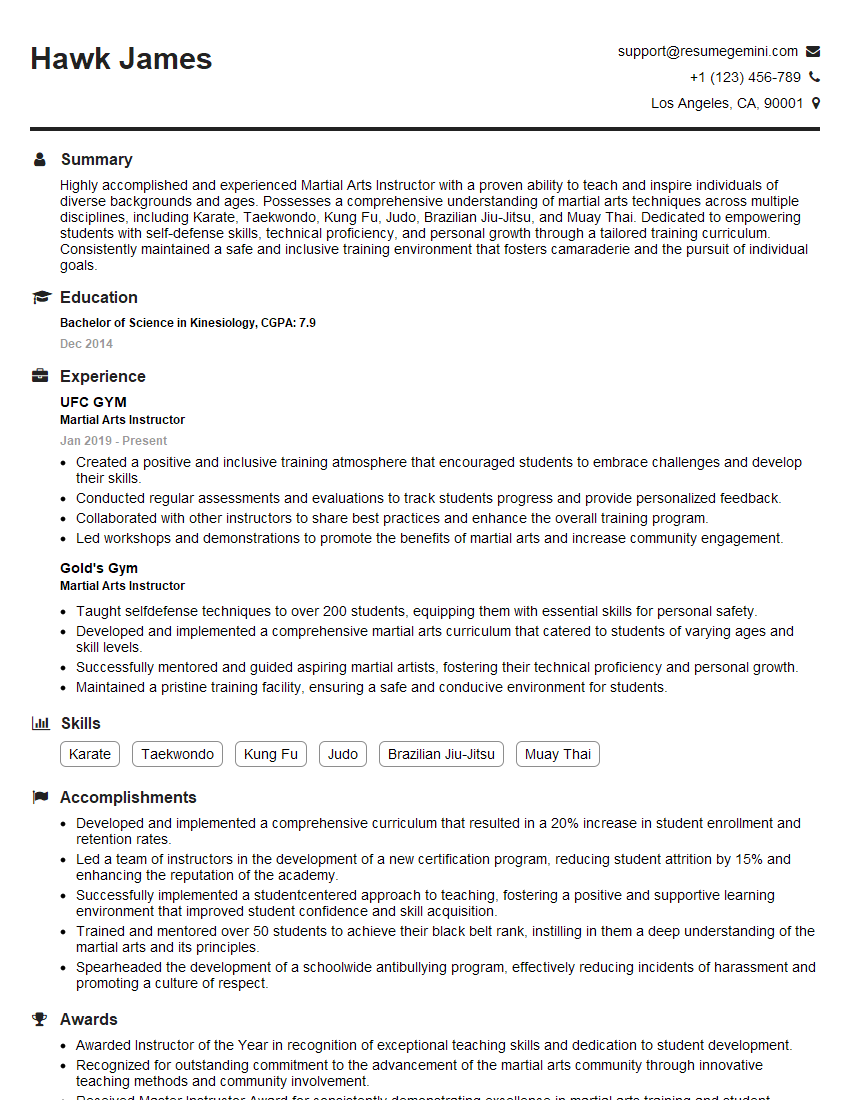
Mastering the art of planning and preparing Judo lessons is crucial for career advancement in this field. It demonstrates your ability to create engaging, safe, and effective learning experiences. To significantly boost your job prospects, focus on crafting a compelling and ATS-friendly resume that highlights your relevant skills and experience. ResumeGemini is a trusted resource that can help you build a professional and impactful resume tailored to your specific needs. Examples of resumes tailored to Planning and Preparing Judo Lessons are available to guide you.

Explore more articles
Users Rating of Our Blogs
Share Your Experience
We value your feedback! Please rate our content and share your thoughts (optional).
What Readers Say About Our Blog
Very informative content, great job.
good