Feeling uncertain about what to expect in your upcoming interview? We’ve got you covered! This blog highlights the most important Plastic manufacturing interview questions and provides actionable advice to help you stand out as the ideal candidate. Let’s pave the way for your success.
Questions Asked in Plastic manufacturing Interview
Q 1. Explain the difference between thermoplastic and thermoset polymers.
The key difference between thermoplastics and thermosets lies in their response to heat. Think of it like this: thermoplastics are like Play-Doh – you can repeatedly heat them up, mold them, and cool them down without fundamentally changing their chemical structure. Thermosets, on the other hand, are like an egg – once they’re cooked (cured), they’re permanently set and cannot be remolded by heating.
- Thermoplastics: These polymers soften when heated and harden when cooled, allowing for repeated melting and reshaping. Examples include polyethylene (PE), polypropylene (PP), polyvinyl chloride (PVC), and polystyrene (PS). They are widely used for things like plastic bottles, food containers, and toys.
- Thermosets: These polymers undergo irreversible chemical changes upon heating, forming a rigid, cross-linked structure. Heating them again won’t soften them; instead, they might decompose. Examples include epoxy resins, polyester resins, and vulcanized rubber. These are often used for high-strength applications like car parts, electrical insulation, and fiberglass-reinforced plastics.
Q 2. Describe the injection molding process in detail.
Injection molding is a high-volume manufacturing process that creates plastic parts by injecting molten plastic into a mold. Imagine a syringe filled with hot plastic pushing it into a precisely engineered cavity. Here’s a step-by-step breakdown:
- Clamping: The two halves of the mold are clamped together tightly to create a sealed cavity.
- Injection: Molten plastic, heated to a specific temperature in an injection unit, is forced into the mold cavity under high pressure.
- Cooling: The molten plastic cools and solidifies within the mold cavity, taking the shape of the mold.
- Ejection: Once the plastic has solidified, ejector pins push the molded part out of the mold.
- Mold Opening: The mold opens, allowing the removal of the finished part.
The process is automated and highly efficient, producing identical parts repeatedly. The complexity of the mold determines the final shape and features of the plastic part.
Q 3. What are the common types of plastic resins used in manufacturing?
The plastics industry uses a wide variety of resins, each with unique properties. Here are some of the most common:
- Polyethylene (PE): A flexible, low-cost resin used for films, bags, and bottles. There are high-density (HDPE) and low-density (LDPE) varieties.
- Polypropylene (PP): A versatile resin known for its strength and chemical resistance, often used for containers, automotive parts, and fibers.
- Polyvinyl Chloride (PVC): A rigid resin used in pipes, windows, and flooring; known for its durability and resistance to weathering.
- Polystyrene (PS): A readily moldable resin used for disposable cups, food containers, and insulation; it’s lightweight and inexpensive.
- Acrylonitrile Butadiene Styrene (ABS): A tough, impact-resistant resin used in electronics housings, automotive parts, and Lego bricks.
- Polycarbonate (PC): A high-performance resin known for its high impact strength and transparency; used in safety glasses, lenses, and medical devices.
The choice of resin depends heavily on the intended application’s requirements, like strength, flexibility, chemical resistance, and cost.
Q 4. How do you troubleshoot common problems in an injection molding machine?
Troubleshooting injection molding problems requires a systematic approach. It often involves careful observation, data analysis, and a good understanding of the machine and the molding process. Here’s a possible strategy:
- Identify the problem: What is the defect? Is it cosmetic (e.g., short shots, flash), dimensional (e.g., warping, sink marks), or material-related (e.g., discoloration, degradation)?
- Gather data: Check machine parameters (temperature, pressure, injection speed, cycle time), examine the molded part, and inspect the mold for wear or damage.
- Analyze the root cause: Based on the problem and data, systematically rule out potential causes. For example, short shots might indicate insufficient injection pressure or material viscosity issues. Warpage could be due to uneven cooling or mold design issues.
- Implement corrective actions: Adjust machine parameters, modify the mold, change the material, or adjust the process parameters based on the analysis. This might involve tweaks to injection speed, melt temperature, or mold cooling.
- Verify the solution: Monitor the process after implementing changes to ensure the problem is resolved and the parts meet specifications.
Proper record-keeping is essential for tracking issues and their resolutions. A systematic approach combined with experience ensures efficiency in troubleshooting.
Q 5. Explain the concept of cycle time in injection molding.
Cycle time in injection molding refers to the total time required to complete one molding cycle. It’s a critical parameter that affects production efficiency and cost. A shorter cycle time translates to higher production output.
The cycle time is made up of various subprocesses including:
- Mold closing time
- Injection time
- Cooling time (this is usually the longest)
- Mold opening time
- Ejection time
- Part removal time
Optimizing cycle time involves fine-tuning the process parameters like injection speed, melt temperature, and cooling time, while maintaining part quality. Reducing cycle time without compromising quality is a key objective for manufacturers.
Q 6. What are the key quality control measures in plastics manufacturing?
Quality control in plastics manufacturing is essential to ensure consistent product quality and customer satisfaction. Key measures include:
- Incoming Material Inspection: Checking the raw materials for quality, consistency, and conformity to specifications.
- In-Process Monitoring: Regularly monitoring the injection molding process parameters to detect deviations early on.
- Dimensional Inspection: Using measuring tools like calipers and CMMs (Coordinate Measuring Machines) to verify part dimensions meet specifications.
- Visual Inspection: Checking for surface defects like flash, sink marks, and discoloration.
- Mechanical Testing: Testing the mechanical properties of the parts like tensile strength, impact resistance, and flexural strength.
- Statistical Process Control (SPC): Employing statistical methods to monitor and control the process variability.
- Regular Machine Maintenance: Ensuring proper maintenance of injection molding machines to minimize defects and downtime.
Implementing a robust quality control system ensures consistent part quality and minimizes waste and rework, saving both time and resources.
Q 7. How do you ensure the dimensional accuracy of plastic parts?
Ensuring dimensional accuracy of plastic parts requires careful control throughout the manufacturing process. Several factors contribute to this:
- Precise Mold Design: The mold is the primary determinant of part dimensions. CAD/CAM software and high-precision machining are crucial for accurate mold creation.
- Controlled Process Parameters: Maintaining consistent process parameters like injection pressure, melt temperature, and cooling time is vital. Deviations can lead to dimensional inaccuracies.
- Material Selection: Different plastics have varying shrinkage rates during cooling. Choosing the appropriate material and accounting for shrinkage is crucial.
- Mold Temperature Control: Even cooling throughout the mold is essential to prevent warping and dimensional inconsistencies.
- Dimensional Inspection and Feedback: Regular dimensional inspection using appropriate measuring tools provides feedback that helps fine-tune the process.
- Material Characterization: A thorough understanding of the polymer’s rheological properties (flow behavior) is important to predict and control shrinkage.
A combination of careful planning, precise execution, and regular monitoring ensures dimensional accuracy in the final product. This minimizes rework, reduces waste and ensures a high-quality end-product.
Q 8. Describe your experience with different types of extrusion processes.
Extrusion is a continuous manufacturing process where molten plastic is forced through a die to create a consistent shape. I have extensive experience with various extrusion processes, including:
- Single-screw extrusion: This is the most common type, using a single screw to melt, mix, and pump the plastic. I’ve worked extensively with this method in producing pipes, films, and profiles, optimizing screw design and die geometry for different material properties and desired product characteristics. For instance, adjusting the screw’s length-diameter ratio and flight depth significantly affects the melt homogeneity and output rate.
- Twin-screw extrusion: This process employs two screws that rotate intermeshing, providing superior mixing and the capability to handle highly filled or reactive compounds. My experience includes using this technique for producing high-performance compounds and specialized blends, where precise control over material distribution is crucial. A specific example is compounding recycled plastics with virgin materials to meet certain mechanical properties.
- Co-extrusion: This method extrudes multiple layers of different plastic materials simultaneously, creating multi-layered products. This technique is commonly used in packaging applications. In my past role, I was involved in optimizing the co-extrusion process to minimize layer delamination and ensure the desired barrier properties.
My experience encompasses optimizing process parameters such as temperature profiles, screw speed, and die pressure to achieve consistent product quality and high throughput. I also possess significant troubleshooting skills to address common issues like melt fracture, die swell, and material degradation.
Q 9. What are the common defects found in plastic parts and their causes?
Plastic parts can exhibit various defects, often stemming from issues within the manufacturing process or material properties. Some common defects include:
- Sink marks: These are indentations on the surface, typically caused by insufficient material to fill the mold cavity completely, often due to improper mold design or insufficient injection pressure.
- Short shots: These are incompletely filled parts, often resulting from low injection pressure, insufficient melt flow, or gate restrictions. Think of trying to pour water into a bottle with a tiny opening – you won’t fill it completely.
- Warping/Distortion: This occurs due to uneven cooling or internal stresses, causing the part to deform after molding. This can often be addressed through careful mold design, including cooling channels, or material selection.
- Flashing: This is excess material squeezed out between the mold halves, caused by excessive injection pressure or improper mold closure. Imagine squeezing toothpaste out from the tube’s edges.
- Burn marks: These are surface discolorations or degradation of the plastic due to excessive temperatures within the barrel or mold.
- Weld lines: These are visible lines where two melt flows join within the part, which can cause reduced strength. Careful control over flow and gate location helps minimize these.
Root cause analysis is critical to resolve these defects. This involves examining the process parameters, material characteristics, and the mold design, using various tools like visual inspection, dimensional measurements, and sometimes microscopy.
Q 10. How do you calculate the material usage for a specific plastic part?
Calculating material usage for a plastic part involves a few key steps:
- Determine the part volume: This can be done through CAD software (Computer-Aided Design), generating a 3D model of the part. The software then provides the exact volume. For simpler shapes, manual calculations can be used.
- Account for shrinkage: Plastics shrink as they cool down. This shrinkage factor (usually provided by the material supplier) must be factored in to determine the amount of material needed to fill the mold cavity. For example, a shrinkage rate of 1% means that 101 units of material are needed to create 100 units of final product.
- Consider runner and gate systems: The runner and gate system directs molten plastic into the mold cavity. The amount of material wasted in these systems needs to be accounted for, usually determined experimentally or through simulation.
- Calculate total material weight: Once the total volume (part volume + runner/gate volume, adjusted for shrinkage) is known, it’s converted to weight using the plastic’s density (typically found in material datasheets).
For instance, if a part has a volume of 100 cm³ after shrinkage, with a runner/gate volume of 10 cm³, and the plastic density is 1 g/cm³, the total weight needed would be (100 + 10) cm³ * 1 g/cm³ = 110 g.
Q 11. Explain the importance of proper mold design in injection molding.
Proper mold design is paramount in injection molding. A well-designed mold ensures consistent part quality, minimizes defects, and optimizes the manufacturing process. Key aspects include:
- Gate location and design: The gate’s location and design significantly impact flow patterns and the formation of weld lines. Proper gate design minimizes pressure drop and ensures complete filling of the mold cavity.
- Cooling system: Efficient cooling is crucial for fast cycle times and preventing warping. Well-designed cooling channels ensure uniform cooling throughout the part.
- Ejection system: This ensures parts are easily removed from the mold without damage. Effective ejection systems minimize cycle times and prevent part deformation.
- Material selection: Mold material selection depends on factors such as the plastic being molded, the cycle time, and the expected number of parts. Steel, aluminum, and beryllium copper are common choices. Choosing an unsuitable material can lead to premature mold failure.
- Cavity and core design: The precision of the cavity and core dictates the part’s dimensional accuracy and surface finish. Any flaws in this design can result in defects.
A poorly designed mold can lead to a cascade of problems, including increased scrap, extended cycle times, and subpar part quality. It’s like building a house on a weak foundation – the entire structure is compromised.
Q 12. What are the different types of plastic testing methods?
Plastic testing methods are crucial for ensuring quality and compliance with industry standards. The choice of testing method depends on the specific properties of interest and the application of the part. Common methods include:
- Mechanical testing: Tensile strength, flexural strength, impact resistance, and hardness tests determine the material’s ability to withstand various mechanical stresses.
- Thermal testing: Glass transition temperature (Tg) and melting point (Tm) determine the material’s response to temperature changes. These tests are crucial for determining the usable temperature range for a part.
- Chemical testing: Chemical resistance tests assess the material’s ability to withstand exposure to different chemicals and solvents.
- Dimensional testing: This involves verifying the part’s dimensions and tolerances using calipers, micrometers, and coordinate measuring machines (CMMs).
- Visual inspection: A critical first step, checking for surface defects like scratches, cracks, or other imperfections.
- Optical microscopy: Observing the internal structure of a material at the microscopic level to assess its uniformity.
These methods ensure the plastic parts meet the required specifications and provide the expected performance in their intended applications.
Q 13. Describe your experience with Statistical Process Control (SPC).
Statistical Process Control (SPC) is a crucial tool for monitoring and improving manufacturing processes. My experience involves using SPC techniques to track key process parameters and identify trends and potential problems before they significantly impact product quality. I’ve implemented control charts (like X-bar and R charts, p-charts, and c-charts), analyzed process capability (Cp, Cpk), and employed various statistical methods to analyze data and make data-driven decisions. For example, using control charts helped me identify a subtle shift in injection pressure that was initially undetectable visually, but which resulted in a gradual increase in short shots. By implementing adjustments, we improved the process capability and reduced defects significantly. SPC allows for proactive problem solving, leading to more consistent product quality and reduced waste.
Q 14. How do you handle material variations in plastics manufacturing?
Material variations in plastics manufacturing are inevitable, stemming from sources like resin batches, supplier changes, and environmental factors. Handling these variations effectively is essential for maintaining consistent product quality. My strategies include:
- Incoming material inspection: Rigorous testing of incoming resin batches for properties like melt flow index (MFI), density, and color ensures conformity to specifications.
- Process adjustments: Based on incoming material properties, process parameters like temperature, pressure, and injection speed can be adjusted to compensate for variations and maintain consistent product quality. This often necessitates real-time data analysis.
- Material blending: In some cases, blending different resin batches can help to average out variations and produce a consistent material feedstock.
- Supplier management: Working closely with suppliers, ensuring they consistently provide materials that meet our quality standards. Clearly defined specifications and regular audits are essential.
- Process monitoring and control: Implementing SPC techniques allows for continuous monitoring of process parameters and identifying shifts or trends that might indicate material-related issues.
Effective material management is crucial. It’s about understanding the influence of material variability on the final product and implementing strategies to mitigate its impact.
Q 15. Explain your experience with different types of plastic machinery.
My experience encompasses a wide range of plastic machinery, from extrusion systems for creating films and pipes to injection molding machines for producing complex parts, and blow molding machines for hollow containers. I’ve worked extensively with both high-volume production lines and smaller, more specialized equipment. For example, in a previous role, I oversaw a line of injection molding machines producing intricate medical components, requiring precise control over temperature, pressure, and injection speed. This involved managing the entire process from raw material handling to final product inspection. I also have experience with thermoforming, a process where plastic sheets are heated and formed into shapes using molds, often utilized for packaging applications. This experience extends to troubleshooting, preventative maintenance, and optimizing the performance of these machines to minimize downtime and maximize output.
- Injection Molding: High-pressure machines forming parts from molten plastic.
- Extrusion: Creating continuous profiles of plastic like pipes, films, or sheets.
- Blow Molding: Forming hollow plastic items like bottles or containers.
- Thermoforming: Heating plastic sheets and shaping them over molds.
Career Expert Tips:
- Ace those interviews! Prepare effectively by reviewing the Top 50 Most Common Interview Questions on ResumeGemini.
- Navigate your job search with confidence! Explore a wide range of Career Tips on ResumeGemini. Learn about common challenges and recommendations to overcome them.
- Craft the perfect resume! Master the Art of Resume Writing with ResumeGemini’s guide. Showcase your unique qualifications and achievements effectively.
- Don’t miss out on holiday savings! Build your dream resume with ResumeGemini’s ATS optimized templates.
Q 16. How do you ensure the safety of workers in a plastics manufacturing environment?
Worker safety is paramount in plastics manufacturing. My approach is multifaceted, focusing on prevention and mitigation. This starts with comprehensive safety training covering machine operation, material handling, personal protective equipment (PPE) usage, and emergency procedures. Regular safety audits are crucial to identify and rectify potential hazards. We use lockout/tagout procedures to prevent accidental machine starts during maintenance. Furthermore, ergonomic assessments ensure workstations are designed to minimize repetitive strain injuries. Proper ventilation systems control the emission of volatile organic compounds (VOCs) from plastics and additives. I always advocate for a culture of safety, encouraging workers to report near misses and participate in safety discussions. In one instance, we implemented a new safety protocol after a near-miss incident, resulting in a significant reduction in minor injuries within the following quarter.
- Safety Training: Regular and comprehensive training on machinery and safety protocols.
- Lockout/Tagout Procedures: Preventing accidental machine activation during maintenance.
- Ergonomic Assessments: Optimizing workstations to prevent injuries.
- Ventilation Systems: Controlling VOC emissions.
Q 17. Describe your experience with Lean Manufacturing principles.
Lean Manufacturing principles are deeply ingrained in my approach. I have a proven track record of implementing and improving lean processes in plastics manufacturing. This includes value stream mapping to identify waste and bottlenecks, 5S methodology for workplace organization, and Kaizen events for continuous improvement. For example, in a previous role, we implemented a Kanban system for managing inventory, reducing lead times and storage costs significantly. We also streamlined the production process by eliminating unnecessary steps, thereby increasing efficiency and reducing waste. I believe in empowering employees to identify and resolve problems through continuous improvement initiatives. The key is to constantly evaluate processes, removing waste (muda), and improving flow (workflow).
- Value Stream Mapping: Identifying and eliminating waste in the production process.
- 5S Methodology: Organizing the workplace for efficiency and safety (Sort, Set in Order, Shine, Standardize, Sustain).
- Kaizen Events: Focused improvement initiatives involving teams.
- Kanban: A visual system for managing workflow and inventory.
Q 18. How do you manage production schedules and deadlines?
Effective production schedule management involves careful planning and robust communication. I utilize advanced scheduling software to create realistic production plans, considering machine capacity, material availability, and customer demands. Regular progress monitoring helps identify potential delays early on. We use a combination of methods, including Gantt charts for visualizing the timeline and Kanban boards for tracking real-time progress. Communication is key – daily stand-up meetings ensure transparency and enable prompt responses to unforeseen issues. In situations of unexpected delays, I employ contingency planning, exploring options like overtime or alternative production strategies to meet deadlines. For instance, when a critical machine malfunctioned, we successfully re-routed production to other machines, minimizing delays through proactive resource allocation and close collaboration with the maintenance team.
Q 19. What are the common challenges in plastics recycling?
Plastics recycling faces significant challenges. One major hurdle is the diversity of plastic types. Different plastics (PET, HDPE, PVC, etc.) require different recycling processes, and contamination from mixed plastics can render recycling inefficient. Another challenge lies in the economic viability of recycling. The cost of collecting, sorting, and processing recycled plastics often exceeds the market value of the recycled material. Furthermore, the degradation of plastic properties during the recycling process can limit its reusability, particularly for high-performance applications. Finally, the development of efficient technologies for recycling complex plastic items, like multi-layered packaging, remains a significant area of research and development.
Q 20. Explain the principles of Six Sigma and its application in plastics manufacturing.
Six Sigma is a data-driven methodology focused on minimizing defects and variability in processes. In plastics manufacturing, this translates to producing consistently high-quality products that meet customer specifications. We employ statistical tools like DMAIC (Define, Measure, Analyze, Improve, Control) to systematically improve processes. For example, we might use control charts to monitor the dimensions of molded parts, ensuring they fall within acceptable tolerances. By identifying and addressing the root causes of variations, we can improve product quality, reduce waste, and enhance customer satisfaction. A successful Six Sigma project in a previous role led to a 90% reduction in the number of defective parts produced on a specific injection molding machine.
- DMAIC: A structured problem-solving methodology.
- Control Charts: Monitoring process variability.
- Statistical Process Control (SPC): Using statistical methods to monitor and control processes.
Q 21. How do you maintain and troubleshoot plastic molding machines?
Maintaining and troubleshooting plastic molding machines requires a combination of preventative maintenance and reactive problem-solving. Preventative maintenance involves regular inspections, lubrication, and part replacements according to a scheduled plan. This minimizes unexpected downtime. When troubleshooting, I follow a systematic approach, starting with a thorough examination of the machine’s operational logs and error messages. We then systematically check hydraulic systems, electrical components, and the molding process parameters (temperature, pressure, injection speed). I often use specialized diagnostic tools to pinpoint issues quickly. For example, a recent issue involved inconsistent part dimensions. By analyzing the temperature profiles and adjusting the injection pressure, we resolved the problem. Documentation is crucial – meticulous record-keeping enables efficient troubleshooting and preventative maintenance.
Q 22. Describe your experience with CAD/CAM software.
My experience with CAD/CAM software spans over 15 years, encompassing various platforms like SolidWorks, Autodesk Inventor, and Mastercam. I’m proficient in 3D modeling, design for manufacturing (DFM), and generating CNC machining programs. For instance, in a recent project involving the design of a complex plastic housing for a medical device, I utilized SolidWorks to create the 3D model, ensuring all design parameters met the stringent requirements for biocompatibility and sterilizability. Then, using Mastercam, I generated the necessary CNC toolpaths for machining the mold tooling, optimizing for both speed and precision. My expertise extends to using simulation software to predict and optimize the molding process, minimizing defects and ensuring a high-quality final product.
Beyond the software itself, I understand the critical interplay between design parameters and manufacturability. I consistently incorporate DFM principles to streamline production, reduce costs, and enhance product quality. This includes considerations like draft angles, wall thicknesses, and undercuts to make the molding process efficient and reliable.
Q 23. How do you select appropriate plastic materials for a given application?
Selecting the right plastic material is paramount to a product’s success. It’s a multifaceted decision based on the specific application requirements, considering factors like mechanical properties, thermal properties, chemical resistance, cost, and environmental impact. For example, if I’m designing a food container, I’d prioritize FDA-approved materials like polypropylene (PP) for its durability, heat resistance, and inertness. On the other hand, a high-performance automotive part might require a more specialized engineering plastic, like polycarbonate (PC) or polyetheretherketone (PEEK), for its high strength and temperature resistance.
My approach involves a systematic process. First, I carefully analyze the application’s demands. Then, I consult material property databases and datasheets to shortlist suitable candidates. Finally, I may conduct testing to validate the chosen material’s performance under actual operating conditions. This ensures that the final product meets all functional and regulatory requirements.
Q 24. What are the environmental considerations in plastics manufacturing?
Environmental considerations are increasingly critical in plastics manufacturing. We must strive to minimize our environmental footprint throughout the entire lifecycle, from raw material sourcing to end-of-life management. This includes reducing energy consumption during the manufacturing process, using recycled materials whenever possible, and designing for recyclability and biodegradability.
- Reducing Energy Consumption: Optimizing molding processes, using energy-efficient machinery, and implementing waste heat recovery systems can significantly reduce energy use.
- Material Selection: Choosing plastics with a lower carbon footprint or opting for recycled content directly minimizes the environmental impact.
- Waste Management: Implementing effective waste reduction strategies, recycling plastic scraps, and exploring options like chemical recycling can reduce landfill burden.
- Design for Recyclability: Designing parts that are easily separable and compatible with existing recycling streams increases the likelihood of successful recycling.
Furthermore, we must comply with all relevant environmental regulations and continuously explore innovative solutions to minimize our impact on the planet.
Q 25. Describe your experience with different types of plastic finishing processes.
My experience encompasses a wide range of plastic finishing processes, each serving a unique purpose in enhancing the appearance, functionality, or durability of the final product.
- Painting: Applying paints or coatings improves aesthetics and provides protection against environmental factors.
- Electroplating: This process deposits a thin layer of metal onto the plastic surface, enhancing its conductivity, corrosion resistance, or appearance. It’s commonly used for parts requiring a metallic finish.
- Printing: Techniques like screen printing, pad printing, or digital printing allow for adding logos, graphics, or other markings.
- Texturing: Techniques like embossing or injection molding with textured molds add visual appeal or improve grip.
- Ultrasonic Welding: This joining technique is used to fuse two plastic parts together seamlessly.
The choice of finishing process depends on the specific application and desired outcome. For example, a high-gloss finish might be required for consumer electronics, while a textured surface could be preferable for a handgrip. I have hands-on experience selecting and overseeing the implementation of these processes, ensuring consistent quality and adherence to industry standards.
Q 26. Explain your understanding of plastic degradation and its impact.
Plastic degradation refers to the breakdown of polymers over time due to various factors such as exposure to sunlight (UV radiation), heat, oxygen, and microbial action. This degradation can lead to a loss of mechanical strength, discoloration, embrittlement, or the release of harmful chemicals. The impact of plastic degradation can be significant, ranging from diminished product performance and shortened lifespan to environmental pollution.
The type and rate of degradation depend on the type of plastic and the environmental conditions. For instance, polypropylene (PP) is relatively resistant to UV degradation, while polyethylene (PE) is more susceptible. Understanding these degradation mechanisms is crucial for designing products with appropriate lifespans and for managing the end-of-life disposal of plastic materials. Strategies for mitigating degradation include using UV stabilizers, antioxidants, or incorporating more resistant polymers.
Q 27. How do you address customer complaints related to plastic part quality?
Addressing customer complaints regarding plastic part quality is a critical aspect of maintaining customer satisfaction and product reputation. My approach is systematic and focuses on prompt resolution and preventive measures.
- Gather Information: Thoroughly document the complaint, including details like the part number, date of manufacture, the nature of the defect, and any supporting evidence (photos, videos).
- Investigate the Root Cause: This often involves examining the faulty part, reviewing production records, and potentially conducting testing to pinpoint the source of the defect. This might involve analyzing the molding process parameters, material properties, or the finishing process.
- Implement Corrective Actions: Based on the root cause analysis, corrective actions are implemented to prevent similar issues in the future. This might involve adjusting machine parameters, improving material handling, or refining quality control procedures.
- Communicate with the Customer: I maintain open and transparent communication with the customer throughout the process, providing regular updates on the investigation and corrective actions.
- Implement Preventive Measures: After resolving the immediate issue, preventive measures are implemented to prevent similar issues in the future. This might involve implementing new quality control checks or investing in updated equipment.
By following this systematic approach, we ensure customer satisfaction and improve our processes to avoid future complaints.
Q 28. Describe your experience with root cause analysis in a manufacturing setting.
Root cause analysis (RCA) is a crucial problem-solving technique in manufacturing. I have extensive experience using various RCA methodologies, including the 5 Whys, Fishbone diagrams, and Fault Tree Analysis (FTA).
For example, in a situation where we experienced a high rate of warping in a particular plastic part, I utilized the 5 Whys technique to systematically investigate the root cause. By asking ‘why’ repeatedly, we uncovered that the problem stemmed from inconsistent cooling in the mold, which was caused by a malfunctioning cooling system, which was due to inadequate maintenance, ultimately tracing back to a lapse in our preventive maintenance schedule.
The Fishbone diagram was used in a different instance where we experienced inconsistent color in our finished products. This approach helped us brainstorm and categorize potential causes – material inconsistencies, machine settings, environmental factors, and operator errors. This helped us narrow down and investigate the most likely causes of this issue. Each RCA method offers a unique approach to problem-solving, and I choose the most suitable method based on the nature of the problem and the available data. The goal is always to identify the root cause, implement corrective actions, and prevent recurrence.
Key Topics to Learn for Your Plastic Manufacturing Interview
- Polymer Science Fundamentals: Understanding different polymer types (thermoplastics, thermosets), their properties (strength, flexibility, durability), and how these properties relate to processing methods.
- Manufacturing Processes: Gain a solid grasp of injection molding, extrusion, blow molding, thermoforming, and other common plastic manufacturing techniques. Be prepared to discuss the advantages and limitations of each.
- Mold Design and Engineering: Familiarize yourself with the principles of mold design, including gate placement, runner systems, and cooling systems. Understand how these aspects influence product quality and efficiency.
- Material Selection and Properties: Learn how to select the appropriate plastic resin for a given application, considering factors such as cost, performance requirements, and environmental impact.
- Quality Control and Testing: Understand common quality control methods used in plastic manufacturing, including dimensional inspection, material testing, and visual inspection. Be prepared to discuss quality assurance procedures.
- Automation and Robotics in Plastic Manufacturing: Explore the role of automation and robotics in improving efficiency and productivity in modern plastic manufacturing facilities.
- Troubleshooting and Problem-Solving: Develop your ability to identify and solve common problems encountered in plastic manufacturing, such as defects in molded parts, processing issues, and equipment malfunctions.
- Health and Safety Regulations: Understand relevant health and safety regulations and best practices related to plastic manufacturing, including handling of chemicals and machinery safety.
- Sustainability and Recycling: Be aware of current trends and challenges related to sustainable plastic manufacturing and recycling practices. This demonstrates environmental awareness.
Next Steps: Unlock Your Career Potential in Plastics
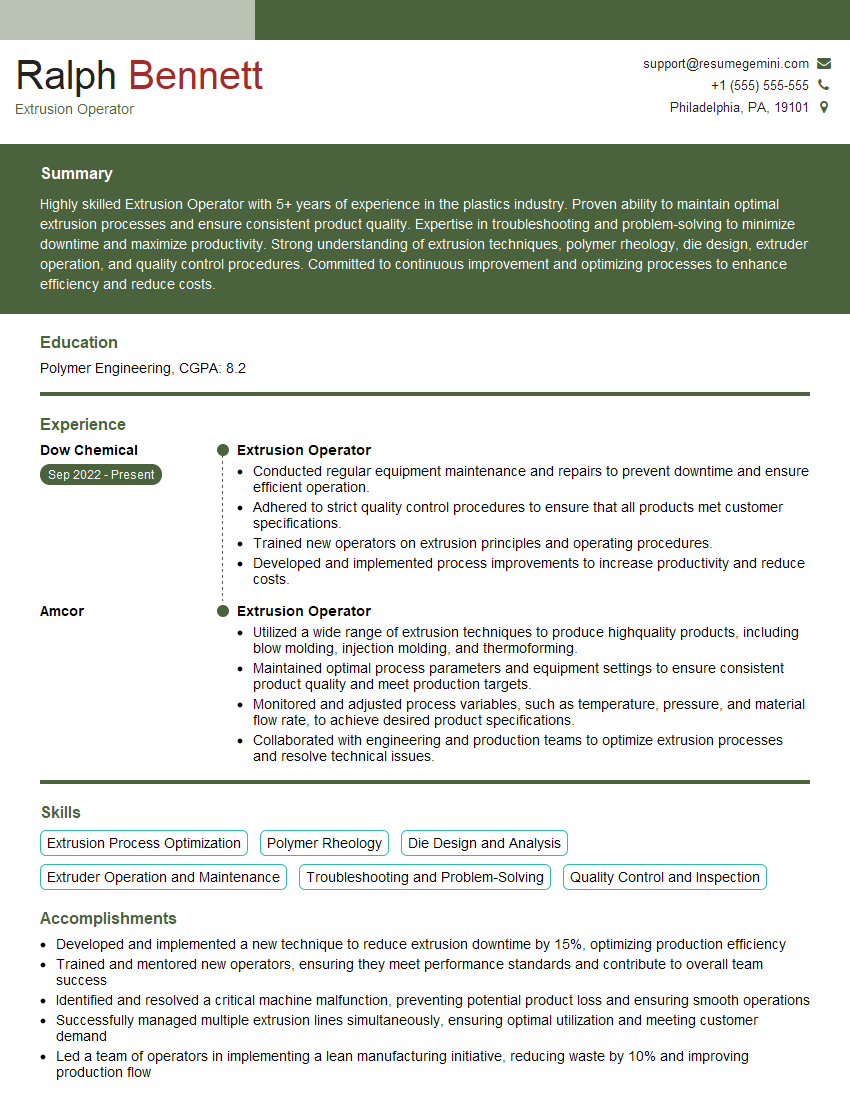
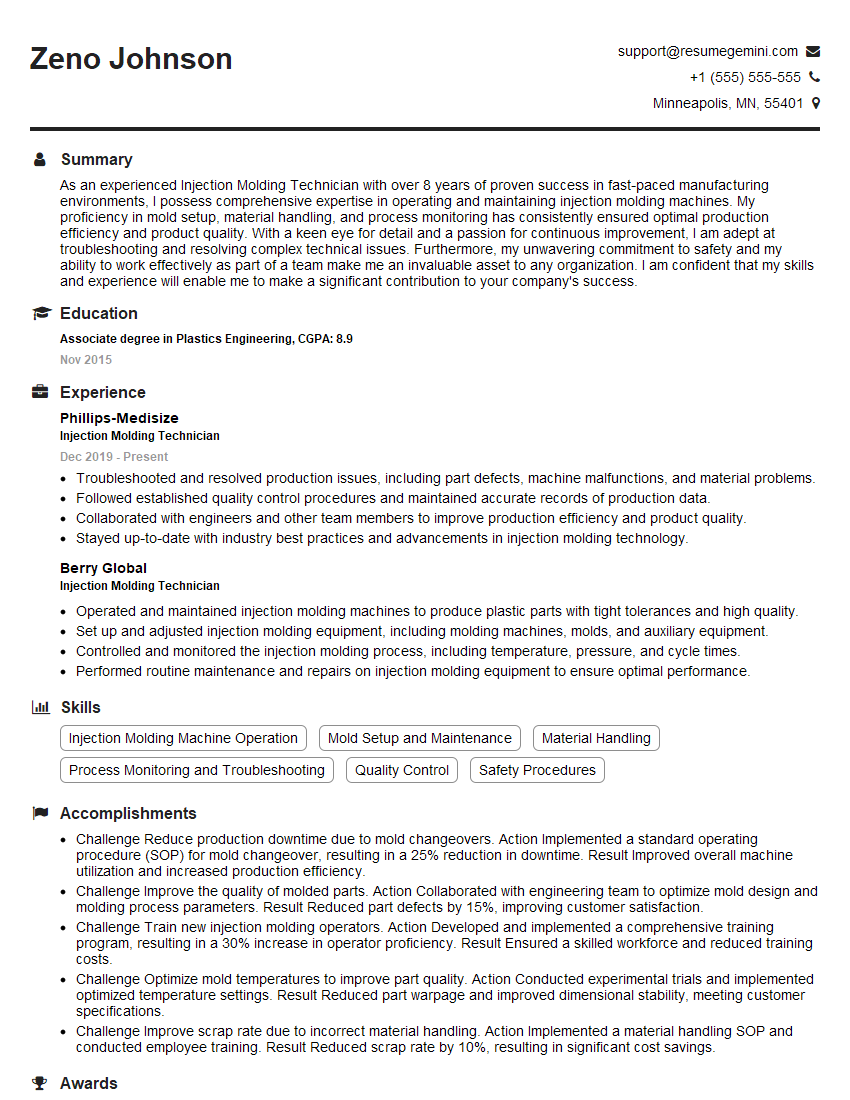
Mastering the key concepts of plastic manufacturing opens doors to exciting career opportunities in a dynamic and ever-evolving industry. To maximize your job prospects, focus on creating a strong, ATS-friendly resume that highlights your skills and experience effectively. ResumeGemini is a trusted resource to help you build a professional and impactful resume tailored to the plastic manufacturing sector. Examples of resumes specifically crafted for this industry are available to guide you. Invest the time to create a compelling resume – it’s your first impression on potential employers.
Explore more articles
Users Rating of Our Blogs
Share Your Experience
We value your feedback! Please rate our content and share your thoughts (optional).
What Readers Say About Our Blog
Very informative content, great job.
good