Are you ready to stand out in your next interview? Understanding and preparing for Plate making and imposition techniques interview questions is a game-changer. In this blog, we’ve compiled key questions and expert advice to help you showcase your skills with confidence and precision. Let’s get started on your journey to acing the interview.
Questions Asked in Plate making and imposition techniques Interview
Q 1. Explain the difference between CTP and conventional platemaking.
The key difference between Computer-to-Plate (CTP) and conventional platemaking lies in how the image is transferred onto the printing plate. Conventional platemaking, also known as film-based platemaking, uses film negatives or positives as an intermediary step. The image is first created digitally and then outputted onto film, which is then used to expose the printing plate. This is a multi-step process, prone to errors and often slower.
CTP, on the other hand, is a direct digital process. The digital image is sent directly from the computer to the platemaking device (a CTP imager), bypassing the film stage entirely. This eliminates the film processing steps, significantly reducing production time and improving accuracy. Think of it like this: conventional platemaking is like making a photocopy of a photocopy, while CTP is like printing directly from the original digital file. The result is a sharper, more consistent image with less potential for degradation.
For example, imagine preparing for a high-volume print run of a magazine. Using CTP, we can directly expose the plates with high precision and quickly move to printing. With conventional methods, additional time is needed for film processing, potentially causing delays and increasing costs.
Q 2. Describe the process of plate mounting on a printing press.
Plate mounting is a crucial step in the printing process, ensuring the plate is correctly positioned and securely attached to the printing cylinder. The process generally involves these steps:
- Cleaning: The plate and the mounting cylinder are meticulously cleaned to remove any dust or debris that could interfere with adhesion.
- Positioning: Using precision tools and registration marks, the plate is carefully positioned on the cylinder to guarantee accurate alignment with other plates and the printing substrate.
- Adhesive Application: A thin layer of adhesive, often a double-sided tape or a specialized mounting solution, is applied to either the plate or the cylinder. The type of adhesive depends on the plate material and the press type.
- Mounting: The plate is firmly pressed onto the adhesive, ensuring complete contact to prevent slippage during printing.
- Inspection: After mounting, the plate is thoroughly inspected for proper alignment and secure attachment. Any issues, like air bubbles or uneven adhesion, are addressed immediately.
Incorrect mounting can lead to misregistration, where colors or elements are not perfectly aligned, ruining the print quality. Imagine a perfectly printed image where the text is slightly shifted from the graphics – a disastrous outcome avoidable with careful plate mounting.
Q 3. What are the common types of printing plates used in the industry?
The printing industry uses various plate types, each with its own strengths and weaknesses. Some common ones include:
- PS Plates (Photosensitive Plates): These are widely used in offset lithography. They are exposed to UV light through a film or directly from a CTP device, hardening the exposed areas to create the printing image. Different types exist such as thermal plates and violet plates, each having specific sensitivity characteristics.
- CTP Plates: These plates are specifically designed for direct digital exposure from a CTP device. They come in various materials (aluminum, polyester) and are optimized for different press speeds and ink types.
- Flexographic Plates: Used for flexible packaging and labels, these plates are typically photopolymer plates that are created using laser ablation or other engraving techniques. They are designed to be more resilient than offset plates.
- Gravure Plates: Used in rotogravure printing, these plates are etched with tiny wells that hold ink. They are typically made of copper or chrome cylinders and offer high print quality for long runs.
The choice of plate depends on factors such as printing process, print quality requirements, print run length, and budget.
Q 4. How do you ensure accurate color reproduction during platemaking?
Accurate color reproduction in platemaking relies on a combination of careful color management practices and advanced technologies. This starts with the digital file itself:
- Color Profiles: Using the correct color profile (e.g., ICC profiles) ensures the digital file’s colors accurately represent the intended output. This step is critical for consistent color across different devices and processes.
- Proofing: Soft proofing (on-screen) and hard proofing (physical print) help validate color accuracy before platemaking. A soft proof gives a preview of what the printed image will look like on the screen. A hard proof is a physical representation, offering a more accurate color representation than a screen.
- Calibration: Regular calibration of both the digital workflow (monitors, RIP software) and the platemaking equipment is crucial. This prevents drifting over time and maintains color accuracy.
- Densitometry: Measuring the density of the plate ensures the proper tonal values are achieved, crucial for achieving desired color and contrast.
Imagine printing a vibrant corporate logo; without meticulous color management, the printed logo could be washed out or have inaccurate colors, harming brand recognition. Therefore, the entire process, from design to platemaking, needs to be meticulously color-calibrated to achieve a spot-on match.
Q 5. What are the different imposition methods for a 16-page booklet?
There are several imposition methods for a 16-page booklet, depending on the printing press and finishing requirements. Common methods include:
- Two-Up Imposition: This is a simple method, where two sets of 8 pages are imposed together on a single sheet. The pages are arranged so that when the sheet is folded and trimmed, the pages fall in the correct sequence.
- Four-Up Imposition: Four sets of 4 pages each are imposed on a single sheet. This method reduces the number of sheets needed but requires more complex folding and trimming.
- Eight-Up Imposition: Eight sets of 2 pages are imposed. This further reduces the number of sheets but makes the imposition and finishing significantly more complex.
The choice of method depends on factors such as sheet size, press capabilities, and the desired efficiency. A professional imposition software is usually employed to determine the optimum arrangement, minimizing waste and maximizing efficiency. For example, a smaller press may only accommodate two-up imposition, while a larger press can handle four-up or eight-up.
Q 6. Explain the concept of imposition and its importance in printing.
Imposition is the arrangement of pages on a printing sheet before printing. It’s like a puzzle where you arrange the pieces (pages) in a specific order to achieve the final product (booklet or leaflet) once folded and trimmed.
Its importance in printing cannot be overstated. It ensures that the final printed piece has the correct page sequence and that the minimum amount of paper is used. Poor imposition can lead to pages being out of order, significant paper waste, increased printing costs, and production delays. Imagine a cookbook with recipes out of order – completely unusable! Imposition prevents that scenario and enables the efficient and accurate production of printed materials.
Q 7. How do you troubleshoot common platemaking issues such as dot gain or ghosting?
Troubleshooting platemaking issues requires a systematic approach. Let’s look at dot gain and ghosting:
Dot Gain: Dot gain is the enlargement of printed dots during the printing process. This leads to darker and less defined images. Troubleshooting steps include:
- Check Platemaking Settings: Verify that the platemaking exposure settings are correct and consistent. Excessive exposure can lead to increased dot gain.
- Assess Ink and Paper: The ink viscosity and paper absorbency can influence dot gain. Testing different ink formulations or paper types might solve the issue.
- Examine Press Conditions: Incorrect printing pressure, speed, or dampening solution can also contribute to dot gain.
Ghosting: Ghosting is the appearance of faint images or shadows, usually caused by ink transferring from one color to another. Here’s how to address it:
- Examine Ink Properties: The ink’s viscosity and drying properties are crucial. Using inks with better drying characteristics reduces the chance of ghosting.
- Check Press Conditions: Similar to dot gain, press conditions like pressure, speed, and ink distribution influence ghosting. Fine-tuning these might solve the problem.
- Clean the Press: Thoroughly cleaning the press and rollers eliminates residual ink that can cause ghosting.
Systematic troubleshooting, starting with the simplest steps and progressing to more complex ones, is crucial. For complex issues, consulting experienced press operators or platemaking technicians is necessary.
Q 8. What are the key quality control checks performed on printing plates?
Quality control in platemaking is crucial for consistent print quality. We perform several checks at various stages. Initially, we inspect the plates for physical defects like scratches, blemishes, or inconsistencies in the imaging layer. This is often done visually with magnification and sometimes with specialized plate inspection equipment that detects subtle flaws. Then, we assess the plate’s density and dot gain using a densitometer. This ensures the correct amount of ink will be transferred, preventing problems like poor image contrast or muddy colors. Finally, a proof is created from the plate, and this proof is meticulously compared against the digital design file. This visual comparison catches any errors in image registration, color accuracy, or missing elements before the plate goes to press. A failing in any of these checks could result in wasted materials, delays, and ultimately, unhappy customers.
Q 9. Describe the different types of plate materials and their applications.
Printing plates come in various materials, each suited for specific applications. The most common are:
- Aluminum plates: These are widely used due to their cost-effectiveness and compatibility with a range of printing processes, including offset lithography. They are relatively easy to process and offer good print quality for most applications.
- Polymer plates (e.g., polyester): These are more durable and flexible than aluminum, better suited for longer print runs and applications requiring high image quality. They are also environmentally friendly due to their reusability potential, as they generally offer superior resistance to abrasion than aluminum. They are frequently used in flexographic printing and for high-speed presses.
- PS Plates (photosensitive plates): These plates use photosensitive technology, which allows for high precision and detail. They are widely used for high-quality printing where fine details are essential.
The choice of plate material depends on factors such as print run length, desired image quality, budget constraints, and the specific printing press being used. For a small print run of high-quality business cards, a PS plate might be ideal, while a larger run of simple flyers could efficiently use aluminum plates.
Q 10. How do you handle a damaged or defective printing plate?
Handling damaged or defective plates depends on the nature and extent of the damage. Minor scratches or blemishes might be acceptable if they’re outside the print area, but significant damage requires action. If the damage is confined to a small area, and the plate material allows it, we could attempt repair using specialized plate repair solutions, potentially coupled with careful retouching. However, for major damage, like deep scratches or significant inconsistencies in the imaging layer, replacing the plate is the most practical solution. It’s always more cost-effective to replace a defective plate rather than risk printing a large run with errors. We maintain meticulous records of plate usage and defects, which helps us anticipate and prevent similar problems in the future.
Q 11. Explain the importance of proper plate storage and handling.
Proper plate storage and handling are essential for maintaining print quality and extending plate lifespan. Plates should be stored in a cool, dry, and dark environment to prevent oxidation and degradation of the imaging layer. They should be kept flat and protected from dust and physical damage. Using proper plate sleeves or storage boxes is crucial. Moreover, plates should be handled carefully, avoiding contact with sharp objects or abrasive materials. Incorrect handling leads to scratches, which directly impact print quality. Remember, a damaged plate translates to wasted materials and potentially costly reprints. A meticulous approach to plate storage is as critical as the plate making process itself.
Q 12. What software are you familiar with for imposition and plate design?
I’m proficient in several software packages commonly used for imposition and plate design. These include Esko Automation Engine, which is particularly powerful for automating prepress workflows; Creo Prinergy, known for its robust color management capabilities; and Adobe Illustrator, which is widely used for creating and manipulating vector-based artwork suitable for platemaking. The specific software chosen depends on the complexity of the job and the client’s preferences. For simple jobs, even a software like Adobe InDesign can suffice. The selection of software is often tied to the overall workflow and prepress automation level of the print production facility.
Q 13. How do you calculate the required number of plates for a specific print job?
Calculating the number of plates needed depends on several factors, primarily the number of colors used and the printing technique. For example, a four-color process (CMYK) printing requires four plates: one for each color (Cyan, Magenta, Yellow, and Black). If you’re using Pantone colors (special colors beyond CMYK), you need an additional plate for each Pantone color. Let’s say we’re printing a brochure with a four-color process plus a specific Pantone gold color. That would require five plates. The imposition software helps to arrange the pages onto these plates in the most efficient way (minimizing waste), and the plate size and sheet size further impacts the precise number of plates you will require.
Q 14. What is the significance of maintaining accurate color profiles in platemaking?
Maintaining accurate color profiles in platemaking is paramount for achieving consistent and predictable color reproduction across the entire print process. Color profiles define the relationship between the digital representation of a color and how it will appear on the printed material. An inaccurate color profile will lead to color shifts between the proof and the final print, making it difficult to achieve the desired results. This is particularly critical for jobs requiring precise color matching, such as corporate branding or high-end packaging, where consistency is essential. Using accurate ICC profiles, regular color calibration, and the use of color management software are all essential components in achieving consistent color reproduction.
Q 15. Explain the concept of imposition workflow and its importance.
Imposition is the strategic arrangement of pages on a printing sheet before printing, ensuring the correct sequence and orientation for final product assembly. Think of it like planning the layout of a jigsaw puzzle before you start putting the pieces together. A well-planned imposition workflow is crucial for efficient printing and minimizes waste. It involves several steps:
- Design & Planning: Determining the number of pages, sheet size, and the most efficient arrangement to minimize paper waste.
- Imposition Software: Using specialized software (like Imposition Pro, or features within Adobe Acrobat) to create the imposition layout digitally. This software allows for precise placement and calculation of margins, bleeds, and gutter space.
- Plate Creation: The digitally imposed layout is then used to create printing plates (e.g., offset plates) which will transfer the image onto the substrate.
- Press Operation: The plates are mounted on the printing press according to the imposition scheme. The press prints the entire sheet, which is later cut and folded to create the final product.
The importance lies in reducing material costs, optimizing press time, and ensuring accurate page sequencing. A poorly planned imposition can lead to significant waste, production delays, and printing errors.
For example, a 24-page booklet can be imposed in various ways. A poorly planned imposition could require multiple sheets, leading to substantial paper waste. An expertly planned imposition might utilize only two or three sheets, significantly reducing costs and materials.
Career Expert Tips:
- Ace those interviews! Prepare effectively by reviewing the Top 50 Most Common Interview Questions on ResumeGemini.
- Navigate your job search with confidence! Explore a wide range of Career Tips on ResumeGemini. Learn about common challenges and recommendations to overcome them.
- Craft the perfect resume! Master the Art of Resume Writing with ResumeGemini’s guide. Showcase your unique qualifications and achievements effectively.
- Don’t miss out on holiday savings! Build your dream resume with ResumeGemini’s ATS optimized templates.
Q 16. What is your experience with different types of printing presses and their plate requirements?
My experience encompasses a range of printing presses, each with unique plate requirements:
- Offset Lithography: I’ve extensively worked with offset presses, utilizing both conventional and computer-to-plate (CTP) methods for platemaking. These presses require plates made from aluminum, typically coated with photosensitive material. Plate thickness and image area vary according to press size and capabilities. I’m proficient in managing different plate sizes and formats, from small business card plates to large format posters.
- Flexography: My experience includes working with flexographic presses, commonly used for packaging and labels. These presses utilize flexible photopolymer plates, which require different imaging and processing techniques compared to offset plates. I’m familiar with various plate materials and thicknesses, tailored to different substrates and print runs.
- Digital Printing: I have worked with digital printing systems that utilize inkjet or toner-based imaging processes. While not involving traditional plates, the same imposition principles apply to managing the print file for optimal efficiency. Here, understanding the digital press’ capabilities and optimizing file sizes for maximum quality and speed is key.
Understanding the unique requirements of each press type is crucial for efficient platemaking and high-quality print results. For instance, the screen ruling (dots per inch) of an offset plate needs to match the press’ capabilities, while flexographic plates need to be considered for their durability and resistance to wear and tear across varying substrates.
Q 17. How do you manage different substrates during platemaking and imposition?
Substrate management is critical throughout the platemaking and imposition process. The choice of substrate significantly impacts the printing process and the final output. Different substrates require different ink densities, printing pressures, and even plate materials.
- Paper: The type of paper (coated, uncoated, recycled etc.) affects ink absorption, resulting in varied dot gain (the spreading of ink dots) which must be considered during both imposition and plate creation. For instance, coated paper allows for sharper images, requiring a different plate preparation than uncoated paper.
- Cardboard and Paperboard: These substrates require more robust plates due to their thickness and potential for wear and tear during the printing process. Choosing the right plate material and thickness is critical here.
- Film and Plastics: Printing on film and plastics requires specialized plates and inks due to their non-porous nature and potential for chemical interactions. I have experience preparing plates for these challenging substrates to ensure proper adhesion and print quality.
Imposition directly relates to substrate selection because the sheet size and orientation needs to be optimized for the specific substrate. For example, large format printing on thinner substrates requires careful consideration of handling and registration to avoid tearing.
Q 18. How do you ensure the accurate alignment of plates on a printing press?
Accurate plate alignment, or registration, is paramount for high-quality printing. Misaligned plates result in blurry images, misregistered colors, and overall poor print quality. Ensuring accurate alignment involves several steps:
- Precise Imposition: The initial digital imposition process is crucial. Software features allow for precise measurement and positioning of images to ensure consistent margins and accurate registration marks.
- Plate Mounting: Plates are carefully mounted onto the printing press using registration pins and other alignment tools. The slightest misalignment during mounting can cause significant problems.
- Press Calibration: Before printing, the press undergoes a calibration process to verify the accuracy of plate positioning and ensure consistent ink distribution. This usually involves printing test sheets and making adjustments as needed.
- Registration Marks: Registration marks printed on the plates during the imposition process help the press accurately align the plates and prevent color misregistration. These marks are vital for automation and adjustments.
- Regular Monitoring: During the print run, the print quality is continuously monitored, with adjustments made to maintain registration accuracy throughout the entire process.
Imagine trying to align several layers of transparent film perfectly. Any slight shift would create an inaccurate image. Similarly, misaligned plates on a press render the final product unacceptable.
Q 19. What is your experience with various types of RIP software?
My experience encompasses a variety of RIP (Raster Image Processor) software, including:
- Esko Color Engine: A high-end RIP solution known for its accurate color reproduction and advanced features for color management and pre-press workflow automation.
- EFI Fiery: Widely used in the industry for digital printing and known for its robust features and ease of use, particularly for managing color profiles and optimizing for different substrates.
- Agfa Apogee: A versatile RIP software that offers various pre-press tools, ideal for both conventional and digital workflows, including offset and flexo.
Selecting the right RIP software depends on the specific requirements of the job and the printing press used. The software’s ability to handle large files, its color management capabilities, and its integration with other pre-press software are key considerations. For example, when dealing with complex spot colors, a RIP with robust color management features is essential.
Q 20. Describe your experience with quality control procedures in a platemaking environment.
Quality control is a cornerstone of effective platemaking. My experience involves a multi-stage quality control process:
- Pre-press Inspection: Digital files are carefully checked for resolution, color accuracy, and overall image quality before plate creation. This includes verifying bleed areas, fonts, and image sharpness.
- Plate Inspection: After plate creation, the plates are visually inspected for defects such as scratches, dust, or incomplete imaging. Specialized tools are employed to assess the quality of the plate image and ensure even ink distribution.
- Proofing: Color proofs are created to compare the final output to the digital design and fine tune colors as needed.
- Press Check: Once plates are mounted, a press check is conducted to ensure proper alignment, color accuracy, and overall print quality before full production runs.
- Post-Print Inspection: A final quality check is done after the print run to detect any inconsistencies, ensuring that the final product meets the required specifications.
Our quality control measures adhere to industry standards (e.g., ISO standards), documenting each stage of the process. This ensures traceability and helps in identifying and resolving issues promptly.
Q 21. Explain your problem-solving approach when facing challenges in platemaking.
My approach to problem-solving in platemaking is systematic and data-driven:
- Identify the Problem: Clearly define the issue. Is it a color problem, registration issue, plate defect, or something else?
- Gather Information: Collect data relevant to the problem. This might involve examining the digital files, the plates themselves, and press settings.
- Analyze the Data: Determine the root cause of the problem. Is it a software issue, a hardware problem, or an operator error?
- Develop Solutions: Propose several solutions, weighing their effectiveness and potential impact.
- Implement and Test: Implement the chosen solution and test it rigorously. Document the results.
- Refine and Optimize: If the initial solution doesn’t fully resolve the problem, make necessary adjustments. Continuous improvement is always a priority.
For example, if I encounter consistent color misregistration, I systematically examine each stage of the process – from the digital file to the press – looking for discrepancies in settings, equipment malfunctions, or operator error. Data analysis, combined with my experience, allows me to pinpoint the cause and implement the necessary corrective actions.
Q 22. How do you ensure efficient workflow management in platemaking?
Efficient workflow management in platemaking is crucial for timely project completion and cost-effectiveness. It’s like orchestrating a symphony – each instrument (process) needs to play its part perfectly in time.
- Automated Workflow Systems: Implementing software solutions that integrate pre-press, platemaking, and press operations allows for automated job tracking, reducing manual errors and bottlenecks. This includes scheduling, tracking plate production, and alerting of potential delays.
- Standardized Operating Procedures (SOPs): Clear, documented SOPs for each stage – from file preparation to plate processing – ensure consistency and predictability. Everyone knows their role and the expected outcome, minimizing discrepancies.
- Regular Maintenance: Preventative maintenance of platemaking equipment is paramount. Just like a well-tuned car runs smoothly, scheduled maintenance prevents costly downtime and ensures consistent plate quality.
- Inventory Management: Effective inventory control of plates, chemicals, and consumables is essential. Knowing what’s available and anticipating needs prevents production delays. Think of it like a well-stocked kitchen – you won’t run out of essential ingredients in the middle of cooking.
- Quality Control Checks: Regular quality checks at various stages – file inspection, plate proofing, and final print checks – catch errors early, preventing costly reprints. This is like proofreading a document before submitting it – a small edit early on saves significant effort later.
Q 23. How familiar are you with different plate sizes and their applications?
Plate sizes vary widely depending on the printing press and the desired output. Think of it like choosing the right canvas for a painting – the size must be appropriate for the image.
- Standard Sizes: Common sizes include those compatible with sheetfed and web offset presses, ranging from smaller formats used for business cards or brochures to large-format plates for newspapers or posters.
- Custom Sizes: In specialized applications, custom-sized plates might be needed to fit unique press configurations or accommodate unusually shaped print materials.
- Applications: Smaller plates are used for smaller print jobs, while larger plates are typically used for high-volume printing jobs like newspapers and magazines. The choice depends on the print job’s size and volume.
- Material Considerations: Different plate materials (e.g., aluminum, polyester) also influence the feasible sizes and their suitability for various printing processes (offset, flexo, etc.). Aluminum plates are common for offset, while flexo often uses polymer plates.
Q 24. How do you manage color consistency across multiple print runs using the same plates?
Maintaining color consistency across multiple print runs is critical for brand identity and product quality. It’s like a painter ensuring each coat of paint matches the original sample.
- Color Management System (CMS): Employing a robust CMS, including calibrated monitors and profiling of the entire printing process (from design to platemaking to printing), ensures consistent color reproduction. This standardizes the color space and minimizes variations.
- Plate Storage: Proper plate storage conditions (temperature and humidity controlled) minimize plate degradation, preserving color fidelity. Plates need to be protected from dust, chemicals, and light.
- Regular Cleaning & Inspection: Plates should be thoroughly cleaned and inspected before each print run to remove debris or damage that could affect color. This proactive approach ensures every print is of consistent color quality.
- Proofing: Careful proofing and comparison against the original artwork help identify and correct any color discrepancies before large-scale printing. This step helps prevent costly reprints.
- Ink Consistency: Consistent ink formulation and application are equally important. Changes in ink viscosity or temperature may affect color rendition.
Q 25. Describe your understanding of different screen rulings and their impact on print quality.
Screen ruling refers to the number of lines per inch (lpi) on a printing plate, impacting image sharpness and detail. Think of it as the pixel density of a digital image – a higher resolution provides finer details.
- Impact on Print Quality: Higher lpi (e.g., 150-175 lpi) produces finer detail and smoother gradients, ideal for high-quality images. Lower lpi (e.g., 85-133 lpi) is better for solid colors and text to avoid moiré patterns. The choice depends on the image content and the printing process.
- Relationship with Paper Stock: The screen ruling should be matched to the paper type. Coarser paper stocks are better suited to lower lpi to avoid the screen being visible, whereas smoother papers can handle higher lpi for sharper results.
- Moiré Patterns: Using incompatible screen rulings in the different color separations can lead to unwanted moiré patterns, interfering with the image’s aesthetic appeal. Careful selection and alignment are necessary to avoid this.
- Halftone Dots: The screen ruling determines the size and shape of the halftone dots that form the image. Higher lpi means smaller, more numerous dots, leading to improved resolution.
Q 26. What are the safety precautions you take while working with printing plates and chemicals?
Safety is paramount when working with printing plates and chemicals. It’s crucial to follow all safety protocols meticulously to protect oneself and the environment.
- Personal Protective Equipment (PPE): Always wear appropriate PPE, including gloves, eye protection, and respiratory protection when handling chemicals. This prevents skin irritation, eye damage, and inhalation of hazardous fumes. This is non-negotiable.
- Proper Ventilation: Ensure adequate ventilation in the platemaking area to prevent the buildup of harmful fumes. Using a well-ventilated room or a fume hood is often required.
- Chemical Handling: Follow the manufacturer’s instructions for handling and storing chemicals carefully. This includes using appropriate containers and avoiding mixing incompatible chemicals.
- Waste Disposal: Dispose of chemical waste according to local regulations and environmental guidelines. Never pour chemicals down the drain.
- Emergency Procedures: Be familiar with emergency procedures in case of spills or accidents. Know the location of eyewash stations and safety showers.
Q 27. How do you stay updated with the latest advancements in platemaking technology?
Staying abreast of the latest advancements is essential in this rapidly evolving field. It’s like a chef constantly refining their culinary skills.
- Industry Publications and Trade Shows: Regularly reading industry publications and attending trade shows allows for direct exposure to new technologies and techniques. This is a great way to learn about what is actually being used in the field.
- Online Resources and Webinars: Utilizing online resources, webinars, and professional organizations provides access to information and training on the latest platemaking processes and equipment.
- Vendor Training: Many platemaking equipment vendors provide comprehensive training programs on their latest products and technologies. This firsthand experience is invaluable.
- Networking with Peers: Engaging with colleagues and other professionals through networking events and online forums facilitates knowledge sharing and the exchange of best practices.
Q 28. Describe your experience with different types of plate cleaning and processing techniques.
Plate cleaning and processing are crucial for maintaining plate quality and extending their lifespan. It’s like regularly servicing a car engine to ensure its optimal performance.
- Manual Cleaning: This involves using brushes and specialized cleaning solutions to remove ink and other residues from plates. This is labor-intensive but necessary for delicate plates.
- Automated Plate Processors: These machines automate the cleaning, gumming, and drying processes, ensuring consistent results and increased efficiency. This is a much faster and more consistent process.
- Cleaning Solutions: The choice of cleaning solutions depends on the type of ink and plate material. Using the wrong solution can damage the plate or leave residues.
- Plate Regeneration: Some plate types can undergo regeneration processes to restore their printing qualities, reducing waste and saving costs. This extends the life cycle of the plates.
- Recycling: Proper recycling of plates and cleaning solutions is crucial for environmental responsibility. This is a critical step to minimize environmental impact.
Key Topics to Learn for Plate Making and Imposition Techniques Interview
- Digital Plate Making: Understanding different platemaking technologies (CTP, conventional), their advantages and disadvantages, and the impact on print quality and efficiency. Practical application: Troubleshooting common platemaking issues, optimizing plate settings for various substrates and print jobs.
- Imposition Techniques: Mastering imposition software and workflows, including the creation of imposition layouts for different printing methods (sheetfed, web offset). Practical application: Calculating imposition dimensions accurately, ensuring correct imposition for different page counts and finishing requirements.
- Color Management in Platemaking: Understanding color profiles, color space conversion, and the importance of accurate color reproduction. Practical application: Troubleshooting color discrepancies between proof and final print, implementing strategies for consistent color across multiple print runs.
- Pre-press Quality Control: Implementing effective quality control measures throughout the platemaking process, including inspecting plates for defects and ensuring accurate registration. Practical application: Identifying and correcting pre-press errors before printing, minimizing waste and maximizing efficiency.
- Workflow Optimization: Streamlining the platemaking workflow to improve efficiency and reduce turnaround time. Practical application: Implementing automation where possible, optimizing processes to minimize waste and maximize productivity.
- Understanding Different Printing Processes: Knowing the specific plate requirements for various printing techniques (offset, flexo, screen). Practical application: Selecting appropriate plates and techniques for different print jobs, optimizing print quality for each specific process.
- Troubleshooting and Problem Solving: Developing a systematic approach to diagnosing and resolving issues related to platemaking and imposition. Practical application: Using diagnostic tools and techniques to identify and correct errors, ensuring consistent high-quality output.
Next Steps
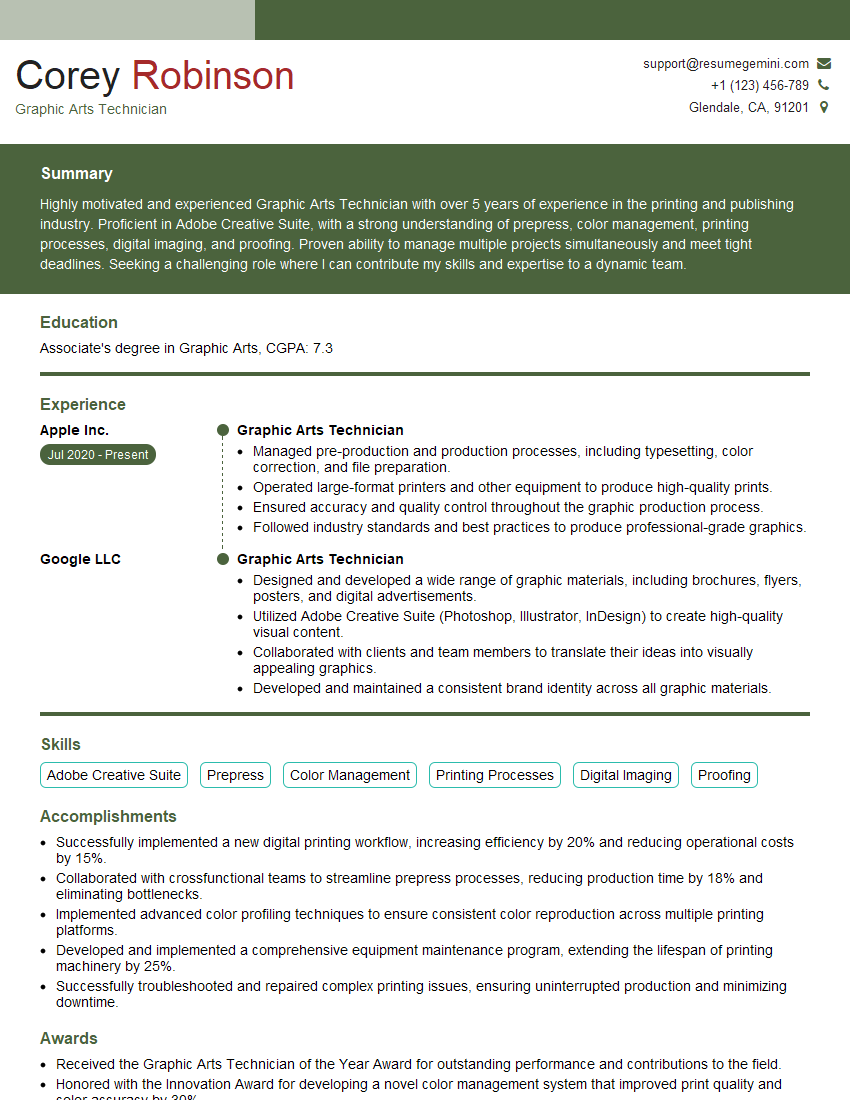
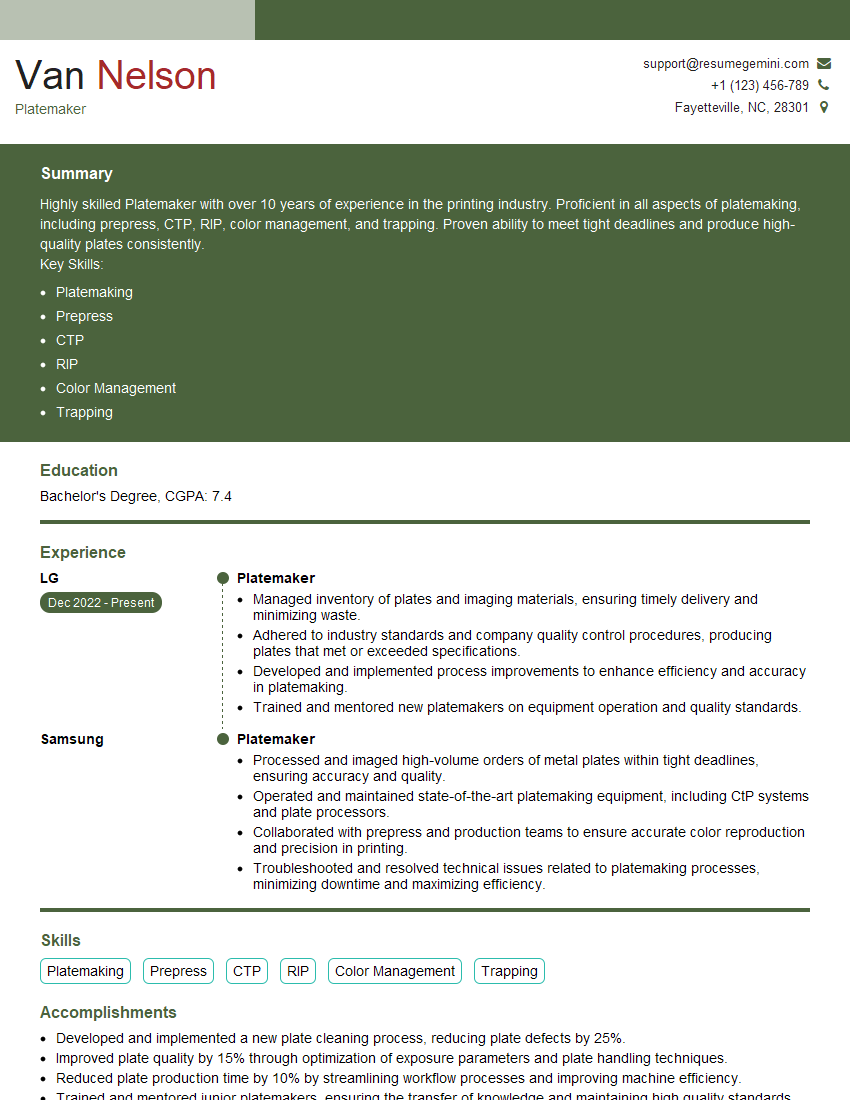
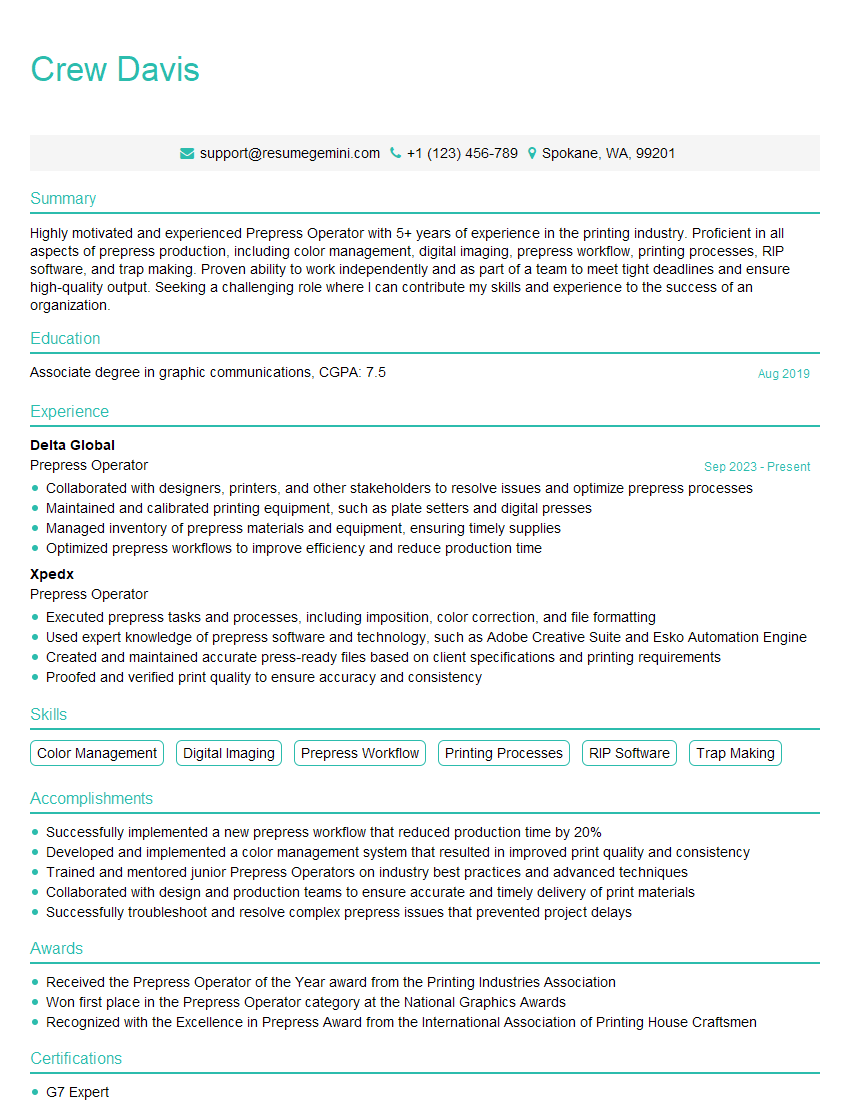
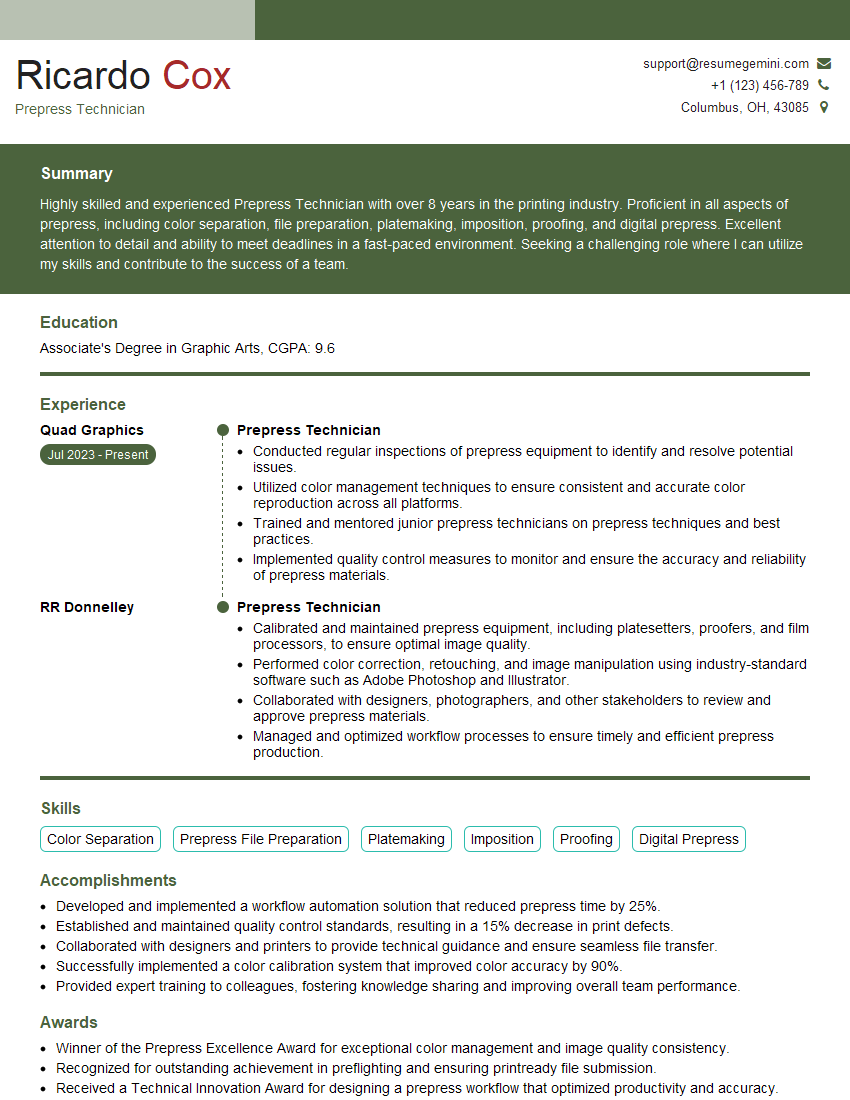
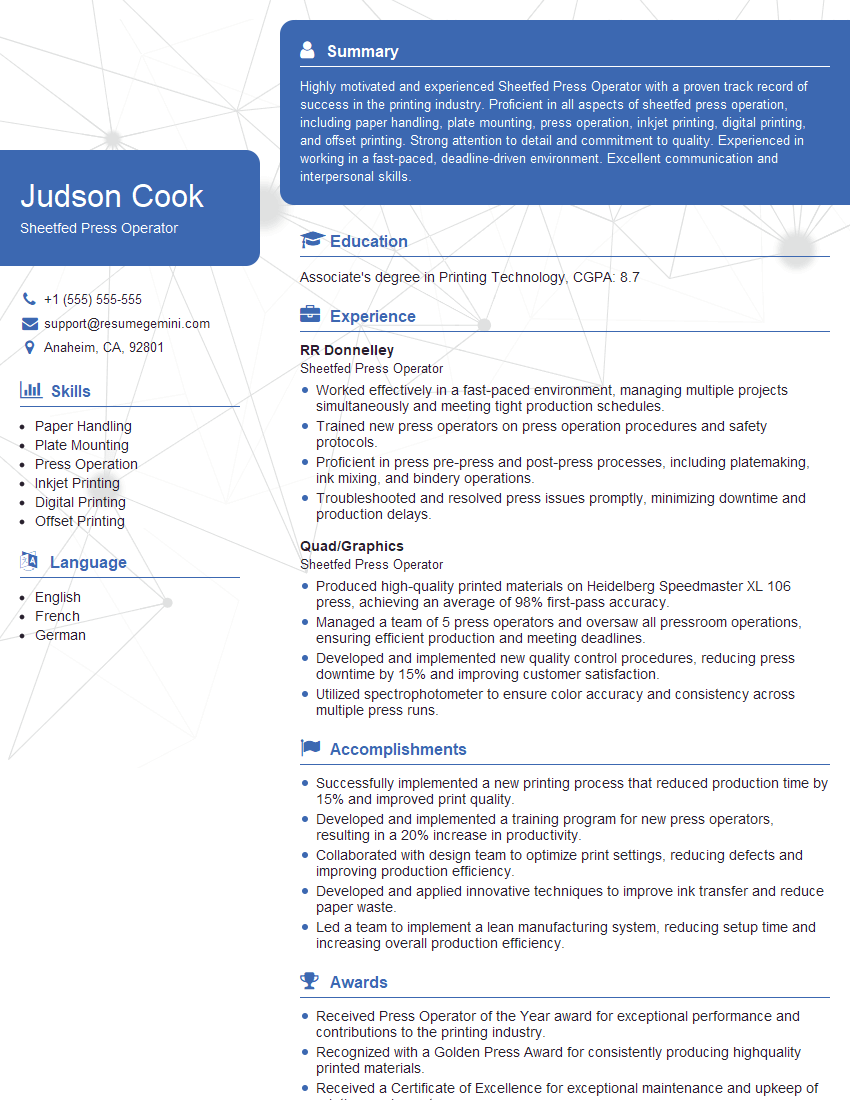
Mastering plate making and imposition techniques is crucial for career advancement in the printing industry, opening doors to more senior roles and higher earning potential. A well-crafted resume is your key to unlocking these opportunities. An ATS-friendly resume, optimized for Applicant Tracking Systems used by recruiters, significantly increases your chances of getting your application noticed. ResumeGemini is a trusted resource to help you build a professional, impactful resume that highlights your skills and experience effectively. Examples of resumes tailored to plate making and imposition techniques are available to help guide you.

Explore more articles
Users Rating of Our Blogs
Share Your Experience
We value your feedback! Please rate our content and share your thoughts (optional).
What Readers Say About Our Blog
good