The right preparation can turn an interview into an opportunity to showcase your expertise. This guide to Power Distribution Network Design interview questions is your ultimate resource, providing key insights and tips to help you ace your responses and stand out as a top candidate.
Questions Asked in Power Distribution Network Design Interview
Q 1. Explain the difference between radial and meshed power distribution networks.
The fundamental difference between radial and meshed power distribution networks lies in their topology – the way the lines are interconnected. Think of it like a road system: a radial network is like a tree, with power flowing from a single source (the substation) along branches to individual consumers. A meshed network, however, is like a city grid, with multiple interconnected paths allowing power to flow from various sources and along multiple routes to reach consumers.
- Radial Networks: Simple, cost-effective to build, but less reliable. A fault on one line cuts off power to all downstream consumers. Imagine a single road leading to a village; if that road is blocked, the village is isolated.
- Meshed Networks: More complex and expensive to build, but significantly more reliable. Power can be rerouted around faults, ensuring continued service to most consumers. This is akin to a city with multiple interconnected roads; if one road is blocked, traffic can be rerouted.
In practice, choosing between radial and meshed depends on factors like the load density, required reliability, and overall cost. Rural areas often use radial networks, while densely populated urban areas benefit from the redundancy of meshed networks.
Q 2. Describe the various methods used for fault current calculations in a distribution network.
Fault current calculations are crucial for ensuring the safety and reliability of distribution networks. They determine the magnitude of current that flows during a fault (like a short circuit), helping us select appropriate protective devices. Several methods are used:
- Symmetrical Component Method: This is the most widely used method, especially for complex systems. It decomposes unbalanced fault currents into symmetrical components (positive, negative, and zero sequence) simplifying the calculations. Software tools like ETAP or PSS/E are frequently employed.
- Z-Bus Method: This method builds an impedance matrix (Z-bus) representing the entire network. By applying the appropriate fault conditions, the fault currents can be determined. This is suitable for smaller networks where manual calculation might be feasible.
- Simplified Methods: For simple radial networks, simplified formulas and approximations can be used. However, these lack the accuracy of the other methods and should only be applied in very specific scenarios. One example is using per-unit calculations to simplify the process.
The chosen method will depend on the complexity of the network and the desired level of accuracy. For instance, a large meshed network would require the use of software implementing the symmetrical component method. A simple radial feeder might allow for the use of a simplified method with acceptable error margin.
Q 3. How do you determine the optimal size and location of substations in a power distribution network?
Optimal substation sizing and location are critical for efficient and reliable power distribution. This involves a complex optimization problem balancing cost, reliability, and voltage profile.
The process typically involves:
- Load Forecasting: Accurately predicting future power demand is essential. This involves analyzing historical data, considering population growth, and incorporating projected economic development.
- Network Analysis: Simulating the network with different substation locations and sizes helps evaluate the voltage profile, power losses, and overall system performance. Software tools are heavily utilized here.
- Cost-Benefit Analysis: Weighing the capital cost of building substations against the benefits of reduced power losses, improved voltage regulation, and enhanced reliability is crucial. This frequently involves discounted cash flow (DCF) analysis.
- Optimization Algorithms: Advanced techniques like genetic algorithms or particle swarm optimization can be used to search for the best combination of substation locations and sizes based on the defined objectives (minimizing cost, maximizing reliability, etc.).
For example, in a rapidly developing area, strategically placing a new substation might prevent voltage drops and ensure service reliability for the future. In contrast, upgrading an existing substation might be more cost-effective than building a new one in a less densely populated region.
Q 4. Explain the importance of power factor correction in distribution systems.
Power factor correction is essential in distribution systems because it minimizes the reactive power component, leading to several benefits:
- Reduced Power Losses: Reactive power does not contribute to useful work but causes increased current flow. Lower current reduces I²R losses in transmission and distribution lines.
- Improved Voltage Regulation: Reactive power can cause voltage fluctuations. Correcting it improves voltage stability and quality.
- Increased System Capacity: By reducing current, the system can handle a higher real power load without exceeding its capacity limits. Think of it as clearing space on a highway; better power factor allows more ‘useful’ power to travel.
- Smaller Equipment Sizes: Lower current requirements mean smaller transformers, cables, and other equipment can be used, saving on capital costs.
Power factor correction is typically achieved using capacitor banks, either switched manually or automatically based on real-time system conditions. The size and placement of these banks are determined through power flow studies. A low power factor situation, say 0.8 lagging, indicates a significant need for correction to reap the mentioned benefits.
Q 5. What are the different types of protective relays used in power distribution networks, and how do they function?
Protective relays are the brains of a power distribution system, instantly detecting faults and initiating corrective actions to protect equipment and maintain system stability. Several types exist:
- Overcurrent Relays: These are the most common, tripping a circuit breaker when the current exceeds a preset threshold. They can be time-overcurrent (with intentional time delay) or instantaneous (immediate trip).
- Distance Relays: These measure the impedance to the fault location and trip the breaker if the impedance falls within a specific range. They are particularly useful for protecting long transmission lines.
- Differential Relays: These compare the currents entering and leaving a protected zone. Any significant difference indicates an internal fault, triggering a trip.
- Ground Fault Relays: These detect ground faults, a common type of fault, especially in ungrounded systems.
- Directional Relays: These relays measure the direction of fault current flow. This is crucial for preventing cascading outages in interconnected systems.
Modern relays utilize sophisticated algorithms and communication protocols, allowing for advanced protection schemes and improved coordination between relays in a network. For instance, a distance relay might use a complex impedance measurement technique and coordinate with other relays to isolate the fault quickly and precisely.
Q 6. Discuss the impact of distributed generation (DG) on power distribution networks.
Distributed generation (DG), such as solar panels and wind turbines, significantly impacts power distribution networks. While offering benefits like increased reliability and reduced emissions, it also presents challenges:
- Voltage Rise: DG can cause voltage rise at the point of connection, potentially damaging equipment or violating voltage limits. Voltage regulators or reactive power compensation might be required.
- Reverse Power Flow: DG can cause power to flow back towards the substation, potentially overloading equipment not designed for bi-directional flow. This necessitates careful grid planning and protection coordination.
- Islanding: If a fault isolates a section of the network with DG, the DG might continue to operate, creating an ‘island’ that is electrically isolated from the main grid. This can be dangerous for line workers and requires sophisticated islanding detection and prevention methods.
- Protection Coordination: The presence of DG complicates protection coordination, as the fault currents can be different from those in a traditional network. New protection schemes may be needed.
Effective integration of DG requires careful planning and analysis, often involving detailed power flow studies and transient stability simulations. The grid needs to be strengthened, and protection schemes need to be reviewed and adjusted to safely and efficiently integrate DG sources into the distribution network.
Q 7. How do you analyze voltage stability in a power distribution network?
Voltage stability analysis is crucial for ensuring the reliability of a power distribution network. It involves determining the network’s ability to maintain acceptable voltage levels under various operating conditions and disturbances.
Several methods are used:
- Power Flow Studies: These provide a steady-state analysis of the voltage profile. They identify potential voltage violations under normal operating conditions.
- Voltage Stability Indices: These indices, such as the L-index or the proximity to voltage collapse, provide a quantitative measure of the voltage stability margin.
- Time-Domain Simulations: These simulations model the dynamic behavior of the network following disturbances (like a sudden load increase or a fault). They can predict voltage collapse events.
- Continuation Power Flow (CPF): This technique traces the system’s voltage profile as the load is gradually increased, identifying the point of voltage collapse.
These methods are often used in conjunction with each other to provide a comprehensive assessment of voltage stability. For example, a power flow study might reveal a low voltage margin in a certain part of the network. A time-domain simulation could then be conducted to evaluate the system’s response to a contingency, such as a loss of a generator, to estimate the risk of voltage collapse.
Q 8. Explain the principles of load flow analysis in power distribution systems.
Load flow analysis is the backbone of power distribution network design. It’s essentially a mathematical process that determines the voltage, current, and power flow at every point in the network under a given set of operating conditions. Think of it like tracing the flow of water through a complex network of pipes; we need to know how much water is flowing through each pipe and the pressure at each point. This helps us ensure that every part of the network receives the necessary power without overloading any component.
The analysis uses a system of equations based on Kirchhoff’s laws (conservation of energy and current). These equations, often non-linear, are solved iteratively using numerical methods, such as Gauss-Seidel or Newton-Raphson. Input data includes the network topology (lines, transformers, buses), impedance values, and load demands at each bus. The output provides a comprehensive picture of the network’s state, highlighting potential voltage violations, overloaded lines, and areas requiring upgrades.
For example, a load flow study might reveal that a particular transformer is operating near its capacity during peak demand. This information guides engineers to choose appropriate transformer sizes and upgrade locations to meet future load growth and maintain voltage stability.
Q 9. Describe different methods for loss reduction in power distribution networks.
Reducing power losses is crucial for economic and environmental reasons. There are several strategies:
- Conductor Upgrading: Using larger conductors (with lower resistance) reduces resistive losses – think of a wider pipe allowing more water to flow with less friction.
- Optimized Network Configuration: Careful planning of the network topology, including the placement of substations and feeders, minimizes transmission distances and reduces losses. Imagine strategically placing water pumps to minimize pressure drop.
- Voltage Optimization: Maintaining voltage levels within a narrow, optimal range minimizes losses. Higher voltages mean less current for the same power, thus reducing resistive losses.
- Reactive Power Compensation: Adding capacitor banks compensates for reactive power demand, reducing current flow and subsequently minimizing losses. Capacitors act like storage tanks for electricity, smoothing out the flow.
- Improved Power Factor: Improving the power factor (the ratio of real power to apparent power) reduces the current required to deliver the same real power, thus lowering losses. This involves using power factor correction equipment.
- Smart Grid Technologies: Advanced technologies like smart meters and grid automation allow for dynamic load balancing and real-time loss reduction strategies.
For instance, replacing old, thin aluminum conductors with larger copper conductors can significantly reduce losses in a feeder line, but comes with a higher initial investment.
Q 10. How do you model power distribution networks using simulation software?
Power distribution networks are modeled using specialized simulation software like ETAP, CYME, or OpenDSS. The process involves several steps:
- Data Input: Defining the network topology (buses, lines, transformers) and their parameters (impedances, ratings, etc.). This often involves importing data from CAD drawings or GIS systems.
- Component Modeling: Selecting appropriate models for each component within the software, considering their characteristics and behavior under various operating conditions.
- Load Modeling: Defining load profiles at each bus, representing the expected power demand throughout the day or year. These can be based on historical data or load forecasts.
- Simulation Execution: Running simulations to analyze the network’s performance under various scenarios (normal operation, faults, contingencies). This might involve running load flow analysis, short-circuit analysis, or other studies.
- Result Analysis: Interpreting the simulation results to identify potential problems, such as voltage violations, overloaded equipment, or high losses. Results are visualized through reports, diagrams, and graphs.
Example (Simplified OpenDSS script):new transformer.transformer1 phases=3 kVA=1000 kV=10/0.4
This line of code defines a three-phase transformer in OpenDSS. The full model includes significantly more detailed information.
Q 11. What are the key considerations for designing a reliable power distribution network?
Designing a reliable power distribution network involves several key considerations:
- Redundancy: Including backup systems and alternative pathways ensures continuous power supply even if a component fails. Think of having multiple pipes bringing water to a house – if one breaks, others still provide water.
- Fault Tolerance: Designing the network to withstand faults (short circuits, lightning strikes) without causing widespread outages. This involves protection devices like circuit breakers and fuses.
- Protection and Control: Implementing sophisticated protection schemes and control systems to automatically isolate faulted sections and restore power quickly. This is like having automated valves in the water system that automatically isolate leaks.
- Capacity Planning: Accurately forecasting future load growth and designing the network with sufficient capacity to meet demand. Failing to do so can lead to voltage drops and overloaded equipment.
- Reliability Standards: Adhering to relevant industry standards and regulations to ensure safety and reliability. This ensures the network meets a predefined level of performance and safety.
- Maintenance Planning: Developing a preventive maintenance schedule to avoid equipment failures and ensure long-term reliability. Regular inspections and maintenance are like regularly servicing your car to prevent breakdowns.
Q 12. Explain the role of SCADA systems in power distribution network monitoring and control.
Supervisory Control and Data Acquisition (SCADA) systems are the nervous system of modern power distribution networks. They provide real-time monitoring and control capabilities. Think of them as the central control room for the entire network.
SCADA systems collect data from various devices (meters, sensors, relays) throughout the network using communication protocols such as Modbus or DNP3. This data is then processed and displayed on a central control console, providing operators with a comprehensive view of the network’s state. SCADA systems allow operators to remotely control devices, such as circuit breakers and switches, enabling rapid response to faults and ensuring network stability. SCADA also facilitates automated control strategies, such as voltage regulation and load shedding, further improving network reliability and efficiency.
For example, a SCADA system can automatically detect an overload on a feeder, isolate the faulted section using a remotely controlled circuit breaker, and reroute power through alternative paths to minimize the impact on customers.
Q 13. Discuss the challenges associated with integrating renewable energy sources into existing distribution networks.
Integrating renewable energy sources (RES) like solar and wind power into existing distribution networks presents several challenges:
- Intermittency: RES output fluctuates depending on weather conditions, making it difficult to predict power generation. This requires sophisticated forecasting and grid management strategies.
- Voltage Stability: High RES penetration can cause voltage fluctuations due to their distributed nature and variable output. Voltage regulation becomes crucial to maintain stable voltage levels.
- Grid Infrastructure Limitations: Existing networks may lack the capacity or flexibility to handle the bidirectional power flows associated with RES. Network upgrades might be required.
- Protection Coordination: Integrating RES requires careful coordination of protection schemes to ensure the safety and reliability of the network.
- Power Quality Issues: RES can introduce harmonics and other power quality issues into the grid, impacting the operation of sensitive equipment.
For instance, integrating a large solar farm into a distribution network might require upgrades to the substation transformers and the addition of reactive power compensation to maintain voltage stability.
Q 14. How do you address the impact of harmonics on power distribution networks?
Harmonics are unwanted voltage or current waveforms at multiples of the fundamental frequency (typically 50 or 60 Hz). They’re mainly introduced by non-linear loads such as rectifiers, variable speed drives, and switching power supplies. Harmonics can cause various problems in power distribution networks:
- Overheating of equipment: Harmonics increase the RMS current, leading to higher losses and potential overheating of transformers, cables, and other equipment.
- Equipment malfunction: Harmonics can interfere with the operation of sensitive equipment, causing malfunctions or premature failures.
- Increased neutral current: Third-order harmonics can create high neutral currents, potentially overloading neutral conductors.
- Resonance problems: Harmonics can interact with the network’s impedance, causing resonance which can amplify harmonic currents and lead to instability.
Mitigation strategies include:
- Using harmonic filters: Passive or active filters can reduce harmonic currents by absorbing or canceling them.
- Installing harmonic suppressors: These devices are added to non-linear loads to reduce their harmonic generation.
- Proper load balancing: Distributing non-linear loads evenly across the network reduces harmonic distortion.
- Careful equipment selection: Choosing equipment with low harmonic generation characteristics.
For example, installing a passive harmonic filter at a substation can significantly reduce harmonic distortion in the downstream network, protecting sensitive equipment and preventing overheating.
Q 15. What are the key performance indicators (KPIs) used to evaluate the performance of a power distribution network?
Key Performance Indicators (KPIs) for a power distribution network are crucial for assessing its efficiency, reliability, and overall health. They’re used to track performance, identify areas for improvement, and ensure the network meets service level agreements (SLAs). Think of them as a health check-up for your power grid.
- System Average Interruption Duration Index (SAIDI): This metric measures the average length of time a customer experiences an outage. A lower SAIDI indicates better reliability. For example, a SAIDI of 1 hour means customers, on average, experience a one-hour outage annually.
- System Average Interruption Frequency Index (SAIFI): This KPI measures how often, on average, a customer experiences an outage. A lower SAIFI shows improved reliability. A SAIFI of 0.5 means a customer experiences, on average, half an outage per year.
- Customer Average Interruption Duration Index (CAIDI): This KPI reflects the average time it takes to restore power after an outage. A low CAIDI signifies quick and efficient restoration efforts.
- Power Quality Metrics: These include measures like voltage sags, swells, and harmonics, which impact the reliability and performance of connected equipment. For instance, frequent voltage sags can damage sensitive electronic devices.
- Energy Losses: This KPI represents the percentage of generated energy lost during transmission and distribution. Lower losses indicate improved efficiency in the network’s infrastructure.
- Network Efficiency (Load Factor): The ratio of average load to peak load. A higher load factor suggests better utilization of network capacity.
Regular monitoring and analysis of these KPIs allow utilities to proactively identify potential problems, optimize operations, and improve overall customer satisfaction.
Career Expert Tips:
- Ace those interviews! Prepare effectively by reviewing the Top 50 Most Common Interview Questions on ResumeGemini.
- Navigate your job search with confidence! Explore a wide range of Career Tips on ResumeGemini. Learn about common challenges and recommendations to overcome them.
- Craft the perfect resume! Master the Art of Resume Writing with ResumeGemini’s guide. Showcase your unique qualifications and achievements effectively.
- Don’t miss out on holiday savings! Build your dream resume with ResumeGemini’s ATS optimized templates.
Q 16. Explain the concept of power system stability and its importance in distribution network design.
Power system stability refers to the ability of a power system to maintain synchronism between generators and remain in a steady-state operating condition after being subjected to a disturbance. In simpler terms, it’s the system’s ability to recover from shocks without widespread blackouts. Think of it like a tightrope walker – a stable system is one that can maintain balance even when faced with unexpected bumps or winds.
In distribution network design, maintaining stability is paramount. Instability can lead to cascading outages, widespread blackouts, and significant economic losses. Factors affecting stability include generator dynamics, load characteristics, transmission line characteristics, and protection system response. Effective design involves carefully considering these factors, incorporating appropriate protection schemes (such as relays and circuit breakers), and implementing strategies for load shedding and voltage regulation to prevent instability.
For example, a sudden loss of a major generation unit can trigger instability if the remaining generators can’t compensate for the lost power, possibly leading to frequency drops and cascading outages. Therefore, careful planning and system analysis are crucial to ensure the resilience of the network against such events.
Q 17. Describe various methods for improving the efficiency of power distribution networks.
Improving the efficiency of power distribution networks is a continuous process focusing on minimizing energy losses and maximizing resource utilization. Several methods contribute to this goal:
- Optimal conductor sizing: Selecting the right conductor size based on load, distance, and voltage minimizes energy losses due to resistance.
- Advanced metering infrastructure (AMI): Smart meters provide real-time data on energy consumption, enabling better load management and demand-side management programs.
- Distribution automation: Implementing automated switching devices, fault locators, and reclosers helps minimize outage durations and improve reliability.
- Undergrounding of distribution lines: Reduces outages caused by weather events like storms and improves aesthetics, although this method is generally more expensive.
- Power factor correction (PFC): Installing capacitors at strategic locations improves the power factor, reducing reactive power flow and losses.
- Loss reduction programs: Identifying and addressing areas of high energy losses through maintenance, upgrades, and replacement of aging equipment.
- Integration of Renewable Energy Sources (RES): Incorporating renewable sources like solar and wind reduces reliance on conventional generators and can lead to better overall efficiency depending on the network configuration and resources.
For example, replacing aging transformers with more efficient ones can significantly reduce losses and increase the overall network efficiency. Similarly, implementing a smart grid infrastructure allows for dynamic load balancing, reducing peak demand and improving overall network utilization.
Q 18. How do you plan for future expansion and upgrades in a power distribution network?
Planning for future expansion and upgrades in a power distribution network requires a long-term perspective and a robust planning process. This involves:
- Load forecasting: Predicting future electricity demand based on population growth, economic development, and technological advancements. This helps determine the capacity needed for future expansion.
- Network planning studies: Conducting detailed studies (like load flow and fault studies) to assess the network’s ability to handle future loads and identify potential bottlenecks.
- Geographic Information System (GIS) mapping: Utilizing GIS tools to visualize the network, identify optimal locations for new substations and lines, and manage infrastructure assets effectively.
- Modular design: Designing the network in a modular fashion allows for incremental upgrades and expansion as needed, minimizing disruption and cost.
- Right-of-way acquisition: Securing the necessary land for new transmission lines and substations well in advance.
- Technology assessment: Evaluating new technologies (like smart grids and renewable energy integration) to ensure the network remains adaptable and efficient.
- Financial planning: Developing a sound financial plan to cover the cost of upgrades and expansions over the long term. This includes securing funding and budgeting for projects.
For instance, a utility anticipating rapid growth in a suburban area might plan for a new substation well in advance, ensuring sufficient capacity to meet the projected demand. This proactive approach prevents outages and ensures reliable power delivery.
Q 19. Explain the role of smart grid technologies in enhancing power distribution network operation.
Smart grid technologies revolutionize power distribution network operation by enhancing efficiency, reliability, and sustainability. Imagine a power grid that can self-heal, adapt to changing conditions, and seamlessly integrate renewable energy sources. This is what smart grid technologies enable.
- Advanced Metering Infrastructure (AMI): Smart meters provide real-time data on energy consumption, enabling better load management and demand-side management programs.
- Distribution Automation: Automated switching devices, fault locators, and reclosers rapidly isolate faults, minimize outage durations, and improve grid stability.
- Wide-Area Monitoring Systems (WAMS): Provides comprehensive real-time monitoring of the entire network, enabling early detection of potential issues and proactive interventions.
- Phasor Measurement Units (PMUs): Provide high-precision measurements of voltage and current, crucial for advanced state estimation and control.
- Energy Storage Systems (ESS): Batteries and other energy storage technologies improve grid stability by smoothing out intermittent renewable energy sources and improving power quality.
- Demand-Side Management (DSM): Programs designed to encourage consumers to shift energy consumption to off-peak hours, reducing peak demand and improving grid efficiency.
For example, a smart grid system can automatically reroute power around a fault, minimizing the impact on customers. Furthermore, the integration of renewable energy sources is greatly facilitated by smart grid technologies, enabling the efficient and stable operation of a more sustainable power system.
Q 20. What are the regulatory compliance requirements for power distribution networks in your region?
Regulatory compliance requirements for power distribution networks vary significantly by region, but generally involve adhering to safety standards, environmental regulations, and performance benchmarks. It’s essential to consult the specific regulations of the relevant jurisdiction. These regulations are critical to ensure public safety and maintain the integrity of the power system.
Common aspects of regulatory compliance include:
- Safety standards: Adhering to standards such as those set by IEEE, IEC, and national regulatory bodies related to equipment safety, worker safety, and public safety near power lines.
- Environmental regulations: Meeting environmental protection requirements concerning emissions, waste disposal, and land use. This often includes permitting processes and environmental impact assessments.
- Reliability standards: Meeting reliability metrics (SAIDI, SAIFI, CAIDI) set by regulatory authorities and ensuring service quality for consumers.
- Grid codes and interconnection standards: Adhering to the specific technical requirements for connecting distributed generation resources to the grid.
- Data privacy and cybersecurity: Protecting customer data and ensuring the security of the smart grid infrastructure.
Non-compliance can result in significant penalties, including fines, operational restrictions, and legal action. Therefore, a robust compliance program is crucial for power distribution companies.
Q 21. Describe the process of designing a new substation.
Designing a new substation is a complex process involving meticulous planning, engineering, and regulatory approvals. Think of it as building a highly specialized and critical piece of infrastructure.
The process typically involves these steps:
- Feasibility Study: Evaluating the need for a new substation, considering factors like load growth, existing infrastructure limitations, and economic viability.
- Site Selection: Identifying a suitable location considering factors like land availability, proximity to load centers, access to transmission lines, environmental impact, and zoning regulations.
- System Planning: Determining the substation’s capacity, voltage level, equipment specifications (transformers, circuit breakers, switchgear, protection relays), and layout. This often involves sophisticated software simulations.
- Engineering Design: Preparing detailed engineering drawings and specifications for the substation’s infrastructure, including civil works (foundations, buildings), electrical equipment, and protection systems.
- Environmental Impact Assessment: Conducting a thorough environmental assessment to evaluate potential impacts on the environment and comply with environmental regulations.
- Permitting and Approvals: Obtaining all necessary permits and approvals from relevant regulatory authorities and stakeholders.
- Construction: Overseeing the construction of the substation, ensuring adherence to safety standards and engineering specifications.
- Commissioning and Testing: Rigorous testing and commissioning of the substation equipment to ensure its proper operation and reliability.
- Operation and Maintenance: Establishing procedures for the operation and maintenance of the substation, including regular inspections and preventive maintenance.
The entire process requires expertise in power system engineering, civil engineering, environmental science, and project management. Thorough planning and adherence to regulations are crucial for the successful completion of a new substation project.
Q 22. How do you handle contingency analysis in a power distribution network?
Contingency analysis in power distribution networks is crucial for ensuring reliable power supply. It involves simulating the impact of various fault scenarios, like equipment failures (transformer outages, line breaks) or unexpected load increases, to assess the network’s resilience. The goal is to identify potential vulnerabilities and develop mitigation strategies.
We use software like ETAP or PSS/E to perform these analyses. The process typically involves:
- Building a detailed model: This includes accurately representing all components – generators, transformers, lines, loads, protective devices – and their parameters.
- Defining contingencies: This involves specifying different fault scenarios, such as a single line outage, multiple line outages, or the failure of a major substation transformer. The number and type of contingencies considered depend on the criticality of the system and regulatory requirements.
- Running simulations: The software simulates the network’s response to each contingency, calculating voltage drops, power flows, and assessing the impact on load supply.
- Analyzing results: The results identify areas of weakness, potential overloading, and voltage violations. This analysis helps determine the need for additional equipment, network upgrades, or improved protection schemes.
- Developing mitigation strategies: Based on the analysis, we develop strategies to enhance reliability. This could involve adding new lines, upgrading existing equipment, implementing automatic load shedding, or improving protection coordination.
For example, in a recent project, contingency analysis revealed that a particular substation was vulnerable to cascading outages during peak load conditions. This led us to recommend installing a new feeder and upgrading the substation transformer capacity, significantly improving the network’s resilience.
Q 23. Explain the difference between overhead and underground power distribution lines.
Overhead and underground power distribution lines differ significantly in their construction, cost, reliability, and aesthetic impact.
- Overhead Lines: These lines use conductors suspended on poles or towers. They are generally less expensive to install, especially in sparsely populated areas. However, they are more susceptible to damage from weather events (storms, lightning), tree branches, and accidents. Maintenance is also more challenging and potentially risky.
- Underground Lines: These lines use cables buried underground in conduits or directly in the ground. They are more resistant to weather damage and are aesthetically more pleasing. However, installation is significantly more expensive, requiring extensive excavation and specialized equipment. Fault location and repair are also more complex and costly.
The choice between overhead and underground lines depends on various factors, including cost, environmental considerations, population density, and reliability requirements. In densely populated urban areas, underground lines are preferred for safety and aesthetic reasons, despite the higher cost. In rural areas, overhead lines are often the more economical option.
Q 24. What are the different types of cables used in power distribution networks?
Power distribution networks use a variety of cables, each suited to different voltage levels, load currents, and environmental conditions. Some common types include:
- Aluminum Conductor Steel Reinforced (ACSR): Common in overhead lines due to its high strength-to-weight ratio and relatively low cost. The steel core provides mechanical strength, while the aluminum provides conductivity.
- Copper Conductors: Used in both overhead and underground applications, particularly where high conductivity is required. Copper is more expensive than aluminum but has better conductivity.
- Cross-Linked Polyethylene (XLPE) Insulated Cables: Widely used in underground distribution networks. XLPE insulation offers excellent dielectric strength, moisture resistance, and thermal stability.
- High-Pressure Fluid-Filled (HPFF) Cables: Used for high-voltage underground applications. These cables are filled with oil under pressure to prevent void formation and enhance insulation performance.
- Gas-Filled Cables: Another option for high-voltage underground applications, utilizing gas pressure to maintain insulation integrity.
The selection of the appropriate cable type depends on factors such as voltage level, current carrying capacity, installation environment (underground, aerial), and cost considerations. For instance, in a high-voltage underground application, HPFF cables would be preferred for their superior reliability, while ACSR is better suited for overhead lines where cost-effectiveness is a priority.
Q 25. How do you select appropriate protective devices for different parts of a distribution network?
Selecting appropriate protective devices is essential for ensuring the safety of personnel and equipment, and maintaining the reliability of the distribution network. The choice of device depends on factors such as the voltage level, fault current, and the type of equipment being protected.
- Fuses: Used for lower voltage applications and provide overcurrent protection by melting when excessive current flows. They are simple, inexpensive, and offer fast fault clearing.
- Circuit Breakers: Used for higher voltage applications, offering both overcurrent and short-circuit protection. They can be remotely controlled and provide faster fault clearing than fuses.
- Relays: Used in conjunction with circuit breakers to detect faults and initiate tripping. They provide sophisticated protection functions, such as distance protection, differential protection, and over/under voltage protection.
- Transformers: Often have built-in protection, such as overcurrent and temperature relays, to protect against various fault conditions.
Protection coordination is crucial; devices need to be set to operate in a specific sequence to isolate faults without causing cascading outages. We use time-current curves and coordination studies to ensure proper device coordination. For example, a downstream fuse should clear a fault before the upstream circuit breaker to limit the impact of the fault.
Q 26. Describe the principles of power system grounding.
Power system grounding is vital for safety, equipment protection, and system stability. It provides a low-impedance path for fault currents to flow to earth, minimizing voltage surges and protecting personnel from electric shock. The principles of grounding involve connecting various parts of the system (neutral points, equipment frames, etc.) to the earth through grounding electrodes.
Different grounding schemes exist, including:
- Solid grounding: The neutral point of the transformer is directly grounded, providing a low-impedance path for fault currents. This is common for lower voltage systems.
- Resistance grounding: A resistor is inserted between the neutral point and the ground to limit the fault current. This is often used for higher voltage systems to reduce the stress on the system during ground faults.
- Reactance grounding: A reactor is used instead of a resistor to limit fault currents.
- Ungrounded system (isolated neutral): The neutral point is not directly grounded. Fault currents are limited, but this increases the risk of voltage rise on healthy phases.
Proper grounding design is crucial for minimizing the impact of ground faults and maintaining system stability. Improper grounding can lead to equipment damage, safety hazards, and system instability.
Q 27. What are the challenges of integrating electric vehicles into the power distribution grid?
Integrating electric vehicles (EVs) into the power distribution grid presents several challenges:
- Increased load: Widespread EV adoption will significantly increase the electricity demand, especially during peak hours when many EVs are charging simultaneously. This could lead to overloading of transformers and distribution lines.
- Unpredictable load patterns: Unlike predictable industrial or residential loads, EV charging patterns can be highly variable depending on user behavior and charging infrastructure availability.
- Impact on voltage profiles: High concentrations of EV charging stations can cause significant voltage fluctuations, potentially affecting the quality of power supply to other customers.
- Distribution network upgrades: Upgrading the existing infrastructure to accommodate increased load and maintain voltage stability requires significant investment.
- Smart charging technologies: Implementing smart charging technologies that optimize charging times and manage load distribution is crucial to mitigate these challenges.
Addressing these challenges requires a multifaceted approach involving advanced grid planning, smart grid technologies, and effective demand-side management strategies. For instance, time-of-use pricing and vehicle-to-grid (V2G) technologies can help manage EV charging loads and even contribute to grid stability.
Q 28. Explain your experience with power system analysis software such as ETAP or PSS/E.
I have extensive experience using power system analysis software such as ETAP and PSS/E for various projects, including distribution network planning, protection coordination studies, and fault analysis.
In ETAP, I’ve used its capabilities for:
- Creating detailed models of distribution networks, incorporating various components and their parameters.
- Performing load flow studies to assess voltage profiles and power flows under normal operating conditions.
- Conducting short-circuit studies to determine fault currents and verify protective device settings.
- Developing and evaluating various protection schemes to ensure proper coordination.
- Analyzing harmonic distortion and its impact on the system.
With PSS/E, I’ve focused on more complex studies, such as:
- Transient stability analysis to evaluate the system’s response to major disturbances.
- Dynamic simulation of the distribution network including distributed generation.
- State estimation and bad data detection.
These software packages are invaluable tools for designing, operating, and maintaining reliable and efficient power distribution networks. My proficiency in these tools allows me to perform accurate analyses and make data-driven decisions to optimize network performance and reliability.
Key Topics to Learn for Power Distribution Network Design Interview
- Load Flow Analysis: Understanding power flow calculations, including methods like Gauss-Seidel and Newton-Raphson, and their application in network optimization.
- Fault Calculation and Protection: Analyzing fault currents, selecting appropriate protective devices (relays, breakers), and designing protection schemes for various fault types (e.g., three-phase, single-line-to-ground).
- Voltage Regulation and Control: Exploring techniques for maintaining voltage within acceptable limits, including the use of voltage regulators, capacitor banks, and reactive power compensation.
- Power System Stability: Grasping the concepts of transient and steady-state stability, and their implications for network design and operation. Understanding the role of various control systems in enhancing stability.
- Distribution System Planning and Expansion: Applying network analysis techniques to plan future expansion needs, considering load growth, reliability requirements, and economic factors.
- Substation Design and Integration: Understanding the components of a substation (transformers, switchgear, protection systems) and their integration within the broader distribution network.
- Distribution Automation and Smart Grid Technologies: Familiarizing yourself with advanced technologies such as SCADA systems, advanced metering infrastructure (AMI), and their impact on network management and efficiency.
- Reliability and Resilience: Analyzing system reliability metrics (e.g., SAIDI, SAIFI), designing for resilience against natural disasters and cyber threats.
- Economic Considerations: Understanding the cost implications of different design choices, including capital costs, operating costs, and lifecycle costs.
- Software and Tools: Familiarity with industry-standard software packages used for power system analysis and design (mentioning specific software is optional, keeping it general is better for broader application).
Next Steps
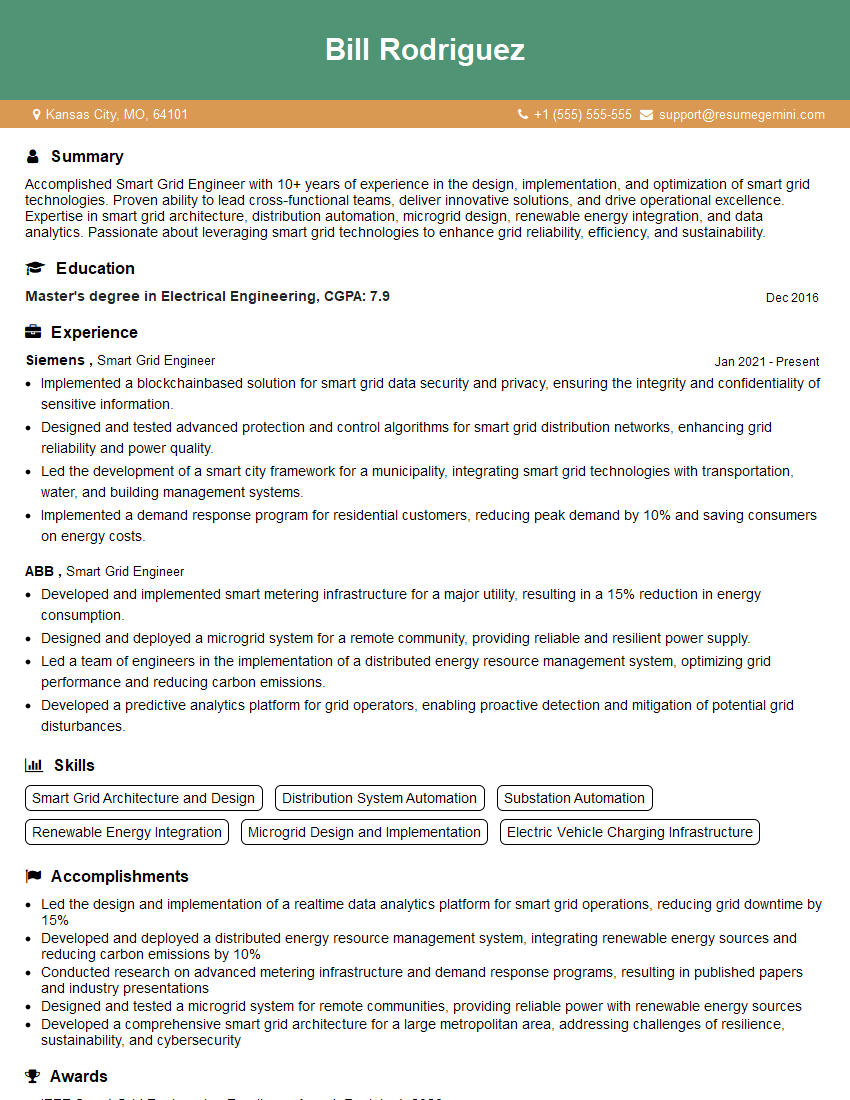
Mastering Power Distribution Network Design opens doors to exciting and impactful careers in the energy sector. A strong understanding of these principles is highly sought after, leading to greater career advancement opportunities and higher earning potential. To maximize your job prospects, it’s crucial to present your skills effectively. Creating an ATS-friendly resume is key to getting your application noticed by recruiters. ResumeGemini is a trusted resource that can help you build a professional and impactful resume, tailored to highlight your expertise in Power Distribution Network Design. Examples of resumes tailored to this field are available to guide you.
Explore more articles
Users Rating of Our Blogs
Share Your Experience
We value your feedback! Please rate our content and share your thoughts (optional).
What Readers Say About Our Blog
Very informative content, great job.
good