The thought of an interview can be nerve-wracking, but the right preparation can make all the difference. Explore this comprehensive guide to Power Simulation and Analysis Tools interview questions and gain the confidence you need to showcase your abilities and secure the role.
Questions Asked in Power Simulation and Analysis Tools Interview
Q 1. Explain the difference between power flow and fault analysis.
Power flow and fault analysis are both crucial parts of power system analysis, but they address different aspects of system behavior. Think of it like this: power flow studies are like taking the system’s ‘pulse’ under normal operating conditions, while fault analysis examines its ‘reaction’ to unexpected events.
Power flow analysis determines the voltage magnitude and angle at each bus (node) in a power system under steady-state conditions. It calculates the real and reactive power flow in each line and transformer, ensuring the system operates within its limits. Imagine it as a map showing how power flows smoothly throughout the electrical grid during normal operation.
Fault analysis, on the other hand, simulates the effects of short circuits or other faults on the system. It calculates the fault currents, voltage dips, and the stability of the system during and after a fault. This is like a stress test – simulating a sudden disruption (like a tree falling on a power line) and seeing how the system handles it. This analysis helps in designing protective relaying schemes and determining the required fault current interrupting capacity of circuit breakers.
In essence, power flow studies tell us how the system is performing, while fault studies tell us how resilient it is to disturbances.
Q 2. Describe the various types of power system studies.
Power system studies encompass a wide range of analyses to ensure reliable and efficient operation. These studies can be broadly categorized as follows:
- Power Flow Studies: As discussed earlier, these determine voltage magnitudes, angles, and power flows under steady-state conditions.
- Fault Studies: These analyze the impact of various faults (short circuits, etc.) on the system, determining fault currents and system stability.
- Stability Studies: These examine the system’s ability to maintain synchronism after a disturbance, including transient stability (immediate response) and dynamic stability (long-term response). This often involves detailed modelling of generators and their control systems.
- Transient Stability Studies: These focus on the immediate response of the system to large disturbances like faults or loss of generation. They involve detailed modelling of generator dynamics and excitation systems.
- Small Signal Stability Studies: These evaluate the system’s ability to maintain stability against small perturbations, often associated with long-term oscillations.
- Economic Dispatch and Optimal Power Flow (OPF): These optimize power generation to minimize costs while meeting demand and respecting system constraints.
- State Estimation: This uses real-time measurements to estimate the system’s state, providing a more accurate picture of its operation.
- Harmonic Analysis: This studies the impact of non-linear loads on the system’s harmonic distortion.
These studies use different software tools and models depending on their complexity and the level of detail required. For instance, a simple radial distribution system might only need a power flow analysis, while a large interconnected transmission system would require much more comprehensive studies.
Q 3. What are the limitations of linear power flow analysis?
Linear power flow analysis, also known as the DC power flow method, simplifies the calculations by making several assumptions. While efficient for quick estimations, these simplifications lead to limitations:
- Neglects Reactive Power: It assumes zero reactive power flow, which is a significant oversimplification, especially in systems with heavy reactive loads or weak transmission lines. This can lead to inaccurate voltage predictions.
- Ignores Voltage Magnitude Variations: It assumes constant voltage magnitudes at all buses, which is not true in real-world systems. This can affect the accuracy of power flow calculations, particularly in heavily loaded systems.
- Limited Applicability to Weak Systems: It’s less accurate for systems with weak transmission lines or high R/X ratios (resistance to reactance ratio). These systems have significant voltage variations, which the DC power flow method fails to capture.
- Cannot Analyze Voltage Stability: Because it ignores voltage magnitudes, it’s unsuitable for studying voltage collapse or other voltage stability issues.
Therefore, while the DC power flow method is useful for quick preliminary analysis and planning, more accurate AC power flow methods are necessary for detailed system studies, especially for complex systems under various operating conditions.
Q 4. How do you model synchronous generators in power system simulations?
Modeling synchronous generators accurately is crucial for realistic power system simulations. The level of detail depends on the type of study. Several models exist, ranging from simple to highly complex:
- Classical Model: This is the simplest model, representing the generator as a constant voltage behind a transient reactance. It’s suitable for transient stability studies where high computational speed is paramount, but lacks accuracy in representing the generator’s detailed behavior.
- Simplified Model (with excitation system): This adds an excitation system model to account for the voltage regulation capabilities of the generator. This improves the accuracy of simulations, especially in cases with voltage disturbances.
- Detailed Model (with governor, excitation system, and detailed dynamics): This model includes the governor, excitation system, and detailed generator dynamics, providing the most accurate representation. However, it significantly increases the computational burden and is often used for detailed dynamic and transient stability simulations.
The choice of model depends on the study’s objectives and the required accuracy. Software packages such as PSS/E, PowerWorld Simulator, and DIgSILENT PowerFactory offer various levels of generator modeling capabilities.
For instance, in a transient stability study focusing on the immediate response to a large disturbance, a simplified model might suffice. However, for a dynamic stability study investigating long-term oscillations, a more detailed model is essential to ensure accurate results.
Q 5. Explain the concept of per-unit system in power system analysis.
The per-unit system is a normalization technique used extensively in power system analysis to simplify calculations and improve readability. Instead of using actual values of voltage, current, impedance, and power in various units (kV, kA, ohms, MVA), we express them as fractions (percentages) of a chosen base value.
Choosing Base Values: First, we select base values for power (typically MVA), voltage (typically kV), and frequency (usually 50Hz or 60Hz). Then, other base values are derived from these (e.g., base impedance is Vbase2/Sbase, base current is Sbase/(√3 * Vbase) for three-phase systems).
Calculations: Once the base values are established, all quantities are expressed as per-unit values by dividing the actual value by its corresponding base value. For example, if the actual voltage is 230 kV and the base voltage is 100 kV, the per-unit voltage is 230 kV / 100 kV = 2.3 pu.
Advantages:
- Simplifies Calculations: Per-unit values eliminate the need for repetitive unit conversions, making calculations much simpler and faster.
- Improves Readability: Per-unit values are independent of the actual system size, making it easier to compare and analyze systems of different sizes.
- Reduces Errors: By using a consistent base system, errors in calculations due to incorrect unit conversions are minimized.
The per-unit system is essential for efficiently analyzing and designing power systems, ensuring accurate and consistent results across different components and system sizes.
Q 6. What are the different types of loads used in power system modeling?
Power system loads are represented in various ways depending on the level of detail required in the simulation:
- Constant Impedance Load: This model assumes the load impedance remains constant regardless of voltage changes. It’s simple to implement but doesn’t accurately reflect real-world load behavior, which is voltage-dependent.
- Constant Current Load: This model assumes the load current remains constant regardless of voltage changes. This is a reasonable approximation for motor loads, but also oversimplifies the actual behavior.
- Constant Power Load: This model assumes the load power remains constant regardless of voltage changes. While suitable in some cases (like certain industrial loads), it can lead to numerical instability in simulations since the current increases as voltage decreases.
- ZIP Load (a combination of the three above): This model combines the constant impedance, constant current, and constant power load characteristics, allowing for a more realistic representation of load behavior. It’s more computationally intensive but offers greater accuracy.
- Detailed Load Models: For higher-fidelity simulations, more detailed models can include motor characteristics, frequency dependence, and other factors affecting load behavior.
The choice of load model depends on the specific needs of the simulation. For instance, a preliminary power flow study might use constant impedance loads, whereas a detailed dynamic stability analysis would likely employ ZIP or more complex load models.
Q 7. Describe the process of creating a one-line diagram for a power system.
Creating a one-line diagram (also known as a single-line diagram) is the first step in analyzing any power system. It’s a simplified representation of the system showing the main components and their connections. Here’s the process:
- Gather Data: Collect information about the system’s components, including generators, transformers, transmission lines, buses, and loads. This data may be available from system schematics, equipment specifications, and other system documents.
- Identify Main Components: Select the main components to be included in the diagram. For example, high-voltage transmission lines and transformers would be included, but low-voltage distribution details might be omitted depending on the analysis scope.
- Establish Buses: Define the buses (nodes) where components connect. Each bus represents a point of connection in the system, and buses are typically numbered for easy identification.
- Represent Components Symbolically: Use standard symbols to represent each component. For example, a generator is represented by a circle with a ‘G’, transformers by a circle with a ‘+’ and a ‘-‘, and transmission lines by a single line connecting two buses.
- Connect Components: Connect the components using lines representing the electrical connections between them. Ensure the connection accurately reflects the physical system layout.
- Add Ratings and Parameters: Include relevant data for each component (voltage levels, power ratings, impedance, etc.) directly on the diagram or in a separate table for reference. This is crucial for simulations and analysis.
- Review and Verify: Review the diagram to confirm that all components and connections are accurately represented and that it reflects the actual power system.
One-line diagrams provide a clear and concise overview of the power system, making them essential tools for engineers involved in planning, operation, and analysis. They serve as the foundation for various power system studies and simulations.
Q 8. Explain the significance of transient and steady-state stability studies.
Transient and steady-state stability studies are crucial for ensuring the reliable operation of power systems. They analyze the system’s response to disturbances, focusing on different timescales.
Steady-state stability examines the system’s ability to maintain synchronism after small disturbances. Think of it like a balancing act – if you slightly nudge a balanced object, it should return to its original position. Steady-state analysis uses power flow studies to determine the operating point and assess its stability margins. A loss of a small generation unit might be investigated using steady-state analysis.
Transient stability, on the other hand, analyzes the system’s response to large disturbances, such as a fault or the sudden loss of a major component. Imagine that same balanced object, but this time you give it a significant push. Will it return to its balanced state? This analysis uses time-domain simulations to track the system’s dynamic behavior over seconds following the disturbance. A major fault causing a large generator to trip would necessitate a transient stability study.
Both analyses are critical. Steady-state studies help ensure the system operates within safe margins under normal conditions, while transient studies ensure it can withstand major events and recover quickly. Without these studies, the grid’s reliability and security are at significant risk.
Q 9. How do you model FACTS devices in power system simulations?
Flexible AC Transmission Systems (FACTS) devices are modeled in power system simulations using detailed models that capture their control characteristics and impact on power flow. The complexity of the model depends on the level of detail required for the study.
Simple models might represent FACTS devices as controllable impedances or admittances, while more sophisticated models incorporate their control systems, using differential equations to describe their dynamic behavior. For example, a Thyristor Controlled Series Capacitor (TCSC) might be modeled using its control loop equations and characteristics, including firing angle and switching behavior. This detailed modeling allows the simulation to accurately predict the impact of the FACTS device on voltage, power flow, and overall system stability.
Many power system simulation software packages (e.g., PSS/E, PowerWorld Simulator) offer libraries of pre-built FACTS device models. These models often allow users to adjust parameters such as control gains, limits, and response times to match the specific characteristics of the devices being simulated. The choice of model complexity depends on the study objectives and the level of accuracy needed.
Q 10. What are the different methods for solving power flow equations?
Several iterative methods are used to solve the nonlinear power flow equations, which describe the relationship between voltage magnitudes, angles, and real and reactive power injections at each bus in a power system. The most common include:
- Gauss-Seidel method: A simple and robust method, but can be slow to converge for large systems or weak networks.
- Newton-Raphson method: A more sophisticated method that offers faster convergence than Gauss-Seidel, especially for large systems. It utilizes Jacobian matrix which needs to be updated in each iteration, increasing computational time.
- Fast Decoupled method: A simplified version of Newton-Raphson that leverages the system’s inherent characteristics to reduce computational burden. It’s much faster and commonly used in real-time applications.
The choice of method depends on the size and complexity of the power system, the desired accuracy, and the available computational resources. For smaller systems, Gauss-Seidel might suffice, while for large systems, the faster convergence of Newton-Raphson or Fast Decoupled methods is generally preferred. In real-time applications, the speed of the Fast Decoupled method is critical for efficient monitoring and control.
Q 11. Explain the concept of power system stability and its importance.
Power system stability refers to the ability of a power system to maintain synchronism between generators following a disturbance. It’s absolutely critical for reliable power delivery. Loss of stability can lead to cascading outages, widespread blackouts, and significant economic damage.
There are various aspects of power system stability, including:
- Angle stability: The ability of synchronous generators to remain in synchronism. This is related to rotor angle dynamics and is crucial for large disturbances.
- Frequency stability: The ability of the system to maintain frequency within acceptable limits after a disturbance. This is particularly relevant for balancing generation and load.
- Voltage stability: The ability of the system to maintain acceptable voltage levels throughout the network. This can be impacted by factors like reactive power balance and network topology.
Maintaining stability is a constant challenge due to the inherent complexity of power systems, the increasing penetration of intermittent renewable energy sources, and ever-growing electricity demand. Stability studies and appropriate control measures are essential for ensuring reliable and secure power delivery.
Q 12. How do you model renewable energy resources in power system simulations?
Modeling renewable energy resources in power system simulations requires incorporating their intermittent nature and unique characteristics. This is different from traditional synchronous generators.
For solar PV and wind turbines, models often include:
- Power output variability: This is typically modeled using time series data, probabilistic models, or weather forecasts to simulate the fluctuating power output. This might involve using measured wind speed or solar irradiance data.
- Control systems: Many renewable resources have sophisticated control systems that regulate their power output and ensure grid stability. These control systems need to be accurately represented in the model.
- Converter models: Most renewable energy sources connect to the grid through power electronic converters (inverters), which need to be modeled to capture their impact on voltage and current waveforms. These models can be quite complex.
Accurate modeling is crucial for assessing the impact of renewable energy on system stability, planning grid upgrades, and developing effective control strategies. Without proper modeling, system operators might underestimate the challenges posed by variable renewable energy integration.
Q 13. Describe the impact of harmonics on power systems.
Harmonics are non-sinusoidal currents or voltages at frequencies that are integer multiples of the fundamental frequency (typically 50Hz or 60Hz). They’re generated by nonlinear loads like rectifiers, variable speed drives, and switched-mode power supplies.
The impact of harmonics on power systems can be significant:
- Increased losses: Harmonics cause additional heating in transformers, cables, and other equipment, leading to reduced efficiency and shorter lifespan.
- Overheating and equipment damage: The cumulative effect of harmonic currents can cause overheating and failure of equipment not designed to handle them. This can include transformers, capacitors, and motors.
- Malfunctioning of protection relays: Harmonics can interfere with the operation of protection relays, leading to incorrect tripping or delayed response to faults.
- Voltage distortion: Harmonic currents can distort the voltage waveform, causing problems for sensitive loads and affecting the power quality.
Mitigation strategies include using harmonic filters, installing reactive power compensation, and employing load balancing techniques. Harmonics analysis is a key aspect of power system design and operation to maintain power quality and system reliability.
Q 14. What are the different types of protection schemes used in power systems?
Power system protection schemes are designed to detect faults, isolate faulty equipment, and prevent cascading failures. Different types of protection schemes are used depending on the type of equipment and the nature of the fault.
Common protection schemes include:
- Overcurrent protection: This is the most common type, detecting faults by measuring the current flowing in a line or equipment. Different types of overcurrent relays (instantaneous, time-overcurrent, and distance relays) are used depending on the application.
- Differential protection: This scheme compares the current entering and leaving a protected zone (e.g., a transformer or generator). Any difference indicates a fault within the protected zone.
- Distance protection: This measures the impedance to a fault and trips the breaker if the impedance is within a predetermined range.
- Busbar protection: This protects the busbar from faults by monitoring currents and voltages at the busbar.
- Generator protection: This protects generators from internal faults and other disturbances.
- Transformer protection: This protects transformers from various faults, including winding faults and overcurrents.
The choice of protection scheme depends on several factors, including the cost, complexity, and reliability required. A comprehensive protection scheme ensures the safety and reliability of the power system.
Q 15. Explain the concept of power system protection and coordination.
Power system protection is like a sophisticated security system for your electrical grid. It’s designed to detect faults (like short circuits or overloads) and isolate the affected parts quickly, preventing widespread damage and ensuring the safety of equipment and personnel. Coordination ensures that different protective devices work together seamlessly. Imagine multiple security guards in a building – each responsible for a specific area. Coordination makes sure that when one guard detects a problem, they alert others and everyone responds in a synchronized manner to contain the threat.
For example, a transformer might have multiple protective relays: one monitoring current, another monitoring temperature, and a third detecting differential currents. If a fault occurs, the relay that detects it first will initiate a trip signal, disconnecting the transformer from the grid. Proper coordination ensures that the protection scheme operates correctly and the correct circuit breaker trips, preventing cascading failures throughout the system. This coordination is achieved by setting appropriate time delays and thresholds for each protection device. Failure to coordinate protection can lead to unnecessary outages or, worse, equipment damage.
Career Expert Tips:
- Ace those interviews! Prepare effectively by reviewing the Top 50 Most Common Interview Questions on ResumeGemini.
- Navigate your job search with confidence! Explore a wide range of Career Tips on ResumeGemini. Learn about common challenges and recommendations to overcome them.
- Craft the perfect resume! Master the Art of Resume Writing with ResumeGemini’s guide. Showcase your unique qualifications and achievements effectively.
- Don’t miss out on holiday savings! Build your dream resume with ResumeGemini’s ATS optimized templates.
Q 16. What are the challenges in integrating renewable energy sources into the power grid?
Integrating renewable energy sources like solar and wind power presents several challenges. Their intermittent nature (sun doesn’t always shine, wind doesn’t always blow) makes it hard to predict power output, leading to instability in the grid’s frequency and voltage. This intermittency requires advanced forecasting and grid management strategies. Furthermore, renewable sources often require specialized equipment for voltage regulation and power conversion, adding to system complexity and costs. Renewable sources are often geographically dispersed, necessitating upgrades to transmission infrastructure to carry power efficiently to load centers. Finally, the inherently decentralized nature of many renewable resources (e.g., rooftop solar) adds complexity to grid operation and control.
For example, a sudden drop in solar power generation due to cloud cover could cause a voltage dip. If not managed properly, this could lead to widespread outages. This necessitates robust grid management systems, advanced forecasting techniques, and responsive control strategies, such as energy storage solutions, to mitigate these fluctuations.
Q 17. Describe the role of power system simulation tools in grid modernization.
Power system simulation tools are absolutely crucial for grid modernization. They enable engineers to model and analyze complex power systems under various operating conditions, testing different scenarios before implementing changes in the real world. This reduces risks and costs associated with real-world testing. These tools allow for the evaluation of new technologies like smart grids, renewable energy integration, microgrids, and advanced control systems. By simulating these scenarios, engineers can optimize grid performance, improve reliability, and enhance efficiency. Think of it as a virtual testbed for the power grid.
For example, a utility company might use simulation software to assess the impact of adding a large solar farm to their grid. The simulation would model the solar farm’s intermittent power output, evaluate its impact on voltage levels and system stability, and determine whether grid upgrades are necessary to handle the additional power.
Q 18. How do you validate the results of a power system simulation?
Validating simulation results is paramount to ensure accuracy and reliability. This involves comparing the simulation outputs to real-world measurements whenever possible. This could involve comparing simulated voltage profiles to actual voltage readings from sensors across the grid, or comparing simulated fault currents to those recorded by protective relays during past fault events. Another method involves comparing the simulation results against known analytical solutions, especially for simpler scenarios.
Furthermore, rigorous verification of the simulation model itself is critical. This includes checking the accuracy of the input data (load profiles, generation data, line parameters), verifying the correct implementation of the simulation algorithms, and performing sensitivity analyses to assess the impact of uncertainties in the input data on the simulation outcomes. Documentation of the entire validation process is essential for transparency and traceability.
Q 19. What are the different types of power system simulation software you are familiar with?
I’m familiar with a range of power system simulation software, each with its strengths and weaknesses. Some prominent examples include:
- PSS/E (Power System Simulator for Engineering): A widely used industry standard for steady-state and transient stability analysis.
- PSAT (Power System Analysis Toolbox): An open-source MATLAB-based toolbox commonly used in academic and research settings.
- DIgSILENT PowerFactory: A comprehensive software package that offers a wide range of functionalities, including dynamic simulation, state estimation, and optimal power flow.
- ETAP (Electrical Transient Analyzer Program): A widely used software for protection coordination and power system studies.
My experience includes using these tools for various applications, from planning and design to operational analysis and troubleshooting.
Q 20. Explain the concept of state estimation in power system analysis.
State estimation in power system analysis is like taking a snapshot of the entire grid’s condition at a given moment. It uses measurements from various points in the system (voltage, current, power flow) to estimate the overall state of the network – voltages and angles at each bus – even with incomplete or noisy measurements. This is crucial for real-time monitoring and control of the grid, providing a comprehensive picture despite the limitations of the measurement infrastructure.
Imagine having a vast network of sensors on the grid providing data. State estimation uses advanced mathematical techniques, often weighted least squares methods, to combine these measurements, account for measurement errors, and generate a consistent and accurate representation of the grid’s operating conditions. This allows operators to quickly identify problems and take appropriate action.
Q 21. Describe the process of tuning a power system stabilizer.
Tuning a power system stabilizer (PSS) is like fine-tuning the suspension system of a car to provide a smooth and stable ride. A PSS is a control system that enhances the stability of synchronous generators, preventing oscillations and ensuring reliable operation. Tuning involves adjusting the PSS parameters (gains, lead/lag time constants) to achieve optimal damping of power system oscillations. This is typically an iterative process involving simulation and real-world testing.
The process often begins with initial parameter settings based on established guidelines or previous experience. Next, simulations are run to assess the PSS performance under various fault conditions and operating points. The PSS parameters are then adjusted to improve damping, typically through trial-and-error approaches or more sophisticated optimization techniques. The tuning process is validated using time-domain simulations, eigenvalue analysis, and even real-world field testing on a smaller scale (where possible). The goal is to find a parameter setting that provides sufficient damping without causing undesirable side effects, such as excessive control action or instability under different operating conditions.
Q 22. What are the key performance indicators (KPIs) for power system analysis?
Key Performance Indicators (KPIs) in power system analysis are crucial metrics that help assess the health, efficiency, and reliability of the system. They can be broadly categorized into several areas:
- Voltage Profile: Maintaining voltage within acceptable limits (typically +/- 5%) across the entire network is paramount. KPIs here include minimum and maximum voltage magnitudes, voltage deviations, and the number of buses experiencing voltage violations.
- Power Flow: Efficient and balanced power flow is vital. KPIs include active and reactive power flows on lines, transformer loadings, and generator outputs, checking for overloading.
- Stability: The system’s ability to maintain synchronism and recover from disturbances is critical. KPIs include transient stability margin (how much disturbance the system can handle before losing synchronism), rotor angle stability, and frequency stability.
- Losses: Minimizing power losses in transmission and distribution is crucial for economic operation. KPIs here include total transmission losses, line losses, and transformer losses.
- Security: The system’s ability to withstand contingencies (e.g., line outages, generator trips) is essential. KPIs include N-1 security (ability to withstand the loss of any single component), N-2 security (ability to withstand the loss of any two components), and the system’s ability to maintain voltage and frequency within acceptable limits after a contingency.
Imagine a city’s power grid: low voltage means dim lights and malfunctioning appliances, while overloading lines could lead to blackouts. KPIs help us anticipate and prevent such scenarios.
Q 23. How do you model transformers in power system simulations?
Transformers are modeled in power system simulations using equivalent circuits that represent their key characteristics. The complexity of the model depends on the required accuracy and the study’s purpose. Common modeling approaches include:
- Ideal Transformer: A simplified model that only considers the turns ratio and neglects losses and other non-ideal behaviors. Useful for preliminary studies but lacks accuracy.
- T-equivalent Circuit: A more accurate model that includes resistance, reactance, and magnetizing reactance, representing losses and leakage flux. This model provides a good compromise between accuracy and computational complexity. The parameters are usually obtained from the transformer’s nameplate data or manufacturer specifications.
- Detailed Transformer Model: This model may incorporate features like tap changers, saturation effects, and core losses, providing highly accurate results. This is used for detailed studies requiring high precision.
Example: A simplified T-equivalent circuit might be represented as: Zeq = R + jX, where R is the equivalent resistance and X is the equivalent reactance.
The choice of model depends on the specific needs of the simulation. For example, a preliminary analysis might use an ideal transformer, whereas a detailed stability study would require a more sophisticated model.
Q 24. Explain the concept of voltage stability and its importance.
Voltage stability refers to the ability of a power system to maintain acceptable voltage levels at all buses following a disturbance or change in load. It’s critical because low voltages can damage equipment, lead to cascading outages, and compromise system reliability. Think of it like blood pressure in the human body: too low, and the system fails.
Loss of voltage stability can manifest as a slow voltage collapse, where voltage gradually declines until system instability occurs. This can be triggered by factors like increased load, insufficient reactive power support, or line outages.
Importance: Maintaining voltage stability is crucial for ensuring the reliable and secure operation of the power system. Voltage instability can result in widespread blackouts, significant economic losses, and disruption of essential services.
A real-world example is the 1996 Western US blackout, partly attributed to voltage instability issues exacerbated by insufficient reactive power support. Understanding and maintaining voltage stability is essential for preventing such large-scale disruptions.
Q 25. Describe the various methods for improving power system stability.
Improving power system stability involves a combination of strategies aimed at enhancing both transient and voltage stability. Methods include:
- Reactive Power Compensation: Installing devices like capacitor banks, Static Var Compensators (SVCs), and Static Synchronous Compensators (STATCOMs) to enhance voltage regulation and improve reactive power balance.
- Fast-Acting Protection Systems: Implementing fast and reliable protection schemes to quickly isolate faults and prevent cascading outages.
- Generator Control Improvements: Employing advanced generator controls such as Power System Stabilizers (PSS) to dampen oscillations and improve transient stability. This is analogous to a car’s anti-lock braking system.
- Load Shedding Schemes: Implementing load shedding strategies to selectively disconnect non-critical loads during emergencies, preventing widespread collapse. This is a last resort, like a firefighter strategically cutting through a wall to prevent fire spread.
- Flexible AC Transmission Systems (FACTS): Utilizing FACTS devices like Unified Power Flow Controllers (UPFCs) and Thyristor Controlled Series Compensation (TCSC) to enhance power transfer capability and control system dynamics. These are high-tech solutions designed to manage the flow of power effectively.
- Improved Network Planning and Design: Careful planning and design of the power system with sufficient transmission capacity and redundancy to withstand contingencies. This is similar to designing a robust bridge to withstand heavy loads.
The specific methods employed depend on the system characteristics and the nature of the stability issues.
Q 26. How do you handle contingencies in power system simulations?
Contingency analysis is a crucial part of power system simulations. It involves systematically assessing the impact of various disturbances, or contingencies, on the system’s operation. Common contingencies include:
- Line outages: Simulating the loss of transmission or distribution lines.
- Generator outages: Simulating the sudden loss of a generating unit.
- Transformer outages: Simulating the failure of a transformer.
- Bus faults: Simulating faults at a busbar.
Handling contingencies: Power system simulation software typically includes tools for performing contingency analysis. These tools automate the process of identifying critical contingencies and evaluating their impact on system performance. The process often involves:
- Contingency identification: Defining a set of potential contingencies to be analyzed.
- Simulation: Running power flow simulations for each contingency to assess the system’s response.
- Results analysis: Evaluating the results to identify potential vulnerabilities and areas for improvement.
The software will usually perform a power flow calculation after each contingency to check for voltage violations, line overloading, or instability issues. This ensures that the system remains operational even after experiencing unexpected failures. A well-designed power system should be resilient to various contingencies, with measures in place to mitigate their impact.
Q 27. Explain the concept of optimal power flow (OPF).
Optimal Power Flow (OPF) is an optimization problem that aims to find the optimal operating point of a power system while satisfying various constraints. It’s like finding the best way to distribute resources to meet the demands while minimizing cost and maximizing efficiency.
Objective: The primary objective of OPF is to minimize a cost function, often the total generation cost, while adhering to various constraints such as:
- Power balance constraints: Ensuring that generation meets load demand at every bus.
- Voltage limits: Maintaining voltage magnitudes within acceptable ranges at all buses.
- Line flow limits: Keeping power flows on transmission lines below their thermal limits.
- Generator limits: Respecting the minimum and maximum output limits of generators.
Methods: Various optimization techniques are used to solve OPF problems, including linear programming, nonlinear programming, and interior point methods. The choice of method depends on the size and complexity of the power system and the desired level of accuracy.
Applications: OPF is used for various applications, including:
- Economic dispatch: Determining the optimal generation dispatch to minimize the overall cost of power generation.
- Voltage control: Optimizing the setting of voltage regulators and reactive power sources to maintain voltage stability.
- Congestion management: Managing congestion on transmission lines by adjusting generation dispatch or controlling reactive power resources.
In essence, OPF helps power system operators to manage the power system efficiently and economically, ensuring reliable and secure operation.
Key Topics to Learn for Power Simulation and Analysis Tools Interview
- Power System Modeling: Understand the fundamental principles of modeling power systems, including components like generators, transmission lines, and loads. Explore different modeling techniques and their applications in various scenarios.
- Steady-State Analysis: Master the concepts of power flow studies and their importance in analyzing system performance under normal operating conditions. Practice solving power flow problems using various methods.
- Transient Stability Analysis: Learn how to analyze system stability during disturbances, such as faults and load changes. Understand the significance of swing curves and clearing times.
- Fault Analysis: Gain proficiency in short-circuit calculations and their applications in protective relay coordination and equipment sizing.
- Optimal Power Flow (OPF): Explore optimization techniques used to improve system efficiency and economics, such as minimizing losses or maximizing power transfer capability.
- State Estimation: Learn about the process of estimating the state of a power system based on available measurements and its role in ensuring reliable operation.
- Software Proficiency: Demonstrate practical experience with industry-standard power system simulation software (mentioning specific software names is discouraged here to maintain generality and broad applicability). Be prepared to discuss your experience with modeling, analyzing, and interpreting results.
- Practical Applications: Be ready to discuss real-world applications of power system analysis, such as planning for new generation and transmission, improving system reliability, and optimizing energy markets.
- Problem-Solving Skills: Highlight your ability to troubleshoot issues, interpret simulation results, and propose effective solutions to real-world power system challenges.
Next Steps
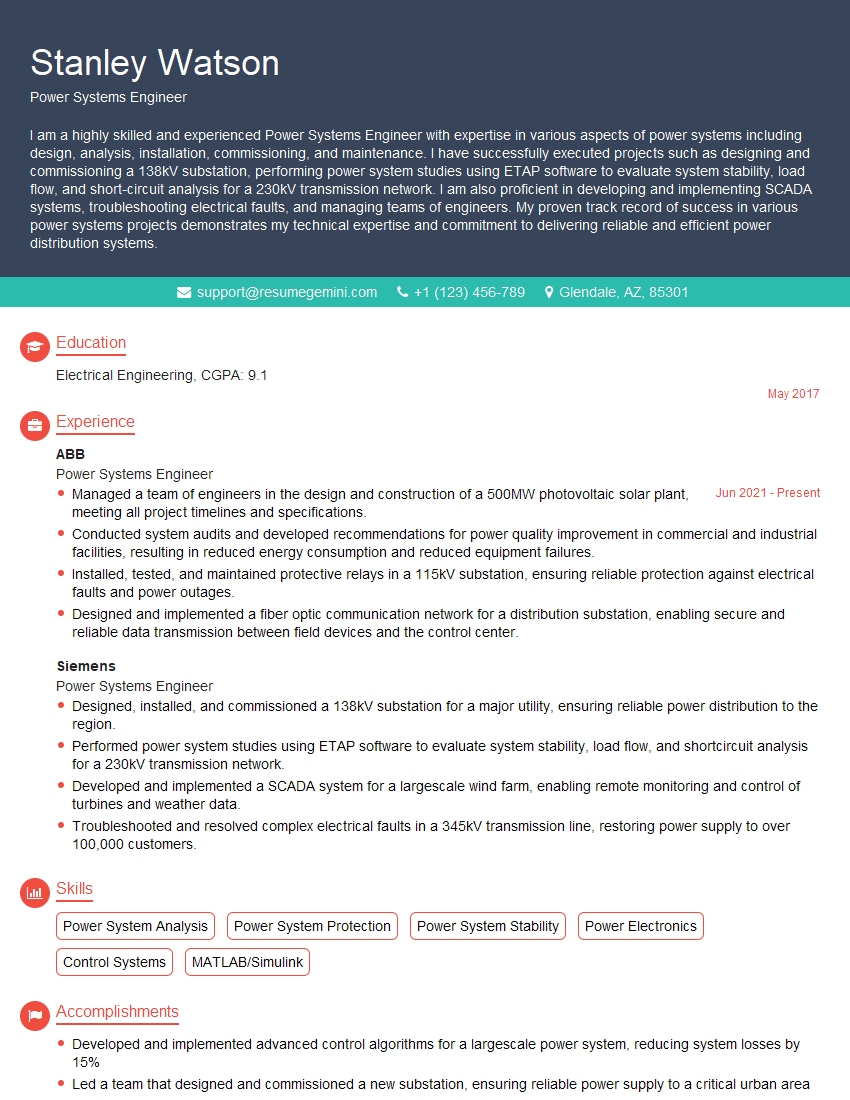
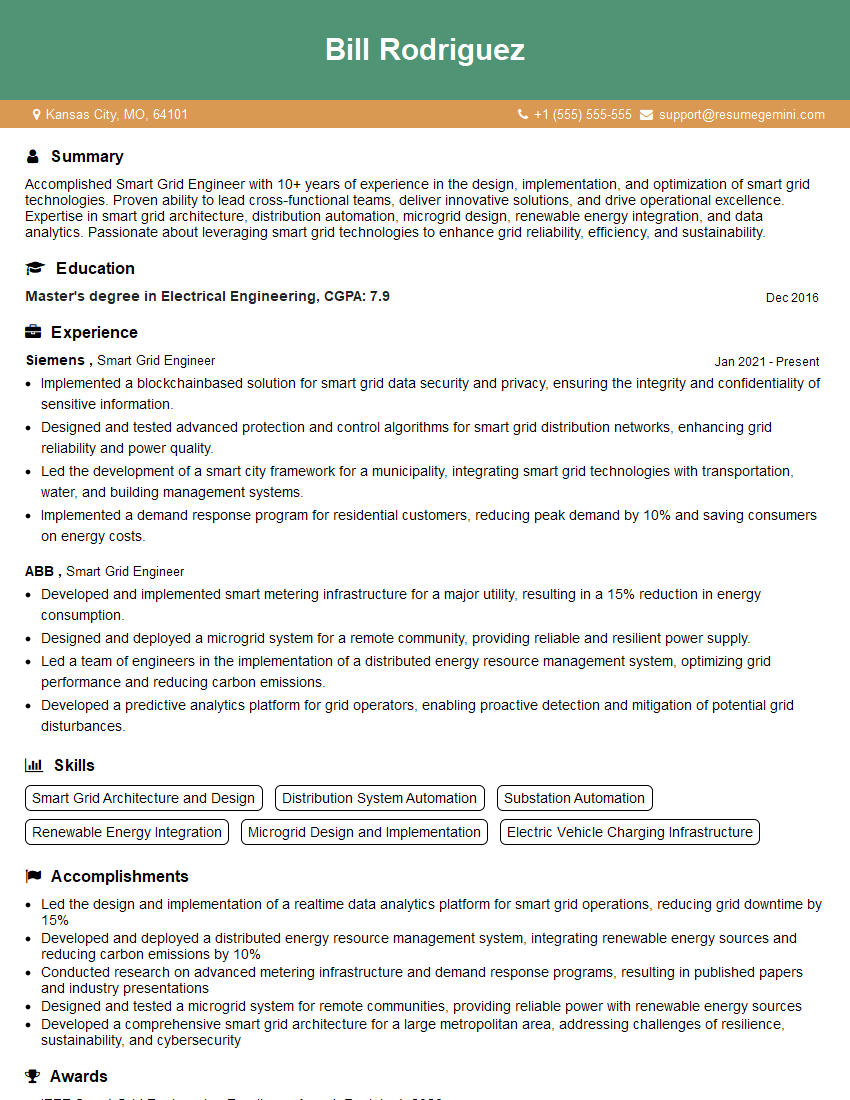
Mastering power simulation and analysis tools is crucial for a successful career in the power industry, opening doors to exciting roles and contributing to a sustainable energy future. To significantly enhance your job prospects, focus on crafting a compelling and ATS-friendly resume that showcases your skills and experience effectively. ResumeGemini is a trusted resource that can help you build a professional resume tailored to the power industry. Examples of resumes specifically designed for candidates proficient in Power Simulation and Analysis Tools are available to guide you.

Explore more articles
Users Rating of Our Blogs
Share Your Experience
We value your feedback! Please rate our content and share your thoughts (optional).
What Readers Say About Our Blog
Very informative content, great job.
good