Preparation is the key to success in any interview. In this post, we’ll explore crucial Power System Control interview questions and equip you with strategies to craft impactful answers. Whether you’re a beginner or a pro, these tips will elevate your preparation.
Questions Asked in Power System Control Interview
Q 1. Explain the difference between open-loop and closed-loop control in power systems.
Imagine you’re driving a car. Open-loop control is like setting the cruise control to 60 mph and hoping you reach your destination. You’re providing a command (60 mph), but there’s no feedback mechanism to ensure you’re actually going 60 mph. The car’s speed might vary based on inclines, wind, etc. In power systems, open-loop control involves setting a generation level without continuously monitoring and adjusting based on actual system conditions. This is simpler but less accurate and robust.
Closed-loop control, on the other hand, is like using the cruise control and constantly monitoring your actual speed with the speedometer. If you start going slower uphill, the system adjusts the engine output to maintain 60 mph. In power systems, closed-loop control uses feedback from sensors (like voltage, frequency, power flow) to adjust generation and other control parameters, maintaining the system within desired limits despite disturbances. It’s more complex but significantly more reliable and efficient.
For example, Automatic Generation Control (AGC) is a classic example of closed-loop control, where the system constantly monitors system frequency and adjusts generator outputs to maintain it at the nominal value (e.g., 50 Hz or 60 Hz).
Q 2. Describe the function of a SCADA system in power system control.
SCADA, or Supervisory Control and Data Acquisition, is the nervous system of a power system. Think of it as a massive digital dashboard showing real-time information about the entire power grid. It gathers data from various points (substations, generators, transmission lines) through Remote Terminal Units (RTUs) and Programmable Logic Controllers (PLCs). This data, including voltage, current, power flow, and equipment status, is then displayed on a central control center console, providing operators with a comprehensive overview of the system’s health.
SCADA systems don’t just monitor; they also control. Operators can remotely operate switches, transformers, and other equipment using the SCADA system. This allows for efficient grid management, optimized power flow, and rapid response to disturbances. Imagine a fault occurring on a transmission line – SCADA enables remote isolation of the faulty section, minimizing the impact on the rest of the system. Moreover, advanced SCADA systems employ sophisticated algorithms for predictive maintenance, optimizing the lifespan and performance of grid assets.
Q 3. What are the different types of protective relays used in power systems?
Protective relays are the first line of defense in power systems, acting as rapid-response guardians to safeguard equipment and maintain grid stability. They constantly monitor various parameters like current, voltage, and impedance. When a fault (like a short circuit) occurs, they detect it almost instantaneously and initiate the necessary protective actions (e.g., tripping circuit breakers).
- Overcurrent Relays: These are the workhorses, tripping breakers when the current exceeds a preset threshold. They’re crucial for detecting short circuits.
- Differential Relays: These compare the current entering and leaving a protected zone (like a transformer). Any mismatch indicates an internal fault, triggering a trip.
- Distance Relays: These measure the impedance to the fault location. This allows them to trip breakers only if the fault lies within a specific distance from the relay, improving selectivity.
- Pilot Relays: These protect long transmission lines by communicating with relays at each end. If a fault occurs, the communication is broken, leading to the tripping of both ends of the line.
- Ground Fault Relays: These detect faults involving ground, often a significant safety concern.
The type of relay used depends on the specific application and the characteristics of the equipment being protected. Modern relays often incorporate sophisticated algorithms and digital signal processing for improved performance and fault analysis capabilities.
Q 4. Explain the concept of power system stability and its importance.
Power system stability refers to the ability of a power system to maintain synchronism between generators and to remain in a state of equilibrium after being subjected to a disturbance. Think of it as the system’s ability to ‘stay balanced’ even when things go wrong. Maintaining stability is paramount for reliable power delivery.
There are different types of stability, including:
- Angle Stability (Rotor Angle Stability): This relates to the ability of synchronous generators to maintain synchronism (remain in step) with each other. A loss of synchronism leads to cascading outages and blackouts.
- Frequency Stability: This refers to the system’s ability to maintain its nominal frequency following a disturbance. Large frequency deviations can cause generators to trip, leading to widespread blackouts.
- Voltage Stability: This involves the system’s ability to maintain voltage levels within acceptable limits. Voltage instability can lead to equipment damage and widespread collapses.
Loss of stability can have catastrophic consequences, ranging from localized outages to widespread blackouts affecting millions of people. Therefore, ensuring power system stability is a critical aspect of grid operation.
Q 5. How do you ensure the security and reliability of a power system?
Ensuring security and reliability in a power system is a multifaceted challenge requiring a layered approach.
- Redundancy: Having backup systems and multiple paths for power flow ensures continued operation even if one component fails. Imagine having multiple transmission lines connecting the same regions – if one fails, the others can take over.
- Protection Systems: Sophisticated protective relays and circuit breakers quickly isolate faults, minimizing their impact on the rest of the system.
- Cybersecurity: Protecting the SCADA system and other control infrastructure from cyberattacks is crucial. A successful cyberattack could compromise grid operations and even trigger widespread blackouts.
- Predictive Maintenance: Using data analytics to predict equipment failures allows for proactive maintenance, reducing the likelihood of unexpected outages.
- Grid Modernization: Upgrading the grid infrastructure with smart grids, advanced sensors, and improved control systems enhances both security and reliability.
- Load Forecasting: Accurate load forecasting helps in planning and managing generation resources effectively, preventing overloading and potential collapses.
Furthermore, robust emergency response plans and procedures are essential to deal effectively with major disturbances and restore service quickly and safely.
Q 6. Describe the role of FACTS devices in enhancing power system control.
Flexible AC Transmission Systems (FACTS) devices are advanced power electronic devices that enhance power system control and increase transmission capacity. Think of them as intelligent valves and switches within the grid, dynamically adjusting power flow to optimize performance and stability.
Some examples include:
- Thyristor Controlled Series Capacitor (TCSC): These devices can dynamically adjust the impedance of transmission lines, improving power flow control and enhancing stability.
- Static Synchronous Compensator (STATCOM): These devices provide reactive power compensation, helping to maintain voltage levels and improve voltage stability.
- Unified Power Flow Controller (UPFC): This is a more versatile device that can control both active and reactive power flow, offering a wide range of control functionalities.
FACTS devices improve the grid’s ability to handle increased power flows from renewable energy sources, enhance stability during disturbances, and optimize power system operation for greater efficiency.
Q 7. What are the challenges associated with integrating renewable energy sources into the power grid?
Integrating renewable energy sources like solar and wind power presents several challenges:
- Intermittency: Solar and wind power are inherently intermittent; their output fluctuates based on weather conditions. This variability makes it challenging to maintain grid stability and balance supply and demand.
- Predictability: Accurately forecasting the output of renewable energy sources is crucial for effective grid management. However, forecasting accuracy can be limited due to the unpredictable nature of weather.
- Grid Infrastructure: Existing grid infrastructure may not be adequately equipped to handle the decentralized nature and variability of renewable energy sources. Upgrades and modernization are often required.
- Voltage and Frequency Regulation: The intermittent nature of renewables can create challenges for maintaining stable voltage and frequency in the grid. Advanced control systems and energy storage solutions are needed to address this.
- Location Constraints: The optimal locations for renewable energy generation may be geographically distant from load centers, necessitating investments in transmission and distribution infrastructure.
Overcoming these challenges requires a combination of advanced grid technologies, smart grids, energy storage solutions, improved forecasting techniques, and updated regulatory frameworks.
Q 8. Explain the concept of load frequency control (LFC).
Load Frequency Control (LFC) is a crucial aspect of power system operation that maintains the system frequency and prevents large-scale frequency deviations. Imagine a power grid as a giant clock; LFC ensures its hands stay close to the correct time (50Hz or 60Hz). It does this by automatically adjusting the generation output of power plants in response to changes in load demand.
When the load (demand) increases, the system frequency tends to drop. LFC detects this drop and signals power plants to increase their generation. Conversely, when the load decreases, the frequency rises, and LFC signals a reduction in generation. This continuous balancing act keeps the frequency stable within an acceptable range, typically ±0.05 Hz. The control system typically uses a combination of integral and proportional control actions to achieve quick and stable response.
A simple analogy: Imagine a water tank with a drain. The load is the rate at which water is flowing out. If you increase the outflow, the water level (frequency) drops. LFC is like a valve that automatically opens (increases generation) to maintain the water level.
Q 9. How does automatic generation control (AGC) maintain system frequency?
Automatic Generation Control (AGC) is the advanced implementation of LFC. It’s the brain of the power grid, coordinating the responses of multiple power plants to maintain the system frequency and exchange power between different areas of the grid. While LFC focuses on individual plant responses, AGC orchestrates the collective action of numerous generating units across a wider geographical area.
AGC works by constantly monitoring the system frequency and the net interchange of power between control areas. If the frequency deviates from its setpoint, the AGC calculates the necessary generation adjustments for each participating power plant, considering their individual capabilities and constraints. This ensures a coordinated and efficient response to load fluctuations.
For example, if one area of the grid experiences a sudden load increase, the AGC will dispatch more generation in that area and potentially reduce generation in other areas to maintain overall frequency and power balance. This involves sophisticated algorithms considering factors such as generation unit ramp rates, capacity limitations, and economic dispatch.
Q 10. Describe the different methods for power system state estimation.
Power system state estimation (PSSE) is the process of determining the complete state of the power system—voltage magnitudes and angles at each bus—based on a set of measurements from various sources. Accurate state estimation is vital for monitoring, control, and protection of the grid.
There are two primary methods:
- Weighted Least Squares (WLS): This is the most widely used method. It uses a statistical approach to find the optimal state that minimizes the weighted sum of squares of the errors between the measured and estimated quantities. The weights reflect the accuracy of each measurement.
- Maximum Likelihood Estimation (MLE): MLE considers the probabilistic nature of measurement errors and aims to find the state that maximizes the likelihood of observing the actual measurements. It’s computationally more intensive than WLS but can handle more complex measurement error models.
Other advanced methods involve robust estimators that handle bad data more effectively and state estimators that incorporate PMU measurements.
Q 11. What is the role of phasor measurement units (PMUs) in power system monitoring?
Phasor Measurement Units (PMUs) are revolutionary devices that provide synchronized, high-resolution measurements of voltage and current phasors at various points in the power system. Unlike traditional measurements, PMUs utilize a GPS-synchronized clock, providing extremely precise timing information.
This synchronization allows for real-time monitoring of dynamic events in the power system, greatly enhancing situational awareness. PMUs facilitate:
- Improved State Estimation: PMU data improves the accuracy and speed of state estimation, especially during dynamic events.
- Wide-Area Monitoring and Control (WAMC): PMU data is crucial for WAMC systems, enabling better control and coordination across large geographical areas.
- Faster Fault Detection and Localization: PMU measurements allow for rapid detection and accurate localization of faults, leading to faster restoration times.
- Dynamic System Simulation and Analysis: PMU data is invaluable for validating power system models and improving their accuracy.
PMUs are like high-speed cameras recording the power system’s behavior, providing unparalleled insights into its dynamics.
Q 12. Explain the concept of power system restoration after a major outage.
Power system restoration after a major outage is a complex and critical process requiring careful planning and execution. It involves a systematic approach to re-energize the system safely and efficiently, minimizing disruption to consumers.
The restoration process typically follows these steps:
- Damage Assessment: Identifying the extent of damage to equipment and infrastructure.
- System Isolation: Isolating the faulted area to prevent further damage.
- Restoration Planning: Developing a detailed plan for restoring power, prioritizing critical loads such as hospitals and emergency services.
- Islanding: Creating smaller, independent sections (islands) of the power system that can be restored individually.
- Step-by-Step Restoration: Gradually energizing the system in a controlled manner, starting with critical loads and gradually adding more.
- System Monitoring and Control: Continuously monitoring the system for stability and taking corrective actions as needed.
Effective restoration requires coordination between various entities including system operators, utility crews, and emergency response teams.
Q 13. Describe different types of power system disturbances and their impact.
Power system disturbances can range from minor fluctuations to catastrophic events, significantly impacting system stability and reliability. Here are some common types:
- Faults: Short circuits (e.g., three-phase, single-line-to-ground) resulting from insulation failure or equipment damage. These lead to voltage drops, current surges, and potential cascading outages.
- Load Changes: Sudden and large variations in load demand can strain the system, causing frequency deviations and voltage instability. Examples include large industrial motor starts or loss of a major load.
- Generator Tripping: Unexpected loss of generation, often due to equipment failure, reduces system capacity and can destabilize the frequency.
- Lightning Strikes: Can cause insulation failure and initiate faults, especially in overhead transmission lines.
- Islanding: A portion of the power system becomes isolated from the rest, potentially leading to frequency and voltage instability within the isolated area.
The impact of these disturbances depends on their magnitude, location, and the system’s ability to withstand them. Severe disturbances can lead to widespread blackouts and significant economic losses.
Q 14. How do you analyze power system fault using software tools?
Power system fault analysis is routinely performed using specialized software tools, allowing for detailed investigation of fault events and system behavior. Popular tools include ETAP, PSS/E, and PowerWorld Simulator.
The analysis typically involves these steps:
- Data Acquisition: Gathering relevant data from protective relays, SCADA systems, and PMUs.
- System Modeling: Creating a detailed model of the power system, including transmission lines, transformers, generators, and loads.
- Fault Simulation: Simulating the fault using the software tool, specifying the type, location, and duration of the fault.
- Analysis of Results: Examining the simulation results to assess fault currents, voltage drops, and relay operations.
- Protective Relay Coordination: Ensuring that protective relays operate correctly and in proper sequence to isolate the fault without unnecessary tripping.
Example (Conceptual): Software tools allow users to input system parameters, apply fault scenarios (e.g., a three-phase fault at Bus 123), and then analyze the resulting waveforms of voltage and current at various locations, providing insights into fault propagation and protection system performance.
Q 15. What are the different types of power flow studies?
Power flow studies analyze the steady-state behavior of a power system under a given operating condition. They determine the voltage magnitude and phase angle at each bus, as well as the real and reactive power flow in each line. Different types cater to various needs and system complexities:
- Load Flow Analysis (LF): This is the most common type, used for planning and operation. It assumes a balanced system and calculates power flows based on known loads and generation. Imagine it as mapping the flow of electricity through a network, much like charting traffic flow on a highway system.
- Fault Analysis: This examines the impact of short circuits or other faults on the system. It’s crucial for protection system design and ensuring system stability. Think of it as a ‘what-if’ scenario analysis – what happens if a major line goes down?
- Optimal Power Flow (OPF): This goes beyond basic load flow by optimizing the system’s operation based on certain objective functions, such as minimizing generation cost or transmission losses. It’s like finding the most efficient route for electricity to travel, considering various factors and constraints.
- State Estimation (SE): This uses real-time measurements from the system to estimate the actual state (voltages and flows). It helps in monitoring and control, providing a real-time snapshot of the system’s health.
The choice of method depends on the specific application. A simple load flow might suffice for initial planning, while a more complex OPF is needed for detailed optimization tasks.
Career Expert Tips:
- Ace those interviews! Prepare effectively by reviewing the Top 50 Most Common Interview Questions on ResumeGemini.
- Navigate your job search with confidence! Explore a wide range of Career Tips on ResumeGemini. Learn about common challenges and recommendations to overcome them.
- Craft the perfect resume! Master the Art of Resume Writing with ResumeGemini’s guide. Showcase your unique qualifications and achievements effectively.
- Don’t miss out on holiday savings! Build your dream resume with ResumeGemini’s ATS optimized templates.
Q 16. Explain the importance of power system modeling and simulation.
Power system modeling and simulation are indispensable for understanding and improving power system performance. They provide a virtual environment to test different scenarios, analyze system behavior, and assess the impact of changes without risking the real-world system. Think of it as a virtual power grid laboratory.
Importance:
- Planning and Design: Models help determine optimal sizes for generation, transmission, and distribution equipment, ensuring sufficient capacity and reliability. For example, deciding where to build new substations or power lines.
- Operational Analysis: Simulations help analyze system stability under various operating conditions, including contingencies such as generator outages or transmission line failures. This is crucial for preventative maintenance and avoiding blackouts.
- Control System Design: Models are used to design and test control systems, ensuring they effectively manage the power system. For example, testing the effectiveness of a new voltage control strategy.
- Protection System Design: Models are vital to design and test protective relays and other safety devices, ensuring they correctly identify and respond to faults. It’s like setting the trip points of breakers in a way that ensures maximum safety.
Software tools like PSS/E and PowerWorld Simulator are widely used for these analyses, allowing engineers to build detailed representations of power systems and run simulations under various conditions.
Q 17. What are the key performance indicators (KPIs) for a power system?
Key Performance Indicators (KPIs) for a power system are metrics that measure its efficiency, reliability, and security. Some crucial KPIs include:
- System Reliability (SAIFI, SAIDI, CAIDI): These metrics quantify the frequency and duration of outages experienced by customers. Lower values indicate higher reliability. (SAIFI: System Average Interruption Frequency Index, SAIDI: System Average Interruption Duration Index, CAIDI: Customer Average Interruption Duration Index)
- Voltage Profile: Measures the voltage level at various points in the system. Maintaining voltage within acceptable limits is vital for equipment operation and customer satisfaction. Think of it as keeping the water pressure in a city’s pipes within an acceptable range.
- Power Losses: Quantifies the energy lost in transmission and distribution. Minimizing these losses improves efficiency and reduces operational costs.
- Frequency Stability: Measures how well the system maintains the nominal frequency (e.g., 50 Hz or 60 Hz). Frequency deviations can indicate imbalance between generation and load.
- Security Margins: Assess the system’s ability to withstand contingencies. For example, how much reserve power is available in case of a generator failure. This essentially ensures there’s extra capacity to deal with unexpected issues.
The specific KPIs used can vary depending on the system’s size, operating conditions, and regulatory requirements. A small, isolated system might prioritize different KPIs than a large, interconnected grid.
Q 18. Describe your experience with different types of power system control strategies.
My experience encompasses various power system control strategies, including:
- Automatic Generation Control (AGC): I’ve worked on designing and implementing AGC systems to maintain frequency and tie-line power flow within specified limits. This involves using control algorithms to adjust generator outputs in response to load changes and maintain grid stability. It’s like a sophisticated thermostat constantly adjusting power generation to match the energy demand.
- Voltage Regulation: I have extensive experience with voltage control strategies, including reactive power compensation and tap-changer control. This ensures that voltages remain within the acceptable range, preventing voltage collapses. This is a bit like carefully adjusting water pressure to ensure proper flow throughout a city.
- Power System Stabilizers (PSS): I’ve designed and implemented PSSs to improve the stability of synchronous generators and prevent oscillations. These controllers provide additional damping to the system, preventing dangerous oscillations that can lead to instability. Imagine it as a shock absorber for the power grid.
- FACTS devices (Flexible AC Transmission Systems): I’ve worked on integrating and controlling FACTS devices like STATCOMs and SVCs to enhance power system stability and control. These are advanced power electronic devices that can quickly improve the grid’s performance under varying conditions.
My experience includes both simulation-based design and real-world implementation and testing of these control strategies using SCADA (Supervisory Control and Data Acquisition) systems and various control algorithms.
Q 19. Explain the concept of voltage stability and control.
Voltage stability refers to the ability of a power system to maintain acceptable voltage levels following disturbances. A voltage instability event can lead to a voltage collapse, resulting in widespread outages. Voltage control is the set of actions taken to maintain voltage stability.
Concept: Voltage stability is primarily related to the reactive power balance in the system. Insufficient reactive power can lead to voltage drops and instability. Imagine a water pipe system: if the pressure (voltage) drops too low, the flow (power) will be disrupted.
Control: Voltage control involves several techniques:
- Reactive Power Compensation: Using devices like capacitors or reactors to provide or absorb reactive power, thereby maintaining voltage levels.
- Voltage Regulators: These devices, such as tap-changing transformers and voltage regulators on generators, adjust voltage at specific points in the system.
- FACTS devices: STATCOMs and SVCs offer fast and flexible reactive power compensation, enhancing voltage stability.
- Load Shedding: As a last resort, load shedding can be employed to reduce demand and prevent voltage collapse.
Effective voltage control is crucial for maintaining reliable power supply. Without it, voltage instability can lead to widespread blackouts and significant economic losses.
Q 20. What is the role of reactive power compensation in power system control?
Reactive power compensation plays a critical role in power system control by maintaining voltage levels and improving system stability. Reactive power is essential for maintaining the voltage magnitude, while real power is responsible for the actual energy transfer. Think of it like this: real power is the amount of water flowing through a pipe, while reactive power is the pressure needed to maintain that flow.
Role:
- Voltage Regulation: Capacitors provide reactive power, increasing voltage levels, while reactors absorb reactive power, lowering them. This is crucial for maintaining acceptable voltage levels at all points in the system, preventing voltage collapses.
- Power Factor Improvement: Reactive power compensation improves the power factor, reducing transmission losses and improving system efficiency. It’s like ensuring your electrical devices use the energy efficiently.
- Stability Enhancement: Reactive power compensation enhances system stability by damping oscillations and improving the system’s ability to withstand disturbances. It’s like adding shock absorbers to a power system.
Various devices are used for reactive power compensation, including shunt capacitors, shunt reactors, and FACTS devices. The choice depends on the specific needs and the characteristics of the system.
Q 21. How do you address issues related to harmonic distortion in power systems?
Harmonic distortion refers to the presence of non-sinusoidal waveforms in the power system, typically caused by non-linear loads like rectifiers, variable-speed drives, and switching power supplies. These harmonics can cause various issues like overheating of equipment, malfunction of sensitive electronics, and increased transmission losses.
Addressing Harmonic Distortion:
- Identifying Sources: The first step is to identify the sources of harmonic distortion through harmonic analysis using specialized equipment and software. This is similar to a doctor diagnosing the root cause of a health problem.
- Mitigation Techniques: Once the sources are identified, several techniques can mitigate harmonic distortion:
- Passive Filters: These are tuned circuits that absorb specific harmonics. They are relatively inexpensive but less flexible.
- Active Filters: These use power electronics to actively compensate for harmonics, offering more flexibility and effectiveness.
- Harmonic Load Balancing: Distributing harmonic loads evenly throughout the system can reduce their overall impact.
- Transformer Design: Using transformers with low harmonic impedance can minimize the impact of harmonics.
The choice of mitigation technique depends on the level of harmonic distortion, cost considerations, and the specific characteristics of the system. Often, a combination of techniques is employed for optimal results. Effective harmonic mitigation ensures the reliable and efficient operation of the power system.
Q 22. Explain the concept of optimal power flow (OPF).
Optimal Power Flow (OPF) is a crucial optimization problem in power system operation. It aims to find the best operating point for a power system, minimizing cost while adhering to various constraints. Imagine it like this: you’re a traffic controller for electricity, trying to direct the flow of power efficiently and safely across the entire grid.
In essence, OPF determines the optimal values for variables like generator outputs, voltage magnitudes, and transformer tap settings. The objective function is typically to minimize the total generation cost, which is often a function of fuel costs and generator efficiency. However, other objectives such as minimizing transmission losses or emissions can also be incorporated.
Constraints are equally important. These include limits on generator output, voltage magnitudes, transmission line flows, and reactive power limits. These constraints ensure the system’s stability and prevent equipment damage. The OPF problem is often solved using advanced numerical techniques, such as interior point methods or Newton-Raphson iterations, to find the optimal solution.
For example, during peak demand, an OPF algorithm can strategically allocate generation from various power plants to minimize cost while ensuring sufficient power supply. It would also consider constraints such as the maximum capacity of each generator and the thermal limits of transmission lines. This ensures the grid’s efficiency and reliability.
Q 23. What is your experience with power system protection coordination?
My experience with power system protection coordination spans over [Number] years, encompassing both design and implementation phases. I’ve worked extensively with various protective relaying schemes, including distance protection, differential protection, overcurrent protection, and busbar protection. My work has involved coordinating protection settings to ensure selective tripping during faults, while minimizing unnecessary outages.
I’ve been involved in several large-scale projects where the coordination of protection schemes was paramount. In one project, we had to coordinate the protection of a complex transmission network with multiple interconnected substations. We used specialized software tools to analyze the relay operating times and ensure that the correct protective devices would operate in a coordinated manner during different fault scenarios. This required a deep understanding of fault propagation and the characteristics of different protective relays.
A key aspect of my approach is rigorous testing and simulation. We employed advanced digital simulation tools to verify the protection coordination scheme under various fault conditions, ensuring that the system responds as expected. I am also proficient in interpreting protective relay settings and analyzing fault recordings to identify potential areas for improvement in the coordination schemes.
Q 24. How do you ensure the cybersecurity of power system control systems?
Cybersecurity in power system control systems is of paramount importance, given the critical nature of electricity infrastructure. A successful cyberattack could have devastating consequences, leading to widespread blackouts and significant economic losses. My approach to ensuring cybersecurity is multi-layered and incorporates several key strategies.
- Network Segmentation: Dividing the control system network into smaller, isolated segments limits the impact of a potential breach. Think of it like compartmentalizing a ship – if one section floods, the rest remains unaffected.
- Intrusion Detection and Prevention Systems (IDPS): Implementing advanced IDPS systems helps to detect and prevent malicious activities in real-time. These systems constantly monitor network traffic for suspicious patterns and can automatically take action to mitigate threats.
- Regular Security Audits and Penetration Testing: Regular security audits identify vulnerabilities and ensure that security protocols are up to date. Penetration testing simulates real-world attacks to identify weaknesses in the system.
- Access Control and Authentication: Implementing strict access control measures ensures that only authorized personnel can access critical system components. Strong authentication methods are also crucial to prevent unauthorized access.
- Secure Communication Protocols: Utilizing secure communication protocols such as TLS/SSL for data transmission protects sensitive information from eavesdropping and tampering.
Furthermore, continuous monitoring and response planning are critical. This involves developing incident response plans to address potential cyber threats effectively and rapidly restore system functionality in the event of a successful attack.
Q 25. Explain the impact of distributed generation on power system control.
The integration of Distributed Generation (DG), such as solar and wind farms, significantly impacts power system control. While DG offers many benefits, it also introduces new challenges. The intermittent and unpredictable nature of renewable energy sources necessitates advanced control strategies to maintain grid stability and reliability.
Traditionally, power systems relied on large, centralized power plants for generation. With DG, generation is distributed across the grid, making it more difficult to predict power flow and voltage levels. This necessitates sophisticated control algorithms that can dynamically adapt to fluctuating DG output. For example, voltage regulation becomes more complex, requiring faster and more responsive control mechanisms. This is where advanced control techniques such as voltage and frequency control using FACTS devices (Flexible AC Transmission Systems) and smart inverters come into play.
Another key challenge is power quality. The fluctuating nature of DG can introduce harmonics and other power quality issues. Therefore, effective filtering and power electronic control techniques are crucial. In addition, advanced grid monitoring and state estimation techniques are necessary to accurately track DG output and its impact on the grid.
Managing the bidirectional power flows associated with DG requires sophisticated control mechanisms. Smart inverters play a critical role in this context, providing real-time control and reactive power support to enhance grid stability. Furthermore, effective communication infrastructure is vital to facilitate coordination between DG units and the central control system.
Q 26. Describe your experience with power system control using AI/ML techniques.
I have extensive experience applying AI/ML techniques to various power system control problems. I’ve worked on projects involving:
- State Estimation: Using neural networks and other ML algorithms to improve the accuracy and efficiency of power system state estimation, leading to better grid monitoring and control.
- Fault Detection and Classification: Developing AI-based systems to detect and classify faults in real-time, enabling faster fault response and minimizing outage durations. This often involves analyzing large datasets of sensor readings and protective relay signals.
- Load Forecasting: Employing machine learning models to predict future load demand more accurately, enabling better resource planning and optimization. We leveraged techniques such as time series analysis and deep learning to achieve high accuracy.
- Optimal Power Flow (OPF) Optimization: Enhancing the efficiency and speed of OPF calculations through the use of reinforcement learning and other AI techniques. This allowed us to solve large-scale OPF problems in real-time, which is critical for dynamic grid management.
In one particular project, we developed a deep learning model to predict the power output of a large wind farm. This model achieved significantly higher accuracy compared to traditional forecasting methods, resulting in improved grid stability and reduced operational costs.
Q 27. What is your understanding of the future trends in power system control?
The future of power system control is rapidly evolving, driven by several key trends:
- Increased Integration of Renewable Energy Sources: The continued growth of renewable energy will necessitate more sophisticated control strategies to manage intermittent power generation and maintain grid stability.
- Smart Grid Technologies: The implementation of smart grid technologies, such as smart meters and advanced sensors, will enable greater grid visibility and more efficient control.
- Advanced Communication Networks: High-bandwidth, low-latency communication networks are essential for supporting real-time control and coordination of distributed energy resources.
- Wide-area Monitoring and Control Systems (WAMS): WAMS will provide real-time visibility across large geographical areas, enabling faster response to disturbances and improved grid stability.
- Artificial Intelligence and Machine Learning: AI/ML will play an increasingly important role in various aspects of power system control, from fault detection and prediction to optimal power flow optimization.
- Cybersecurity Enhancements: Robust cybersecurity measures will be critical to protect against cyber threats and ensure the reliability and safety of power systems.
These trends will lead to a more decentralized, flexible, and resilient power grid, capable of adapting to the changing demands of the 21st century.
Q 28. Explain your experience with different communication protocols used in power system control.
My experience encompasses a wide range of communication protocols used in power system control, including:
- IEC 61850: This standard defines communication protocols for substation automation, enabling seamless data exchange between various devices, such as protective relays, circuit breakers, and metering equipment. I’ve extensively utilized this standard in various projects, leveraging its benefits in improving protection coordination and fault response.
- DNP3: Distributed Network Protocol 3 is another widely used protocol, particularly in the North American power industry. I have experience integrating DNP3 into SCADA systems for monitoring and control of power generation and distribution facilities.
- Modbus: Modbus is a simple and widely adopted protocol used for communication with various industrial devices. I’ve used it for monitoring and control of smaller-scale power systems and related equipment.
- Ethernet and IP-based Protocols: The increasing use of Ethernet and IP-based protocols in power systems requires understanding of network security and management practices to ensure reliable and secure communication.
In recent projects, I’ve seen a significant trend towards the adoption of IEC 61850 due to its superior capabilities for integrating diverse devices and supporting advanced communication features. Choosing the appropriate protocol depends heavily on the specific application and the requirements for communication speed, reliability, and security.
Key Topics to Learn for Power System Control Interview
- Power System Stability: Understand transient, small-signal, and voltage stability concepts. Explore methods for enhancing system stability, including FACTS devices and control strategies.
- Economic Dispatch and Optimal Power Flow (OPF): Learn the principles behind minimizing generation costs while meeting demand and constraints. Familiarize yourself with different optimization techniques and their applications.
- State Estimation and Bad Data Detection: Grasp the process of estimating the system’s state from measurements. Understand techniques for identifying and handling bad data to maintain accurate system models.
- Protection and Relaying: Explore various protection schemes for transmission lines, transformers, and generators. Understand the principles of different relay types and their coordination.
- Supervisory Control and Data Acquisition (SCADA): Familiarize yourself with the architecture and functionalities of SCADA systems in power system control. Understand data acquisition, monitoring, and control aspects.
- Renewable Energy Integration: Learn about the challenges and solutions associated with integrating renewable energy sources (solar, wind) into the power grid. Understand control strategies for handling intermittent generation.
- Power System Simulation and Modeling: Gain experience with power system simulation software (e.g., PSS/E, PowerWorld Simulator) to analyze system behavior and test control strategies.
- Advanced Control Techniques: Explore advanced control strategies such as model predictive control (MPC) and robust control for enhanced system performance and resilience.
Next Steps
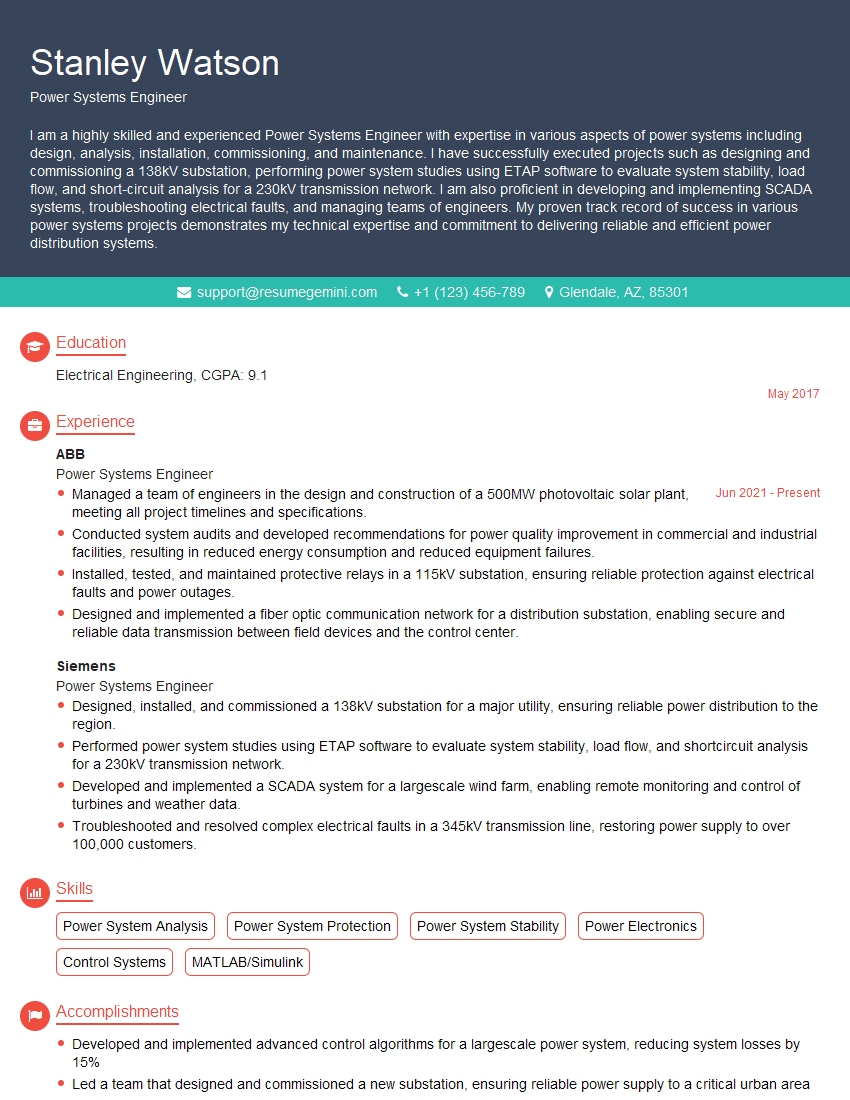
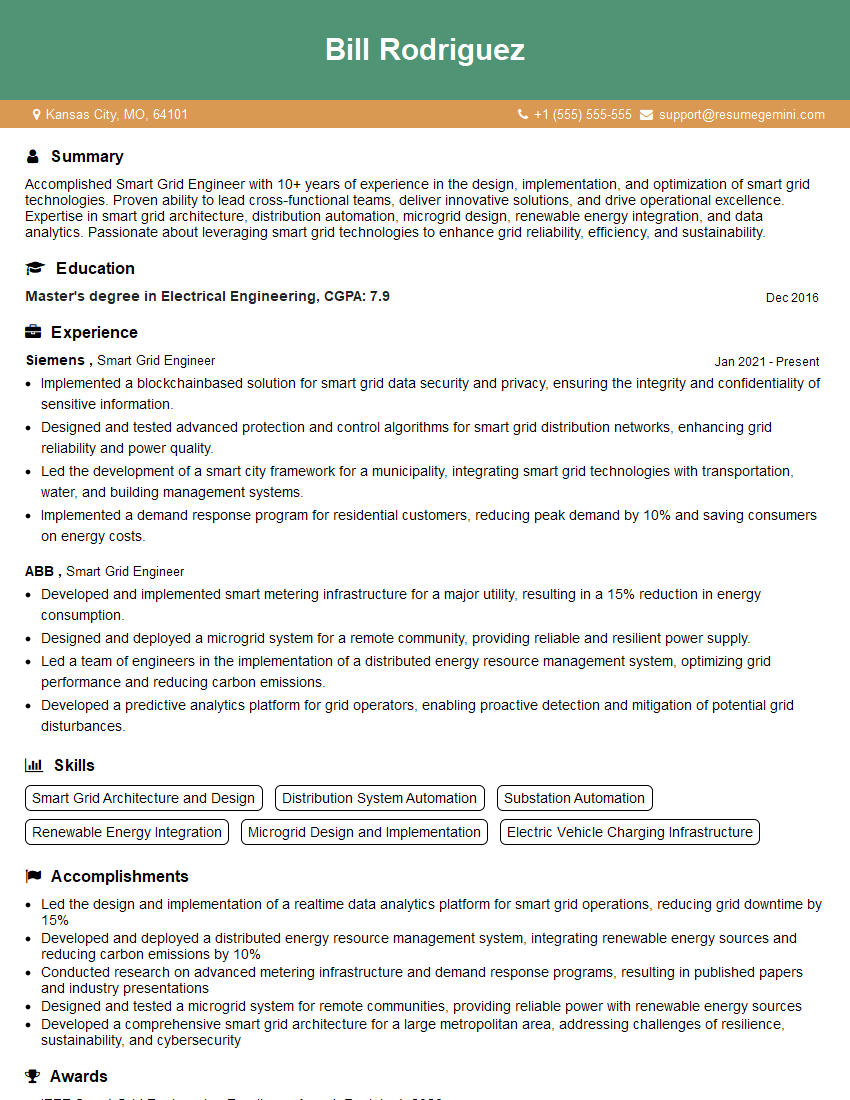
Mastering Power System Control opens doors to exciting and impactful careers in the energy sector, offering opportunities for innovation and leadership. A strong foundation in these core concepts is crucial for securing your ideal role. To significantly improve your job prospects, it’s vital to create a resume that Applicant Tracking Systems (ATS) can easily parse and understand. ResumeGemini is a trusted resource that can help you build a professional and effective resume tailored to highlight your skills and experience. Examples of resumes specifically designed for Power System Control professionals are available to guide you through the process.
Explore more articles
Users Rating of Our Blogs
Share Your Experience
We value your feedback! Please rate our content and share your thoughts (optional).
What Readers Say About Our Blog
Very informative content, great job.
good