Interviews are opportunities to demonstrate your expertise, and this guide is here to help you shine. Explore the essential Precious Metalworking interview questions that employers frequently ask, paired with strategies for crafting responses that set you apart from the competition.
Questions Asked in Precious Metalworking Interview
Q 1. Describe your experience with various precious metal alloys (gold, silver, platinum, palladium).
My experience spans over two decades working with precious metal alloys, encompassing gold, silver, platinum, and palladium. I’ve worked extensively with various karats of gold, from 10k to 24k, understanding the implications of each karat on the metal’s properties like hardness, color, and cost. Similarly, I’m familiar with sterling silver (925), fine silver (999), and the intricacies of platinum and palladium alloys, including their differing melting points and workability. For instance, I’ve found that platinum’s higher melting point necessitates specialized torches and techniques compared to gold. Palladium’s lower melting point makes it easier to work with but requires careful control to prevent oxidation. This deep understanding of the properties of each alloy allows me to select the most appropriate material for a specific design, considering factors like durability, cost-effectiveness, and aesthetic appeal. I’ve even created custom alloys for special projects, blending different metals to achieve specific colors and hardnesses.
Q 2. Explain the process of melting and casting precious metals.
Melting and casting precious metals requires precision and attention to detail. The process typically begins with weighing the precise amount of metal needed, ensuring accuracy to maintain the desired karat or purity. The metal is then placed in a crucible, a heat-resistant container, often made of graphite or ceramic. Different metals have different melting points, necessitating the use of appropriate torches – oxy-acetylene torches are common, but induction furnaces are used for larger quantities or higher precision. The metal is heated until it reaches its molten state, which is characterized by a shimmering, liquid surface. Once melted, any flux (a cleaning agent) is added to remove impurities and prevent oxidation. The molten metal is then carefully poured into a mold, which can be made of plaster, rubber, or investment casting material. The mold’s design determines the final shape of the piece. After the metal cools and solidifies, the casting is carefully removed from the mold, and any excess metal is trimmed. Finally, the piece undergoes cleaning and finishing processes to achieve the desired appearance.
Q 3. What are the different soldering techniques used in precious metalworking?
Several soldering techniques are employed in precious metalworking, each suited to different situations.
- Hard soldering (brazing): Uses higher-temperature solder with higher melting points for stronger joints. This is often used for structural elements.
- Soft soldering: Employs lower-melting-point solders, ideal for delicate work or repairs. It’s less durable than hard soldering.
- Laser soldering: A precise and clean method, excellent for fine details and intricate designs. Minimizes heat damage to surrounding areas.
Q 4. How do you ensure the quality and purity of your precious metal work?
Maintaining the quality and purity of precious metal work is paramount. This starts with sourcing high-quality, refined metals from reputable suppliers. Throughout the entire process, careful attention is paid to prevent contamination. This includes using clean tools, appropriate fluxes, and maintaining a clean working environment. I regularly use acid tests (like nitric acid for silver) to check the purity of the metal before and after various stages of the work. Furthermore, for intricate or high-value pieces, I often use spectrographic analysis to provide definitive confirmation of the metal’s composition and purity. This ensures that the client receives a piece of the guaranteed quality and the weight expected. Documentation of each step of the process, including material tracking, ensures complete traceability and accountability for quality control.
Q 5. Describe your experience with different types of gemstones and their settings.
My experience encompasses a wide variety of gemstones, from diamonds and sapphires to emeralds and rubies, as well as many semi-precious stones. I’m proficient in various setting techniques, including
- Prong settings: Ideal for showcasing the stone’s brilliance, offering a secure yet elegant setting.
- Bezel settings: Offering a more protective setting, encasing the stone within a metal frame.
- Channel settings: Setting stones in a continuous groove or channel, creating a sleek, modern look.
- Pavé settings: A technique that features numerous small stones set closely together, resulting in a sparkling, textured surface.
Q 6. What safety precautions do you take when working with precious metals and chemicals?
Safety is my top priority when working with precious metals and chemicals. I always wear appropriate personal protective equipment (PPE), including safety glasses, gloves, and a respirator, particularly when handling chemicals like acids or fluxes. My workspace is well-ventilated to minimize the inhalation of fumes. I use fume hoods when working with particularly hazardous materials. I store all chemicals properly, following all relevant safety data sheets (SDS) and regulations. Proper disposal of hazardous waste is crucial, and I adhere strictly to local regulations for this. Furthermore, I handle sharp tools with caution, regularly maintaining and storing them safely. I use appropriate quenching and cooling techniques when working with molten metals to prevent burns. Safety isn’t just a protocol; it’s an integral part of my daily practice.
Q 7. Explain your experience with different finishing techniques (polishing, tumbling, etc.).
Finishing techniques are essential for achieving the desired luster and appearance of a precious metal piece.
- Polishing: I use various polishing compounds and tools, from abrasive wheels to polishing cloths, to achieve a high-gloss shine. The choice of compound depends on the metal and the desired finish.
- Tumbling: This is a more efficient method for larger quantities or pieces requiring a consistent finish. Pieces are placed in a rotating barrel with abrasive media, smoothing and cleaning them.
- Sandblasting: Used for creating matte finishes or textured surfaces.
- Electro polishing: a more advanced method, which creates an extremely smooth and bright surface and is excellent for harder metals like platinum.
Q 8. How do you handle repairs and alterations on precious metal jewelry?
Repairing and altering precious metal jewelry requires a delicate touch and a deep understanding of the metal’s properties. The process begins with a thorough assessment of the damage. I carefully examine the piece to determine the extent of the repair needed, identifying any broken components, weakened areas, or stones that might be loose.
For example, if a chain is broken, I’ll use a fine jeweler’s saw to carefully cut away any damaged links. I then use a micro-torch to solder in replacement links, ensuring a seamless, invisible repair. If a prong is broken on a gemstone setting, I’ll carefully replace it using the appropriate gauge wire, ensuring the stone is securely held without damage. Resizing rings is another common alteration. This requires careful measurement and often involves cutting the ring, adding or removing metal, and then soldering it back together precisely. Throughout the process, I prioritize maintaining the integrity and aesthetic quality of the original piece.
Beyond simple repairs, I also handle more complex alterations, such as converting a pendant into earrings, or redesigning a ring to incorporate new stones. This involves creative problem-solving and careful metal manipulation to achieve the desired aesthetic result while preserving the value of the precious metal.
Q 9. What CAD/CAM software are you proficient in?
My proficiency in CAD/CAM software is extensive. I’m highly skilled in using industry-standard programs like RhinoGold and Matrix, both of which offer powerful design and manufacturing capabilities for jewelry. RhinoGold, in particular, excels at creating intricate, three-dimensional models with precise detailing, which is crucial for capturing the nuances of complex designs. I’m also familiar with various rendering and animation software to help clients visualize the final product before production. My experience encompasses the complete CAD/CAM workflow, from initial design and rendering to generating CNC (Computer Numerical Control) toolpaths for manufacturing. This allows me to seamlessly translate digital designs into physical reality with high accuracy and efficiency. I regularly utilize these skills for creating custom pieces, repairing intricate jewelry, and streamlining the manufacturing process.
Q 10. Explain your experience with different jewelry manufacturing processes.
My experience spans a wide range of jewelry manufacturing processes, including casting, fabrication, and stone setting. Casting involves creating a mold from the CAD design and then pouring molten metal into it. This is particularly useful for intricate designs that would be difficult or time-consuming to fabricate manually. I’m experienced with various casting methods, including investment casting (lost-wax casting), which allows for high detail and precision. Fabrication, on the other hand, involves constructing the jewelry piece by hand using techniques like soldering, forging, and wire wrapping. This method offers greater control over the finished product and allows for unique, personalized designs. My stone-setting expertise includes prong setting, bezel setting, channel setting, and pave setting – all techniques requiring precision and attention to detail to ensure the stones are securely and aesthetically pleasingly set.
I’ve also worked extensively with finishing techniques, like polishing, buffing, and rhodium plating, to enhance the shine and durability of the finished jewelry. Understanding the strengths and limitations of each method allows me to choose the most appropriate process for a given project, optimizing both quality and efficiency.
Q 11. How do you maintain precision and accuracy in your work?
Maintaining precision and accuracy in precious metalworking is paramount. It requires a combination of skill, proper tooling, and meticulous attention to detail. I start by using high-quality measuring tools like micrometers and calipers to ensure precise dimensions throughout the process. When soldering, I use a micro-torch to control heat precisely, preventing damage to the metal. For intricate work, I use magnification tools like jeweler’s loupes and microscopes to enhance visibility and improve accuracy. CAD/CAM technology plays a vital role as well, allowing for highly accurate digital models and CNC machining for consistent results. Finally, regular calibration and maintenance of my tools are critical for ensuring accuracy over time. Think of it like a surgeon needing precise instruments – the slightest inaccuracy can have a significant impact on the final product.
Q 12. Describe your problem-solving skills in relation to a specific precious metalworking challenge.
One challenging project involved repairing an antique brooch with a severely damaged clasp. The clasp was intricately designed, made of 18-karat gold, and extremely delicate. Simply replacing it wouldn’t maintain the piece’s historical integrity. My solution involved a multi-step approach. First, I carefully documented the original clasp’s construction using photographs and detailed sketches. Then, I used a combination of 3D modeling in RhinoGold and traditional hand fabrication techniques. I created a digital model of the damaged components, and using the model, I manufactured replacement parts using lost wax casting. Finally, I hand-soldered these components into place, meticulously matching the original design and achieving an almost invisible repair. This project highlighted my ability to combine modern technology with traditional craftsmanship to solve complex challenges, respecting both the historical and aesthetic value of the piece.
Q 13. How do you measure and weigh precious metals accurately?
Accurate measurement and weighing of precious metals are essential for both cost calculation and precise work. I utilize a variety of precision instruments. For weighing, I use a highly sensitive analytical balance, capable of measuring to the nearest 0.001 gram. This precision is vital, especially when dealing with small quantities of expensive metals like platinum or gold. For linear measurements, I rely on precision calipers and micrometers, capable of measuring to a fraction of a millimeter. These instruments are crucial for ensuring proper sizing of components and maintaining accuracy during fabrication and repairs. Regular calibration of these tools ensures they remain accurate and reliable. Think of it like a baker using a precise scale – the accuracy of the measurements directly impacts the final result.
Q 14. What types of tools and equipment are you familiar with?
My tool collection is extensive and reflects the breadth of my expertise. I regularly use various hand tools such as jeweler’s saws, files, pliers, hammers, and punches. For soldering, I utilize a micro-torch and various fluxes to ensure clean, precise joins. Power tools include a flex-shaft rotary tool for polishing and intricate detailing, and a bench grinder for shaping and smoothing metal. My equipment also includes a variety of stone-setting tools, including various types of punches and setting burs. For more advanced work, I use a CNC mill for precise machining of components. Finally, my finishing tools include polishing wheels, buffers, and various polishing compounds to achieve a high-quality finish. Each tool plays a specific role in achieving the desired result, ensuring both precision and efficiency throughout the process.
Q 15. Describe your experience with stone setting (various techniques).
Stone setting is a crucial aspect of jewelry making, requiring precision and artistry. I’m proficient in several techniques, each suited to different stone types and designs.
- Prong Setting: This involves using metal prongs to secure the stone. It’s a classic method offering excellent visibility and security. For example, a diamond solitaire ring often uses a four-prong setting for its elegance and strength. I carefully consider prong thickness and angle depending on the stone’s size and hardness.
- Bezel Setting: A metal rim (the bezel) encircles the stone, providing a secure and protective setting. It’s ideal for stones prone to chipping, like opals or turquoise. I meticulously ensure the bezel fits snugly to prevent the stone from falling out. The bezel itself can be further embellished with intricate milling or textures.
- Channel Setting: Stones are held in place within a channel created in the metal. This method is often used for creating continuous lines of stones, as seen in many wedding bands. Precision is paramount; I utilize specialized tools to ensure each stone is securely seated and perfectly aligned.
- Pave Setting: Tiny stones are closely set together, creating a sparkling surface. This technique requires exceptional skill and patience. I use specialized tools and techniques to meticulously place each stone, ensuring tight spacing and a uniform surface. It’s a visually striking method, but the stones must be securely held to prevent loss.
- Flush Setting: The stone sits flush with the surface of the metal, offering a smooth and seamless appearance. This is a challenging technique requiring precise measurements and careful hammering to set the stone perfectly without damaging it. It’s particularly popular for modern, minimalist designs.
My experience encompasses working with a wide array of gemstones, from delicate opals to robust sapphires, demanding different techniques and levels of precision for each.
Career Expert Tips:
- Ace those interviews! Prepare effectively by reviewing the Top 50 Most Common Interview Questions on ResumeGemini.
- Navigate your job search with confidence! Explore a wide range of Career Tips on ResumeGemini. Learn about common challenges and recommendations to overcome them.
- Craft the perfect resume! Master the Art of Resume Writing with ResumeGemini’s guide. Showcase your unique qualifications and achievements effectively.
- Don’t miss out on holiday savings! Build your dream resume with ResumeGemini’s ATS optimized templates.
Q 16. What are the different types of finishes achievable on precious metals?
Precious metals offer a stunning array of finishes, each contributing to the overall aesthetic and feel of a piece. These finishes are achieved through various polishing and texturing techniques.
- High Polish: This creates a mirror-like shine, highlighting the metal’s inherent luster. It’s achieved through multiple stages of polishing with progressively finer abrasives.
- Satin Finish: A smooth but non-reflective finish. It’s created by using fine abrasives in a specific direction, producing a subtle, elegant sheen.
- Brushed Finish: Achieved using a brush-like tool, creating fine lines across the metal’s surface. This offers a matte texture with subtle directional highlights. I can vary the direction and pressure to produce unique patterns.
- Hammered Finish: A textured finish with a multitude of small dents, created using various hammers and techniques. This results in a more rustic or antique look.
- Sandblasted Finish: A matte finish with a slightly rougher texture, created by blasting the metal with fine abrasive particles. This is effective for creating a unique surface contrast.
- Oxidized Finish: This process darkens the metal’s surface, creating a contrast with the brighter, polished areas. This technique is often used to highlight intricate details or create a vintage or antique appearance. I control the oxidation process carefully to achieve specific shades and depths of color.
The choice of finish depends on the design’s style and the desired effect; I guide clients in choosing the appropriate finish that complements their vision.
Q 17. How do you create wax models for casting?
Wax model creation is a critical stage in the lost-wax casting process. It’s where the design comes to life in three dimensions, before the final metal piece is created.
I typically start with a design sketch or CAD model. Then:
- Wax Selection: I choose the appropriate type of wax, considering its properties and the complexity of the design. Different waxes have varying melting points and hardness.
- Wax Carving: For intricate designs, I carefully carve the wax by hand using specialized tools. This requires a steady hand, patience, and a keen eye for detail.
- Wax Injection: For more complex designs, I use a wax injection machine. This method involves injecting molten wax into a mold, which is more efficient for repetitive designs and allows for precise replication.
- Wax Assembly: Multiple wax pieces can be assembled, forming a complete wax model. I carefully join the segments, ensuring that there are no gaps or imperfections.
- Wax Refining: Once the wax model is complete, I refine it using various tools and techniques, making sure it’s smooth, precise, and free of imperfections. This step is crucial for a clean and precise final metal cast.
I frequently use a combination of hand carving and injection molding depending on project demands and design intricacy. I believe that combining traditional skills with modern technology provides me with a versatile toolkit for high-quality wax model creation.
Q 18. What are the common issues encountered during the casting process?
The casting process, while precise, is prone to certain issues. Careful preparation and attention to detail are crucial to mitigate these.
- Incomplete Burnout: If the wax isn’t completely removed from the investment mold, it can leave residue in the final casting, affecting its integrity. I meticulously follow the burnout schedule to ensure complete removal.
- Mold Defects: Cracks or imperfections in the investment mold can lead to defects in the casting. Careful investment mixing and handling are crucial to avoid this.
- Metal Flow Issues: Poor sprue design or air bubbles in the molten metal can result in incomplete filling of the mold. Experience and attention to sprue design are key to ensuring proper metal flow. I frequently use different sprue designs based on the model’s complexity.
- Shrinkage: Metals contract as they cool, leading to slight shrinkage in the final casting. This is accounted for in the initial design stage.
- Pitting or Porosity: Small holes or voids in the casting can occur due to dissolved gases or impurities in the metal. Maintaining cleanliness and using high-quality metal are crucial to prevent this.
Troubleshooting these issues involves careful examination of each stage of the process. Identifying the root cause, whether it’s a material issue or a procedural error, allows for corrective action and the creation of a high-quality final product.
Q 19. How do you manage your time and workflow effectively?
Effective time and workflow management are critical for success in precious metalworking. My approach involves a multi-pronged strategy.
- Project Prioritization: I prioritize projects based on deadlines and complexity. This ensures that urgent tasks receive the necessary attention.
- Detailed Planning: Before starting a project, I create a detailed plan outlining each step, including materials, tools, and time estimates. This minimizes disruptions and keeps the workflow on track.
- Batching Similar Tasks: I group similar tasks together to improve efficiency. For example, I might polish all the pieces at once before moving on to setting stones.
- Regular Breaks: Taking regular breaks prevents burnout and improves focus, resulting in higher quality work. I use the Pomodoro Technique, working in focused bursts with short breaks in between.
- Clean Workspace: Maintaining a clean and organized workspace greatly improves efficiency, minimizing time spent searching for tools or materials. I follow the 5S methodology for workplace organization.
By consistently applying these strategies, I can meet deadlines, manage multiple projects effectively, and maintain a high level of precision in my work.
Q 20. How do you maintain accurate inventory of precious metals?
Accurate inventory management is crucial for controlling costs and preventing losses, especially with precious metals. I use a combination of physical and digital methods:
- Physical Inventory: I regularly conduct physical inventories, weighing and documenting each piece of metal. This verifies accuracy and catches discrepancies promptly.
- Digital Tracking System: I maintain a detailed spreadsheet or database, tracking metal purchases, usage, and remaining stock. This allows for real-time inventory monitoring.
- Secure Storage: Precious metals are stored in a secure location, protected from theft and damage. This ensures the safety and accountability of materials.
- Waste Management: I meticulously collect and recycle metal scraps to minimize waste and recover valuable materials. This reduces costs and promotes environmental responsibility.
- Regular Audits: Periodic audits compare physical inventory with digital records, ensuring accuracy and identifying any discrepancies early.
This layered approach ensures accuracy, minimizes losses, and provides transparency in my financial management.
Q 21. Explain your experience with quality control checks throughout the process.
Quality control is integrated throughout the entire precious metalworking process. I employ checks at each stage to ensure excellence.
- Material Inspection: I carefully inspect incoming precious metals for purity, ensuring they meet the required standards before commencing any work.
- Design Review: Before starting fabrication, I meticulously review the design, ensuring feasibility and addressing potential issues beforehand.
- Process Monitoring: I carefully monitor each step of the process, ensuring precise execution of techniques, like soldering, casting, and finishing.
- Intermediate Inspections: At various points during fabrication, I conduct thorough checks, correcting any imperfections before they become irreversible.
- Final Inspection: Before delivery, a final inspection ensures that the piece meets the design specifications and quality standards. I examine for any imperfections in the metal’s finish or stone setting.
- Documentation: I document each step, including photographs and notes, providing a record for traceability and quality assurance.
This multi-stage approach minimizes errors and defects, leading to consistently high-quality pieces that meet or exceed client expectations. I take pride in delivering work that stands the test of time.
Q 22. Describe your knowledge of relevant industry standards and regulations.
My work in precious metalworking adheres strictly to several key industry standards and regulations. These ensure quality, safety, and ethical sourcing. For instance, hallmarking laws in many countries mandate the marking of precious metal items with their purity. I’m thoroughly familiar with these regulations, ensuring every piece I create meets or exceeds the legal requirements for its designated karat or fineness. Additionally, I comply with Responsible Jewellery Council (RJC) standards, which encompass ethical sourcing of materials, fair labor practices, and environmental protection. This commitment extends to safety regulations concerning handling and disposal of chemicals used in various processes such as soldering and polishing. Understanding and adhering to these standards builds trust with clients and upholds the integrity of the craft.
- Hallmarking: Ensures accurate indication of precious metal purity (e.g., 18k gold).
- RJC Code of Practices: Addresses ethical sourcing, environmental responsibility, and labor standards.
- Occupational Safety and Health Administration (OSHA) guidelines (or equivalent in other countries): Cover safe handling of chemicals and equipment.
Q 23. How do you handle customer requests and feedback?
Handling customer requests and feedback is crucial. I begin by actively listening to understand their vision, whether it’s a bespoke design or a repair. I ask clarifying questions to ensure I grasp all aspects of their request, including desired metal, finish, and any specific design elements. Following completion, I present the finished piece, inviting thorough inspection and feedback. Positive feedback is appreciated, of course! However, constructive criticism is invaluable; it helps me understand if I’ve fully met expectations or if adjustments are needed. I value open communication, aiming for a collaborative process that ensures client satisfaction. If there are issues, I work closely with the client to resolve them promptly and professionally, often offering revisions or alternative solutions until they are completely happy.
For example, one client requested a unique platinum ring with a specific type of intricate filigree work. After careful discussion, I created a wax model for their approval. Following their feedback on the model, I proceeded with the casting and finishing. Post-delivery, I followed up to address any concerns and gather feedback for future improvement. This approach ensures high customer satisfaction.
Q 24. Describe your experience with different types of metal finishes (e.g., brushed, satin, high polish).
My experience encompasses a wide range of metal finishes. Each finish imparts a unique aesthetic and requires specific techniques. A high polish finish creates a mirror-like shine, achieved through meticulous buffing with progressively finer abrasives. This process requires patience and skill to avoid scratching the metal. Satin finishes provide a smooth, subtle sheen, often created using abrasive wheels or polishing compounds with a less aggressive action. A brushed finish gives the metal a directional texture, resulting in a matte appearance. This is typically achieved using wire brushes or specialized tools, adjusting the brush’s pressure and direction to create the desired effect. The choice of finish greatly impacts the final look and feel of the piece, from the understated elegance of a satin finish to the dramatic gleam of a high polish.
- High Polish: Mirror-like shine, achieved with fine abrasives.
- Satin Finish: Smooth, subtle sheen, less aggressive polishing.
- Brushed Finish: Directional texture, matte appearance, created using wire brushes.
Q 25. What are your preferred methods for cleaning and maintaining precious metal items?
Cleaning and maintaining precious metals requires gentle care to avoid damage. For everyday cleaning, a soft, lint-free cloth is sufficient to remove fingerprints and dust. For more thorough cleaning, a mild detergent solution (specifically designed for jewelry) and a soft-bristled brush can be used, followed by a thorough rinsing and careful drying. Ultrasonic cleaners can be effective for intricate pieces but should be used cautiously and only with appropriate solutions, as they can damage certain stones or delicate designs. Avoid harsh chemicals, abrasive cleaners, and excessive heat, all of which can damage the metal or any gemstones.
Regular cleaning prevents buildup and maintains the luster of the metal. Storing precious metal items properly, ideally in a soft pouch or lined jewelry box, further safeguards them from scratches and tarnishing. For particularly delicate pieces, professional cleaning and inspection are advisable.
Q 26. Explain your understanding of karat gold and its properties.
Karat gold refers to the proportion of pure gold in an alloy. Pure gold (24 karat) is too soft for jewelry, so it’s typically alloyed with other metals like copper, silver, or zinc to increase its durability and alter its color. The karat number indicates the percentage of pure gold. For example, 18-karat gold is 18/24 or 75% pure gold, while 14-karat gold is 14/24 or approximately 58% pure gold. The alloying metals influence the color and hardness of the gold. For instance, copper adds a reddish hue, while silver creates a lighter, almost white gold. Understanding karat is vital in assessing the value and properties of gold items.
The higher the karat, the purer and generally more expensive the gold is, but it’s also softer. 24-karat gold is the purest form, but it’s too malleable for most jewelry applications. A balance needs to be struck between purity and durability when choosing the karat for a specific piece.
Q 27. How do you identify different precious metals?
Identifying precious metals involves a combination of techniques. Visual inspection can provide initial clues; for example, the color can indicate the type of metal (yellow for gold, white for platinum or white gold, etc.). However, visual assessment isn’t foolproof. More reliable methods include:
- Specific gravity testing: This measures the density of the metal. Each precious metal has a distinct specific gravity.
- Acid testing: Applying a specific acid solution to a small, inconspicuous area of the metal can reveal its composition through the resulting reaction (color change, etc.). This requires expertise to avoid damage.
- X-ray fluorescence (XRF) spectroscopy: This non-destructive method uses X-rays to analyze the elemental composition of the metal, providing an accurate identification of its purity and composition.
I regularly use a combination of these techniques to ensure the accurate identification of precious metals. Knowing the methods and having the right tools is crucial for accurate metal identification, guaranteeing both the quality of my work and my clients’ trust.
Q 28. What are the challenges you’ve faced and how did you overcome them in your precious metalworking experience?
One of the biggest challenges has been working with intricate designs that require precision casting and finishing. Tiny details can be easily lost during the casting process, or damaged during finishing. To overcome this, I developed a multi-step process that involves creating highly detailed wax models, utilizing investment casting techniques for precise metal reproduction, and employing specialized tools and techniques for delicate finishing. I’ve also invested in high-quality magnification equipment to assist in the intricate work. Another challenge was meeting tight deadlines on complex projects. I addressed this by implementing detailed project planning, prioritizing tasks, and occasionally seeking assistance from trusted colleagues when needed. Open communication with clients is key throughout the process. These strategies ensure that I can consistently deliver high-quality work, even when faced with intricate designs and demanding timelines.
Key Topics to Learn for Your Precious Metalworking Interview
- Metal Properties & Selection: Understanding the characteristics of gold, silver, platinum, palladium, etc., including their malleability, ductility, and reactivity, and choosing the appropriate metal for specific applications.
- Soldering & Brazing: Mastering various soldering and brazing techniques, including choosing the right flux and filler metal for different alloys and joint types. Practical application: Explain your experience troubleshooting a difficult solder joint.
- Casting Techniques: Familiarity with lost-wax casting, centrifugal casting, and other methods. Consider the advantages and disadvantages of each process.
- Fabrication Techniques: Proficiency in techniques like forging, rolling, drawing, stamping, and spinning. Be prepared to discuss your experience with different fabrication methods and their suitability for different designs.
- Finishing & Polishing: Understanding various finishing techniques, including polishing, buffing, and electroplating, to achieve desired surface finishes. Discuss different polishing compounds and their application.
- Jewelry Design & Construction: Knowledge of jewelry design principles and the ability to translate designs into tangible pieces. Discuss your experience with CAD design software and prototyping.
- Quality Control & Inspection: Understanding quality control procedures and techniques for identifying defects in precious metalwork. Explain your experience with quality assurance processes.
- Safety Procedures & Regulations: Knowledge of relevant safety protocols and regulations related to handling precious metals and working with specialized tools and equipment.
- Troubleshooting & Problem Solving: The ability to identify and resolve problems encountered during the manufacturing process. Prepare examples of how you’ve overcome challenges in previous projects.
- Metallurgical Concepts: A basic understanding of alloying, heat treating, and other metallurgical concepts related to precious metalworking.
Next Steps
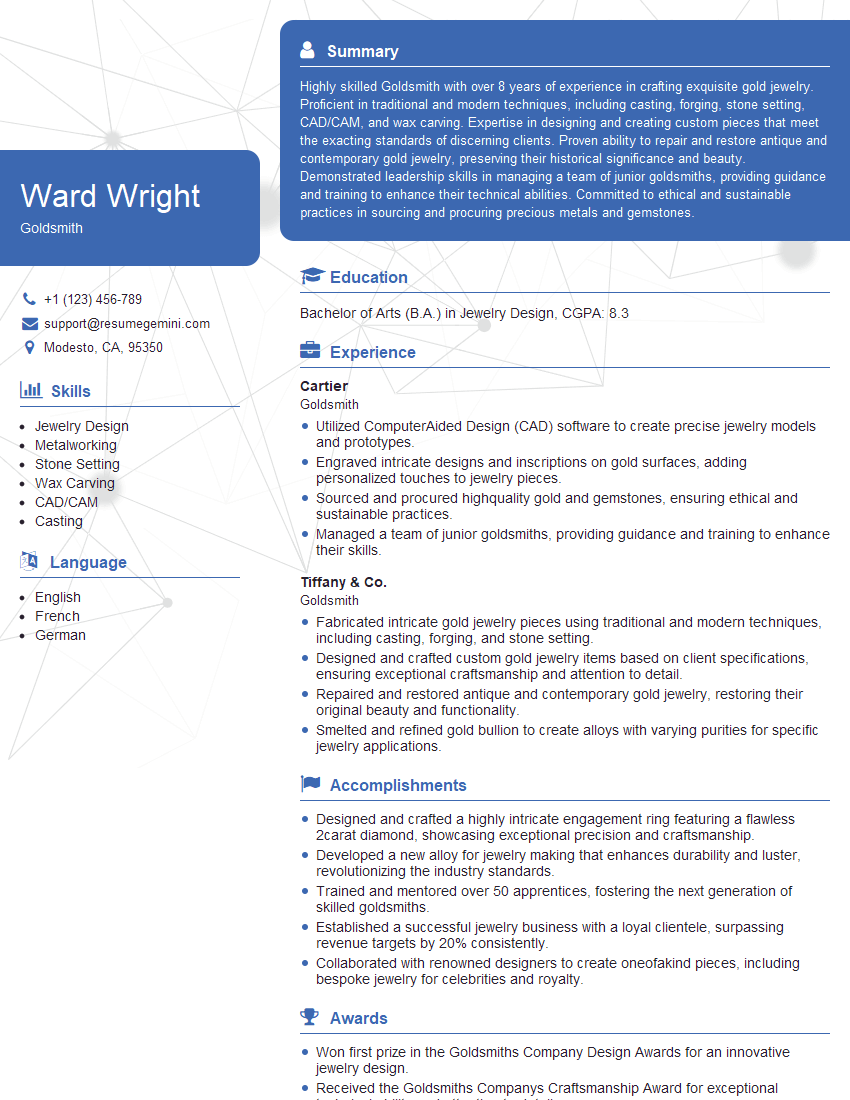
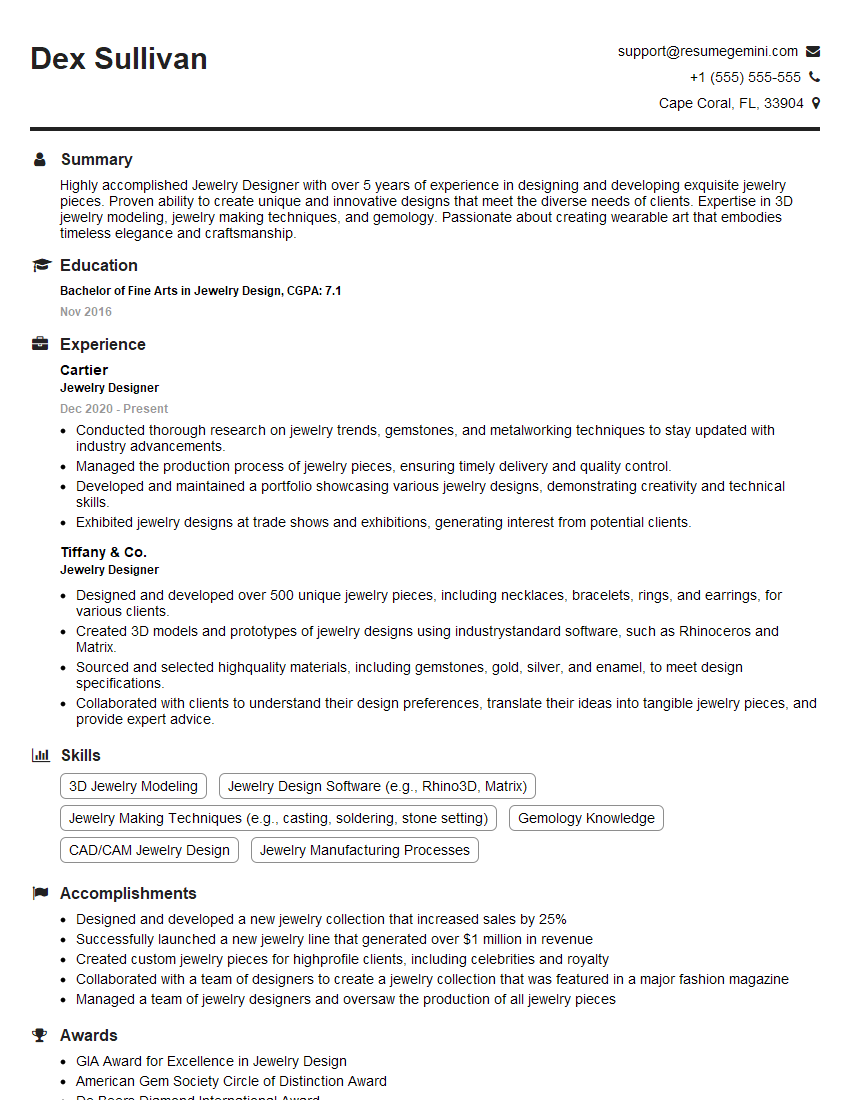
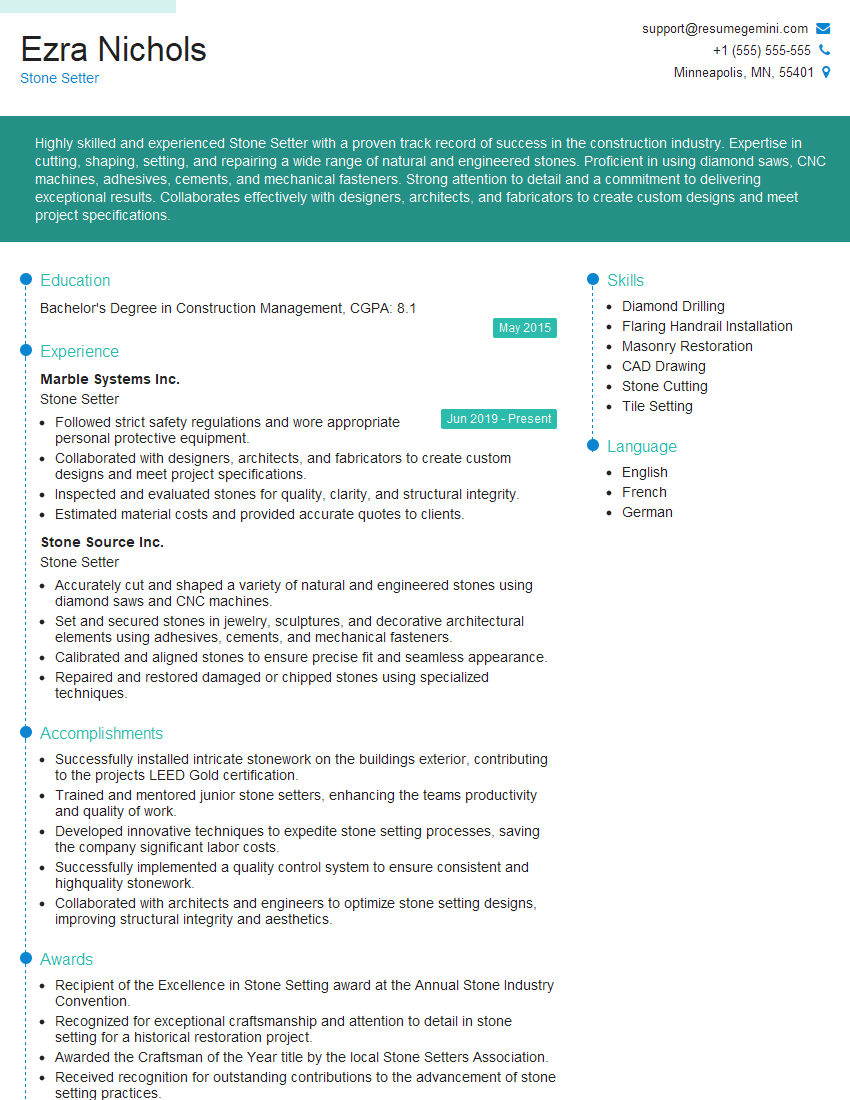
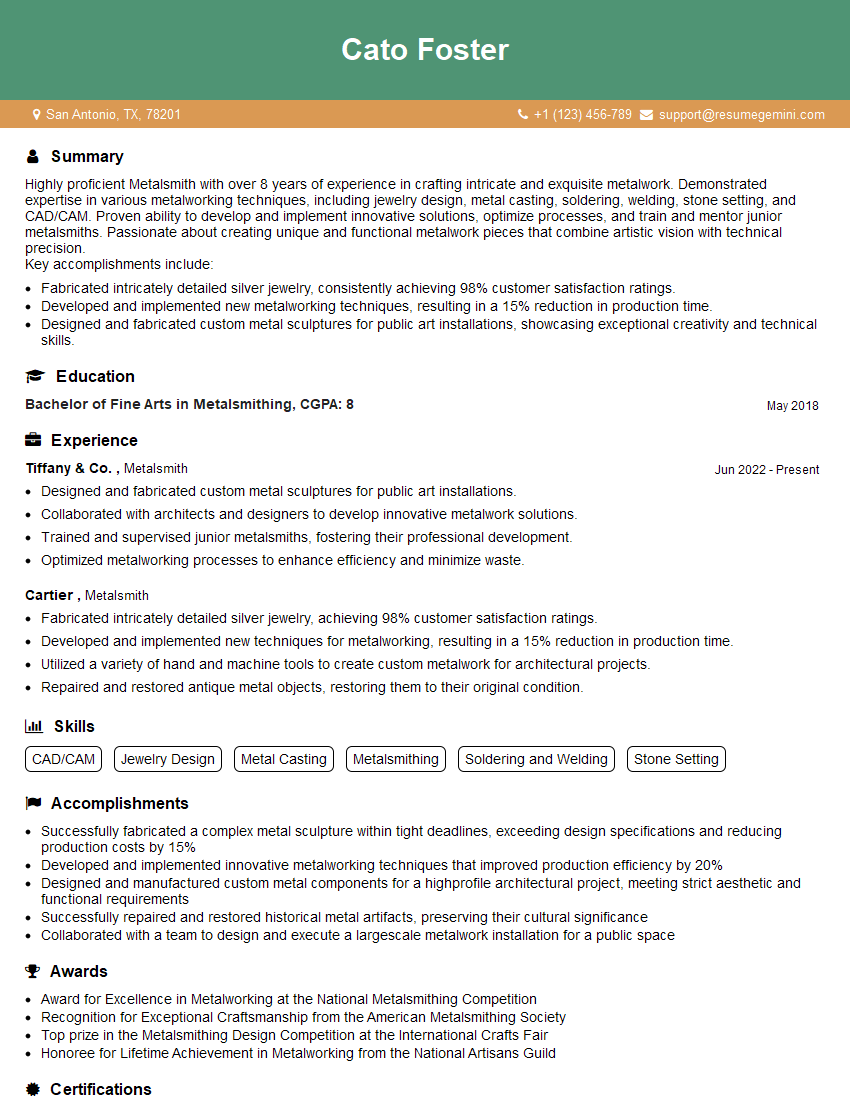
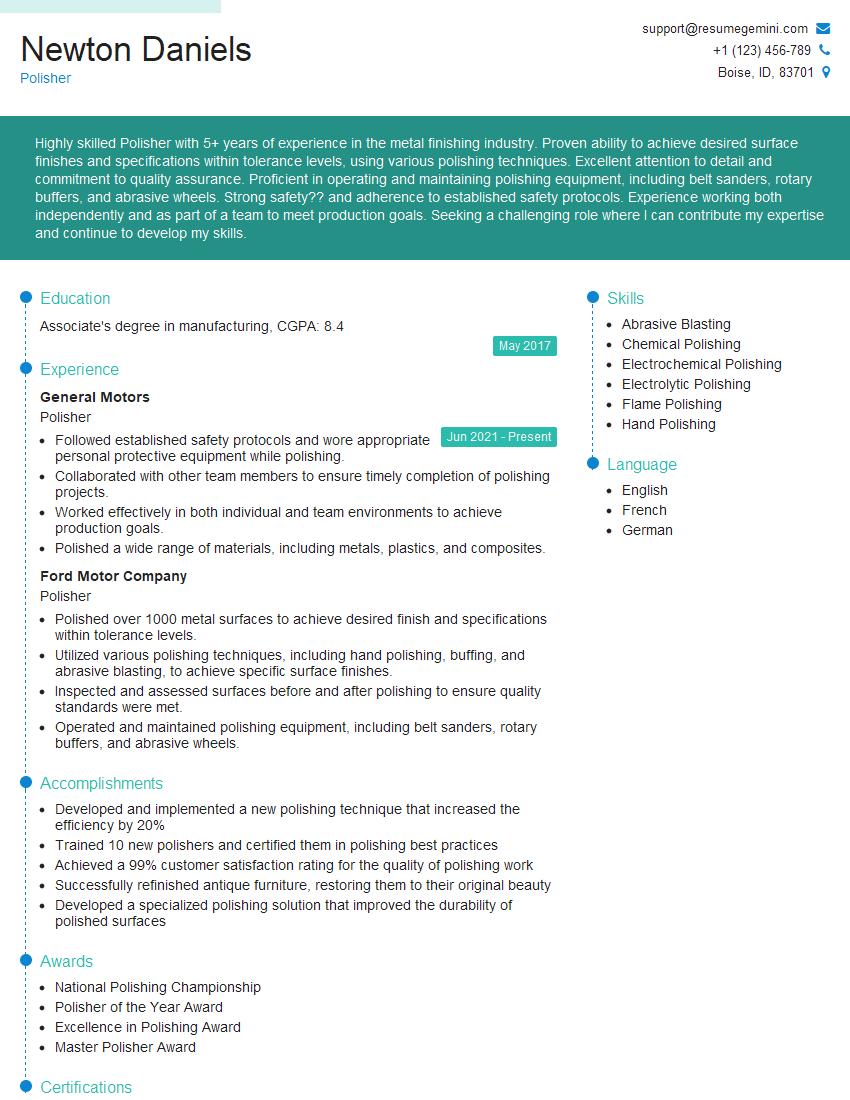
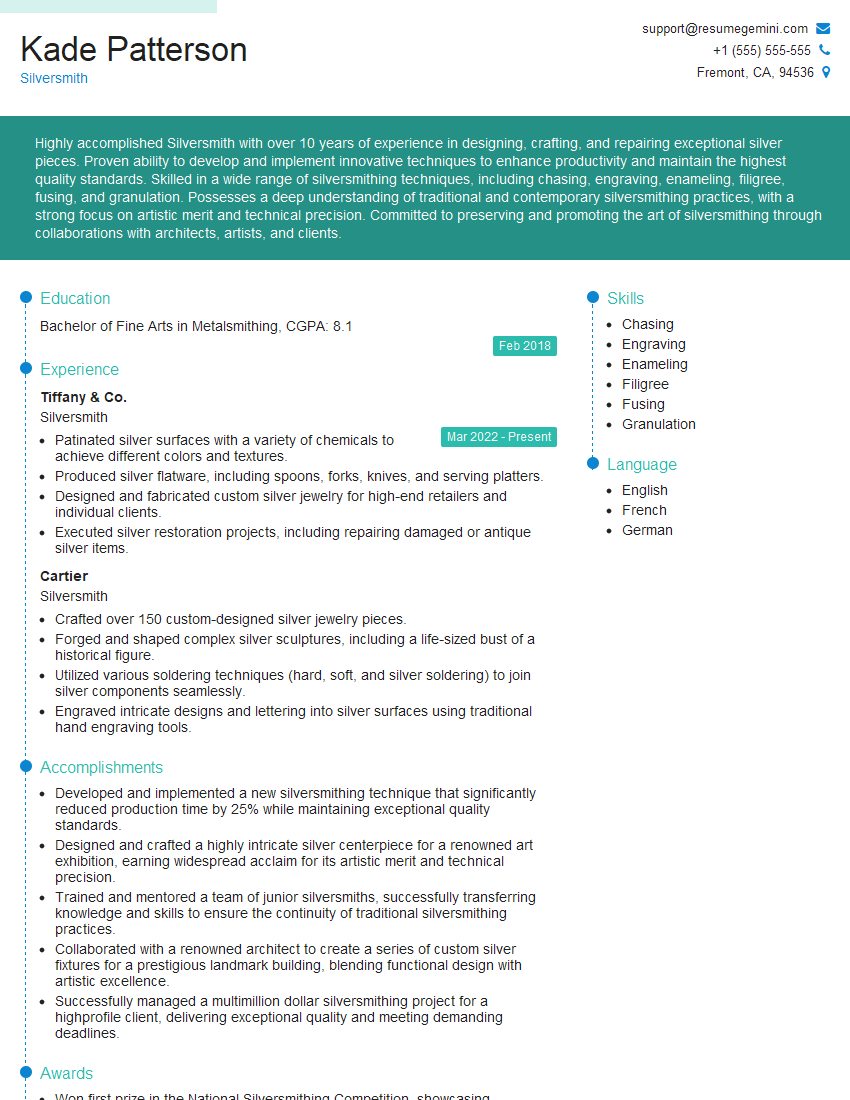
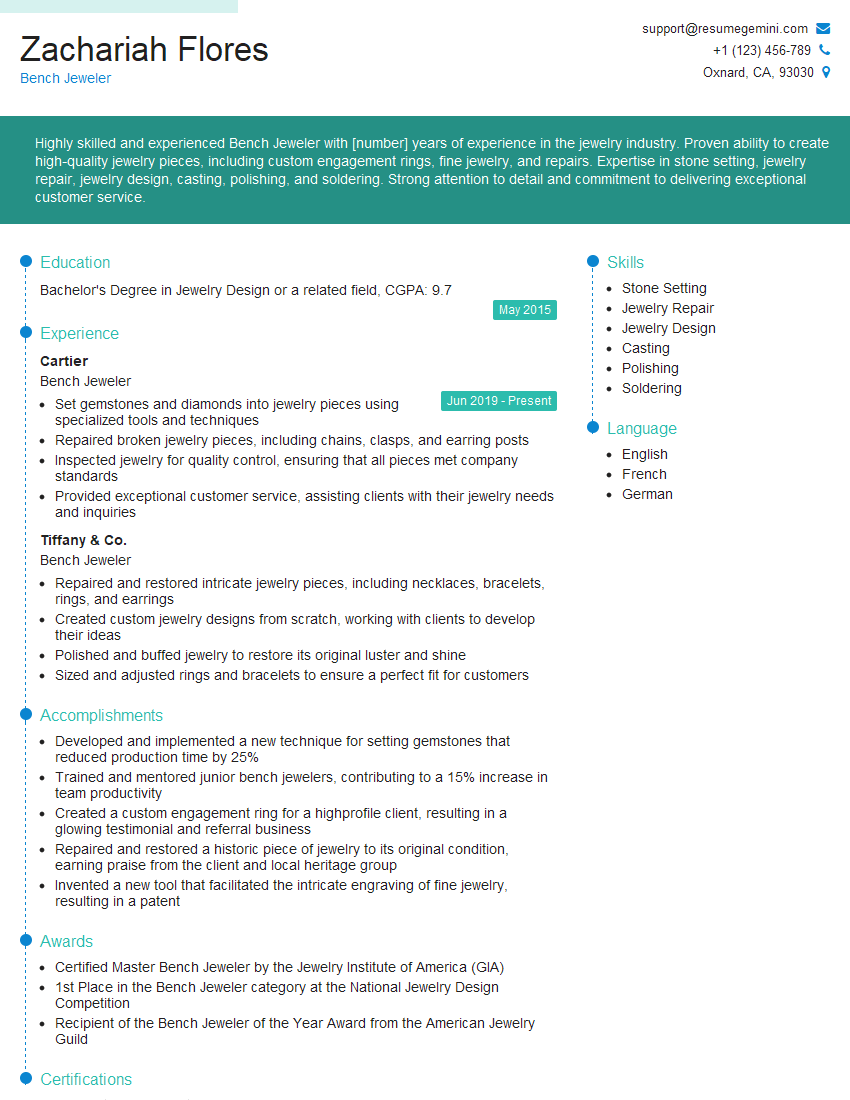
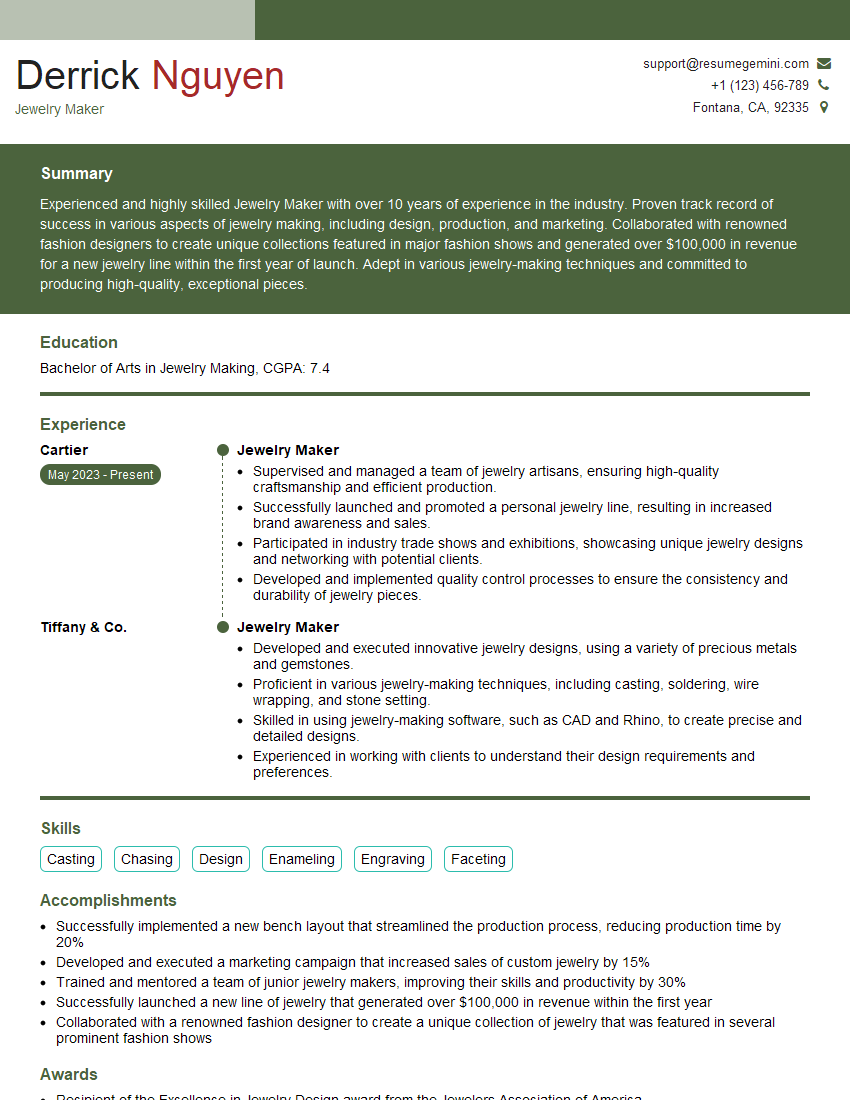
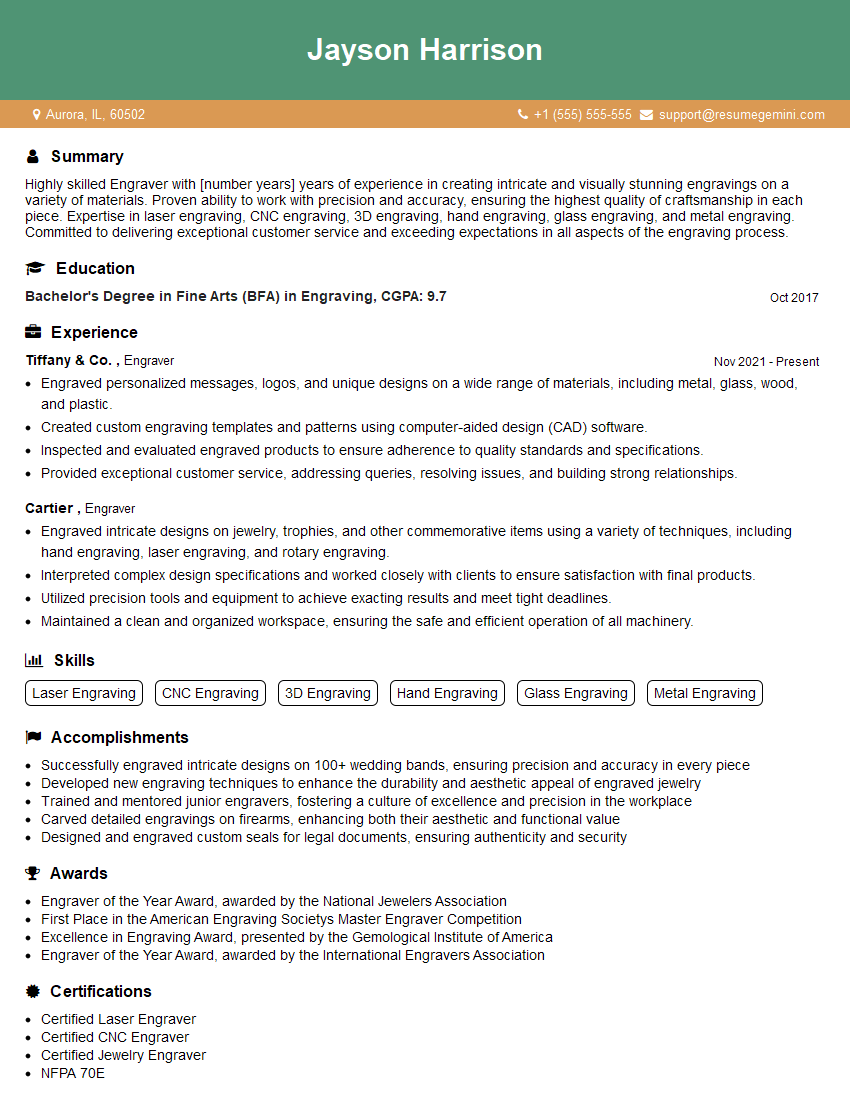
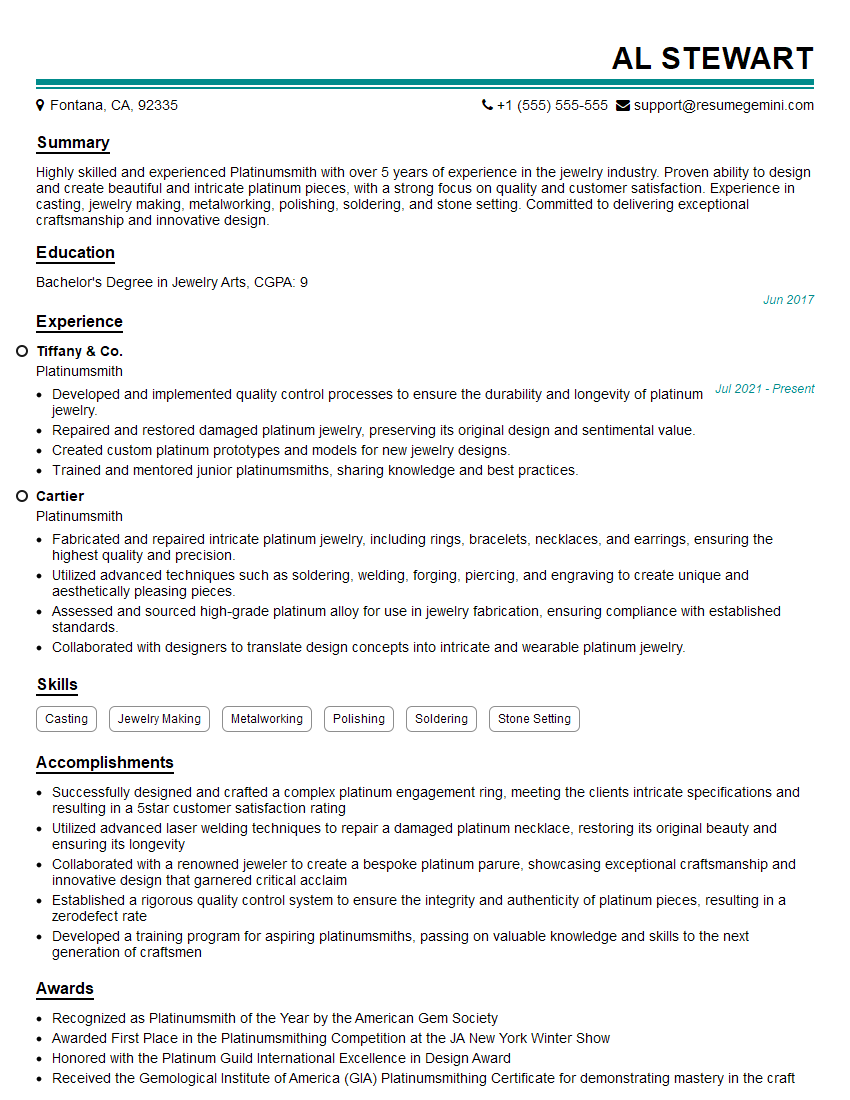
Mastering precious metalworking opens doors to a rewarding career with diverse opportunities for growth and specialization. To stand out, create a resume that showcases your skills effectively. An ATS-friendly resume is crucial for getting your application noticed by recruiters. ResumeGemini is a trusted resource that can help you build a compelling and professional resume tailored to the precious metalworking industry. Examples of resumes tailored to Precious Metalworking are available to help you get started.

Explore more articles
Users Rating of Our Blogs
Share Your Experience
We value your feedback! Please rate our content and share your thoughts (optional).
What Readers Say About Our Blog
Very informative content, great job.
good