Interviews are opportunities to demonstrate your expertise, and this guide is here to help you shine. Explore the essential Precision Targeting and Fire Control interview questions that employers frequently ask, paired with strategies for crafting responses that set you apart from the competition.
Questions Asked in Precision Targeting and Fire Control Interview
Q 1. Explain the principles of precision-guided munitions (PGMs).
Precision-guided munitions (PGMs) are weapons systems designed to deliver lethal effects with a high degree of accuracy. Unlike unguided munitions that rely on proximity to the target, PGMs use various guidance systems to correct their trajectory mid-flight, ensuring they hit the intended target even at long ranges. This accuracy is crucial for minimizing collateral damage and maximizing the effectiveness of military operations. The core principles revolve around three key elements: guidance, navigation, and control. Guidance involves the system’s ability to sense its position relative to the target and deviations from the intended trajectory. Navigation involves determining the munition’s location and orientation. Finally, control entails the mechanisms for correcting trajectory using actuators like fins or thrusters.
For example, a laser-guided bomb uses a laser designator to illuminate the target. The bomb’s seeker then follows the laser beam to the target, allowing for very precise targeting, even in challenging conditions. Another example is GPS-guided munitions that use satellite signals for navigation to the target coordinates.
Q 2. Describe different types of targeting sensors and their applications.
Targeting sensors are the eyes and ears of a precision-guided weapon. They provide the crucial information needed for accurate targeting. Several types exist, each with specific applications:
- Electro-Optical (EO) Sensors: These include cameras (visible and infrared) and laser rangefinders. Visible cameras provide real-time imagery, while infrared cameras detect heat signatures, useful for finding targets at night or obscured by foliage. Laser rangefinders precisely measure the distance to the target. EO sensors are widely used for identifying targets before an attack and guiding munitions like laser-guided bombs.
- Infrared (IR) Seekers: These passively detect the infrared radiation emitted by a target. They’re very effective in low-light conditions and can discriminate between targets based on their thermal signatures. Many air-to-air and surface-to-air missiles utilize IR seekers.
- Radar Seekers: These emit radio waves and detect the reflections to locate and track targets. Radar can work in all weather conditions, making it valuable for long-range engagements. Examples include radar-guided missiles and anti-tank guided missiles.
- GPS Receivers: These use satellite signals to determine the munition’s position. They are fundamental for GPS-guided bombs and other precision weapons. The data is then used to correct the munition’s flight path to hit the target’s pre-programmed coordinates.
- Millimeter-Wave (MMW) Sensors: These sensors use high-frequency radio waves that provide fine details about a target’s shape and characteristics, even under adverse weather conditions. This makes them effective for target identification and tracking.
Q 3. What are the limitations of various targeting systems?
Targeting systems, despite their advancements, face limitations. These limitations can impact the overall effectiveness and precision of the weapon system:
- Environmental Factors: Adverse weather conditions like fog, rain, snow, or dust can severely degrade the performance of electro-optical and millimeter-wave sensors. Similarly, atmospheric interference can affect GPS signal reception.
- Jamming and Deception: Electronic countermeasures (ECM) such as jamming can disrupt the functioning of radar and GPS-guided munitions. Targets can also use camouflage or deceptive techniques to evade detection.
- Target Characteristics: The size, shape, and material of the target influence its detectability and the effectiveness of different targeting sensors. Small or camouflaged targets are much harder to acquire and engage.
- Sensor Limitations: Each sensor type has its own range, resolution, and field of view. This means that they may not always be ideal for all scenarios. Sensor fusion (combining data from multiple sensors) can help mitigate this, but it adds complexity.
- Computational Constraints: Sophisticated algorithms and real-time processing are essential for precise targeting. Limits in processing power or communication bandwidth can slow down the system or reduce its accuracy.
Q 4. How does GPS affect precision targeting accuracy?
GPS plays a vital role in achieving precision targeting accuracy. By providing extremely accurate positional information (latitude, longitude, and altitude), GPS allows munitions to navigate directly to pre-programmed coordinates. The accuracy of the targeting is directly tied to the accuracy of the GPS signal. However, the accuracy is not solely dependent on the GPS itself. Several factors influence the overall accuracy:
- Signal Integrity: Atmospheric conditions, signal obstructions, and intentional jamming can degrade GPS signal quality, leading to errors in positioning.
- GPS Receiver Quality: The quality of the GPS receiver in the munition affects how well it can process the signal and determine its location. Higher-end receivers typically offer better accuracy.
- Error Propagation: Small errors in GPS positioning can accumulate over time, potentially leading to larger deviations from the intended target. Sophisticated navigation algorithms help to mitigate this effect.
- Target Dynamics: If the target is moving, the timing and accuracy of the impact are affected. This requires predictions of the target’s future location, which can introduce further error.
In summary, while GPS significantly enhances precision targeting, it is crucial to consider and account for these limitations to ensure that the weapon system delivers the desired level of accuracy.
Q 5. Explain the concept of circular error probable (CEP).
Circular Error Probable (CEP) is a statistical measure used to express the accuracy of a weapon system. It represents the radius of a circle within which 50% of the munitions fired will land. A smaller CEP indicates higher accuracy. For example, a CEP of 10 meters means that half of the munitions will land within a 10-meter radius of the target point. CEP is commonly used to compare the performance of different weapon systems. It’s a crucial metric for assessing the effectiveness and precision of a weapons system. It doesn’t provide information on the distribution of the other 50% of impacts, meaning it doesn’t reflect the full spread of the shots.
For instance, a missile with a CEP of 5 meters is considerably more precise than one with a CEP of 50 meters. This information is vital in planning military operations and minimizing unintended damage.
Q 6. Describe the process of target acquisition and designation.
Target acquisition and designation is a critical process involving the identification, location, and confirmation of a target before engaging with it. It often involves a sequence of steps:
- Intelligence Gathering: This involves collecting information about potential targets, including their location, size, and other characteristics. This may involve human intelligence (HUMINT), signals intelligence (SIGINT), or imagery intelligence (IMINT).
- Target Identification: Using the gathered intelligence and sensor data, the target is identified and verified. This often involves comparing the observed characteristics with known intelligence.
- Target Location: Once the target is identified, its precise location is determined using various sensors such as radar, EO/IR systems, or GPS.
- Target Designation: This is the process of communicating the target’s location and other relevant information to the weapon system. This may involve using laser designators, GPS coordinates, or other communication methods.
- Confirmation: Prior to launch or firing, the target’s identification and location should be confirmed to ensure that the intended target is actually engaged and that collateral damage is minimized. This often involves a ‘re-confirmation’ stage involving multiple sensors and operators.
Throughout this process, human judgment and experience are essential to ensure the accuracy and safety of the engagement.
Q 7. Discuss different fire control algorithms and their advantages/disadvantages.
Fire control algorithms are sophisticated mathematical models that control the weapon system’s aiming and firing process to hit the target accurately. Many different algorithms exist, each with advantages and disadvantages:
- Proportional Navigation (PN): This is a common guidance algorithm that calculates the necessary control inputs based on the relative velocity between the missile and the target. It’s relatively simple but effective for intercepting moving targets. It’s susceptible to certain types of maneuvers by the target.
- Augmented Proportional Navigation (APN): Improves upon PN by adding terms that account for target maneuvers. This improves performance against agile targets, but adds complexity.
- Optimal Control Algorithms: These algorithms optimize the control inputs based on a cost function that considers fuel consumption, maneuverability constraints, and accuracy. These algorithms are computationally more expensive than simpler algorithms like PN but can provide better accuracy in complex scenarios.
- Predictive Algorithms: These algorithms attempt to anticipate the future position of the target and adjust the weapon’s trajectory accordingly. They are essential when engaging rapidly moving or maneuvering targets but may also be affected by inaccurate target motion prediction.
The choice of fire control algorithm depends on factors such as the type of weapon, the characteristics of the target, and the environmental conditions. Modern systems often use a combination of algorithms and advanced sensor data fusion techniques to improve accuracy and robustness.
Q 8. Explain the role of inertial navigation systems (INS) in precision targeting.
Inertial Navigation Systems (INS) are crucial for precision targeting because they provide continuous, independent measurement of a projectile’s or platform’s position, velocity, and orientation. Imagine a sophisticated, self-contained GPS that doesn’t rely on external signals. This is essentially what an INS does. It uses highly sensitive accelerometers and gyroscopes to track changes in movement and rotation. By integrating these measurements over time, the INS calculates its own position and orientation relative to a known starting point. This is especially valuable in environments where GPS signals might be jammed or unavailable.
In the context of precision targeting, the INS data feeds into the fire control system. The system uses this information to compensate for the platform’s movement, ensuring that the projectile’s trajectory is adjusted accurately to hit the intended target. For example, if a ship is firing a missile while rolling slightly, the INS data will help compensate for this movement to achieve a pinpoint strike.
Different types of INS exist, each with varying levels of accuracy and complexity. Fiber optic gyroscopes (FOG) and ring laser gyroscopes (RLG) are common in high-precision systems. The accuracy of the INS directly impacts the precision of the targeting solution; a more accurate INS leads to a more precise strike.
Q 9. How does atmospheric conditions affect projectile trajectory and targeting accuracy?
Atmospheric conditions significantly affect projectile trajectory and targeting accuracy. Think of throwing a ball on a windy day – the wind pushes it off course. Similarly, projectiles experience forces from wind, temperature, and air density changes.
Wind introduces lateral and vertical forces, pushing the projectile off its intended path. Strong headwinds, for instance, will decrease the projectile’s range. Crosswinds will cause lateral deflection. The magnitude and direction of the wind must be measured and accounted for in the fire control calculations.
Temperature affects air density. Warmer air is less dense, leading to reduced drag on the projectile, resulting in a longer range than predicted under standard conditions. Conversely, colder, denser air increases drag, reducing the range.
Air density itself is also affected by altitude and humidity. Higher altitudes have lower air density, reducing drag. Higher humidity increases air density, increasing drag. These factors, often subtle individually, can accumulate and create significant deviations from the intended trajectory, reducing accuracy. Sophisticated fire control systems utilize weather sensors and ballistic models to compensate for these effects.
Q 10. What are the key components of a fire control system?
A fire control system is essentially the brain of a weapon system, responsible for calculating the precise aiming solution necessary to hit a target. It integrates various inputs to determine the necessary launch parameters, such as angle, elevation, and fuse settings.
Key components typically include:
- Target acquisition and tracking system: This identifies and continuously monitors the target’s position, often using radar, laser rangefinders, or electro-optical sensors.
- Weapon platform sensors: These provide data about the weapon system’s position, orientation, and movement (e.g., INS, GPS, and other navigational aids).
- Ballistic computer: The heart of the system, this processes data from various sources (target location, environmental conditions, weapon characteristics) to calculate the firing solution.
- Actuators: These physically adjust the weapon’s aiming mechanism (e.g., elevation and azimuth) to align with the calculated firing solution.
- Command and control interface: This allows operators to input target data, select weapon type, and monitor the fire control system’s operation.
- Data link: Enables communication between the fire control system and other systems, such as targeting systems on other platforms.
The complexity of a fire control system can vary widely, depending on the sophistication of the weapon and its intended use.
Q 11. Describe the different types of fuses used in precision-guided munitions.
Precision-guided munitions (PGMs) use various types of fuses to initiate detonation at the optimal moment. The choice of fuse depends on the target type, the desired effect, and the PGM’s guidance system.
- Impact fuses: These detonate upon contact with the target. Simple and reliable, they are suitable for hard targets.
- Proximity fuses: These detonate when the projectile comes within a predetermined distance of the target, maximizing the blast’s effectiveness. Useful for soft targets and area denial.
- Time fuses: These detonate after a set time delay, providing a predictable detonation time. Less precise than other fuse types.
- Point detonating fuses: These initiate detonation at the projectile’s nose, ideal for penetrating hard targets.
- Delay fuses: These introduce a delay between impact and detonation, allowing penetration before explosion (e.g., bunker busters).
Many PGMs use sophisticated electronic fuses that can combine these functionalities, offering greater flexibility and control. These advanced fuses often incorporate sensors such as accelerometers and magnetometers for enhanced performance and safety.
Q 12. Explain the concept of predictive targeting.
Predictive targeting involves anticipating a target’s future location based on its current trajectory and other relevant factors. Instead of aiming at the target’s current position, the weapon is aimed at where the target is *predicted* to be when the projectile arrives. Think of shooting a moving duck – you don’t aim directly at where it is, but rather where it will be by the time the shot reaches its destination.
This technique is crucial when dealing with fast-moving targets like aircraft or missiles. Predictive targeting requires accurate target tracking, precise projectile ballistics modelling, and real-time calculations. Several algorithms and prediction models are employed, accounting for factors like target speed, acceleration, maneuverability, wind conditions, and projectile flight time. This results in a significant improvement in the chances of successfully engaging the moving target.
The accuracy of predictive targeting depends heavily on the quality of the tracking data and the sophistication of the prediction algorithms. The better the prediction, the higher the probability of hitting the moving target.
Q 13. How do you account for windage and drift in fire control calculations?
Windage and drift are significant factors affecting projectile trajectory that must be accounted for in fire control calculations. They represent the deviations caused by external forces.
Windage is the lateral deflection of a projectile due to crosswinds. It’s directly proportional to the wind speed and the projectile’s time of flight. A strong crosswind will cause a large windage correction. The fire control system uses wind speed and direction data from meteorological sensors (e.g., anemometers) to calculate the necessary correction in the aiming solution. This involves adjusting the firing angle and direction to compensate for the wind’s influence on the projectile.
Drift is a more complex phenomenon, mostly associated with spinning projectiles. Due to the Magnus effect (a physical force that arises from the interaction between a spinning object and a surrounding fluid), the projectile experiences a lateral force causing it to drift away from its initial trajectory. The magnitude of drift depends on the projectile’s spin rate, its shape, and the air density. Fire control systems incorporate models to predict drift and incorporate the necessary corrections into the firing solution.
Both windage and drift corrections are applied by the ballistic computer within the fire control system, ensuring the projectile’s trajectory is adjusted to hit the intended target.
Q 14. Describe the process of conducting a fire control system test and evaluation.
Testing and evaluating a fire control system is a rigorous process, ensuring its accuracy, reliability, and overall effectiveness. It usually involves a series of tests conducted in controlled environments, progressing towards increasingly realistic scenarios.
The process typically includes:
- Component-level testing: Individual components like sensors, actuators, and the ballistic computer are thoroughly tested to verify their functionality and performance.
- System-level testing: The integrated fire control system is tested to ensure seamless interaction between its components. This often involves simulating various scenarios and evaluating the system’s response.
- Environmental testing: The system is exposed to various environmental conditions (extreme temperatures, humidity, vibration, etc.) to check its robustness and reliability under stressful conditions.
- Live-fire testing: This crucial phase involves firing live rounds under controlled conditions to validate the system’s accuracy and precision. Data is meticulously collected and analyzed to assess the system’s performance against predetermined metrics.
- Operational testing: After successful completion of the previous stages, the system undergoes field tests under realistic operational conditions. This helps identify and rectify any unforeseen issues.
Throughout the testing process, data is continuously analyzed and compared to expected performance metrics. Any discrepancies are investigated and corrective actions are taken. Detailed reports documenting the test results and findings are crucial in the certification and deployment of the fire control system.
Q 15. Explain how you would troubleshoot a malfunctioning fire control system.
Troubleshooting a malfunctioning fire control system requires a systematic approach, combining technical expertise with a methodical process. My first step would be to isolate the problem. This involves checking for obvious issues – are there any visible damage or loose connections? Are there any error codes displayed on the system’s interface? I’d then consult the system’s diagnostic tools and manuals. Most modern fire control systems have built-in self-diagnostic capabilities that can pinpoint the source of the malfunction. For example, a gyroscope malfunction might lead to inaccurate targeting solutions.
Next, I’d proceed through a series of tests, starting with the simplest components and moving towards more complex subsystems. This might involve checking sensor readings (e.g., radar, laser rangefinder), verifying the accuracy of the internal computer calculations, and testing the actuators that control the weapon platform. The troubleshooting process is iterative; I’d test and retest after each step to see if the problem has been solved or if further investigation is needed. Documentation is critical throughout this entire process. I meticulously record every step, test result, and any modifications made. This documentation helps trace the path of the troubleshooting process and prevents repetitive work if the issue recurs. In a real-world scenario, I might also involve other team members, leveraging their expertise if the malfunction requires specialized knowledge.
For instance, during a field exercise, we experienced a malfunction in the predictive targeting module of our system. By carefully following the diagnostic procedures and examining the system logs, we identified a software bug causing incorrect calculations in the ballistic model. A quick software patch resolved the issue, and the system was back online within an hour.
Career Expert Tips:
- Ace those interviews! Prepare effectively by reviewing the Top 50 Most Common Interview Questions on ResumeGemini.
- Navigate your job search with confidence! Explore a wide range of Career Tips on ResumeGemini. Learn about common challenges and recommendations to overcome them.
- Craft the perfect resume! Master the Art of Resume Writing with ResumeGemini’s guide. Showcase your unique qualifications and achievements effectively.
- Don’t miss out on holiday savings! Build your dream resume with ResumeGemini’s ATS optimized templates.
Q 16. What are the safety procedures for handling and deploying precision-guided munitions?
Safety is paramount when handling and deploying precision-guided munitions (PGMs). Our procedures begin with rigorous training on handling and arming procedures. This training covers everything from recognizing the munition type and its unique safety features to understanding the risks associated with mishandling. We always follow the manufacturer’s safety instructions meticulously.
Before deployment, a thorough pre-flight check is mandatory to ensure that the PGMs are correctly armed and functional. This includes visual inspections, functional checks of the guidance systems, and verification of the target data. The deployment area must be carefully selected to minimize the risk of collateral damage. This involves assessing potential hazards and considering environmental factors like weather conditions. Clear communication protocols are established to coordinate the deployment and to ensure everyone in the vicinity is aware of the operation.
We utilize specialized equipment to handle PGMs, such as lifting devices and protective gear, to prevent accidental detonation or injury. Safe storage and transportation are also crucial, involving secure containers and adherence to strict transportation regulations. Regular maintenance and inspections of handling and deployment equipment are conducted to ensure their reliability and safety. Failure to adhere to these procedures can lead to serious injury or even death, underscoring the importance of rigorous adherence to these protocols.
Q 17. Describe your experience with simulation and modeling of fire control systems.
I have extensive experience using simulation and modeling software to analyze and improve fire control systems. I’ve worked with both commercial and custom-built simulation tools. My experience includes using discrete event simulation software to model complex scenarios, testing various targeting algorithms, and predicting system performance under diverse operational conditions. I’ve also employed high-fidelity physics-based simulations, incorporating factors such as wind, terrain, and target movement to generate realistic results. This allows for rigorous testing and optimization of the fire control system without the risks and expenses involved in live-fire exercises.
For instance, in one project, we used a high-fidelity 6-DOF (six degrees of freedom) simulation to model the effects of atmospheric conditions on projectile trajectory. The simulation helped us to refine our targeting algorithms to compensate for the impact of wind and temperature variations, significantly improving the accuracy of our precision-guided munitions. We also use modeling to evaluate the effectiveness of different sensor configurations and fusion algorithms. By simulating various scenarios, we can determine the optimal combination of sensors to achieve the desired level of targeting accuracy.
Q 18. What programming languages are you proficient in and how have you used them in fire control or targeting projects?
My proficiency includes C++, Python, and MATLAB. C++ is frequently used for developing real-time control systems due to its speed and efficiency. I’ve utilized C++ in several projects to design and implement low-level algorithms for fire control systems, focusing on real-time performance and memory optimization. For example, I developed a Kalman filter in C++ for sensor fusion, improving target tracking accuracy. // Example C++ Kalman filter code snippet (simplified): x = x + K * (z - H * x);
Python is a powerful tool for data analysis, visualization, and prototyping. I’ve used it extensively for analyzing large datasets of targeting data, identifying patterns, and evaluating the performance of different targeting algorithms. MATLAB is excellent for its mathematical computing capabilities and visualization tools. It has been particularly useful for designing and simulating complex control systems, as well as generating detailed performance reports.
Q 19. Discuss your experience with different types of targeting software.
My experience spans several types of targeting software, from basic ballistic calculators to advanced, AI-driven systems. I’ve worked with software that integrates diverse sensor data, predicts projectile trajectories, and calculates firing solutions for different weapon systems. I’ve used software with digital map integration, enabling precise target location and course correction. I’ve also used software incorporating sophisticated algorithms for target recognition and tracking, improving engagement success rate even in complex environments. Furthermore, I’ve encountered software specifically designed for air-to-ground, ground-to-ground, and naval applications, each requiring a unique understanding of the specific challenges presented.
The use of these software systems requires a comprehensive understanding of their functionalities and limitations. Knowing which targeting solution is most appropriate for a given scenario based on the available resources and the nature of the target is critical to mission success. For instance, in one project, we compared the performance of several targeting algorithms using simulated data, and then selected the one that proved most robust and accurate in diverse scenarios.
Q 20. How do you ensure the accuracy and reliability of targeting data?
Ensuring the accuracy and reliability of targeting data involves a multi-layered approach. Firstly, data validation is crucial. We use techniques such as checksums and error-correction codes to detect and correct errors during data transmission and storage. Data redundancy plays an important role; we often use multiple sensors to gather information about the same target and compare the data to identify and discard any outliers. Data fusion techniques combine information from multiple sources to improve the overall accuracy and reliability of the targeting solution.
Regular calibration and maintenance of sensors and equipment are also critical. We follow rigorous calibration procedures to maintain the accuracy of our sensors, and we perform regular preventative maintenance to minimize the risk of malfunctions. The development and implementation of rigorous quality control procedures is essential. These procedures involve both automated checks during data processing and manual verification steps, ensuring the quality of the information employed for targeting.
Finally, simulations play a pivotal role in validating the accuracy of the data and the targeting process itself. We employ simulated scenarios to test the performance of the entire system, identifying potential vulnerabilities and improving overall effectiveness before deployment.
Q 21. Explain the concept of sensor fusion in targeting.
Sensor fusion is a critical aspect of modern targeting systems, where data from multiple sensors are combined to provide a more complete and accurate picture of the target. Imagine trying to describe an object using only one sense: you might miss crucial details. Sensor fusion is analogous to using multiple senses – sight, sound, touch – to build a holistic understanding.
In targeting, we use different sensors, such as radar, infrared cameras, and laser rangefinders, to collect data about a target. Each sensor provides a unique perspective and may have its own limitations. For example, radar is excellent for detecting targets at long range but can struggle in bad weather. An infrared camera excels in detecting heat signatures but may be affected by atmospheric interference. Sensor fusion algorithms combine the data from these different sensors, leveraging their strengths and mitigating their weaknesses to generate a more comprehensive and reliable target profile. This leads to improved target detection, tracking, and classification accuracy. Advanced algorithms like Kalman filters and Bayesian networks are often used to manage and combine sensor data, providing increased accuracy and robustness compared to any single sensor alone.
Q 22. Discuss the ethical considerations related to precision targeting.
Precision targeting, while offering significant advantages in minimizing collateral damage, presents complex ethical dilemmas. The core issue revolves around balancing military necessity with the inherent risk of civilian casualties. Even with the most advanced technology, there’s always a margin of error, and the potential for unintended harm is ever-present.
One crucial ethical consideration is the definition of a legitimate military target. The principle of distinction – differentiating between combatants and civilians – is paramount. However, this distinction can be blurry in modern conflict zones, particularly when dealing with blended populations or enemy combatants utilizing civilian infrastructure. For example, a factory producing military equipment could also employ civilian workers, raising questions about the acceptable risk of civilian casualties during a strike.
Another ethical concern involves the use of autonomous weapons systems (AWS). The potential for algorithms to make life-or-death decisions without human oversight introduces profound ethical challenges, particularly regarding accountability and the potential for unintended escalation. The debate surrounding responsible development and deployment of AWS is ongoing and crucial for ensuring ethical conduct in warfare.
Furthermore, the potential for bias in targeting algorithms, arising from biased training data or flawed design, is a major concern. This could lead to disproportionate harm to specific populations, exacerbating existing inequalities. Therefore, rigorous testing and validation are vital to minimize such biases.
Ultimately, the ethical use of precision targeting necessitates a continuous evaluation of the technology’s limitations, a commitment to transparency and accountability, and a robust framework for legal and moral decision-making.
Q 23. How do you stay up to date with the latest advancements in precision targeting technology?
Staying current in the rapidly evolving field of precision targeting requires a multi-pronged approach. I actively participate in professional organizations like the Association of Old Crows and attend relevant conferences and seminars to hear from leading experts and learn about emerging technologies. These events often feature presentations on cutting-edge advancements in sensor technology, data processing algorithms, and weapon system integration.
I also subscribe to key industry publications and journals, which regularly publish articles and research papers on the latest developments in precision-guided munitions (PGMs), targeting software, and related fields. This keeps me abreast of not just technological advances, but also the evolving doctrines and tactics employed in utilizing these technologies.
Furthermore, I maintain an extensive professional network, including colleagues, researchers, and academics, that I regularly interact with to exchange information and insights on emerging trends. The constant exchange of information with a diverse group of peers and experts ensures I have access to diverse perspectives and cutting-edge information.
Finally, I dedicate time to self-directed learning through online courses, webinars, and independent study of relevant technical literature. This continuous professional development is essential to remain a competent and knowledgeable expert in the rapidly advancing domain of precision targeting.
Q 24. Describe your experience with different types of weapon systems and their corresponding targeting requirements.
My experience encompasses a broad range of weapon systems, each with unique targeting requirements. I’ve worked extensively with air-launched precision-guided bombs (PGMs), such as the Joint Direct Attack Munition (JDAM) and Paveway series, understanding their limitations and capabilities relating to accuracy, range, and environmental factors. These systems demand accurate targeting coordinates, often derived from multiple sensor sources, along with precise navigation and guidance updates.
I’ve also been involved with artillery systems, focusing on precision-guided artillery shells incorporating GPS and inertial navigation systems. The demands here differ slightly, requiring detailed knowledge of ballistic calculations, atmospheric conditions, and terrain effects on projectile trajectory. The integration of advanced fire control systems is crucial for accurate strikes.
Furthermore, my experience includes working with naval weapon systems, such as Tomahawk cruise missiles. These pose distinct challenges involving long-range targeting, maritime navigation, and target identification in dynamic environments. Effective targeting relies heavily on real-time intelligence and sophisticated target acquisition systems.
In each case, success depends on an understanding of the system’s strengths and limitations, careful selection of appropriate munitions and the seamless integration of various sensor and communication networks to deliver the desired precision and effect.
Q 25. What is your experience with data analysis and interpretation in the context of targeting data?
Data analysis and interpretation are critical aspects of my work. I’m proficient in using various software tools and statistical methods to analyze targeting data obtained from a variety of sources, including intelligence reports, sensor data, and post-strike assessments. This includes both quantitative data like GPS coordinates and sensor readings, and qualitative information such as human intelligence reports and imagery analysis.
For instance, I might analyze sensor data to identify patterns and anomalies to determine the validity of a target location or refine the target profile. I utilize statistical techniques to assess the accuracy of targeting solutions and identify sources of error. My experience also includes utilizing Geographic Information Systems (GIS) to model terrain effects, population densities, and potential collateral damage.
A crucial aspect is validating the data’s reliability and integrity. This involves assessing data sources for potential biases, inconsistencies, and errors. Understanding these limitations is crucial for making informed decisions and avoiding potential misinterpretations that could lead to flawed targeting solutions.
My experience extends to communicating the results of data analysis clearly and concisely to both technical and non-technical audiences, ensuring everyone understands the implications of the data and its role in the targeting process. Effective visualization of data is a key aspect of this process.
Q 26. How do you handle conflicting data or information during a targeting scenario?
Conflicting data is a common challenge in targeting. The first step is identifying the source and nature of the conflict. Is it due to different sensor readings, conflicting intelligence reports, or discrepancies in data from multiple sources? A systematic approach involves a thorough review of each data source to evaluate its reliability and credibility.
I employ a tiered approach to resolve conflicts. First, I examine the inherent limitations of each data source. For example, a satellite image might lack sufficient resolution to clearly identify a target, while a human intelligence report could be inaccurate or biased. Secondly, I assess the quality of the data by looking at factors such as the timeliness, source credibility, and corroboration with other data points.
Triangulation is a key technique I utilize. This involves comparing data from multiple independent sources to confirm or refute conflicting information. If the conflict remains unresolved, I will consult with subject matter experts to help make the determination. In some cases, further intelligence gathering or sensor data might be necessary to resolve the uncertainty.
Finally, I document all conflicting data and the reasoning behind the chosen course of action. Maintaining a clear audit trail is crucial for accountability and future reference. The objective is always to prioritize minimizing risk and ensuring the greatest accuracy, even if it means delaying a strike until the conflict is resolved.
Q 27. Describe your experience in working with cross-functional teams in a targeting environment.
My experience in cross-functional teams has been extensive, as precision targeting is inherently a collaborative effort. I’ve worked closely with intelligence analysts to gather and interpret target information, ensuring accurate and up-to-date data is available. This involves coordinating with imagery analysts, signals intelligence specialists, and human intelligence sources to build a comprehensive picture of the target.
Collaboration with weapons systems officers is essential to ensure that the selected munitions are appropriate for the target and environmental conditions. This includes discussions on the optimal delivery method, the expected effects, and the mitigation of potential collateral damage.
Furthermore, I’ve regularly worked with legal advisors to ensure that all targeting decisions are compliant with the Law of Armed Conflict (LOAC) and international humanitarian law. This involves rigorous review of proposed targets to assess whether they are legitimate military objectives and whether the planned strikes are proportionate and minimize harm to civilians.
Finally, collaboration with post-strike assessment teams is vital for evaluating the effectiveness of strikes and identifying areas for improvement in targeting procedures and processes. This feedback loop is critical to continuous improvement and the refinement of targeting methods.
Effective communication, shared understanding, and mutual respect are essential elements of my collaborative work style. I value the diverse perspectives that each team member brings to the table, recognizing that a collaborative approach significantly enhances the accuracy, effectiveness, and ethical conduct of precision targeting operations.
Key Topics to Learn for Precision Targeting and Fire Control Interview
- Sensor Technologies: Understanding various sensor types (e.g., radar, lidar, infrared), their limitations, and data fusion techniques for accurate target identification and tracking.
- Fire Control Systems: Familiarity with the architecture and functionality of fire control systems, including algorithms for target acquisition, prediction, and weapon engagement.
- Ballistics and Weapon Dynamics: Knowledge of projectile motion, environmental factors influencing trajectory (wind, gravity), and weapon system characteristics impacting accuracy.
- Coordinate Systems and Transformations: Proficiency in working with different coordinate systems (e.g., geodetic, Cartesian) and performing coordinate transformations for precise targeting.
- Precision Guided Munitions (PGMs): Understanding the design, capabilities, and limitations of various PGMs, including their guidance systems and effectiveness in different scenarios.
- Target Acquisition and Recognition: Knowledge of image processing, pattern recognition, and automated target recognition techniques used in modern fire control systems.
- Error Analysis and Mitigation: Understanding sources of error in targeting and fire control systems and applying techniques to minimize their impact on accuracy and effectiveness.
- Software and Algorithms: Familiarity with programming languages and algorithms commonly used in fire control applications (e.g., Kalman filtering, trajectory optimization).
- System Integration and Testing: Understanding the process of integrating various components of a fire control system and conducting rigorous testing to ensure performance and reliability.
- Ethical Considerations: Awareness of the ethical implications of precision targeting and fire control technologies and the importance of responsible development and deployment.
Next Steps
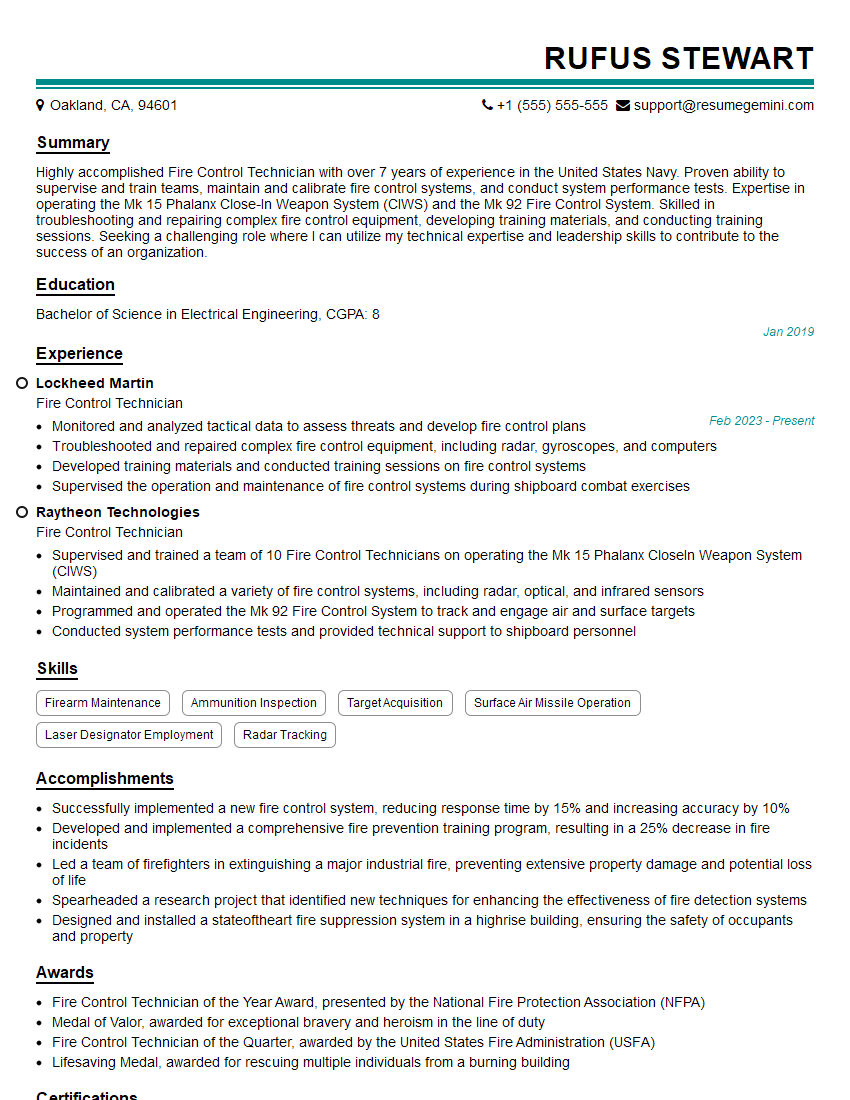
Mastering Precision Targeting and Fire Control opens doors to exciting and impactful careers in defense, aerospace, and related fields. A strong foundation in these areas significantly enhances your marketability and positions you for leadership roles. To increase your job prospects, create an ATS-friendly resume that highlights your skills and experience effectively. ResumeGemini is a trusted resource to help you build a professional and impactful resume, ensuring your qualifications shine through to potential employers. Examples of resumes tailored to Precision Targeting and Fire Control are available to guide your resume creation process.
Explore more articles
Users Rating of Our Blogs
Share Your Experience
We value your feedback! Please rate our content and share your thoughts (optional).
What Readers Say About Our Blog
Very informative content, great job.
good