The thought of an interview can be nerve-wracking, but the right preparation can make all the difference. Explore this comprehensive guide to Press Operation and Management interview questions and gain the confidence you need to showcase your abilities and secure the role.
Questions Asked in Press Operation and Management Interview
Q 1. Describe your experience with different types of printing presses (e.g., offset, digital, flexographic).
My experience encompasses a wide range of printing presses, each with its own unique strengths and challenges. I’ve worked extensively with offset printing, the workhorse of the industry, known for its high-volume, high-quality output. I’m proficient in setting up and operating both sheetfed and web offset presses, understanding the nuances of perfecting registration, ink balance, and paper handling. For shorter runs and personalized projects, my expertise extends to digital printing, particularly inkjet and toner-based systems. This involves managing workflow, calibrating color profiles, and understanding the limitations of variable data printing. Finally, I’ve gained significant experience with flexographic printing, focusing on its application in packaging and label production. This involves a deep understanding of anilox rollers, plate mounting, and the unique challenges of printing on various substrates like films and corrugated board. Each press type requires a distinct skill set, from understanding the intricacies of ink chemistry to mastering the precise adjustments needed for optimal print quality. For example, troubleshooting a ghosting issue on an offset press requires a completely different approach than resolving banding on a digital printer.
Q 2. What are your troubleshooting skills regarding common press malfunctions?
Troubleshooting press malfunctions requires a systematic and analytical approach. My process typically involves:
- Identifying the problem: Carefully observing the print defect – is it a color issue, registration problem, or a mechanical malfunction?
- Analyzing the cause: Considering factors such as ink viscosity, paper type, plate wear, or mechanical components (dampening system, rollers, etc.).
- Testing solutions: Methodically adjusting variables to pinpoint the root cause. For instance, if the problem is poor ink transfer, I might adjust the ink fountain keys or check the rollers’ condition.
- Implementing solutions: Making the necessary adjustments, whether it’s replacing a worn roller, cleaning a clogged duct, or adjusting the pressure settings.
- Monitoring results: Observing the print quality after each adjustment to ensure the issue is resolved. If not, I go through the entire process again.
For instance, I once encountered a recurring smear problem on an offset press. Through systematic troubleshooting, I discovered a worn-out blanket cylinder. Replacing it resolved the issue, demonstrating my ability to swiftly identify and resolve complex pressroom challenges.
Q 3. How do you ensure consistent print quality throughout a large production run?
Maintaining consistent print quality throughout a large production run involves meticulous attention to detail and proactive measures. This includes:
- Pre-press preparation: Ensuring accurate color proofing and plate making, verifying that the plates are properly mounted and cleaned.
- Press setup: Accurately setting up the press, paying close attention to ink density, registration, and moisture balance (in offset).
- Regular monitoring: Consistently checking the print quality throughout the run using color control devices and visual inspection, immediately addressing any deviation.
- Maintaining press conditions: Keeping the press clean and well-maintained. Regular cleaning of rollers and blankets is crucial for maintaining consistent ink transfer and image quality.
- Ink and paper control: Using consistent inks and paper stock, monitoring environmental conditions like temperature and humidity to prevent variations.
Imagine printing 10,000 brochures. Maintaining consistency requires a proactive strategy, preventing problems before they snowball into significant waste and re-work.
Q 4. Explain your experience with color management and calibration.
Color management and calibration are critical for achieving accurate and consistent color reproduction. My experience includes using colorimetric devices such as spectrophotometers and densitometers to measure and profile inks, paper, and press output. I’m proficient in using color management software to create and maintain ICC profiles, which are essential for translating digital color data to the printed output. I understand the concepts of color spaces (CMYK, RGB, etc.) and their relevance in achieving accurate color reproduction. Furthermore, I’m skilled in performing press calibrations using standardized color targets, ensuring consistent results across different printing jobs and machines. For instance, on a recent job requiring precise Pantone matching, I utilized a spectrophotometer to carefully measure and adjust ink densities to meet the client’s specifications, achieving a perfect color match across the entire print run.
Q 5. How do you manage pressroom workflow and scheduling?
Efficient pressroom workflow and scheduling are vital for maximizing productivity and meeting deadlines. My approach involves:
- Job prioritization: Determining the order of jobs based on urgency, complexity, and due dates.
- Resource allocation: Optimally assigning presses and personnel to different jobs.
- Material management: Ensuring that all necessary materials—inks, paper, plates—are readily available.
- Production tracking: Monitoring job progress and identifying any potential bottlenecks.
- Communication: Maintaining open communication with pre-press, post-press, and client teams.
I often use software like MIS (Management Information Systems) to optimize scheduling and track production efficiently. Think of it as air traffic control for the pressroom, ensuring a smooth and efficient flow of jobs.
Q 6. What are your methods for optimizing press speed and efficiency?
Optimizing press speed and efficiency requires a holistic approach focusing on both the machine and the process. This involves:
- Press maintenance: Regular preventative maintenance to minimize downtime and maximize press performance.
- Operator training: Ensuring that press operators are highly skilled and efficient.
- Workflow optimization: Streamlining processes to reduce waste and non-productive time.
- Automation: Utilizing automation features where appropriate to increase efficiency.
- Material selection: Choosing appropriate paper and inks for optimal press performance.
For example, implementing a new makeready system reduced our press setup time by 20%, resulting in a significant increase in overall efficiency. It’s about constantly looking for ways to improve and refine the process, small improvements can add up to significant gains in the long run.
Q 7. Describe your experience with pre-press procedures and their impact on press operation.
Pre-press procedures are critical for successful press operation. They directly impact print quality, efficiency, and overall cost. My experience includes working closely with pre-press teams to ensure that files are properly prepared, plates are created accurately, and color profiles are correctly managed. Key aspects include:
- File preparation: Verifying the accuracy and suitability of design files, checking for resolution, color modes, and bleed issues.
- Platemaking: Understanding different platemaking technologies and their impact on print quality and efficiency.
- Color proofing: Using color proofing methods to ensure accurate color reproduction before printing.
- Imposition: Optimizing the arrangement of pages on the printing plate to minimize waste and maximize efficiency.
A poorly prepared file can lead to significant problems on the press, such as color inconsistencies or registration issues, resulting in costly delays and waste. Close collaboration with pre-press ensures a smooth and efficient printing process from start to finish.
Q 8. How do you maintain press equipment and prevent downtime?
Press equipment maintenance is crucial for preventing downtime and ensuring consistent print quality. It’s a proactive, multi-faceted approach involving regular inspections, scheduled maintenance, and prompt repairs. Think of it like maintaining a high-performance car – regular servicing prevents major breakdowns.
- Preventive Maintenance: This includes daily checks of vital components like rollers, blankets, and impression cylinders. We lubricate moving parts, clean ink ducts, and inspect for wear and tear. A scheduled maintenance plan, often following manufacturer guidelines, involves more extensive checks and potential part replacements. For instance, we might replace worn-out impression cylinders every six months, depending on usage.
- Predictive Maintenance: We utilize data from press sensors to monitor performance. Vibration sensors, for example, can alert us to potential bearing failures before they cause a breakdown. This allows for timely repairs and minimizes disruptions.
- Corrective Maintenance: This addresses unexpected issues. A skilled press operator can often diagnose minor problems quickly, but major malfunctions require specialized technicians. Having a strong relationship with a reliable service provider is essential for minimizing downtime during repairs. For example, a sudden paper jam might require immediate troubleshooting and clearing, while a malfunctioning feeder requires the expertise of a technician.
By combining preventive, predictive, and corrective maintenance, we strive for maximum uptime and minimal disruption to the printing process.
Q 9. What safety procedures do you follow in the pressroom?
Safety is paramount in the pressroom. We adhere to strict protocols to protect ourselves and our equipment. It’s not just about following rules, but fostering a safety-first culture.
- Lockout/Tagout Procedures (LOTO): Before any maintenance or repair, we always follow LOTO procedures to prevent accidental start-ups. This ensures that power is completely disconnected and the machine is secured before anyone works on it. We use clearly labeled tags to indicate who is working on the machine and when it can be restarted.
- Personal Protective Equipment (PPE): We always wear appropriate PPE, including safety glasses, hearing protection, and gloves. The type of PPE varies depending on the task – for example, different gloves are needed for handling ink versus cleaning chemicals.
- Emergency Procedures: Everyone on the team is trained on emergency procedures, including how to use fire extinguishers, first-aid kits, and how to react in case of a power failure or other unexpected events. We conduct regular safety drills to ensure everyone is prepared.
- Housekeeping: A clean and organized pressroom is a safer pressroom. We regularly clear away debris, properly dispose of hazardous materials, and ensure proper lighting to minimize accidents.
Regular safety training and reinforcement of these procedures are essential for maintaining a safe working environment.
Q 10. How do you manage ink and paper inventory?
Effective ink and paper inventory management is critical for smooth operations and cost control. It’s a balancing act between having enough stock to meet demand and avoiding unnecessary storage costs. Think of it like a well-stocked supermarket – always enough to satisfy customers without excessive waste.
- Demand Forecasting: We analyze past printing jobs and future orders to predict demand accurately. This helps us order the right amount of ink and paper to avoid shortages or excess inventory.
- Vendor Relationships: Building strong relationships with reliable suppliers is essential for consistent supply and competitive pricing. We negotiate favorable terms and establish reliable delivery schedules.
- Inventory Tracking System: We use a computerized inventory management system to track stock levels in real-time. This allows us to monitor consumption, identify trends, and place timely orders. This system also helps us manage expiry dates for inks and other consumables.
- Storage Conditions: Proper storage is vital to maintain the quality of ink and paper. We store materials in a climate-controlled environment to prevent damage from moisture, temperature fluctuations, or light exposure.
Regular inventory checks and efficient stock rotation ensure we always have the right materials on hand.
Q 11. Explain your experience with different types of substrates.
My experience encompasses a wide range of substrates, from standard coated and uncoated papers to specialty materials like card stock, plastics, and synthetics. Each material presents unique challenges and requires adjustments to press settings.
- Paper Types: I’m proficient in handling various weights and finishes of paper, understanding their unique properties such as absorbency and surface texture. This allows for optimal ink transfer and print quality. For example, working with a heavier paper stock requires adjustments to the impression cylinder pressure to avoid crushing the paper.
- Specialty Substrates: I have experience printing on materials like vinyl, canvas, and metallic substrates. These often require specialized inks and press configurations. For example, printing on synthetic materials needs to account for higher temperatures and different ink adhesion properties.
- Substrate Compatibility: I understand the importance of selecting the right ink for the substrate. Using the wrong ink can lead to poor adhesion, smudging, or other print quality issues. For example, using a water-based ink on a plastic substrate might result in poor adhesion, while a UV-curable ink would work better.
My knowledge and experience with different substrates allows me to select the optimal settings and materials to achieve high-quality prints on various materials.
Q 12. Describe your experience with quality control and inspection procedures.
Quality control and inspection are integral to the printing process. We employ a multi-stage approach to ensure that every print job meets the highest standards. Think of it as a rigorous quality assurance process that begins at the very first step and continues until final delivery.
- Pre-press Checks: We meticulously review the digital files for errors, ensuring color accuracy and proper image resolution before the printing begins. We use color management tools to ensure consistency across different devices.
- In-Press Monitoring: During printing, we constantly monitor the output, checking for color consistency, registration, and any defects. We use specialized tools to measure density and color values.
- Post-Press Inspection: After printing, we conduct a thorough inspection of the finished product, checking for defects such as smudging, misregistration, and paper flaws. This often involves visual inspection combined with automated quality control systems.
- Statistical Process Control (SPC): We utilize SPC charts and other statistical methods to track key quality indicators over time. This helps us to identify trends and make improvements to prevent future defects.
By combining these methods, we maintain consistent high quality and meet client expectations.
Q 13. How do you address customer complaints regarding print quality?
Addressing customer complaints regarding print quality requires a systematic and professional approach. It’s about understanding the problem, finding the root cause, and providing a solution that satisfies the customer. This requires empathy and a willingness to find a fair resolution.
- Gather Information: First, we carefully gather information about the complaint. This includes details about the specific print job, the nature of the problem, and any supporting images or documentation. We might ask the customer for specifics such as the location of the defect or its frequency.
- Investigate the Root Cause: We investigate the problem using our knowledge of the printing process and quality control procedures. We might review the original digital files, check the press settings used for the job, and examine the printed sheets closely. We may even re-run the job to eliminate variables.
- Provide a Solution: Based on the investigation, we propose a solution. This might involve reprinting the job, offering a discount, or providing other forms of compensation. We aim to find a solution that is both fair and addresses the customer’s concerns.
- Follow-Up: It is crucial to follow up with the customer to ensure they are satisfied with the solution. This helps build trust and shows that we value their business.
By following this process, we can turn a negative experience into an opportunity to build stronger customer relationships.
Q 14. What metrics do you use to track press performance?
Tracking press performance involves using key metrics to assess efficiency, productivity, and quality. These metrics provide valuable insights into areas for improvement and help us make data-driven decisions. Think of it as a dashboard for the pressroom – showing key performance indicators (KPIs).
- Uptime: This measures the percentage of time the press is running versus downtime. High uptime indicates efficient operation and minimal disruptions. We strive for maximum uptime to maximize productivity.
- Speed: This measures the press’s speed in impressions per hour (IPH) or sheets per hour (SPH). It reflects the overall efficiency of the printing process. We monitor speed to optimize production and identify bottlenecks.
- Waste: This measures the amount of wasted paper or ink during a print job. Lower waste indicates efficient material utilization. We strive to minimize waste to reduce costs and environmental impact.
- Defects per Million (DPM): This tracks the number of defects per million printed sheets, reflecting print quality. A lower DPM indicates higher quality and efficiency.
- Setup Time: This measures the time required to set up the press for a new job. Shorter setup times indicate higher efficiency and improved turnaround times.
Regularly analyzing these metrics allows us to identify areas for improvement and optimize the press operation for higher productivity and quality.
Q 15. How do you handle emergency situations in the pressroom?
Handling emergencies in a pressroom requires a calm, decisive approach and a well-rehearsed emergency response plan. My first priority is always the safety of personnel. This involves immediately stopping the press, evacuating the area if necessary, and assessing the situation to determine the nature of the emergency.
For example, if a paper jam occurs, we follow a standardized procedure: turning off the press, locking out/tagging out the power, safely accessing the jammed area, clearing the jam, and performing a safety check before restarting. More serious incidents, such as a fire or equipment malfunction, necessitate contacting emergency services immediately and following established evacuation protocols. Regular drills and training ensure everyone knows their role and can respond effectively.
Beyond immediate response, post-incident analysis is crucial. We meticulously document what happened, identify contributing factors, and implement corrective actions to prevent recurrence. This might involve upgrading safety equipment, revising operating procedures, or providing additional training to operators.
Career Expert Tips:
- Ace those interviews! Prepare effectively by reviewing the Top 50 Most Common Interview Questions on ResumeGemini.
- Navigate your job search with confidence! Explore a wide range of Career Tips on ResumeGemini. Learn about common challenges and recommendations to overcome them.
- Craft the perfect resume! Master the Art of Resume Writing with ResumeGemini’s guide. Showcase your unique qualifications and achievements effectively.
- Don’t miss out on holiday savings! Build your dream resume with ResumeGemini’s ATS optimized templates.
Q 16. Describe your experience with training and supervising press operators.
Training and supervising press operators is a cornerstone of efficient and safe press operation. My approach emphasizes a combination of theoretical knowledge and hands-on practical experience. New operators begin with classroom training covering press mechanics, safety procedures, quality control, and troubleshooting common issues. This is followed by supervised practical training on the press itself, starting with simple tasks and gradually increasing complexity under close observation. I use a mentoring approach, providing regular feedback and support, addressing concerns, and fostering a culture of continuous learning.
I utilize various training methods such as demonstrations, interactive exercises, and on-the-job coaching. Regular performance reviews identify areas for improvement and tailor training to address individual needs. For example, if an operator struggles with color matching, we’ll dedicate extra time to color theory and calibration techniques. Safety is paramount and is continuously reinforced through regular safety meetings, refresher courses, and adherence to strict safety protocols. My aim is to develop highly skilled, confident, and safety-conscious operators.
Q 17. How do you stay current with advancements in printing technology?
Staying abreast of advancements in printing technology is essential for maintaining a competitive edge. I actively participate in industry conferences and trade shows, such as drupa or PrintNext, to network with peers and explore the latest innovations. I subscribe to industry publications and online resources, including technical journals and manufacturers’ websites, to learn about new equipment, software, and best practices.
Furthermore, I actively seek out training opportunities, such as vendor-provided workshops on new press technologies or software updates. Online courses and webinars are also valuable resources. I encourage my team to participate in such activities to ensure the entire pressroom benefits from the latest advancements. By adopting a proactive learning approach, we can incorporate the most efficient and effective techniques into our daily operations and maintain our position at the forefront of printing technology.
Q 18. Explain your experience with press maintenance scheduling and preventative maintenance.
Effective press maintenance scheduling and preventative maintenance are crucial for minimizing downtime and ensuring consistent print quality. I utilize a computerized maintenance management system (CMMS) to track all maintenance activities, schedule preventative maintenance tasks, and manage spare parts inventory. This system allows us to proactively identify potential problems before they escalate into costly repairs.
Preventative maintenance tasks are scheduled based on manufacturer’s recommendations and our historical maintenance data. This includes regular inspections, lubrication, cleaning, and adjustments of critical components. We maintain detailed logs of all maintenance activities, documenting the work performed, parts replaced, and any findings. This data is invaluable for identifying trends, optimizing maintenance schedules, and predicting future maintenance needs. For instance, if we notice a pattern of frequent failures with a particular component, we can explore options like upgrading to a more robust part or adjusting operating parameters to reduce wear and tear. This proactive approach significantly reduces downtime and extends the lifespan of our equipment.
Q 19. How do you manage waste and reduce costs in the pressroom?
Waste reduction and cost management are critical in pressroom operations. My strategy focuses on minimizing waste in several areas: paper, ink, and cleaning supplies. We use sophisticated color management systems to ensure accurate color matching and reduce the number of test prints and spoilage. We also utilize efficient paper handling techniques to minimize waste due to misfeeds or jams.
Ink management involves using accurate ink metering systems and regularly cleaning the ink system to prevent ink waste. We also employ techniques like using smaller ink batches to reduce ink aging and waste from unused ink. To control cleaning supplies, we follow strict procedures to minimize the amount of cleaning fluids used, implementing practices like using reusable cleaning cloths. Regular training and monitoring of waste generation help to reinforce the importance of waste reduction among operators. Continuous improvement initiatives and benchmarking against industry best practices are regularly assessed to identify further cost-saving opportunities.
Q 20. Describe your experience with press setup and makeready procedures.
Press setup and makeready procedures are highly technical and require precision and expertise. My experience encompasses a range of printing presses, from sheet-fed to web-fed. The process begins with a thorough review of the job specifications, ensuring we understand the paper type, ink colors, and finishing requirements. We then prepare the press by conducting a thorough inspection, cleaning, and lubrication of key components. Accurate registration is critical and requires careful adjustment of the press to ensure perfect alignment of colors and images.
Makeready involves setting up the paper path, adjusting the ink keys, and performing color calibration. We utilize sophisticated color management software to ensure accurate color reproduction. A series of test prints are run to check registration, color accuracy, and overall print quality. Adjustments are made as needed until the desired quality is achieved. Throughout the process, we meticulously document every step, recording settings, adjustments, and the results of each test print. This documentation provides a valuable record for future jobs with similar specifications and helps troubleshoot any issues.
Q 21. What are your methods for improving communication within the pressroom team?
Effective communication is crucial for a well-functioning pressroom team. I utilize a multi-pronged approach to enhance communication. Daily team meetings are held to discuss upcoming jobs, address any outstanding issues, and share best practices. These meetings provide a forum for open dialogue and problem-solving. We also use a visual management system, such as whiteboards or digital dashboards, to display key performance indicators, upcoming schedules, and any relevant information. This keeps everyone informed and engaged.
Open-door policy encourages operators to voice their concerns or suggestions at any time. Regular feedback sessions provide opportunities to recognize accomplishments, address concerns, and facilitate two-way communication. In addition to face-to-face communication, we leverage technology to facilitate quick and efficient communication. For instance, we use instant messaging platforms or email for urgent updates or to clarify instructions. A well-defined communication structure and open channels encourage a collaborative and supportive work environment, leading to improved efficiency and overall job satisfaction.
Q 22. How do you ensure compliance with environmental regulations?
Ensuring environmental compliance in a press operation is paramount. It’s not just about meeting regulations; it’s about responsible stewardship. My approach is multi-faceted and begins with a thorough understanding of all applicable local, regional, and national environmental laws and regulations, specifically those related to waste disposal, air emissions, and water usage. This includes staying updated on any changes or amendments to these regulations.
- Waste Management: We implement a rigorous waste segregation program, separating inks, solvents, paper scraps, and other materials according to their hazardousness. Proper labeling and storage are crucial. We partner with licensed waste haulers to ensure proper disposal and recycling of materials. We regularly audit our waste management practices to identify areas for improvement, such as reducing waste generation through process optimization.
- Air Emissions: We utilize technologies like VOC (Volatile Organic Compound) abatement systems to reduce harmful emissions from printing processes. Regular maintenance of these systems is vital to ensure their continued effectiveness. We also monitor air quality within the pressroom using appropriate sensors and logging systems. Regular preventative maintenance on presses also helps to mitigate emissions.
- Water Usage: We monitor water consumption closely and implement water-saving techniques where possible, such as using low-flow fixtures and recycling wastewater wherever feasible. We track our water usage and identify potential areas for conservation. Regular cleaning procedures follow environmental best-practices, minimizing water and chemical usage.
- Supplier Collaboration: We choose suppliers who prioritize environmentally friendly products and packaging. We prioritize inks and other materials with low environmental impact, such as vegetable-based inks and recycled papers.
Regular internal audits and external compliance reviews are conducted to ensure our practices remain compliant and to identify any potential improvements or areas needing immediate attention. Documentation is meticulously maintained to demonstrate our adherence to environmental regulations.
Q 23. Explain your experience with different types of printing inks.
My experience encompasses a wide range of printing inks, each with its own properties and applications. Understanding the nuances of different ink types is crucial for achieving optimal print quality and managing pressroom efficiency.
- Solvent-based inks: These offer vibrant colors and excellent print quality, but require careful handling due to their volatile nature and environmental considerations. I’ve worked extensively with solvent-based inks on sheet-fed presses, emphasizing safety protocols and proper ventilation to manage VOC emissions.
- UV (Ultraviolet) curable inks: These inks cure instantly upon exposure to UV light, offering rapid drying times and reduced drying costs. I’ve managed projects using UV inks, focusing on efficient press setup and maintenance of the UV curing systems. Understanding the precise energy requirements for the curing process is important for achieving consistently high-quality results and energy conservation.
- Water-based inks: These are environmentally friendly options, requiring less energy and generating fewer VOCs compared to solvent-based inks. I’ve implemented water-based inks in various projects, adjusting press settings and utilizing appropriate paper stocks to achieve desired print quality. Choosing the right paper stock is key in preventing ink bleeding and maintaining vibrant colors.
- Vegetable-based inks: These sustainable inks are derived from natural sources, aligning with environmentally conscious initiatives. I have experience selecting and implementing vegetable-based inks, balancing environmental responsibility with print quality and performance demands.
Selecting the appropriate ink type involves a careful assessment of factors such as substrate, printing method, desired color gamut, drying speed, and environmental impact. This decision directly affects print quality, production speed, and overall operational costs.
Q 24. How do you manage pressroom budgets and resources?
Effective pressroom budget management is essential for profitability. My approach uses a combination of proactive planning, meticulous tracking, and data-driven decision-making.
- Budgeting and Forecasting: I develop detailed budgets based on projected workload, ink and paper costs, maintenance expenses, and labor costs. Regular forecasting helps anticipate potential cost overruns and allows for proactive adjustments. I use software for tracking and reporting, allowing for regular budget updates.
- Cost Control: I implement strategies to minimize waste, optimizing ink usage through efficient color management and reducing paper waste via careful job planning and precise cutting. I prioritize preventative maintenance to reduce unplanned downtime and associated costs.
- Resource Allocation: I allocate resources efficiently, ensuring that personnel and equipment are utilized optimally. This involves scheduling jobs strategically to maximize press uptime and minimize idle time. I utilize data-driven analysis to understand resource usage and identify any potential inefficiencies or waste. Scheduling of maintenance is crucial, to minimize the impact on production.
- Performance Monitoring: I regularly monitor key performance indicators (KPIs) such as press uptime, waste rates, and production costs to identify areas for improvement and track progress towards budget goals. I use this data to inform decisions on resource allocation and process optimization.
By combining careful planning, proactive cost management, and data-driven decision making, I ensure the pressroom operates efficiently and within budget constraints. Regular reporting to management keeps stakeholders informed of progress and potential issues.
Q 25. Describe your experience with lean manufacturing principles in a pressroom setting.
Lean manufacturing principles are critical for optimizing pressroom efficiency and reducing waste. My experience involves implementing several lean methodologies in a pressroom setting.
- 5S Methodology: I’ve successfully implemented 5S (Sort, Set in Order, Shine, Standardize, Sustain) to create a cleaner, more organized, and safer work environment. This has significantly improved workflow efficiency and reduced waste through easier identification and recovery of materials.
- Value Stream Mapping: I’ve used value stream mapping to identify and eliminate waste in the printing process. By visually mapping the entire workflow, from job intake to delivery, we could pinpoint bottlenecks and areas where improvements were needed.
- Kaizen Events: I’ve facilitated Kaizen events (continuous improvement workshops) to involve pressroom staff in identifying and solving problems. This collaborative approach enhances ownership and fosters a culture of continuous improvement.
- Kanban Systems: I have implemented Kanban systems to visualize workflow and manage the flow of jobs through the pressroom. This improves communication, reduces lead times, and prevents overproduction.
For example, implementing a Kanban system for ink ordering allowed us to reduce storage space and ink waste by only ordering what was immediately needed based on actual job demand. The implementation of 5S principles in our pressroom resulted in an increase in our press uptime of 12%. Lean manufacturing methodologies are not just about efficiency; they also improve safety and create a more positive and engaging work environment.
Q 26. How do you handle complex press problems requiring collaboration with multiple departments?
Handling complex press problems requires a structured approach and effective collaboration. My strategy involves clearly defining the problem, involving relevant departments, and implementing a solution collaboratively.
- Problem Definition: I begin by meticulously defining the problem, gathering data such as error logs, print samples, and operator feedback. This helps accurately identify the root cause. This step often involves detailed analysis of press settings, inks, and substrates.
- Cross-Departmental Collaboration: I establish clear communication channels with relevant departments, such as pre-press, post-press, and maintenance. Regular meetings ensure everyone is informed and contributes to the problem-solving process. This coordinated effort reduces the time taken to resolve the problem and avoids potential for miscommunication.
- Solution Implementation: Once a solution is identified, I work with the relevant teams to implement it efficiently. This may involve adjustments to press settings, replacement of parts, or changes in pre-press procedures. Thorough documentation of solutions provides a knowledge base for handling similar issues in the future.
- Post-Implementation Review: After implementing a solution, I conduct a thorough review to assess its effectiveness and identify any further improvements that can be made. This ensures that the problem is permanently resolved and learning from mistakes can happen.
For instance, a recent complex problem involving inconsistent color registration required collaboration with pre-press to review plate making, with the maintenance team to inspect the press’s registration system, and the post-press team to evaluate finishing procedures. A collaborative approach resulted in a swift resolution of the issue, minimizing production downtime and ensuring customer satisfaction.
Q 27. What is your approach to continuous improvement in press operations?
Continuous improvement is a cornerstone of successful press operations. My approach is based on a proactive, data-driven methodology.
- Data Analysis: I consistently monitor key performance indicators (KPIs) such as press uptime, waste rates, production speed, and customer satisfaction to identify areas requiring improvement. Regular analysis of this data informs strategic decisions and identifies trends.
- Regular Audits: I conduct regular audits of pressroom processes, equipment, and safety procedures to identify potential risks and areas for improvement. These audits provide a valuable baseline to identify improvements and create a detailed understanding of current processes.
- Employee Input: I actively encourage feedback and suggestions from pressroom personnel, recognizing their expertise and frontline perspective. Regular meetings allow for constructive discussion and problem solving.
- Benchmarking: I benchmark our performance against industry best practices and competitors to identify opportunities for improvement and innovation. External benchmarking provides valuable insights and facilitates new and improved approaches.
- Training and Development: I invest in ongoing training and development for pressroom staff to enhance skills, improve efficiency, and foster a culture of continuous learning. This ensures employees have the knowledge and skills to effectively contribute to improvement initiatives.
Continuous improvement is not a one-time event but an ongoing process. By consistently monitoring, auditing, and adapting, we can strive for optimal pressroom efficiency and performance.
Q 28. How do you prioritize tasks in a fast-paced pressroom environment?
Prioritizing tasks in a fast-paced pressroom requires a structured approach that balances urgency, importance, and available resources.
- Urgency and Importance Matrix: I use an urgency/importance matrix to categorize tasks, prioritizing those that are both urgent and important (e.g., immediate press breakdowns). This helps determine the order in which to address tasks.
- Job Scheduling Software: I leverage job scheduling software to optimize the workflow, prioritizing jobs based on deadlines, complexity, and resource availability. This allows for efficient planning and scheduling of jobs.
- Communication and Teamwork: Clear communication with the pressroom team is crucial. Regular team briefings ensure everyone understands priorities and can coordinate effectively. This collaboration enhances efficiency and reduces potential for delays or conflicts.
- Flexibility and Adaptability: Unexpected issues arise frequently in a pressroom. I maintain flexibility in scheduling to accommodate urgent requests or unexpected breakdowns. Adaptability is crucial in a constantly shifting environment.
A combination of planning tools, effective communication, and adaptable problem-solving ensures that tasks are prioritized effectively, optimizing productivity and meeting deadlines even in high-pressure situations. The ability to quickly and effectively prioritize is a key to successful pressroom management.
Key Topics to Learn for Press Operation and Management Interview
- Press Equipment Knowledge: Understanding the mechanics, operation, and maintenance of various printing presses (offset, digital, flexographic, etc.). This includes troubleshooting common issues and preventative maintenance strategies.
- Production Planning & Scheduling: Mastering job scheduling, workflow optimization, and resource allocation to meet deadlines and production targets. Practical application involves analyzing production data to identify bottlenecks and inefficiencies.
- Quality Control & Assurance: Deep understanding of color management, print quality standards (e.g., ISO standards), and implementing quality control checks throughout the printing process. Problem-solving includes identifying and resolving print defects.
- Safety Procedures & Regulations: Familiarity with relevant safety regulations and protocols within a printing environment. Practical application focuses on ensuring a safe working environment for yourself and your team.
- Material Management & Inventory Control: Efficient management of inks, papers, plates, and other consumables. This includes optimizing inventory levels to minimize waste and maximize efficiency.
- Cost Management & Budgeting: Understanding the financial aspects of press operation, including cost estimation, budget tracking, and identifying areas for cost reduction.
- Team Management & Leadership: If applicable to the role, demonstrating skills in leading and motivating a team, assigning tasks effectively, and fostering a collaborative work environment.
- Digital Printing Technologies: Familiarity with modern digital printing technologies, their capabilities, and limitations, compared to traditional methods.
- Pre-press Procedures: Understanding the stages leading up to printing, including file preparation, color proofing, and platemaking.
- Waste Management & Sustainability: Understanding environmentally friendly printing practices and waste reduction strategies.
Next Steps
Mastering Press Operation and Management opens doors to rewarding careers with excellent growth potential, offering opportunities for specialization and advancement within the industry. To maximize your job prospects, crafting an ATS-friendly resume is crucial. This ensures your application gets noticed by recruiters and hiring managers. We highly recommend using ResumeGemini, a trusted resource, to build a professional and impactful resume. ResumeGemini provides examples of resumes tailored to Press Operation and Management, guiding you through the process of creating a document that showcases your skills and experience effectively.

Print Production Manager Resume Sample
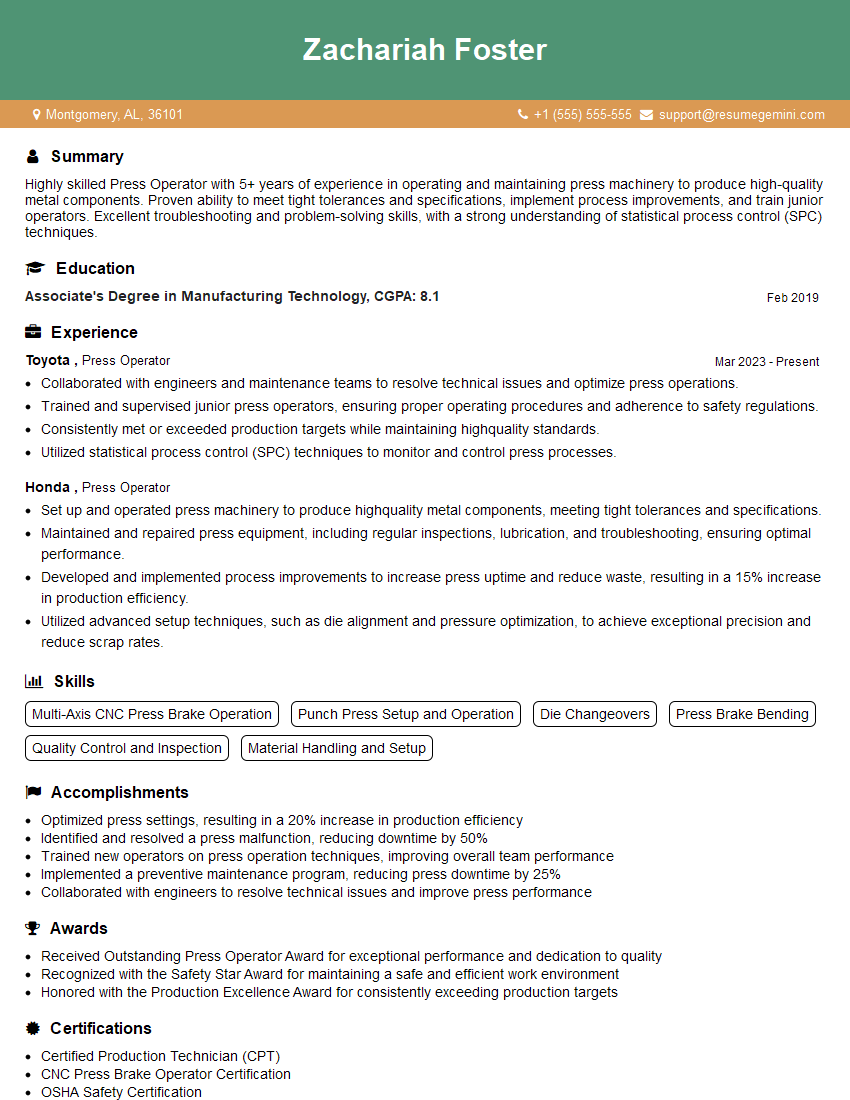
Press Operator Resume Sample

Pressroom Supervisor Resume Sample
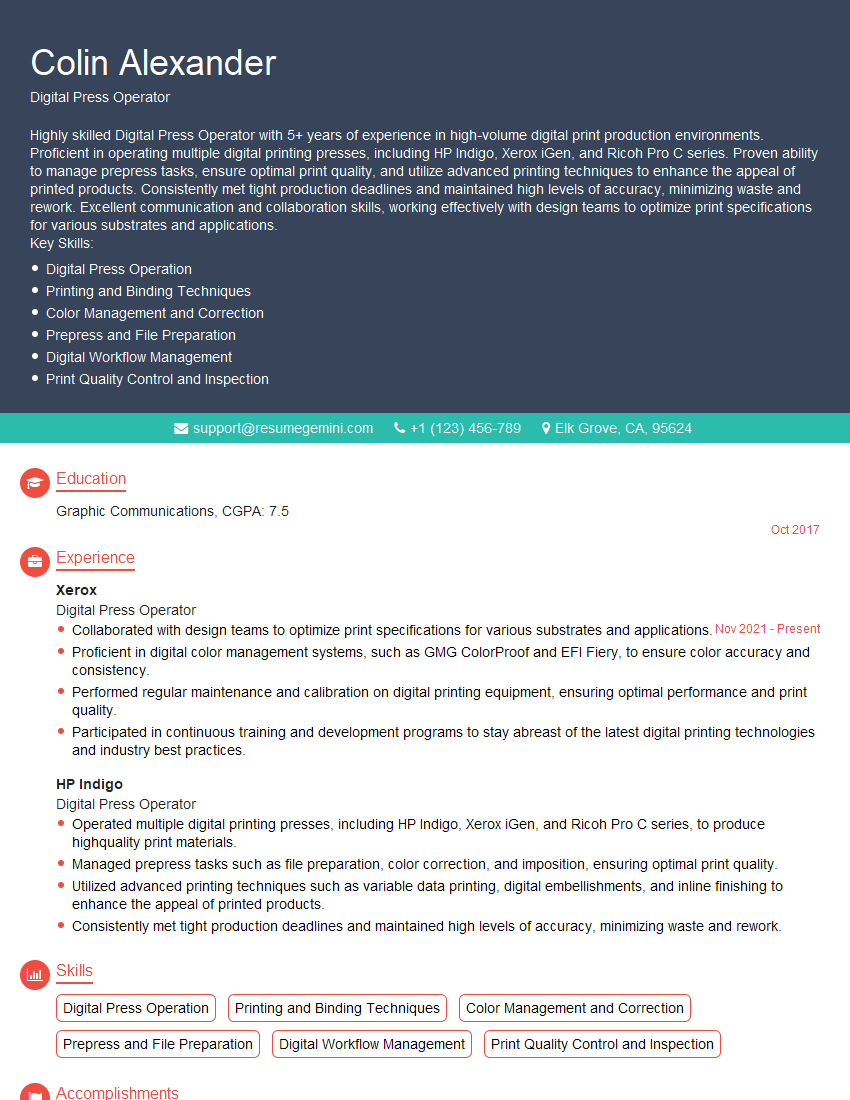
Digital Press Operator Resume Sample
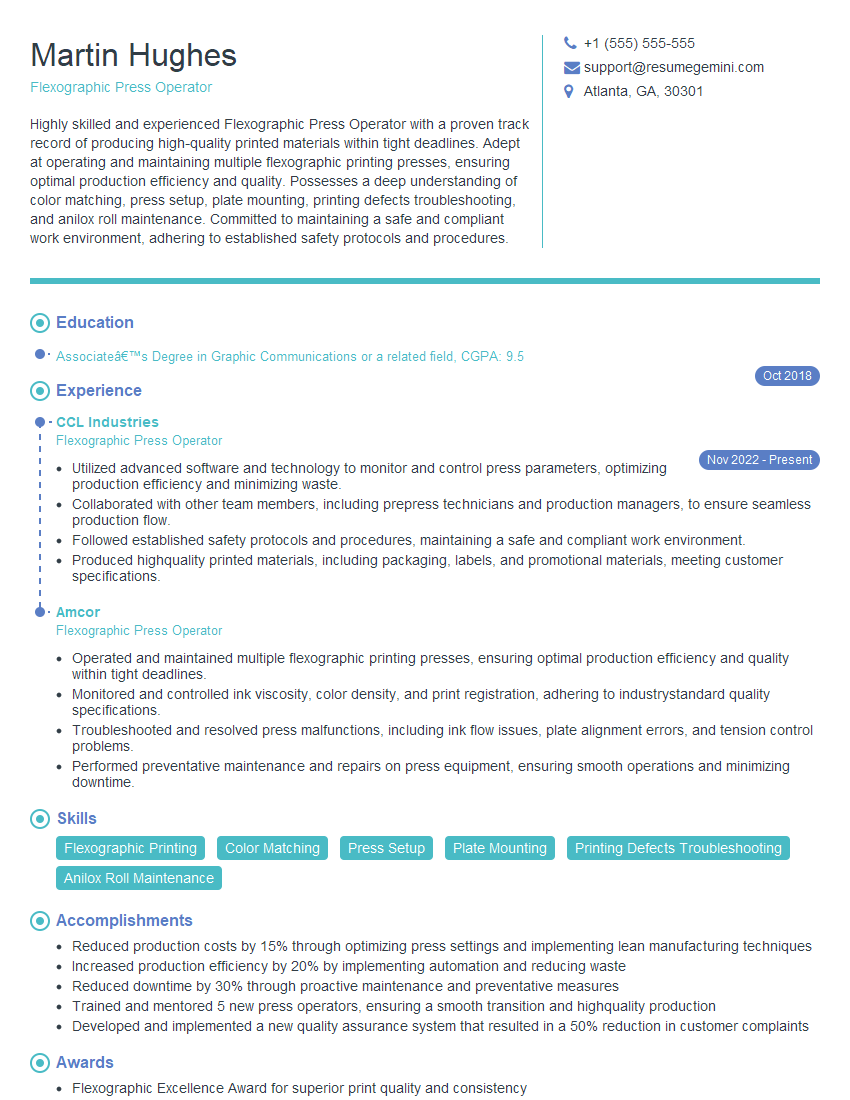
Flexographic Press Operator Resume Sample
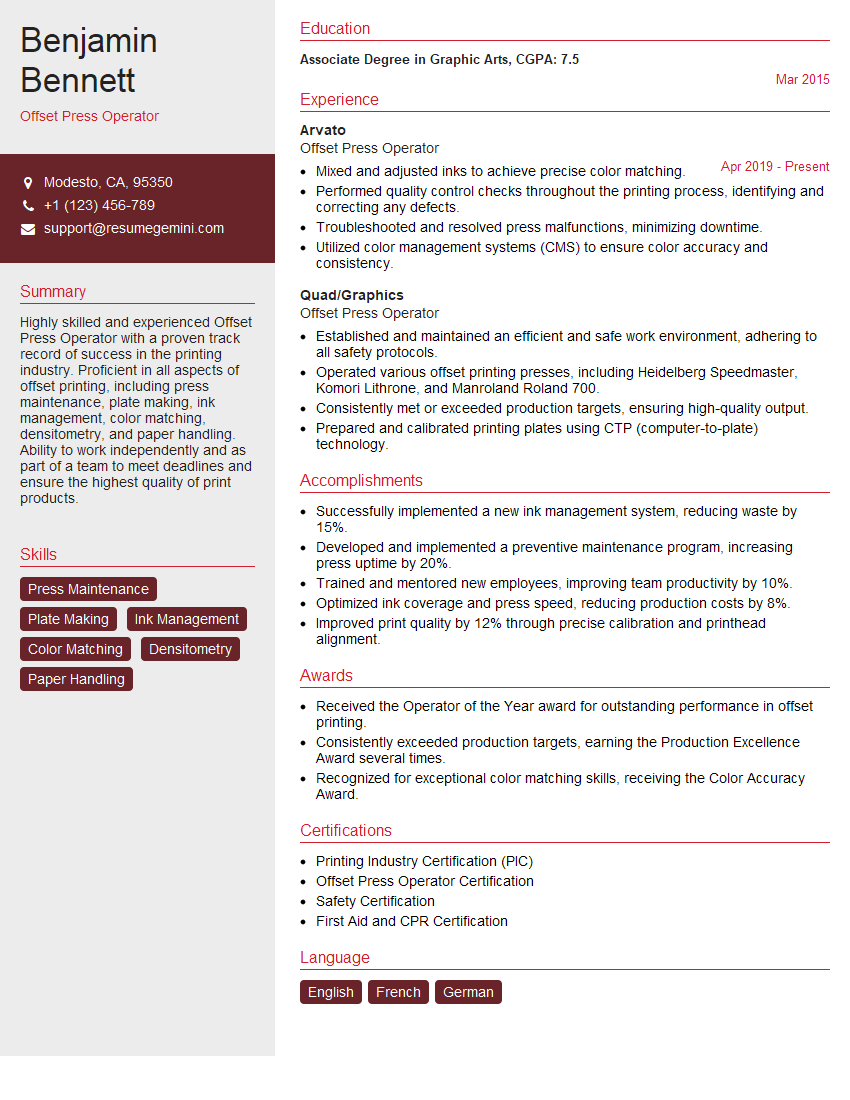
Offset Press Operator Resume Sample
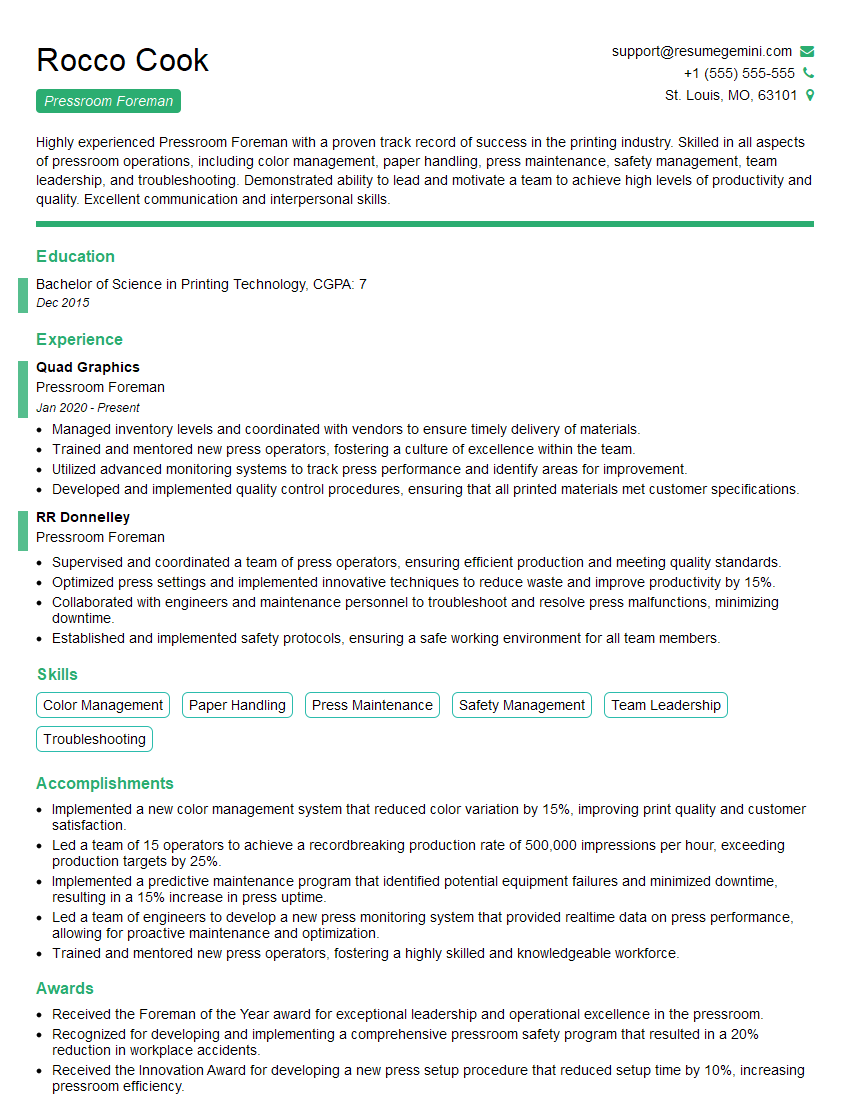
Pressroom Foreman Resume Sample
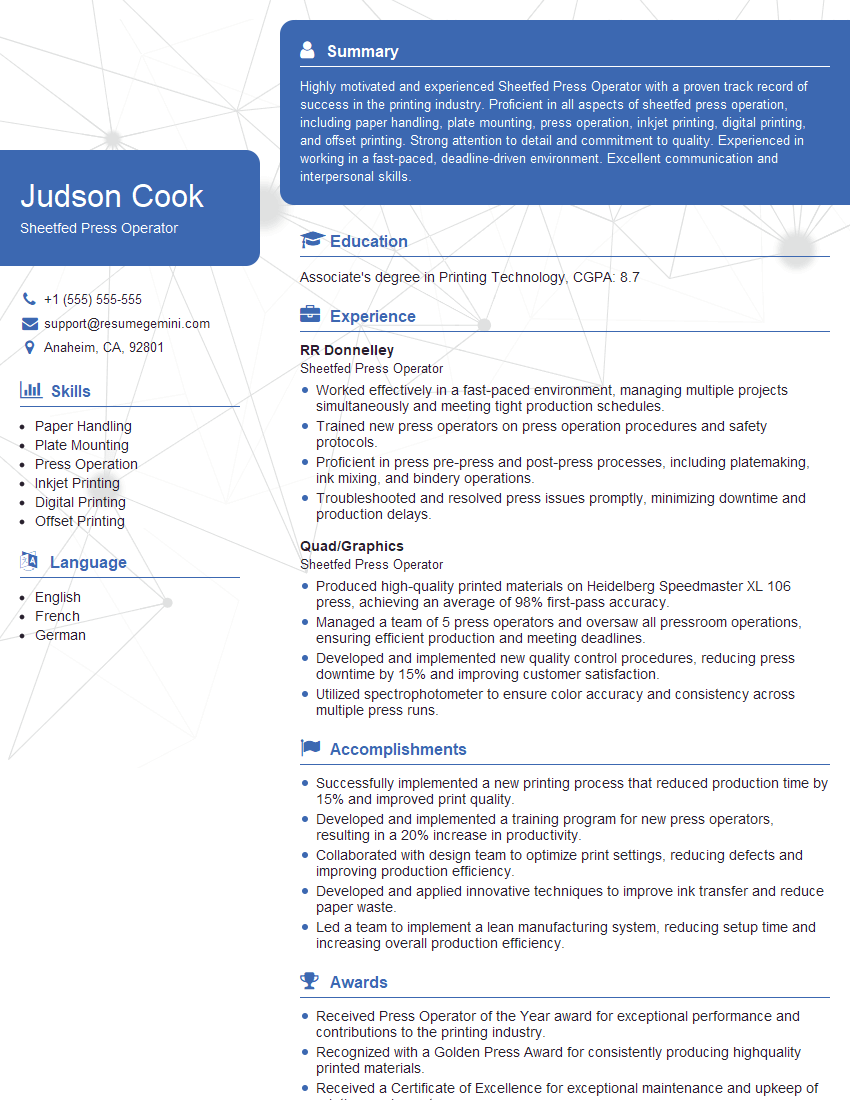
Sheetfed Press Operator Resume Sample
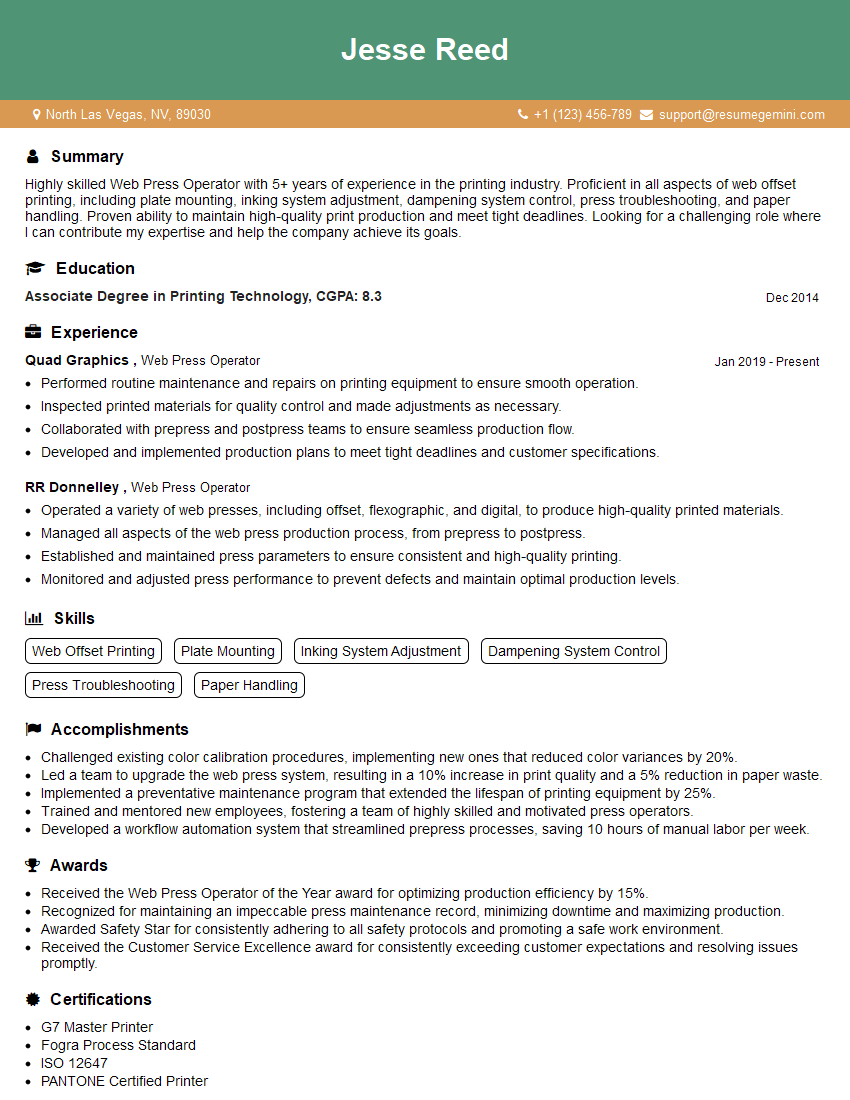
Web Press Operator Resume Sample
Explore more articles
Users Rating of Our Blogs
Share Your Experience
We value your feedback! Please rate our content and share your thoughts (optional).
What Readers Say About Our Blog
Very informative content, great job.
good