Feeling uncertain about what to expect in your upcoming interview? We’ve got you covered! This blog highlights the most important Pressing Garments interview questions and provides actionable advice to help you stand out as the ideal candidate. Let’s pave the way for your success.
Questions Asked in Pressing Garments Interview
Q 1. What types of pressing equipment are you familiar with?
My experience encompasses a wide range of pressing equipment, from basic household irons to professional-grade industrial machines. I’m proficient with various types of steam irons, including those with variable temperature and steam settings, as well as professional steam presses like the ones found in garment factories. I’m also familiar with specialized equipment such as vacuum presses for delicate fabrics and smaller, more targeted tools like point pressers and clapper boards.
- Household Irons: These are versatile for basic pressing needs at home or for smaller projects, but lack the power and consistency of professional machines.
- Professional Steam Presses: These provide even heat distribution and powerful steam penetration for efficient pressing, particularly on larger garments or heavier fabrics. They’re crucial for achieving a crisp, professional finish.
- Vacuum Presses: Ideal for delicate materials like silk or lace. The vacuum function helps to prevent stretching or damage by keeping the fabric taut while pressing.
- Point Pressers and Clapper Boards: Handheld tools used for precise pressing around buttons, seams, and other detailed areas of a garment.
Q 2. Explain the difference between steam pressing and dry pressing.
The key difference lies in the use of moisture. Steam pressing uses steam to penetrate the fabric, relaxing fibers and removing wrinkles. It’s generally best for most fabrics as the moisture helps set the fibers back into place and create a smoother finish. Think of it like giving your fabric a spa day! Dry pressing, on the other hand, relies solely on heat. This is better suited for fabrics that are sensitive to moisture or for certain finishes where you want to avoid adding extra moisture, such as some types of linen or delicate silk. It’s more precise and allows for more control to prevent issues like water marks, but also requires more finesse and experience.
Q 3. How do you identify different fabric types and adjust your pressing techniques accordingly?
Identifying fabric type is paramount for successful pressing. I use a combination of visual inspection (checking weave, texture, and drape) and sometimes a burn test (a small, inconspicuous area) to determine composition. For example, I immediately recognize the differences between a crisp cotton poplin and a delicate silk chiffon. This knowledge dictates my pressing temperature, pressure, and technique.
- Cotton: Can withstand higher temperatures and more aggressive pressing.
- Linen: Needs careful pressing to avoid creasing; sometimes a clapper is needed for a crisp finish.
- Silk and Wool: Require low temperatures and a press cloth to protect the fabric from scorching or damage. I often use a steam press for these.
- Synthetics: Vary widely, so I always check care labels. High heat can damage many synthetic fabrics.
Adapting my technique includes adjusting the iron’s temperature, using a press cloth, and varying the pressure applied. For instance, I’d use a low temperature and a press cloth for silk, whereas for cotton, a higher temperature and direct pressing might be appropriate.
Q 4. Describe your experience with various pressing tools (e.g., sleeve board, point presser).
I’m highly proficient with a variety of pressing tools. The sleeve board is essential for pressing sleeves and other cylindrical garment parts, preventing unwanted creases or stretching. A point presser is indispensable for precise work around buttons, collar points, and other intricate details. I’ve also used tailor’s ham, seam roll, and clapper to improve pressing accuracy and efficiency. The tailor’s ham is particularly helpful for shaping curved areas like the bust of a jacket. The seam roll is used to press seams open, while the clapper helps to set creases in linen and other fabrics that may not hold their shape readily.
For example, when pressing a shirt sleeve, I would use a sleeve board to ensure an even, wrinkle-free finish. For creating sharp creases on trousers, a tailor’s ham and steam press are essential for achieving a professional finish.
Q 5. How do you prevent scorching or shining delicate fabrics?
Preventing scorching and shining on delicate fabrics involves several key techniques. Always test the iron’s temperature on an inconspicuous area first. Use a press cloth – a thin layer of cotton or other suitable material – between the iron and the fabric. This acts as a buffer, preventing direct heat contact. Never press down too hard; use a light touch for the best results. Work quickly and methodically, and consider using a lower temperature than you might normally use. And for extra sensitive fabrics, steam is sometimes better avoided, opting instead for a dry pressing technique.
For instance, when pressing a silk blouse, I always use a press cloth and a low iron setting. A steam press can be a helpful tool for delicate fabrics, as it provides a more even distribution of moisture and heat.
Q 6. What are the common pressing issues you’ve encountered and how did you resolve them?
Common pressing issues include uneven pressing, scorching, water marks, and shiny patches. Uneven pressing often results from insufficient heat or pressure, which I rectify by adjusting the temperature, pressing time, and ensuring even pressure across the fabric. Scorching is usually due to excessive heat or pressure; I prevent this by using lower temperatures, press cloths, and lifting the iron more frequently. Water marks appear from too much moisture; addressing this requires using less steam, a press cloth, or dry pressing instead. Shiny patches can come from over-pressing or pressing synthetic fabrics at too high a temperature, and I fix them by using a low-temperature press and working carefully.
Q 7. How do you ensure consistent pressing quality across different garment types?
Ensuring consistent pressing quality across different garment types requires a methodical approach. I always start by identifying the fabric type and its care instructions. Then, I select the appropriate pressing equipment and adjust settings accordingly. This includes adjusting the temperature, pressure, and whether I utilize steam or dry pressing. I meticulously follow a systematic process, pressing sections in a logical order to maintain consistency. Regular maintenance of the equipment, including cleaning the iron’s soleplate, is vital for maintaining quality. Finally, consistent practice and a keen eye for detail are crucial for achieving professional results.
For instance, when pressing a suit jacket, I would systematically press the body, sleeves, collar, and lapels in a specific order, paying close attention to detail to ensure a sharp and crisp finish. I would likely use a professional steam press for this task and a tailor’s ham for shaping.
Q 8. Describe your process for pressing a shirt, including collar, cuffs, and placket.
Pressing a shirt involves a methodical approach to ensure a crisp, professional finish. I always begin with the body of the shirt, working from the center outwards to avoid creasing. I use a pressing cloth to protect the fabric and prevent shine. Then, I move onto the more delicate areas.
Collar: I press each collar point individually, ensuring a sharp edge. I then press the entire collar, paying close attention to the roll. Think of it like shaping a delicate flower – you want it to stand tall and proud, not limp!
Cuffs: Similar to the collar, I press the cuffs carefully, ensuring crisp edges and smooth surfaces. I often use a tailor’s ham to create a rounded, defined shape.
Placket: The placket requires precision. I press each buttonhole and the entire placket, ensuring a clean, straight finish. A sleeve board helps me maintain the proper shape and prevent distortion.
Finally, I give the entire shirt a final press to ensure everything is perfectly aligned and wrinkle-free. The key is consistent pressure and even heat to get that perfect, professional look.
Q 9. How do you handle wrinkles on different fabrics (e.g., linen, silk, cotton)?
Different fabrics require different pressing techniques. The key is to understand the fabric’s sensitivity to heat and moisture.
Linen: Linen is a strong fiber, but it can wrinkle easily. I use a slightly higher temperature with a press cloth to prevent scorching. Damp pressing is often effective with linen but requires careful attention to avoid watermarks.
Silk: Silk is very delicate. I always use a low temperature with a press cloth and never apply direct heat or steam. Pressing silk is more about smoothing than pressing.
Cotton: Cotton is relatively easy to press. I use a moderate temperature and press cloth, and sometimes add a light spray of water for stubborn wrinkles. Cotton generally responds well to steaming.
Always test a small, inconspicuous area of the garment first to check for any reaction to heat or moisture.
Q 10. What safety precautions do you follow when operating pressing equipment?
Safety is paramount when operating pressing equipment. I always follow these precautions:
Proper training: I have received comprehensive training on the safe operation of all pressing equipment I use.
Personal Protective Equipment (PPE): This includes heat-resistant gloves and eye protection, especially when dealing with steam. Protecting my hands and eyes is non-negotiable.
Regular maintenance: I inspect the equipment regularly for any damage or malfunctions before each use. A well-maintained machine is a safe machine.
Proper ventilation: I ensure adequate ventilation in the pressing area to prevent overheating and buildup of steam.
Water handling: I am careful handling hot water and steam to prevent burns and scalds.
By prioritizing safety, I minimize the risk of accidents and ensure a safe and productive working environment.
Q 11. What is your experience with industrial pressing machines?
I have extensive experience operating industrial pressing machines, including both steam and dry pressing equipment. My experience encompasses various models from different manufacturers. This includes both large-scale industrial units used in factories and smaller, more specialized machines for boutique settings.
I’m proficient in operating and maintaining these machines, from troubleshooting minor issues to performing regular cleaning and preventative maintenance. Understanding the nuances of different machines—their pressure settings, steam output, and temperature controls—allows me to tailor my approach to the specific garment and fabric.
For example, I’ve used industrial presses for large-scale shirt production, ensuring consistent quality and efficiency. I’ve also utilized specialized machines for pressing delicate fabrics and intricate designs, such as those found on high-end clothing.
Q 12. Explain your understanding of different pressing temperatures and their applications.
Pressing temperatures are crucial for achieving the desired results without damaging the garment. Different fabrics have different temperature tolerances.
Low Temperature (around 150°F/65°C): Suitable for delicate fabrics like silk, rayon, and acetate. Too much heat can cause irreversible damage.
Medium Temperature (around 250°F/120°C): Appropriate for most natural fibers like cotton, linen, and wool. It’s a versatile setting for many garment types.
High Temperature (around 300°F/150°C): Used for synthetic fibers that can withstand higher heat, such as polyester. However, this setting needs to be used with extreme caution, often with a press cloth.
I always consult the garment’s care label before selecting the appropriate temperature. It’s better to err on the side of caution—a lower temperature is always preferable to risking damage.
Q 13. How do you maintain the cleanliness and functionality of pressing equipment?
Maintaining the cleanliness and functionality of pressing equipment is essential for both safety and quality. I follow a rigorous cleaning routine after every use.
Daily Cleaning: I wipe down the pressing surface with a damp cloth to remove any lint or residue. I also empty any water reservoirs and clean the steam vents to prevent clogging.
Regular Maintenance: I perform more thorough cleaning and maintenance on a weekly or monthly basis, depending on the frequency of use. This includes inspecting and cleaning internal components, as needed.
Professional Servicing: I schedule regular professional servicing for more intensive cleaning and potential repairs. This ensures the equipment remains in top condition.
A clean and well-maintained machine not only works more efficiently but also prevents damage to garments and prolongs the lifespan of the equipment itself. Regular maintenance is a proactive approach that pays off in the long run.
Q 14. Describe your experience with pressing specialty garments (e.g., wedding dresses, suits).
I have considerable experience pressing specialty garments, requiring a high level of skill and attention to detail.
Wedding Dresses: Pressing a wedding dress is a delicate art. I use low temperatures and press cloths to avoid damaging the fabric, often working section by section to prevent creasing. I understand the importance of preserving intricate beading and lacework.
Suits: Pressing suits demands precision. I pay close attention to the seams, pleats, and creases, ensuring a sharp, tailored finish. Understanding the construction of a suit is crucial to achieving that impeccable fit and look.
Pressing specialty garments requires a deep understanding of fabric types, construction techniques, and the importance of preserving the integrity of the garment. It’s not just about removing wrinkles, but enhancing the overall aesthetic appeal and structural perfection of the piece.
Q 15. How do you prioritize tasks in a high-volume pressing environment?
In a high-volume pressing environment, prioritization is key to efficiency and meeting deadlines. I utilize a system combining urgency and garment type. Garments with imminent deadlines or those requiring specialized techniques are tackled first. I then prioritize by fabric type – delicate silks, for example, need gentler handling and will be prioritized before heavy cottons. This system is further refined by batching similar items together to optimize the use of pressing equipment and minimize setup time. For instance, I might press all the blouses of a similar fabric before moving onto trousers. Think of it like a conductor leading an orchestra – each instrument (garment) has its part to play, and I ensure they all contribute to the overall harmony (on-time delivery).
Career Expert Tips:
- Ace those interviews! Prepare effectively by reviewing the Top 50 Most Common Interview Questions on ResumeGemini.
- Navigate your job search with confidence! Explore a wide range of Career Tips on ResumeGemini. Learn about common challenges and recommendations to overcome them.
- Craft the perfect resume! Master the Art of Resume Writing with ResumeGemini’s guide. Showcase your unique qualifications and achievements effectively.
- Don’t miss out on holiday savings! Build your dream resume with ResumeGemini’s ATS optimized templates.
Q 16. How do you identify and address pressing defects?
Identifying pressing defects involves a keen eye for detail and a thorough understanding of fabric behavior. Common defects include wrinkles, creases, scorch marks, and puckering. I use a systematic approach. First, I visually inspect each garment, paying close attention to seams, collars, and cuffs, areas prone to imperfections. Then, I check for any distortion from the original pattern. For example, a sleeve that’s been pressed unevenly will show obvious distortion. Addressing these defects depends on the type and severity of the defect. Minor wrinkles can be corrected with a light press using steam, while more serious issues might require re-pressing with a tailor’s ham or pressing cloth. Scorch marks, unfortunately, are usually irreparable and require action to prevent them in the future by adjusting the temperature or using a pressing cloth.
Q 17. What is your understanding of fabric shrinkage and how it relates to pressing?
Fabric shrinkage is the reduction in size of a textile due to the relaxation of fibers during washing or exposure to heat and moisture. This is critically important during pressing, as applying too much heat or moisture can cause unwanted shrinkage. Different fibers shrink at different rates; wool, for instance, is particularly prone to shrinkage. Understanding this allows me to tailor my pressing technique accordingly. For example, when pressing wool garments, I would use a lower temperature and less steam, and use a pressing cloth to prevent direct contact between the iron and the fabric. Furthermore, I always check the care label before pressing to understand the fabric’s characteristics and any potential shrinkage concerns. I often pre-shrink fabrics before cutting and construction to minimize this risk.
Q 18. How do you maintain a clean and organized work station?
Maintaining a clean and organized workstation is essential for efficiency and safety. My process involves several steps. At the start of each day, I clean my pressing board and iron rest, ensuring they are free from any lint or debris. I organize my pressing equipment – irons, pressing cloths, tailor’s ham, etc. – in a logical manner, ensuring easy access to the tools I frequently use. During the pressing process, I regularly clear away any scraps of fabric or unwanted threads. At the end of the day, I clean the iron thoroughly and store all equipment away safely. A tidy workstation not only improves efficiency but also reduces the risk of accidents such as burns or equipment damage. Think of it like preparing your kitchen for a meal: a clean and organized space leads to better results.
Q 19. Describe your experience with different pressing techniques (e.g., blocking, pleating).
My experience encompasses a variety of pressing techniques. Blocking is a method used to shape and flatten large sections of fabric, often employed for structured garments like jackets or coats. This involves placing the fabric on a blocking form or tailor’s ham and applying controlled heat and pressure. Pleating, on the other hand, is a more intricate technique involving the creation of precise folds in the fabric. This requires careful measurement and the use of specialized tools to maintain consistency. Other techniques I utilize include edge pressing, which involves carefully pressing seams and edges for a clean finish, and seam pressing, which helps to flatten seams and prevent puckering. I adapt my technique based on the fabric type and the desired outcome. Each technique requires a different level of precision and attention to detail.
Q 20. How do you handle emergency situations (e.g., equipment malfunction)?
Handling emergency situations requires a calm and decisive approach. If an iron malfunctions, for example, my first priority is safety – immediately turning off the power and ensuring the iron is cool before attempting any repairs or calling for maintenance. If the malfunction disrupts workflow, I prioritize completing urgent tasks using alternative methods if possible, like manually pressing less complex garments. I also document the issue and notify the relevant personnel or maintenance team, providing all necessary details. In the event of a fabric-related emergency, such as a spill or a large tear in a garment, my immediate action is to contain the damage – perhaps by blotting up the spill or carefully securing the tear with pins – to prevent further complications. Quick thinking and resourcefulness are crucial in such scenarios.
Q 21. What is your experience with different types of interfacing and how do they impact pressing?
Interfacing plays a crucial role in garment construction and significantly impacts the pressing process. Different types of interfacing – woven, knit, fusible, non-fusible – possess unique characteristics that influence how they respond to heat and pressure. Fusible interfacing, which bonds to fabric with heat, requires careful attention to prevent scorching or melting. Non-fusible interfacing offers more control but necessitates additional steps like basting. Woven interfacing provides structure and support, often used in collars and cuffs. The type of interfacing selected directly affects the pressing process; a heavier interfacing might require more heat and pressure, while a lightweight interfacing needs a more gentle approach. Choosing the correct interfacing for a garment is crucial for achieving the desired drape and preventing issues during pressing. For instance, a fusible interfacing that’s too heavy might cause puckering while a lightweight non-fusible interfacing may not provide enough support to a structured garment.
Q 22. How do you handle difficult fabrics (e.g., those prone to wrinkling or stretching)?
Handling difficult fabrics requires a nuanced approach. Wrinkle-prone fabrics like linen or silk need low heat and possibly a press cloth to prevent scorching. Stretchy fabrics like jersey knits require careful placement and minimal pressure to avoid distortion. Think of it like baking – you wouldn’t use the same temperature for a delicate cake as you would for a hearty loaf of bread.
- Wrinkle-prone fabrics: Use a low to medium iron temperature, always with a press cloth (a thin, absorbent cotton cloth placed between the iron and the fabric). Pressing on the wrong side often helps as well. Steam can be helpful, but avoid excessive moisture which could cause watermarks.
- Stretchy fabrics: Use a tailor’s ham or a sleeve board to support the fabric and prevent stretching. Press with light pressure and lift the iron frequently instead of gliding it across the surface. Often, a cool iron and pressing from the wrong side will suffice.
- Example: When pressing a linen shirt, I’d use a low temperature and a press cloth, working on smaller sections at a time. For a jersey knit dress, I’d use a tailor’s ham and press lightly on the wrong side to maintain the fabric’s drape.
Q 23. What is your understanding of pressing sequence in relation to garment construction?
The pressing sequence is crucial for a professional finish. It’s essentially a carefully planned process of pressing different garment components in a specific order to achieve the desired shape and prevent unwanted wrinkles or creases. The general rule of thumb is to press seams open before pressing the next component that will overlap it. It is similar to constructing a building – you want the foundational elements in place before you start erecting the walls.
- Seams: Seams are pressed open or to one side, depending on the seam type and garment design. This is typically the first pressing step.
- Darts: Darts are pressed towards the center back or center front, depending on their placement. Proper dart pressing is vital for shaping.
- Facings and Interfacings: These are pressed to maintain their structure and to prevent them from showing through the outer fabric.
- Collar and Cuffs: These components require precise pressing to achieve a clean, crisp look.
- Final Pressing: A final pressing of the entire garment is done to remove any remaining wrinkles or creases and to give the garment a polished finish.
Incorrect pressing sequence can lead to puckering, uneven seams, and ultimately a lower-quality garment. The order ensures that previously pressed parts are not disturbed by subsequent pressing steps.
Q 24. How do you adapt your pressing techniques for different garment styles?
Pressing techniques vary greatly depending on garment style. A structured blazer requires firm, precise pressing to maintain its shape, while a flowing maxi dress needs gentler handling to avoid creating unwanted creases. This adaptation comes with experience and understanding of fabric types and garment construction.
- Structured garments (e.g., blazers, jackets): Require firm pressing with potentially higher heat and the use of pressing aids like tailor’s ham and sleeve board to create sharp creases and defined lines.
- Flowing garments (e.g., dresses, skirts): Usually involve lighter pressing or steaming to avoid creating unwanted impressions. A pressing cloth is nearly always advisable.
- Detailed garments (e.g., shirts, blouses): Requires precise pressing of darts, pleats, and seams, often utilizing point pressers for fine details.
For example, when pressing a tailored blazer, I’d use a tailor’s ham and a sleeve board to shape the shoulders and lapels perfectly. For a flowing silk blouse, I’d use a lower heat and press cloth and avoid excessive pressure to prevent distortion.
Q 25. Explain your experience with using various pressing aids (e.g., press cloths, seam rolls).
Pressing aids are essential for achieving professional results. They provide support and prevent unwanted impressions on the fabric.
- Press cloths: These protect delicate fabrics from scorching and help to distribute steam evenly. Different fabrics (muslin, silk) can be used depending on the material being pressed. For example, a silk press cloth is perfect for delicate materials that would be damaged by a regular cloth.
- Tailor’s ham: This curved, padded form helps to shape curved areas like collars, sleeves, and darts, preventing unwanted creases and promoting an even press.
- Sleeve board: A specialized board that allows for easy pressing of sleeves and other cylindrical garment parts.
- Point presser: Used to press sharply defined points, such as the points on a collar or the edges of pockets.
- Seam roll: Cylindrical tool to press open seams, avoiding any marking on the garment.
My experience shows that proper use of these tools significantly improves the quality and efficiency of the pressing process. For instance, using a tailor’s ham while pressing the curved areas of a jacket is instrumental in achieving a smooth, professional finish.
Q 26. How do you ensure the longevity of pressed garments?
The longevity of pressed garments depends on proper care and handling. Correct pressing is only half the battle.
- Proper storage: Hanging garments appropriately on padded hangers prevents wrinkles and maintains their shape. Folding garments correctly can also help to preserve the press.
- Avoid over-pressing: Excessive heat and pressure can damage the fabric fibers over time, leading to dullness and weakening of the material. This is especially true for natural fibers such as linen or silk.
- Gentle cleaning: Always follow garment care instructions to avoid damaging the fabric. This often includes a recommendation of dry-cleaning or hand washing.
- Avoid overcrowding closets: Allow sufficient space for garments to breathe and prevent creasing.
Imagine a crisp white shirt – you’ll want to keep it looking sharp for as long as possible, so adhering to these guidelines will significantly extend its life and keep it crease-free.
Q 27. How would you train a new employee on proper pressing techniques?
Training a new employee involves a structured approach, starting with the basics and gradually moving towards complex techniques. It’s important to prioritize safety and accuracy.
- Safety first: Emphasize the importance of correct iron temperature settings and safe handling procedures to prevent burns.
- Introduction to pressing equipment: Familiarize the employee with all the equipment and its function (iron, steam iron, pressing aids).
- Fabric identification: Teach them to identify different fabrics and their pressing requirements.
- Basic pressing techniques: Start with simple techniques like pressing seams open and then gradually progress to more complex methods such as pressing darts, collars, and cuffs.
- Practical exercises: Provide ample opportunities for hands-on practice with feedback and guidance. Start with simple garments before proceeding to more complex ones.
- Continuous learning: Encourage the employee to observe and learn from experienced pressers and stay updated on new techniques.
I would use a combination of demonstrations, hands-on training, and feedback to ensure that they understand and can consistently execute the techniques. Regular evaluations are needed to track progress and provide further training as necessary.
Q 28. What are your strategies for maintaining high quality and productivity in pressing?
Maintaining high quality and productivity requires a balanced approach. It’s not just about speed, but about consistent quality. This is achieved by efficiency and planning.
- Efficient workflow: Organize the work area effectively to minimize time spent searching for tools and materials. Pre-sorting garments by fabric type and complexity helps streamline the process.
- Proper equipment maintenance: Regularly cleaning the iron and maintaining the pressing aids ensures consistent performance and longevity. A clean iron is crucial for preventing stains.
- Quality control: Regularly inspect the pressed garments to ensure they meet the required standards. A systematic approach will help catch any errors before they go unnoticed.
- Time management: Setting realistic goals and prioritizing tasks helps to achieve optimal productivity without compromising quality. Break larger jobs into smaller, manageable units.
- Continuous improvement: Regularly reviewing processes to identify areas for improvement is key to maintaining high standards. This could include examining the steps needed to complete a certain pressing task.
For instance, I always pre-sort garments and organize my pressing aids to ensure I have a smooth and efficient workflow. This allows for higher output without sacrificing the standard of press.
Key Topics to Learn for Pressing Garments Interview
- Understanding Fabric Types: Learn to identify different fabric compositions (cotton, linen, silk, etc.) and their properties, impacting pressing techniques and potential damage.
- Pressing Equipment & Techniques: Master the use of irons, steam generators, pressing cloths, and various pressing surfaces (e.g., ironing boards, sleeve boards). Understand different pressing techniques for various garment types and fabrics (e.g., pressing seams, pleats, collars).
- Quality Control & Finishing: Develop a keen eye for detail to identify imperfections like wrinkles, creases, and puckers. Learn how to achieve a professional, high-quality finish on various garments.
- Safety Procedures & Maintenance: Understand and follow safety protocols when using pressing equipment. Learn about the proper maintenance and cleaning of equipment to ensure its longevity.
- Garment Construction & Seam Pressing: Develop a basic understanding of garment construction to effectively press seams, darts, and other structural elements. Understand the importance of correct seam pressing for garment fit and appearance.
- Problem-Solving & Troubleshooting: Learn to identify and rectify common pressing problems, such as scorch marks, wrinkles, and uneven pressing. Be prepared to discuss your approach to troubleshooting.
- Industry Best Practices: Familiarize yourself with industry standards and best practices for pressing garments to ensure consistency and high-quality results. This includes understanding different finishing techniques based on garment type and style.
Next Steps
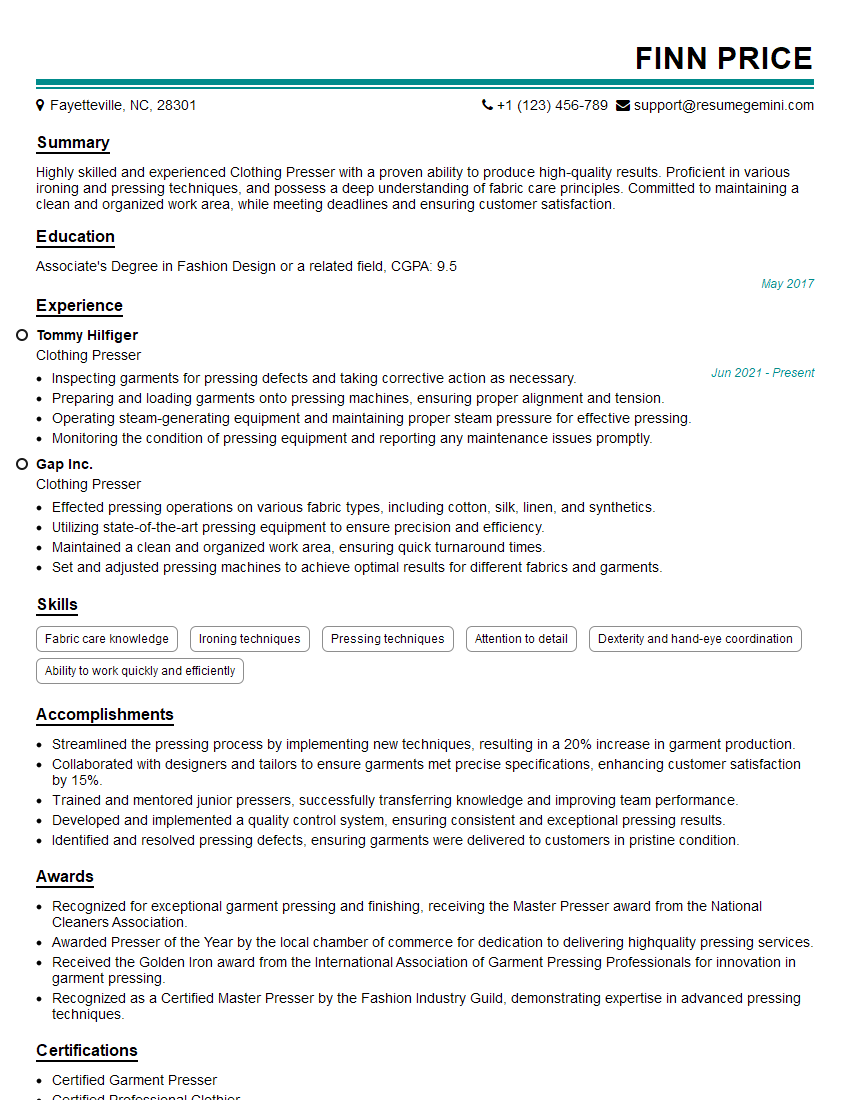
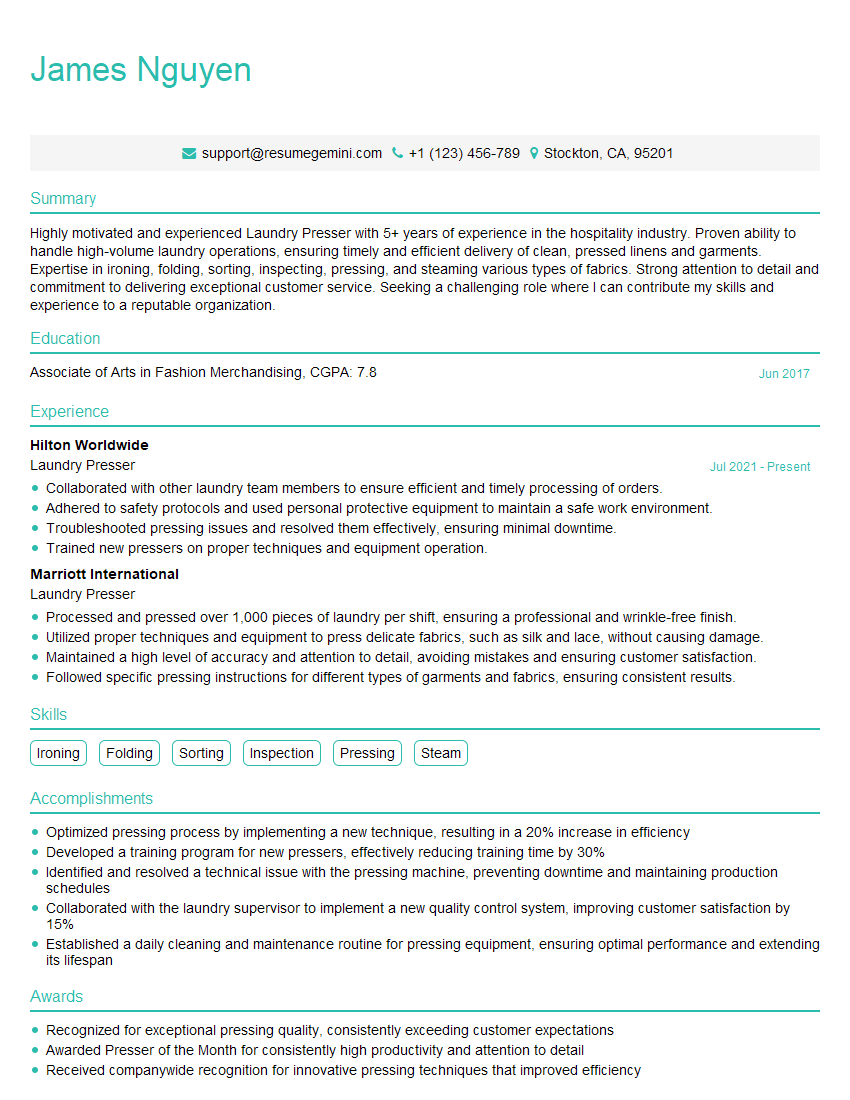
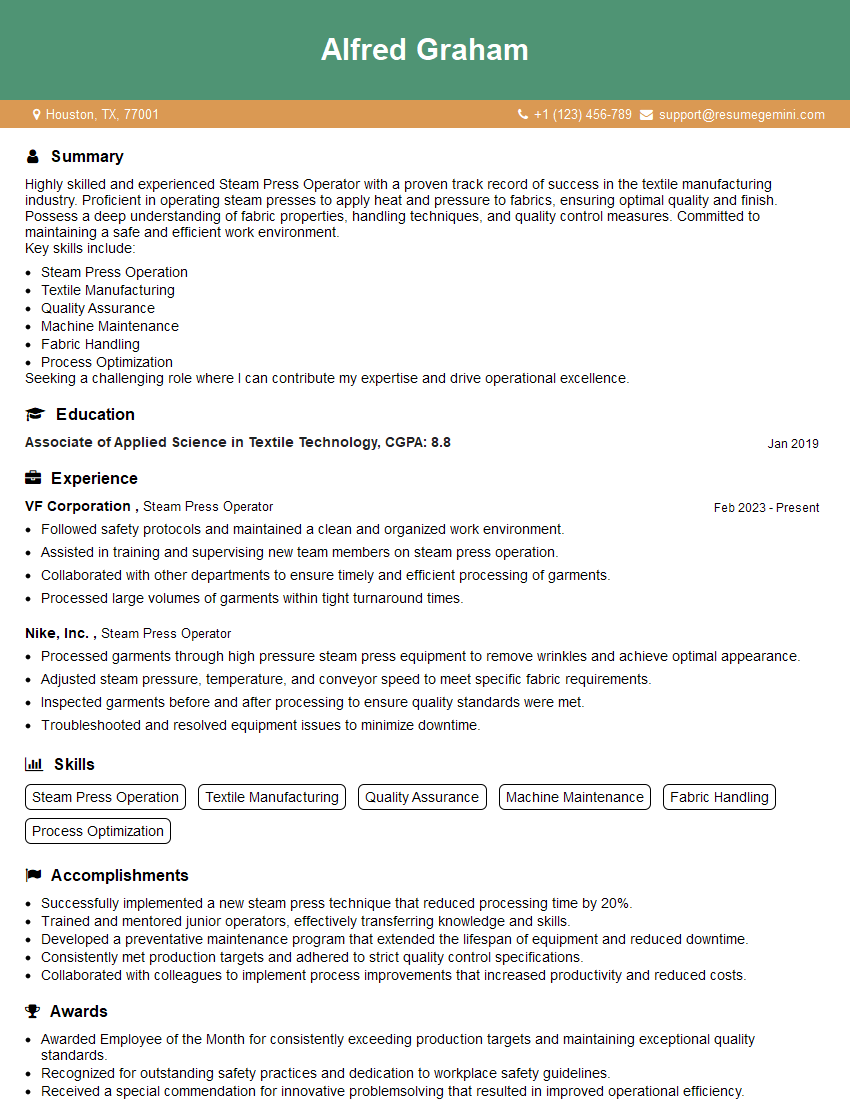
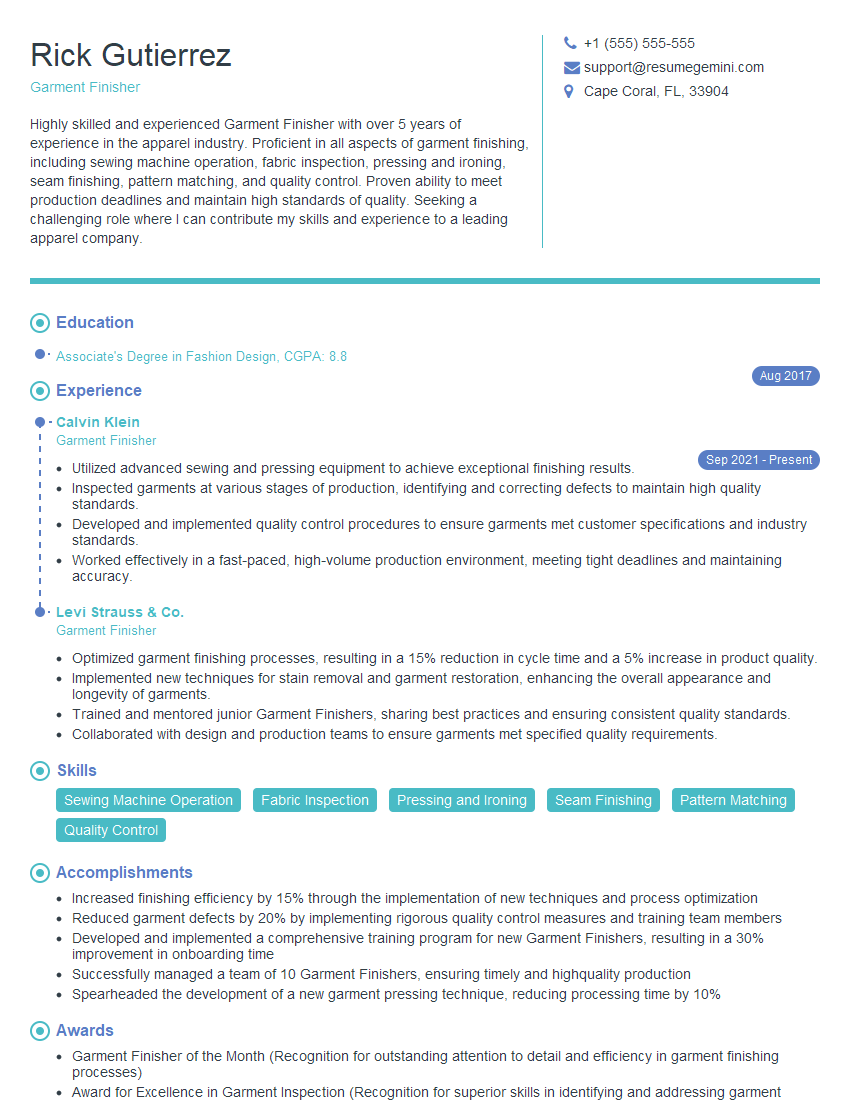
Mastering the art of pressing garments opens doors to exciting career opportunities within the fashion and apparel industry. A strong understanding of pressing techniques showcases attention to detail, precision, and a commitment to quality – highly valued skills in any professional setting. To maximize your job prospects, focus on building an ATS-friendly resume that highlights these skills effectively. ResumeGemini is a trusted resource that can help you create a professional and impactful resume tailored to the specific requirements of Pressing Garments jobs. Examples of resumes tailored to this industry are available to help guide you.

Explore more articles
Users Rating of Our Blogs
Share Your Experience
We value your feedback! Please rate our content and share your thoughts (optional).
What Readers Say About Our Blog
Very informative content, great job.
good