Feeling uncertain about what to expect in your upcoming interview? We’ve got you covered! This blog highlights the most important Process Integration interview questions and provides actionable advice to help you stand out as the ideal candidate. Let’s pave the way for your success.
Questions Asked in Process Integration Interview
Q 1. Explain the difference between synchronous and asynchronous communication in process integration.
In process integration, synchronous and asynchronous communication describe how systems interact. Think of it like a phone call versus sending a letter.
Synchronous communication requires both systems to be active and available simultaneously. It’s like a real-time conversation – one system sends a request, and the other immediately responds. This is straightforward but can lead to delays if one system is slow or unavailable. A good example is a direct database call from one application to another. The requesting application waits for the response before continuing.
Asynchronous communication allows systems to interact without needing to be available at the same time. One system sends a message and continues processing, while the receiving system processes the message later. This is more flexible and resilient because it decouples the systems. Imagine an email: you send it, and the recipient can read it whenever they have time. A common example is using a message queue where a system places a message, and a separate consumer processes it at a later time.
The choice between synchronous and asynchronous communication depends on the specific needs of the integration. If real-time interaction is critical, synchronous communication is preferred. If resilience and flexibility are paramount, asynchronous communication is a better choice.
Q 2. Describe your experience with different integration patterns (e.g., message queues, publish-subscribe).
I have extensive experience with various integration patterns, particularly message queues and publish-subscribe architectures. Message queues, like RabbitMQ or Kafka, are excellent for reliable asynchronous communication. I’ve used them in scenarios where a system needs to process large volumes of data or where the receiving system might be temporarily unavailable. For instance, in an e-commerce platform, order processing can be decoupled from inventory updates by using a message queue. The order processing system places a message indicating a successful order, and an inventory system asynchronously updates the stock levels based on this message. This approach prevents order processing from being blocked by slow inventory updates and improves overall system resilience.
Publish-subscribe patterns provide a more event-driven approach. I’ve leveraged this in situations requiring broadcasting information to multiple interested systems, such as notifications or logging. For example, in a social media application, when a user posts an update, the system publishes an event. Various subscribers (such as the user’s followers’ newsfeeds, activity trackers, etc.) then receive and process this event asynchronously. This creates a loosely coupled architecture where new subscribers can be added easily without changing existing components. I’ve worked with message brokers such as Apache Kafka and Redis Pub/Sub to implement these patterns effectively.
Q 3. What are the benefits and drawbacks of using an Enterprise Service Bus (ESB)?
Enterprise Service Buses (ESBs) are powerful integration platforms that offer a centralized approach to connecting various applications. However, their suitability depends on the specific context.
Benefits:
- Centralized management: ESBs simplify managing and monitoring integrations within a large ecosystem.
- Protocol transformation: They handle different communication protocols, simplifying integrations between systems using varying standards.
- Message routing and transformation: They can intelligently route messages and transform data formats between different systems.
- Security: They can enforce security policies and manage access control across integrated applications.
Drawbacks:
- Complexity: ESBs can be quite complex to set up and maintain, often requiring specialized skills.
- Vendor lock-in: Choosing a specific ESB can lead to vendor lock-in, making it difficult to switch providers later.
- Performance overhead: Adding an ESB layer introduces potential performance overhead.
- Cost: ESBs can be expensive both in terms of licensing and infrastructure.
In my experience, ESBs are most beneficial for large organizations with highly complex integration requirements. However, for simpler integration needs, lighter solutions like microservices architectures with direct API calls or message queues might be more appropriate.
Q 4. How do you handle data transformations during process integration?
Data transformation is crucial in process integration because systems rarely use identical data formats. I typically handle data transformations using a combination of techniques.
Mapping tools: I use ETL (Extract, Transform, Load) tools like Informatica PowerCenter or Talend Open Studio to define mapping rules that convert data between formats. These tools provide a visual interface to design transformations, making them relatively easy to manage and maintain.
Scripting languages: For more complex transformations or custom logic, I employ scripting languages like Python or JavaScript. This offers greater flexibility and control over the transformation process. For instance, I might use Python to parse XML data, enrich it using external services, and then transform it into a JSON structure suitable for the target system. # Example Python code snippet for data transformation import json data = {'name': 'John Doe', 'age': 30} json_data = json.dumps(data) print(json_data)
Message transformation frameworks: In some cases, message transformation frameworks (like Apache Camel) are employed within the integration architecture to handle data transformation as part of the message routing process. This approach allows for centralized transformation rules and management.
The optimal approach depends on the complexity of the transformation and the tools available within the integration architecture.
Q 5. Explain your experience with API gateways and their role in integration.
API gateways are crucial in modern integration architectures. They act as a central point of entry for all API requests, providing several key functions.
Authentication and Authorization: API gateways enforce security policies, authenticating and authorizing access to backend services. This protects sensitive data and prevents unauthorized access.
Rate limiting and traffic management: They manage API traffic, preventing overload and ensuring optimal performance. They can throttle requests, handle spikes in traffic, and enforce usage limits.
Protocol transformation: API gateways can transform protocols, allowing various client applications to interact with backend systems regardless of their communication protocols.
Monitoring and logging: They provide comprehensive monitoring and logging capabilities, enabling you to track API usage, identify issues, and improve performance.
In my experience, API gateways significantly improve the security, performance, and manageability of API-based integrations. I’ve used Kong, Apigee, and AWS API Gateway in various projects, leveraging their capabilities to create robust and scalable API integration solutions.
Q 6. Describe your approach to troubleshooting integration issues.
My approach to troubleshooting integration issues is systematic and methodical. It involves the following steps:
- Identify the problem: Precisely define the issue and gather all relevant information, including error messages, logs, and timestamps.
- Isolate the component: Pinpoint the specific component or system causing the issue. This often involves checking logs, analyzing network traffic, and performing tests.
- Check configuration: Verify that all configurations are correct, including connection details, credentials, and message formats.
- Test each component: Isolate and test each component individually to ensure it functions correctly. This can involve using unit tests or simulating interactions.
- Examine data: Analyze the data exchanged between components, looking for inconsistencies or errors. Data transformation errors are a common source of integration problems.
- Use monitoring tools: Utilize monitoring tools to track the performance of the system and identify bottlenecks. This can provide valuable insights into the root cause of the issue.
- Reproduce the issue: Try to reproduce the issue consistently in a controlled environment. This allows for systematic troubleshooting and testing of solutions.
I often use tools like debuggers, network sniffers (like Wireshark), and logging frameworks to aid in the troubleshooting process. A methodical and organized approach is essential in successfully diagnosing and resolving integration problems.
Q 7. What are your preferred tools and technologies for process integration?
My preferred tools and technologies for process integration depend on the specific requirements of the project, but my expertise includes a range of options.
Message brokers: Apache Kafka and RabbitMQ for robust asynchronous communication.
Integration platforms: MuleSoft Anypoint Platform for complex enterprise-level integrations and Apache Camel for lightweight, flexible integrations.
API Gateways: Kong, Apigee, and AWS API Gateway for managing API traffic and security.
Programming languages: Python and Java for developing custom integrations and transformations, along with JavaScript for client-side interactions and scripting.
Data transformation tools: Informatica PowerCenter and Talend Open Studio for ETL processes.
Monitoring tools: Tools like Prometheus, Grafana, and ELK stack for comprehensive system monitoring.
I am adept at selecting the best tools for each project, considering factors like scalability, performance, cost, and maintainability.
Q 8. How do you ensure data security and integrity during integration processes?
Data security and integrity are paramount in integration processes. We achieve this through a multi-layered approach encompassing various security measures and best practices.
- Encryption: Data at rest and in transit should be encrypted using robust algorithms like AES-256. This protects sensitive information from unauthorized access, even if a breach occurs.
- Access Control: Implementing role-based access control (RBAC) restricts access to data and systems based on user roles and responsibilities. This prevents unauthorized modifications or disclosures.
- Data Validation and Sanitization: Input validation rigorously checks all incoming data against predefined rules, preventing malicious code injection or data corruption. Sanitization removes or escapes potentially harmful characters before processing.
- Auditing and Logging: A comprehensive audit trail tracks all data access, modifications, and integration events. This allows for identifying and investigating any security incidents or anomalies. Logs should include timestamps, user IDs, and the specifics of the actions performed.
- Secure Transport Protocols: Using HTTPS for communication between systems ensures secure data transmission over networks. Protocols like TLS/SSL provide confidentiality and integrity.
- Data Masking and Anonymization: For sensitive data used in testing or non-production environments, data masking techniques replace sensitive information with dummy values, preserving the structure without revealing real data.
For instance, in a recent project integrating a CRM with an ERP system, we implemented end-to-end encryption using TLS 1.3 and RBAC to control access to sensitive customer data. Regular security audits and penetration testing further ensured the robustness of our security measures.
Q 9. Explain your experience with different messaging formats (e.g., XML, JSON).
I have extensive experience working with various messaging formats, primarily XML and JSON. The choice of format depends heavily on the context and the systems involved.
- XML (Extensible Markup Language): XML is a highly structured format well-suited for complex data structures and scenarios requiring strict schema validation. Its self-describing nature facilitates clear data representation. However, it can be more verbose than JSON.
- JSON (JavaScript Object Notation): JSON’s lightweight nature and simpler syntax make it more efficient for data transmission, particularly in web-based applications. Its readability is a significant advantage for developers. However, its schema validation capabilities are less robust than XML’s.
In practice, I’ve used XML extensively in legacy systems where data schema adherence is crucial, employing XSD validation for data integrity. For newer projects and microservices architectures, JSON’s simplicity and speed make it the preferred choice. I’ve also used JSON Schema for validation to maintain data consistency.
For example, in one project, we used XML to integrate with a mainframe system due to its existing data structure, while simultaneously using JSON for communication with newer, cloud-based services to leverage its lightweight nature.
Q 10. How do you handle error handling and exception management in integration projects?
Robust error handling and exception management are critical for reliable integration. Our approach involves several key steps:
- Centralized Error Handling: Instead of scattered
try-catchblocks, a centralized error handling mechanism manages exceptions consistently across the integration layer. This enhances maintainability and facilitates troubleshooting. - Exception Logging: Detailed logs capture exception details (type, message, stack trace, context) to aid in debugging and root cause analysis. This information is invaluable during investigations.
- Retry Mechanisms: Transient errors (network issues, temporary service outages) can be handled by implementing retry logic with exponential backoff. This prevents cascading failures and improves system resilience.
- Dead-Letter Queues (DLQs): Messages that fail processing multiple times are moved to a DLQ for manual review and resolution. This isolates failed messages and prevents them from blocking the main processing flow.
- Alerting and Monitoring: Real-time monitoring and alerts notify stakeholders of critical errors or service disruptions, allowing for prompt intervention.
- Comprehensive Error Codes: Using meaningful error codes provides context about the failure reason, aiding developers in faster resolution.
For example, in a financial transaction integration, we implemented a retry mechanism with exponential backoff for network connectivity issues and a DLQ to store messages that failed repeatedly, allowing for manual investigation and resolution. We also used centralized logging and alerting to provide immediate notification of critical failures.
Q 11. Describe your experience with different integration testing methodologies.
My experience encompasses various integration testing methodologies:
- Unit Testing: Individual components (e.g., data transformations, message mappings) are tested independently to ensure they function correctly. This approach isolates issues early in the development cycle.
- Integration Testing: Interactions between different components and systems are tested, validating data flow and communication. This includes testing various scenarios and edge cases.
- Contract Testing: This verifies that communicating systems adhere to agreed-upon data contracts (e.g., using OpenAPI/Swagger). This helps prevent integration issues arising from incompatible data formats or structures.
- End-to-End Testing: The entire integration process, from start to finish, is tested to ensure seamless data flow across all involved systems. This validates the integration’s overall functionality in a real-world context.
In one project, we employed contract testing to ensure compatibility between microservices, significantly reducing integration issues during later stages. We also leveraged automated testing frameworks to enhance efficiency and coverage.
Q 12. How do you manage version control and code deployment in integration projects?
Version control and code deployment are managed using industry best practices. We employ a combination of tools and strategies:
- Git for Version Control: Git is used for code versioning, branching, and merging. This allows for tracking changes, collaborating effectively, and reverting to previous versions if needed.
- CI/CD Pipelines: Continuous Integration/Continuous Deployment pipelines automate the build, testing, and deployment processes. This ensures quick and reliable deployments with minimal manual intervention.
- Automated Testing: Automated testing is integrated into the CI/CD pipeline to ensure code quality and catch integration errors early. This greatly reduces risks during deployment.
- Environment Management: Separate environments (development, testing, staging, production) are used to isolate development work and ensure stability in production.
- Rollback Strategy: A robust rollback plan is in place to revert to a previous stable version in case of deployment failures.
For example, in a recent project, we used GitLab CI/CD to automate the build, testing, and deployment to AWS. This reduced deployment time considerably and improved reliability.
Q 13. Explain your understanding of microservices architecture and its impact on integration.
Microservices architecture significantly impacts integration. Instead of monolithic applications, systems are broken down into smaller, independent services. This impacts integration by:
- Increased Number of Integration Points: Each microservice requires its own integration points, leading to a more complex integration landscape.
- API-Driven Communication: Microservices communicate primarily via APIs (REST, gRPC), necessitating careful API design and management.
- Need for API Gateways: API gateways provide a single entry point for managing traffic, security, and routing to individual microservices.
- Complexity in Data Management: Data consistency and integrity become more complex when data is distributed across numerous microservices.
I’ve worked on several projects leveraging microservices, where we utilized API gateways (like Kong or Apigee) for managing communication and security. Careful API design using OpenAPI specifications ensured interoperability between services. We also implemented event-driven architectures using message brokers (like Kafka or RabbitMQ) to facilitate asynchronous communication between microservices.
Q 14. How do you ensure scalability and performance in integration solutions?
Ensuring scalability and performance in integration solutions requires a multifaceted approach:
- Asynchronous Communication: Using message queues (e.g., RabbitMQ, Kafka) enables asynchronous communication, preventing blocking calls and improving responsiveness.
- Load Balancing: Distributing traffic across multiple servers prevents overload on individual systems. Load balancers manage incoming requests effectively.
- Caching: Caching frequently accessed data reduces database load and improves response times. Appropriate caching strategies (e.g., using Redis or Memcached) are essential.
- Database Optimization: Efficient database design and indexing improve data access performance. Database tuning is crucial for high-throughput integrations.
- Horizontal Scaling: Scaling horizontally by adding more servers enables handling increasing volumes of data and transactions. This improves scalability.
- Performance Monitoring and Tuning: Regular performance monitoring and profiling pinpoint bottlenecks and areas for optimization.
In a project handling high-volume e-commerce transactions, we implemented asynchronous message processing, caching for frequently accessed product data, and horizontal scaling to manage peak loads during promotional events. Continuous performance monitoring allowed us to proactively address potential bottlenecks and optimize the integration’s performance.
Q 15. Describe your experience with monitoring and logging integration processes.
Monitoring and logging are crucial for the success of any integration process. Think of it like having a dashboard for your integration pipeline – it allows you to track its health, performance, and identify potential issues before they become major problems. My approach involves a multi-layered strategy:
Centralized Logging: I leverage centralized logging platforms like ELK stack (Elasticsearch, Logstash, Kibana) or Splunk to aggregate logs from various integration components. This provides a single pane of glass view of the entire system’s activity.
Real-time Monitoring: I use tools that provide real-time dashboards and alerts. This allows for immediate identification of performance bottlenecks, errors, or security breaches. For example, in a MuleSoft environment, Anypoint Platform provides robust monitoring capabilities.
Alerting and Notification: Critical events trigger automated alerts via email, SMS, or even PagerDuty, ensuring timely responses to incidents. The alert thresholds are carefully configured based on the criticality of the integration process.
Log Analysis and Troubleshooting: I utilize log analysis tools to identify patterns and root causes of issues. This involves using filtering, searching, and aggregation capabilities to pinpoint the source of problems and implement corrective actions.
Performance Metrics Tracking: I focus on Key Performance Indicators (KPIs) such as message processing time, error rates, and throughput. Tracking these metrics helps identify areas for optimization and improvement.
For example, in a recent project involving the integration of an ERP system with a CRM, we used Splunk to monitor the data flow. An alert triggered when the processing time exceeded a predefined threshold, allowing us to quickly identify and resolve a database query performance issue.
Career Expert Tips:
- Ace those interviews! Prepare effectively by reviewing the Top 50 Most Common Interview Questions on ResumeGemini.
- Navigate your job search with confidence! Explore a wide range of Career Tips on ResumeGemini. Learn about common challenges and recommendations to overcome them.
- Craft the perfect resume! Master the Art of Resume Writing with ResumeGemini’s guide. Showcase your unique qualifications and achievements effectively.
- Don’t miss out on holiday savings! Build your dream resume with ResumeGemini’s ATS optimized templates.
Q 16. How do you address challenges related to data consistency and synchronization?
Data consistency and synchronization are paramount in integration. Inconsistent data leads to inaccurate reports, flawed decision-making, and ultimately, business losses. My approach is based on several key strategies:
Idempotency: Designing integration processes to be idempotent means that multiple executions of the same request will produce the same result. This ensures data consistency even in cases of message redelivery or failures.
Transaction Management: Utilizing distributed transactions or two-phase commit protocols to ensure that data modifications across multiple systems happen atomically – either all changes are committed, or none are. For example, using XA transactions in a database environment.
Change Data Capture (CDC): Employing CDC techniques allows for efficient tracking of changes in source systems and propagating only those changes to target systems. This minimizes data transfer overhead and improves performance.
Data Reconciliation: Regularly reconciling data between source and target systems is crucial to detect inconsistencies and ensure data integrity. This might involve using checksums or data comparison tools.
Conflict Resolution Strategies: Establishing clear strategies for handling data conflicts (e.g., last-write-wins, timestamp-based resolution) is crucial to maintaining data consistency.
For instance, while integrating a supply chain management system, we used a combination of CDC and transaction management to ensure inventory updates remained consistent across the warehouse management system and the central ERP.
Q 17. What is your experience with different integration platforms (e.g., MuleSoft, Dell Boomi, TIBCO)?
I have extensive experience with various integration platforms, including MuleSoft, Dell Boomi, and TIBCO. Each platform has its strengths and weaknesses, and the choice often depends on the specific project requirements and organizational preferences.
MuleSoft: I’m proficient in using Anypoint Studio and its connectors for various enterprise applications. Its strong API-led connectivity approach is particularly useful for building reusable and scalable integration solutions. I’ve used it extensively for building REST APIs and integrating with SaaS applications.
Dell Boomi: I’ve utilized Boomi’s low-code/no-code approach for rapid prototyping and deployment of integration flows. Its ease of use and visual interface make it ideal for projects with shorter timelines. Its master-data management capabilities are particularly useful.
TIBCO: My experience with TIBCO includes using its Enterprise Message Service (EMS) for asynchronous communication and its BusinessWorks platform for building robust and complex integration flows. TIBCO is a powerful solution for high-volume, mission-critical integration scenarios.
The selection of a platform is always a trade-off between cost, functionality, ease of use, and the existing skills within the team. My experience allows me to make informed recommendations based on project specifics.
Q 18. Explain your understanding of SOA (Service-Oriented Architecture) and its relevance to integration.
Service-Oriented Architecture (SOA) is a design principle that structures applications as a collection of loosely coupled, reusable services. These services communicate with each other over a network, typically using standard protocols like SOAP or REST. SOA is fundamental to modern integration because it promotes modularity, reusability, and interoperability.
Modularity: Services are self-contained units, making them easier to develop, deploy, and maintain independently.
Reusability: Services can be reused across different applications, reducing development time and effort.
Interoperability: Standard protocols enable services built on different technologies to communicate with each other.
In integration projects, SOA enables the creation of flexible and adaptable systems. For example, a new application can be easily integrated by simply consuming existing services, rather than having to rebuild custom interfaces.
Imagine building with LEGOs. Each brick is like a service, and you can combine them in different ways to create various structures. SOA is like having a standardized set of LEGOs, allowing seamless integration and innovation.
Q 19. How do you ensure compliance with relevant regulations and standards in integration projects?
Compliance is a critical aspect of any integration project. This involves adhering to relevant regulations and standards such as HIPAA, GDPR, PCI DSS, and industry-specific guidelines. My approach is proactive and multi-faceted:
Data Masking and Anonymization: Sensitive data is masked or anonymized to protect privacy during testing and development.
Access Control and Authorization: Robust security measures, including authentication and authorization mechanisms, are implemented to control access to sensitive data and integration components.
Data Encryption: Data is encrypted both in transit and at rest to protect it from unauthorized access.
Auditing and Logging: Comprehensive auditing and logging mechanisms are implemented to track all data access and modifications, providing an audit trail for compliance purposes.
Regular Security Assessments: Regular security assessments and penetration testing are performed to identify and address vulnerabilities.
Documentation: Meticulous documentation of the integration process, including security measures, is crucial for auditing and demonstrating compliance.
For instance, in a healthcare integration project, we adhered to HIPAA regulations by implementing strict access controls, data encryption, and a comprehensive audit trail, ensuring all interactions were compliant.
Q 20. Describe your experience with different database technologies and their integration with applications.
I have experience with various database technologies including relational databases (Oracle, SQL Server, MySQL, PostgreSQL), NoSQL databases (MongoDB, Cassandra), and cloud-based databases (AWS DynamoDB, Azure Cosmos DB). The integration of applications with databases usually involves using database connectors, APIs, or ETL (Extract, Transform, Load) processes.
Relational Databases: I use JDBC or ODBC connectors for Java and .NET applications respectively, allowing access and manipulation of data via SQL queries.
NoSQL Databases: I utilize the native drivers provided by NoSQL databases to interact with these systems. The choice depends on the specific data model and application requirements.
Cloud Databases: Cloud databases offer managed services, often with built-in connectors or APIs for seamless integration.
ETL Processes: For large-scale data integration, I utilize ETL tools like Informatica or Talend to extract data from source systems, transform it, and load it into target databases.
For example, in a project that involved migrating data from a legacy system to a cloud-based data warehouse, I used Informatica PowerCenter to extract data from the legacy system, transform it to match the new data warehouse schema, and load it into AWS Redshift.
Q 21. How do you prioritize tasks and manage time effectively in complex integration projects?
Managing time and prioritizing tasks in complex integration projects requires a structured approach. My strategy combines planning, prioritization techniques, and effective communication:
Detailed Project Planning: I start with a comprehensive project plan that clearly defines scope, timelines, and dependencies. This involves breaking down the project into smaller, manageable tasks.
Prioritization Techniques: I employ prioritization matrices like MoSCoW (Must have, Should have, Could have, Won’t have) or Eisenhower Matrix (Urgent/Important) to focus on the most critical tasks first.
Agile Methodologies: I leverage agile methodologies like Scrum or Kanban, adapting them to the project needs. This allows for iterative development and flexibility to adapt to changing requirements.
Risk Management: Identifying potential risks early on and developing mitigation plans is essential. This involves regular risk assessment meetings and proactive problem-solving.
Communication and Collaboration: Open communication and collaboration with the team, stakeholders, and other relevant parties are critical. Regular status updates and meetings help track progress and address issues promptly.
For example, in a large-scale integration project involving multiple teams, we used Scrum to manage the project, breaking it down into sprints with clearly defined objectives and deliverables. Regular stand-up meetings ensured issues were addressed quickly and kept the project on track.
Q 22. How do you collaborate effectively with different teams and stakeholders during integration projects?
Effective collaboration is the cornerstone of successful integration projects. I approach this by establishing clear communication channels and utilizing collaborative tools from the outset. This includes regular meetings with stakeholders (business users, developers, database administrators, network engineers etc.), using tools like Microsoft Teams or Slack for quick updates and issue tracking, and employing project management software like Jira or Asana to track progress, manage tasks, and ensure transparency. I find that proactively identifying potential conflicts and addressing them early through open dialogue prevents larger problems down the line. For instance, in a recent project integrating a legacy CRM with a new ERP system, I held daily stand-up meetings with the respective teams to ensure everyone was aligned on tasks, dependencies, and potential roadblocks. This proactive communication prevented significant delays and ensured a smoother integration.
- Regular Meetings: Daily stand-ups, weekly progress reviews, and bi-weekly stakeholder meetings.
- Collaborative Tools: Utilizing project management software and communication platforms.
- Proactive Conflict Resolution: Identifying and addressing potential conflicts before they escalate.
Q 23. Describe your experience with agile development methodologies in the context of integration.
Agile methodologies are invaluable in integration projects, particularly because of their iterative nature and adaptability. Instead of a monolithic, upfront design, we break the integration process into smaller, manageable sprints. This allows us to incorporate feedback quickly and adjust the integration strategy as needed. For example, in a recent project involving the integration of multiple microservices, we used Scrum. Each sprint focused on a specific aspect of the integration, such as data transformation or API development. This allowed us to deliver working increments frequently, receive feedback, and adjust our approach to challenges as they arose. Key agile principles such as continuous integration and continuous delivery (CI/CD) are crucial for ensuring rapid deployment and efficient testing. Using automated testing frameworks, we can immediately validate the functionality of integrated components after each sprint, reducing the risk of errors and improving overall project quality.
- Iterative Development: Breaking down the integration into smaller, manageable sprints.
- Continuous Integration/Continuous Delivery (CI/CD): Automating the build, test, and deployment process.
- Feedback Incorporation: Regularly soliciting and incorporating feedback from stakeholders.
Q 24. Explain your understanding of cloud-based integration platforms.
Cloud-based integration platforms (CIPs) offer a managed service approach to process integration. They provide pre-built connectors, APIs, and tools to streamline the integration of various applications and systems, often reducing the need for extensive custom development. These platforms typically handle aspects like security, scalability, and monitoring, freeing up development teams to focus on the core integration logic. Examples include MuleSoft Anypoint Platform, IBM Cloud Integration, and AWS Mulesoft. Key benefits include scalability (easily handling increased data volume), reduced infrastructure management (the cloud provider manages the underlying infrastructure), and improved agility (faster deployment and updates). However, a potential drawback is vendor lock-in, and careful consideration needs to be given to data security and compliance requirements when choosing a CIP.
- Pre-built Connectors: Simplifying integration with various applications and systems.
- Scalability: Easily handling increased data volume and traffic.
- Managed Services: Reduced infrastructure management and maintenance.
Q 25. How do you design and implement a robust security strategy for your integration solutions?
Security is paramount in any integration solution. My approach involves a multi-layered strategy encompassing authentication, authorization, data encryption, and vulnerability management. This includes implementing strong authentication mechanisms like OAuth 2.0 or OpenID Connect to secure access to APIs and systems. Authorization controls ensure that only authorized users and applications can access specific data and functionalities. Data encryption, both in transit (using TLS/SSL) and at rest, protects sensitive information. Regular security audits and penetration testing identify and address vulnerabilities. In addition, using a well-defined security policy and adhering to industry best practices such as OWASP guidelines is essential. For example, in a recent project, we employed end-to-end encryption for all data exchanged between systems and implemented multi-factor authentication for all users accessing the integration platform.
- Authentication: Securely verifying the identity of users and applications.
- Authorization: Controlling access to specific data and functionalities.
- Data Encryption: Protecting sensitive information both in transit and at rest.
- Vulnerability Management: Regularly identifying and addressing security vulnerabilities.
Q 26. Describe a challenging integration project you worked on and how you overcame the challenges.
One particularly challenging project involved integrating a legacy mainframe system with a modern cloud-based CRM. The mainframe system had limited API capabilities, and its data structure was complex and poorly documented. We initially struggled with data transformation and ensuring data consistency. To overcome this, we adopted a phased approach. First, we created a data mapping layer to translate the mainframe data into a format compatible with the CRM. We then implemented robust error handling and logging to quickly identify and resolve issues. Secondly, we employed a message queue to handle asynchronous communication between the systems, which significantly improved performance and resilience. Finally, we engaged the mainframe team for guidance and collaboration, creating a bridge between our teams. This collaborative effort, combined with a phased implementation and careful attention to data transformation and error handling, ultimately resulted in a successful integration, although it required significantly more time and effort than originally anticipated.
Q 27. What are your future learning goals in the area of process integration?
My future learning goals include deepening my expertise in serverless architectures for integration, particularly using platforms like AWS Lambda and Azure Functions. I also aim to expand my knowledge in event-driven architectures and real-time data integration using technologies like Apache Kafka. Furthermore, I am interested in exploring advanced security techniques in integration, particularly around zero-trust architectures and AI-driven security solutions. Staying current with these rapidly evolving technologies will ensure I can design and implement cutting-edge integration solutions.
Q 28. How do you stay up-to-date with the latest trends and technologies in process integration?
I stay up-to-date with the latest trends through a multi-pronged approach. I actively participate in online communities and forums, such as those focused on MuleSoft, AWS, and Azure integration services. I regularly attend industry conferences and webinars to learn about new technologies and best practices. I also follow influential industry blogs, publications, and podcasts, and subscribe to newsletters from key technology providers. Hands-on experimentation with new technologies and platforms is crucial, and I dedicate time to personal projects to test out new integration patterns and tools. Continuous learning is essential in this rapidly evolving field.
Key Topics to Learn for Process Integration Interview
- Process Modeling & Analysis: Understanding different process modeling notations (BPMN, EPC) and techniques for analyzing process efficiency, bottlenecks, and areas for improvement. Practical application: Analyzing a given process model to identify inefficiencies and propose optimization strategies.
- Integration Architectures: Familiarize yourself with various integration patterns (e.g., message queues, APIs, ESBs) and their suitability for different scenarios. Practical application: Choosing the optimal integration architecture for a specific business requirement, considering factors like scalability, security, and cost.
- Data Transformation & Mapping: Mastering techniques for transforming data between different systems and formats. Practical application: Designing and implementing data mappings using ETL tools or scripting languages.
- API Management & Security: Understanding API gateways, security protocols (OAuth, JWT), and best practices for API design and management. Practical application: Designing a secure and scalable API for integrating two disparate systems.
- Integration Platforms & Technologies: Gaining hands-on experience with popular integration platforms (e.g., MuleSoft, Dell Boomi, SAP PI) or technologies (e.g., Kafka, RabbitMQ). Practical application: Implementing a simple integration scenario using a chosen platform or technology.
- Monitoring & Troubleshooting: Understanding techniques for monitoring the performance and health of integrated systems and troubleshooting integration issues. Practical application: Analyzing logs and metrics to identify and resolve integration failures.
- Cloud-Based Integration: Familiarize yourself with cloud-based integration services (e.g., AWS Integration Services, Azure Integration Services, Google Cloud Integration) and their benefits. Practical application: Designing a cloud-native integration solution.
Next Steps
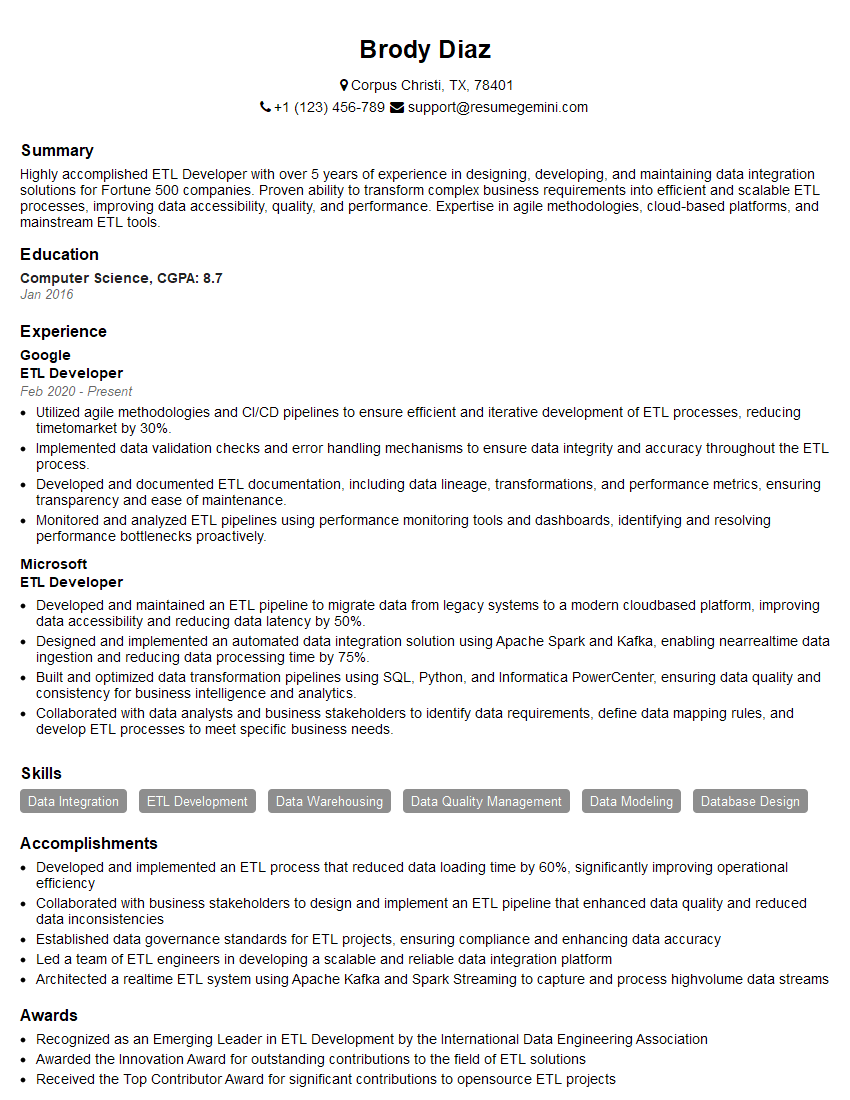
Mastering Process Integration opens doors to exciting career opportunities in a rapidly evolving technological landscape. A strong understanding of these concepts significantly enhances your employability and positions you for leadership roles. To maximize your chances of landing your dream job, creating an ATS-friendly resume is crucial. ResumeGemini can help you build a professional and impactful resume that highlights your skills and experience effectively. We provide examples of resumes tailored to Process Integration to guide you through the process. Take the next step toward your successful career journey today!
Explore more articles
Users Rating of Our Blogs
Share Your Experience
We value your feedback! Please rate our content and share your thoughts (optional).
What Readers Say About Our Blog
Very informative content, great job.
good