Feeling uncertain about what to expect in your upcoming interview? We’ve got you covered! This blog highlights the most important Product Safety Software interview questions and provides actionable advice to help you stand out as the ideal candidate. Let’s pave the way for your success.
Questions Asked in Product Safety Software Interview
Q 1. Explain the difference between hazard analysis and risk assessment.
Hazard analysis and risk assessment are closely related but distinct processes in product safety. Think of it like this: hazard analysis identifies what could go wrong, while risk assessment determines how likely it is to go wrong and how serious the consequences would be.
Hazard analysis systematically identifies potential hazards associated with a product. A hazard is a potential source of harm, such as sharp edges on a device or a software glitch causing a system malfunction. This process involves brainstorming, reviewing similar products, and analyzing design specifications. For example, in a smart home device, a hazard could be unauthorized access to the user’s data.
Risk assessment takes the identified hazards and evaluates the associated risks. This involves determining the likelihood (probability) of the hazard occurring and the severity of the harm if it does occur. This assessment often uses a risk matrix to categorize risks by severity and probability, allowing prioritization of mitigation efforts. For the unauthorized access hazard mentioned earlier, the risk assessment would consider factors like the probability of a successful cyberattack and the severity of the resulting data breach.
In essence, hazard analysis is the identification phase, while risk assessment is the evaluation and prioritization phase. They work together to ensure product safety.
Q 2. Describe your experience with various product safety standards (e.g., ISO 14971, IEC 61508).
I have extensive experience with various international and industry-specific product safety standards, including ISO 14971 and IEC 61508.
ISO 14971:2019 is a widely used standard for medical devices, but its principles are applicable to many product types. My experience involves applying its risk management process throughout the entire product lifecycle, from design and development through to post-market surveillance. This includes creating risk management plans, conducting hazard analyses, performing risk assessments, and implementing risk controls. I’ve also worked extensively on verification and validation activities to demonstrate compliance with the risk controls.
IEC 61508 is a functional safety standard for electrical/electronic/programmable electronic safety-related systems. I’ve utilized this standard, primarily focusing on the software aspects, in projects involving industrial automation systems where the safety of personnel is paramount. This includes defining safety requirements, performing hazard and operability studies (HAZOP), and selecting appropriate safety integrity levels (SILs) based on risk assessments.
Beyond these specific standards, I’m familiar with many others depending on the product domain and its intended use, ensuring each project adheres to the appropriate regulatory requirements.
Q 3. How do you identify and mitigate potential hazards in a software product?
Identifying and mitigating potential hazards in software is a systematic process involving several key steps:
- Hazard Identification: This involves techniques like brainstorming, checklists, fault tree analysis (FTA), and hazard and operability studies (HAZOP) to uncover potential hazards. For instance, a software crash could cause a self-driving car to lose control, representing a significant hazard.
- Risk Assessment: Once hazards are identified, we evaluate their likelihood and severity. This often involves using a risk matrix to categorize risks. A software crash is high severity but its likelihood depends on the software’s quality and testing rigor.
- Risk Mitigation: This is where we implement controls to reduce the risk. Mitigation strategies include adding error handling, performing thorough testing, using robust design principles, and employing version control to track changes and roll back faulty updates. The car example might employ redundant systems to take over if one part fails.
- Verification and Validation: This involves confirming that implemented mitigation strategies are effective. Techniques like code reviews, unit testing, integration testing, and system testing verify that the software behaves as intended and mitigates identified risks.
Throughout the process, careful documentation is critical to maintain a complete and auditable record of the safety analysis and risk mitigation activities.
Q 4. What are your experiences with Failure Mode and Effects Analysis (FMEA)?
Failure Mode and Effects Analysis (FMEA) is a proactive risk assessment technique used to identify potential failure modes in a system and assess their effects. I’ve extensively used FMEA in various projects, focusing on both hardware and software components.
My experience encompasses:
- Conducting FMEAs: Leading teams through structured FMEA workshops to systematically identify potential failure modes, their causes, effects, severity, occurrence, and detection.
- Developing FMEA documentation: Creating and maintaining comprehensive FMEA documentation, including tables with detailed descriptions of each failure mode and its associated risk parameters.
- Prioritizing risk reduction efforts: Using the FMEA results (Risk Priority Number – RPN) to prioritize mitigation strategies based on the overall risk level.
- Implementing corrective actions: Tracking the implementation of corrective actions to reduce the identified risks and regularly reviewing the effectiveness of those actions.
A real-world example involved an FMEA on a medical device software. We identified a potential failure mode where a sensor malfunction could lead to an inaccurate reading, potentially impacting patient treatment. Through the FMEA, we developed mitigation strategies, such as adding redundancy and implementing thorough testing, to significantly reduce the associated risk.
Q 5. Explain your understanding of Fault Tree Analysis (FTA).
Fault Tree Analysis (FTA) is a deductive, top-down analytical technique used to identify the combinations of events that can lead to a specific undesired event, or top event. It visually represents these event combinations as a tree, allowing a clear understanding of potential system failures.
My understanding of FTA includes:
- Building fault trees: Developing FTA diagrams using appropriate logic gates (AND, OR) to illustrate the relationships between events and the top event.
- Performing quantitative analysis: Using probabilities and failure rates to determine the likelihood of the top event occurring. This allows for a numerical risk assessment.
- Identifying critical failure modes: Identifying the most important events or components contributing to the top event, guiding the prioritization of mitigation efforts.
- Implementing mitigation strategies: Using the insights from FTA to guide the design and implementation of safety mechanisms to reduce the likelihood of the top event occurring.
For example, in a process control system, FTA can model the events leading to a hazardous chemical leak. The analysis may reveal that a combination of sensor failure, valve malfunction, and control system error are all required to cause the leak. This allows for targeted improvements in sensor reliability, valve design, and software robustness.
Q 6. Describe your experience using software tools for safety analysis.
I have significant experience using various software tools for safety analysis. These tools significantly enhance efficiency and accuracy compared to manual methods.
My experience includes the use of tools like:
- Risk management software: Software designed specifically for hazard analysis, risk assessment, and risk mitigation, often incorporating FMEA and FTA capabilities. These tools streamline documentation, calculations, and reporting.
- Modeling and simulation software: Software that allows for the simulation of system behavior under various conditions, including failure scenarios. This aids in identifying potential hazards and evaluating the effectiveness of safety mechanisms.
- Code analysis tools: Static and dynamic code analysis tools are used to identify potential software vulnerabilities and defects that could lead to safety-critical failures. These tools are particularly crucial for software with safety implications.
The choice of tools depends on the specific project requirements and the complexity of the system. However, using such tools helps ensure thorough and traceable analysis, leading to safer and more reliable products.
Q 7. How do you manage and track product safety issues throughout the product lifecycle?
Managing and tracking product safety issues throughout the product lifecycle is crucial. This requires a robust system combining technical expertise, process rigor, and effective communication.
My approach involves:
- Establishing a comprehensive risk management plan: This plan details the processes and procedures for identifying, assessing, and mitigating risks throughout the entire product lifecycle, from initial concept through post-market surveillance.
- Implementing a defect tracking system: Utilizing software tools to track safety-related issues, record corrective actions, and monitor their effectiveness. This ensures timely resolution of problems and prevents recurrence.
- Conducting regular safety reviews: Performing periodic reviews of the product’s safety performance, analyzing incident reports, and updating the risk assessment as necessary. This proactive approach ensures ongoing safety.
- Maintaining thorough documentation: Maintaining meticulous records of all safety-related activities, including hazard analysis, risk assessments, mitigation strategies, and verification and validation results. This ensures traceability and regulatory compliance.
- Effective communication and collaboration: Fostering clear communication among all stakeholders, including engineers, management, and regulatory bodies, to ensure that safety concerns are addressed promptly and efficiently.
By diligently following these practices, we can significantly improve product safety and minimize risks to users.
Q 8. How familiar are you with safety lifecycle processes (e.g., V-model, Agile)?
Safety lifecycle processes are crucial for developing safe and reliable software. They provide a structured approach to managing safety throughout the software development lifecycle (SDLC). Two popular models are the V-model and Agile. The V-model is a linear approach where each development phase has a corresponding testing phase. This ensures verification and validation at each stage. Agile, on the other hand, is iterative and incremental, with frequent feedback loops and continuous testing integrated throughout the process. My experience encompasses both models, adapting my approach based on project needs and regulatory requirements. For instance, in projects with stringent safety standards like those in the medical device industry, a more formal V-model approach might be necessary, emphasizing meticulous documentation and verification at each phase. In other projects, an Agile methodology might be more suitable to incorporate frequent feedback and adapt to changing requirements while still maintaining a robust safety process.
Q 9. Describe your experience with safety requirements specification and verification.
Safety requirements specification involves identifying all hazards and potential risks associated with the software and defining the necessary safety requirements to mitigate those risks. This often involves using techniques like Hazard and Operability Studies (HAZOP) and Failure Modes and Effects Analysis (FMEA). Verification, on the other hand, is the process of confirming that the software meets its specified safety requirements. This typically involves activities such as code reviews, static analysis, and dynamic testing. For example, in a project involving a medical infusion pump, a safety requirement might be “The system shall automatically stop infusion if the pressure exceeds a predefined limit.” Verification would then involve testing the system under various scenarios to confirm that this requirement is consistently met. My experience includes specifying these requirements, often using tools like DOORS or Jama, and using a range of verification techniques to ensure compliance.
Q 10. How do you ensure traceability of safety requirements throughout the development process?
Traceability is essential for demonstrating compliance with safety standards and regulations. It involves establishing a clear link between safety requirements, their implementation in the design and code, and the evidence that demonstrates the system meets those requirements. This is typically achieved through a system of identification numbers and references that connect artifacts across the lifecycle. For example, a requirement ID might be linked to specific design documents, code modules, and test cases. Tools like requirements management systems (RMS) greatly facilitate traceability by providing features for linking artifacts, managing changes, and generating traceability matrices. I use these tools extensively and maintain a robust traceability matrix to clearly demonstrate the link between high-level requirements and low-level implementation details, allowing for easy auditing and verification of compliance. Think of it like a thread running through the entire project, weaving together all aspects of development and ensuring nothing falls through the cracks.
Q 11. Explain your understanding of software safety integrity levels (SILs).
Software Safety Integrity Levels (SILs) are a classification scheme used to specify the required level of safety for software in safety-critical systems. They range from SIL 1 (lowest) to SIL 4 (highest), with each level representing a progressively lower risk tolerance. The SIL assigned to a software component depends on the severity of potential hazards and the probability of their occurrence. Higher SILs demand more rigorous development processes, stricter testing methodologies, and more extensive documentation. For example, a software component controlling the braking system of a car would likely require a higher SIL (perhaps SIL 3 or 4) than a software component controlling the window wipers (which might only need SIL 1). Understanding SILs is crucial because it dictates the level of effort and resources needed to ensure the safety of the software.
Q 12. How do you validate and verify the safety of software components?
Validating and verifying the safety of software components involves a combination of techniques. Validation ensures that the software meets the user needs and requirements, while verification confirms that the software meets its specifications. This includes:
- Static analysis: Automated tools to check code for potential errors without actually executing the code.
- Dynamic analysis: Testing the software while it’s running, including unit testing, integration testing, and system testing.
- Formal methods: Using mathematical techniques to prove the correctness of the software.
- Fault injection testing: Deliberately introducing faults into the system to assess its resilience.
Q 13. Describe your experience with safety testing methodologies.
My experience encompasses various safety testing methodologies, including:
- Unit testing: Testing individual software components.
- Integration testing: Testing the interaction between different components.
- System testing: Testing the entire system as a whole.
- Fault injection testing: Simulating faults to assess the system’s reaction.
- Stress testing: Pushing the system to its limits to evaluate its robustness.
- Safety-critical testing: Focused testing that directly targets safety-related requirements.
Q 14. How do you handle conflicts between safety requirements and other project constraints?
Conflicts between safety requirements and other project constraints (like time, budget, or resources) are inevitable. Resolving these conflicts requires a careful balance between safety and practicality. My approach involves:
- Prioritizing safety: Safety requirements always take precedence. Trade-offs might be necessary, but they should be carefully documented and justified.
- Risk assessment: Evaluating the impact of potential compromises on safety.
- Negotiation and communication: Working with stakeholders to find solutions that meet both safety and project goals. This might include adjusting schedules, reallocating resources, or simplifying certain features.
- Formal documentation: Recording all decisions and justifications for any compromises made.
Q 15. What is your experience with safety certification processes?
My experience with safety certification processes spans various international standards, including ISO 13485 (medical devices), IEC 62304 (software in medical devices), and UL standards for consumer products. I’ve been involved in all stages, from initial gap analysis and documentation preparation to audits and remediation. For example, in a recent project involving a medical device, I led the team in implementing a quality management system compliant with ISO 13485, resulting in successful certification within six months. This included establishing robust processes for design control, risk management, and change control. I’m familiar with navigating the intricacies of regulatory requirements and ensuring compliance throughout the entire product lifecycle.
- Gap Analysis: Identifying discrepancies between existing processes and certification requirements.
- Documentation: Creating and maintaining comprehensive documentation to support the certification process.
- Internal Audits: Conducting regular internal audits to identify and address potential non-conformances.
- Corrective and Preventive Actions (CAPA): Implementing CAPA plans to address identified non-conformances.
Career Expert Tips:
- Ace those interviews! Prepare effectively by reviewing the Top 50 Most Common Interview Questions on ResumeGemini.
- Navigate your job search with confidence! Explore a wide range of Career Tips on ResumeGemini. Learn about common challenges and recommendations to overcome them.
- Craft the perfect resume! Master the Art of Resume Writing with ResumeGemini’s guide. Showcase your unique qualifications and achievements effectively.
- Don’t miss out on holiday savings! Build your dream resume with ResumeGemini’s ATS optimized templates.
Q 16. Describe your experience with reporting and documenting safety-related incidents.
Reporting and documenting safety-related incidents is paramount to continuous improvement and preventing future occurrences. My approach follows a structured methodology encompassing immediate response, thorough investigation, and comprehensive documentation. I utilize dedicated incident reporting systems and ensure alignment with regulatory requirements. For example, in a past role, we implemented a system for tracking and analyzing near-miss incidents. This allowed us to proactively identify potential hazards and implement corrective actions before they resulted in actual accidents. Each incident report includes detailed descriptions of the event, contributing factors, root cause analysis, corrective actions, and verification of implemented changes. This information is then used for continuous improvement in our safety management system.
- Immediate Response: Prioritizing immediate actions to mitigate ongoing risks.
- Investigation: Conducting thorough investigations to determine root causes.
- Documentation: Creating detailed and accurate incident reports.
- Analysis: Analyzing trends to identify systemic issues and preventive measures.
Q 17. How do you stay up-to-date with changes in product safety regulations?
Staying current with evolving product safety regulations is crucial. I employ a multi-faceted approach: I subscribe to industry newsletters and journals, actively participate in professional organizations (like IEEE and ASME), attend conferences and webinars, and monitor government agency websites (e.g., FDA, CPSC). I also leverage online resources such as legal databases and regulatory information providers to access up-to-date information. For example, I regularly monitor the FDA’s website for updates on medical device regulations and attend webinars hosted by regulatory bodies to stay informed about changes and best practices. This proactive approach allows me to ensure that our products consistently meet the latest safety standards.
Q 18. Describe your experience with risk mitigation strategies.
Risk mitigation is a cornerstone of product safety. My experience involves employing a systematic approach, starting with hazard identification and risk assessment using techniques like Failure Mode and Effects Analysis (FMEA) and Fault Tree Analysis (FTA). I then develop and implement control measures, considering the severity and likelihood of risks. This could involve design modifications, protective measures, warning labels, or operator training. For example, in one project, a FMEA identified a potential risk of overheating in a product. Through a combination of design changes (improved heat dissipation) and software safeguards (temperature monitoring and shutdown), we significantly reduced the risk to an acceptable level. The key is a proactive approach, continually monitoring and reassessing risks throughout the product lifecycle.
Q 19. How do you collaborate effectively with cross-functional teams on safety-related issues?
Effective collaboration is key to addressing safety-related issues. I foster open communication and encourage active participation from all relevant teams, including engineering, design, manufacturing, quality assurance, and legal. I utilize tools like project management software and regular meetings to facilitate information sharing and coordination. Building trust and mutual respect within the team is critical. For instance, when addressing a safety concern, I prioritize a collaborative approach, involving all relevant stakeholders in the problem-solving process. This ensures a comprehensive solution that considers multiple perspectives and avoids potential conflicts down the line.
Q 20. Explain your understanding of cybersecurity risks and their impact on product safety.
Cybersecurity risks significantly impact product safety. Vulnerabilities in software can lead to malfunctions, data breaches, unauthorized access, and even physical harm. My understanding encompasses the entire spectrum, from secure coding practices to penetration testing and incident response. For example, I’ve worked on projects where secure design principles were integrated from the initial stages of development. This includes secure authentication mechanisms, data encryption, and regular security audits. Addressing cybersecurity vulnerabilities requires a multi-layered approach, combining preventative measures with robust detection and response capabilities. Ignoring cybersecurity risks can lead to severe consequences, including product recalls, legal liabilities, and reputational damage.
Q 21. Describe your experience with safety-critical software development processes.
Safety-critical software development requires rigorous processes to ensure reliability and safety. My experience includes utilizing methodologies such as the V-model and Agile with safety-specific extensions. This involves meticulous requirements analysis, formal verification techniques (e.g., model checking), extensive testing (including unit, integration, system, and user acceptance testing), and rigorous documentation. For example, I have implemented a safety-critical software development process using the V-model, where each phase of development is linked to a corresponding verification and validation activity. This ensures that the software meets its safety requirements throughout the development lifecycle. A key element is the use of version control and configuration management to track changes and ensure traceability. The goal is to minimize the risk of defects that could compromise safety.
Q 22. How do you handle pressure and tight deadlines in a safety-critical environment?
In a safety-critical environment, pressure and tight deadlines are inevitable. My approach focuses on proactive planning and efficient execution. I begin by clearly defining project scope and deliverables, breaking down large tasks into smaller, manageable units. This allows for better time management and easier tracking of progress. I utilize project management tools to visualize workflows and identify potential bottlenecks early. Prioritization is key – we focus on the most critical safety aspects first. Open communication with the team is essential to ensure everyone is aware of deadlines and potential roadblocks. If a deadline appears unachievable, I advocate for open discussion with stakeholders to adjust expectations or secure additional resources rather than compromising safety. I also believe in promoting a culture of continuous improvement, learning from past experiences to refine our processes and enhance efficiency for future projects.
For example, during a recent project involving firmware updates for a medical device, we faced a tight deadline. By employing Agile methodologies and daily stand-ups, we were able to quickly identify and resolve issues, keeping the project on track and ensuring the safety of the final product. Regular risk assessments allowed us to proactively mitigate potential delays.
Q 23. How would you approach improving the safety of an existing product?
Improving the safety of an existing product requires a systematic approach. It starts with a thorough hazard analysis, identifying potential hazards associated with the product’s design, operation, and use. This often involves reviewing incident reports, field data, and user feedback. Next, we assess the risks associated with each identified hazard, considering the severity and likelihood of harm. Then, we prioritize these risks based on their risk level (severity x likelihood). For high-priority risks, we explore mitigation strategies, such as redesigning components, improving instructions, adding safety features (e.g., interlocks, sensors), or implementing safety software updates. Following implementation, we validate the effectiveness of the mitigation strategies through testing and verification. Finally, we monitor the performance of the improved product through post-market surveillance to continually identify and address any emerging safety concerns. This iterative process ensures continuous improvement of product safety.
For instance, imagine an older model of a power tool with a known issue of overheating. Improving its safety might involve adding a thermal cutoff switch, redesigning the motor ventilation, or providing clearer warnings about overheating in the user manual. Each mitigation strategy would be rigorously tested before deployment.
Q 24. Describe your understanding of human factors in product safety.
Human factors engineering is critical to product safety. It acknowledges that product design and use are deeply intertwined with human capabilities and limitations. We need to understand how people interact with products, considering their physical and cognitive abilities, as well as their potential for errors. This involves analyzing user interfaces, task flows, warning systems, and other aspects of the product’s design to ensure they are intuitive, safe, and accommodate human variability. For instance, ergonomic considerations, such as appropriate handle size and weight distribution, are critical for hand tools. Similarly, clear and concise warning labels are vital to prevent misuse. Incorporating human factors principles into the design process from the outset significantly reduces the likelihood of accidents and improves user safety.
A classic example is the placement of controls on a machine. Poorly placed controls can lead to accidental activation, creating a safety hazard. Understanding human factors principles would involve careful consideration of reach, visibility, and the potential for unintended activation to design controls that are both easily accessible and safe to operate.
Q 25. What is your approach to conducting a root cause analysis of a safety incident?
Conducting a root cause analysis (RCA) for a safety incident requires a systematic and thorough investigation. I typically use a structured methodology, such as the “5 Whys” technique or a fault tree analysis (FTA). The goal is to move beyond simply identifying what happened to understanding *why* it happened. This involves gathering data from multiple sources – incident reports, witness testimonies, equipment logs, and potentially simulations or forensic analysis. The team then collaborates to identify contributing factors, systematically drilling down to the underlying root causes. This process necessitates open communication and a blame-free environment to encourage honest reporting and effective problem-solving. Once the root causes are identified, we develop corrective actions to prevent recurrence, and these actions are documented and implemented.
Let’s say a robotic arm malfunctioned, causing an injury. A 5 Whys analysis might proceed as follows: 1. Why did the arm malfunction? Because a sensor failed. 2. Why did the sensor fail? Because it was improperly calibrated. 3. Why was it improperly calibrated? Because the calibration procedure wasn’t followed. 4. Why wasn’t the procedure followed? Because the training was inadequate. 5. Why was the training inadequate? Because there wasn’t sufficient time allocated for it. The root cause, then, is insufficient training time, necessitating better resource allocation for employee training.
Q 26. How do you prioritize safety risks based on severity and likelihood?
Prioritizing safety risks involves a risk assessment matrix that considers both the severity and likelihood of each potential hazard. Severity is usually categorized into levels such as catastrophic, critical, marginal, and negligible. Likelihood is assessed based on the probability of the hazard occurring, ranging from frequent, probable, occasional, to remote. We often use a numerical scale (e.g., 1-5 for both severity and likelihood) to quantify these factors. The risk level is then calculated by multiplying severity and likelihood. Hazards with the highest risk level (highest product of severity and likelihood) are prioritized for mitigation first. This ensures that resources are focused on the most critical safety concerns, improving overall product safety efficiently.
For example, a hazard with a high severity (e.g., potential fatality) and a high likelihood (e.g., frequent occurrence) would receive a very high risk score and necessitate immediate action. Conversely, a hazard with low severity and low likelihood may warrant less immediate attention. This structured approach ensures that resources are directed towards effectively mitigating the greatest threats.
Q 27. Explain your experience with different safety management systems (SMS).
I have extensive experience with various Safety Management Systems (SMS), including ISO 9001 (Quality Management Systems), ISO 14971 (Medical devices risk management), and IEC 61508 (Functional safety of electrical/electronic/programmable electronic safety-related systems). These systems provide frameworks for identifying, assessing, controlling, and monitoring safety risks throughout the product lifecycle. My experience spans from implementing these systems in new product development to auditing existing systems to ensure compliance and continuous improvement. I am also familiar with industry-specific standards, such as those used in the automotive, aerospace, and medical device industries. Understanding these systems allows us to integrate best practices and compliance requirements into our processes, fostering a culture of safety throughout our operations. The practical application of these SMS involves meticulous documentation, regular audits, and continuous monitoring of the effectiveness of implemented safety measures.
For example, in a medical device project, I utilized ISO 14971 to conduct a thorough risk analysis, resulting in the identification and mitigation of several critical hazards before product launch. This proactive approach reduced potential risks to patients and ensured compliance with regulatory requirements. The experience instilled the importance of early risk assessment and continuous monitoring throughout the product’s lifecycle.
Key Topics to Learn for Product Safety Software Interview
- Regulatory Compliance: Understand key regulations like ISO 13485, FDA 21 CFR Part 820, and others relevant to your target industry. Be prepared to discuss how product safety software helps meet these requirements.
- Risk Management: Learn about Hazard Analysis and Critical Control Points (HACCP), Failure Mode and Effects Analysis (FMEA), and other risk assessment methodologies. Discuss how software facilitates these processes and improves data management.
- Data Management and Traceability: Understand how product safety software manages and tracks product data throughout the lifecycle, from design and manufacturing to distribution and recall. Be able to discuss data integrity and audit trails.
- Incident Reporting and Investigation: Explore how software supports efficient reporting, investigation, and analysis of product-related incidents. Consider the role of data analytics in identifying trends and preventing future issues.
- Software Functionality & Features: Familiarize yourself with the common features of product safety software, such as database management, reporting tools, document control, and workflow management. Be able to discuss the advantages and disadvantages of different features.
- Integration with Other Systems: Understand how product safety software integrates with other enterprise systems like ERP, PLM, and CRM. Discuss the benefits and challenges of system integration.
- Problem-Solving and Critical Thinking: Practice applying your knowledge to hypothetical scenarios. Be prepared to discuss how you would use product safety software to solve real-world problems related to product safety and compliance.
Next Steps
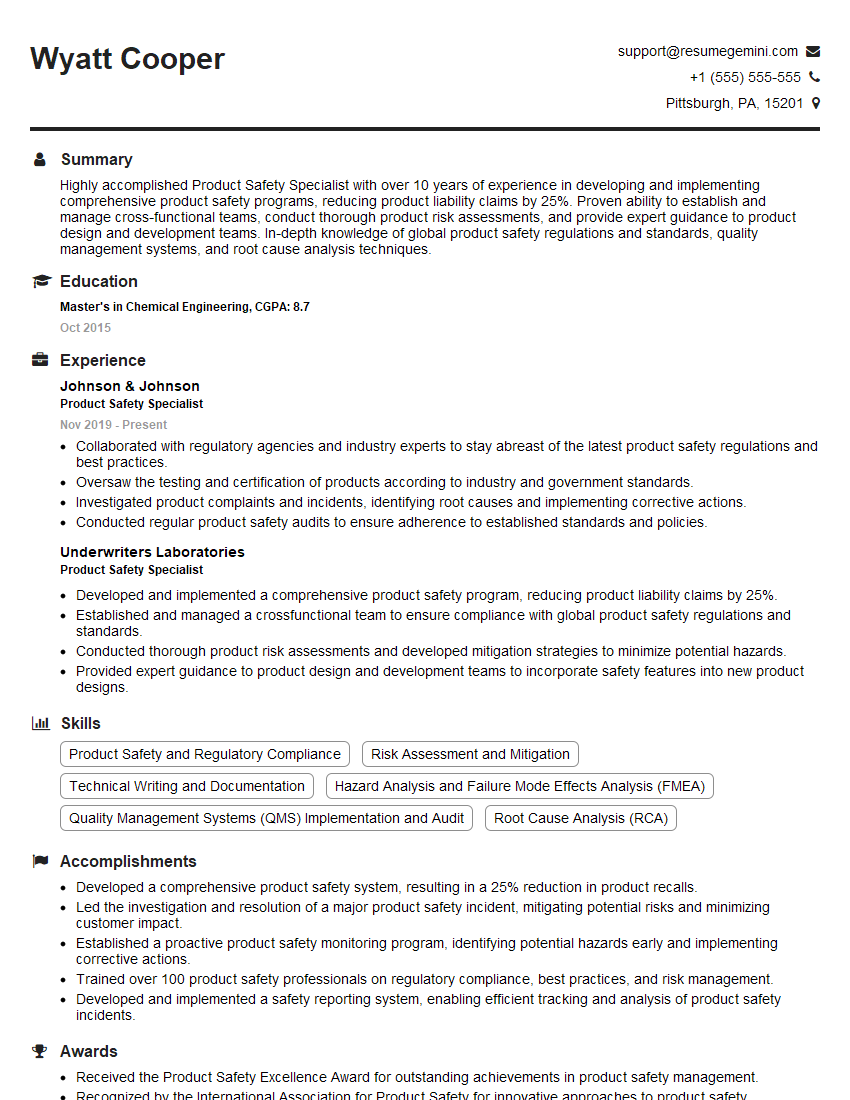
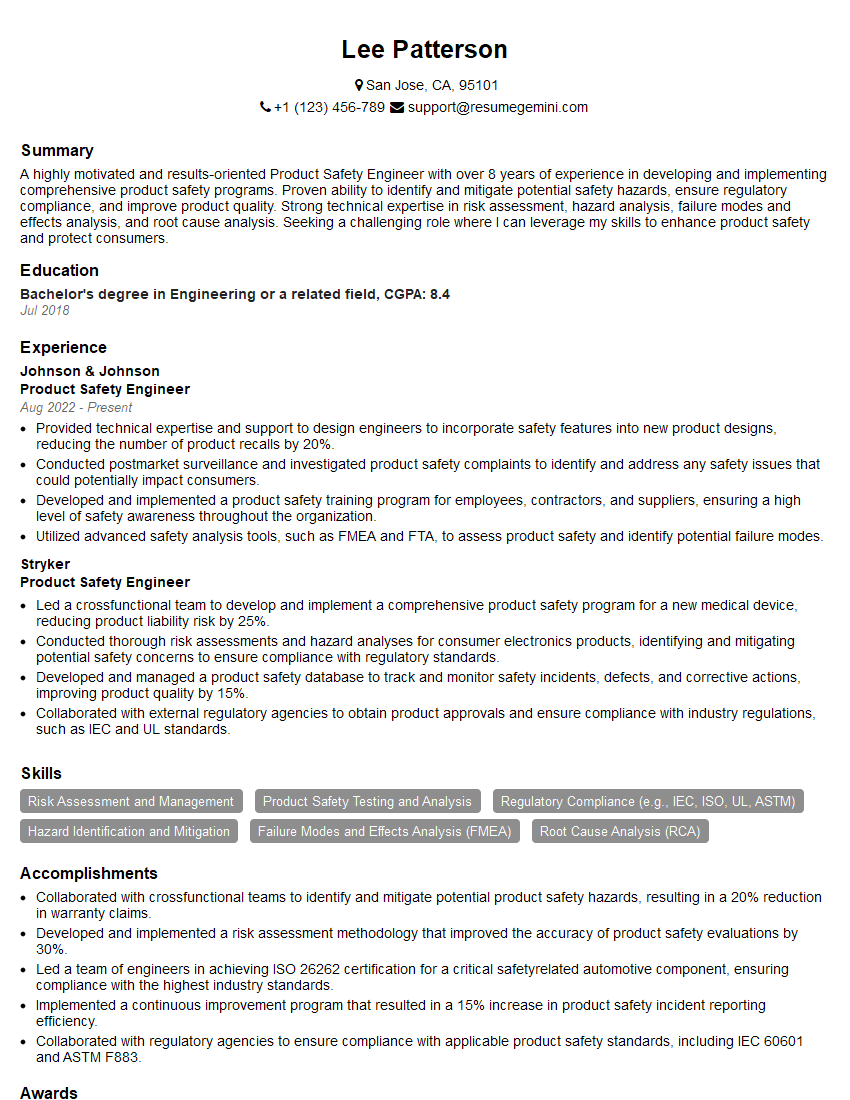
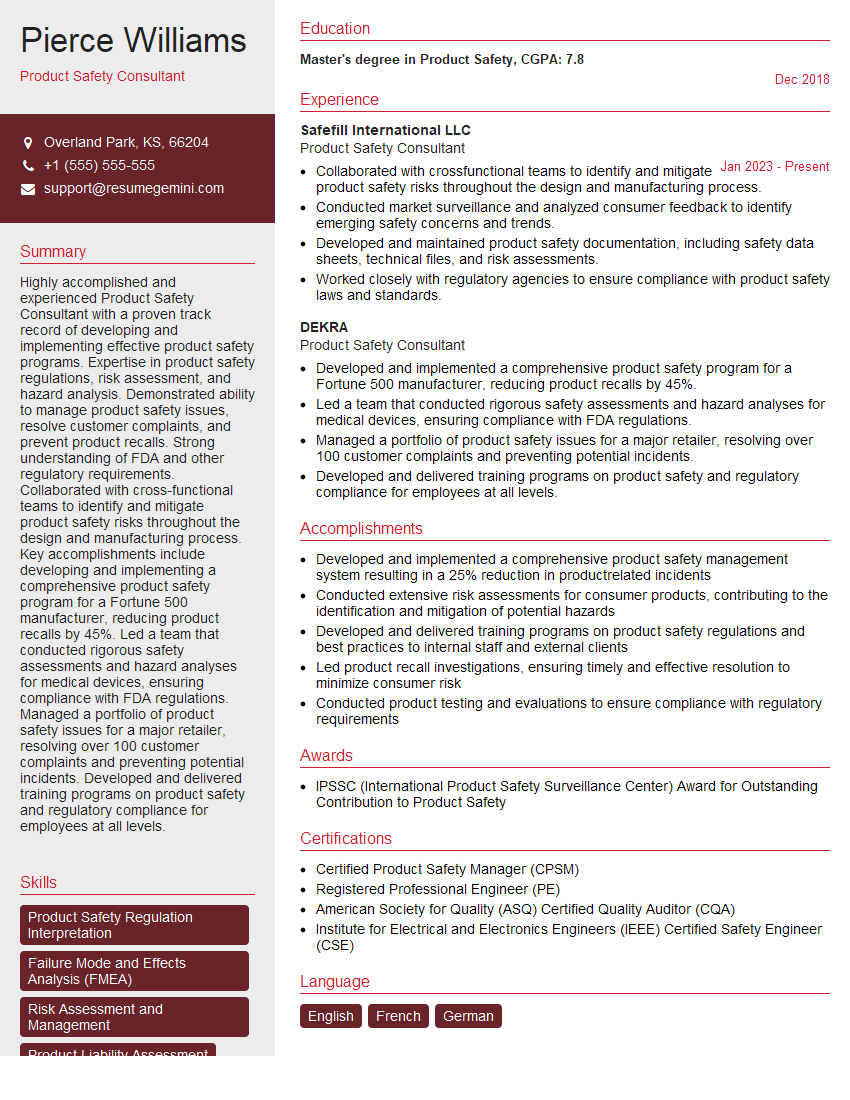
Mastering Product Safety Software is crucial for career advancement in this rapidly evolving field. A strong understanding of these systems demonstrates your commitment to safety and compliance, making you a highly valuable asset to any organization. To significantly increase your job prospects, focus on building an ATS-friendly resume that highlights your relevant skills and experience. ResumeGemini is a trusted resource for creating professional, impactful resumes. They offer examples of resumes tailored to the Product Safety Software industry, helping you present your qualifications effectively and land your dream job.
Explore more articles
Users Rating of Our Blogs
Share Your Experience
We value your feedback! Please rate our content and share your thoughts (optional).
What Readers Say About Our Blog
Very informative content, great job.
good