Interviews are opportunities to demonstrate your expertise, and this guide is here to help you shine. Explore the essential Production Assistant interview questions that employers frequently ask, paired with strategies for crafting responses that set you apart from the competition.
Questions Asked in Production Assistant Interview
Q 1. What software are you proficient in (e.g., Microsoft Office Suite, scheduling software)?
My proficiency in software is extensive and tailored to the needs of a Production Assistant. I’m highly skilled in the Microsoft Office Suite, including Word for document creation and revision, Excel for budget tracking and data analysis, and PowerPoint for presentations. Beyond that, I’m proficient in various scheduling and collaboration software. This includes Google Calendar for scheduling and appointment management, Asana or Trello for project management and task assignment, and Slack for team communication. I also have experience with specialized production software depending on the project, including scheduling tools like StudioBinder or Celtx.
For example, during a recent independent film project, I used Excel to create a detailed budget breakdown, tracking expenses against allocated funds, and then used Google Calendar to coordinate the schedules of multiple crew members and actors.
Q 2. Describe your experience with budget tracking and expense reports.
Budget tracking and expense reporting are crucial aspects of my role. I meticulously track all expenses, ensuring they align with the allocated budget. My process involves creating a detailed budget spreadsheet (usually in Excel), categorizing expenses, and obtaining necessary receipts. I then generate regular expense reports, comparing actual spending against projected costs. This allows for proactive identification of potential budget overruns and enables informed decision-making.
For instance, on a recent commercial shoot, I noticed a potential cost overrun in catering. By analyzing the expense data, I identified a less expensive vendor and negotiated a more suitable contract, ultimately saving the production several hundred dollars while still maintaining a high level of quality.
Q 3. How would you handle a last-minute change to the production schedule?
Handling last-minute schedule changes requires quick thinking, adaptability, and excellent communication. My approach involves several key steps:
- Immediate Assessment: First, I would understand the nature and scope of the change, its impact on the overall production schedule, and any potential conflicts.
- Communication: I’d immediately inform all relevant parties—the director, line producer, crew heads, and actors—clearly communicating the change and its implications.
- Problem Solving: I’d collaboratively brainstorm solutions with the team, prioritizing tasks and potentially rescheduling other aspects of the production to accommodate the change.
- Documentation: I would update the schedule immediately, keeping everyone informed of the revised plan. I also document all communications and changes made.
For example, during a music video shoot, a crucial location became unavailable at the last minute. By swiftly communicating with the director and location manager, we found an alternative location, adjusted the shoot schedule, and informed the talent and crew in time, minimizing disruption.
Q 4. What is your experience with equipment organization and maintenance?
Equipment organization and maintenance are critical for a smooth production. My experience includes organizing equipment prior to, during, and after shoots. I’m skilled in creating and maintaining an inventory system, ensuring all equipment is accounted for, properly functioning, and stored safely. Regular cleaning and basic maintenance are part of my routine. I’m also comfortable working with various types of equipment—lighting, cameras, sound, grip—and familiar with their appropriate handling and storage.
In a previous role, I developed a color-coded equipment labeling system that improved the efficiency of equipment retrieval and setup, saving valuable time during busy shoots.
Q 5. Explain your understanding of call sheets and their importance.
A call sheet is a crucial document that outlines the daily schedule for a film or television production. It contains essential information such as the date, time, call times for each crew member and actor, locations, and contact information. Its importance lies in keeping everyone informed, organized, and on schedule. It ensures smooth communication and prevents delays.
Call sheets are invaluable because they are the central point of reference for the entire production team. Without them, coordinating a shoot, especially a complex one, would be chaotic. They are like a daily roadmap for the shoot.
Q 6. How familiar are you with production workflows and different stages of production?
I have a solid understanding of production workflows and the various stages of production, which typically include pre-production (planning, budgeting, scheduling), production (filming, recording), and post-production (editing, sound mixing, color correction). I understand the interconnectedness of these phases and how each stage affects the others. I’ve worked on numerous productions, gaining experience in each phase, and know the importance of meeting deadlines and working efficiently throughout the process.
For example, my experience in pre-production includes helping to assemble the call sheets and coordinate with various departments. My understanding of the post-production workflow helps me ensure that all necessary materials—such as footage logs and release forms—are organized and readily available for the editors.
Q 7. Describe your experience working within a team environment.
I thrive in team environments. I believe in clear communication, collaboration, and mutual respect. My experience working on numerous productions has honed my ability to work effectively with diverse personalities and skill sets, always prioritizing the team’s overall success. I’m adept at taking direction, contributing my skills and knowledge, and actively supporting my colleagues.
On a recent documentary project, I was part of a small, tight-knit team. We relied heavily on open communication and mutual support to overcome challenges, and our collaboration resulted in a highly successful production. My role involved not only handling logistical tasks but also proactively anticipating needs and proactively supporting the team, fostering a collaborative and productive atmosphere.
Q 8. Have you worked with talent or crew logistics?
Yes, talent and crew logistics are core components of a Production Assistant’s role. My experience includes managing talent call times, coordinating travel arrangements (flights, ground transportation), ensuring their needs are met on set (catering, accommodations), and handling their contracts and payments. For crew, this involves scheduling, communication (often via various apps like Slack or production-specific software), distributing call sheets, and tracking their hours and overtime. For example, on a recent independent film shoot, I was responsible for coordinating the travel and accommodation for our lead actor, who was flying in internationally. This involved booking flights, securing a suitable hotel near the filming location, and liaising with the actor’s agent to ensure all travel documents were in order.
Furthermore, I’ve managed the logistics of larger crews, such as coordinating craft services, managing their break schedules and ensuring that everyone has the necessary resources to perform their jobs effectively. This involved proactively anticipating potential problems and finding solutions before they impacted the shoot schedule.
Q 9. How do you handle multiple tasks and prioritize effectively under pressure?
Handling multiple tasks and prioritizing under pressure is a critical skill for a Production Assistant. I utilize several strategies: First, I create detailed to-do lists, prioritizing tasks based on urgency and impact on the production schedule. I employ time management techniques, like the Pomodoro Technique, to stay focused and avoid burnout. Second, I’m adept at using project management software and tools to track progress and deadlines. Finally, I communicate proactively with the production team to manage expectations and ensure everyone is on the same page. This ensures that I’m not overwhelmed and that the most crucial tasks always get completed first. For example, during a live television broadcast, I might have to simultaneously handle requests for props, track talent arrival times, and coordinate with the technical crew – all while maintaining composure under the pressure of a live event.
Q 10. How familiar are you with different types of production (film, television, events)?
I have experience across various production types, including film, television (both studio and location shoots), and live events. While the specific tasks vary, the underlying principles of organization, communication, and problem-solving remain consistent. My experience in film includes working on both short films and feature-length productions, where I was responsible for tasks such as set preparation, assisting with prop management, and running errands. My television experience includes working on both studio-based and location shoots, with responsibilities including talent wrangling and maintaining set organization. My event experience includes working on corporate events and music festivals, where my focus was on logistics, supporting the on-site team, and ensuring a smooth event flow.
The difference lies in the pace and scale. Film productions are often more deliberate, allowing for careful planning, while television and events often require a more immediate and adaptable approach to problem-solving.
Q 11. What is your experience with location scouting or securing permits?
My experience with location scouting and permit securing is limited but growing. I’ve assisted in the location scouting process by researching potential locations, attending scouting visits, and helping to gather relevant information (access, parking, permits required). I understand the importance of securing necessary permits well in advance to avoid delays. While I haven’t independently secured permits, I’ve assisted in compiling the necessary paperwork and submitting applications, working closely with the production team’s location manager. For example, on a recent shoot, I helped research locations matching the script’s descriptions and then gathered information on parking availability and potential noise restrictions for the location manager.
Q 12. Describe your experience with transportation and logistics in production.
Transportation and logistics are crucial aspects of my work. I’ve coordinated transportation for talent and crew, including arranging pick-ups, managing travel itineraries, and ensuring vehicles are available as needed. I’ve also worked on managing equipment transport, coordinating with transportation companies, and tracking equipment movements to ensure it arrives safely and on time. This includes creating and managing spreadsheets tracking vehicle assignments, driver information, and schedules. On one project, I managed the transportation of delicate camera equipment, requiring special handling and insurance coordination. This involved close communication with the equipment rental company and the transport provider to ensure everything arrived undamaged and on schedule.
Q 13. How would you handle a conflict between crew members?
Handling crew conflicts requires diplomacy and tact. My approach involves firstly, listening carefully to each party to understand their perspectives and the root cause of the conflict. Then, I encourage open and respectful communication. I aim to mediate, facilitating a discussion where both parties can express their concerns and find common ground. If mediation fails, I escalate the conflict to the appropriate supervisor, providing a detailed and unbiased account of the situation. The key is to avoid taking sides and focus on resolving the conflict in a way that minimizes disruption to the production. For instance, I once mediated a disagreement between a camera operator and a lighting technician regarding set space. By calmly explaining both perspectives to the team lead and suggesting a compromise, we avoided a significant delay in the shoot.
Q 14. What are your strengths and weaknesses as a production assistant?
My strengths as a Production Assistant include my organizational skills, proactive problem-solving abilities, and my ability to work effectively under pressure. I’m a highly organized individual, detail-oriented and committed to meeting deadlines. I am also a quick learner, adaptable to new situations, and a strong communicator. I excel in anticipating potential problems and implementing solutions before they escalate. My weakness is sometimes my desire for perfection, which can lead to overworking myself. I am actively working on improving my delegation skills and time management to ensure that I can maintain high standards without sacrificing my well-being. I actively seek feedback and am constantly looking for ways to improve my efficiency and effectiveness.
Q 15. How do you ensure accuracy and attention to detail in your work?
Accuracy and attention to detail are paramount in a production assistant role. It’s not just about avoiding mistakes; it’s about proactively preventing them. I approach this through a multi-pronged strategy.
- Systematic Double-Checking: I always double-check my work, employing different methods each time. For instance, if I’m compiling a shot list, I’ll first verify the information against the script, then cross-reference it with the director’s notes, and finally perform a visual check against any existing footage.
- Organized Systems: I utilize meticulously organized systems, like color-coded spreadsheets or clearly labeled folders, to ensure nothing gets overlooked. This helps me track assets, manage schedules, and avoid confusion.
- Proactive Communication: I actively communicate potential issues or uncertainties to the relevant team members immediately. This allows for collaborative problem-solving and prevents minor errors from escalating into major problems. For example, if I notice a discrepancy in the call sheet, I’ll bring it to the attention of the production coordinator right away.
Essentially, my approach is one of proactive diligence, understanding that preventing errors is far more efficient than correcting them later.
Career Expert Tips:
- Ace those interviews! Prepare effectively by reviewing the Top 50 Most Common Interview Questions on ResumeGemini.
- Navigate your job search with confidence! Explore a wide range of Career Tips on ResumeGemini. Learn about common challenges and recommendations to overcome them.
- Craft the perfect resume! Master the Art of Resume Writing with ResumeGemini’s guide. Showcase your unique qualifications and achievements effectively.
- Don’t miss out on holiday savings! Build your dream resume with ResumeGemini’s ATS optimized templates.
Q 16. Are you comfortable working long and irregular hours?
Yes, I am completely comfortable working long and irregular hours. The production environment often demands flexibility, and I understand that meeting deadlines might require working evenings, weekends, or even through the night. In my previous role, I routinely worked 12-14 hour days during peak production periods. I’m adaptable and prepared to adjust my schedule as needed to contribute to a successful project.
Moreover, I prioritize efficient time management techniques to maximize productivity even during extended work periods. This includes breaking down tasks into manageable chunks, strategically scheduling breaks, and prioritizing tasks based on urgency and importance.
Q 17. Describe a time you had to solve a problem quickly and efficiently.
During a short film shoot, we discovered that our primary location was unexpectedly unavailable just hours before the scheduled start time. Instead of panicking, I immediately initiated a problem-solving process.
- Assess the Situation: I quickly assessed the impact: lost time, potential budget overruns, and cast/crew scheduling conflicts.
- Generate Solutions: I brainstormed alternative locations, considering factors like accessibility, lighting, and overall suitability for the scenes. I also considered postponing but that wasn’t ideal given scheduling constraints.
- Evaluate Options: I researched alternative locations, considering their availability and cost implications. I also contacted the location manager, the director, and the production manager to discuss the options.
- Implement Solution: We found a suitable backup location, slightly further afield but still feasible. We promptly notified the cast and crew of the change, minimizing disruption to their schedules. I ensured all new logistical details were updated.
Through quick thinking and proactive communication, we successfully mitigated a potentially disastrous situation, and the shoot went ahead with minimal disruption.
Q 18. How do you maintain positive working relationships with colleagues?
Maintaining positive working relationships is essential in a collaborative environment like film production. My approach emphasizes respect, open communication, and teamwork.
- Respectful Communication: I communicate clearly and respectfully, even under pressure. I actively listen to others’ perspectives and contribute constructively to discussions.
- Proactive Collaboration: I proactively seek input and collaborate with colleagues on tasks, ensuring everyone feels valued and their contributions are recognized.
- Teamwork and Support: I offer support to my colleagues whenever possible, understanding that a successful production relies on everyone working together effectively. I believe in mutual support and celebrating collective achievements.
- Conflict Resolution: If disagreements arise, I address them directly and constructively, focusing on finding solutions rather than assigning blame. I believe in finding common ground.
By fostering a supportive and collaborative environment, I contribute to a positive team dynamic and ensure everyone feels comfortable and engaged.
Q 19. What is your experience with data entry and record-keeping?
I have extensive experience with data entry and record-keeping, honed through various production roles. I am proficient in using various software, including spreadsheets (Excel, Google Sheets), databases, and specialized production management software.
- Data Accuracy: I’m meticulous in my data entry, ensuring accuracy and consistency. I use techniques like double-checking entries and employing error-checking tools.
- Record Management: I have experience maintaining comprehensive production records, including call sheets, shot lists, budget tracking, and expense reports. I understand the importance of maintaining organized and easily accessible records.
- Software Proficiency: I’m adept at using different software systems to efficiently manage data, adapting my skills to any software used by the production team. For example, I’m proficient in using industry-standard software such as Movie Magic Scheduling.
My organized approach to data management ensures efficient workflows and minimizes the risk of errors or information loss.
Q 20. Describe your understanding of production insurance and risk management.
My understanding of production insurance and risk management is foundational to my approach to production support. I understand the critical role insurance plays in protecting the production from various unforeseen circumstances.
- Types of Insurance: I’m familiar with common types of production insurance, such as liability insurance, equipment insurance, and workers’ compensation. I understand their purpose and how they work.
- Risk Identification: I’m able to identify potential risks on a set, ranging from equipment malfunctions to on-set injuries, and suggest preventative measures to minimize these risks.
- Safety Protocols: I’m knowledgeable about standard safety protocols and regulations related to film production, including those that pertain to insurance coverage. For instance, ensuring all cast and crew understand the safety procedures for using specific equipment.
- Reporting: I understand the importance of reporting any incidents or near misses to the appropriate personnel, facilitating the proper documentation needed for insurance purposes.
By proactively addressing potential risks and understanding insurance implications, I help contribute to a safe and secure production environment.
Q 21. How familiar are you with industry standard communication protocols?
I am highly familiar with industry-standard communication protocols. Effective communication is the lifeblood of any production.
- Communication Methods: I’m comfortable using various communication channels, including email, phone, walkie-talkies, and production management software. I know when each method is most appropriate.
- Clear and Concise Messaging: I always strive to deliver clear, concise messages, avoiding ambiguity to prevent misunderstandings. I tailor my communication to the audience, ensuring everyone understands.
- Professionalism: I maintain a professional tone in all my communication, ensuring my interactions reflect well on the production team.
- Timely Responses: I always respond promptly to messages, particularly those that require immediate attention.
My experience has reinforced the value of timely, clear, and professional communication in maintaining smooth workflows and positive team dynamics on set.
Q 22. How would you handle a discrepancy in the production budget?
Handling budget discrepancies requires immediate action and clear communication. First, I’d meticulously review the budget documents to pinpoint the exact discrepancy – is it an overspend, an underspend, or a misallocation of funds? I’d then analyze the cause. Was it due to unforeseen costs (e.g., equipment rental price increase), inaccurate initial estimations, or simply an accounting error?
Once the root cause is identified, I’d create a revised budget outlining the necessary adjustments. This might involve negotiating lower prices with vendors, exploring alternative resources, or reallocating funds from less critical areas. Transparency is key, so I’d immediately inform the production manager and other relevant stakeholders about the discrepancy and the proposed solutions. We’d collaboratively decide on the best course of action, prioritizing the completion of the project while staying within revised budget constraints. For instance, if catering costs exceeded the budget, I might explore cheaper but equally suitable options or reduce the number of meals provided while ensuring the crew is still adequately fed.
Q 23. What is your experience with script breakdown and scheduling?
Script breakdown and scheduling are crucial for efficient production. My experience involves meticulously analyzing the script, identifying scenes, locations, props, costumes, and talent needed for each scene. I then use this information to create a detailed schedule, considering factors like shooting days, location availability, cast availability, and crew availability. I’m proficient in various scheduling software, such as (mention specific software if you have experience, e.g., StudioBinder, Celtx), allowing for efficient organization and tracking of progress.
For example, I once broke down a script for a short film with multiple locations and complex special effects. The breakdown provided a clear sequence of shots, identifying all necessary resources, and facilitated the creation of a realistic schedule that factored in travel time between locations and setup time for each scene. This detailed planning allowed us to manage the production effectively and complete filming on time and within budget.
Q 24. How would you organize and manage a large volume of documents?
Managing a large volume of documents requires a systematic approach. I utilize a combination of cloud-based storage (e.g., Google Drive, Dropbox) and a robust file management system. I employ a clear and consistent folder structure, organizing documents by category (e.g., production documents, legal documents, financial records), project, and date. This allows for easy retrieval and ensures no information is lost.
Furthermore, I utilize metadata tagging and keyword searches to improve the efficiency of document retrieval. For example, I’d tag documents with keywords such as ‘budget’, ‘release forms’, ‘call sheets’, and ‘location permits’. This allows for quick searching and access, even when dealing with a vast number of documents. Regular backups are also crucial to prevent data loss.
Q 25. What steps would you take to ensure the safety of equipment and crew?
Ensuring the safety of equipment and crew is paramount. My approach involves multiple layers of safety protocols. Before commencing any filming activity, I conduct a thorough risk assessment, identifying potential hazards related to equipment, location, and activities. This assessment helps in developing a safety plan that includes appropriate safety measures and emergency procedures.
I make sure all crew members are briefed on safety procedures and are provided with the necessary Personal Protective Equipment (PPE). Regular equipment checks are conducted to ensure proper functioning and prevent malfunctions. Safe handling and storage practices are strictly enforced. I also ensure adherence to all relevant health and safety regulations. This proactive approach has consistently prevented accidents and injuries on my previous sets.
Q 26. Describe your experience with catering and crew meals.
My experience with catering involves coordinating with catering companies, ensuring meal times and dietary requirements are met. I manage orders, communicate with the crew about meal options, and resolve any issues promptly. I’m adept at creating catering schedules that align with the production schedule, allowing for efficient meal service during breaks.
For example, on a recent project, I handled catering for a crew of 30 people with various dietary restrictions. I coordinated with the caterer to create a menu with vegetarian, vegan, and gluten-free options. I also ensured the meals were delivered on time and met the crew’s satisfaction. Managing meal services efficiently is crucial for maintaining crew morale and productivity.
Q 27. How would you handle a situation where a piece of equipment malfunctions?
Equipment malfunction is a common challenge on set. My response is swift and organized. The first step is to assess the severity of the malfunction and its impact on the production schedule. Is it a minor issue that can be quickly resolved, or does it require significant repairs or replacement?
If it’s a minor problem, I’ll attempt to troubleshoot it with the help of the equipment operator or technicians. If it’s a major issue, I’ll immediately contact the equipment rental company or technical support to arrange for repairs or replacement equipment. In the meantime, I’ll work with the director and other crew members to adjust the shooting schedule to minimize disruption. This might involve shifting to scenes that don’t require the malfunctioning equipment or rescheduling the shoot entirely. Clear communication and problem-solving skills are essential in these situations.
Q 28. Describe a time you had to adapt to unexpected circumstances on set.
During a music video shoot, we faced unexpected heavy rain. Our outdoor location was rendered unusable, and our schedule was jeopardized. Instead of panicking, I quickly assessed the situation. We had a backup indoor location, but it wasn’t ideal for the envisioned shots.
I worked with the director to revise the shooting plan, focusing on scenes that could be effectively shot indoors, while retaining the artistic vision. We also creatively adapted the remaining outdoor scenes to be suitable for shooting at a later date, under better weather conditions. Through effective communication and quick thinking, we were able to adapt, minimize disruption, and successfully complete the project while maintaining a high standard.
Key Topics to Learn for Production Assistant Interview
- Production Workflow & Scheduling: Understand the various stages of production, from pre-production planning to post-production wrap. Be prepared to discuss scheduling techniques and your experience managing time effectively.
- Technical Proficiency: Familiarize yourself with common production equipment (cameras, audio recorders, lighting) and software (editing software, scheduling programs). Highlight any relevant experience and your ability to quickly learn new technologies.
- Teamwork & Communication: Production is a collaborative effort. Showcase your ability to communicate clearly and effectively with team members at all levels, including directors, crew, and clients. Prepare examples demonstrating your collaborative problem-solving skills.
- Organization & Problem-Solving: Detail your experience with organization systems (e.g., file management, inventory control) and your approach to resolving unexpected issues on set or in the production process. Focus on solutions and proactive measures.
- Budgeting & Resource Management: Demonstrate an understanding of production budgets and how to manage resources efficiently. Discuss your experience tracking expenses and ensuring projects stay on track.
- Health & Safety Regulations: Show awareness of relevant safety protocols and procedures on a film or television set. Understanding and adherence to these regulations is crucial.
Next Steps
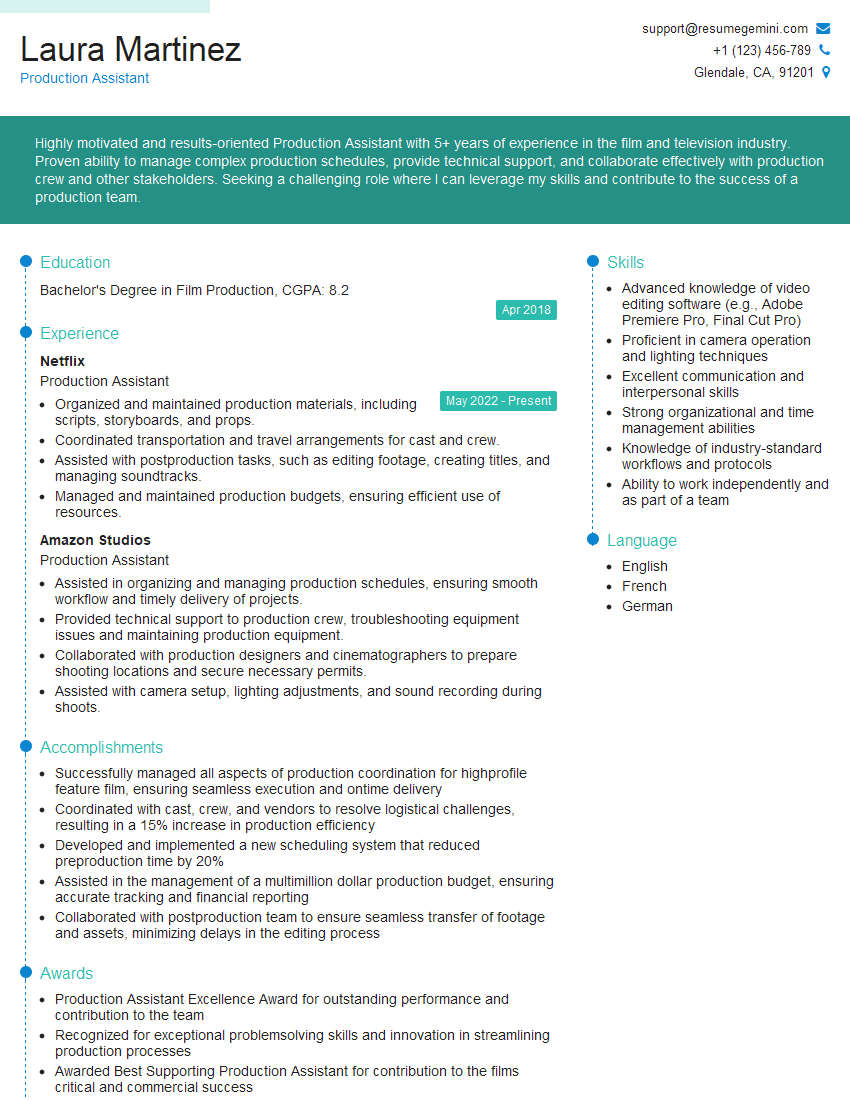
Mastering the skills of a Production Assistant opens doors to exciting career growth within the media industry, offering opportunities for advancement into roles with greater responsibility and creative input. To maximize your job prospects, crafting a strong, ATS-friendly resume is crucial. ResumeGemini is a trusted resource that can help you build a professional resume that highlights your skills and experience effectively. Examples of resumes tailored specifically for Production Assistant roles are available to help you get started.
Explore more articles
Users Rating of Our Blogs
Share Your Experience
We value your feedback! Please rate our content and share your thoughts (optional).
What Readers Say About Our Blog
Very informative content, great job.
good