Interviews are more than just a Q&A session—they’re a chance to prove your worth. This blog dives into essential Production Reporting and Data Analysis interview questions and expert tips to help you align your answers with what hiring managers are looking for. Start preparing to shine!
Questions Asked in Production Reporting and Data Analysis Interview
Q 1. Explain your experience with various data visualization tools.
Data visualization is crucial for turning raw data into actionable insights. My experience spans several tools, each with its strengths. I’m proficient in Tableau, known for its user-friendly interface and powerful analytical capabilities. I’ve used it extensively to create interactive dashboards displaying key production metrics, allowing for real-time monitoring and trend analysis. For instance, I built a dashboard that tracked production output across multiple factories, highlighting areas needing attention based on real-time data feeds. Power BI is another tool I’m familiar with, particularly effective for integrating data from various sources. I’ve used it to connect production data with sales and marketing data to provide a holistic view of business performance. Finally, I have experience with Python libraries like Matplotlib and Seaborn, providing more control over customization and statistical visualizations for more in-depth analyses. For example, I used Seaborn to create detailed distribution plots of production defects, helping pinpoint root causes.
Q 2. Describe your process for identifying and resolving data inconsistencies.
Identifying and resolving data inconsistencies is a critical part of ensuring data quality. My approach is systematic and involves several steps. First, I perform data profiling to understand the data’s characteristics, identifying potential inconsistencies like missing values, outliers, and data type mismatches. Then, I employ data validation techniques, using constraints and checks to flag inconsistencies. For example, if a production line reports a negative output, this is immediately flagged as an error. Next, I investigate the root cause of the inconsistencies. This often involves collaborating with the data source owners to understand the processes that generated the data. Finally, I implement data cleansing techniques to correct or remove inconsistent data. This might include imputation (filling in missing values) or outlier removal, always ensuring these processes maintain data integrity and don’t introduce bias.
Q 3. How do you ensure the accuracy and reliability of production reports?
Ensuring the accuracy and reliability of production reports is paramount. My approach focuses on establishing a robust data governance framework. This involves defining clear data quality rules and standards, establishing data validation procedures at each stage of the reporting process, and documenting the entire process meticulously. I use automated checks and validation rules whenever possible. For instance, I’ve developed scripts that automatically compare daily production figures against historical averages, flagging significant deviations for investigation. Regular reconciliation of data from different sources helps identify discrepancies. Finally, I conduct periodic audits to ensure that reporting processes are functioning as intended and that the data being used is accurate and reliable. This combination of proactive measures and auditing ensures the highest level of confidence in our production reports.
Q 4. What methods do you use to analyze large datasets efficiently?
Analyzing large datasets efficiently requires leveraging appropriate tools and techniques. I extensively use SQL for querying and manipulating large relational databases. For example, using optimized SQL queries with appropriate indexing significantly speeds up data retrieval. I also utilize data sampling techniques to work with a representative subset of the data when complete analysis is computationally expensive. Furthermore, I leverage cloud-based data warehousing solutions like Snowflake or BigQuery, enabling parallel processing and efficient handling of massive datasets. Finally, I’m proficient in using programming languages like Python with libraries such as Pandas and Dask, which provide tools for parallel processing and efficient data manipulation for larger-than-memory datasets. These methods ensure rapid analysis without compromising accuracy.
Q 5. Explain your experience with SQL and its application in production reporting.
SQL is my primary tool for accessing and manipulating production data stored in relational databases. I’m proficient in writing complex queries to extract, transform, and load (ETL) data for reporting. For example, I regularly use JOIN statements to combine data from multiple tables – say, production output with machine maintenance logs – to get a complete picture. I also utilize aggregate functions like SUM, AVG, and COUNT to calculate key metrics such as total units produced, average production time, and defect rates. Window functions allow for sophisticated calculations within subsets of data, such as calculating running totals or moving averages. Stored procedures help automate repetitive tasks, streamlining the reporting process. For instance, I’ve developed stored procedures to generate weekly production summaries automatically.
Q 6. How do you communicate complex data insights to non-technical stakeholders?
Communicating complex data insights to non-technical stakeholders requires translating technical language into clear, concise, and engaging narratives. I focus on visualizing data using charts and graphs that are easy to understand, avoiding technical jargon. I use storytelling techniques to present findings in a compelling way, emphasizing the key takeaways and their implications. For example, instead of discussing statistical significance, I might say something like, “Our data shows a clear trend of increased efficiency since implementing the new production process.” I prioritize interactive presentations, allowing stakeholders to explore the data at their own pace and ask questions. I also provide executive summaries, highlighting the most critical points, ensuring that key information is easily accessible, even for those with limited time.
Q 7. Describe your experience with data mining techniques.
Data mining techniques have been instrumental in identifying trends and patterns within production data. I frequently use association rule mining to uncover relationships between different factors affecting production output. For example, I might analyze machine settings and defect rates to identify optimal configurations. Clustering techniques, such as k-means clustering, allow me to group similar production runs, identifying best practices or areas needing improvement. Regression analysis helps predict future production output based on historical data and various influencing factors. For example, I used a regression model to predict the impact of seasonal fluctuations on production yields. These techniques allow for proactive identification of issues and optimization opportunities.
Q 8. How do you handle missing data in your analysis?
Handling missing data is crucial for accurate analysis. My approach involves a multi-step process starting with understanding why the data is missing. Is it random (missing completely at random – MCAR), or is there a pattern (missing at random – MAR, or missing not at random – MNAR)? This understanding dictates the best imputation strategy.
For MCAR data, simple methods like mean/median imputation might suffice, particularly for large datasets where the impact is minimized. However, this can distort the variance. For more robust results, I’d prefer multiple imputation techniques that create several plausible datasets to account for uncertainty. These methods, often implemented in R or Python using packages like mice or Amelia, generate multiple imputed datasets, each analyzed separately, and then results are combined.
If the data is MAR or MNAR, more sophisticated methods are required. For instance, I might use regression imputation, k-nearest neighbors, or maximum likelihood estimation. The choice depends on the nature of the data and the missingness mechanism. Always, the limitations of the imputation technique and its potential impact on the analysis are carefully considered and documented.
Finally, thorough documentation of the imputation strategy is vital for transparency and reproducibility. The report should clearly state the methods used and any potential biases introduced.
Q 9. What key performance indicators (KPIs) are relevant for production reporting?
Key Performance Indicators (KPIs) for production reporting depend heavily on the specific industry and production process. However, some common and vital KPIs include:
- Overall Equipment Effectiveness (OEE): This measures the efficiency of a manufacturing process by considering availability, performance, and quality.
- Production Output/Throughput: The total number of units produced within a given time frame. This could be measured in units, tons, or other relevant metrics.
- Yield/Defect Rate: The percentage of good units produced versus defective units. A lower defect rate indicates higher quality.
- Cycle Time: The time it takes to complete one production cycle.
- Labor Productivity: Output per labor hour, assessing the efficiency of the workforce.
- Inventory Turnover: How efficiently inventory is managed and converted into sales.
- Downtime/MTBF (Mean Time Between Failures): The frequency and duration of equipment downtime, crucial for identifying maintenance needs.
The specific KPIs selected should align with business objectives and be tracked consistently to monitor progress and identify areas for improvement.
Q 10. How do you identify trends and patterns in production data?
Identifying trends and patterns in production data requires a combination of visual exploration and statistical analysis. I typically begin with data visualization techniques like:
- Time series plots: To visualize changes in KPIs over time, easily revealing seasonal trends or upward/downward patterns.
- Scatter plots: To explore relationships between different variables, such as production output and energy consumption.
- Histograms and box plots: To understand the distribution of KPIs and identify outliers.
Following visualization, I apply statistical methods like:
- Moving averages: To smooth out short-term fluctuations and highlight longer-term trends.
- Regression analysis: To model the relationship between variables and predict future outcomes.
- Time series decomposition: To separate a time series into its components (trend, seasonality, and residuals) for better understanding.
- Control charts: To monitor process stability and detect deviations from expected values.
For instance, if I notice a downward trend in OEE using a time series plot, I’d then investigate potential causes using regression analysis to correlate OEE with factors like machine downtime or material quality.
Q 11. Explain your experience with statistical analysis methods.
My experience encompasses a wide range of statistical analysis methods, including:
- Descriptive statistics: Calculating measures of central tendency (mean, median, mode), dispersion (variance, standard deviation), and other summary statistics to provide a concise overview of the data.
- Inferential statistics: Using hypothesis testing (t-tests, ANOVA, chi-square tests) and confidence intervals to draw conclusions about the population based on sample data. For example, comparing the mean output of two different production lines using a t-test.
- Regression analysis: Linear, multiple, and logistic regression to model relationships between variables and make predictions. For example, predicting production output based on labor hours and material usage.
- Time series analysis: ARIMA, exponential smoothing, and other methods to model and forecast time-dependent data, crucial for production planning.
- Quality control techniques: Control charts (Shewhart, CUSUM) and process capability analysis (Cp, Cpk) to assess and improve process stability and quality.
I am proficient in using statistical software packages like R and Python (with libraries like statsmodels, scikit-learn) to perform these analyses.
Q 12. Describe your experience with different database management systems (DBMS).
I have experience with several database management systems (DBMS), including:
- SQL Server: Extensive experience in writing complex SQL queries for data extraction, transformation, and loading (ETL) processes. I am comfortable with stored procedures, views, and indexing for efficient data retrieval.
- MySQL: Experience with MySQL for smaller-scale projects and data warehousing.
- PostgreSQL: Familiarity with PostgreSQL’s advanced features, including its JSON handling capabilities for working with semi-structured data.
- Cloud-based databases (e.g., AWS RDS, Google Cloud SQL): Experience managing and querying data in cloud environments.
My experience extends to data warehousing concepts and techniques. I’m proficient in designing and implementing dimensional models for efficient reporting and analysis.
Q 13. How do you prioritize tasks when working with multiple reporting requests?
Prioritizing multiple reporting requests requires a structured approach. I typically use a system that combines urgency, impact, and dependencies.
Urgency: Requests with immediate deadlines (e.g., urgent management reports) are given higher priority.
Impact: Requests with a significant impact on business decisions (e.g., analysis to inform strategic planning) take precedence over those with less critical outcomes.
Dependencies: Some requests depend on the completion of others. I create a dependency graph to ensure the right order of execution. For example, a detailed analysis might depend on the completion of preliminary data cleaning.
I use project management tools (like Jira or Trello) to track requests, their priorities, and progress, providing transparent communication with stakeholders about timelines and potential delays.
Q 14. Describe a time you had to troubleshoot a data issue. How did you resolve it?
In a previous role, we were experiencing discrepancies in production output reported by the shop floor versus the data in our central database. The output numbers consistently differed by a small but significant margin.
My troubleshooting involved several steps:
- Data validation: I first checked data integrity in both systems. This involved examining data types, ranges, and potential outliers.
- Data source identification: I traced the data flow from the shop floor (using their reporting systems) to the central database to identify potential points of failure.
- Log analysis: I reviewed system logs from data transfer processes to pinpoint any errors or inconsistencies.
- Testing & investigation: I identified a timing issue. The shop floor system recorded production data slightly before it was officially transmitted to the database, creating the discrepancy.
- Solution implementation: The solution involved adjusting the data synchronization process to account for the timing difference. This required collaboration with the IT team to update data transfer scripts.
This experience highlighted the importance of thorough data validation, clear documentation of data flow, and collaborative problem-solving. The resolution improved data accuracy and reliability.
Q 15. How do you ensure the timely delivery of production reports?
Timely delivery of production reports hinges on a well-defined process, proactive planning, and robust automation. Think of it like a well-oiled machine – each part needs to function smoothly and efficiently. My approach involves:
- Scheduling and Prioritization: I collaborate with stakeholders to establish clear report deadlines and prioritize reports based on urgency and business impact. This often involves using project management tools to track progress and identify potential bottlenecks.
- Automated Processes: Leveraging automation wherever possible is crucial. This includes scripting data extraction, transformation, and loading (ETL) processes, automating report generation, and setting up automated email delivery.
- Data Pipeline Monitoring: I implement real-time monitoring of the data pipeline to identify and address any issues promptly. This involves setting up alerts and dashboards that provide visibility into the data flow and report generation process. For example, if a data source is unavailable, I’ll receive an immediate alert, allowing me to investigate and resolve the issue before it impacts report delivery.
- Testing and Quality Assurance: Rigorous testing is essential to ensure reports are accurate and reliable. This includes unit testing, integration testing, and user acceptance testing.
In a previous role, I implemented a fully automated reporting system that reduced report delivery time from 24 hours to just 2 hours, significantly improving decision-making speed.
Career Expert Tips:
- Ace those interviews! Prepare effectively by reviewing the Top 50 Most Common Interview Questions on ResumeGemini.
- Navigate your job search with confidence! Explore a wide range of Career Tips on ResumeGemini. Learn about common challenges and recommendations to overcome them.
- Craft the perfect resume! Master the Art of Resume Writing with ResumeGemini’s guide. Showcase your unique qualifications and achievements effectively.
- Don’t miss out on holiday savings! Build your dream resume with ResumeGemini’s ATS optimized templates.
Q 16. What is your experience with automated reporting tools?
I have extensive experience with various automated reporting tools, including Tableau, Power BI, and Qlik Sense. These tools allow for the creation of interactive dashboards and reports, simplifying data analysis and visualization. Beyond these, I’m proficient in scripting languages like Python, using libraries such as Pandas and Plotly to automate report generation and data manipulation. I’ve also worked with dedicated ETL tools like Informatica and Talend for large-scale data processing and reporting needs.
For example, in a previous project, I used Python with Pandas and Plotly to automate the creation of daily production summaries, significantly reducing manual effort and improving data accuracy. The code dynamically pulled data from a database, performed calculations, and generated visually appealing charts and graphs that were automatically emailed to stakeholders.
#Example Python code snippet (simplified):
import pandas as pd
import plotly.express as px
# ... data loading and processing ...
fig = px.line(df, x='Date', y='Production_Units')
fig.write_html('report.html')
Q 17. How do you validate data sources and ensure data integrity?
Data integrity is paramount. My approach to validating data sources and ensuring integrity involves a multi-faceted strategy:
- Source Verification: I meticulously verify the reliability and accuracy of each data source. This includes assessing the data’s origin, its methodology, and its potential biases. I often cross-reference data from multiple sources to identify inconsistencies or anomalies.
- Data Profiling: I use data profiling techniques to understand the characteristics of the data, including data types, distributions, missing values, and outliers. This helps identify potential issues early in the process.
- Data Cleaning and Transformation: I employ various data cleaning techniques to handle missing values, outliers, and inconsistencies. This might involve imputation, outlier removal, or data transformation using appropriate methods.
- Data Validation Rules: I implement data validation rules to ensure data consistency and accuracy. This includes range checks, uniqueness checks, and cross-field validation. For instance, I might check that the sum of parts produced equals the total production count.
- Regular Audits: Performing regular data quality audits is crucial to ensure ongoing data integrity. This involves reviewing data profiles, validation rules, and report outputs to identify potential issues.
Imagine building a house – you wouldn’t start without ensuring the foundation is solid. Similarly, robust data validation is the foundation of reliable production reports.
Q 18. How familiar are you with forecasting techniques in a production environment?
Forecasting in a production environment is vital for optimizing resource allocation and meeting demand. I have experience with various forecasting techniques, including:
- Moving Average: Simple and effective for stable time series data.
- Exponential Smoothing: Accounts for trends and seasonality.
- ARIMA (Autoregressive Integrated Moving Average): A powerful statistical model for complex time series data.
- Regression Analysis: Useful for identifying relationships between production and other factors.
- Machine Learning Models: Advanced techniques such as LSTM networks or Prophet can provide highly accurate forecasts, especially for complex scenarios with non-linear trends.
The choice of technique depends on the nature of the data and the desired level of accuracy. I always perform model validation and accuracy checks to ensure the reliability of the forecasts. For instance, in one project, I used ARIMA modeling to forecast demand for a specific product, leading to a 15% reduction in inventory holding costs.
Q 19. What is your experience with Agile methodologies in data analysis?
While Agile methodologies are often associated with software development, their principles readily apply to data analysis. My experience with Agile in data analysis includes:
- Iterative Approach: I embrace the iterative nature of Agile, delivering incremental improvements to reports and analysis rather than aiming for a single, large-scale deliverable.
- Collaboration and Communication: Agile emphasizes collaboration and communication with stakeholders. I actively involve stakeholders throughout the process to ensure alignment on objectives and priorities.
- Flexibility and Adaptability: Agile allows for flexibility and adaptability. I can easily adjust to changing requirements or priorities throughout the analysis process.
- Use of Agile Tools: I utilize Agile project management tools like Jira or Trello to track progress, manage tasks, and facilitate communication.
In a previous role, we used an Agile approach to develop a series of production dashboards, releasing updates and new features iteratively based on stakeholder feedback, resulting in a more user-friendly and effective system.
Q 20. How do you contribute to process improvement in production reporting?
Contributing to process improvement is a core aspect of my role. I actively seek opportunities to enhance efficiency and accuracy in production reporting. My contributions include:
- Identifying Bottlenecks: Through data analysis and process mapping, I pinpoint bottlenecks and inefficiencies in the reporting process.
- Automating Tasks: I automate repetitive tasks to reduce manual effort and improve consistency.
- Data Quality Improvements: I implement measures to enhance data quality, reducing errors and inconsistencies.
- Developing New Reporting Tools and Techniques: I explore and implement new tools and techniques to improve the efficiency and effectiveness of reporting.
- Providing Data-Driven Recommendations: I provide data-driven recommendations to stakeholders on how to improve production processes.
For example, by analyzing report generation times, I identified a specific data source that was causing delays. By implementing a caching mechanism, we reduced the report generation time by 40%.
Q 21. Explain your experience with different data formats (CSV, XML, JSON, etc.).
I am proficient in working with various data formats, including CSV, XML, JSON, and database formats such as SQL Server and Oracle. My experience encompasses:
- CSV (Comma Separated Values): A simple and widely used format, ideal for importing and exporting data to spreadsheets and other applications. I routinely use this for data manipulation and analysis.
- XML (Extensible Markup Language): A hierarchical data format commonly used for structured data exchange. I leverage XML parsing libraries in Python or other languages to extract information from XML documents.
- JSON (JavaScript Object Notation): A lightweight and widely used format for data interchange, especially with web applications and APIs. I use JSON libraries to parse and manipulate JSON data.
- Database Formats: I possess extensive experience with SQL databases, including data querying, manipulation, and database design. I regularly interact with databases to extract and update production data. I can write complex queries to extract specific data subsets.
My ability to handle diverse data formats allows me to integrate data from various sources to create comprehensive production reports. For example, I once integrated sales data from a JSON API, manufacturing data from a SQL database, and inventory levels from a CSV file to create a holistic view of the production process.
Q 22. How do you measure the success of your production reporting efforts?
Measuring the success of production reporting isn’t just about hitting deadlines; it’s about ensuring the reports deliver real value. I gauge success through a multi-faceted approach focusing on impact, efficiency, and accuracy.
- Impact: Are the reports driving better decision-making? Are they leading to improvements in production efficiency, cost reduction, or quality enhancement? I track key performance indicators (KPIs) directly tied to business goals to measure this. For example, if a report highlights a bottleneck in the production line, and subsequent actions based on that report lead to a 10% increase in output, that’s a clear measure of success.
- Efficiency: Are the reports generated in a timely and cost-effective manner? I analyze report generation time, resource utilization, and automation levels. Implementing automated reporting processes, for example, significantly improves efficiency by reducing manual effort and potential errors.
- Accuracy: Are the reports reliable and free from errors? Regular data validation and reconciliation are crucial. I use various techniques like data quality checks, comparing data from multiple sources, and establishing clear data governance processes to ensure accuracy. Discrepancies are investigated thoroughly and corrective actions implemented.
Ultimately, successful production reporting is about providing actionable insights that improve business outcomes. Regular feedback from stakeholders, coupled with these metrics, ensures the reports remain relevant and valuable.
Q 23. Describe your experience with data warehousing and business intelligence tools.
I have extensive experience with various data warehousing and business intelligence (BI) tools. My expertise spans from designing and implementing data warehouses using tools like Snowflake and Amazon Redshift to developing interactive dashboards using Tableau and Power BI.
In previous roles, I’ve been involved in the entire lifecycle of BI projects, from requirements gathering and data modeling to report development and deployment. For example, in one project, I designed a star schema data warehouse to consolidate production data from disparate sources. This improved data accessibility and enabled the creation of insightful reports that were previously unavailable. I also have experience with ETL (Extract, Transform, Load) processes, utilizing tools like Informatica PowerCenter to cleanse and transform data for analysis. My understanding extends to data visualization best practices, ensuring clear and concise communication of complex information to both technical and non-technical audiences.
Q 24. How do you handle conflicting priorities or deadlines in a fast-paced environment?
Handling conflicting priorities in a fast-paced environment requires a structured approach. My strategy involves prioritization, communication, and proactive problem-solving.
- Prioritization: I use methods like MoSCoW (Must have, Should have, Could have, Won’t have) analysis to rank tasks based on their importance and urgency. This helps me focus on the most critical tasks first.
- Communication: Open and transparent communication with stakeholders is key. I proactively update them on progress, potential roadblocks, and any necessary adjustments to timelines. This ensures everyone is aligned and informed.
- Proactive Problem-Solving: I anticipate potential conflicts and proactively seek solutions. This might involve negotiating deadlines, delegating tasks, or identifying alternative approaches. For example, if I foresee a delay in obtaining necessary data, I’ll communicate this early and explore alternative data sources or adjust the reporting scope to mitigate the impact.
Ultimately, effective time management, clear communication, and a flexible mindset are crucial for navigating conflicting priorities effectively. Think of it like conducting an orchestra; each instrument (task) needs to be managed to create a harmonious and successful outcome.
Q 25. What are some common challenges faced in production reporting, and how do you overcome them?
Production reporting faces numerous challenges, but consistent attention to detail and proactive problem-solving can overcome many of them.
- Data Quality Issues: Inconsistent data, missing values, and errors are common. I address this through robust data validation, data cleansing processes, and implementing data quality checks at various stages of the reporting pipeline.
- Data Silos: Data often resides in disparate systems, making integration challenging. To combat this, I leverage ETL processes and data warehousing techniques to consolidate data into a central repository.
- Evolving Requirements: Business needs change rapidly. I address this by employing agile methodologies, allowing for iterative development and adjustments to reports as needed.
- Lack of Automation: Manual reporting is time-consuming and prone to errors. I advocate for automating report generation using scripting languages like Python and scheduling tools whenever possible.
By combining rigorous data governance, robust data management, and agile development practices, I strive to mitigate these challenges and deliver reliable, accurate, and timely reports.
Q 26. How do you stay updated with the latest trends and technologies in data analysis?
Staying current in data analysis requires a proactive approach. I utilize several strategies to ensure I remain updated on the latest trends and technologies.
- Online Courses and Certifications: Platforms like Coursera, edX, and DataCamp offer valuable courses on advanced analytics, machine learning, and new data visualization techniques. I regularly complete relevant courses to enhance my skillset.
- Industry Conferences and Webinars: Attending conferences like Strata Data, and participating in webinars presented by industry leaders allows me to learn about cutting-edge technologies and best practices.
- Professional Networks: Engaging with online communities (e.g., Stack Overflow, Kaggle) and attending industry meetups fosters knowledge sharing and provides exposure to new ideas and challenges.
- Reading Industry Publications: Staying updated with relevant publications like journals, blogs and research papers helps to stay abreast with emerging trends.
Continuous learning is vital in this ever-evolving field. It’s not just about learning new tools but also understanding the underlying principles and adapting them to solve increasingly complex business problems.
Q 27. Describe your experience with predictive modeling in a production context.
Predictive modeling in a production context involves leveraging historical production data to forecast future outcomes and optimize production processes. I have experience building models using techniques like time series analysis, regression modeling, and machine learning algorithms.
For example, I developed a model to predict equipment failure based on sensor data from manufacturing machines. This allowed for proactive maintenance, minimizing downtime and reducing production losses. The model used a combination of regression and machine learning techniques, incorporating factors like machine age, operating hours, and sensor readings to predict the probability of failure within a specific time frame. This improved overall equipment effectiveness (OEE) and reduced maintenance costs significantly. Model evaluation and retraining are also crucial, ensuring the models remain accurate and relevant over time.
Q 28. How do you ensure data security and compliance in your work?
Data security and compliance are paramount in my work. I adhere to strict protocols to protect sensitive data and ensure compliance with relevant regulations.
- Access Control: I implement role-based access control to restrict data access to authorized personnel only. This minimizes the risk of unauthorized data access or modification.
- Data Encryption: Sensitive data is encrypted both in transit and at rest to prevent unauthorized access, even if a breach occurs. I utilize industry-standard encryption methods and tools.
- Regular Security Audits: I conduct regular security audits and vulnerability assessments to identify and address potential security weaknesses proactively.
- Compliance Adherence: I stay informed about and adhere to relevant data privacy regulations like GDPR, CCPA, etc., ensuring all data handling practices comply with the legal requirements.
- Data Loss Prevention (DLP): I implement DLP measures to prevent sensitive data from leaving the organization’s control, using tools that monitor data transfers and block unauthorized access.
Data security is not merely a technical issue; it’s a cultural one. I promote a culture of security awareness within my team and work collaboratively with IT security to ensure a robust and secure environment.
Key Topics to Learn for Production Reporting and Data Analysis Interview
- Data Collection & Cleaning: Understanding various data sources (e.g., databases, spreadsheets, APIs), techniques for data cleaning (handling missing values, outliers), and data transformation for analysis.
- Production Metrics & KPIs: Defining and interpreting key performance indicators (KPIs) relevant to production processes, such as yield, efficiency, and downtime. Practical application: Analyzing KPI trends to identify areas for improvement and potential bottlenecks.
- Data Visualization & Reporting: Mastering data visualization tools (e.g., Tableau, Power BI) to create compelling reports and dashboards that effectively communicate production performance. Understanding best practices for report design and storytelling with data.
- Statistical Analysis & Forecasting: Applying statistical methods (e.g., regression analysis, time series analysis) to analyze production data, identify trends, and make accurate forecasts. Problem-solving: Using forecasting models to optimize production schedules and resource allocation.
- Database Management & SQL: Working with relational databases, writing efficient SQL queries to extract and manipulate production data for analysis. Practical application: Building automated reporting processes using SQL.
- Data Interpretation & Communication: Clearly and concisely communicating complex data insights to both technical and non-technical audiences. Practical application: Presenting findings and recommendations to stakeholders.
- Root Cause Analysis & Problem Solving: Utilizing data-driven approaches (e.g., Pareto analysis, 5 Whys) to identify the root causes of production issues and recommend effective solutions.
Next Steps
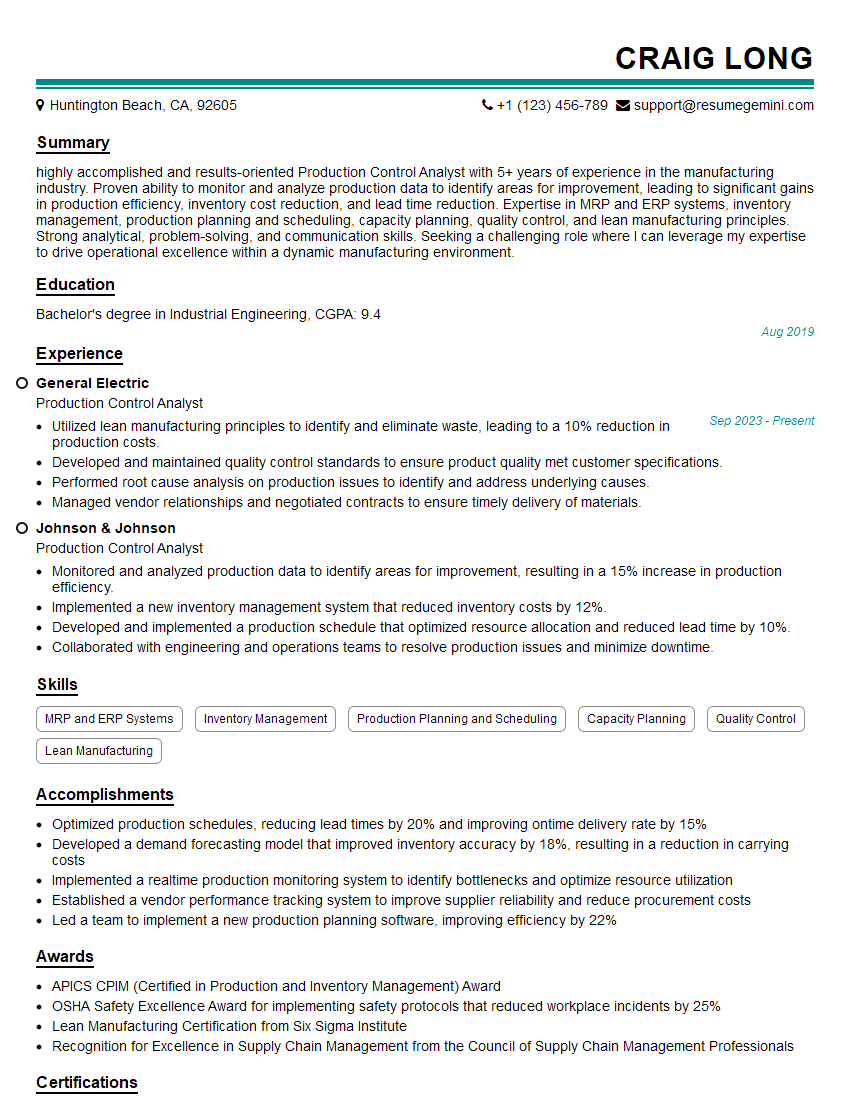
Mastering Production Reporting and Data Analysis is crucial for career advancement in today’s data-driven world. These skills are highly sought after, opening doors to exciting opportunities and higher earning potential. To maximize your job prospects, it’s vital to present your qualifications effectively. Building an ATS-friendly resume is key to getting your application noticed. We recommend using ResumeGemini to craft a professional and impactful resume that highlights your expertise. ResumeGemini provides examples of resumes tailored to Production Reporting and Data Analysis to help you get started.
Explore more articles
Users Rating of Our Blogs
Share Your Experience
We value your feedback! Please rate our content and share your thoughts (optional).
What Readers Say About Our Blog
Very informative content, great job.
good