The right preparation can turn an interview into an opportunity to showcase your expertise. This guide to Proficiency in Digital Prepress Systems interview questions is your ultimate resource, providing key insights and tips to help you ace your responses and stand out as a top candidate.
Questions Asked in Proficiency in Digital Prepress Systems Interview
Q 1. Explain the difference between CMYK and RGB color spaces.
CMYK and RGB are two different color models used to represent colors digitally. RGB (Red, Green, Blue) is an additive color model, meaning colors are created by adding light. It’s used for screens, like monitors and televisions. CMYK (Cyan, Magenta, Yellow, Key – black) is a subtractive color model, where colors are created by subtracting light from white. It’s used for print, as inks absorb light.
Think of it this way: Mixing RGB light creates white; mixing CMYK inks creates black (though often a separate black ink is added for better results). An image that looks vibrant on your screen (RGB) may appear duller when printed (CMYK) because the color spaces don’t perfectly align. Accurate color conversion between these spaces is crucial in prepress.
Q 2. Describe your experience with color profile management (e.g., ICC profiles).
Color profile management, primarily using ICC (International Color Consortium) profiles, is fundamental to my workflow. ICC profiles are essentially digital descriptions of a specific device’s color characteristics – a printer, monitor, scanner etc. They ensure that colors appear consistently across different devices. For instance, a profile for a specific printer tells the system how that printer renders colors, allowing for accurate color prediction in print output. I regularly embed and utilize ICC profiles in my workflows, ensuring a consistent color experience from design to print. My experience includes handling and troubleshooting issues arising from mismatched profiles or missing profiles. I’m proficient in working with software that allows for profile selection, conversion, and soft proofing – crucial for preventing costly color discrepancies during printing.
Q 3. What are common preflight checks you perform before sending files to print?
Preflight checks are critical to prevent printing errors. My standard procedure involves several steps:
- Font Verification: Checking for missing or embedded fonts, ensuring they’re compatible and correctly outlined.
- Image Resolution: Verifying image resolution is adequate for print (typically 300 dpi or higher), checking for low-resolution images that could result in pixelation.
- Color Space Conversion: Confirming appropriate color space (CMYK) and that color profiles are correctly embedded and managed.
- Overprint Check: Identifying and correcting any potential overprint issues, especially crucial in designs with spot colors.
- Bleed and Trim Marks: Checking that bleed is correctly set up, and trim marks are included for accurate cutting.
- Document Structure: Ensuring correct page order and orientation.
- Color Management: Validating color consistency throughout the document using soft proofing tools.
I use dedicated preflight software to automate these checks and generate a report detailing any issues found. This significantly reduces errors and speeds up the production process.
Q 4. How do you handle a file with missing fonts or images?
Missing fonts and images are common problems. My approach is systematic:
- Missing Fonts: I first try to locate the fonts. If available, I install them. If not, I substitute them with similar fonts, ensuring visual consistency, or I ask the client to supply them. As a last resort, I create outlines of the fonts.
- Missing Images: I contact the client immediately to obtain the missing images. If there’s a delay, I use placeholder images, ensuring that the size and position are correct to maintain the layout integrity.
I meticulously document all substitutions and replacements, keeping clear communication with the client throughout the process.
Q 5. What is trapping and why is it important in prepress?
Trapping is a technique used to prevent small gaps from appearing between colors during the printing process. Due to the slight misregistration that can occur when printing multiple colors, a small overlap (trap) is created, ensuring that the colors meet without visible gaps. The amount of overlap is determined by factors such as the paper stock, printing process, and the color combination. The importance of trapping lies in producing clean, professional-looking results, especially noticeable in fine lines or small text. Without proper trapping, your printed piece could have unsightly white gaps between colors, particularly noticeable on dark backgrounds.
Q 6. Explain your experience with different imposition software.
I have extensive experience with various imposition software packages, including but not limited to; [Mention specific software names e.g., Esko Automation Engine, Adobe Acrobat Pro, etc.]. My proficiency extends beyond simple imposition to include the creation of complex layouts for different print formats. This includes managing imposition for booklets, brochures, calendars, and other projects. I understand how to optimize imposition for efficiency and minimum waste, incorporating elements like imposition presets, custom imposition settings, and nested imposition for complex layouts. I regularly use imposition software to create job tickets, ensuring accurate settings for the printer are included, leading to a seamless transition from prepress to print.
Q 7. What are the benefits of using a digital workflow in prepress?
A digital workflow in prepress offers numerous advantages:
- Increased Efficiency: Automation streamlines tasks, reducing manual intervention and speeding up turnaround times.
- Reduced Errors: Automated preflight checks and digital proofing minimize the risk of errors, reducing waste and reprint costs.
- Improved Communication: Digital asset management and online proofing facilitate seamless communication with clients and printers.
- Cost Savings: Reduced waste, faster turnaround, and fewer errors translate to significant cost savings.
- Enhanced Collaboration: Digital workflows enable easy collaboration among team members and across different locations.
- Version Control: Digital archives keep track of file versions, simplifying revision management.
In my experience, implementing a well-structured digital workflow has significantly improved both efficiency and quality in my prepress operations.
Q 8. Describe your experience with various file formats (PDF, TIFF, EPS, etc.).
My experience encompasses a wide range of file formats crucial in digital prepress. Understanding their strengths and limitations is key to ensuring a smooth workflow and high-quality output.
- PDF (Portable Document Format): The industry standard for final print-ready files. I’m proficient in creating press-ready PDFs, ensuring appropriate bleeds, color spaces (CMYK primarily), and correct resolution for optimal print results. I often use PDF/X-1a or PDF/X-4 standards for reliable color consistency across platforms. For example, I’ve used Acrobat Pro to preflight and fix PDF issues like missing fonts or embedded images before sending them to press.
- TIFF (Tagged Image File Format): Ideal for high-resolution images, particularly those with complex color profiles. I use TIFFs extensively for image pre-processing, knowing how different compression options (like LZW or Packbits) affect file size and image quality. I’ve worked with very large TIFF files for billboard printing and had to manage them efficiently using tools like Bridge to avoid system slowdowns.
- EPS (Encapsulated PostScript): While less common now, I still encounter EPS files, especially in older projects. My experience includes handling vector graphics and ensuring proper embedding of fonts and linked images within the EPS file structure. I know that these files can sometimes be problematic if not properly set up.
- Other Formats: I’m also familiar with JPEGs (for web use and lower-resolution applications), AI (Adobe Illustrator), and InDesign files (.indd). I know how to manage these different file types within a larger prepress workflow, ensuring consistent and accurate output.
Q 9. How do you ensure color consistency across different printing processes?
Maintaining color consistency across various printing processes is critical for achieving the desired visual result. It requires a multi-faceted approach.
- Color Space Management: I always work in CMYK color space for print projects. This prevents unexpected shifts during the conversion from the RGB workspace often used in digital design.
- Color Profiles (ICC Profiles): Accurate color profiling of both the monitor and the printing press is essential. I use dedicated software to create and manage these profiles. Knowing how to correctly assign profiles and ensure the correct color space is applied throughout the process is crucial. For example, I might use a profile tailored for a specific type of paper and ink in a printing press.
- Proofing: Soft proofs (on-screen previews) and hard proofs (physical prints from a calibrated printer) are essential for verification. I use both methods and compare them to the original design file to make sure that colors are accurate. Soft proofing requires calibrated monitors. Hard proofing can use a color-managed printer and color-calibrated paper to simulate the final printed result.
- Collaboration with Printers: Close communication with printers about their specific color capabilities and preferences is a must. They often provide their own color profiles, and I would use these throughout the workflow.
Think of it like baking a cake – you need to use the correct ingredients (colors), follow the recipe (workflow), and use the correct oven (printing press) to get the desired result.
Q 10. What is your experience with color calibration and profiling?
Color calibration and profiling are fundamental aspects of my work. They directly impact color accuracy.
- Monitor Calibration: I regularly calibrate my monitor using a colorimeter (e.g., X-Rite i1Display) to ensure consistent color representation on screen. I typically use a specific profile generated by the colorimeter for the monitor.
- Printer Profiling: For my soft proofing and hard proofing processes, I have worked extensively with profiling software (such as X-Rite i1Profiler) to create custom ICC profiles for different printers and substrates (paper types). This is crucial for getting consistent results between soft proofing and final output.
- Software Integration: My knowledge extends to integrating these profiles into design and prepress software (Adobe Creative Suite, etc.) so they’re automatically used during the workflow. Failure to integrate them appropriately will cause inaccuracies.
Imagine trying to paint a picture using mismatched paints – the end result would be inaccurate and disappointing. Similarly, improper calibration and profiling lead to inconsistent color in print.
Q 11. Explain your experience with different types of printing plates (CTP, etc.).
My experience mainly involves Computer-to-Plate (CTP) technology, which has largely replaced traditional film-based platemaking.
- CTP Workflow: I’m proficient in preparing files for CTP output, ensuring appropriate resolution and image settings for different plate types (e.g., thermal, violet laser). I understand the importance of correct file formats and resolution, often using high-resolution TIFFs for optimal quality.
- Plate Types: I’m familiar with various plate technologies, such as thermal CTP, which uses heat to expose the plate, and violet laser CTP, which uses laser exposure. Understanding the specific requirements of each type is vital for producing high-quality plates.
- RIP Software: My expertise includes using RIP (Raster Image Processor) software to manage the workflow from digital file to plate. This software plays a key role in image processing, color management, and plate creation.
CTP is the backbone of modern printing, and mastering its nuances is crucial for efficient and accurate plate production.
Q 12. How do you troubleshoot common prepress issues (e.g., banding, moiré)?
Troubleshooting prepress issues requires a methodical approach and deep understanding of the printing process.
- Banding: This often stems from insufficient resolution, incorrect halftoning settings (e.g., screen angles, frequency), or problems with the printing press. I’d first check the resolution of the image files, then examine the halftone settings in the RIP software. If the issue persists, then I would investigate the printing press itself.
- Moiré: Moiré patterns arise from interference between the image’s frequencies and the printing screen’s angle. I address this by adjusting the screen angle or frequency in the RIP software, ensuring that the screen angle doesn’t align with any prominent lines in the image. Sometimes, resampling the image or altering the halftone pattern can also be helpful.
- Other Issues: I have extensive experience in dealing with issues like incorrect color, poor registration (misalignment of colors), and image distortions, using a combination of image editing techniques and close collaboration with the printing press to diagnose and resolve the root cause.
Solving these problems requires systematic investigation; often involving careful analysis of the image files, printing settings, and the printing press itself.
Q 13. Describe your experience with image editing software (Photoshop, etc.).
My image editing expertise centers primarily around Adobe Photoshop. I utilize it for a broad range of prepress tasks.
- Image Retouching: I routinely perform retouching, color correction, and image manipulation to enhance image quality and prepare them for print. I carefully manage color profiles and resolution to avoid introducing any artifacts or errors.
- Image Preparation: I’m skilled in preparing images for different printing techniques, ensuring appropriate resolution, color modes (CMYK), and appropriate sharpening techniques.
- File Conversion: I use Photoshop to efficiently convert images between different file formats (e.g., TIFF to JPEG, RGB to CMYK), while paying attention to maintain image quality. Incorrect conversions can significantly affect the final printed output.
Photoshop is my go-to tool for preparing images for print, allowing for meticulous control over color, resolution, and other crucial aspects of image quality.
Q 14. How do you manage high-volume prepress projects effectively?
Managing high-volume prepress projects effectively requires a structured approach and careful planning.
- Workflow Automation: I utilize automation tools and scripts to streamline repetitive tasks, such as file conversion, preflighting, and color profile management. This significantly reduces errors and increases efficiency. For instance, I might use automated preflighting to automatically flag potential problems before sending the files to print.
- Job Ticketing and Tracking: Implementing a robust job ticketing system allows for efficient tracking of projects, deadlines, and client communications. This helps maintain clarity and prevent confusion during busy periods.
- Teamwork and Collaboration: Effective communication and collaboration with designers, printers, and other team members are crucial to ensure a smooth workflow, especially with high volumes.
- Prioritization and Time Management: I use prioritization techniques and time management strategies (such as project management software) to ensure that high-priority tasks are completed on time and deadlines are met. A well-defined workflow and project plan greatly assist in this process.
Think of it like an orchestra – each player needs to know their role, follow the conductor’s instructions, and work together harmoniously to produce a beautiful symphony. Managing high-volume projects is similar – efficiency and collaboration are key to success.
Q 15. What is your understanding of print finishing processes?
Print finishing processes are the steps taken after the printing itself to enhance the final product’s appearance, durability, and functionality. Think of it as the final touches that transform a printed sheet into a finished, marketable item. These processes can significantly impact the overall quality and perceived value of the printed piece.
- Cutting and Trimming: Precisely cutting printed sheets to the desired size and shape. This ensures clean edges and a professional finish. For example, trimming business cards to their precise dimensions.
- Folding and Creasing: Folding sheets to create brochures, leaflets, or booklets. Creasing helps ensure clean, sharp folds without cracking the paper. Think of a beautifully folded tri-fold brochure.
- Binding: Securing pages together to create books, magazines, or reports. Methods include saddle stitching (stapling), perfect binding (gluing), and wire-o binding (using metal loops). Consider the different binding styles used for a novel versus a corporate annual report.
- Laminating: Applying a protective plastic film to enhance durability and provide a glossy or matte finish. This protects against moisture, scratches, and wear and tear, like a laminated poster that resists damage.
- Die-Cutting: Using a custom-shaped die to create unique shapes and designs in printed materials. This adds a level of sophistication and customization, like a die-cut business card in the shape of a company logo.
- Embossing and Debossing: Creating raised (embossing) or indented (debossing) designs on the paper surface for a tactile and visually appealing effect. Think of a high-end invitation with an embossed logo.
Understanding these processes is crucial for prepress professionals to ensure the design is compatible with the chosen finishing methods and to advise clients on the best options for their specific project needs.
Career Expert Tips:
- Ace those interviews! Prepare effectively by reviewing the Top 50 Most Common Interview Questions on ResumeGemini.
- Navigate your job search with confidence! Explore a wide range of Career Tips on ResumeGemini. Learn about common challenges and recommendations to overcome them.
- Craft the perfect resume! Master the Art of Resume Writing with ResumeGemini’s guide. Showcase your unique qualifications and achievements effectively.
- Don’t miss out on holiday savings! Build your dream resume with ResumeGemini’s ATS optimized templates.
Q 16. Describe your experience with PDF/X standards.
PDF/X standards are crucial for ensuring color accuracy and reliable printing across different platforms. They’re essentially a set of rules that dictate how a PDF file should be structured to guarantee consistent results in the printing process. Different PDF/X versions exist, each with its own set of features and capabilities. My experience encompasses working extensively with PDF/X-1a, PDF/X-3, and PDF/X-4 standards.
I’m proficient in using preflight tools to check for compliance with the specified PDF/X standard. This includes verifying that fonts are embedded, color spaces are correctly defined (usually CMYK), images are high-resolution, and the document is free from errors that could cause problems during printing. For instance, I’ve had to fix issues with missing fonts or color profiles multiple times to ensure seamless printing. Using a preflight tool is akin to a thorough spell check and grammar review before submitting a critical document—it prevents potential printing disasters.
Choosing the right PDF/X standard depends on the specific requirements of the project and the printing method. For instance, PDF/X-1a is best suited for simple documents with no transparency, while PDF/X-4 offers better support for features like transparency and spot colors.
Q 17. How do you handle client revisions and feedback during the prepress process?
Handling client revisions and feedback is a critical part of the prepress workflow. My approach centers around clear communication, version control, and efficient revision management. I utilize collaborative tools like online proofing platforms or dedicated revision tracking software to manage changes.
The process typically involves the following steps:
- Clearly define the revision process: Setting expectations early about turnaround times and communication channels reduces potential misunderstandings.
- Maintain version control: Each revision is saved as a separate version, clearly labeled with notes on the changes made. This allows for easy tracking and comparison.
- Provide clear communication: I make sure to explain clearly the implications of any changes, highlighting potential impacts on deadlines or costs.
- Employ proofing software or methods: I use professional proofing tools to accurately reflect the changes requested, making sure to check the impact across the entire document.
A memorable instance involved a client requesting numerous changes to a complex brochure design right before the print deadline. By leveraging version control and clear communication, we managed to implement all the changes efficiently, maintaining quality and meeting the deadline. This exemplifies the importance of a structured and efficient revision process.
Q 18. What is your experience with different types of paper and their impact on printing?
Different types of paper significantly impact the final printed product. My experience includes working with a wide range of paper types, including coated, uncoated, offset, and specialty papers. I understand how factors like weight, texture, finish, and brightness influence print quality and overall aesthetics.
Understanding paper’s characteristics is vital for prepress professionals. For example:
- Coated papers offer a smooth surface for vibrant color reproduction and sharp images, making them ideal for high-quality brochures or magazines. However, they can be more expensive.
- Uncoated papers provide a more natural, textured feel and are suitable for projects requiring a less glossy finish, such as letterheads or invitations. The ink absorption can differ.
- Offset papers are designed specifically for offset printing and offer a good balance between cost and quality.
- Specialty papers include options like textured papers, recycled papers, or metallic papers, adding unique visual and tactile effects to the final product. For example, using recycled paper aligns with eco-conscious branding.
In my work, I carefully consider the client’s needs and the intended application of the printed piece when recommending a suitable paper type, ensuring the paper selection complements the design and fulfills the project’s requirements.
Q 19. Explain your experience with prepress quality control procedures.
Prepress quality control (QC) procedures are essential for ensuring a flawless final printed product. My experience encompasses a comprehensive QC process, implemented at every stage of the prepress workflow. It’s all about catching potential problems *before* they reach the printing press.
My QC process generally involves:
- Preflight checks: Using software to identify and resolve potential issues such as missing fonts, incorrect color profiles, low-resolution images, or any other flaws in the design files. This is a crucial step to catch errors early.
- Proofing: Creating and reviewing color proofs (hard or soft) to verify color accuracy and ensure that the printed output matches the design intent. This can involve soft proofing on screen and requesting hard color proofs from the printer.
- Imposition checks: Verifying that the pages are correctly arranged for printing, ensuring efficient use of paper and correct page sequencing. This step is crucial to ensure the printing plates are properly imposed for the printing press.
- File format verification: Ensuring all files are in the correct formats (e.g., PDF/X) and meet the specific requirements of the printing press.
- Final review: A final, comprehensive review before sending the files to print, involving multiple team members to reduce chances of missed errors.
A systematic approach to QC minimizes printing errors and significantly reduces costly reprintings, ensuring high-quality output and client satisfaction.
Q 20. How familiar are you with Pantone Matching System (PMS)?
The Pantone Matching System (PMS) is a standardized color system widely used in the printing industry to ensure accurate color reproduction across different printing processes. I have extensive experience using PMS colors, particularly in situations where consistent color representation is critical across various projects.
My knowledge of PMS goes beyond simple color selection. I understand the importance of specifying PMS colors correctly in design files to avoid color variations and ensure accurate color matching. This includes understanding the limitations and challenges of matching PMS colors precisely in different printing techniques and on various substrates. I’m also familiar with translating PMS colors to CMYK equivalents, though I acknowledge the limitations inherent in that conversion. Accuracy is always the primary concern, particularly with high-end print jobs where precision is essential. For example, corporate branding guidelines frequently mandate specific PMS colors for logos, and my expertise ensures accurate replication.
Q 21. What is your experience with automated workflow systems?
Automated workflow systems are essential for optimizing efficiency and productivity in prepress. My experience encompasses working with various automated systems, including MIS (Management Information Systems) and automated prepress software solutions. These systems streamline tasks like job submission, file processing, imposition, and proof generation.
I’m familiar with the advantages of automating repetitive tasks, thereby reducing manual errors and speeding up the overall production process. Specific examples include using systems to automate preflight checks, ensuring consistency and catching potential problems early. Workflow automation also helps in tracking jobs, managing deadlines, and generating reports on production metrics. This leads to more efficient use of resources and improved turnaround times. For instance, in a previous role, we implemented a new automated workflow system, which resulted in a 20% reduction in turnaround time for our projects. This significant improvement demonstrated the power of automation in optimizing the prepress workflow.
Q 22. Describe a time you had to solve a complex prepress problem.
One particularly challenging prepress project involved a client who submitted a complex, multi-layered InDesign file for a high-volume magazine printing job. The file contained numerous embedded images in various color spaces, inconsistent fonts, and overset text. The deadline was incredibly tight.
The complexity stemmed from the file’s size and the numerous potential issues. A standard preflight check revealed several problems: some images were low resolution, resulting in poor print quality; others were in CMYK but were improperly profiled, causing color discrepancies; and there were several instances of missing fonts. Moreover, the text overset in several columns made automated corrections impossible.
My solution involved a multi-pronged approach. First, I systematically reviewed and replaced low-resolution images with higher-quality alternatives from the client. Next, I worked with the client to correct font issues by providing them a list of missing and incorrect fonts. For color profile issues, I applied appropriate color profiles, closely consulting the client to ensure color accuracy. Finally, I meticulously edited the overset text, ensuring proper page breaks and avoiding layout distortions. Thorough communication was key to navigating the changes and ensuring client approval at each stage.
Ultimately, by adopting a methodical approach and prioritizing clear communication, I managed to successfully deliver the job on time and to the client’s satisfaction. It highlighted the importance of proactive preflight checks and collaborative problem-solving in prepress.
Q 23. What software and hardware are you proficient in (e.g., Acrobat, Creo, etc.)?
My proficiency spans a wide range of prepress software and hardware. I’m highly experienced with Adobe Creative Suite, specifically InDesign, Photoshop, and Illustrator, which are essential for file preparation and manipulation. I’m also proficient in Acrobat Pro, crucial for PDF creation, editing, and preflighting. My experience extends to professional prepress workflow software such as Esko Suite (including ArtiosCAD and Deskpack), and Creo software (for imposition and workflow management). I’m familiar with various color management systems, including Pantone and ICC profiles. Hardware-wise, I’m comfortable working with various high-resolution monitors, color calibrated for accurate onscreen proofing, and familiar with large format printers for creating digital proofs.
Q 24. How do you ensure the accuracy and integrity of client files?
Ensuring file accuracy and integrity is paramount. My process begins with a rigorous preflight check using industry-standard software like Acrobat Pro. This automated check identifies potential problems such as missing fonts, low-resolution images, color space inconsistencies, and overset text. I then perform a thorough manual review, paying close attention to details the automated check might miss, such as potential color shifts or unexpected transparency effects.
Beyond the preflight, I establish clear communication channels with the client early on. I request all necessary files in their native formats where possible to maintain the highest quality. I provide them with detailed specifications for file preparation to prevent issues. During the prepress stage, I inform them of any identified discrepancies or potential problems, seeking their approval before making any significant changes. Maintaining comprehensive documentation and version control ensures traceability throughout the process, allowing for quick identification and resolution of any potential issues.
Think of it like building a house – a solid foundation (preflight) is crucial, but constant inspection (manual review) and open communication with the client (feedback and approvals) ensure the final product is exactly what they envision.
Q 25. Explain your experience with digital proofing methods.
My experience with digital proofing methods is extensive, encompassing both soft proofs and hard proofs. Soft proofing leverages onscreen displays calibrated to accurately represent colors and tones. I utilize color-managed monitors and proofing software to ensure that on-screen representations accurately reflect the final printed output. Software like X-Rite i1Profiler and Adobe’s color management tools are frequently used in this process.
Hard proofs, on the other hand, produce physical samples. I frequently use high-resolution inkjet printers capable of simulating the final printed output, providing a tangible representation of the final product. These proofs are important for evaluating elements like texture and ink density, which are harder to assess on a screen. The choice between soft and hard proofs depends heavily on the project’s complexity, the client’s needs, and the desired level of accuracy.
In both instances, a detailed proof report is generated, highlighting any potential deviations from the expected output. This report is discussed and approved by the client before proceeding with the final print run.
Q 26. How do you stay updated on the latest trends and technologies in prepress?
Staying updated in the dynamic field of prepress requires a multi-faceted approach. I actively participate in industry events, conferences, and webinars, both online and in-person. This allows me to network with other professionals and learn about the latest advancements firsthand. I also subscribe to several industry publications and online resources that provide in-depth articles and tutorials on new technologies and best practices.
Furthermore, continuous learning is a priority. I actively seek out online courses and training programs offered by software vendors, enhancing my skills with the latest versions of software and understanding new workflow efficiencies. Following industry influencers and experts on social media also provides valuable insight into current trends. It’s a continuous cycle of learning and adaptation that keeps my skills sharp and ensures I remain at the forefront of prepress innovation.
Q 27. What is your experience with variable data printing?
My experience with variable data printing (VDP) involves creating personalized documents on a large scale. This is achieved by merging a database with a template to generate unique outputs for each recipient. I’m proficient in using software such as Adobe InDesign and specialized VDP software to automate this process. I’ve worked on various projects, including personalized marketing materials, direct mail campaigns, and transactional documents.
One notable project involved generating personalized birthday cards for a large customer database. This required integrating a database containing customer information, including names and addresses, with a pre-designed InDesign template. The software automatically populated the customer details, generating a unique card for each recipient, vastly increasing efficiency compared to manual creation. The process involved rigorous data validation and testing to ensure accurate output and avoid any errors.
Understanding data structures and database management is crucial for successful VDP implementation. This includes familiarity with common file formats like CSV and XML, and the ability to identify and resolve data discrepancies. Ensuring data security and privacy throughout the process is also a vital aspect of this specialized work.
Q 28. What is your understanding of bleed and safety margins?
Bleed and safety margins are crucial for professional printing to prevent unsightly white edges on the final product. Bleed refers to the area of your design that extends beyond the trim line – the final size of your printed piece. This is important because the paper may shift slightly during the cutting process, and bleed ensures that the intended design reaches the edge, preventing gaps.
Safety margins, on the other hand, are the areas within the trim line where essential design elements, such as text and important images, should reside. This ensures these elements are not inadvertently cropped during the trimming process. These margins usually range from 0.125 inches to 0.25 inches, depending on the printing process and the type of paper used. The exact specifications would always be provided by the printer.
Imagine designing a postcard: the image might extend slightly beyond the final postcard size (bleed), while the text of the address and greeting must be safely within the trim line (safety margin) to prevent it being cut off during finishing.
Key Topics to Learn for Proficiency in Digital Prepress Systems Interview
- Color Management: Understanding color spaces (CMYK, RGB, Pantone), color profiles, and color conversion processes. Practical application: Troubleshooting color inconsistencies between digital and printed output.
- File Formats and Pre-flighting: Expertise in PDF, TIFF, JPEG, and other relevant formats. Practical application: Identifying and resolving potential printing problems before sending files to press, using preflight tools.
- Image Editing and Retouching: Skills in manipulating images for print, including resolution adjustments, sharpening, and color correction. Practical application: Preparing high-quality images for optimal print results.
- Imposition and Trapping: Understanding and executing imposition techniques for efficient printing and the importance of trapping for preventing color gaps between different elements.
- Digital Proofing and Quality Control: Experience with digital proofing software and techniques for identifying and correcting errors before printing. Practical application: Ensuring consistent quality across all printed materials.
- Print Production Workflow: Knowledge of the entire print production process, from file preparation to final output. Practical application: Understanding and optimizing each step for efficiency and quality.
- Software Proficiency: Demonstrate hands-on experience with industry-standard software such as Adobe Acrobat, InDesign, Illustrator, Photoshop, and prepress workflow automation tools.
Next Steps
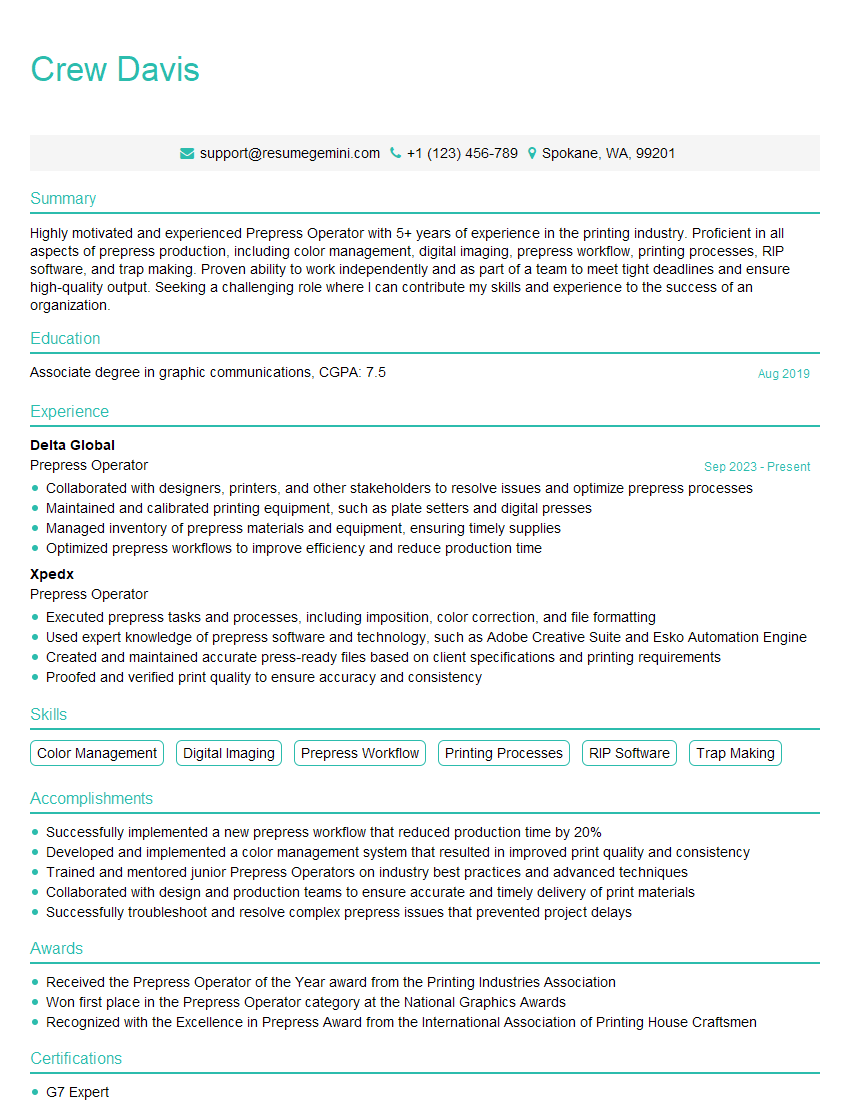
Mastering Proficiency in Digital Prepress Systems opens doors to exciting career opportunities in the graphic design and printing industries. A strong understanding of these processes is highly valued by employers, leading to increased job prospects and higher earning potential. To maximize your chances of landing your dream role, focus on creating a compelling and ATS-friendly resume that showcases your skills and experience effectively. ResumeGemini is a trusted resource to help you build a professional and impactful resume that grabs recruiters’ attention. Examples of resumes tailored to Proficiency in Digital Prepress Systems are available – leverage them to craft your best application yet!

Explore more articles
Users Rating of Our Blogs
Share Your Experience
We value your feedback! Please rate our content and share your thoughts (optional).
What Readers Say About Our Blog
Very informative content, great job.
good