Feeling uncertain about what to expect in your upcoming interview? We’ve got you covered! This blog highlights the most important Proficient in using a variety of music software, including notation software, audio editing software, and MIDI sequencing software interview questions and provides actionable advice to help you stand out as the ideal candidate. Let’s pave the way for your success.
Questions Asked in Proficient in using a variety of music software, including notation software, audio editing software, and MIDI sequencing software Interview
Q 1. Describe your experience with different Digital Audio Workstations (DAWs), such as Pro Tools, Logic Pro X, Ableton Live, Cubase, or FL Studio.
My experience with DAWs is extensive, encompassing Pro Tools, Logic Pro X, Ableton Live, Cubase, and FL Studio. Each has its strengths. Pro Tools is industry-standard for film and television scoring, known for its rock-solid stability and powerful editing capabilities. Logic Pro X excels in orchestral work, offering a vast library of instruments and sophisticated MIDI editing tools. Ableton Live is a powerhouse for electronic music production, its session view making live performance and improvisation seamless. Cubase is a versatile option suited for a wide range of genres, appreciated for its comprehensive mixing and mastering features. Finally, FL Studio is a favourite among hip-hop and electronic music producers for its intuitive workflow and strong beat-making capabilities. My choice often depends on the project’s specifics; for instance, I’d likely choose Pro Tools for a film score but Ableton for an electronic dance music track.
My proficiency extends beyond basic operation; I understand advanced routing, automation, and scripting within these platforms. For example, I’ve used Logic Pro X’s AppleScript capabilities to automate repetitive tasks, significantly boosting my workflow efficiency. In Ableton, I’m adept at creating complex instrument racks and using Max for Live to customize functionalities.
Q 2. Explain the process of recording, editing, and mixing audio using your preferred DAW.
My preferred DAW is Logic Pro X, although my process is adaptable across platforms. Recording begins with meticulous preparation: ensuring proper microphone placement, gain staging to avoid clipping, and monitoring levels. Once the performance is captured, editing involves tasks such as removing unwanted noise, trimming sections, and correcting timing imperfections. I utilize Logic’s extensive editing tools, including its powerful comping function for selecting the best takes. Mixing follows, a crucial phase of sculpting the sound. This involves EQing individual tracks to achieve clarity, using compression to control dynamics, adding reverb and delay for spatial effects, and carefully balancing levels across the frequency spectrum. I constantly monitor the mix using various reference tracks and different listening environments to ensure translation across systems.
For instance, in a recent project, I recorded a complex vocal performance. I used Logic’s comping features to combine the best parts of multiple takes, creating a polished final vocal line that was cleaner and more consistent than any single take could have been. The mixing phase then involved subtle EQ adjustments to enhance presence, compression to smooth out dynamic variations, and reverb to create a natural-sounding ambience.
Q 3. How do you handle audio latency issues during recording and playback?
Audio latency, the delay between playing a note and hearing it, is a common challenge. My approach is multifaceted. First, I ensure that my buffer size is appropriately set within the DAW’s preferences; a higher buffer size reduces latency but increases processing load, impacting performance. Finding a balance between low latency and stability is key. Second, I use low-latency drivers for my audio interface. These drivers are specifically optimized to minimize processing delays. Third, I use hardware monitoring, which allows me to hear the audio directly from the interface, bypassing the DAW’s processing chain and eliminating significant latency during recording. Finally, if latency remains an issue, I might use a direct monitoring feature built into many interfaces which routes the signal from the microphone directly to your headphones, eliminating the latency caused by the computer processing.
Q 4. What are your preferred techniques for audio restoration and noise reduction?
My audio restoration techniques depend on the nature of the problem. For unwanted background noise, I frequently employ spectral editing tools within Logic Pro X or other DAWs. These tools allow me to visually identify and remove frequencies specific to the noise, preserving the integrity of the desired audio. For clicks, pops, or other transient artifacts, I use tools like iZotope RX’s de-clicker or similar algorithms found in other restoration suites. These often involve intelligently analyzing the audio and replacing the problematic samples with interpolated versions. In cases of significant degradation such as tape hiss or crackle, I might employ specialized noise reduction plugins, carefully balancing noise reduction with the preservation of sonic detail. The key is a nuanced approach – aggressive noise reduction can often result in a lifeless, artificial sound.
For example, I recently restored a vintage vinyl recording. I used a combination of spectral editing to remove surface noise and de-click algorithms to address pops and clicks. The process involved careful monitoring to ensure the subtle character of the recording wasn’t compromised in the process.
Q 5. What are your go-to plugins for compression, EQ, and reverb, and why?
My plugin choices often depend on the specific context, but some favorites include FabFilter Pro C for compression (its dynamic processing is extremely transparent and musical), Waves Q10 for EQ (its surgical precision and ease of use are invaluable), and ValhallaRoom for reverb (its algorithms create incredibly natural and immersive spaces). I appreciate the ability to subtly shape the dynamics of a signal using FabFilter Pro C, the precise control that Waves Q10 offers, and the versatility of ValhallaRoom in creating varied reverb soundscapes.
For instance, I might use FabFilter Pro C on a vocal track to gently control dynamics, Waves Q10 to precisely sculpt the frequency response of a guitar, and ValhallaRoom to add a sense of space and ambience to a piano part.
Q 6. Describe your experience with MIDI sequencing and programming.
My MIDI sequencing and programming skills are a core part of my workflow. I’m proficient in creating and editing MIDI sequences in various DAWs, comfortable with advanced concepts like automation, modulation, and advanced MIDI editing techniques. I understand the nuances of MIDI controllers, and I can program complex MIDI parts and write custom MIDI scripts for repetitive or time-consuming tasks. My experience spans creating MIDI arrangements for orchestral scores, electronic music, and even interactive installations.
Beyond simply playing notes, I utilise MIDI to create sophisticated musical structures and automate complex parameters. For instance, I might use MIDI to automate changes in filter cutoff frequencies during a bassline, or to create dynamic changes in reverb send levels. I’m also experienced in using MIDI to control external hardware synths and effects, expanding the sonic palette of my projects.
Q 7. Explain how you would create a complex MIDI arrangement involving multiple instruments and tracks.
Creating a complex MIDI arrangement with multiple instruments starts with a solid foundation – a well-defined compositional structure. I typically begin by sketching out the arrangement in a piano roll, laying down basic melodic and rhythmic ideas. Then, I assign different MIDI tracks to various instruments, ensuring that each track has its unique sound and arrangement. This might involve using virtual instruments or external synths. I’ll often use different MIDI channels to facilitate layering and organization. Automation comes next – controlling volume, panning, effects sends, or instrument parameters over time. Logic Pro X’s extensive automation features are invaluable here. Finally, the arrangement is refined, adding subtle nuances, transitions, and subtle changes in instrumentation to create dynamic and engaging music.
For example, in a recent orchestral piece, I had several distinct instrumental sections. Each section received its own MIDI track with its corresponding virtual instrument (strings, brass, woodwinds, percussion). The arrangement involved intricate automation to control the volume swells and dynamic shifts within these sections. Each instrument section used automation to achieve specific effects and transitions, and the final piece demonstrated a sophisticated dynamic range.
Q 8. How do you troubleshoot MIDI timing and synchronization issues?
MIDI timing and synchronization issues are a common headache in music production, but thankfully, there are systematic ways to troubleshoot them. The core problem usually lies in latency (delay) or clock inaccuracies between different devices or software components.
Check Buffer Sizes: Larger buffer sizes in your DAW (Digital Audio Workstation) reduce CPU load but increase latency. Start by lowering your buffer size gradually until you find a balance between performance and timing accuracy. Experiment with different settings; a lower buffer size will generally improve timing, but may cause audio dropouts if your computer isn’t powerful enough.
MIDI Clock Source: Ensure you have a reliable MIDI clock source. Ideally, use your DAW as the master clock and slave all external MIDI devices to it. Inconsistent clock signals from multiple sources will create timing drift.
Driver Issues: Outdated or faulty MIDI drivers can cause timing problems. Update your drivers to the latest versions provided by the manufacturer.
Hardware Latency: Certain MIDI interfaces or hardware instruments may introduce their own latency. If possible, test with different devices to identify any potential culprits. Some interfaces provide features to compensate for this latency.
Software Conflicts: Conflicting software or background processes can impact MIDI timing. Close unnecessary applications while working on your project to minimize this possibility.
Sample Rate and Block Size: In your DAW, the sample rate and block size settings also affect timing. Experimenting with these might help find an optimal configuration for your system and project. Higher sample rates generally improve accuracy, but may increase processing demands.
Example: I once experienced significant timing jitter in a project with multiple VST instruments. By meticulously lowering the buffer size in my DAW and updating the drivers for my MIDI keyboard, the issue was resolved. It’s a process of elimination; try each step systematically to pinpoint the cause.
Q 9. What are your experiences with different MIDI controllers (keyboards, pads, etc.)?
I’ve had extensive experience with a wide range of MIDI controllers, each with its own strengths and weaknesses. My experience includes:
Keyboards: From simple 25-key controllers ideal for sketching ideas to 88-key weighted hammer-action keyboards that provide a realistic piano playing experience. I’m proficient with various brands like M-Audio, Akai, and Native Instruments, appreciating the differences in key action, velocity sensitivity, and aftertouch capabilities. The choice depends greatly on the style of music and personal preference.
Pads: I frequently use pads such as Akai’s MPC series and Native Instruments Maschine for beat production and melodic sequencing. Their tactile response and intuitive layout are crucial for creating rhythmic patterns and manipulating samples. The different pad sizes and pressure sensitivity impact the expressiveness of the performance.
Other Controllers: My experience extends to using more specialized controllers like drum machines (Roland TR-8S for example), ribbon controllers for pitch bending, and faders/knobs for real-time mixing and effects automation. Each controller offers unique control capabilities and workflow enhancements.
For example, I might use a weighted keyboard for a classical piece, a pad controller for electronic music, and a drum machine for a more organic drum track. The key is understanding which controller best suits the creative task at hand.
Q 10. How familiar are you with virtual instruments (VSTs) and sample libraries?
My familiarity with VSTs (Virtual Studio Technology) and sample libraries is comprehensive. I’m adept at browsing, installing, and utilizing a vast array of instruments and sounds. This involves understanding the nuances of different synthesis engines, sampling techniques, and sound design principles.
VST Instruments: I frequently employ software synthesizers like Native Instruments Massive, Serum, and Arturia V Collection, as well as various samplers such as Kontakt. Each offers a unique sonic palette and workflow, allowing for diverse sound creation.
Sample Libraries: I’m comfortable working with extensive sample libraries from Spitfire Audio, EastWest, and Output, leveraging their detailed articulations and expressive capabilities. I understand how to efficiently manage large sample library collections and optimize my DAW for efficient playback.
Sound Design: I am skilled in the art of sound design, using VSTs to create custom sounds or modifying existing samples to tailor them for specific musical contexts. I’m also proficient in using various effects processors (reverbs, delays, compressors, EQs) to shape and enhance the sound.
For instance, in a recent project requiring a specific orchestral sound, I used Spitfire Audio’s Albion One library, complementing it with some custom synth textures for added depth and complexity.
Q 11. Explain your workflow for creating and editing musical notation using software like Sibelius or Finale.
My workflow for creating and editing musical notation in Sibelius or Finale is highly structured and efficient. It typically involves these steps:
Input: I begin by inputting the musical ideas either by hand-entering notes or using the software’s MIDI input capabilities to record a performance. I often employ a combination of both methods.
Editing: Once the basic musical structure is in place, I meticulously edit the score, refining pitch, rhythm, articulation, dynamics, and expression. This includes using Sibelius’s powerful editing tools to fine-tune individual notes, chords, or measures.
Layout: I pay careful attention to the visual appearance of the score, ensuring proper spacing, system breaks, and overall readability. Sibelius and Finale offer robust layout tools to adjust the appearance and optimize the score for printing or screen display.
Formatting: I apply appropriate formatting to the score, including adding titles, composer information, instrument designations, and any other relevant metadata.
Proofreading: Before finalizing the score, I carefully proofread and review the entire document for any errors or inconsistencies.
Export: Finally, I export the score in various formats, such as PDF, MusicXML, or MIDI, depending on the intended use.
Example of Sibelius shortcut: Ctrl+M inserts a new measure.
I find this structured approach ensures accuracy and efficiency in producing polished, professional-quality scores. Every detail matters, from note placement to the final printed appearance.
Q 12. How do you handle complex musical scores with multiple instruments and voices?
Handling complex scores with multiple instruments and voices requires a systematic approach and a deep understanding of musical structure. My strategy involves:
Staff Organization: I carefully organize the staves to maintain clarity and readability. Grouping instruments logically and using appropriate spacing is crucial.
Layer Management: I utilize layering techniques to manage the complexity of multiple instrument parts. This might involve creating separate layers for different instrument groups or individual voice parts, allowing for easy editing and manipulation.
Score Templates: I often create custom score templates tailored to specific ensemble configurations to ensure consistency and efficiency.
Color Coding: Strategic color-coding helps distinguish different instrument parts or voice sections, facilitating quick visual identification and editing.
Reference Tracks: When dealing with very complex scores, I sometimes create reference tracks to help maintain the musical flow and balance between instrument parts.
Example: While working on a large-scale orchestral score, I employed a system of color-coded layers, with each instrument family (strings, woodwinds, brass, percussion) assigned a unique color. This greatly simplified the editing process and prevented accidental modifications.
Q 13. What are your methods for exporting and sharing musical scores?
Exporting and sharing musical scores is a vital part of my workflow. The method I use depends heavily on the intended audience and purpose:
PDF: For sharing final scores with performers or publishers, I export as a high-resolution PDF, ensuring the score is visually appealing and print-ready.
MusicXML: For collaborators who may be using different notation software, I often export in MusicXML format, a widely accepted standard for exchanging musical data. This enables seamless interoperability.
MIDI: For sharing the musical ideas or parts as audio-playable data, MIDI export is invaluable for providing a basic musical framework. It’s easily imported into different DAWs.
Audio Files: Once the score is completed, creating high-quality audio files (WAV, MP3) is essential for sharing the final product. This involves rendering the score using the software’s playback engine or an external audio interface.
Cloud Storage: I utilize cloud storage services like Google Drive or Dropbox to facilitate sharing files, particularly when collaborating with other musicians or composers.
Example: For a recent collaboration, I shared the score in MusicXML format, allowing my colleague to work on their part within their preferred notation software. After revisions, we consolidated the individual parts into a final PDF score and shared high-quality audio files to illustrate the piece.
Q 14. Describe your experience with music notation software features such as engraving, playback, and printing.
I have extensive experience utilizing the engraving, playback, and printing features of music notation software. These features are crucial for producing high-quality scores.
Engraving: I am highly proficient in using the engraving tools to fine-tune the visual aesthetics of the score. This includes adjusting spacing, font sizes, slurs, ties, and other musical symbols to create a visually appealing and readable score. Attention to detail is paramount.
Playback: I frequently use the built-in playback engines to audition the score, identifying potential issues in rhythm, melody, or harmony before finalizing. The ability to adjust playback parameters, such as instrument sounds and tempo, is invaluable.
Printing: I have considerable experience in setting up print settings for optimal results, such as page size, margins, and instrument layout. This ensures a professional and visually pleasing printed score.
Example: I once had to produce a score with complex rhythmic patterns and multiple instrumental parts. The software’s playback capabilities were vital in identifying and correcting timing inconsistencies. Careful engraving ensured the score looked as professional as it sounded.
Q 15. How do you ensure your notation is accurate, consistent, and readable?
Accuracy, consistency, and readability in music notation are paramount for clear communication. I achieve this through a multi-pronged approach, starting with meticulous input in my chosen notation software (typically Sibelius or Dorico). This includes using appropriate noteheads, rests, and articulations, diligently checking for correct rhythms and pitches, and employing consistent spacing and layout.
Beyond basic input, I leverage the software’s tools for advanced checks. For instance, Sibelius offers powerful verification features that identify potential errors, such as accidental inconsistencies or rhythmic ambiguities. I also regularly zoom in to inspect the notation at high magnification to catch subtle errors that might be missed at a glance. Finally, I always proofread my scores meticulously, often printing them out to review the layout visually – something a digital screen might miss. A consistent style guide, established early in a project, ensures uniformity across large or multi-part works.
Consider the difference between a score cluttered with errors and one that’s elegantly presented. The clarity of the notation directly impacts a performer’s ability to interpret and execute the music accurately and effectively.
Career Expert Tips:
- Ace those interviews! Prepare effectively by reviewing the Top 50 Most Common Interview Questions on ResumeGemini.
- Navigate your job search with confidence! Explore a wide range of Career Tips on ResumeGemini. Learn about common challenges and recommendations to overcome them.
- Craft the perfect resume! Master the Art of Resume Writing with ResumeGemini’s guide. Showcase your unique qualifications and achievements effectively.
- Don’t miss out on holiday savings! Build your dream resume with ResumeGemini’s ATS optimized templates.
Q 16. Explain your understanding of different audio file formats (WAV, MP3, AIFF, etc.) and their characteristics.
Audio file formats differ primarily in their compression methods and resulting file sizes. Understanding these differences is crucial for optimizing workflow and maintaining audio quality.
- WAV (Waveform Audio File Format): An uncompressed format preserving the raw audio data. It offers the highest fidelity but results in large file sizes, suitable for mastering and archival purposes.
- MP3 (MPEG Audio Layer III): A lossy compressed format that reduces file size significantly by discarding some audio data. It’s ideal for online distribution and streaming due to its small size, but at the cost of some audio quality. The degree of compression can be adjusted, impacting both size and quality.
- AIFF (Audio Interchange File Format): An uncompressed format similar to WAV, popular on Apple platforms. It offers the same high fidelity as WAV but uses a slightly different encoding.
- AAC (Advanced Audio Coding): A lossy compressed format, often used for streaming and digital downloads. Generally considered to offer better quality at lower bitrates compared to MP3.
Choosing the right format depends on the specific application. For example, I’d use WAV for studio work and mastering, and MP3 or AAC for distribution to online platforms.
Q 17. Describe your experience with audio mastering techniques.
Audio mastering is the final stage of audio production, focusing on optimizing the overall sound and loudness of a recording for distribution. My approach involves several key techniques:
- Gain Staging: Carefully adjusting the levels of individual tracks and buses to ensure optimal dynamic range and prevent clipping.
- EQ (Equalization): Shaping the frequency response to enhance clarity, remove muddiness, and create a balanced sound. This could involve boosting certain frequencies, cutting others, or using dynamic EQ to target specific frequencies based on their level.
- Compression: Reducing the dynamic range to control peaks and create a more consistent loudness. Different compressor types (e.g., optical, FET, VCA) offer unique characteristics.
- Stereo Imaging: Widening or narrowing the stereo field to create a more spacious or intimate sound.
- Limiting: Carefully applying limiting to maximize loudness without causing distortion. This is a critical step for preparing the audio for distribution, but must be done subtly to avoid ‘brickwalling’ and loss of dynamics.
- Dithering: Adding a small amount of noise to reduce quantization errors when converting between different bit depths (e.g., from 24-bit to 16-bit).
Mastering requires a delicate balance, enhancing the audio’s strengths while addressing its weaknesses without sacrificing its artistic integrity. I always prioritize listening critically throughout the process, making subtle adjustments to achieve the optimal sound for the intended medium.
Q 18. How do you approach the challenges of working with different audio formats and sample rates?
Working with varying audio formats and sample rates requires careful attention to detail to avoid artifacts and maintain quality. I use a digital audio workstation (DAW) that offers robust sample rate conversion (SRC) capabilities. This allows me to confidently handle different projects without worrying about quality loss.
For example, if I receive a 44.1 kHz WAV file and need to integrate it into a project at 48 kHz, I’d use my DAW’s SRC engine to convert the file without introducing audible artifacts. The quality of the SRC algorithm is critical; high-quality algorithms minimize the introduction of unwanted noise or distortion. Furthermore, I always ensure that the bit depth remains consistent throughout the process (typically 24-bit for high-resolution work). Proper file management is key here; naming files clearly with their sample rate and bit depth ensures there’s no confusion and the process is transparent.
In essence, a solid understanding of digital audio principles, coupled with a powerful DAW and careful workflow, makes handling different audio specifications a straightforward process.
Q 19. What are your strategies for organizing and managing large audio and MIDI projects?
Managing large audio and MIDI projects efficiently is crucial for avoiding chaos and maintaining a clear workflow. My strategy is built on a foundation of structured file organization and smart use of my DAW’s features:
- Folder Structure: I use a hierarchical folder system, typically categorized by project, then by instrument/track type, and finally by individual files (audio, MIDI, stems). Clear, descriptive file names are essential.
- Color-Coding: Within my DAW, I use color-coding to visually organize tracks, making it easy to identify different instrument groups or sections of a composition.
- Project Templates: I create custom project templates for different types of projects, pre-setting common parameters such as sample rate, bit depth, and default routing. This saves setup time and ensures consistency.
- DAW’s Features: My DAW provides tools for organizing tracks within the session itself – for example grouping tracks and using folders to contain related content.
- Regular Backups: I maintain a system for regular backups, storing project files in multiple locations (cloud storage and external hard drives).
This disciplined approach ensures that even large and complex projects remain manageable and easy to navigate. Think of it like a well-organized library: finding the right book (or audio file) is quick and easy because the system is well-defined.
Q 20. How do you handle project collaboration within your chosen DAW?
Collaboration is seamlessly integrated into my workflow through the features of my chosen DAW (Ableton Live, for example). Here’s how I typically approach collaborative projects:
- Cloud-Based Collaboration: Ableton Live integrates well with cloud storage solutions, allowing multiple users to access and work on a project simultaneously. This facilitates real-time collaboration and reduces the need for cumbersome file sharing.
- Version Control: Ableton Live allows for saving different versions of a project, enabling easy rollback to previous states if needed. This is crucial for managing changes and avoiding conflicts when working with multiple collaborators.
- Clear Communication: Effective communication is key to successful collaboration. I utilize online tools like Slack or email to discuss project details, assign tasks, and address issues promptly.
- Session Organization: I maintain a clear and consistent session organization that is easy for other collaborators to understand and navigate. This might include track naming conventions and color-coding.
- Stem Export/Import: Ableton Live also makes it easy to export individual stems (separate tracks) to share with collaborators. This allows for focused work on particular aspects of the project without impacting other parts.
These strategies reduce confusion and ensure that everyone is working with the most up-to-date version of the project. Clear communication and a well-defined workflow are the cornerstones of effective collaboration.
Q 21. Describe your process for creating sound effects using synthesizers, samplers, and other sound design tools.
Creating sound effects involves a blend of creativity and technical skill, utilizing a variety of tools and techniques. My process generally follows these steps:
- Conceptualization: I start by clearly defining the desired sound effect. What kind of sound am I aiming for? What are its key characteristics (e.g., pitch, timbre, duration)?
- Source Material: I might use a combination of synthesis, sampling, and recording to generate the core sounds. Synthesizers offer highly customizable sounds, allowing me to create textures and tones from scratch, while samplers allow me to manipulate existing recordings. I also directly record sounds using microphones.
- Sound Design Techniques: I use various sound design techniques such as filtering, distortion, modulation (LFOs, envelopes), and granular synthesis to shape the sound to match my vision. For example, I might use a low-pass filter to create a muddy, distant sound, or distortion to add grit and aggressiveness.
- Effects Processing: Once I have the basic sound, I use various effects, such as reverb, delay, chorus, and EQ, to add spatial depth, texture, and polish. Reverb can create the sense of a sound existing in a specific space (large hall, small room etc.).
- Automation: Automation allows me to modify parameters over time, enabling the creation of dynamic and evolving sounds.
- Layering and Mixing: Often, I layer multiple sounds to create more complexity and depth, carefully mixing them together to achieve a balanced and cohesive sound.
Sound design is an iterative process. I constantly listen critically, adjusting parameters and experimenting with different techniques until I achieve the desired result. Each sound effect is a unique challenge, demanding both technical prowess and creative vision.
Q 22. Explain your understanding of different audio effects processing techniques.
Audio effects processing is the art and science of manipulating audio signals to achieve a desired sonic outcome. This involves a wide range of techniques, each impacting different aspects of the sound. Think of it like a painter using different brushes and paints to create a masterpiece – each effect is a tool in your sonic palette.
EQ (Equalization): EQ shapes the frequency balance of a sound. Boosting certain frequencies can make an instrument sound brighter or fuller, while cutting others can remove muddiness or harshness. For example, I might boost the high frequencies of a vocal to make it cut through a mix, or cut the low frequencies of a guitar to prevent it from clashing with the bass.
Compression: Compression reduces the dynamic range of a sound, making quieter parts louder and louder parts quieter. This creates a more consistent and powerful sound. I often use compression on vocals to even out their volume and make them sit well in the mix. A good example is using a compressor on a drum buss to glue the drums together and make them punchier.
Reverb: Reverb simulates the reflection of sound in a space, adding depth and ambience. The type of reverb used can dramatically change the feel of a track; a large hall reverb might be used for a dramatic orchestral piece, while a small room reverb might be used for a more intimate acoustic song.
Delay: Delay creates echoes of the original sound, adding rhythmic interest and texture. Delay can be used creatively to thicken sounds or create rhythmic patterns, or used sparingly for subtle textural additions. For instance, a short delay on a vocal can add a sense of width.
Distortion/Overdrive: These effects add harmonic richness and saturation to a sound, making it sound warmer, fuller or more aggressive. They’re often used on guitars and vocals to add grit and character.
Understanding how these effects interact is crucial. For instance, you might use EQ to clean up a sound before applying compression to avoid boosting unwanted frequencies. The key is experimentation and understanding the effect of each processor on your audio.
Q 23. How do you utilize automation in your DAW to enhance your productions?
Automation is incredibly important for creating dynamic and engaging productions. It allows me to control almost any parameter of a plugin or instrument over time, creating subtle shifts or dramatic changes. Imagine it as choreographing the sound; each parameter’s movement is a step in the dance.
In my DAW, I use automation for:
Volume Automation: Gradually increasing or decreasing the volume of a track to create fades, crescendos, or other dynamic shifts. A common example is automating the volume of a synth pad to swell and then fade out over several bars.
Panning Automation: Moving a sound from left to right in the stereo field to create a sense of space and movement. I might automate the panning of a vocal to create a wider soundstage.
Effect Parameter Automation: Changing the settings of effects plugins over time. For example, I might automate the reverb send of a vocal to increase the ambience during a chorus.
Plugin Parameter Automation: Changing any parameter of a synth or other instrument plugin over time. I could automate the cutoff frequency of a filter on a synth to create a sweeping effect.
I often use automation clips in my DAW to create complex parameter movements, offering greater control and precision than simply drawing automation curves. This allows for smooth and natural-sounding transitions in my mixes.
Q 24. Describe your experience in troubleshooting hardware and software issues related to music production.
Troubleshooting is a crucial part of music production. It’s rarely a smooth process, and I’ve encountered countless hardware and software issues over the years. My approach is systematic and involves a combination of technical knowledge, problem-solving skills, and a little bit of detective work!
When facing a hardware issue, I start by checking the obvious: cables, power supplies, and connections. Is everything properly plugged in? Are there any visible damages? If it’s an interface issue, I’ll try different USB ports or even a different computer. Software issues usually require a more in-depth diagnosis. I often start by checking for updates to my DAW, drivers, and plugins. I’ll also check the system requirements to make sure my computer can handle the workload.
One memorable experience involved a faulty audio interface that caused intermittent dropouts during recording. After systematically eliminating other possibilities, I identified the issue as a faulty USB port on the interface itself; contacting customer support got it quickly replaced. I also regularly back up my projects to avoid losing work due to software crashes or hardware failures – prevention is always the best cure.
Q 25. What strategies do you employ for efficient workflow and time management in music production?
Efficient workflow and time management are critical to success in music production. A chaotic workflow can lead to wasted time and creative frustration. My strategies revolve around organization, planning, and a mindful approach.
Project Templates: I use pre-built project templates tailored to different genres or project types. This ensures consistency and saves time on setting up initial configurations.
Session Organization: I meticulously organize my sessions using clear naming conventions for tracks, folders, and groups, ensuring easy navigation. Color-coding tracks makes it easier to visually distinguish instruments and groups.
Time Blocking: I allocate specific times for specific tasks, like composing, arranging, mixing, or mastering, which helps maintain focus. This prevents tasks from bleeding into one another and encourages focused effort.
Regular Breaks: Taking short breaks throughout the day helps to prevent burnout and maintain creativity.
Task Prioritization: I identify the most important aspects of a project and focus on completing them first, this minimizes the likelihood of getting stuck on less critical elements.
By adopting these strategies, I create a streamlined, productive environment that enables me to focus on the creative aspects of music production without being bogged down by organizational chaos.
Q 26. How do you adapt your workflow to meet the specific demands of different musical genres?
Adapting my workflow to different genres is essential because each genre has its own unique sonic characteristics, production techniques, and creative approaches.
Genre-Specific Plugins: I utilize genre-specific plugins and virtual instruments. For example, I might use a vintage synth emulator for a retro-pop track, or a heavy distortion plugin for metal.
Tempo and Time Signatures: I adjust the tempo and time signatures to suit the specific genre. A fast tempo might be appropriate for techno while slower tempos are common for balladry.
Instrumentation: My instrumentation choices are genre-dependent; hip-hop might involve heavy use of drum machines and samplers while classical often uses orchestral instruments.
Mixing Techniques: My mixing techniques are also tailored to the genre; the loud, aggressive mixes of metal differ significantly from the more delicate mixes of ambient electronic music.
For example, when working on a dance track, my focus would be on creating a powerful, rhythmic bassline and building layered soundscapes. This contrasts greatly with working on an acoustic folk song, which prioritizes clarity and natural tonality. The key is to adapt and remain flexible, understanding that each genre presents different musical challenges and rewards.
Q 27. Describe your experience with using various audio interfaces and recording equipment.
My experience with audio interfaces and recording equipment is extensive. I’ve worked with a wide range of devices, from budget-friendly options to high-end professional equipment. This broad experience allows me to select the right tools for any project, understanding the strengths and limitations of each device.
I’ve used interfaces from Focusrite, Universal Audio, RME, and PreSonus, each offering unique features and sound characteristics. Choosing an interface involves considering factors such as the number of inputs/outputs, pre-amp quality, and AD/DA conversion quality. Higher-end interfaces often boast superior pre-amps, providing cleaner and more transparent recordings.
My experience with microphones includes dynamic mics (like the Shure SM58) ideal for capturing vocals in live settings or robust instruments, and condenser mics (like the Neumann U87) for more delicate instruments and vocals in studio environments. Choosing the right microphone depends on the sound source and desired sonic characteristics. I also have experience with various recording equipment, such as outboard gear – compressors, EQs, reverb units – offering different tonal palettes and creative opportunities. Proper microphone placement and signal flow are also key to a great recording.
Q 28. How would you approach creating a soundscape with multiple layers of sound effects and instruments?
Creating a soundscape with multiple layers requires careful planning and execution. Think of it like composing an orchestral piece – each instrument plays a distinct role, contributing to the overall harmony and texture. My approach is systematic and involves several steps:
Sketching and Planning: I begin with a rough sketch, outlining the overall structure and emotional arc of the soundscape. I consider the desired mood, tempo, and key, then determine which instruments and effects will best convey that mood.
Layering and Arrangement: I start by laying down a foundation of bass and rhythm elements, gradually adding layers of melody, harmony, and texture. I use different panning techniques to create space and depth; sounds can be panned to create a wider stereo image or to create movement.
Sound Selection and Processing: I carefully choose sounds that complement and contrast each other. I use EQ, compression, reverb, and other effects to shape the individual sounds and ensure they integrate well within the soundscape. Precise use of reverb helps to create a sense of space and depth.
Balancing and Mixing: Once all layers are in place, I carefully balance the levels of each element, ensuring that no single sound overwhelms the others, and to create clarity and spatial presence. This careful balance is what creates a rich, immersive listening experience.
Iteration and Refinement: Creating a soundscape is an iterative process. I continually listen and adjust, making subtle tweaks to achieve the desired outcome. It often involves many rounds of listening, tweaking, and refining.
The goal is to create a cohesive whole where each element plays a role and contributes to the overall artistic vision. This requires a deep understanding of sonic design principles, meticulous attention to detail, and an ear attuned to both the individual parts and the holistic experience.
Key Topics to Learn for Proficient in using a variety of music software, including notation software, audio editing software, and MIDI sequencing software Interview
- Notation Software Proficiency: Understanding the nuances of different notation software (e.g., Sibelius, Finale, Dorico). This includes score creation, editing, printing, and exporting in various formats. Be prepared to discuss your experience with advanced features like engraving, playback customization, and score organization techniques.
- Audio Editing Software Expertise: Demonstrate your skills in audio editing software (e.g., Pro Tools, Logic Pro X, Ableton Live). Focus on areas such as recording, editing, mixing, mastering, and effects processing. Be ready to discuss your workflow, troubleshooting experience, and familiarity with different audio formats and plugins.
- MIDI Sequencing Software Mastery: Showcase your proficiency in MIDI sequencing software (e.g., Cubase, Logic Pro X, Ableton Live). Highlight your knowledge of MIDI data manipulation, virtual instrument usage, automation, and creating complex musical arrangements. Be prepared to discuss your approach to workflow optimization and project management within these programs.
- Software Comparison and Workflow: Be ready to discuss the strengths and weaknesses of different software packages and how you choose the right tools for specific tasks. Explain your workflow for integrating notation, audio, and MIDI sequencing software in a project.
- Troubleshooting and Problem-Solving: Prepare examples of times you encountered technical challenges while using music software and how you successfully resolved them. This demonstrates your problem-solving skills and resourcefulness.
- File Management and Collaboration: Discuss your strategies for managing large projects, organizing files, and collaborating with other musicians using shared software projects or cloud-based storage.
Next Steps
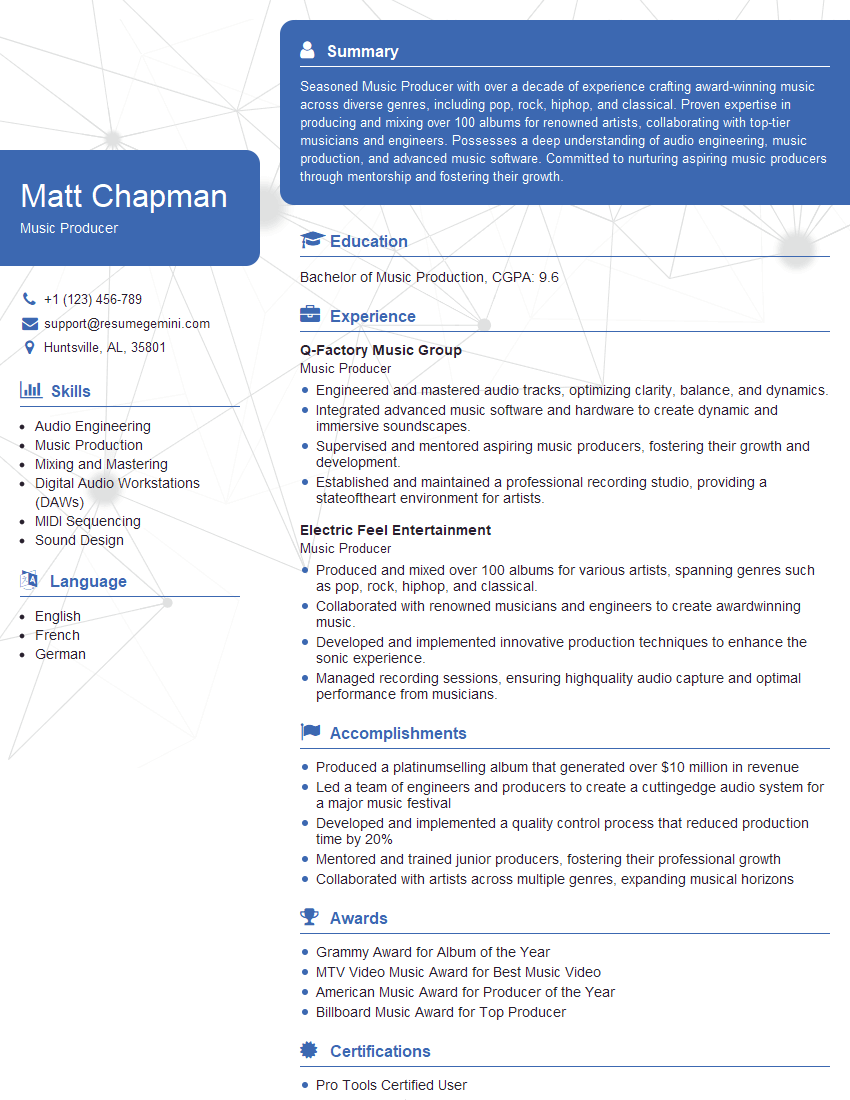
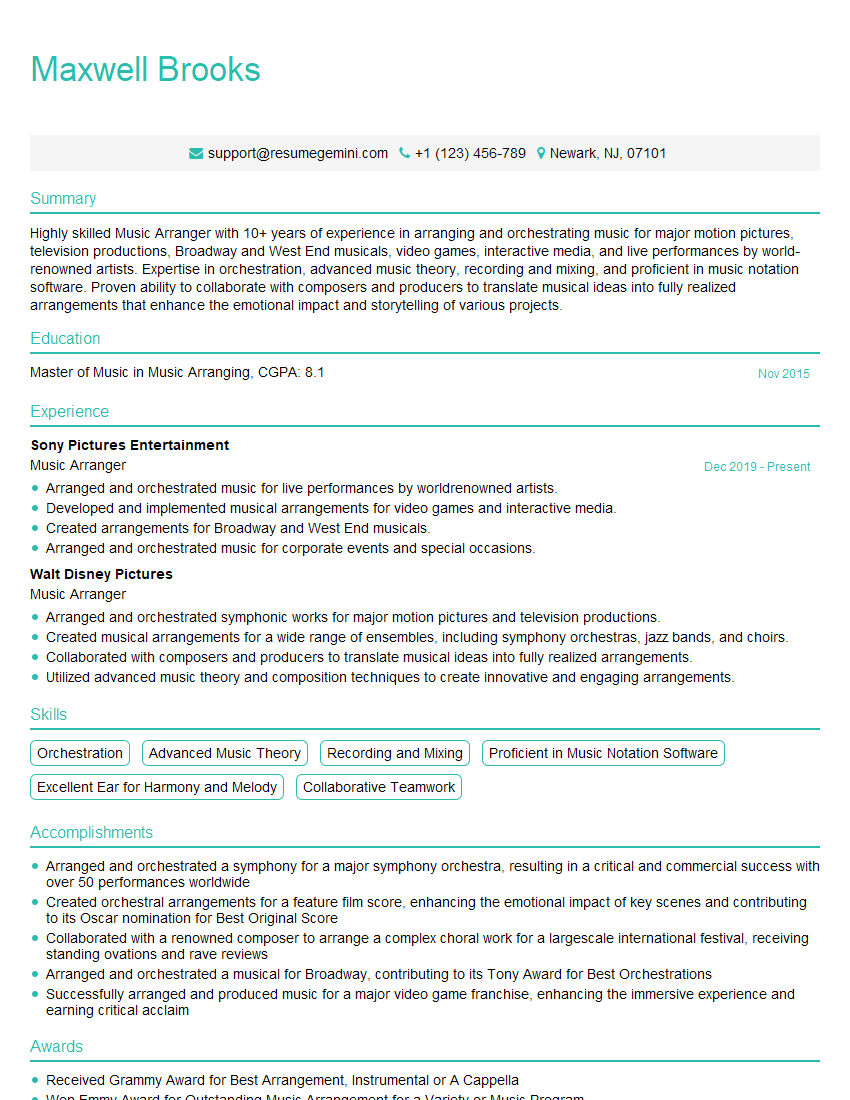
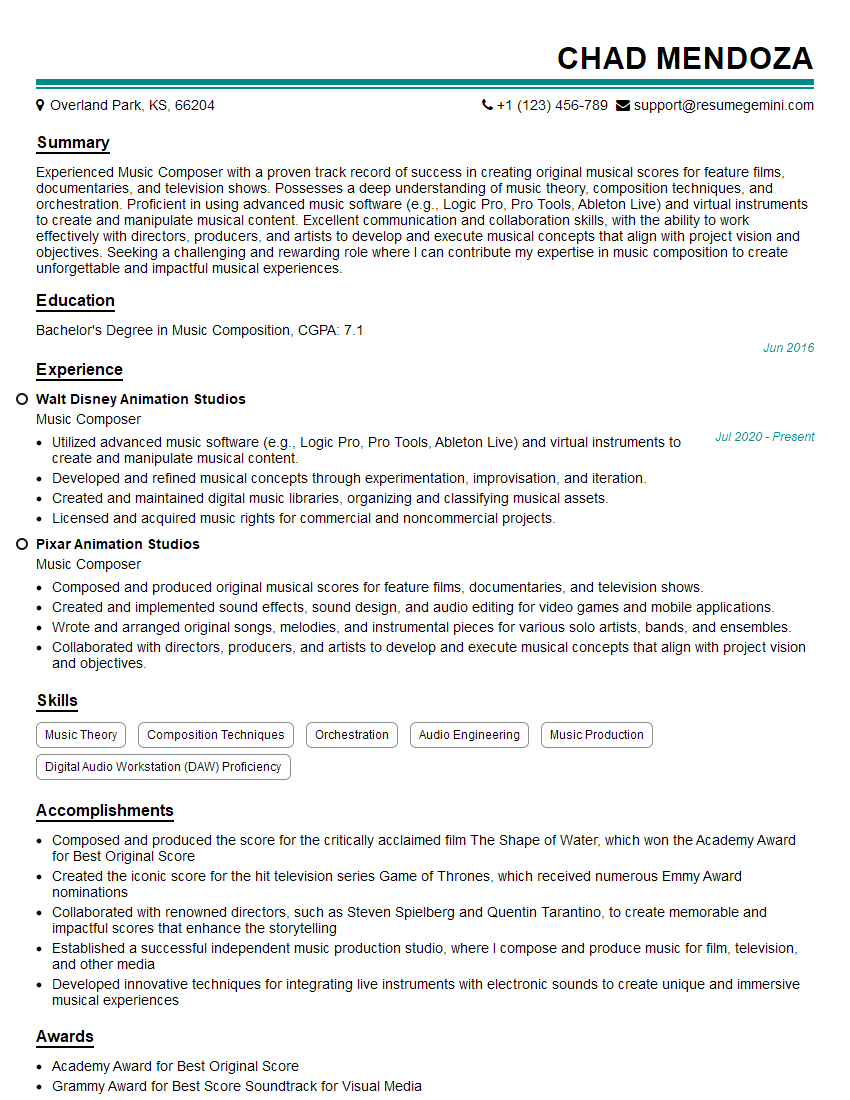
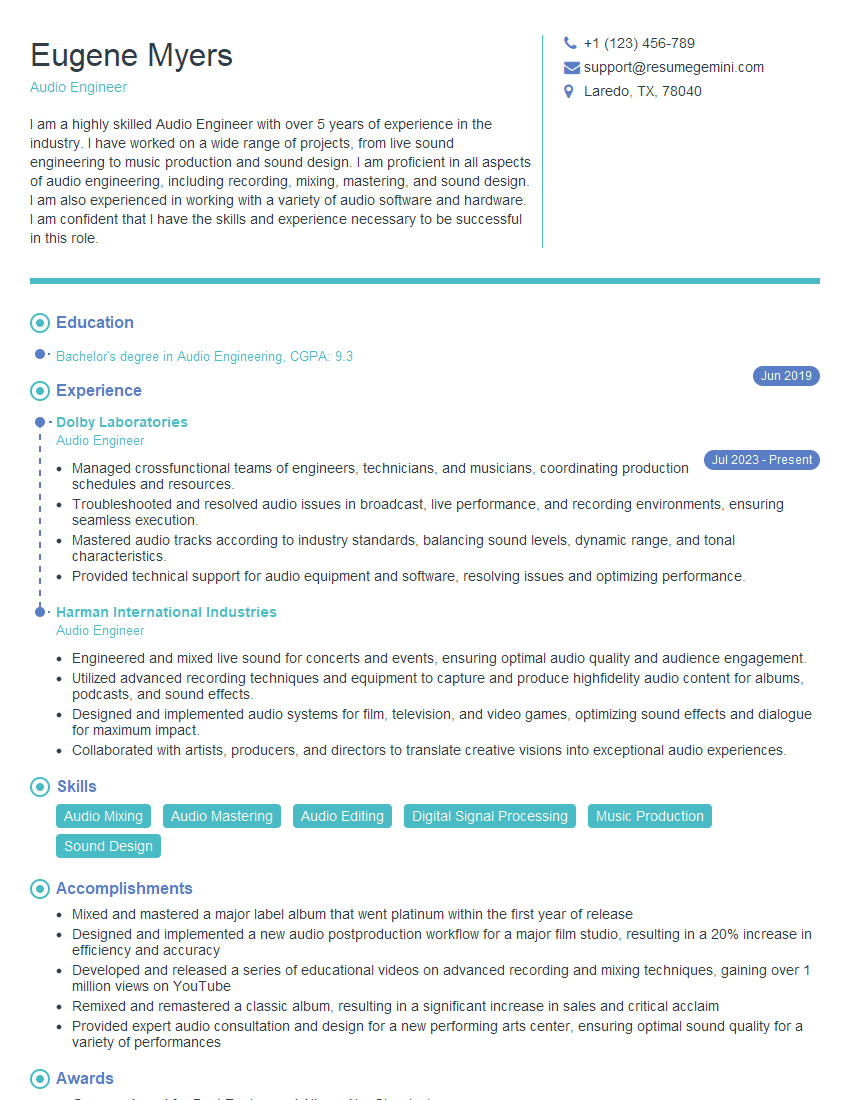
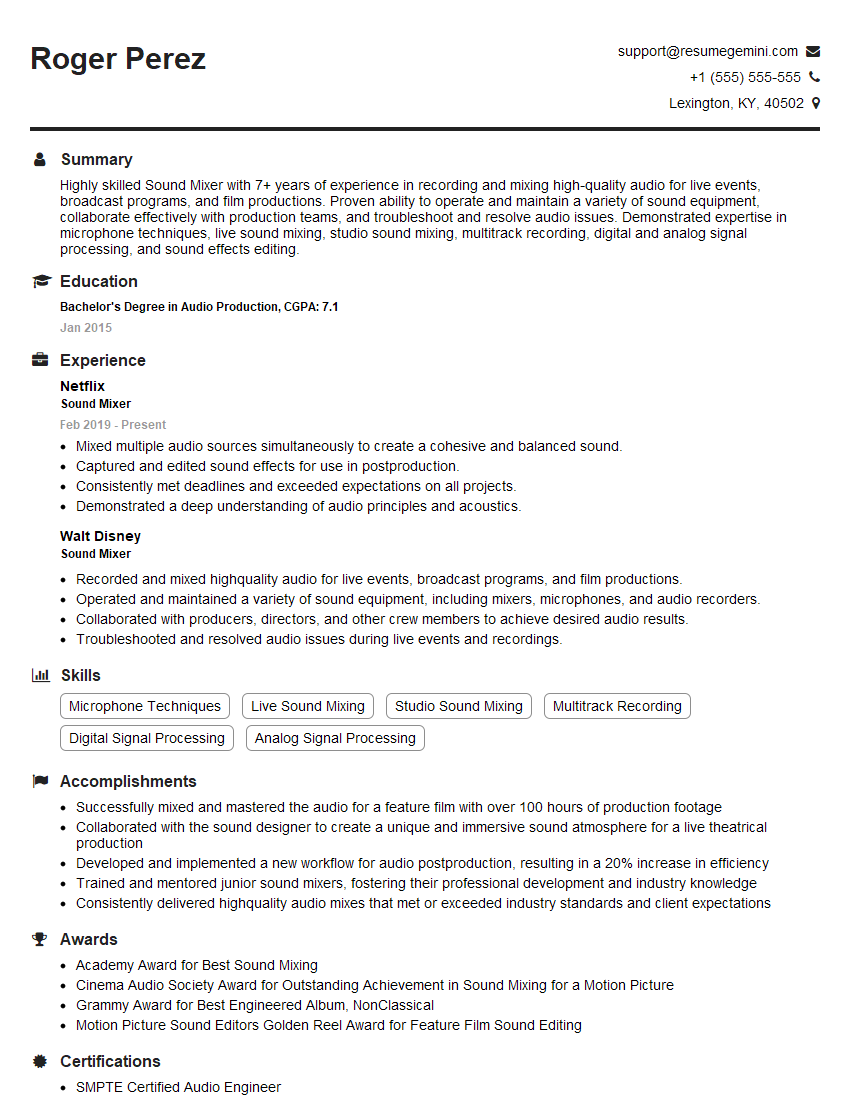
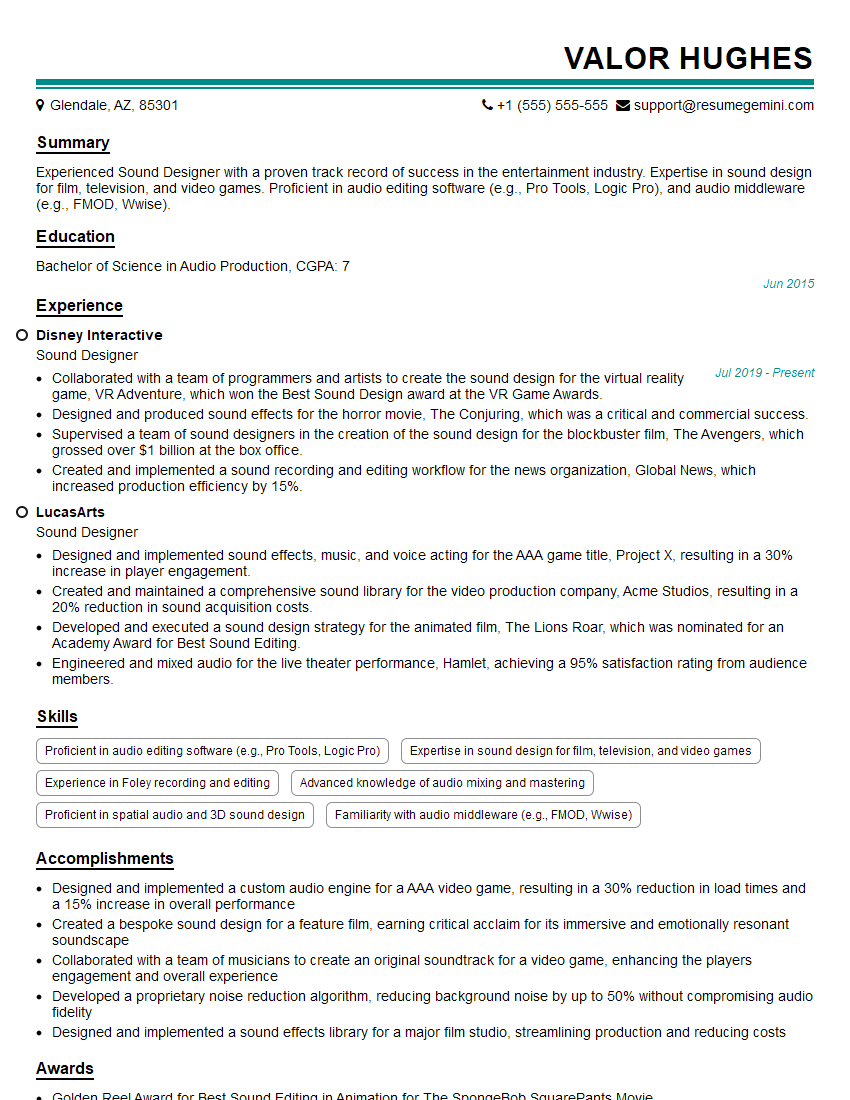
Mastering a variety of music software is crucial for career advancement in the music industry. Proficiency in these tools opens doors to diverse opportunities, from composition and arranging to audio engineering and music production. To maximize your job prospects, create an ATS-friendly resume that highlights your skills effectively. ResumeGemini is a trusted resource that can help you build a professional and impactful resume tailored to your specific experience. Examples of resumes tailored to showcasing proficiency in notation, audio editing, and MIDI sequencing software are available to help guide your resume creation process. Invest the time in crafting a compelling resume—it’s your first impression on potential employers.
Explore more articles
Users Rating of Our Blogs
Share Your Experience
We value your feedback! Please rate our content and share your thoughts (optional).
What Readers Say About Our Blog
Hello,
we currently offer a complimentary backlink and URL indexing test for search engine optimization professionals.
You can get complimentary indexing credits to test how link discovery works in practice.
No credit card is required and there is no recurring fee.
You can find details here:
https://wikipedia-backlinks.com/indexing/
Regards
NICE RESPONSE TO Q & A
hi
The aim of this message is regarding an unclaimed deposit of a deceased nationale that bears the same name as you. You are not relate to him as there are millions of people answering the names across around the world. But i will use my position to influence the release of the deposit to you for our mutual benefit.
Respond for full details and how to claim the deposit. This is 100% risk free. Send hello to my email id: [email protected]
Luka Chachibaialuka
Hey interviewgemini.com, just wanted to follow up on my last email.
We just launched Call the Monster, an parenting app that lets you summon friendly ‘monsters’ kids actually listen to.
We’re also running a giveaway for everyone who downloads the app. Since it’s brand new, there aren’t many users yet, which means you’ve got a much better chance of winning some great prizes.
You can check it out here: https://bit.ly/callamonsterapp
Or follow us on Instagram: https://www.instagram.com/callamonsterapp
Thanks,
Ryan
CEO – Call the Monster App
Hey interviewgemini.com, I saw your website and love your approach.
I just want this to look like spam email, but want to share something important to you. We just launched Call the Monster, a parenting app that lets you summon friendly ‘monsters’ kids actually listen to.
Parents are loving it for calming chaos before bedtime. Thought you might want to try it: https://bit.ly/callamonsterapp or just follow our fun monster lore on Instagram: https://www.instagram.com/callamonsterapp
Thanks,
Ryan
CEO – Call A Monster APP
To the interviewgemini.com Owner.
Dear interviewgemini.com Webmaster!
Hi interviewgemini.com Webmaster!
Dear interviewgemini.com Webmaster!
excellent
Hello,
We found issues with your domain’s email setup that may be sending your messages to spam or blocking them completely. InboxShield Mini shows you how to fix it in minutes — no tech skills required.
Scan your domain now for details: https://inboxshield-mini.com/
— Adam @ InboxShield Mini
Reply STOP to unsubscribe
Hi, are you owner of interviewgemini.com? What if I told you I could help you find extra time in your schedule, reconnect with leads you didn’t even realize you missed, and bring in more “I want to work with you” conversations, without increasing your ad spend or hiring a full-time employee?
All with a flexible, budget-friendly service that could easily pay for itself. Sounds good?
Would it be nice to jump on a quick 10-minute call so I can show you exactly how we make this work?
Best,
Hapei
Marketing Director
Hey, I know you’re the owner of interviewgemini.com. I’ll be quick.
Fundraising for your business is tough and time-consuming. We make it easier by guaranteeing two private investor meetings each month, for six months. No demos, no pitch events – just direct introductions to active investors matched to your startup.
If youR17;re raising, this could help you build real momentum. Want me to send more info?
Hi, I represent an SEO company that specialises in getting you AI citations and higher rankings on Google. I’d like to offer you a 100% free SEO audit for your website. Would you be interested?
Hi, I represent an SEO company that specialises in getting you AI citations and higher rankings on Google. I’d like to offer you a 100% free SEO audit for your website. Would you be interested?
good