The thought of an interview can be nerve-wracking, but the right preparation can make all the difference. Explore this comprehensive guide to Prop Inventory Control interview questions and gain the confidence you need to showcase your abilities and secure the role.
Questions Asked in Prop Inventory Control Interview
Q 1. Describe your experience with different inventory management systems (e.g., spreadsheets, databases, software).
My experience with inventory management systems spans a range of tools, from simple spreadsheets to sophisticated database systems and dedicated prop inventory software. Early in my career, I relied heavily on spreadsheets for smaller projects. This worked reasonably well for basic tracking, but limitations quickly became apparent as the number of props and their details increased. Spreadsheets struggled with complex searches, data validation, and reporting. For larger-scale projects, I transitioned to database systems like MySQL and PostgreSQL, which offered superior organization, search capabilities, and the ability to handle complex relationships between props (e.g., linking props to sets, scenes, or actors). More recently, I’ve utilized specialized inventory management software tailored for prop departments, incorporating features like barcode scanning, image uploads, condition reporting, and automated reporting. These systems greatly improve efficiency and accuracy. For instance, one software I used allowed for real-time tracking of props during a film shoot, minimizing delays and ensuring everything was where it needed to be.
Each system offers unique benefits and drawbacks depending on the project’s scale and complexity. Spreadsheets are cost-effective for very small projects, databases offer scalability and data integrity, while dedicated software provides specialized features for prop management.
Q 2. Explain your process for tracking prop movements and locations.
My process for tracking prop movements and locations is meticulous and relies on a combination of physical tagging and digital record-keeping. Each prop receives a unique identifier, typically a barcode or RFID tag, linked to a comprehensive database entry. This entry includes detailed information such as the prop’s description, condition, images, assigned location, and movement history. When a prop moves, its location is updated immediately in the system. For larger productions, handheld scanners are invaluable for quick updates, even on set. We also maintain physical location records – a detailed inventory list for each storage area and set location.
Think of it like a library catalog system, but for props! Just as a librarian knows exactly where each book is, our system provides immediate visibility into every prop’s whereabouts. This ensures smooth workflows and significantly reduces time spent searching for missing items.
Q 3. How do you ensure accuracy in prop inventory counts?
Accuracy in prop inventory counts is paramount. We employ a multi-stage process to ensure reliability. Firstly, we conduct regular cyclical counts, verifying the physical presence of props against the digital inventory. This is often done by teams working in parallel, comparing their findings. We also use barcode or RFID scanners to expedite the process and minimize human error. Secondly, we perform a complete physical inventory count at the beginning and end of each project, meticulously comparing the physical count to our database. Discrepancies are immediately investigated. Finally, we use a ‘two-person check’ system for all prop transactions—requisitioning, returning, and transferring. This ensures accountability and reduces the chance of mistakes.
For example, during a recent museum exhibition setup, we discovered a discrepancy between our records and the physical count of artifacts. By carefully examining the process, we pinpointed an error in the initial data entry that had propagated throughout our records. This highlighted the importance of both meticulous data entry and regular reconciliation.
Q 4. What methods do you use to prevent prop loss or damage?
Preventing prop loss and damage requires a proactive approach combining careful handling procedures, secure storage, and diligent record-keeping. Props are stored in designated areas appropriate for their type and fragility. Fragile items are stored in climate-controlled spaces, while larger props might need specialized racks or supports. We implement a clear check-in/check-out procedure for all prop movements, ensuring accountability. Regular inspections are crucial, allowing for early detection of damage or wear. Repair procedures are established, and damaged props are documented and prioritized for repair. Additionally, we use high-quality protective materials like cases, padding, and specialized containers during transport.
Imagine a high-end antique shop; the level of care for each item mirrors the approach we take. Every prop is treated with the respect it deserves.
Q 5. How do you handle discrepancies in inventory records?
Discrepancies in inventory records are handled systematically and thoroughly. When a discrepancy is identified, a thorough investigation is launched, tracing the prop’s movements from its last recorded location. We examine all related documentation: check-out records, receipts, maintenance logs, and any relevant communication. If a prop is truly missing, we initiate a search, utilizing all available resources and personnel. We explore possible explanations: errors in data entry, damage rendering the prop unusable, or theft. Each case is documented and investigated to determine the root cause and implement preventative measures. A detailed report is generated outlining the findings and corrective actions taken.
One time, a discrepancy was due to a mislabeled prop. The investigation helped refine our labeling procedures and strengthen our internal quality control.
Q 6. Describe your experience with prop maintenance and repair procedures.
My experience with prop maintenance and repair procedures is extensive, covering various materials and restoration techniques. We maintain a detailed record of each prop’s condition, including any repairs or maintenance performed. This includes documenting the type of repair, materials used, and the date of completion. This ensures we can track the longevity of our props and optimize our maintenance schedule. For minor repairs, our in-house team may be sufficient. However, delicate or antique props often require specialized expertise, and we engage external conservators or restorers for these tasks. A comprehensive maintenance schedule is developed, prioritizing high-usage items and items prone to damage. Regular cleaning and inspection of all props are part of this ongoing maintenance effort.
We treat prop maintenance like car maintenance; regular checks and timely repairs extend the life and value of our assets.
Q 7. How do you prioritize tasks when managing a large volume of props?
Prioritizing tasks when managing a large volume of props involves a structured approach. I use a combination of methods to ensure efficiency. Firstly, I prioritize tasks based on urgency and importance. High-priority tasks include those with imminent deadlines (e.g., props needed for an upcoming shoot) or those related to critical maintenance (e.g., repairing a damaged prop used frequently). Secondly, I employ a project management methodology, breaking down large tasks into smaller, manageable units. This makes it easier to track progress and allocate resources effectively. A task management system, either digital or physical, is essential for clear visibility and accountability. Finally, I regularly review and adjust priorities based on changing circumstances and new information. Flexibility is key, allowing me to adapt to unforeseen events or shifting demands.
Think of it like a conductor of an orchestra; each instrument (task) needs to be managed to create a harmonious outcome (successful project).
Q 8. How familiar are you with barcoding or RFID tagging for prop tracking?
Barcoding and RFID (Radio-Frequency Identification) tagging are crucial for efficient prop tracking. Barcoding uses unique linear barcodes scanned with a barcode reader, providing a simple and cost-effective solution for identifying individual props. RFID, however, uses radio waves to identify and track tagged items, offering advantages like automatic identification, even if the tag is obscured. This means quicker inventory checks and less manual labor.
In a previous role at a large film studio, we implemented RFID tagging for high-value props like antique furniture and specialized equipment. This greatly reduced the time spent during inventory, minimizing the risk of loss or damage and providing real-time location data. We also used barcodes for less expensive, easily damaged props where the cost of RFID wasn’t justified. The choice between the two depends on the budget, the value of the props, and the level of tracking precision needed.
Q 9. Explain your experience with prop rental processes.
My experience with prop rental processes encompasses the entire lifecycle, from initial request to final return. This includes managing online or in-person bookings, creating rental agreements specifying terms, conditions, and insurance, and handling payment processing. A key aspect is conducting thorough inspections before and after rentals to assess condition. I utilize a comprehensive system to ensure accurate record-keeping of rental dates, fees, and any damages incurred.
For example, at a previous theatre company, we developed a customized online rental system where clients could browse our prop inventory, check availability, and book items. The system automatically generated rental agreements and sent email confirmations, simplifying the process for both us and the clients. This streamlined process resulted in increased efficiency and reduced administrative overhead.
Q 10. How do you manage prop returns and condition reports?
Managing prop returns and condition reports is critical for maintaining inventory accuracy and minimizing financial losses. Upon return, each prop undergoes a detailed inspection against its initial condition report. Any damage or missing components are meticulously documented, with photographic evidence often included. These findings are compared against the rental agreement to determine responsibility for damages and associated costs. The condition report is then updated, reflecting the prop’s current state. This information is crucial for future rentals and for assessing the overall life expectancy of each prop.
To streamline this process, I use a digital condition reporting system with integrated photography capabilities, directly linking it to the prop’s inventory record. This eliminates the need for manual paperwork and ensures all relevant data is consistently and readily available.
Q 11. Describe your approach to organizing and storing props efficiently.
Efficient organization and storage are foundational to effective prop inventory control. My approach prioritizes a system that’s intuitive, easily navigable, and protects the props from damage. This involves categorizing props logically (e.g., by type, era, or material), using clearly labeled storage units (shelves, bins, containers), and maintaining a clean and organized storage space. Clear labeling and a well-documented inventory system are essential for quick retrieval. Props should be stored in a climate-controlled environment to prevent deterioration.
For instance, in one project, I implemented a color-coded system for categorizing props, with each color representing a specific category. This visual system improved efficiency and made it easier for team members to locate needed props.
Q 12. How do you handle prop requests from different departments?
Handling prop requests from different departments requires a structured approach. This involves a clear request process, whether online or in person, that includes specifying the prop needed, the date(s) required, and the department requesting it. A centralized system tracks all requests, ensuring transparency and preventing conflicts. Prioritization is often necessary, balancing urgency and availability. Communication with requesting departments is key, managing expectations about availability and timelines.
I’ve successfully managed prop requests across multiple departments in high-pressure environments such as live television production. We used a dedicated online request system that integrates with our inventory database to ensure accuracy and efficiency in allocating props, preventing potential delays and ensuring every department had access to updated information.
Q 13. Explain your experience with creating and maintaining prop databases.
Creating and maintaining a prop database is central to effective inventory management. The database should include detailed information about each prop, including descriptions, images, condition notes, location, and associated costs. It’s crucial to use a robust database system (like Access or Filemaker) capable of handling large datasets, allowing for efficient searching and filtering. Regular updates are critical to maintain data accuracy. The system should also track prop movement – rentals, returns, repairs, and disposals.
In my previous role, I oversaw the transition from a manual spreadsheet-based system to a comprehensive database management system. This improved data accuracy, reduced search time considerably, and provided management with real-time insights into inventory levels and usage patterns.
Q 14. What reporting methods do you use to track key inventory metrics?
Tracking key inventory metrics helps optimize inventory management and improve resource allocation. I use several reporting methods, including:
- Inventory Turnover Rate: Calculates how quickly props are rented and replaced, helping identify slow-moving items.
- Prop Usage Reports: Tracks the frequency of prop use, revealing popular items and those that need replacement or repair.
- Damage Reports: Tracks damages and their costs, helping identify high-risk props or potential training needs for handling.
- Rental Revenue Reports: Monitors rental income, helping assess profitability and inform pricing strategies.
These reports are generated regularly and used to identify trends, make data-driven decisions regarding acquisitions and disposals, and ultimately optimize the overall efficiency of the prop inventory system.
Q 15. How do you ensure compliance with prop insurance requirements?
Ensuring compliance with prop insurance requirements begins with a thorough understanding of the policy. This includes knowing the specific coverage, the value of each prop item, and the conditions under which claims can be made. I always start by categorizing props based on their value and risk profile. High-value or fragile items require more stringent security measures and documentation. Regular inventory checks are crucial – we maintain a detailed inventory database that’s reconciled against the physical inventory at least quarterly. This allows for timely identification of missing items or damage, enabling us to submit claims promptly and accurately. Furthermore, we ensure proper storage and handling practices are followed to minimize the risk of damage and losses, which are meticulously documented with photos and videos. This documentation serves as crucial evidence in any claim process.
For example, imagine a high-value antique prop. We’d not only record its insurance value but also photograph it from multiple angles, noting any pre-existing flaws. This meticulous approach minimizes disputes and ensures a smooth claim process if something goes wrong.
Career Expert Tips:
- Ace those interviews! Prepare effectively by reviewing the Top 50 Most Common Interview Questions on ResumeGemini.
- Navigate your job search with confidence! Explore a wide range of Career Tips on ResumeGemini. Learn about common challenges and recommendations to overcome them.
- Craft the perfect resume! Master the Art of Resume Writing with ResumeGemini’s guide. Showcase your unique qualifications and achievements effectively.
- Don’t miss out on holiday savings! Build your dream resume with ResumeGemini’s ATS optimized templates.
Q 16. Describe your experience with budgeting and forecasting for prop acquisitions.
Budgeting and forecasting for prop acquisitions involves a multi-step process. It starts with anticipating project needs – understanding the specific props required for upcoming productions, factoring in potential changes, and estimating quantities. I then gather pricing from various suppliers, always comparing quality and cost-effectiveness. This is often done using spreadsheet software, and I include contingency buffers to account for unexpected costs or inflation. Forecasting also incorporates the depreciation value of props over time and the need for regular replacements. We’ll use historical data from past productions to refine our estimates. For example, if we’ve used a particular type of furniture extensively in the past, we’ll have a better sense of its lifespan and replacement cycle.
This data is presented in a clear and concise report which includes detailed breakdowns of costs, projected expenses, and possible savings scenarios. This allows for informed decision-making and justifies budget requests to stakeholders.
Q 17. How do you handle damaged or lost props?
Handling damaged or lost props starts with immediate documentation. Photos and detailed descriptions are crucial, particularly if an insurance claim is necessary. We then assess the damage or loss – is it repairable, or is replacement necessary? For repairable items, we’ll secure quotes from qualified repair specialists, ensuring we receive competitive pricing while preserving the integrity of the prop. For irreparable items or losses, we evaluate the insurance coverage, file a claim promptly, and maintain meticulous records of the entire process. In parallel, we identify and source a replacement prop as quickly as possible, minimizing disruption to future productions.
Consider a broken vase. We’d first photograph the damage from multiple angles. If repair is viable, we’d obtain estimates from several restorers and select the best option. If not, we’d initiate an insurance claim, using all the documented evidence. Concurrently, we’d begin the search for a suitable replacement, utilizing our established supplier network and online resources.
Q 18. How do you work with prop suppliers and vendors?
Working with prop suppliers and vendors requires a proactive and collaborative approach. I establish strong, mutually beneficial relationships with reliable suppliers by building trust and consistent communication. I regularly evaluate supplier performance based on factors such as delivery times, product quality, pricing, and responsiveness. This involves maintaining a detailed database of suppliers, their specializations, and historical performance data. Negotiating contracts that protect our interests while ensuring fair pricing is also key. Regularly reviewing contracts and maintaining open communication with vendors avoids potential conflicts and ensures smooth collaborations.
For instance, I might negotiate volume discounts with a recurring supplier to reduce costs for frequently used props. Alternatively, we might invite potential vendors to bid on custom prop creation projects to ensure we’re getting the best value.
Q 19. Explain your experience with prop labeling and identification systems.
A robust prop labeling and identification system is fundamental to effective inventory management. We utilize a standardized system incorporating barcodes or RFID tags for each prop item. These tags contain unique identifiers linked to a comprehensive database containing detailed information about the prop, such as its description, value, condition, and location. The database is accessible via a customized software, allowing for real-time inventory tracking and easy retrieval of information. This system significantly improves the efficiency of inventory audits and minimizes the time spent searching for specific props.
For example, a uniquely labelled sword will be registered in our system with details like its material, maker, condition, and its designated storage location in our warehouse. This instantly accessible information speeds up workflows and prevents potential misplacements.
Q 20. How do you ensure the safety and security of props?
Ensuring the safety and security of props involves implementing a layered security approach. This begins with secure storage facilities – climate-controlled areas to preserve delicate items, and locked storage for high-value or easily stolen props. Access to these areas is restricted to authorized personnel only. We also integrate physical security measures like surveillance cameras and alarm systems. Beyond the physical aspects, we implement strict handling procedures – clear guidelines for handling fragile items, appropriate lifting techniques for heavy props, and careful packaging during transport. Regular safety inspections and training sessions further reinforce these measures.
We might, for instance, use specialized crates and padding for fragile artifacts and install motion detectors in the warehouse to quickly identify unauthorized access attempts.
Q 21. How do you utilize technology to improve prop inventory management?
Technology significantly enhances prop inventory management. We use a custom-built inventory management software that integrates barcode scanning, RFID tracking, and cloud storage. This allows for real-time tracking of props, automated inventory updates, and streamlined reporting. The software also assists with predicting future prop needs based on historical data and optimizing storage space. Furthermore, digital asset management software allows us to store high-resolution images and descriptions of each prop, enhancing inventory accuracy and facilitating smoother collaboration with various production teams.
For instance, our software can automatically generate reports on prop usage, identifying frequently used items and prompting timely replacements or acquisitions. This data-driven approach minimizes waste and ensures optimal resource allocation.
Q 22. Describe your experience with implementing new inventory control procedures.
Implementing new inventory control procedures requires a phased approach, focusing on analysis, design, implementation, and evaluation. First, I thoroughly analyze the existing system, identifying its weaknesses and areas for improvement. This might involve reviewing current processes, interviewing stakeholders, and analyzing data on prop loss, damage, and downtime. Based on this analysis, I design a new system, often incorporating best practices like barcode scanning, a robust database system, and a clear workflow for prop movement. For example, in a previous role at a large film studio, we transitioned from a manual, spreadsheet-based system to a cloud-based inventory management software. This involved training staff on the new software, establishing clear roles and responsibilities, and developing standardized procedures for checking props in and out. The implementation phase requires meticulous planning and execution, with careful consideration given to data migration and user training. Finally, I monitor the new system’s effectiveness, collecting feedback from users and analyzing performance metrics to identify areas for further optimization.
Q 23. How do you handle prop audits and inspections?
Prop audits and inspections are crucial for maintaining accuracy and minimizing losses. I typically conduct these audits using a combination of physical checks and system verification. A physical check involves systematically examining each prop, comparing its physical condition to the inventory records. This helps identify discrepancies, damage, or missing items. Simultaneously, I verify the data in the inventory management system against the physical count. This comparison helps pinpoint inaccuracies in the system itself. Any discrepancies found are documented meticulously, and corrective actions are implemented immediately. For instance, if a prop is missing, an investigation will be launched to determine its location or if it was lost or stolen. Regular audits, conducted at set intervals, are essential to prevent inventory issues from becoming significant problems. The frequency of audits depends on the value and criticality of the props. High-value or frequently used props would naturally require more frequent inspection.
Q 24. Explain your experience with managing prop depreciation.
Managing prop depreciation involves tracking the decrease in value of assets over time. I utilize a systematic approach, commonly employing the straight-line or declining balance methods. The straight-line method depreciates the asset equally over its useful life, while the declining balance method accelerates depreciation in the earlier years. The choice of method depends on the nature of the prop and company accounting policies. For example, a vintage prop might be depreciated using a slower method to reflect its enduring value. Accurate records are essential for tax purposes and financial reporting. To ensure accuracy, I maintain detailed records of each prop’s purchase price, estimated useful life, and salvage value (the value at the end of its useful life). Regularly reviewing these records allows for adjustments based on actual wear and tear, market value fluctuations, or unexpected damage. This information is crucial for accurate financial reporting and planning for future prop replacements.
Q 25. Describe your experience with physical inventory counts and reconciliation.
Physical inventory counts and reconciliation are the cornerstones of accurate inventory control. I use a systematic approach, often employing a cycle counting methodology rather than a complete inventory count every year. Cycle counting involves counting a smaller subset of the inventory at regular intervals. This is more efficient than a full count and allows for identification of discrepancies promptly. Before a count, I ensure the team is properly trained on procedures. We use barcode scanners to accelerate the process and minimize errors. Once the count is completed, the physical count data is reconciled against the inventory management system data. Any differences are investigated to identify the cause – data entry errors, theft, or damage. This may involve reviewing security footage, interviewing personnel, or adjusting system records. This iterative process helps maintain a high level of accuracy. Regular reconciliation is key to identifying problems promptly rather than letting small inaccuracies accumulate into major discrepancies.
Q 26. How do you communicate effectively with various stakeholders regarding prop inventory?
Effective communication is vital in prop inventory control. I use a multi-faceted approach. Regular meetings with stakeholders – production teams, finance, and management – are crucial to ensure everyone is informed and aligned. Clear, concise reports provide an overview of inventory levels, status, and any identified issues. These reports could include dashboards showing key metrics or detailed reports on specific prop categories. I leverage technology like project management software and communication platforms to facilitate information sharing, ensuring transparency. For example, I might use a project management platform to update stakeholders on the status of missing props or impending audits. Providing regular updates keeps everyone informed and proactive in addressing potential issues. For urgent matters, I prioritize direct communication via email or phone calls to guarantee immediate attention and resolution.
Q 27. What are some common challenges you’ve faced in prop inventory control, and how did you overcome them?
Common challenges include inaccurate data entry, prop damage or loss, and lack of standardization. Inaccurate data entry is usually addressed through enhanced staff training and implementing better data validation within the inventory management system. Prop damage or loss is tackled with improved handling procedures, stricter security measures (like improved access control), and potentially insurance. Lack of standardization is resolved by establishing clear procedures for prop check-in/check-out, storage, and maintenance. For example, I once implemented a color-coded labeling system to easily identify prop categories and their condition, significantly improving the accuracy of inventory counts. A key approach in overcoming these challenges is continuous improvement; regularly reviewing processes, analyzing data, and soliciting feedback from stakeholders are all essential to a successful inventory management system.
Q 28. How would you improve the existing prop inventory management system in a hypothetical scenario?
Improving a hypothetical prop inventory management system would focus on several key areas. Firstly, I’d assess the current system’s weaknesses and limitations. This might include interviews with users, analysis of data, and observation of current processes. Then, I’d explore implementing a more robust inventory management software system with features like barcode scanning for efficient tracking and reporting. Integration with other systems, such as accounting or production scheduling software, would improve data flow and reduce manual data entry. Improved user training and access control would help ensure data accuracy and security. Finally, I’d develop key performance indicators (KPIs) to monitor the system’s effectiveness, such as inventory accuracy rates, prop loss rates, and efficiency of inventory processes. By monitoring these KPIs, we can make continuous improvements and optimize the system over time. For example, tracking the frequency of missing prop reports could highlight problematic areas in the workflow.
Key Topics to Learn for Prop Inventory Control Interview
- Inventory Management Systems (IMS): Understanding different IMS software and their functionalities, including database management, data entry, and reporting. Practical application: Describe your experience with various IMS systems and how you optimized their use for efficiency.
- Prop Tracking and Categorization: Developing and implementing effective systems for tracking props, including barcoding, RFID tagging, or other methods. Practical application: Explain how you would categorize and track a large and diverse collection of props to ensure accurate inventory and easy retrieval.
- Data Analysis and Reporting: Analyzing inventory data to identify trends, predict needs, and make informed decisions about purchasing, maintenance, and disposal. Practical application: Describe a time you used inventory data to identify a problem, such as low stock of a frequently used prop, and how you solved it.
- Inventory Control Procedures: Establishing and maintaining standardized procedures for receiving, storing, managing, and disposing of props, including security measures. Practical application: Outline the steps you would take to ensure the security and proper handling of valuable or fragile props.
- Budgeting and Cost Control: Developing and managing budgets related to prop acquisition, maintenance, and disposal. Practical application: Explain how you would track and manage the budget for prop inventory, identifying areas for potential cost savings.
- Problem-Solving and Troubleshooting: Identifying and resolving discrepancies in inventory records, managing damage or loss, and implementing preventative measures. Practical application: Describe a situation where you successfully resolved an inventory discrepancy or loss.
- Teamwork and Collaboration: Effectively collaborating with other departments, such as set design and production, to ensure efficient prop management. Practical application: Explain how you would collaborate with other teams to streamline the prop acquisition and usage process.
Next Steps
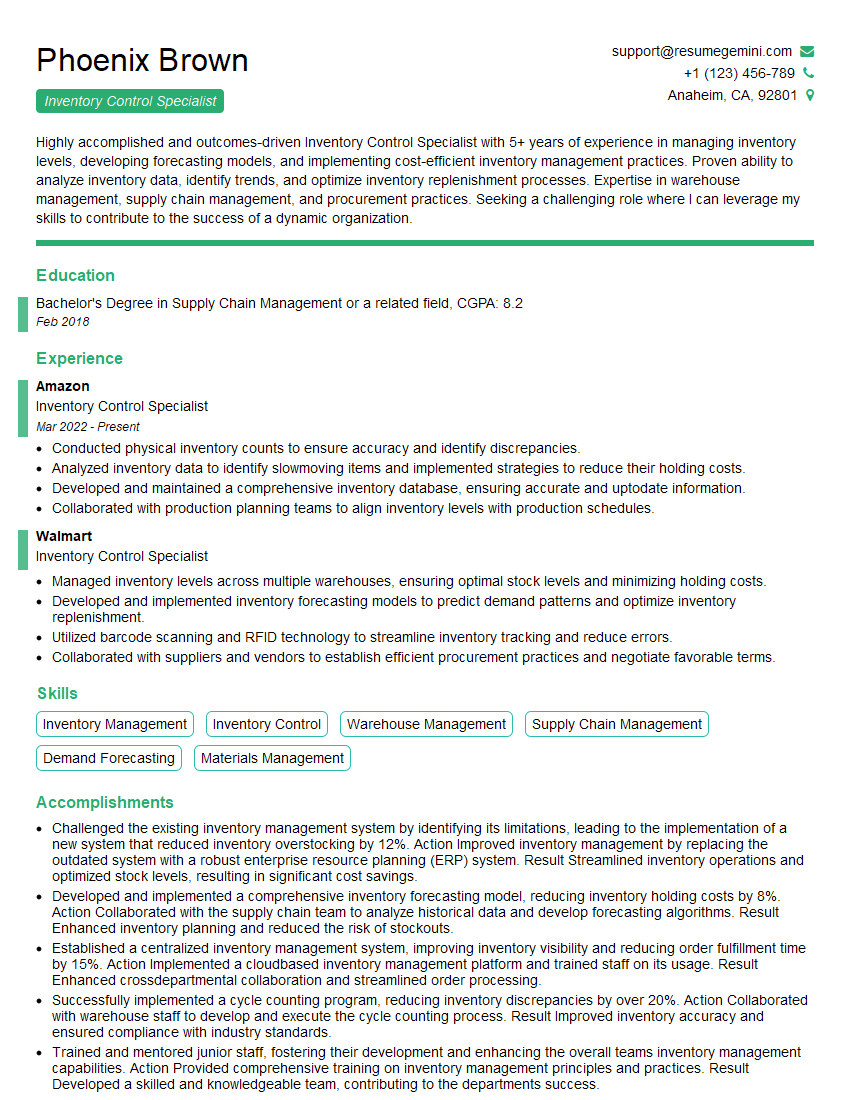
Mastering Prop Inventory Control opens doors to exciting career advancements within the entertainment, film, and event industries. A strong understanding of inventory management translates to increased efficiency, cost savings, and improved project outcomes. To maximize your job prospects, invest time in crafting an ATS-friendly resume that showcases your skills and experience effectively. ResumeGemini is a trusted resource that can help you build a professional and impactful resume. Examples of resumes tailored to Prop Inventory Control are available to help guide you through the process.
Explore more articles
Users Rating of Our Blogs
Share Your Experience
We value your feedback! Please rate our content and share your thoughts (optional).
What Readers Say About Our Blog
Very informative content, great job.
good