Unlock your full potential by mastering the most common Props and Fixture Management interview questions. This blog offers a deep dive into the critical topics, ensuring you’re not only prepared to answer but to excel. With these insights, you’ll approach your interview with clarity and confidence.
Questions Asked in Props and Fixture Management Interview
Q 1. Describe your experience with prop inventory management systems.
My experience with prop inventory management systems spans several years and various software platforms. I’ve worked with both simple spreadsheet-based systems and sophisticated database-driven solutions, including specialized software designed for film and theater production. My proficiency extends beyond data entry; I understand the importance of accurate data entry for efficient location, tracking and reporting. For example, in one project, we migrated from a manual inventory system to a cloud-based platform. This improved our efficiency significantly, reducing search times from hours to minutes and eliminating the risk of human error inherent in manual spreadsheets. The new system allowed for better tracking of prop condition, rental status and associated costs, leading to improved budget management and reduced losses from damaged or missing items.
A key aspect of my expertise is understanding how to customize these systems to meet specific project needs. This includes setting up custom fields for tracking specific details about props, like material, fragility, and required maintenance. I also understand the need to integrate these systems with other production management tools, allowing for smoother workflows across departments.
Q 2. How do you prioritize prop acquisition and maintenance?
Prioritizing prop acquisition and maintenance involves a multifaceted approach that balances artistic vision with practical considerations. I typically start by analyzing the script and production design documents to identify all required props. This forms the basis for creating a prioritized list, considering factors like scene importance, potential risks (fragile items, hazardous materials), and availability. For instance, props crucial for key scenes or requiring specialized fabrication would take precedence over less critical items.
Maintenance prioritization follows a similar logic, focusing on high-use or fragile items first. A robust preventative maintenance program is key, including regular cleaning and inspections. I use a color-coded system to mark the condition of props—green for excellent, yellow for needing attention, and red for requiring immediate repair or replacement—which helps in scheduling maintenance tasks.
Q 3. Explain your process for sourcing unique or hard-to-find props.
Sourcing unique or hard-to-find props requires creative problem-solving and a network of contacts. My approach involves a multi-pronged strategy:
- Extensive Online Research: Utilizing specialized online marketplaces, antique shops, and auction sites for unique and rare items. This requires dedicated time and meticulous keyword searching.
- Networking: Building relationships with prop houses, antique dealers, and collectors. These connections often lead to exclusive access to unique items or information about upcoming auctions.
- Custom Fabrication: If an item cannot be found, I explore commissioning custom fabrication from skilled artisans or workshops. This requires clear specifications, accurate budgeting, and effective communication with the artisans.
- Rental vs. Purchase: Carefully weighing the cost-effectiveness of renting versus purchasing. Renting is often preferable for items used only briefly, while purchasing might be more economical for frequently used props.
For example, when sourcing a specific type of antique clock for a period piece, I combined online searches with contacts within the antique community. The combined strategy led to discovery of a suitable piece within a private collection.
Q 4. What methods do you use to track prop usage and condition?
I employ a comprehensive system for tracking prop usage and condition, combining digital and physical methods for maximum effectiveness. Every prop receives a unique ID number, which is recorded in our inventory management system. This system logs all movements, usage dates, locations (set, storage, etc.), and any damage or maintenance notes. Additionally, we use QR codes or barcodes linked to the inventory database, enabling quick scanning and updating of information during production. This allows us to generate reports on prop usage patterns, assisting in budget planning and identifying potential maintenance needs. Physically, I implement a clear labeling system for props, with labels indicating the prop ID, condition, and any special handling instructions.
Q 5. How do you handle damaged or lost props?
Handling damaged or lost props involves a structured process that balances financial responsibility with minimizing disruption to production. Firstly, a detailed damage report is created, including photographs and a description of the damage. This is crucial for insurance claims or discussions with the prop owner (if rented). For minor damage, we initiate repairs in-house or through specialized repair services. For significant damage or loss, I immediately inform the production manager and initiate the claim process with insurance if applicable. This requires meticulous documentation and accurate valuation of the damaged or lost item. If a prop is lost, a thorough search is conducted before considering replacement. Replacing lost or severely damaged props also involves carefully balancing cost and time constraints with the importance of the prop to the production.
Q 6. Describe your experience working with budgets for props and fixtures.
My experience managing prop and fixture budgets includes creating detailed cost estimates, tracking expenses, and ensuring adherence to allocated funds. I use budgeting software to track costs and expenditures, providing regular reports to the production team. The process starts with detailed breakdown of costs for each prop, considering acquisition, rental, repair, and potential insurance costs. I frequently negotiate with vendors to secure the best possible prices, looking for discounts and leveraging relationships to secure better deals. Throughout production, I monitor spending closely, identifying and addressing any potential budget overruns promptly. This also involves regular communication with the production manager to discuss any budget constraints and explore potential cost-saving measures. A key aspect is contingency planning; some budget is always set aside for unexpected repairs or replacements.
Q 7. How do you ensure the safety and security of props on set/location?
Ensuring prop safety and security on set or location involves a multi-layered approach. First, the storage area needs to be secure and well-organized, limiting access to authorized personnel. Props are categorized according to their fragility or value, with higher-risk items stored in locked containers or dedicated secure areas. On set, a designated prop wrangler is responsible for supervising the handling and use of props, ensuring that fragile or dangerous items are handled carefully and according to safety guidelines. We implement strict rules regarding prop handling and usage, including clear instructions for actors and crew members. A detailed inventory is maintained throughout the filming, allowing us to quickly account for all props at any given time. Furthermore, for valuable or unique items, insurance coverage is always ensured. Finally, regular safety inspections and training sessions are conducted for the crew to raise awareness of potential hazards and safe handling techniques.
Q 8. Explain your experience with prop fabrication or repair.
Prop fabrication and repair are crucial aspects of prop management. My experience encompasses a wide range of techniques, from basic woodworking and painting to more specialized skills like sculpting, metalwork, and electronics repair. I’ve successfully fabricated props ranging from simple set dressings like books and picture frames to more complex items such as period-accurate weaponry and functional mechanical devices.
For example, on a recent historical drama, I had to fabricate a number of antique-looking clocks that needed to appear functional, even though they weren’t. This involved sourcing aged wood, learning some basic clockmaking techniques, and then carefully distressing the finished pieces to achieve the right level of authenticity. Repair work often involves dealing with broken pieces, restoring damaged finishes, and reinforcing weakened structures using appropriate materials. I’m adept at sourcing replacement parts, and understanding how to safely and effectively repair delicate items without compromising their integrity or appearance.
In another instance, I repaired a vintage gramophone that was crucial to a scene. This required a good understanding of its mechanics and the use of specialized tools to carefully replace damaged parts and ensure it functioned correctly for filming.
Q 9. How do you collaborate effectively with other departments (e.g., set design, production)?
Effective collaboration is paramount in prop management. I foster strong working relationships with set designers by actively participating in pre-production meetings, understanding their vision for the set, and offering input on prop feasibility and aesthetics. This includes discussing material choices, scale, and the practicality of using certain props on set.
With the production team, I maintain open communication regarding prop availability, scheduling, and any potential issues. Clear and consistent updates ensure the smooth flow of production. I use a combination of email, shared spreadsheets and project management software to ensure transparency and efficient communication. For example, I might use a shared Google Sheet to track the status of each prop – its location, condition, and availability.
A key aspect of this collaboration is proactive problem-solving. If a prop becomes damaged or unavailable, I quickly identify alternative solutions, ensuring that the production schedule is not impacted. This could involve sourcing a replacement prop, creating a similar substitute, or adjusting the scene to accommodate the change.
Q 10. Describe your experience with prop rentals and returns.
My experience with prop rentals and returns involves a meticulous process. It begins with identifying reputable rental houses and meticulously researching options to find props that meet the production’s needs and budget. I carefully review contracts, ensuring that insurance, delivery, and return procedures are clearly outlined.
Upon delivery, I conduct a thorough inspection of each item, noting any existing damage in detail, and comparing it to the condition report. This meticulous documentation prevents disputes later. During the production period, I ensure proper handling and storage to prevent any further damage. When returning props, I thoroughly clean them, and again, document their condition, making sure that this aligns with the initial condition report. Any damage incurred during production is noted and communicated promptly to the rental house.
Using a clear and well-organized system for tracking rented props from checkout to return is key to avoiding complications and costly charges. For instance, I would use dedicated tracking spreadsheets to maintain an auditable record of the rental process.
Q 11. How do you maintain a clean and organized prop storage area?
Maintaining a clean and organized prop storage area is essential for efficiency and prop longevity. My approach involves a system of categorization and labeling, using a combination of physical and digital organization. Props are categorized by type (e.g., furniture, costumes, small props), material (e.g., wood, metal, fabric), and production. Each item has a unique identification number or code, with a corresponding entry in a database or spreadsheet containing information such as the item’s description, condition, and location within the storage space.
The storage space itself is meticulously organized, with clearly defined zones for different prop categories. Shelves are labeled, and items are arranged to ensure easy access and prevent damage. Regular cleaning and maintenance are crucial, addressing dust, pests, and potential environmental hazards. This includes periodic inspection for any deterioration of props, to allow for timely repairs or disposal.
Think of it like a well-stocked library – everything is carefully cataloged and easily retrievable. Using a clear system makes finding the right prop quick and efficient, saving valuable time during production.
Q 12. How do you handle last-minute prop requests?
Handling last-minute prop requests requires a calm and efficient approach. My immediate response is to assess the request: What is needed? Is it readily available? Can it be quickly sourced or fabricated? I prioritize the urgency of the request, evaluating its impact on production.
If the prop is already in inventory, I immediately locate and prepare it for use. If sourcing is necessary, I leverage my network of contacts – rental houses, prop suppliers, and even local craft stores – to find a suitable replacement quickly. In cases where fabrication is required, I prioritize speed without compromising quality, focusing on functionality and visual accuracy.
For example, if a scene requires a specific type of vintage suitcase, I’d check my inventory first. If unavailable, I’d call rental houses or use online marketplaces. If all else fails, I might need to improvise using existing props or source materials and quickly create a believable substitute. Good communication with the production team throughout this process is key to managing expectations and preventing delays.
Q 13. What software or tools do you use to manage props?
I utilize a combination of software and tools to manage props effectively. A robust database management system (DBMS) is crucial for tracking inventory, maintaining detailed descriptions of each item, and recording its condition, rental history, and location. I often utilize spreadsheets and custom databases alongside software like Filemaker Pro, or Airtable to create and maintain these records. This system allows for easy searching and filtering, making it simple to find specific props based on various criteria.
Beyond database management, I also use digital photography and videography to document props, which is particularly helpful for rentals and insurance purposes. Furthermore, project management software, such as Asana or Trello, helps manage workflows, deadlines, and communication between different departments involved in the prop management process.
For example, a custom database might include fields for prop ID, description, condition (e.g., excellent, good, fair, poor), location, assigned production, rental history, and images. This centralized system ensures accurate information and efficient prop tracking.
Q 14. Describe your experience with different types of props (e.g., antiques, electronics, perishable goods).
My experience encompasses a wide range of prop types, each presenting unique challenges and considerations. Working with antiques requires a delicate touch and an understanding of their fragility. Proper handling, storage, and insurance are crucial to avoid damage or loss. Detailed documentation, including high-resolution photographs, is vital. This often includes understanding the appropriate environmental controls to protect such items from excessive light, humidity, or temperature fluctuations.
Electronics require a different approach. Functionality must be verified and maintained. Regular testing and potential repairs may be necessary. Safety precautions are also paramount, ensuring that any electrical connections are safe for use and that the items are handled by trained personnel. Perishable goods, such as food or flowers, require meticulous planning to ensure their freshness and suitability for the shoot. Timing is everything; careful scheduling and appropriate storage conditions are key.
For instance, I once had to manage a collection of antique clocks for a period piece. These needed careful handling, protection, and even temperature control. On a completely different project, I was responsible for procuring and maintaining several large batches of fresh flowers, which involved coordinating with florists, ensuring timely delivery and storing them correctly to maintain their appearance for the duration of filming.
Q 15. How do you ensure props are appropriately aged or distressed?
Achieving the right level of aging or distressing on props is crucial for authenticity and visual storytelling. It’s not just about making something look old; it’s about making it look convincingly old, used, or weathered in a specific way. This requires a nuanced understanding of materials and aging techniques.
- Understanding the Material: Different materials age differently. Wood might crack and warp, metal might rust or tarnish, fabrics might fade or fray. The aging process should reflect these natural changes.
- Controlled Aging Techniques: We employ various techniques including using specific paints and stains, applying washes, strategically distressing with sandpaper or wire brushes, and even using heat and chemicals (under controlled conditions) to create authentic wear and tear. For example, to age a wooden chest, we might use a dark stain, then selectively lighten areas with sandpaper to simulate years of use.
- Research and Reference: We heavily rely on reference images and historical examples to inform our aging techniques, ensuring accuracy and realism. This might involve studying images of similar antiques or props used in period films.
- Testing and Refinement: It’s a process of iterative refinement. We often test different techniques on sample pieces before applying them to the actual prop to avoid irreversible damage or undesired effects.
Career Expert Tips:
- Ace those interviews! Prepare effectively by reviewing the Top 50 Most Common Interview Questions on ResumeGemini.
- Navigate your job search with confidence! Explore a wide range of Career Tips on ResumeGemini. Learn about common challenges and recommendations to overcome them.
- Craft the perfect resume! Master the Art of Resume Writing with ResumeGemini’s guide. Showcase your unique qualifications and achievements effectively.
- Don’t miss out on holiday savings! Build your dream resume with ResumeGemini’s ATS optimized templates.
Q 16. How do you deal with conflicting requests for props?
Conflicting prop requests are common, especially during peak production periods. We address this through a combination of meticulous scheduling, proactive communication, and a flexible, yet firm, approach.
- Prioritization Based on Production Schedule: We carefully review the production schedule to understand which scenes or shoots have immediate needs. Requests are prioritized based on deadlines and criticality.
- Open Communication with Production Teams: We actively communicate with various departments (set design, wardrobe, etc.) to understand the overall needs and to identify any potential conflicts early on. This often involves attending pre-production meetings and providing regular updates on prop availability.
- Negotiation and Compromise: When conflicts arise, we work closely with production to find solutions that meet most requirements. This could involve suggesting alternative props, adjusting schedules, or creatively finding a way to use limited resources effectively. It’s a collaborative problem-solving process.
- Documentation and Tracking: We maintain a detailed log of all prop requests, allocations, and conflicts. This transparency is crucial for accountability and conflict resolution.
Q 17. Describe your experience with prop transportation and logistics.
Prop transportation and logistics are critical for the safety and preservation of the props. We take a methodical approach that considers the fragility of the props, the distance and mode of transport, and the need for secure handling.
- Careful Packaging and Crating: Fragile props require custom-built crates or specialized packaging to protect them during transit. We use padding, bracing, and other protective measures to prevent damage.
- Selection of Appropriate Transportation: The choice of transport depends on the size, weight, and fragility of the props, as well as the distance. We use climate-controlled vehicles for sensitive items and secure transport for valuable pieces. We might utilize specialized carriers for oversized or delicate props.
- Route Planning and Scheduling: We meticulously plan routes to minimize handling and transit time. This includes factoring in potential traffic delays and weather conditions.
- On-Site Handling and Unloading: We provide on-site supervision for loading and unloading to ensure props are handled with care and minimize risk of damage during delivery and placement.
- Insurance and Tracking: We use tracking systems for all prop shipments and maintain insurance coverage to protect against loss or damage during transit.
Q 18. How do you handle insurance and liability related to props?
Insurance and liability are paramount considerations in prop management. We employ comprehensive strategies to mitigate risks and ensure compliance.
- Comprehensive Insurance Coverage: We maintain a robust insurance policy that covers loss, damage, theft, and liability for all props in our inventory. The policy needs to accommodate the value and type of props.
- Detailed Inventory and Valuation: We maintain a detailed inventory with photographic records and accurate valuations of each prop. This is essential for insurance claims and accurate risk assessment.
- Safe Handling Procedures: We implement and enforce strict safe handling procedures to minimize the risk of accidents and damage. Training on proper handling techniques is mandatory for all personnel.
- Regular Inspections and Maintenance: Routine inspections and maintenance help identify potential problems early on, reducing the risk of accidents or damage. This also extends the lifespan of our props.
- Legal Compliance: We ensure compliance with all relevant safety regulations and insurance requirements. This involves regular review and updating of our procedures and policies.
Q 19. What is your experience with prop duplication and replication?
Prop duplication and replication are vital for managing costs and availability, especially for frequently used items or those prone to damage. We use a range of techniques depending on the complexity and material of the prop.
- Mold Making and Casting: For props with intricate details or complex shapes, we employ mold making and casting techniques. This allows us to create accurate copies from original pieces using materials like resin, plaster, or other suitable substitutes.
- 3D Printing: For some props, 3D printing offers a fast and efficient way to create replicas. This is particularly useful for props with complex geometries or those requiring specific dimensions.
- Traditional Replication Techniques: In some cases, traditional methods like woodworking or metalworking may be used to replicate props. This often relies on the skills of experienced craftsmen.
- Material Selection: Careful consideration is given to the materials used in replication. We strive to use materials that are durable, cost-effective, and visually consistent with the original prop.
- Quality Control: A rigorous quality control process ensures that the replicas meet the required standards of accuracy and durability.
Q 20. How do you maintain a detailed inventory of props and their condition?
Maintaining a precise and up-to-date inventory is critical for efficient prop management. We use a combination of physical and digital systems to achieve this.
- Database System: We use a dedicated database system to record all props with detailed information including descriptions, images, condition assessments, and location. The system allows for efficient searching, filtering, and reporting.
- Barcoding or RFID Tracking: Each prop is identified with a unique barcode or RFID tag to facilitate tracking and inventory management. This minimizes the risk of loss or misplacement.
- Regular Physical Audits: Regular physical audits are conducted to verify the accuracy of the database and identify any discrepancies.
- Condition Reporting: A standardized condition reporting system helps track wear and tear, damage, and necessary repairs. This allows for proactive maintenance and replacement as needed.
- Photography and Documentation: High-quality photographs and detailed descriptions are crucial for accurate inventory records. This allows for quick identification and assessment of the condition of each prop.
Q 21. Explain your experience with different types of fixture management (e.g., lighting, furniture).
Fixture management extends beyond props to include various elements of the set and production environment. My experience spans several key areas.
- Lighting Fixtures: We manage the inventory, maintenance, and safe handling of lighting fixtures, including bulbs, gels, and other accessories. This requires knowledge of electrical safety regulations and the proper handling of sensitive equipment. We maintain a detailed log of each fixture, its condition, and its location.
- Furniture Fixtures: The management of furniture requires consideration of its size, weight, and fragility. We oversee the storage, transport, setup, and safe handling of furniture pieces, ensuring they are appropriately protected during transport and storage.
- Set Dressing Fixtures: This encompasses a wide array of items used for setting the scene, including artwork, mirrors, decorative items, etc. We manage their inventory, condition, and appropriate placement within the set design.
- Software for Fixture Management: We utilize inventory management software to track the location and condition of all fixtures. This ensures that appropriate personnel can quickly locate any needed fixtures for production.
- Safety and Maintenance: Regular inspections are essential to ensure the safety and functionality of all fixtures. We follow strict safety protocols and ensure that all fixtures are in good working order to prevent accidents.
Q 22. How do you ensure fixtures are properly installed and maintained?
Proper fixture installation and maintenance are paramount to safety and the success of any production. It starts with a thorough pre-installation check, verifying the structural integrity of the fixture and ensuring it’s compatible with the environment and intended use. This includes checking for any damage, loose wiring, or missing parts. For example, before installing a large lighting fixture, I’d inspect the cabling, ensure the mounting points are secure, and test the electrical connection.
After installation, regular maintenance is crucial. This involves periodic inspections to identify potential issues like loose bolts, frayed wires, or flickering lights. We document these inspections meticulously, using checklists and photographs, to track the fixture’s condition over time. A proactive maintenance schedule, perhaps a weekly or monthly check depending on the fixture and its usage, helps prevent catastrophic failures and extends the fixture’s lifespan. Think of it like regular car maintenance – preventative measures save money and potential disasters down the line.
We also adhere to strict safety protocols during both installation and maintenance. This includes using appropriate safety equipment like harnesses for working at heights and ensuring all electrical work is performed by qualified electricians. All work is carried out with a designated safety officer overseeing the process.
Q 23. How do you handle fixture malfunctions or breakdowns?
Fixture malfunctions are handled swiftly and efficiently following a clear protocol. The first step is immediate isolation of the faulty fixture to prevent further damage or injury. This might involve switching off the power supply or physically disconnecting the fixture. Safety is always the top priority.
Next, we assess the nature of the malfunction. Is it a simple bulb replacement? A loose connection? Or something more complex requiring specialist repair? For minor issues, our team might be able to resolve the problem on-site. However, for more serious malfunctions, we immediately contact a qualified technician or the manufacturer for repair or replacement. We maintain a detailed log of all malfunctions, including the date, time, nature of the fault, and the resolution, to help us identify recurring problems and improve our preventative maintenance strategies.
For instance, on a recent film set, a lighting fixture began to overheat. We immediately isolated the fixture, contacted our electrical technician, and documented the incident. The technician diagnosed a faulty ballast, replacing it promptly. This quick response prevented a potential fire hazard and minimized downtime.
Q 24. What is your experience with specialized prop handling techniques?
My experience encompasses a wide range of specialized prop handling techniques, adapting to the unique demands of various projects. This includes delicate handling of antique props, requiring specialized gloves and careful placement to avoid damage. I’m proficient in the use of various rigging techniques for suspending props and lighting, ensuring safety and stability. This could involve using counterweights, pulleys, or specialized clamps, always adhering to relevant safety regulations.
For instance, I’ve worked on projects involving fragile period costumes, requiring the use of acid-free tissue paper and archival-quality storage containers. I also have experience handling large-scale sets and props using specialized lifting equipment and employing trained personnel to ensure safe and controlled movement.
Experience also includes using custom-built dollies and transport systems for moving heavy or unusually shaped props, as well as techniques for maintaining delicate mechanisms in antique props, often requiring specific cleaning and lubrication solutions. Safety and preservation are always at the forefront of every operation.
Q 25. How do you manage the disposal or recycling of old or unusable props?
Disposal and recycling of unusable props follow an environmentally responsible protocol. We prioritize recycling and repurposing wherever possible. We categorize props into recyclable materials (metal, plastic, wood) and those requiring special disposal (hazardous materials like paint or chemicals).
Recyclable materials are sorted and sent to appropriate recycling facilities. Props that can be repurposed are often stored for future use in different projects. For example, old wooden crates might become set dressing in a new production. Materials that cannot be recycled or repurposed are disposed of according to local regulations and hazardous waste disposal guidelines. We maintain detailed records of all disposal and recycling activities to ensure compliance and track our environmental impact. This includes partnering with local recycling centers and waste management companies to ensure ethical and efficient disposal procedures.
We also strive to minimize waste from the start. We often source sustainable and reusable materials, selecting props with longer lifespans whenever possible, and encourage creative reuse of existing props across projects. This aligns with our environmental responsibility and cost-effectiveness.
Q 26. Describe your experience working in different environments (e.g., film, theater, events).
My experience spans diverse environments, including film, theater, and large-scale events. Each setting presents unique challenges and demands. In film, the emphasis is on precision and speed, often working with tight schedules and demanding directors. Prop and fixture management require meticulous planning and rapid problem-solving skills, ensuring props are readily available and in perfect condition for each shot.
In theater, the focus shifts to the longevity of the production, requiring durability and the ability to withstand repeated use. Prop and fixture management necessitate careful maintenance and repair to ensure the props remain functional and aesthetically pleasing throughout the run.
Large-scale events require adaptability and the ability to manage a high volume of props and fixtures in a short timeframe. This often involves collaboration with multiple teams and vendors, prioritizing organization and clear communication to ensure everything runs smoothly. For example, I’ve managed prop rentals for a large music festival, coordinating the delivery, setup, and return of hundreds of items, ensuring all safety regulations were met.
Q 27. How do you ensure compliance with safety regulations for props and fixtures?
Safety compliance is of utmost importance. We adhere to all relevant occupational safety and health administration (OSHA) regulations and industry best practices. This includes regular safety training for our team and strict adherence to electrical safety codes when handling lighting and power equipment.
We conduct regular inspections of all props and fixtures, identifying and addressing any potential hazards promptly. For example, we’ll ensure that all electrical equipment is properly grounded and regularly tested, and any sharp objects or potentially hazardous materials are handled and stored safely. We maintain detailed records of these inspections and training sessions.
Furthermore, we use safety equipment such as gloves, eye protection, and harnesses as needed. Every member of our team is well-versed in safe handling procedures and understands emergency response protocols. We also ensure all prop and fixture-related permits and licenses are obtained and up-to-date.
Q 28. How would you handle a situation where a critical prop is missing on set?
The disappearance of a critical prop on set is a serious issue requiring immediate action. The first step is a thorough search of the immediate vicinity, involving the entire team. We use a systematic approach, dividing the search area into sections. We also check all storage areas and any areas where the prop might have been temporarily placed.
If the prop isn’t found quickly, I’d review the prop inventory and movement logs to track its last known location. We may need to review security footage if available. This allows us to determine if the prop was misplaced or possibly stolen. Simultaneously, we contact the relevant production personnel to assess the impact of the missing prop on the schedule and the potential for creative solutions (finding a suitable replacement prop, altering the scene if possible).
Depending on the severity, we may need to investigate further and potentially involve security personnel or even the police if theft is suspected. In some cases, we might need to source a replacement prop quickly, potentially from rental houses or other production companies. This requires a proactive and decisive approach, prioritizing swift resolution to minimize disruptions to the production schedule.
Key Topics to Learn for Props and Fixture Management Interview
- Inventory Management: Understanding and implementing effective inventory tracking systems, including database management and utilizing inventory software. Practical application: Optimizing stock levels to minimize waste and ensure timely availability for productions.
- Prop and Fixture Handling: Safe and efficient handling, storage, and transportation of props and fixtures, considering factors like weight, fragility, and specific handling requirements. Practical application: Developing and implementing safe handling procedures to prevent damage and injury.
- Budgeting and Cost Control: Developing and adhering to budgets, tracking expenses related to prop and fixture acquisition, maintenance, and disposal. Practical application: Negotiating favorable deals with vendors and implementing cost-saving strategies.
- Maintenance and Repair: Performing routine maintenance and minor repairs on props and fixtures to extend their lifespan. Practical application: Identifying potential issues early to prevent costly repairs or replacements.
- Organization and Logistics: Efficient organization and tracking of props and fixtures, managing their movement on set or in storage. Practical application: Implementing a clear labeling and storage system to ensure quick retrieval.
- Communication and Collaboration: Effective communication with production teams, designers, and other stakeholders to ensure seamless integration of props and fixtures into productions. Practical application: Proactively identifying and addressing potential issues before they escalate.
- Safety Regulations and Compliance: Adhering to relevant safety regulations and best practices related to prop and fixture handling and storage. Practical application: Implementing safety protocols to minimize risks on set and in storage facilities.
Next Steps
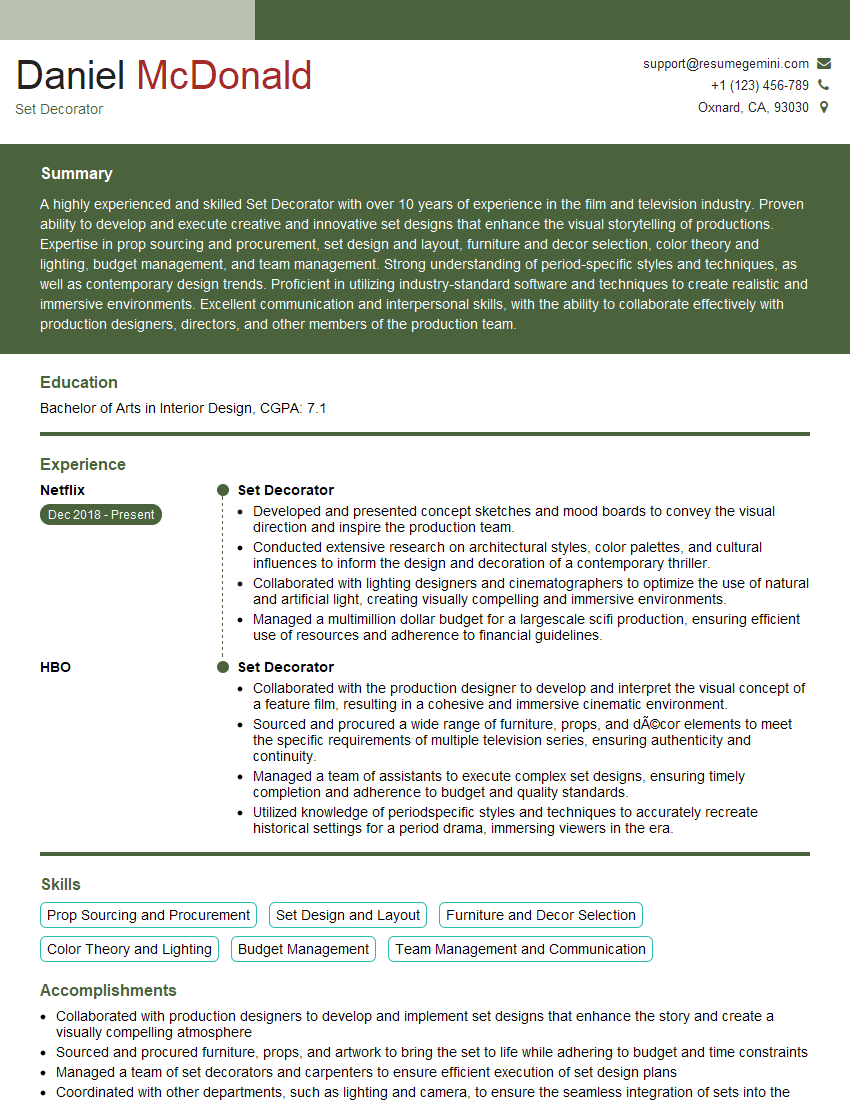
Mastering Props and Fixture Management is crucial for career advancement in the entertainment and events industries. A strong understanding of these skills demonstrates efficiency, organization, and a commitment to safety, all highly valued attributes. To maximize your job prospects, create an ATS-friendly resume that highlights your skills and experience effectively. We strongly recommend using ResumeGemini, a trusted resource, to build a professional resume that stands out. Examples of resumes tailored to Props and Fixture Management are available to help guide you.
Explore more articles
Users Rating of Our Blogs
Share Your Experience
We value your feedback! Please rate our content and share your thoughts (optional).
What Readers Say About Our Blog
Very informative content, great job.
good