Unlock your full potential by mastering the most common Quick Sketching interview questions. This blog offers a deep dive into the critical topics, ensuring you’re not only prepared to answer but to excel. With these insights, you’ll approach your interview with clarity and confidence.
Questions Asked in Quick Sketching Interview
Q 1. What are your preferred sketching techniques for rapid ideation?
My preferred sketching techniques for rapid ideation prioritize speed and clarity. I primarily rely on loose, gestural lines to capture the essence of an idea quickly. This often involves using lightweight, quick-drying mediums to avoid smudging or waiting for ink to dry. I frequently employ techniques like thumbnail sketching – creating many very small sketches to explore multiple options simultaneously. Another technique I find invaluable is using stick figures and simple shapes to represent people and objects, focusing on communicating the key elements rather than fine details. For instance, if I’m sketching a furniture design, I’ll start with basic shapes indicating the overall form before adding finer details. This allows for quick iteration and exploration of many different design directions.
- Gestural Lines: Loose, flowing lines capturing the movement and feel of an object.
- Thumbnail Sketching: Many small sketches to quickly explore numerous ideas.
- Simplified Forms: Using basic shapes (circles, squares, triangles) to build objects.
Q 2. Explain your process for translating a complex idea into a quick sketch.
Translating a complex idea into a quick sketch is a process of simplification and prioritization. First, I break down the complex idea into its fundamental components. For example, if it’s a complex machine, I identify the core functionality and key parts. Then, I prioritize these components based on their importance to understanding the overall concept. I then create a rough layout, focusing on proportions and relationships between these components before adding details. The goal is to communicate the key information concisely and visually. This might involve using annotations or labels if necessary to further clarify aspects. Imagine designing a new type of bicycle. Instead of detailing every part immediately, I would first sketch the overall frame shape, wheel placement, and handlebars, then gradually add components like gears and brakes only if necessary to clarify the concept.
- Deconstruction: Break the complex idea into core components.
- Prioritization: Identify the most crucial elements for communication.
- Layout: Create a basic structure emphasizing proportions and relationships.
- Details: Add details strategically, keeping it simple and clear.
Q 3. How do you handle constraints like time pressure during a sketching session?
Time pressure is a constant in quick sketching. To handle it effectively, I prioritize speed and efficiency over detail. I focus on capturing the essence of the idea rather than getting bogged down in perfectionism. I often pre-plan what I need to draw. Mental rehearsal helps significantly, allowing me to focus on execution rather than thinking through the process on the spot. I also utilize shorthand symbols and abbreviations to speed up the process, and I practice regularly to improve my efficiency. This allows me to produce clear sketches even under tight deadlines. For instance, during a brainstorming session, I would not worry about perfectly rendered lines, but rather concentrate on generating multiple quick sketches conveying different ideas.
- Prioritize Speed: Focus on the core idea and essential details.
- Pre-planning: Think through the sketch before starting.
- Shorthand: Utilize symbols and abbreviations to save time.
- Practice: Regular practice increases speed and efficiency.
Q 4. Describe your experience with different sketching mediums (e.g., pencil, digital).
I have extensive experience with both traditional and digital sketching mediums. Traditional pencils (various grades like H2, 2B, 4B) offer a unique tactile experience and allow for quick variations in line weight. I find them ideal for rough sketches and exploring design possibilities. Pens, particularly fineliners, are excellent for adding crisp details and creating clean lines. Digital sketching, using software like Photoshop or Procreate, offers advantages like easy corrections, layering, and the ability to experiment with different styles and colors quickly. However, the immediacy and spontaneity of traditional mediums are sometimes irreplaceable. My choice depends on the project and its context. For rapid ideation sessions, pencil remains my favorite; for more polished presentations, I often finalize my sketches digitally.
- Traditional: Pencils (H2, 2B, 4B), pens (fineliners).
- Digital: Photoshop, Procreate.
Q 5. How do you incorporate feedback into your quick sketches?
Incorporating feedback is crucial for improving quick sketches. I actively seek feedback at various stages of the sketching process. This feedback helps me identify areas that need improvement, clarify ambiguities, and explore alternate design directions. I usually present my initial sketches and gather feedback, focusing on the overall concept and clarity. I then iterate on these sketches based on the feedback, making adjustments to improve clarity and address concerns. This iterative process continues until the sketch effectively communicates the intended design. For example, if feedback points to a lack of clarity in the proportions of a particular element, I can quickly adjust the sketch to reflect this feedback.
- Present & Gather: Showcase early sketches to get feedback on the core concepts.
- Iterate: Refine the sketches based on the feedback received.
- Refine & Repeat: Continue the iterative process until the sketch effectively communicates the design.
Q 6. Explain your understanding of perspective and its role in quick sketching.
Perspective is fundamental to creating quick sketches that are both clear and believable. Even in quick sketches, understanding one-point, two-point, or even three-point perspective can greatly enhance the realism and communication of the design. Applying even simple perspective techniques can transform a flat drawing into something much more engaging and understandable. For quick sketching, I often rely on simple perspective cues, such as converging lines to suggest depth. The goal is not to achieve photorealistic accuracy but to use perspective to guide the viewer’s eye and help them understand the three-dimensional form of the object being sketched. For instance, sketching a building, even a simple indication of vanishing points, helps the viewer immediately understand the building’s spatial relationships and scale.
- One-Point Perspective: All lines converge to a single vanishing point.
- Two-Point Perspective: Lines converge to two vanishing points.
- Simple Cues: Using converging lines to suggest depth, even without precise vanishing points.
Q 7. How do you achieve clarity and effectiveness in your quick sketches?
Clarity and effectiveness in quick sketches stem from a combination of factors. First, it’s about focusing on the core idea and avoiding unnecessary details. I prioritize conveying the essential information concisely. Second, strong composition plays a vital role. I ensure that the elements are arranged effectively to guide the viewer’s eye and highlight the key features. Third, clear line work – even if loose – helps maintain visual order and prevents confusion. Finally, using appropriate labels or annotations further helps clarify the design and its details. Imagine sketching a new smartphone. Focus on the silhouette, key features like the screen and camera, and avoid minute details like individual buttons or ports in the early stages. Clear lines and possibly a label ‘New Smartphone Design’ will immediately communicate the core concept.
- Simplicity: Focus on core information, avoid unnecessary details.
- Composition: Arrange elements effectively to guide the viewer’s eye.
- Line Work: Clear, consistent lines even in a loose style.
- Annotations: Use labels or annotations to clarify the design.
Q 8. How do you balance detail and speed in your quick sketching workflow?
Balancing detail and speed in quick sketching is a delicate dance. It’s about prioritizing essential information over superfluous detail. Think of it like sculpting with light and shadow – you use a few strong lines to define form and gesture, rather than meticulously rendering every wrinkle or texture. My workflow emphasizes a gestural, loose approach initially, capturing the essence of the subject swiftly. I then selectively add detail to key areas that enhance understanding or add character. For example, when sketching a car, I might quickly establish the overall shape and proportions, then add details to the headlights or wheels to convey a sense of style and specific features. This approach allows me to capture the ‘feel’ of the object rapidly, adding finer points only where necessary.
I often work in stages, starting with very light lines to establish basic forms, gradually building up the details. This avoids overworking the sketch and maintains the energy of the initial gesture. Practice is key; the more you sketch, the better you’ll become at instinctively knowing where to focus your attention for maximum impact.
Q 9. What are your strategies for overcoming creative blocks during a sketching session?
Creative blocks are a common challenge, even for experienced sketchers. My approach is multifaceted. First, I step away from the drawing for a few minutes. A short break allows my mind to reset and approach the problem with fresh eyes. I might take a quick walk, listen to music, or even look at unrelated images to spark new ideas. Sometimes, simply changing my sketching tool – switching from pen to pencil, for instance – can jolt my creativity. If the block persists, I might try a different approach, perhaps starting with a quick value study or focusing on a specific detail of the subject instead of tackling the entire composition at once. I find that sketching from a different angle or using a simplified form to start can also break through the barrier and create renewed confidence.
Another strategy I frequently use involves actively generating multiple ideas, even if they seem initially off the mark. I might start by brainstorming keywords related to the object. This process of idea generation helps me overcome the initial pressure to create the ‘perfect’ sketch right away.
Q 10. Describe your approach to sketching different types of objects (e.g., people, products, landscapes).
My approach to sketching different subjects varies based on their inherent qualities. When sketching people, I focus on capturing gesture and movement. I utilize simple linework to convey the essence of the pose, emphasizing dynamic lines and proportions. A quick sketch of a person should ideally communicate their attitude and energy as well as their physical form. For product sketching, my focus shifts to form, function, and detail. I pay close attention to the object’s proportions, highlighting key features that define its use and aesthetics. Detailed proportions are particularly important to show specific elements that might be overlooked with just gestural lines. Landscape sketching requires an understanding of perspective and composition. I use a combination of line, shape, and value to suggest depth, space, and atmosphere. Here, suggesting the horizon line, major structural points, and light/shadow relationships is crucial.
In essence, it is about adjusting my approach and skill set to the specific needs of the subject matter.
Q 11. How do you ensure your quick sketches are effectively communicating your ideas?
Effective communication in quick sketching is about clarity and conciseness. Avoid clutter; every line should serve a purpose. I prioritize clear shapes, strong lines, and effective use of value to convey form and volume. For example, instead of drawing every leaf on a tree, I might use a simplified shape to suggest foliage, focusing on the overall mass and shape of the crown. Understanding basic design principles – such as balance, proportion, and emphasis – is crucial for communicating ideas effectively. Remember that a successful quick sketch will tell a story, conveying all the core ideas with simple forms and visual cues.
The viewer should be able to grasp the main idea at a glance without having to decipher a dense collection of details.
Q 12. How do you incorporate annotations and labels into your quick sketches?
Annotations and labels are powerful tools for enhancing quick sketches. I use them sparingly, reserving them for crucial information that isn’t easily conveyed visually. For example, in a product sketch, I might label key dimensions or materials. In architectural sketches, I would use labels to specify room types or functional areas. I prefer clear, concise notes rather than lengthy descriptions. My handwriting should be legible, and I keep annotations distinct from the main sketch to prevent visual clutter. I often use different colored pens or pencils to differentiate between the sketch and the annotations. This makes my intent clear and aids communication.
Using arrows or connecting lines between the annotation and its corresponding part of the sketch enhances clarity.
Q 13. Explain your process for selecting the appropriate level of detail for a quick sketch.
Choosing the right level of detail depends on the purpose of the sketch. A quick sketch for brainstorming might only need basic shapes and lines, while a sketch intended for client presentation may require more refinement. It also depends on my audience. A sketch for a technical audience might require more precise details than one aimed at non-technical stakeholders. I always start with the big picture, focusing on essential features and proportions. I then progressively add details, carefully considering whether each addition contributes to understanding or just adds unnecessary complexity. Think of it as a hierarchy of information – the most critical aspects should be emphasized. The most important thing is clarity; the details should support and enhance comprehension rather than distract from the overall impact.
The ultimate goal is to convey the maximum amount of relevant information in the minimum amount of time.
Q 14. What are some common pitfalls to avoid when quick sketching?
Several common pitfalls can hinder the effectiveness of quick sketching. Overthinking is a significant one – don’t strive for perfection; aim for clarity and communication. Another common mistake is trying to achieve photorealism; quick sketching is about capturing essence, not precise detail. Lack of planning can also lead to ineffective sketches; it is important to consider composition and subject emphasis before starting. Getting bogged down in minor details, not conveying proportions effectively, and neglecting the underlying structure of the object should also be avoided. Finally, using the wrong tools for the task can hinder the process. For instance, using a fine-tipped pen for large-scale gestures is not efficient.
Remember that quick sketching is about capturing ideas efficiently, not creating finished artwork. Focus on the essential features and practice regularly to build speed and confidence.
Q 15. How do you use quick sketching to solve design problems?
Quick sketching is invaluable for solving design problems because it allows for rapid ideation and exploration of different solutions before committing to more detailed work. Think of it as brainstorming, but visually. Instead of writing down ideas, you’re drawing them. This process helps to quickly visualize concepts, identify potential flaws early on, and communicate ideas effectively to others.
For example, if I’m designing a new mobile app interface, I’ll start with quick sketches to explore different layouts, button placements, and overall navigation flows. I might create several variations, exploring different approaches to the same problem. This iterative process, fueled by quick sketches, allows me to quickly discard ineffective designs and refine the most promising ones.
In essence, quick sketching acts as a bridge between abstract ideas and concrete visual representations, accelerating the design process and increasing the likelihood of creating a successful design.
Career Expert Tips:
- Ace those interviews! Prepare effectively by reviewing the Top 50 Most Common Interview Questions on ResumeGemini.
- Navigate your job search with confidence! Explore a wide range of Career Tips on ResumeGemini. Learn about common challenges and recommendations to overcome them.
- Craft the perfect resume! Master the Art of Resume Writing with ResumeGemini’s guide. Showcase your unique qualifications and achievements effectively.
- Don’t miss out on holiday savings! Build your dream resume with ResumeGemini’s ATS optimized templates.
Q 16. How familiar are you with sketching software (e.g., Adobe Photoshop Sketch, Procreate)?
I’m proficient in several sketching software applications, including Adobe Photoshop Sketch and Procreate. My familiarity extends beyond basic functionality; I understand how to leverage their unique features for different sketching styles and purposes. For example, Photoshop Sketch’s integration with Adobe Creative Cloud allows for seamless transition to more advanced design tools, while Procreate’s powerful brush engine enables creating highly nuanced and expressive sketches.
I utilize these tools to enhance my workflow, adding digital capabilities to my traditional sketching process. This often involves refining initial paper sketches digitally, adding color and texture, or using digital tools to create variations of a sketch rapidly. The choice of software depends on the specific project requirements and the desired level of fidelity.
Q 17. Describe your experience with different sketching styles (e.g., realistic, abstract).
My experience encompasses a range of sketching styles, adapting my approach depending on the project’s needs. Realistic sketching is crucial for projects requiring detailed representation, like architectural design or product visualization. Here, accuracy in proportions and rendering is paramount. I might use a combination of light and shadow to create depth and realism.
Conversely, abstract sketching is invaluable for brainstorming and exploring conceptual ideas. In this style, the focus shifts from precise representation to capturing the essence of an idea. This can involve using loose lines, shapes, and color to convey feelings, moods, or general forms.
I also frequently utilize a style somewhere between these two extremes – a simplified, semi-realistic style that balances clarity and visual appeal, often incorporating key details while sacrificing photorealism. This is commonly used for quick client presentations or internal design reviews.
Q 18. How do you maintain consistency in style across multiple sketches?
Maintaining consistent style across multiple sketches requires a deliberate approach. I achieve this through several strategies. First, I establish a consistent set of visual vocabulary – a collection of line weights, shading techniques, and overall aesthetic choices – that I apply consistently across my sketches. This could include things like using a particular type of line for outlines, or employing a consistent shading style.
Secondly, I use visual references consistently. Whether it’s a mood board, a style guide, or even a collection of my own previous work, having visual reference points helps ensure that subsequent sketches remain faithful to the established style. Finally, I regularly review my sketches to check for inconsistencies and make adjustments as needed. This self-assessment process is key to maintaining visual harmony and cohesiveness.
Q 19. How do you adapt your sketching approach to different client needs?
Adapting my sketching approach to different client needs requires careful communication and understanding. Before commencing any sketches, I thoroughly discuss the project goals, target audience, and desired aesthetic with the client. This ensures that my sketching style aligns with their vision. For example, a client seeking a modern, minimalist design might require clean lines and a restrained color palette, while a client looking for a rustic, handcrafted feel might prefer a sketch style that emphasizes texture and organic shapes.
Active listening and a willingness to iterate on the sketches based on client feedback are vital. I treat sketches as a collaborative tool, using them to refine the design together until a shared vision is achieved. This collaborative process ensures the final design meets the client’s needs and expectations.
Q 20. What are some tools and resources you use to improve your quick sketching skills?
Improving my quick sketching skills involves ongoing practice and the use of various tools and resources. Regular sketching exercises, such as timed figure drawing or object studies, help to improve my hand-eye coordination and speed. Observing the work of other skilled sketch artists, both traditionally and digitally, provides inspiration and exposes me to new techniques and styles.
Additionally, I utilize a range of physical and digital tools to enhance my workflow. This includes a variety of pencils, pens, and markers for traditional sketching, along with digital styluses and drawing tablets for digital sketching. I also frequently consult online tutorials and workshops to learn new techniques and expand my skillset.
Q 21. Describe your experience with presenting your quick sketches to clients or colleagues.
Presenting quick sketches to clients or colleagues is a crucial part of the design process. I aim for presentations that are clear, concise, and engaging. This typically involves creating a small set of high-quality sketches that effectively communicate the key concepts, focusing on clear visual communication rather than excessive detail. I often use a projector or large monitor for group presentations, and for individual clients, a printed portfolio of sketches usually works best.
During the presentation, I provide context and explain the design rationale behind each sketch, highlighting the strengths and weaknesses of different approaches. I encourage interaction and feedback, using the sketches as a starting point for a collaborative discussion. The goal is not to present a finished product, but to spark conversation and gain valuable input to guide further design development.
Q 22. How do you use quick sketching in collaboration with others?
Quick sketching is incredibly valuable in collaborative environments. It allows for rapid idea generation and visual communication, fostering better understanding and faster iteration. Think of it like a visual brainstorming session.
In a team setting, I might use quick sketches to:
- Quickly visualize concepts: Instead of lengthy explanations, I’ll sketch out interface designs, architectural layouts, or product concepts. This allows everyone to grasp the idea immediately.
- Gather feedback: I’ll present my sketches to get instant feedback from colleagues. Their suggestions can directly inform my next iteration, dramatically speeding up the design process.
- Document ideas: I’ll use quick sketches to document design concepts during meetings. These sketches serve as a visual record of the discussion and make it easy to refer back to crucial details later.
- Communicate with clients: For clients who may not be visually inclined, simple sketches can convey an idea more effectively than complex technical drawings. They can quickly grasp the essence of the design.
Essentially, quick sketching acts as a universal visual language that transcends technical jargon, allowing for seamless teamwork and a shared understanding.
Q 23. Explain your understanding of visual hierarchy and its application in sketching.
Visual hierarchy is the arrangement of visual elements to guide the viewer’s eye through a composition, emphasizing important information and creating a clear visual path. Think of it like a roadmap for the eye. In sketching, we use visual hierarchy to convey meaning and control the focus.
In my sketches, I apply visual hierarchy through:
- Size: Larger elements automatically draw more attention than smaller ones. A large central figure in a sketch immediately becomes the focal point.
- Contrast: Strong contrast in values (light and dark), colors, or textures helps to make certain elements stand out. A brightly colored object against a neutral background will immediately grab the eye.
- Placement: Positioning elements strategically, like placing the main subject in the center or using the rule of thirds, naturally draws attention to specific areas.
- Line Weight: Thicker lines emphasize important elements, while thinner lines create a sense of subtlety or distance. This adds depth and direction.
For example, in a quick sketch of a cityscape, I might use larger, darker buildings to highlight important landmarks while smaller, lighter buildings fill in the background, creating a natural visual flow and emphasizing the key aspects of the scene.
Q 24. How do you use line weight and shading to enhance your quick sketches?
Line weight and shading are fundamental to enhancing quick sketches. They allow you to add depth, dimension, and visual interest, transforming a simple outline into a more dynamic and expressive piece.
I use variations in line weight to:
- Define form: Thicker lines can suggest solidity and mass, while thinner lines create a sense of delicacy or distance. Think of a thick line defining the edge of a solid object compared to the thin line suggesting a distant tree branch.
- Create emphasis: Thicker lines draw the eye to important features, just like highlighting key points in writing. For example, I’ll use a thicker line to indicate the main outline of the subject.
- Suggest texture: Varied line weight can evoke texture, for example, short, choppy lines for rough surfaces and longer, smooth lines for sleek surfaces.
Shading adds depth and volume to the sketch, using varying tones to suggest light and shadow. I might use hatching or cross-hatching techniques to build up tones, creating visual interest and three-dimensionality. Essentially, shading helps to create form and visual appeal.
Q 25. Describe your approach to sketching complex shapes and forms.
Sketching complex shapes and forms requires a structured approach. It’s not about capturing every detail, but rather understanding and simplifying the underlying structure.
My approach involves:
- Breaking down complexity: I start by simplifying the complex form into its basic geometric shapes—cubes, spheres, cylinders, cones. Think of it as building blocks—you can construct any complex shape with these basics.
- Identifying key features: I focus on the most important characteristics of the form and sketch those first. The details can be added later if time permits.
- Using perspective guidelines: When sketching objects in three dimensions, I use light perspective lines to guide proportions and position. This ensures a realistic representation.
- Iterative sketching: I often create a series of quick sketches, refining the form and proportions with each iteration. This is a continuous process of refining and improving.
- Observing light and shadow: Understanding how light falls on the form and creates shadow is essential in creating realistic sketches. This gives your sketch dimensionality.
For instance, if sketching a human figure, I would start with simple shapes for the head, torso, and limbs before adding details like hands, feet, and facial features.
Q 26. How do you incorporate color effectively into your quick sketches?
Color in quick sketching is about enhancing the overall effect and not about photorealistic accuracy. The key is using color strategically to communicate mood, emphasis, and visual interest.
My approach includes:
- Limited palette: I often use a limited color palette, focusing on a few key hues to create a cohesive and impactful image. This avoids visual clutter.
- Color temperature: I use color temperature to evoke a specific feeling—warm colors for comfort and energy, cool colors for calmness and serenity.
- Color accents: A small pop of a contrasting color can draw attention to a specific element, adding visual interest and creating a focal point.
- Monochromatic scheme: For a more unified look, I might stick to varying shades of a single color, creating depth and harmony.
For example, in a quick sketch of a landscape, I might use warm earth tones for the foreground, cooler blues for the sky, and a pop of red for a distant building to create visual interest and draw the viewer’s eye.
Q 27. What is your process for reviewing and refining quick sketches?
Reviewing and refining quick sketches is crucial. It’s an iterative process that allows for improvement and helps to identify areas for enhancement. This process helps to translate rough ideas into clearer visual communications.
My process involves:
- Stepping away: I take a break from the sketches and come back with fresh eyes to evaluate them objectively.
- Analyzing composition: I assess the overall composition, looking at elements like visual hierarchy, balance, and flow.
- Checking proportions: I carefully examine the proportions of the elements to ensure they are accurate and realistic.
- Evaluating line quality: I examine the line work, identifying areas that need refinement or strengthening.
- Considering value and shading: I assess the use of value and shading, making adjustments to enhance depth and dimension.
- Iterative refinement: Based on my evaluation, I make adjustments and create further iterations of the sketches.
This step-by-step approach allows me to identify and correct any issues, transforming initial rough sketches into more polished and refined pieces of work.
Q 28. How do you manage your sketching portfolio?
Managing a sketching portfolio requires organization and a system for archiving and showcasing your work. A well-managed portfolio serves as a visual record of your progress and skills.
My approach includes:
- Digital archiving: I scan all my sketches and store them digitally, organized by project or theme. This allows for easy access and sharing.
- Physical archiving: I keep a selection of my favorite sketches in physical form as well, in dedicated sketchbooks or portfolios.
- Online portfolio: I maintain an online portfolio, showcasing my best work to potential clients or collaborators. Platforms like Behance or ArtStation are great for this.
- Regular updates: I regularly update my portfolio with new sketches, keeping it current and relevant to my skills and interests.
- Tagging and keywords: I use tags and keywords to organize my digital sketches, making it easy to search and find specific pieces of work.
By combining digital and physical archiving, alongside a robust online presence, I ensure my portfolio is well-managed, accessible, and reflective of my skills as a sketcher.
Key Topics to Learn for Quick Sketching Interview
- Understanding Design Principles: Grasping fundamental design principles like composition, perspective, and proportion is crucial for effective quick sketching. Practice applying these principles to various subjects.
- Mastering Basic Shapes and Forms: Develop proficiency in quickly sketching basic shapes (cubes, spheres, cylinders) and translating them into more complex objects. This forms the foundation of rapid sketching.
- Gesture Drawing Techniques: Learn to capture the essence of a subject through quick gesture sketches, focusing on movement and energy rather than detailed accuracy. Practice with different subjects and time constraints.
- Light and Shadow: Understand how light affects form and use quick shading techniques to add depth and realism to your sketches. Practice observing and rendering light and shadow efficiently.
- Material and Texture Representation: Develop the skill to suggest different materials (wood, metal, fabric) through quick sketching techniques. Focus on conveying surface characteristics with minimal lines.
- Perspective and Spatial Relationships: Practice sketching objects in various perspectives (one-point, two-point, three-point) to accurately represent spatial relationships. This is essential for quick environmental sketching.
- Problem-Solving and Adaptability: Quick sketching often requires making quick decisions about composition and simplification. Practice working under pressure and adapting your approach to different situations.
- Different Sketching Media and Techniques: Explore various sketching tools (pencils, charcoal, digital pens) and techniques to find your preferred method for fast sketching.
Next Steps
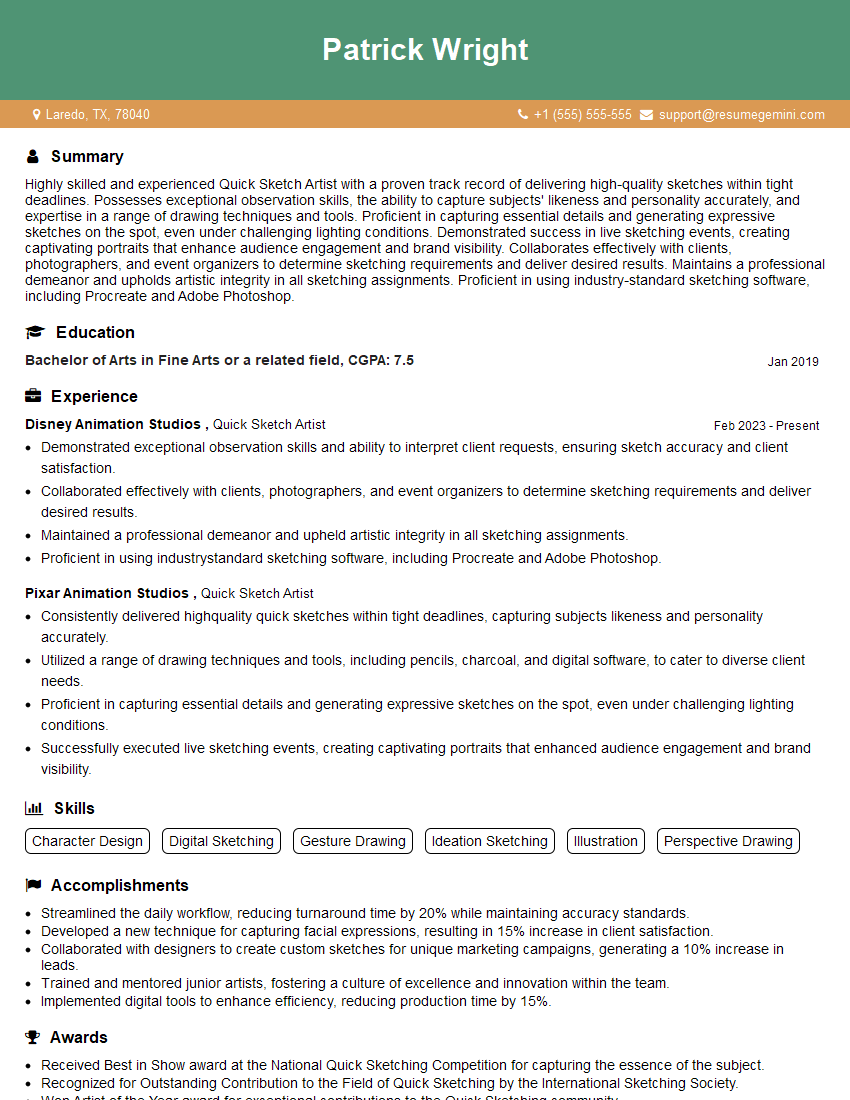
Mastering quick sketching significantly enhances your communication skills and problem-solving abilities, highly valued in many design and creative fields. A strong portfolio showcasing your quick sketching abilities is invaluable for career advancement. To increase your chances of landing your dream job, creating an ATS-friendly resume is crucial. ResumeGemini can help you craft a professional and impactful resume that highlights your skills effectively. ResumeGemini provides examples of resumes tailored to Quick Sketching roles to guide you through the process. Take the next step in your career journey and create a winning resume today!
Explore more articles
Users Rating of Our Blogs
Share Your Experience
We value your feedback! Please rate our content and share your thoughts (optional).
What Readers Say About Our Blog
Very informative content, great job.
good