Every successful interview starts with knowing what to expect. In this blog, we’ll take you through the top Radar System Troubleshooting and Repair interview questions, breaking them down with expert tips to help you deliver impactful answers. Step into your next interview fully prepared and ready to succeed.
Questions Asked in Radar System Troubleshooting and Repair Interview
Q 1. Explain the different types of radar systems and their applications.
Radar systems are categorized based on several factors, primarily their operating frequency and application. Let’s explore some common types:
- Primary Radar: This is the most basic type, transmitting a signal and receiving the echo reflected from a target. It determines range, azimuth (direction), and sometimes elevation. Think of air traffic control radar – a classic example of primary radar.
- Secondary Radar: This system relies on a transponder on the target, which receives the radar signal and transmits a coded reply. This improves accuracy and identification, as the target essentially ‘identifies itself’. Aircraft use secondary radar for air traffic control.
- Pulse Radar: These systems transmit short pulses of energy and measure the time it takes for the echo to return. This allows for determining range. Most weather and air traffic control radars are pulse radars.
- Continuous Wave (CW) Radar: This type transmits a continuous signal, determining relative velocity using the Doppler effect (change in frequency due to target movement). Police speed guns are a prime example.
- Doppler Radar: This system focuses on measuring the Doppler shift to determine target velocity. It’s crucial in weather forecasting (measuring wind speeds) and some automotive applications (adaptive cruise control).
- Synthetic Aperture Radar (SAR): This advanced technique utilizes signal processing to create a high-resolution image of the terrain, even from a considerable distance. Used extensively in mapping, reconnaissance, and Earth observation.
The application of each radar type depends on the specific needs. For instance, a weather radar requires a Doppler system for accurate wind speed measurement, whereas an air traffic control system needs both primary and secondary radar for complete target identification and tracking.
Q 2. Describe the process of troubleshooting a radar system with intermittent signal loss.
Troubleshooting intermittent signal loss requires a systematic approach. Think of it like diagnosing a car problem – you start with the basics and work your way through potential causes.
- Check the Obvious: Start with the simplest explanations. Is the radar switched on? Are there any loose cables or connectors? A surprisingly high percentage of issues stem from simple connections.
- Signal Strength Monitoring: Monitor the signal strength at various points in the system, from the transmitter to the receiver. This will help you pinpoint where the signal is degrading.
- Environmental Factors: Intermittent signal loss can be caused by weather conditions (heavy rain, snow), bird strikes (particularly for antenna), or even electromagnetic interference (EMI) from other systems. Investigate the environment.
- Component Testing: If the problem isn’t environmental, systematically test individual components. This might include checking the transmitter for proper output power, the receiver for sensitivity, and the antenna for proper alignment and integrity.
- Software/Firmware Checks: Many modern radar systems have software or firmware controlling their operations. Check for any errors, glitches, or updates that might be causing intermittent signal loss.
- Log Files: Review any log files generated by the radar system. These files often contain important clues about the nature of the problem.
Example: If you find the signal strength is fine at the transmitter but weak at the receiver, you’ll focus your efforts on the signal path between them, possibly looking for cable damage or faulty amplifiers.
Q 3. How do you identify and diagnose faults in a radar receiver?
Diagnosing faults in a radar receiver involves testing its various stages: RF amplification, mixing, intermediate frequency (IF) amplification, detection, and video amplification.
- Signal Tracing: Use a signal generator to inject signals at various points in the receiver chain and monitor the output at each stage. This allows you to pinpoint the faulty stage.
- Gain Measurements: Measure the gain of each amplification stage to ensure it’s within specifications. Low gain indicates a problem.
- Noise Figure Measurement: A high noise figure indicates excessive noise in the receiver, potentially caused by faulty components or poor shielding.
- Sensitivity Tests: Test the receiver’s sensitivity to weak signals. Poor sensitivity means the receiver can’t detect weak echoes.
- Frequency Response: Measure the receiver’s frequency response to ensure it’s operating within its designed bandwidth.
- Component Level Diagnostics: If a specific stage is faulty, you might need to test individual components (transistors, resistors, capacitors) within that stage to locate the problem.
An example would be observing a significant drop in signal strength after the mixer stage. This would suggest a problem with the mixer, its associated components, or the IF amplification stage.
Q 4. What are the common causes of radar transmitter failures?
Radar transmitter failures are often caused by issues within the high-power components or associated circuitry. Here are some common causes:
- Magnetron Failure (for magnetron-based transmitters): Magnetrons are high-power vacuum tubes prone to aging and eventual failure. Symptoms include reduced power output, arcing, or complete failure.
- Klystron Failure (for klystron-based transmitters): Similar to magnetrons, klystrons are high-power tubes susceptible to failure. Careful monitoring of operating parameters is crucial.
- High Voltage Problems: Power supplies provide the high voltage needed for the transmitter. Malfunctions in these supplies (e.g., insufficient voltage, ripple, or arcing) can lead to transmitter failure.
- RF Circuitry Faults: Problems with components in the RF amplification chain (e.g., circulators, attenuators, amplifiers) can impact the transmitter’s power output and stability.
- Overheating: Transmitters generate considerable heat. Inadequate cooling can lead to component failure.
- Modulator Problems: The modulator controls the pulse width and repetition frequency of the transmitted signal. Faults here directly affect the radar’s operation.
For instance, a sudden drop in transmitted power often points to a problem within the high voltage supply or the high power tube itself.
Q 5. Explain the importance of radar calibration and how it’s performed.
Radar calibration is crucial for ensuring accurate measurements of range, velocity, and target position. It compensates for system drift and ensures reliable operation. It’s akin to regularly calibrating a scale to get accurate weight measurements.
Calibration involves several steps:
- Range Calibration: Uses known targets at specific distances to adjust the system’s timing circuits, guaranteeing accurate range measurements.
- Velocity Calibration: Uses moving targets with known velocities to calibrate the Doppler processing, confirming correct velocity estimations.
- Gain Calibration: Ensures consistent signal amplification throughout the system by adjusting receiver gains to maintain a set signal level.
- Antenna Alignment Calibration: Ensures the antenna is correctly pointed and its beam pattern is optimized, maximizing signal strength and accuracy.
- System-Level Calibration: Checks the entire system’s performance through various tests, such as checking for spurious signals and noise levels.
Calibration procedures vary depending on the radar type and manufacturer, but generally involve using specialized test equipment and following detailed instructions. Regular calibration maintains system accuracy and prevents the accumulation of errors that could lead to inaccurate readings or incorrect conclusions.
Q 6. Describe your experience with radar antenna maintenance and repair.
My experience with radar antenna maintenance and repair involves a wide range of tasks. I’ve worked on various antenna types, including parabolic dishes, phased arrays, and microstrip antennas.
- Routine Inspections: Regular visual inspections are vital for identifying damage, corrosion, or loose connections.
- RF Alignment: Using precision equipment, I’ve adjusted antenna alignment to optimize beam shape and direction, ensuring maximum signal transmission and reception.
- Waveguide Repair: I have expertise in repairing waveguide components, including replacing damaged sections and ensuring proper sealing to prevent signal leakage.
- Radome Maintenance: Radomes protect the antenna from the elements. My work involves inspecting for damage, cleaning, and repairing cracks or other issues.
- Troubleshooting Antenna System Problems: I’ve diagnosed and resolved various antenna-related issues, including signal loss, impedance mismatch, and poor beam pattern.
For example, I once worked on a parabolic dish antenna where severe corrosion had degraded its performance. I meticulously cleaned the surface, replaced corroded components, and realigned the antenna, restoring its operational efficiency. This involved using specialized cleaning agents, precision measuring tools and testing equipment to verify the repair.
Q 7. How do you troubleshoot problems related to radar signal processing?
Troubleshooting radar signal processing problems requires a good understanding of digital signal processing (DSP) techniques. It’s like detective work – you need to systematically analyze the signal at various stages to identify the source of the problem.
- Signal Quality Analysis: Analyze the received signal in the time and frequency domains to check for noise, interference, or distortions.
- Algorithm Verification: Check the implementation of signal processing algorithms (e.g., clutter rejection, target tracking) to ensure they’re operating correctly.
- Data Visualization: Use visualization tools to inspect the processed data and identify anomalies or patterns that indicate a problem.
- Parameter Adjustment: Adjust processing parameters (e.g., threshold levels, filter settings) to optimize performance and resolve issues.
- Software Debugging: If the issue is software-related, debugging tools can be used to trace errors and pinpoint the source of the problem.
A specific example would involve examining the output of a clutter rejection algorithm. If it’s excessively removing legitimate targets along with clutter, we’d need to adjust parameters or possibly modify the algorithm itself to maintain a balance between clutter rejection and target detection.
Q 8. What are the safety precautions you take when working with high-power radar systems?
Safety is paramount when working with high-power radar systems. These systems emit high-intensity electromagnetic radiation, which can be harmful to both personnel and equipment. My safety procedures always begin with a thorough risk assessment, identifying potential hazards specific to the system and environment. This includes understanding the radar’s operating frequency and power output to determine safe distances and exposure limits.
- Personal Protective Equipment (PPE): I always wear appropriate PPE, including safety glasses, and in some cases, specialized RF-shielding clothing and dosimeters to monitor radiation exposure. The type of PPE varies based on the radar’s power and frequency.
- Interlocks and Safety Devices: Before any work, I ensure all interlocks and safety devices are functioning correctly. These devices prevent accidental activation of the high-power transmitter and other hazardous components. For example, I would check the E-stop circuits and verify that the waveguide doors are interlocked with the transmitter.
- Radiation Monitoring: Radiation levels are monitored before, during, and after any work involving high-power components. I’m familiar with using various radiation measurement devices, like survey meters and dosimeters, to ensure we stay well within safe limits.
- Controlled Access: Access to the radar area is strictly controlled. Warning signs are prominently displayed, and unauthorized personnel are kept away from the high-power zones. Lockout/Tagout procedures are followed diligently when working on or near energized equipment.
- Emergency Procedures: All team members are well-versed in emergency procedures, including how to shut down the system quickly in case of a malfunction or incident. We conduct regular safety drills to reinforce these procedures.
For instance, during a recent maintenance project on a high-power weather radar, we meticulously followed these safety protocols, ensuring zero incidents and successful completion of the task.
Q 9. Explain your experience with different types of radar waveguides and their troubleshooting.
My experience encompasses various waveguide types, including rectangular, circular, and ridged waveguides, commonly used in radar systems. Each type presents unique characteristics and troubleshooting challenges.
- Rectangular Waveguides: These are the most common and are relatively straightforward to troubleshoot. Problems often involve mismatched impedance, leading to reflections and signal loss. I utilize techniques like Time Domain Reflectometry (TDR) to pinpoint the location of impedance mismatches or discontinuities. Visual inspection for damage, such as dents or kinks, is also crucial.
- Circular Waveguides: These are often used at higher frequencies and are more susceptible to mode conversion issues. Troubleshooting might involve identifying and correcting mode conversion through careful alignment and the use of mode filters or converters. Mode conversion leads to signal degradation.
- Ridged Waveguides: Designed for broader bandwidth applications, these waveguides can suffer from problems similar to rectangular waveguides, but the presence of ridges adds complexity. Careful alignment and precise measurements are essential for their troubleshooting.
One challenging case involved a weather radar using circular waveguides. The system exhibited inconsistent performance, with sporadic signal dropouts. Through meticulous analysis and using a network analyzer, we discovered a slight misalignment in one section of the waveguide run, causing significant mode conversion and signal attenuation. A minor adjustment corrected the issue, illustrating the importance of precise alignment and the value of using specialized test equipment for these complex components.
Q 10. How do you interpret radar system performance data and identify areas for improvement?
Interpreting radar performance data involves analyzing various parameters to assess the system’s overall health and efficiency. I use a combination of techniques and tools to identify areas for improvement. This often starts with a review of the radar’s key performance indicators (KPIs).
- Signal-to-Noise Ratio (SNR): A low SNR indicates interference or insufficient receiver sensitivity, requiring investigation of the receiver circuitry or antenna performance.
- Range Resolution: Poor range resolution could be due to issues with the pulse width or signal processing algorithms. A detailed analysis helps pinpoint the cause.
- Accuracy and Precision: Analyzing range and angle accuracy helps to identify potential calibration or alignment problems in the antenna or signal processing components.
- False Alarm Rate: An elevated false alarm rate points to issues with the clutter rejection techniques or threshold settings within the signal processor.
I utilize specialized software tools that visually represent these parameters and often employ statistical methods to analyze the data and spot trends or anomalies. For instance, a sudden decrease in SNR over time in a specific direction might suggest issues with antenna pointing or atmospheric conditions.
Based on the analysis, I recommend solutions such as improving antenna design, upgrading signal processing algorithms, recalibrating the system, or replacing faulty components to enhance the radar’s overall performance.
Q 11. Describe your experience with radar system testing and verification procedures.
Radar system testing and verification are crucial to ensure performance and reliability. My experience covers a wide range of testing procedures, from basic functional checks to comprehensive performance evaluations.
- Functional Tests: These validate the basic functionality of each subsystem: transmitter, receiver, antenna, signal processor, and display. This includes verifying that each component operates within its specified parameters.
- Performance Tests: These are more rigorous tests that assess the overall system performance based on parameters like range, accuracy, resolution, and sensitivity. Specialized test equipment, including signal generators, network analyzers, and spectrum analyzers, are employed.
- Environmental Tests: These tests verify the system’s ability to operate under different environmental conditions such as extreme temperatures, humidity, and vibration. These help ensure reliability in real-world deployments.
- Calibration and Alignment: This is a critical aspect of radar testing. It involves calibrating the receiver and transmitter to ensure accurate measurements and aligning the antenna for optimal performance. This often necessitates use of specialized alignment tools and procedures.
A recent project involved the complete testing and verification of a new air traffic control radar system. This entailed conducting rigorous functional and performance tests, culminating in a series of field trials to validate the system’s performance in a real-world operational environment. Thorough documentation was maintained at every stage of the process, ensuring compliance with industry standards.
Q 12. How familiar are you with different radar modulation techniques?
I have extensive familiarity with various radar modulation techniques, each with specific advantages and disadvantages affecting range, resolution, and clutter rejection.
- Pulse Modulation: This is the simplest form, where a short pulse of RF energy is transmitted. It’s straightforward but has limitations in range resolution.
- Frequency Modulation (FM): This technique involves varying the transmitted frequency over time, offering better range resolution than simple pulse modulation. FM-CW (Frequency Modulated Continuous Wave) radar is a good example.
- Phase Modulation: This involves changing the phase of the transmitted signal, enabling superior range and Doppler resolution. Phase-coded waveforms are common in modern radar systems.
- Pulse Compression: This technique uses coded pulses to achieve high range resolution with high average power, reducing the peak power requirement and interference.
The choice of modulation technique depends on the specific application and system requirements. For instance, a weather radar might employ pulse compression for long-range detection and high range resolution, while a short-range automotive radar might use FM-CW for its relative simplicity and efficient implementation.
Q 13. How do you diagnose and repair problems with radar timing and synchronization?
Diagnosing and repairing timing and synchronization problems in a radar system requires a systematic approach, focusing on identifying the source of the timing discrepancies. The root cause could lie in various components.
- Clock Sources: Problems could originate from the system’s main clock oscillator or other timing generators. A faulty clock can affect the timing of the transmitter, receiver, and signal processor, leading to synchronization errors.
- Timing Control Circuits: Malfunctions in the digital logic circuits controlling the timing signals can cause synchronization problems. I employ oscilloscopes and logic analyzers to pinpoint faulty logic circuits or components.
- Signal Path Delays: Mismatched delays in the signal path can cause synchronization errors. This is especially important for coherent radars relying on accurate phase relationships between the transmitted and received signals. Precision time-delay measurements are crucial.
- Data Acquisition and Processing: Errors in data acquisition and processing can indirectly lead to synchronization issues. Examining the data acquisition timing and the signal processing algorithms is needed.
In one instance, a radar system experienced inconsistent range measurements due to timing drift in the pulse repetition frequency (PRF) generator. Using an oscilloscope, I identified a faulty component within the PRF generator circuit. Replacing this component restored the correct timing and resolved the range measurement discrepancies.
Q 14. Explain your experience with radar signal detection and classification.
Radar signal detection and classification involve identifying and categorizing different targets based on their radar signatures. My experience involves various techniques.
- Signal Processing Algorithms: Sophisticated algorithms such as matched filters, moving target indication (MTI), and constant false alarm rate (CFAR) processing are used to detect and distinguish targets from clutter and noise. Understanding and optimizing these algorithms is crucial for robust detection and classification.
- Feature Extraction: Key features of radar returns like amplitude, range, Doppler shift, and pulse width are extracted and used for classification. Machine learning techniques can be very effective in automating this process, improving classification accuracy and speed.
- Target Databases and Libraries: Matching radar signatures to known targets in databases and libraries assists in identification. These libraries contain characteristic signatures of various aircraft, weather phenomena, or other objects.
- Data Fusion: Combining data from multiple radar sensors or other sensors (e.g., infrared or acoustic sensors) enhances detection and classification accuracy, especially in complex environments.
One project involved developing an automated target classification system for an air defense radar. This involved designing and implementing signal processing algorithms to extract relevant features, coupled with a machine learning model to classify various aircraft based on their radar signatures. The system significantly improved the radar’s ability to distinguish between friend or foe.
Q 15. Describe your knowledge of different radar display systems and their interpretation.
Radar display systems present processed radar data in a visually interpretable format. Different systems cater to specific needs and offer varying levels of detail. Common types include:
- PPI (Plan Position Indicator): A circular display showing targets’ range and bearing relative to the radar’s location. Think of it like a map centered on the radar, with targets plotted as blips. Interpretation involves identifying target type, speed, and direction based on their position and movement on the screen.
- B-Scan: A cross-sectional view, useful for detecting elevation changes and target profiles. Imagine slicing through the target’s echo to see its shape.
- A-Scan: Displays the raw radar signal as a function of time, showing the target’s range directly. It’s primarily used for signal analysis and diagnostics rather than direct target identification.
- Modern Digital Displays: These use advanced processing and often integrate multiple views, overlaying maps, weather information, and other relevant data. Interpretation relies on understanding the display’s symbology and color-coding, with options for range, bearing, altitude, and velocity display customization.
Accurate interpretation requires understanding radar principles, signal processing techniques, and the specific display’s settings. Misinterpreting data can lead to critical errors in navigation, surveillance, and other applications. For example, a strong ground clutter return can be mistaken for a target if the clutter rejection isn’t properly configured. Expert knowledge is crucial to accurately distinguish between genuine targets and false indications.
Career Expert Tips:
- Ace those interviews! Prepare effectively by reviewing the Top 50 Most Common Interview Questions on ResumeGemini.
- Navigate your job search with confidence! Explore a wide range of Career Tips on ResumeGemini. Learn about common challenges and recommendations to overcome them.
- Craft the perfect resume! Master the Art of Resume Writing with ResumeGemini’s guide. Showcase your unique qualifications and achievements effectively.
- Don’t miss out on holiday savings! Build your dream resume with ResumeGemini’s ATS optimized templates.
Q 16. How do you troubleshoot problems with radar data acquisition and processing systems?
Troubleshooting radar data acquisition and processing involves a systematic approach. I would start by verifying the signal path from the antenna to the processing unit. This includes checking:
- Antenna integrity: Inspecting for physical damage, proper alignment, and verifying the rotating mechanism (if applicable).
- Waveguide and coaxial cable: Testing for continuity, proper impedance matching, and looking for signs of corrosion or damage. A network analyzer can be used for precise impedance measurements.
- Receiver functionality: Checking for proper gain, noise figure, and linearity. I would use spectrum analyzers and signal generators for detailed assessment.
- Analog-to-digital converters (ADCs): Testing for proper sampling rates, dynamic range, and quantizing errors. Specialized test equipment such as oscilloscopes and logic analyzers are needed.
- Signal processing algorithms: Reviewing the software code for any bugs or errors. Simulation and testing with known inputs can help identify anomalies.
Beyond the hardware, I would check for software issues, such as incorrect parameter settings or software glitches. I often utilize data logging capabilities to analyze the raw and processed data for inconsistencies and patterns indicative of underlying problems. For instance, if I noticed a consistent drop in signal strength during specific weather conditions, I’d investigate the effect of rain or atmospheric refraction on the signal propagation.
Q 17. What is your experience with radar target tracking algorithms?
My experience encompasses various radar target tracking algorithms, including Kalman filtering, alpha-beta filters, and nearest-neighbor algorithms. The choice of algorithm depends on the specific application and the characteristics of the radar system.
Kalman filters are particularly effective in noisy environments due to their ability to incorporate probabilistic models of the target’s motion and measurement errors. I’ve used them extensively in applications requiring high accuracy tracking. The algorithm uses a prediction step and an update step to estimate the target’s state and incorporate new measurements. Example: Predicting a target's trajectory by considering its velocity and acceleration, then updating this prediction when a new measurement is received.
Alpha-beta filters offer a simpler alternative when computational resources are limited. They are suitable for tracking targets with relatively constant velocity. I’ve used this in systems with less demanding performance requirements where the trade-off in accuracy is acceptable.
Understanding the limitations of each algorithm is essential. For instance, nearest neighbor methods are susceptible to false alarms and may struggle in situations where multiple targets are close to each other.
Q 18. Explain your understanding of clutter rejection techniques in radar systems.
Clutter rejection is crucial for improving radar system performance by eliminating unwanted echoes from ground, sea, weather, and other stationary or slow-moving objects. Techniques fall into two main categories:
- Space-time adaptive processing (STAP): This sophisticated method uses multiple antenna elements and temporal data to spatially and temporally filter out clutter, which is particularly useful in airborne radars. It’s computationally intensive but highly effective in complex clutter environments.
- Moving target indication (MTI): A more established technique based on comparing successive radar pulses to identify moving targets against a background of stationary clutter. Different waveforms and signal processing strategies are used. For example, delay-line cancellers are used to subtract consecutive pulses.
- Clutter map techniques: Using prior knowledge about the environment to create a clutter map. The clutter map is then subtracted from the received signal to improve target detection.
- Polarization diversity: Using different polarizations of the transmitted signal to distinguish between target and clutter returns based on their polarization characteristics. For instance, clutter often reflects with a different polarization signature than target aircraft.
The choice of technique depends on the clutter environment, radar parameters, and computational capabilities. In practice, multiple techniques are often combined for optimal clutter rejection.
Q 19. Describe your experience with different types of radar signal interference and their mitigation.
Radar systems are susceptible to various types of interference. I’ve encountered:
- Jamming: Intentional interference aimed at disrupting radar operation. This could be noise jamming, deceptive jamming, or repeater jamming. Mitigation strategies include frequency hopping, spread spectrum techniques, and jamming detection and countermeasures.
- Clutter: As previously discussed, this can overwhelm the radar’s ability to detect targets. Various clutter rejection techniques help mitigate this issue.
- Multipath: Signals reflecting off multiple surfaces, causing ghost targets. Mitigation could involve techniques like spatial filtering or advanced signal processing algorithms that account for multipath effects.
- Interference from other radars: This is common in densely populated areas. Frequency coordination, improved receiver selectivity, and spatial filtering can help reduce this interference.
Effective mitigation often requires a combination of hardware and software solutions, tailored to the specific type and source of interference. For example, using a directional antenna to improve the signal-to-noise ratio is a simple hardware solution that reduces the impact of some forms of interference. Advanced signal processing is another effective strategy to filter unwanted signal components.
Q 20. How familiar are you with using specialized test equipment for radar systems?
I’m highly proficient in using a wide range of specialized test equipment for radar systems. This includes:
- Spectrum analyzers: For analyzing the frequency content of radar signals, identifying interference, and verifying signal purity.
- Signal generators: For simulating radar signals, testing receiver sensitivity, and calibrating radar systems.
- Network analyzers: For measuring impedance matching across the RF components, detecting waveguide leaks and ensuring signal integrity across the system.
- Oscilloscopes: For observing the time-domain characteristics of radar signals and identifying waveform distortions or anomalies.
- Power meters: For measuring the transmitted and received power levels, ensuring safe operation, and diagnosing power-related issues.
- Antenna test range: For verifying antenna gain, beam patterns, and sidelobe levels.
My experience extends to using these instruments for both preventive maintenance and troubleshooting. I understand the limitations and calibration requirements of each piece of equipment and employ best practices to ensure accurate measurements.
Q 21. Explain your experience with diagnosing and repairing radar power supplies.
Diagnosing and repairing radar power supplies requires a thorough understanding of high-voltage electronics and safety procedures. Common issues include:
- High-voltage breakdown: This can damage components within the power supply. I’d use specialized high-voltage probes and insulation testers to identify the location of the breakdown and replace any faulty components carefully. This process needs to follow safety protocols very stringently.
- Component failure: Capacitors, diodes, and transistors are particularly vulnerable. I would conduct a thorough inspection, using multimeters and component testers to pinpoint faulty parts. Replacing components requires paying close attention to specifications and ensuring correct polarity.
- Overheating: Poor ventilation or excessive loading can cause overheating and damage components. I would check cooling systems and adjust loads where needed. Thermal imaging cameras are useful to check for hotspots.
- Control circuit malfunctions: Problems in the control circuitry can prevent the power supply from operating correctly. I’d use oscilloscopes and logic analyzers to trace signals and pinpoint the source of the malfunction.
Safety is paramount when working with high-voltage power supplies. I strictly adhere to lockout/tagout procedures and use appropriate personal protective equipment (PPE), including insulated gloves and safety glasses. Thorough testing and documentation are essential to ensure safe and reliable operation after repairs.
Q 22. Describe your experience with troubleshooting and repairing radar indicator units.
Troubleshooting and repairing radar indicator units involves a systematic approach combining visual inspection, signal tracing, and component-level diagnostics. I’ve worked extensively with various indicator types, from simple analog displays to sophisticated digital units with integrated processing. My process typically begins with a visual check for obvious damage, loose connections, or burned components. Then, I’ll use a multimeter to check voltages and resistances, ensuring they align with the manufacturer’s specifications. For digital units, I utilize oscilloscopes to analyze signal waveforms, identifying anomalies like noise, distortion, or missing signals. For example, if an indicator shows a weak or unstable display, I’d start by checking the power supply, video signal integrity, and the condition of the CRT (for analog units) or LCD panel (for digital units). If the problem persists, component-level repair, possibly involving the replacement of faulty transistors, integrated circuits, or capacitors, would be necessary. I’ve successfully resolved countless issues, ranging from simple power supply failures to complex display-related problems, resulting in a significant improvement in radar system performance.
Q 23. How do you troubleshoot and repair problems with radar rotating mechanisms?
Troubleshooting rotating radar mechanisms requires a thorough understanding of mechanical and electrical systems. It often begins with observing the antenna’s rotation. Is it jerky, too slow, or not rotating at all? I would then check for obvious issues like binding in the rotating mechanism, power supply problems to the motor, and the integrity of the slip rings and wiring connecting the rotating antenna to the stationary parts of the radar. A malfunctioning motor is often the culprit. I might use a motor analyzer to diagnose motor winding faults, check for mechanical wear and tear, or assess the efficiency of the gear train. For example, a slow rotation could indicate issues with the motor’s brushes, excessive friction in the bearings, or a faulty power supply. If the antenna is completely immobile, I’d investigate the motor’s windings, the gear train, and even the possibility of a seized bearing, requiring disassembly and lubrication or replacement. In advanced cases, I’d resort to analyzing the control signals to the motor driver using an oscilloscope to see if the correct signals are sent and to check for signal distortions.
Q 24. What is your experience with radar system documentation and record-keeping?
Accurate documentation and record-keeping are essential in radar system maintenance. I meticulously maintain detailed records of every repair or troubleshooting activity. This includes comprehensive descriptions of the identified fault, diagnostic steps taken, parts replaced, and any corrective actions implemented. These records are crucial for traceability, future maintenance, and warranty claims. I utilize digital record-keeping systems, ensuring easy access and searchability of past maintenance entries. For each system, I typically create a file containing system schematics, relevant maintenance manuals, and a log of all work performed, including dates, times, technicians involved, and the outcomes of repairs. This approach helps ensure consistency, facilitates troubleshooting for recurring problems, and provides an audit trail for compliance.
Q 25. How would you approach troubleshooting a radar system with an unknown fault?
Troubleshooting an unknown radar fault requires a structured, methodical approach. I would start by systematically evaluating the system’s various components and subsystems, beginning with the simplest checks. This usually involves power checks, visual inspections for obvious damage, and testing of readily accessible outputs. For example, I’d confirm proper power levels to the transmitter, receiver, and display. Next, I’d check antenna rotation and then analyze the output signals using instruments such as oscilloscopes, spectrum analyzers, and signal generators to pinpoint the source of the problem. A signal generator can be used to inject test signals to isolate stages. Once the faulty component or subsystem is identified, I’ll use specialized test equipment to perform more detailed diagnostics and pinpoint the precise cause of the failure. I use a ‘divide and conquer’ strategy. If a system is complex, I isolate blocks, testing one at a time.
Q 26. Explain your experience with working with different radar manufacturers and their systems.
My experience encompasses various radar manufacturers and their systems, including Raytheon, Thales, and Lockheed Martin. Each manufacturer employs unique designs and methodologies, requiring a flexible approach to troubleshooting. While the underlying principles remain consistent, the specific implementations, software interfaces, and diagnostic tools vary significantly. For instance, accessing diagnostic information differs across systems, with some using specialized software interfaces while others might rely on more traditional methods. Familiarity with the specific system’s documentation and service manuals is therefore critical. I’ve worked on both military and civilian radar systems, and this experience has given me a broad understanding of the common challenges and unique characteristics of different manufacturers’ products.
Q 27. Describe your understanding of radar system integration with other systems.
Radar systems rarely operate in isolation. They often integrate with other systems, such as navigation systems, air traffic control systems, or weapon control systems. Understanding these integrations is critical. For example, I’ve worked on integrating radar systems with Automatic Dependent Surveillance-Broadcast (ADS-B) systems to enhance situational awareness. This involves understanding the data protocols, communication interfaces, and synchronization requirements between the systems. Troubleshooting problems within integrated systems requires careful examination of the data flow between the various components, ensuring the proper exchange of information and accurate interpretation of data. This may involve software adjustments, protocol analysis, or coordination with specialists from other related system domains.
Q 28. How do you stay up-to-date with the latest advancements in radar technology?
Staying current in radar technology requires continuous learning. I actively participate in professional organizations like the IEEE, attend industry conferences and workshops, and regularly review technical journals and publications such as IEEE Transactions on Aerospace and Electronic Systems. I also utilize online resources, including manufacturer websites and training materials, to stay informed about the latest advancements. Additionally, I maintain a network of colleagues and experts in the field with whom I regularly exchange information and discuss new developments. Furthermore, I actively seek opportunities to work on new radar technologies and projects, allowing me to gain hands-on experience with the latest hardware and software.
Key Topics to Learn for Radar System Troubleshooting and Repair Interview
- Fundamentals of Radar Systems: Understanding basic radar principles, including signal propagation, target detection, and range measurement. This forms the bedrock of effective troubleshooting.
- Antenna Systems and Waveguides: Diagnosing issues related to antenna alignment, waveguide leaks, and impedance matching. Practical experience with testing equipment is invaluable.
- Receiver and Transmitter Circuits: Troubleshooting malfunctions in high-frequency circuitry, including amplifiers, mixers, and oscillators. Familiarity with schematic diagrams and signal tracing is essential.
- Signal Processing and Data Interpretation: Analyzing radar signals to identify anomalies and interpret data outputs. Understanding digital signal processing techniques is beneficial.
- Power Supplies and High-Voltage Systems: Working safely with high-voltage components and understanding the principles of power regulation and distribution in radar systems.
- Test Equipment and Measurement Techniques: Proficiency in using oscilloscopes, spectrum analyzers, and network analyzers for diagnostics. Practical experience is key.
- Troubleshooting Methodologies: Employing systematic approaches to fault isolation, including the use of diagnostic software and flowcharts. Understanding root cause analysis is crucial.
- Safety Procedures and Regulations: Adherence to safety protocols while working with high-powered RF systems. Demonstrate awareness of relevant industry standards.
- System Maintenance and Calibration: Understanding preventative maintenance procedures and performing routine calibrations to ensure optimal system performance.
- Specific Radar Types and Applications: Depending on the job, a deep understanding of specific radar types (e.g., weather radar, air traffic control radar, maritime radar) and their applications is advantageous.
Next Steps
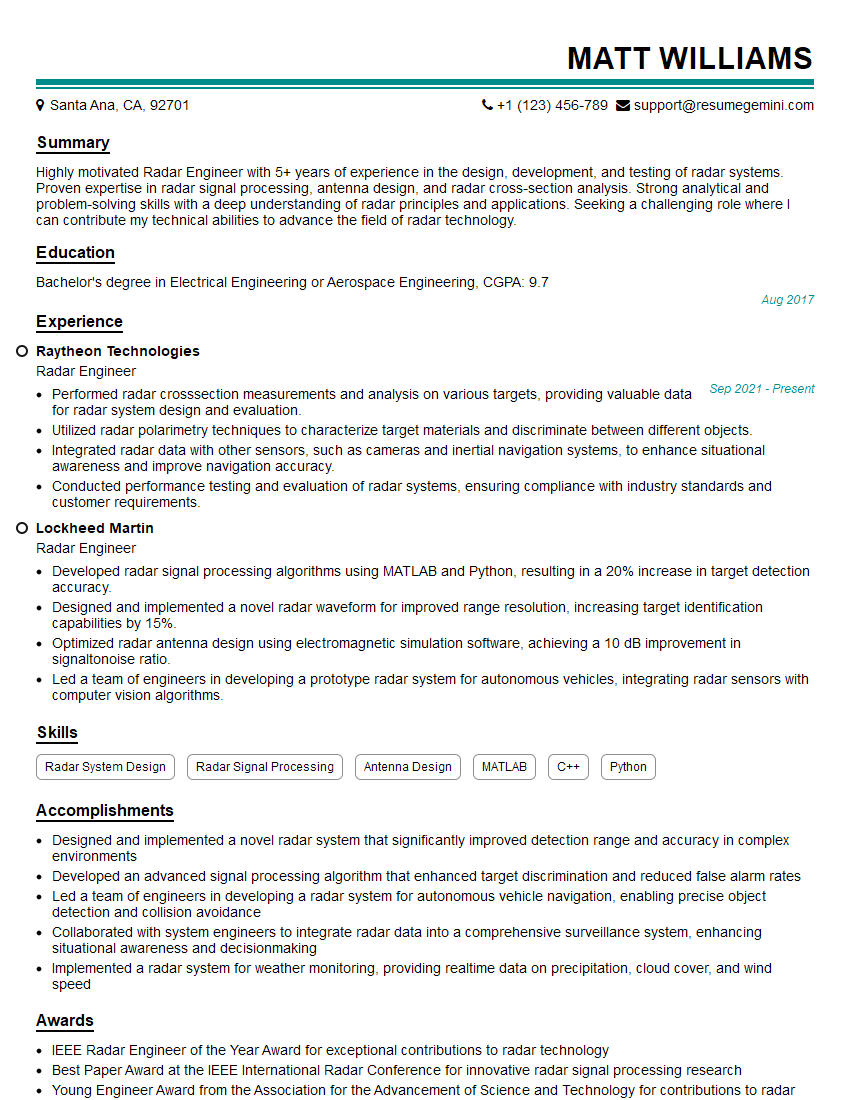
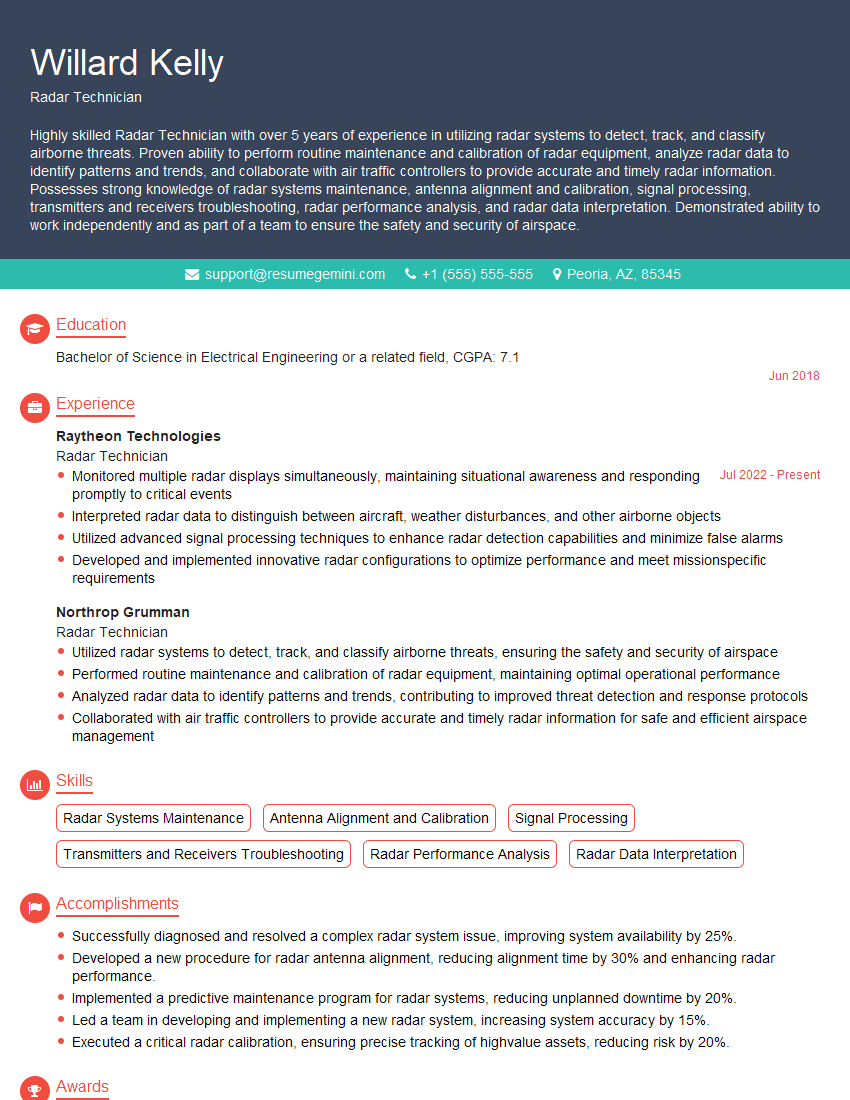
Mastering Radar System Troubleshooting and Repair opens doors to exciting career opportunities in a rapidly evolving technological field, offering excellent growth potential and competitive salaries. To maximize your chances of landing your dream role, creating a strong, ATS-friendly resume is crucial. ResumeGemini is a trusted resource to help you build a professional and impactful resume that highlights your skills and experience effectively. We offer examples of resumes tailored to Radar System Troubleshooting and Repair to help you get started. Invest time in crafting a compelling resume – it’s your first impression on potential employers.
Explore more articles
Users Rating of Our Blogs
Share Your Experience
We value your feedback! Please rate our content and share your thoughts (optional).
What Readers Say About Our Blog
Very informative content, great job.
good