Feeling uncertain about what to expect in your upcoming interview? We’ve got you covered! This blog highlights the most important Radiation Transport Simulation interview questions and provides actionable advice to help you stand out as the ideal candidate. Let’s pave the way for your success.
Questions Asked in Radiation Transport Simulation Interview
Q 1. Explain the difference between deterministic and Monte Carlo methods in radiation transport.
Radiation transport simulations predict how radiation interacts with matter. We primarily use two approaches: deterministic and Monte Carlo methods. Deterministic methods, like the discrete ordinates method (SN), solve the Boltzmann transport equation directly using numerical techniques. They treat radiation as a continuous field, dividing space and angles into discrete meshes and solving equations at each point. Think of it like solving a complex system of equations to find the radiation intensity at every point in your model. Monte Carlo methods, on the other hand, simulate the individual behavior of many particles (photons, neutrons, etc.) as they travel through the material. Each particle’s path is randomly sampled based on probabilistic laws, and the overall radiation field is determined by statistically analyzing the paths of a huge number of particles. It’s like simulating a large number of individual dice rolls to estimate the average result.
The key difference lies in their approach: deterministic methods solve equations, while Monte Carlo methods simulate particle trajectories. Deterministic methods are usually faster for simple geometries, but Monte Carlo methods excel in complex geometries and problems involving many interactions.
Q 2. Describe the limitations of deterministic radiation transport methods.
Deterministic methods, while efficient for simpler problems, have several limitations. Firstly, they struggle with highly complex geometries. Accurately modeling irregular shapes with fine details using meshes can be computationally expensive and prone to numerical errors. Secondly, they face challenges with highly anisotropic scattering, meaning when radiation preferentially scatters in certain directions. Accurately representing such scattering in discrete angles can be difficult and require extremely fine angular meshes, dramatically increasing computational cost. Thirdly, they often have difficulty handling stochastic processes, like nuclear reactions that have probabilistic outcomes. Lastly, ray effects, which manifest as artificial streaks of radiation in the solution, can occur in certain situations, particularly with highly absorbing materials. This is due to the limitations of the angular discretization in representing the radiation transport.
Q 3. What are the advantages and disadvantages of using Monte Carlo methods for radiation transport simulations?
Monte Carlo methods offer several advantages. They can handle complex geometries with ease, as particle trajectories are tracked individually, regardless of shape complexity. They are also naturally suited for handling highly anisotropic scattering and stochastic processes. They provide inherently statistical error estimates – giving you an idea of how accurate your simulation is. However, Monte Carlo methods have disadvantages. They can be computationally expensive, requiring a large number of particle histories for accurate results, especially in optically thick media. Convergence can be slow, meaning you need to simulate many particles to get a reliable result. The results are statistical estimates, not exact solutions, always subject to a degree of uncertainty. It’s important to be aware of this inherent uncertainty when interpreting the results.
Q 4. Explain the concept of variance reduction techniques in Monte Carlo simulations.
Variance reduction techniques aim to improve the efficiency of Monte Carlo simulations by reducing the statistical variance of the results, thereby reducing the number of particles needed to achieve a given accuracy. Imagine you’re trying to estimate the average height of people in a city. Instead of randomly sampling people, you might choose to sample more people from areas known to have taller individuals. This increases efficiency by focusing on more relevant information. Similar techniques are used in Monte Carlo simulations to bias the sampling towards more important particle interactions, leading to faster convergence. Examples include importance sampling, splitting/Russian roulette, and correlated sampling.
Q 5. What is importance sampling and how is it applied in radiation transport simulations?
Importance sampling is a powerful variance reduction technique. The idea is to bias the sampling of particle trajectories to favor regions or interactions that significantly contribute to the quantity of interest. Consider a radiation shielding problem where you’re interested in the radiation dose at a specific location behind a thick shield. Importance sampling would focus more particles on paths that are likely to reach that detector, effectively reducing the number of particles needed for accurate estimation. This is achieved by using a weight function that represents the importance of a given path. Particles are sampled according to this function, with higher-weight paths being more likely to be simulated. This method requires a good understanding of the problem to define the appropriate importance function; a poorly chosen function might even increase the variance.
Q 6. Describe different cross-section data libraries used in radiation transport calculations.
Cross-section data libraries are crucial to radiation transport calculations as they provide the probabilities of various interactions (e.g., scattering, absorption) between radiation and materials. These libraries contain vast amounts of experimental and evaluated data. Popular libraries include ENDF/B (Evaluated Nuclear Data File), JEFF (Joint Evaluated Fission and Fusion), and JENDL (Japanese Evaluated Nuclear Data Library). Each library contains data for different isotopes and energy ranges, describing the probability of various nuclear reactions. The choice of library depends on the specific application and the accuracy requirements. For instance, a high-fidelity reactor simulation might necessitate the use of a highly detailed and comprehensive library like ENDF/B, while a less demanding application could utilize a more compact and readily available library.
Q 7. How do you handle boundary conditions in radiation transport simulations?
Boundary conditions specify how radiation interacts with the boundaries of the simulated system. Common boundary conditions include vacuum (no radiation reflection or re-emission), reflective (complete reflection of radiation), periodic (radiation exiting one boundary enters the opposite boundary), and albedo (partial reflection, typically specified by a reflection coefficient). The choice of boundary condition depends heavily on the specific problem. For example, in a shielding calculation, a vacuum boundary condition might be appropriate for the exterior boundaries, while a reflective condition could represent a perfectly reflecting surface. In Monte Carlo simulations, boundary conditions are implemented by determining the fate of particles that reach a boundary based on the specified condition. For example, in a vacuum boundary condition, a particle that reaches the boundary is terminated; in a reflective boundary condition, the particle is reflected according to the laws of reflection.
Q 8. Explain the concept of a radiation source term in a transport equation.
The radiation source term in a transport equation represents the rate at which radiation is emitted or generated within a given volume or region. Think of it as the ‘fuel’ for the radiation transport process. It describes the intensity and spectral distribution of radiation originating from sources like radioactive decay, nuclear reactions (fission or fusion), or external radiation fields. Without a source term, there’s no radiation to transport!
Mathematically, the source term is often represented as S(r,E,Ω), where r is the spatial location, E is the energy of the radiation, and Ω is the direction of travel. A strong source term implies a high emission rate of radiation, leading to a higher fluence (number of particles passing through a unit area) and dose.
Example: In simulating a nuclear reactor core, the source term would represent the fission events within the fuel, producing neutrons and gamma rays. In medical radiation therapy, the source term would describe the radiation emitted by the treatment machine (e.g., a linear accelerator).
Q 9. What are the different types of radiation interactions considered in transport simulations?
Radiation transport simulations need to consider various types of interactions between the radiation and the materials it passes through. These interactions can drastically affect the radiation’s energy, direction, and even type. Key interaction types include:
- Photoelectric Effect: A photon is completely absorbed by an atom, ejecting an electron. This is more prevalent at lower photon energies and higher atomic numbers.
- Compton Scattering: A photon scatters off an electron, losing some energy and changing direction. This is important at intermediate energies.
- Pair Production: A high-energy photon interacts with the nucleus and converts into an electron-positron pair. The positron eventually annihilates with an electron, producing two 511 keV photons.
- Elastic Scattering (Neutrons): Neutrons scatter off nuclei without significant energy loss. This is crucial for determining neutron moderation and diffusion.
- Inelastic Scattering (Neutrons): Neutrons collide with nuclei, exciting them and losing energy. This contributes significantly to neutron slowing down and heating effects.
- Nuclear Reactions: Neutrons may interact with nuclei, leading to reactions such as fission (splitting the nucleus) or radiative capture (neutron absorption with gamma emission). These are essential in reactor simulations.
The relative importance of each interaction depends on the energy of the radiation and the material properties.
Q 10. Describe the process of generating a radiation transport simulation using MCNP or FLUKA.
Generating a radiation transport simulation using MCNP or FLUKA involves a multi-step process. Both are Monte Carlo codes, meaning they simulate the transport of individual particles and use statistics to obtain results.
- Geometry Definition: Define the geometry of the system using a specific input language (e.g., MCNP’s input language, FLUKA’s geometry definition). This includes materials, surfaces, and cells. Precise geometry is crucial for accuracy.
- Material Specification: Specify the composition and density of all materials in the geometry. You’ll often use nuclear data libraries (like ENDF/B or JEFF) that contain cross-sections for various interactions.
- Source Definition: Define the radiation source, specifying its type, energy spectrum, spatial distribution, and angular distribution. This step is directly related to the source term we discussed earlier.
- Tallies (MCNP) / Scoring (FLUKA): Set up tallies (MCNP) or scoring (FLUKA) to collect the data you are interested in, such as fluxes, doses, reaction rates, etc. Defining the right tallies is key to extracting meaningful results.
- Running the Simulation: Run the simulation. MCNP and FLUKA require powerful computers, especially for complex geometries and detailed simulations.
- Data Analysis: After the simulation finishes, analyze the results, often using visualization tools to understand the spatial and energy distributions of radiation.
Example (Conceptual MCNP Input):
cell 1 0 -100 100 -100 100 -100 100   # Define a cell
mat 1 1 1.0  # Assign material 1 with density 1.0 g/cm^3

... more cell and material definitions ...

source ... #Define a neutron source
Both MCNP and FLUKA have extensive documentation and user manuals to assist in creating more complex simulations.
Q 11. How do you validate the results of a radiation transport simulation?
Validating simulation results is crucial to ensure their reliability and accuracy. This involves comparing the simulation predictions with experimental data or results from other established methods.
- Benchmarking: Comparing simulation results against benchmark experiments (carefully designed and well-documented experiments) is a gold standard. There are numerous benchmark problems and datasets available in the literature.
- Experimental Verification: Conduct experiments that mimic the simulation’s conditions as closely as possible. This is often challenging and expensive.
- Comparison with Other Codes: Running the same problem with different radiation transport codes (e.g., comparing MCNP results with FLUKA) can help identify potential biases or errors.
- Sensitivity Analysis: Varying input parameters (e.g., material densities, source characteristics) and examining the resulting changes in the output can identify sensitive parameters and quantify uncertainties.
- Code Verification: This focuses on verifying the underlying code itself to confirm that it correctly solves the transport equation. This often involves using simplified problems with known analytical solutions.
Validation isn’t a one-time process; it’s iterative and ongoing. Addressing discrepancies between simulation and experimental data often leads to refining the model, improving the accuracy of inputs, or even revealing limitations in the chosen simulation method.
Q 12. Explain the concept of criticality calculations.
Criticality calculations determine whether a system containing fissile material (like uranium or plutonium) will sustain a chain reaction. A critical system is one where the number of neutrons produced in fission equals the number of neutrons lost due to absorption, leakage, or other processes. Imagine it like a self-sustaining fire—if the rate of new fissions matches the rate of neutron losses, the reaction will continue.
The criticality condition is usually expressed as the effective multiplication factor, keff. If:
- keff < 1: The system is subcritical; the chain reaction will die out.
- keff = 1: The system is critical; the chain reaction will be sustained at a constant power level.
- keff > 1: The system is supercritical; the chain reaction will accelerate, potentially leading to an uncontrolled power increase.
Criticality calculations are essential for designing and operating nuclear reactors, handling fissile materials, and ensuring nuclear safety. Radiation transport codes like MCNP and FLUKA are often used for these calculations by modeling the neutron transport and fission processes.
Q 13. What are the key factors influencing radiation shielding design?
Radiation shielding design is crucial for protecting people and equipment from harmful radiation. Key factors influencing the design include:
- Type and Energy of Radiation: Different types of radiation (neutrons, gamma rays, etc.) interact differently with matter. Shielding effectiveness depends strongly on the radiation’s energy.
- Source Strength and Geometry: The intensity and spatial distribution of the radiation source dictate the required shielding thickness and configuration.
- Exposure Limits: Regulations and safety standards define acceptable levels of radiation exposure for workers and the public, setting design constraints.
- Shielding Material Properties: Materials have different attenuation properties. High-density materials (like lead or depleted uranium) are often used for gamma radiation shielding, while materials with good neutron moderation and absorption properties (like water, concrete, or boron) are employed for neutron shielding.
- Cost and Space Constraints: Shielding materials can be expensive and bulky, influencing design choices.
- Environmental Considerations: The disposal and potential environmental impact of the shielding materials must be considered.
Effective shielding design involves a balance between these factors to ensure adequate protection while meeting practical constraints.
Q 14. How do you determine the appropriate shielding material and thickness?
Determining appropriate shielding material and thickness requires a combination of analytical methods, empirical data, and radiation transport simulations. The process typically involves:
- Radiation Source Characterization: Determine the type, energy, intensity, and geometry of the radiation source.
- Dose Rate Calculation: Calculate the unshielded dose rate at the location of interest using analytical approximations or preliminary simulations.
- Material Selection: Choose shielding materials with high attenuation properties for the specific type and energy of radiation. For instance, lead is effective for gamma rays, while concrete or water are suitable for neutrons.
- Thickness Determination: Determine the required shielding thickness to reduce the dose rate to an acceptable level. This can be achieved using analytical methods (like the exponential attenuation formula for gamma rays), empirical data (from existing shielding designs), or advanced radiation transport simulations.
- Simulation and Optimization: Use radiation transport codes (like MCNP or FLUKA) to model the shielding geometry, materials, and radiation source. Optimize the design to minimize shielding thickness while meeting safety requirements.
- Verification and Validation: Verify the results of the simulation and validate the design against experimental data or benchmark solutions.
This is an iterative process; you might refine the material selection and thickness based on the simulation results and further optimize the design until the desired safety criteria are met. For example, layered shielding using different materials might prove more efficient than a single layer.
Q 15. Describe different types of radiation detectors and their applications in radiation transport measurements.
Radiation detectors are instruments used to measure ionizing radiation. Their selection depends heavily on the type and energy of radiation being measured, as well as the desired sensitivity and application. Here are a few examples:
- Ionization Chambers: These are robust and reliable detectors that measure the ionization current produced by radiation passing through a gas-filled cavity. They are widely used for radiation monitoring in nuclear facilities and medical applications due to their wide dynamic range and relative simplicity. For example, they are used to measure dose rates in radiation therapy treatment rooms.
- Scintillation Detectors: These detectors use a scintillator material that produces light when radiation interacts with it. The light is then detected by a photomultiplier tube (PMT) and converted into an electrical signal. Different scintillators are optimized for different types of radiation (e.g., NaI(Tl) for gamma rays, plastic scintillators for beta particles). Applications include gamma spectroscopy in nuclear safeguards and medical imaging (PET scans).
- Semiconductor Detectors: These detectors, such as High Purity Germanium (HPGe) and silicon detectors, use the creation of electron-hole pairs in a semiconductor material to measure radiation. They offer excellent energy resolution, making them ideal for precise measurements in various applications like environmental monitoring and nuclear physics research. For example, HPGe detectors are frequently used in gamma spectroscopy to identify and quantify radionuclides.
- Proportional Counters: These detectors operate in a region where the ionization signal is amplified, allowing for increased sensitivity compared to ionization chambers. They’re frequently used to detect alpha and beta particles, finding applications in radiation protection and environmental monitoring.
- Geiger-Müller Counters: These are highly sensitive detectors suitable for detecting even single particles, though they offer poor energy resolution. Their primary use is for radiation detection in survey meters for radiation safety.
The choice of detector is crucial for accurate measurements. The energy and type of radiation, the required sensitivity, and the application will all influence the selection process. For instance, a Geiger-Müller counter might be sufficient for a quick radiation survey, but an HPGe detector is needed for precise isotopic identification.
Career Expert Tips:
- Ace those interviews! Prepare effectively by reviewing the Top 50 Most Common Interview Questions on ResumeGemini.
- Navigate your job search with confidence! Explore a wide range of Career Tips on ResumeGemini. Learn about common challenges and recommendations to overcome them.
- Craft the perfect resume! Master the Art of Resume Writing with ResumeGemini’s guide. Showcase your unique qualifications and achievements effectively.
- Don’t miss out on holiday savings! Build your dream resume with ResumeGemini’s ATS optimized templates.
Q 16. Explain the concept of dose calculation in radiation transport simulations.
Dose calculation in radiation transport simulations involves determining the amount of energy deposited by ionizing radiation in a specific volume or material. It’s a crucial aspect of radiation protection and risk assessment. The process often involves these steps:
- Particle Tracking: The simulation tracks the individual particles (photons, electrons, neutrons, etc.) as they interact with the materials in the geometry.
- Energy Deposition: For each interaction, the energy deposited in the medium is calculated based on the type of interaction (e.g., Compton scattering, photoelectric effect) and the particle energy.
- Dose Calculation: The energy deposited is then converted into a dose using appropriate conversion factors. Different dose quantities may be calculated, depending on the application:
- Absorbed dose (Gray, Gy): The amount of energy deposited per unit mass of material.
- Equivalent dose (Sievert, Sv): Accounts for the differing biological effectiveness of different types of radiation.
- Effective dose (Sievert, Sv): Considers the weighting factors for different organs and tissues.
- Spatial Distribution: The dose is often presented as a spatial distribution, showing the dose variation throughout the geometry, helping to pinpoint high-dose regions.
For example, in medical physics, dose calculations are essential for treatment planning in radiation therapy. Simulations help predict the dose distribution in a patient’s body, optimizing the treatment plan to maximize tumor coverage while minimizing damage to healthy tissues. In nuclear engineering, dose calculations are used for shielding design to ensure the safety of personnel and the environment.
Q 17. How do you account for the effects of geometry in radiation transport calculations?
Accurately accounting for geometry is paramount in radiation transport simulations because the interaction of radiation with matter is highly dependent on the shape and composition of the materials involved. Different techniques are employed:
- Meshing: The simulation geometry is divided into smaller, simpler shapes (like voxels or tetrahedra) to facilitate calculations. The accuracy of the results depends on the fineness of the mesh. Finer meshes provide better geometrical accuracy but increase computational cost.
- Monte Carlo Methods: These methods intrinsically handle complex geometries by individually tracking particles and their interactions, using a random sampling approach. The geometry is represented by surfaces or regions that the particles either cross or interact within. Sophisticated geometry definition tools are incorporated into most MC codes.
- Deterministic Methods: These methods solve the radiation transport equation numerically on a discrete mesh. Their accuracy in complex geometries can be limited, particularly near sharp corners or discontinuities. However, they can be more efficient for some problems than Monte Carlo methods.
- CAD Integration: Modern radiation transport codes often allow direct import of CAD models, enabling seamless integration of detailed geometric designs into the simulations. This streamlines the workflow and increases geometrical fidelity.
Consider a nuclear reactor core: The detailed geometry of fuel rods, control rods, and moderator needs to be accurately modeled to predict the neutron flux and power distribution precisely. Inaccurate geometry representation could lead to significant errors in criticality calculations and safety analysis.
Q 18. What are some common challenges encountered during radiation transport simulations?
Radiation transport simulations can present several challenges:
- Computational Cost: Simulating radiation transport, especially using Monte Carlo methods, can be computationally intensive, particularly for large and complex geometries. This requires significant computing resources and can lead to long simulation times.
- Cross-Section Data: The accuracy of the simulation relies on the nuclear data (cross-sections) used. These data are often not perfectly known and can have associated uncertainties that propagate through the simulation.
- Variance Reduction Techniques: While Monte Carlo is powerful, it can be noisy, particularly for low-probability events. Implementing effective variance reduction techniques is essential to obtain reliable results within reasonable computational time. This requires a deep understanding of the techniques themselves.
- Geometry Complexity: Modeling intricate geometries accurately can be difficult and time-consuming. Approximations might be necessary, but these can introduce errors into the simulation results.
- Verification and Validation: Ensuring that the simulation results are correct and reliable requires careful verification (checking the code itself) and validation (comparing simulation results with experimental data). This process can be challenging and time-consuming.
For example, simulating the transport of neutrons in a complex reactor design requires considerable computational power, and inaccuracies in nuclear data can lead to significant discrepancies in the predicted criticality and power distribution. Careful benchmarking against experimental data is crucial to validate the simulation results.
Q 19. How do you handle uncertainties in input parameters in radiation transport simulations?
Uncertainties in input parameters are inevitable in radiation transport simulations. These uncertainties stem from measurement errors in material properties, nuclear data, and geometric dimensions. Several techniques can be used to handle these uncertainties:
- Sensitivity Analysis: This involves systematically varying input parameters and assessing the impact on the simulation results. This helps identify the parameters that most strongly influence the output, allowing for focused effort in reducing uncertainties in critical areas.
- Uncertainty Quantification (UQ): This involves using statistical methods to propagate uncertainties in the input parameters through the simulation and quantify the uncertainties in the output. Methods include Monte Carlo sampling and moment-based methods.
- Bayesian Inference: This statistical approach allows one to combine prior knowledge about the input parameters with simulation results and experimental data to produce a posterior distribution of the parameters, leading to more refined and realistic uncertainty estimations.
For example, in the design of a radiation shield, uncertainties in the material density and the nuclear data could affect the predicted dose levels. UQ methods allow one to assess the range of possible dose levels and ensure that the shield adequately protects against the radiation.
Q 20. Describe your experience with specific radiation transport codes (e.g., MCNP, FLUKA, Geant4).
I have extensive experience with several widely used radiation transport codes, including MCNP, FLUKA, and Geant4. Each has its own strengths and weaknesses.
- MCNP: I’ve used MCNP extensively for criticality calculations and shielding design. Its strengths lie in its robust treatment of neutron transport and its well-established user base and extensive documentation. I’ve used it to model various systems, from nuclear reactors to spent fuel storage facilities. I’m proficient in using its advanced features, such as variance reduction techniques.
- FLUKA: FLUKA is a versatile code that I’ve found particularly useful for simulating high-energy particle interactions, such as those found in high-energy physics experiments and medical applications. Its detailed treatment of electromagnetic interactions is a major advantage. I have applied FLUKA to model accelerator shielding and dosimetry in hadron therapy.
- Geant4: Geant4 is a powerful and flexible toolkit that allows for very customized simulations. I’ve utilized Geant4 to develop custom detectors and build dedicated simulation tools for specific experiments and applications. Its object-oriented nature allows for easy extension and adaptation.
My experience extends to applying these codes to diverse problems and leveraging their specific capabilities to solve real-world challenges. I can select the most appropriate code depending on the specific problem at hand, considering factors like the type of radiation, geometry complexity, and desired accuracy.
Q 21. Explain your experience with parallel computing in radiation transport simulations.
Parallel computing is crucial for tackling the computationally intensive nature of radiation transport simulations. My experience encompasses utilizing parallel computing strategies to significantly reduce simulation times and enable the analysis of complex systems that would be otherwise intractable.
- Message Passing Interface (MPI): I have extensively used MPI to parallelize Monte Carlo simulations, distributing the particle tracking workload across multiple processors. This allows for significant speedups, scaling to larger problems and more complex geometries. Effective implementation involves load balancing and minimizing communication overhead.
- OpenMP: For specific parts of the simulation that can be parallelized within a single processor, I’ve employed OpenMP to leverage multi-core architectures. OpenMP simplifies the programming effort compared to MPI for this type of parallelization.
- Hybrid Approaches: In many cases, I’ve employed a combination of MPI and OpenMP for optimal efficiency, leveraging both inter-processor and intra-processor parallelism.
For example, simulating a large nuclear reactor core using Monte Carlo requires distributing the calculation over hundreds or even thousands of processors to achieve reasonable simulation times. The efficient implementation of parallel computing significantly impacts the feasibility and practicality of such simulations.
Q 22. How do you ensure the accuracy and reliability of your simulation results?
Ensuring accuracy and reliability in radiation transport simulations is paramount. It’s a multi-faceted process involving rigorous verification and validation. Verification focuses on ensuring the code is performing as intended – are the equations implemented correctly, are the numerical methods stable and accurate? Validation, on the other hand, assesses whether the simulation results accurately represent the real-world phenomenon. This often involves comparing simulation results against experimental data or benchmark solutions.
- Mesh Convergence Studies: Refining the mesh (the discretization of the geometry) until the solution no longer significantly changes indicates mesh independence and improves accuracy.
- Code Verification: We use established methods like the method of manufactured solutions, where we create a known solution and verify the code can reproduce it. This helps identify and correct any errors in the code’s implementation.
- Benchmarking: Comparing results against well-established benchmark problems or experimental data provides confidence in the simulation’s accuracy. For example, comparing our simulation of neutron transport through a specific material configuration against published experimental data from a criticality experiment.
- Uncertainty Quantification: We incorporate uncertainty in the input parameters (material properties, source terms, geometries) and quantify their effect on the output. This gives a measure of confidence in our results, acknowledging the inherent uncertainties in any modeling process.
These techniques combined provide a robust framework to ensure the reliability of the simulation results.
Q 23. Describe your experience with data analysis and visualization techniques for radiation transport data.
Analyzing and visualizing radiation transport data is crucial for interpreting the simulation results and extracting meaningful insights. My experience involves using a range of techniques:
- Visualization Tools: I’m proficient in using tools like ParaView and VisIt to create 2D and 3D visualizations of scalar and vector fields, such as flux distributions, dose rates, and energy deposition. This allows for a clear and intuitive understanding of the radiation transport processes.
- Data Processing: I use scripting languages like Python with libraries such as NumPy and Pandas to process and analyze large datasets efficiently. This might involve filtering data, calculating statistics, and preparing data for visualization.
- Statistical Analysis: Understanding the statistical distributions of the simulation results is essential. I use statistical methods to determine confidence intervals and assess the uncertainty associated with the predictions. For example, analyzing the distribution of neutron flux to determine the probability of exceeding a certain threshold.
- Custom Visualization Scripts: For complex or specific requirements, I develop customized visualization scripts tailored to the project needs. This allows flexible data representation and analysis, optimizing insights for specific scientific questions.
An example is visualizing the neutron flux distribution inside a nuclear reactor core using ParaView, highlighting regions of high flux that require special attention in the design and operation of the reactor.
Q 24. What are some emerging trends in radiation transport simulation?
The field of radiation transport simulation is constantly evolving. Some key emerging trends include:
- High-Performance Computing (HPC): The increasing complexity of simulations necessitates the use of advanced HPC techniques like parallel computing and GPU acceleration to reduce computation time. This allows us to tackle problems that were previously intractable.
- Machine Learning (ML) and Artificial Intelligence (AI): ML is being used to accelerate simulations, improve accuracy, and develop surrogate models to replace computationally expensive simulations. For example, training a neural network to predict dose distributions based on simplified geometry inputs.
- Coupled Simulations: Integrating radiation transport with other physics models (fluid dynamics, thermal hydraulics) is becoming increasingly important for more realistic simulations of complex systems, such as nuclear reactors or radiation therapy devices.
- Advanced Discretization Methods: New numerical methods, like discontinuous Galerkin methods, are being developed to improve accuracy and efficiency for complex geometries and challenging problems.
- Data-Driven Modeling: Leveraging large datasets from experiments or previous simulations to inform and improve the accuracy of radiation transport models.
These advancements are opening up exciting possibilities for more accurate, efficient, and insightful simulations.
Q 25. Discuss your experience with mesh generation for deterministic radiation transport codes.
Mesh generation is crucial for deterministic radiation transport codes because the accuracy and efficiency of the simulation heavily depend on the quality of the mesh. My experience encompasses using various mesh generation tools and techniques:
- Commercial Software: I’m proficient in using commercial mesh generation tools like ANSYS Meshing and Pointwise, which provide advanced features for generating high-quality meshes for complex geometries.
- Open-Source Tools: I also have experience with open-source mesh generators like Gmsh and TetGen, particularly valuable for customizing mesh properties and adapting to specific simulation needs.
- Mesh Refinement Techniques: I employ adaptive mesh refinement (AMR) techniques to refine the mesh in regions of high gradients or interest, improving accuracy while controlling computational cost. This is especially useful for simulations involving sharp interfaces or localized high-flux regions.
- Mesh Quality Assessment: I use metrics like aspect ratio, skewness, and orthogonality to assess mesh quality and ensure optimal simulation performance and accuracy. Poor mesh quality can lead to numerical errors and inaccurate results.
For example, in simulating radiation shielding for a spacecraft, we would use a mesh that is refined in the areas where the radiation dose is highest, allowing for accurate determination of the shielding effectiveness.
Q 26. How do you handle complex geometries in your radiation transport simulations?
Handling complex geometries efficiently is a major challenge in radiation transport simulations. Different approaches are employed depending on the complexity and specific requirements of the problem:
- Structured Meshes: For simpler geometries, structured meshes can be used, which simplifies the implementation and accelerates the simulation. But this approach often becomes inefficient or impossible for complex shapes.
- Unstructured Meshes: For complex geometries, unstructured meshes are essential, as they can conform to intricate shapes effectively. However, unstructured meshes can introduce complexities in numerical implementation and potentially increase computational cost.
- Hybrid Meshes: Combining structured and unstructured meshes in a single simulation allows for efficient handling of different parts of the geometry. This approach is a good compromise between computational cost and geometrical accuracy.
- Surface Meshing: For very complex geometries, surface meshing is used to accurately represent the boundary of the geometry. The mesh in the interior of the geometry can then be generated based on the surface mesh.
- Geometry Simplification: If computational constraints are significant, carefully planned geometry simplification can be an effective technique, while still maintaining sufficient accuracy.
The choice of method depends on the specific geometry, the desired level of accuracy, and computational resources available. The selection is often an iterative process, balancing accuracy, efficiency, and feasibility.
Q 27. What are your strengths and weaknesses in conducting radiation transport simulations?
Strengths: I possess a strong theoretical understanding of radiation transport principles, coupled with hands-on experience using various deterministic and Monte Carlo codes. I’m proficient in mesh generation, data analysis, and visualization. My problem-solving skills allow me to tackle challenging simulation problems effectively. I have a proven track record of successfully completing complex radiation transport projects within deadlines.
Weaknesses: While I’m proficient in several codes, there is always the potential to encounter a new code or specific advanced feature that requires additional training. My expertise leans more towards deterministic methods, and broadening my experience in specific advanced Monte Carlo techniques is an area for ongoing development. Additionally, while I am comfortable with HPC, staying abreast of the latest advancements in this rapidly evolving field is a continuous process.
Q 28. Describe a challenging radiation transport simulation project you’ve worked on and how you overcame the challenges.
One challenging project involved simulating the radiation transport in a complex fusion reactor design. The geometry was highly intricate, including various materials, voids, and intricate coolant channels. The primary challenge was achieving sufficient accuracy within reasonable computational time.
Challenges Overcome:
- Mesh Optimization: We carefully optimized the mesh using adaptive refinement techniques, focusing on regions with high flux gradients. This reduced the overall number of mesh elements while maintaining accuracy.
- Parallel Computing: We leveraged high-performance computing resources and parallel algorithms to significantly reduce the computational time. This was crucial to obtaining results within a reasonable timeframe.
- Verification and Validation: We rigorously verified the code implementation and validated the results against simplified benchmark problems and available experimental data, ensuring confidence in our findings.
- Collaboration: Effective collaboration with engineers and physicists involved in the reactor design was essential. This facilitated a deeper understanding of the system’s physical aspects, enabling improved model accuracy.
Through this careful and collaborative approach, we successfully generated accurate and timely predictions of neutron flux, radiation heating, and nuclear responses, providing critical information for reactor design optimization and safety assessment.
Key Topics to Learn for Radiation Transport Simulation Interview
- Monte Carlo Methods: Understand the fundamental principles, variance reduction techniques (e.g., importance sampling, splitting), and their application in simulating radiation transport.
- Deterministic Methods: Familiarize yourself with discrete ordinates (SN) and finite element methods, their strengths and limitations, and when to apply each.
- Cross-Section Data: Learn how to utilize and interpret nuclear data libraries (e.g., ENDF) and their importance in accurate simulation.
- Radiation Interactions: Master the physics of various radiation interactions (scattering, absorption, etc.) and their impact on transport calculations.
- Geometry and Meshing: Understand how geometry representation affects simulation accuracy and efficiency. Explore various meshing techniques and their implications.
- Software and Codes: Gain practical experience with commonly used radiation transport codes (mentioning specific examples is avoided to remain generic and broadly applicable). Focus on understanding the underlying algorithms and capabilities.
- Benchmarking and Validation: Learn how to verify the accuracy of simulation results by comparing them to experimental data or analytical solutions.
- Error Analysis and Uncertainty Quantification: Understand sources of error in simulations and methods for quantifying uncertainties in the results.
- Practical Applications: Explore applications in diverse fields such as nuclear reactor design, medical physics (radiotherapy, imaging), radiation shielding, and environmental monitoring.
- Problem-Solving Approaches: Practice tackling complex problems related to radiation transport, focusing on systematic approaches and effective troubleshooting techniques.
Next Steps
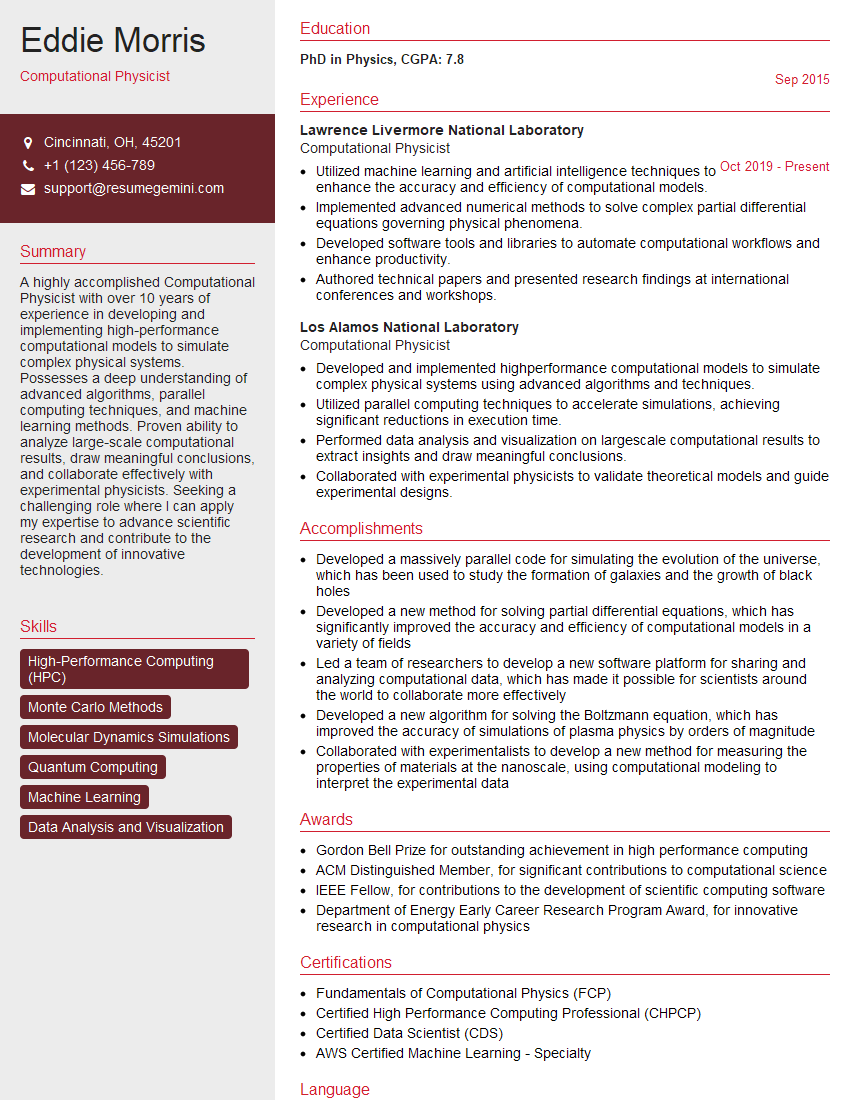
Mastering radiation transport simulation opens doors to exciting and impactful careers in various high-tech industries. A strong foundation in this field is highly sought after, leading to rewarding opportunities and continuous professional growth. To maximize your job prospects, creating a compelling and ATS-friendly resume is crucial. ResumeGemini is a trusted resource that can help you build a professional resume tailored to showcase your skills and experience effectively. Examples of resumes specifically tailored for Radiation Transport Simulation professionals are available to guide you.





Explore more articles
Users Rating of Our Blogs
Share Your Experience
We value your feedback! Please rate our content and share your thoughts (optional).
What Readers Say About Our Blog
Very informative content, great job.
good