Feeling uncertain about what to expect in your upcoming interview? We’ve got you covered! This blog highlights the most important Real-Time Operating Systems (FreeRTOS, Zephyr) interview questions and provides actionable advice to help you stand out as the ideal candidate. Let’s pave the way for your success.
Questions Asked in Real-Time Operating Systems (FreeRTOS, Zephyr) Interview
Q 1. Explain the concept of a Real-Time Operating System (RTOS).
A Real-Time Operating System (RTOS) is a specialized operating system designed to handle time-critical tasks with precise timing constraints. Unlike general-purpose operating systems like Windows or macOS that prioritize responsiveness to user input, RTOSes prioritize the timely execution of tasks, often within strict deadlines. Imagine a car’s anti-lock braking system – it needs to respond instantaneously to wheel slippage; an RTOS ensures this happens predictably and reliably. RTOSes achieve this through features like real-time scheduling, task management, and inter-process communication mechanisms specifically designed for deterministic behavior.
Q 2. What are the key differences between a hard real-time system and a soft real-time system?
The key difference lies in how they handle missed deadlines. A hard real-time system must meet deadlines; missing one can have catastrophic consequences. Think of an aircraft’s flight control system – a missed deadline could lead to a crash. A soft real-time system prioritizes timely execution but can tolerate occasional missed deadlines without causing complete failure. A media player experiencing a slight audio glitch due to a missed deadline is a good example of a soft real-time system. The functionality remains, though the quality might suffer.
Q 3. Describe the FreeRTOS task scheduler and its scheduling algorithm.
The FreeRTOS scheduler is a preemptive, priority-based scheduler. This means tasks with higher priority always get executed before tasks with lower priority. The scheduler uses a round-robin approach within each priority level – if multiple tasks share the same priority, they execute in a cyclical manner. This ensures fairness among equally prioritized tasks. The scheduler’s core function is to constantly monitor the ready tasks, select the highest priority ready task, and switch the processor’s execution to that task. The algorithm is incredibly efficient, making it suitable for resource-constrained embedded systems.
Imagine a factory assembly line: higher priority tasks are like critical assembly steps that must be completed before others, while lower priority tasks are supplementary actions. FreeRTOS ensures the critical steps always happen first.
Q 4. How does FreeRTOS handle context switching?
FreeRTOS handles context switching by saving the current task’s context (registers, stack pointer, etc.) before switching to another task. This process involves saving the state of the currently running task to its task control block (TCB) and loading the context of the next task from its TCB. This is done efficiently through interrupt handling, allowing for rapid transitions between tasks. The speed and efficiency of context switching are crucial for ensuring real-time responsiveness. The overhead is minimized to ensure minimal impact on timing requirements.
Think of it like switching between different TV channels; saving the current channel’s state ensures you can resume watching from where you left off.
Q 5. Explain the concept of priority inversion in FreeRTOS and how it can be avoided.
Priority inversion occurs when a lower-priority task indirectly blocks a higher-priority task. This happens when a higher-priority task needs a resource (like a mutex) held by a lower-priority task, and a medium-priority task preempts the lower-priority task, preventing it from releasing the resource. This can lead to significant delays and compromise real-time performance.
FreeRTOS addresses this through priority inheritance. When a higher-priority task needs a resource held by a lower-priority task, the lower-priority task temporarily inherits the higher priority. This ensures the lower-priority task gets executed and releases the resource quickly, preventing the higher-priority task from being blocked unnecessarily. This approach maintains the real-time characteristics of the system.
Q 6. What are semaphores, mutexes, and their use in FreeRTOS?
Semaphores are signaling mechanisms used for inter-process synchronization. They can be used to control access to shared resources or signal the completion of an event. A semaphore maintains a counter; when a task acquires the semaphore, the counter decrements. If the counter is zero, the task blocks until another task releases the semaphore, incrementing the counter.
Mutexes (mutual exclusions) are a special type of semaphore that only allows one task to access a shared resource at a time, preventing race conditions. They ensure exclusive access to critical sections of code.
In FreeRTOS, both are used extensively for managing shared resources among tasks, ensuring data integrity and preventing conflicts. For example, a mutex could protect access to a sensor’s data, while a semaphore could signal the availability of data from that sensor.
Q 7. How do you handle memory management in a FreeRTOS application?
Memory management in FreeRTOS is typically handled using dynamic memory allocation functions like pvPortMalloc() and vPortFree(). These functions provide memory blocks from a heap, which is a pool of memory allocated at startup. Careful design is required to avoid memory fragmentation and leaks. FreeRTOS offers various memory allocation schemes, including static allocation, where memory is allocated at compile time, and dynamic allocation, where memory is allocated at runtime. The choice depends on the application’s needs and memory constraints.
Proper memory management is essential for the stability and performance of any FreeRTOS application. Memory leaks can lead to system crashes, while inefficient allocation can result in performance degradation. Techniques such as using memory pools and careful error handling can help to improve memory management efficiency.
Q 8. Explain FreeRTOS inter-task communication mechanisms.
FreeRTOS offers several mechanisms for inter-task communication, crucial for coordinating activities between independent tasks within an embedded system. Think of it like different teams working on a project – they need ways to share information and synchronize their actions.
- Semaphores: These are like a shared resource lock. A task wanting to access a resource (e.g., a printer) acquires the semaphore. If another task tries to acquire it while it’s held, it blocks until it’s released. This prevents race conditions.
xSemaphoreTake(xSemaphore, portMAX_DELAY);acquires;xSemaphoreGive(xSemaphore);releases. - Mutexes: Similar to semaphores, but specifically designed for mutual exclusion. Only one task can hold a mutex at a time, ensuring exclusive access to a shared resource, ideal for protecting critical sections of code. They are typically used for more complex resource management than simple semaphores.
- Message Queues: Imagine a mailbox. Tasks can send messages (data) to a queue, and other tasks can receive them. This is asynchronous communication – the sender doesn’t wait for the receiver. This is very flexible for transferring large amounts of data between tasks that may not have tightly coupled timing requirements.
- Event Groups: Allow tasks to set and check for multiple events. Imagine flags to signal different conditions. A task can set an event, and other tasks can wait for a combination of events before proceeding. This enhances the flexibility of signaling specific conditions in complex scenarios.
- Binary Semaphores: A simplified version of a semaphore, only allowing either 0 or 1 count. Useful for simpler synchronization needs.
Choosing the right mechanism depends on the application’s requirements. For simple resource sharing, semaphores or mutexes might suffice. For more complex data exchange or asynchronous communication, message queues are often preferred. Event groups are powerful when coordinating multiple events within a task or across multiple tasks.
Q 9. What are the advantages and disadvantages of using FreeRTOS?
FreeRTOS, while widely popular, has its strengths and weaknesses.
- Advantages:
- Lightweight: It has a small memory footprint, making it suitable for resource-constrained microcontrollers.
- Real-time capabilities: Provides deterministic task scheduling, essential for time-critical applications.
- Portability: Works across a vast range of processors and architectures.
- Open-source: Free to use and modify, fostering community support and customization.
- Well-documented: Extensive documentation and a large community makes it easy to learn and troubleshoot.
- Disadvantages:
- Limited support for complex features: Compared to some other RTOSs, it might lack features like advanced memory management or sophisticated debugging tools.
- Learning curve: While relatively easy to learn, understanding its intricacies requires some effort.
- Limited debugging tools in some implementations: The debugging capabilities depend on the specific implementation and toolchain used.
The choice of using FreeRTOS often comes down to a balance between simplicity, real-time performance, and the available resources of the target embedded system. Its ease of use and extensive community support often outweigh the minor disadvantages for many projects.
Q 10. Describe the Zephyr RTOS architecture.
Zephyr’s architecture is built around a microkernel design, emphasizing modularity and extensibility. Imagine a well-organized toolbox, where each tool (driver, library, etc.) has its specific function and interacts cleanly with others.
- Kernel: The core of Zephyr, handling scheduling, inter-process communication, and memory management. It’s designed to be small and efficient.
- Device Drivers: Modular components interacting with hardware peripherals (sensors, actuators, etc.). They provide a consistent interface to the kernel, regardless of the specific hardware.
- Libraries: Provide higher-level functionalities, such as networking, file systems, and cryptographic operations.
- Applications: The user-level code implementing the specific functions of the embedded system. They utilize kernel services and device drivers through well-defined APIs.
This modularity enables easy configuration and customization. You can select only the components needed for your application, reducing the overall memory footprint and complexity. This is particularly beneficial for resource-constrained devices.
Q 11. How does Zephyr handle device drivers?
Zephyr’s device driver model emphasizes a driver framework based on a consistent API, allowing for easy integration and portability. This simplifies development by creating a standardized approach to how devices interact with the system.
Drivers are organized as modules and typically adhere to a defined structure, including functions for initialization, reading data, writing data, and handling interrupts. This structure simplifies development and maintenance.
Zephyr uses the concept of ‘device nodes’ to represent hardware devices. These nodes are registered with the kernel, making them accessible to the application through a consistent interface. The driver interacts with the hardware and exposes a cleaner, platform-independent interface through these nodes. This abstraction makes it easy to switch between different hardware implementations with minimal changes to the application code.
For instance, if you have a temperature sensor, its driver would handle the low-level details of communication with the sensor’s interface, and then expose a simple function like get_temperature() to the application, hiding the complex hardware details.
Q 12. Explain the concept of threads and processes in Zephyr.
In Zephyr, the terms ‘threads’ and ‘processes’ have specific meanings. They are both units of execution, but with key differences.
- Threads: These are lightweight units of execution within a single process. They share the same memory space. Think of them as different tasks working collaboratively within the same program. They communicate through shared memory and synchronization primitives.
- Processes: In Zephyr, processes are more heavyweight than threads and have their own isolated memory spaces. They typically represent distinct applications running concurrently. Inter-process communication requires more robust mechanisms, like message queues or pipes.
Zephyr primarily uses threads as the primary unit of concurrency. Processes are less common in embedded systems due to their higher overhead, but they offer greater isolation and protection compared to threads, proving useful in specific scenarios like running multiple independent applications on the same device.
Q 13. How does Zephyr manage memory allocation?
Zephyr offers flexible memory management capabilities tailored to embedded systems. It uses a variety of memory allocators to address different needs.
- Static Memory Allocation: Memory is allocated at compile time. Simple and efficient but less flexible.
- Dynamic Memory Allocation: Memory is allocated and freed at runtime. Offers flexibility but requires careful management to prevent fragmentation or memory leaks. Zephyr provides several allocators for this, including a simple first-fit allocator, a buddy allocator, and support for integrating external allocators.
- Memory Pools: Allows pre-allocation of memory blocks of a specific size. This is useful for optimizing performance in memory-constrained environments, reducing the overhead of frequent allocation requests.
The choice of allocator depends on the application’s requirements and constraints. Static allocation might be sufficient for simple applications, while dynamic allocation with a suitable allocator is needed for more complex applications requiring runtime memory management. Memory pools are crucial when performance and predictable memory behaviour are critical.
Q 14. Discuss the different scheduling policies in Zephyr.
Zephyr provides a variety of scheduling policies to manage the execution of threads.
- Round-robin: Each ready thread gets a slice of CPU time in a cyclical manner. Simple and fair, suitable for non-real-time systems or as a fallback mechanism.
- Priority-based preemptive: Threads with higher priority preempt threads with lower priority. Essential for real-time systems to ensure timely execution of critical tasks. Zephyr uses a priority inheritance protocol to avoid priority inversion problems.
- Multiprocessor scheduling: Zephyr supports multicore architectures and offers various strategies for scheduling threads across multiple processors to improve overall performance and responsiveness.
- Cooperative multitasking (limited): Zephyr supports cooperative multitasking, where threads voluntarily relinquish the CPU. This is rarely used in modern systems due to its susceptibility to blocking issues but might find use in niche applications.
The choice of scheduling policy is crucial for meeting the real-time requirements of an application. Priority-based preemptive scheduling is the most common choice for real-time systems, allowing critical tasks to always be executed promptly. Multiprocessor scheduling enhances efficiency and responsiveness in multicore systems.
Q 15. What are the key features of the Zephyr networking stack?
Zephyr’s networking stack is a key component, offering a lightweight and highly configurable solution for embedded systems. It’s designed for resource-constrained devices and boasts several crucial features:
- 6LoWPAN Support: Allows communication over low-power wireless personal area networks (like IEEE 802.15.4), crucial for IoT devices. Think of it as squeezing IPv6 into small packets for energy efficiency.
- IPv4/IPv6 Dual Stack: Supports both IPv4 and IPv6, offering flexibility and future-proofing for your embedded network. This means you can connect to existing infrastructure and prepare for the next generation of internet protocols.
- Bluetooth Support: Provides Bluetooth low energy (BLE) capabilities, enabling seamless integration with Bluetooth devices for applications like health monitoring, smart home automation, and industrial sensors.
- Ethernet Support: Enables connection to wired networks, offering a robust and reliable communication path.
- TCP/IP Implementation: A full TCP/IP stack is implemented, ensuring compatibility with the vast majority of network protocols and applications.
- Lightweight and Modular Design: Only the necessary networking components need to be included in your application, minimizing memory footprint and maximizing performance. This is critical for resource-constrained devices.
Imagine building a smart agriculture system: you’d likely use 6LoWPAN to connect soil moisture sensors to a gateway, then use the gateway’s Ethernet connection to send data to the cloud for analysis. Zephyr’s modular networking stack allows you to select precisely the components needed for each device.
Career Expert Tips:
- Ace those interviews! Prepare effectively by reviewing the Top 50 Most Common Interview Questions on ResumeGemini.
- Navigate your job search with confidence! Explore a wide range of Career Tips on ResumeGemini. Learn about common challenges and recommendations to overcome them.
- Craft the perfect resume! Master the Art of Resume Writing with ResumeGemini’s guide. Showcase your unique qualifications and achievements effectively.
- Don’t miss out on holiday savings! Build your dream resume with ResumeGemini’s ATS optimized templates.
Q 16. How do you debug FreeRTOS applications?
Debugging FreeRTOS applications often involves a multi-pronged approach. Since FreeRTOS is an RTOS (Real-Time Operating System), standard debugging techniques need to be combined with RTOS-specific strategies:
- Hardware Debugger (JTAG/SWD): This is essential for low-level debugging. You can step through code, inspect variables, and set breakpoints. This provides the finest level of control and visibility.
- Logging and Tracing: Implementing logging statements within your application is vital. Use
printf()or a dedicated logging library, but be mindful of the limited resources in embedded systems. Circular buffers are very useful here to ensure you don’t lose data in case of a system crash. - FreeRTOS Tracing Tools: Tools like FreeRTOS+Trace allow you to visualize the task scheduling, interrupt handling, and other RTOS events. This visualization aids in pinpointing bottlenecks or timing issues. Think of it as a system-level profiler.
- Real-Time Analysis Tools: Software like an oscilloscope or logic analyzer can help you visualize the system’s behavior from a hardware perspective. This is indispensable for diagnosing timing-related issues.
- RTOS API Monitoring: Carefully observing the use of FreeRTOS functions (like mutexes, semaphores, queues) through logging or a debugger can help reveal deadlocks or other concurrency problems.
For example, if you suspect a deadlock, you can use a debugger to inspect the state of mutexes held by different tasks, helping you understand the flow and pinpoint the cause. Think of this as detective work to solve concurrency puzzles.
Q 17. How do you debug Zephyr applications?
Debugging Zephyr applications shares similarities with FreeRTOS but leverages Zephyr’s specific features and tools:
- GDB (GNU Debugger): A powerful command-line debugger that allows you to step through code, set breakpoints, inspect variables, and more. It works particularly well with Zephyr’s build system.
- Zephyr’s Logging System: Zephyr provides a robust logging framework that helps you track your application’s behavior. You can define log levels and filter messages to focus on specific events. This is significantly more powerful than simple
printf()statements. - Trace Tools: Similar to FreeRTOS+Trace, Zephyr has its own tracing mechanisms to visualize the RTOS activities, including task scheduling, interrupt handling, and communication patterns. This gives a great overview of your system’s behavior.
- Hardware Debugger (JTAG/SWD): Similar to FreeRTOS debugging, using a hardware debugger is crucial for low-level inspection and analysis.
- SystemView (SEGGER): This is a powerful trace visualization tool that can be integrated with Zephyr applications and can provide detailed insight into runtime activity.
Suppose a device is not responding correctly; using Zephyr’s logging system along with a debugger allows you to monitor variable values at different points, identify problematic sections, and isolate the specific code that causes the issue. It’s a combination of targeted monitoring and low-level investigation.
Q 18. Explain the use of queues in FreeRTOS.
In FreeRTOS, queues provide a mechanism for inter-task communication. They are essentially first-in, first-out (FIFO) buffers that allow one task to send data to another task asynchronously. This is crucial for decoupling tasks and improving system responsiveness.
- Data Transfer: Tasks can send data items (like integers, structures, or pointers) to the queue.
- Asynchronous Communication: Tasks don’t have to wait for each other. A producer task can add data to the queue without waiting for a consumer task to process it.
- Blocking and Non-Blocking Operations: Tasks can choose to block (wait) until data is available in the queue (receiving) or until space is available in the queue (sending). They can also try non-blocking operations, which return immediately.
- Queue Size: The size of the queue is configurable, limiting the amount of data that can be stored.
Imagine a sensor task constantly reading data. Instead of directly processing the data, it sends the readings to a queue. A separate task processes the data from the queue, allowing the sensor task to continue reading data without delays. This increases efficiency and responsiveness.
// Example of creating and using a FreeRTOS queue #include "FreeRTOS.h" #include "semphr.h" #include "queue.h" QueueHandle_t xQueue; //Queue handle int main(){ xQueue = xQueueCreate(10,sizeof(int)); //Create a queue that holds 10 integers. // ...Further code using the queue... vQueueDelete(xQueue); // Delete the queue after use return 0; } Q 19. Explain the use of message queues in Zephyr.
Zephyr’s message queues, similar to FreeRTOS queues, facilitate inter-task communication. However, they are designed with Zephyr’s architecture in mind, offering a more integrated and flexible approach.
- Data Transfer: Tasks can send messages (which can be any data structure) between each other.
- Asynchronous Communication: The sending task doesn’t need to wait for the receiving task. Messages are stored in the queue until received.
- Blocking and Non-Blocking Operations: Similar to FreeRTOS, Zephyr allows for blocking and non-blocking send and receive operations.
- Multiple Consumers: Unlike some simpler queue implementations, Zephyr’s message queues can have multiple consumers, enabling flexible communication patterns.
- Memory Management: Zephyr offers options for managing queue memory, offering fine-grained control.
Consider a system with multiple sensors feeding data to a processing unit. Each sensor can send messages to a single queue. The processing unit can then read from the queue, handling messages from any sensor without knowing which sensor sent the data.
Q 20. How do you implement a producer-consumer scenario in FreeRTOS?
Implementing a producer-consumer scenario in FreeRTOS typically involves one task producing data and another consuming it, using a FreeRTOS queue as the intermediary.
- Producer Task: This task generates data and sends it to the queue using
xQueueSend(). It can block if the queue is full or use a non-blocking version. - Consumer Task: This task retrieves data from the queue using
xQueueReceive(). It can block if the queue is empty or use a non-blocking variant. - Queue: The queue acts as the buffer between the producer and consumer. Its size should be chosen carefully based on the expected data rates.
Error handling is essential. Consider what happens when the queue is full (producer) or empty (consumer). Proper error handling prevents deadlocks and system instability.
// FreeRTOS Producer-Consumer Example (Conceptual) // Producer Task while(1){ int data = generateData(); xQueueSend(xQueue, &data, portMAX_DELAY); // Blocking send } // Consumer Task while(1){ int data; xQueueReceive(xQueue, &data, portMAX_DELAY); // Blocking receive processData(data); } Q 21. How do you implement a producer-consumer scenario in Zephyr?
In Zephyr, you would use Zephyr’s message queues to implement a producer-consumer scenario. The approach is conceptually similar to FreeRTOS but uses Zephyr’s APIs.
- Producer Task: This task uses functions like
k_msgq_put()to send a message to the queue. Similar to FreeRTOS, blocking and non-blocking variants are available. - Consumer Task: This task receives messages from the queue using functions such as
k_msgq_get(). Again, blocking and non-blocking options are available. - Message Queue: The message queue is created using
k_msgq_create()and should be sized appropriately.
Zephyr’s message queues are designed for efficiency and flexibility. Proper error handling in both the producer and consumer tasks is vital to avoid problems such as data loss or system hang-ups. Consider using events or semaphores to indicate message availability to efficiently signal the consumer.
Remember to properly clean up resources. Ensure the message queue is deleted when it’s no longer needed to prevent memory leaks.
Q 22. Describe different synchronization primitives available in RTOS and their use cases.
Real-Time Operating Systems (RTOS) offer various synchronization primitives to manage concurrent access to shared resources and prevent race conditions. Think of these as traffic signals for tasks running simultaneously. Improper synchronization can lead to unpredictable behavior and system crashes.
- Mutexes (Mutual Exclusion): A mutex is like a key to a shared resource. Only one task can hold the key (own the mutex) at a time. Other tasks trying to access the resource must wait until the mutex is released. Example: Protecting a shared buffer used by multiple tasks to avoid data corruption.
- Semaphores: Semaphores are counters that control access to a resource. A binary semaphore (0 or 1) acts like a mutex, while counting semaphores allow multiple tasks to access a resource up to a certain limit. Example: Managing access to a limited number of printer resources.
- Binary Semaphores: A special case of semaphores, limiting access to either 0 (resource unavailable) or 1 (resource available). Essentially a simplified mutex.
- Counting Semaphores: Allow multiple tasks to access a resource concurrently, up to a specified count. Example: Managing a pool of network connections.
- Message Queues: Tasks communicate asynchronously by sending and receiving messages. This avoids direct interaction and potential blocking issues. Example: A sensor task sending data to a processing task.
- Event Flags: Allow tasks to wait for specific events or combinations of events to occur. This provides a flexible way to synchronize tasks based on multiple conditions. Example: A task waiting for multiple sensor readings before processing.
Choosing the right primitive depends on the specific application requirements. For simple mutual exclusion, a mutex is often sufficient. For more complex scenarios involving multiple resources or asynchronous communication, semaphores, message queues, or event flags might be more appropriate.
Q 23. What are the common pitfalls to avoid while developing RTOS-based applications?
Developing RTOS-based applications comes with unique challenges. Overlooking these pitfalls can lead to hard-to-debug issues and system instability.
- Deadlocks: This occurs when two or more tasks are blocked indefinitely, waiting for each other to release resources. Imagine two people holding onto each other’s keys—neither can proceed.
- Priority Inversion: A lower-priority task holds a resource needed by a higher-priority task, causing the higher-priority task to wait indefinitely. This can be mitigated using priority inheritance protocols.
- Race Conditions: Multiple tasks access and modify shared resources concurrently without proper synchronization, leading to unpredictable results. This is like two people writing on the same whiteboard simultaneously—the final result is a mess.
- Stack Overflow: Tasks consuming excessive stack space can lead to crashes or system instability. Proper stack size allocation is crucial.
- Memory Leaks: Failure to properly deallocate memory can gradually deplete available memory, causing performance degradation and eventually crashes.
- Improper Interrupt Handling: Interrupts must be handled efficiently and quickly to maintain real-time responsiveness. Failing to do so can introduce latency and timing issues.
Careful design, thorough testing, and use of appropriate RTOS features (like mutexes, semaphores) are key to avoiding these pitfalls.
Q 24. Explain the concept of RTOS tickless idle mode.
Tickless idle mode is a power-saving technique in RTOS where the system clock timer (tick) is stopped when the system is idle. Instead of regularly interrupting the CPU with timer ticks, the system enters a low-power sleep mode and wakes up only when an event occurs (e.g., interrupt, task wake-up).
Think of it like this: a traditional RTOS timer continuously ticks, like a clock constantly running. Tickless idle is like turning the clock off when it’s not needed; it only ‘ticks’ when something needs to happen. This significantly reduces power consumption, especially in battery-powered devices.
Implementing tickless idle mode involves using timers to schedule wake-up events. The RTOS must be able to accurately track time even when the timer is stopped, usually by counting external interrupts or using low-power wake-up sources. While it saves power, the transition into and out of tickless mode adds some overhead.
Q 25. Discuss the challenges of real-time programming and how RTOS helps address them.
Real-time programming presents unique challenges due to stringent timing constraints. Missing a deadline can have catastrophic consequences in many applications (e.g., flight control, medical devices).
- Deterministic Behavior: Predictable execution times are critical. In a real-time system, we need to know exactly how long a task will take to complete.
- Timing Constraints: Tasks must meet strict deadlines; otherwise, the system fails. Think of air-traffic control software: a delay in processing a flight plan could be disastrous.
- Resource Management: Efficient allocation and management of system resources (CPU, memory) is critical to meet timing requirements.
- Concurrency Control: Multiple tasks may need to run concurrently without interfering with each other.
RTOS addresses these challenges by providing:
- Preemptive Scheduling: Allows higher-priority tasks to interrupt lower-priority tasks to meet deadlines.
- Synchronization Primitives: Provides mechanisms to manage shared resources and prevent race conditions.
- Interrupt Handling: Efficient interrupt handling is essential for responsiveness.
- Real-Time Kernels: Provides a predictable and deterministic execution environment.
In essence, RTOS offers a structured framework for managing concurrency and ensuring timely execution of tasks, making real-time programming manageable and reliable.
Q 26. Compare and contrast FreeRTOS and Zephyr RTOS.
FreeRTOS and Zephyr are both popular open-source RTOSes, but they differ in several key aspects.
- Licensing: FreeRTOS uses a permissive MIT license, while Zephyr uses the Apache 2.0 license. Both are open source and suitable for commercial applications.
- Scalability: FreeRTOS is lightweight and suitable for microcontrollers with limited resources. Zephyr is more scalable, supporting a wider range of architectures and hardware platforms, including more powerful microprocessors and SoCs.
- Features: Both offer a core set of RTOS functionalities (tasks, semaphores, timers). Zephyr, however, offers more advanced features such as networking support, device drivers, and security features out of the box.
- Community and Support: FreeRTOS boasts a large and established community. Zephyr has a rapidly growing community and strong support from the Linux Foundation.
- Development Tools: FreeRTOS tools are generally simpler and easier to integrate. Zephyr typically uses a more sophisticated build system and IDE integration.
In short, FreeRTOS is a simpler, lightweight RTOS ideal for smaller embedded systems. Zephyr is a more powerful and feature-rich RTOS suitable for larger, more complex systems requiring advanced functionalities.
Q 27. How would you design a task to measure the execution time of another task using FreeRTOS?
To measure the execution time of a task in FreeRTOS, we’ll use FreeRTOS’s timer functionality and the tick count. We’ll create a separate task that’s responsible for measuring the execution time of our target task. Here’s a conceptual outline, assuming you have some familiarity with FreeRTOS API:
- Create Two Tasks: One task (TaskA) will be the task whose execution time we want to measure. The other task (TaskB) will be our measurement task.
- Start TaskB first: TaskB should wait for a signal from TaskA (maybe a semaphore or event flag) before the timing starts.
- Measure Start Time: When TaskA begins execution, it should signal TaskB. TaskB, upon receiving the signal, should record the current FreeRTOS tick count using
xTaskGetTickCount(). - TaskA Executes: TaskA completes its operations.
- Measure End Time: Upon completion, TaskA signals TaskB again. TaskB records the current tick count again.
- Calculate Execution Time: TaskB subtracts the start tick count from the end tick count to obtain the execution time in ticks. This can then be converted to milliseconds or seconds using the FreeRTOS tick frequency (configTICK_RATE_HZ).
//Conceptual FreeRTOS C code snippet (requires proper initialization and context):
SemaphoreHandle_t xSemaphore; //Semaphore to synchronize tasks//Task Avoid TaskA( void *pvParameters ){ xSemaphoreTake( xSemaphore, portMAX_DELAY ); //Signal taskB start //Code of Task A to be measured here xSemaphoreGive( xSemaphore ); //Signal taskB end vTaskDelete(NULL);}//Task Bvoid TaskB( void *pvParameters ){ TickType_t startTick, endTick; xSemaphoreTake( xSemaphore, portMAX_DELAY ); //Wait for start signal startTick = xTaskGetTickCount(); xSemaphoreTake( xSemaphore, portMAX_DELAY ); //Wait for end signal endTick = xTaskGetTickCount(); uint32_t executionTimeTicks = endTick - startTick; // Convert to milliseconds uint32_t executionTimeMs = executionTimeTicks * portTICK_PERIOD_MS; //Log or process executionTimeMs vTaskDelete(NULL);}Remember to initialize the semaphore correctly before creating the tasks.
Q 28. How would you implement a watchdog timer in a Zephyr application?
Implementing a watchdog timer in Zephyr involves using the driver for the specific watchdog peripheral on your hardware. The exact implementation details will vary depending on the hardware, but the general steps are as follows:
- Choose a Watchdog Timer: Identify the watchdog timer available on your target hardware. Zephyr’s device tree will typically describe the available watchdog peripherals.
- Driver Initialization: Initialize the watchdog driver using the Zephyr API. This will enable the watchdog timer and configure its behavior (timeout period, reset behavior).
- Periodic ‘Kicking’: Create a task or interrupt routine that periodically ‘kicks’ the watchdog timer (or resets the counter). This prevents the watchdog timer from triggering a system reset.
- Timeout Handling: If the watchdog timer times out (the counter reaches zero without being kicked), it should trigger a system reset, which usually means rebooting the device. This indicates a system failure.
//Conceptual Zephyr C code snippet (requires proper header inclusions and initialization):
#include // Assume 'watchdog0' is configured in the device treeconst struct device *watchdog_dev = DEVICE_DT_GET(DT_NODELABEL(watchdog0));void watchdog_kick(void *arg){ int ret = watchdog_feed(watchdog_dev); //Kick the watchdog if(ret) { //Handle error }}//Initialize Watchdog (In your main application)int ret = watchdog_enable(watchdog_dev);if (ret != 0) { // Handle error}//Periodically call watchdog_kick from a taskk_timer_start(&timer_watchdog, K_MSEC(500), K_MSEC(500)); //Kick every 500msThis is a high-level example. The specific functions and configurations will be determined by the hardware and the Zephyr driver for that specific watchdog. Refer to your hardware’s documentation and the Zephyr documentation for details about the watchdog driver API.
Key Topics to Learn for Real-Time Operating Systems (FreeRTOS, Zephyr) Interview
- Task Management: Understanding task scheduling algorithms (round-robin, priority-based), task states (ready, running, blocked), context switching, and task priorities. Consider the implications of different scheduling strategies on system performance.
- Inter-Process Communication (IPC): Mastering mechanisms like semaphores, mutexes, message queues, and event flags for communication and synchronization between tasks. Practice designing robust solutions to prevent race conditions and deadlocks.
- Memory Management: Familiarize yourself with dynamic memory allocation, heap management, and strategies for preventing memory leaks. Understand the impact of memory fragmentation and techniques to mitigate it.
- Real-Time Constraints: Grasp the concepts of hard and soft real-time systems and their implications on task scheduling and resource allocation. Be prepared to discuss latency and jitter.
- FreeRTOS Specifics: Dive into FreeRTOS features like FreeRTOS kernel, its APIs (xTaskCreate, vTaskDelay, xSemaphoreTake), and common use cases. Practice working with FreeRTOS configuration files.
- Zephyr Specifics: Explore Zephyr’s architecture, its device drivers model, and its support for various hardware platforms. Understand Zephyr’s build system and its integration with different tools.
- Debugging and Profiling: Develop proficiency in debugging RTOS applications, using tools to identify performance bottlenecks, and analyzing system behavior. This includes understanding the use of real-time tracing and debugging techniques.
- Practical Application: Be ready to discuss projects where you’ve used RTOS concepts to build real-time systems. Focus on the challenges you faced and how you overcame them.
Next Steps
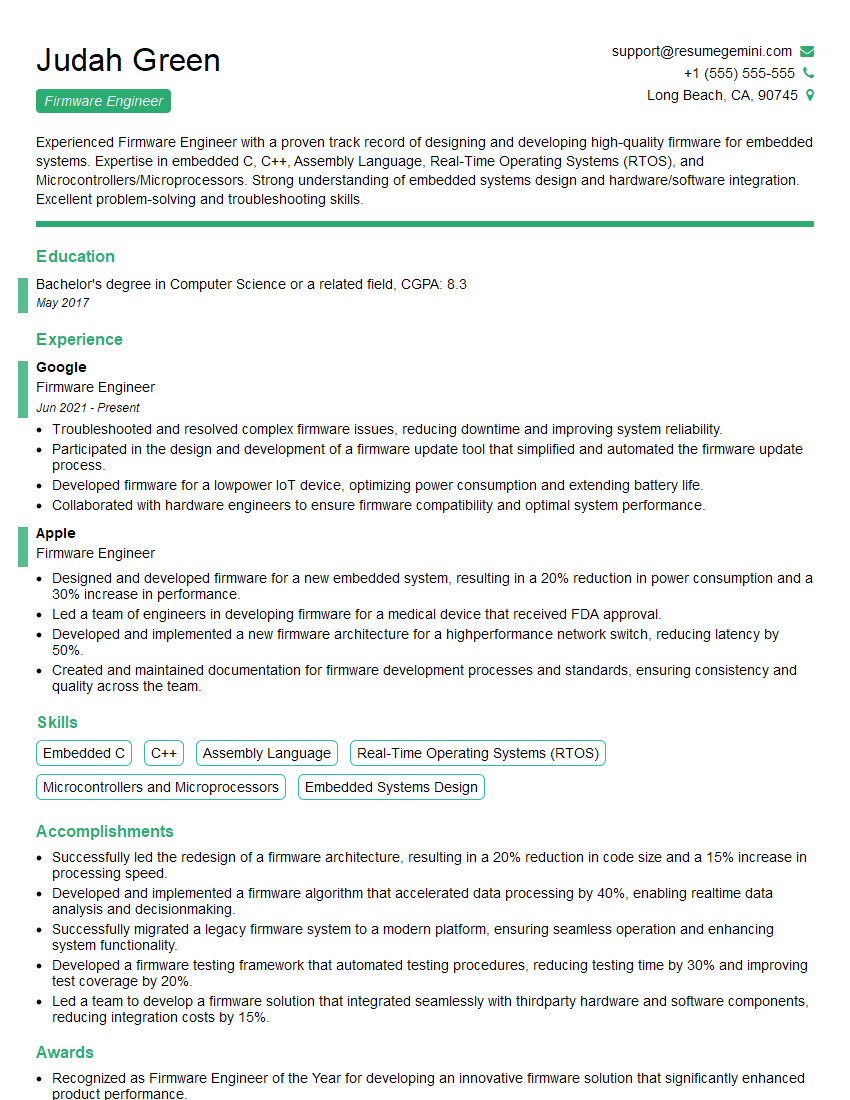
Mastering Real-Time Operating Systems like FreeRTOS and Zephyr is crucial for career advancement in embedded systems and related fields, opening doors to exciting roles with high demand. A well-crafted resume is your key to unlocking these opportunities. Focus on building an ATS-friendly resume that highlights your skills and experience effectively. ResumeGemini is a trusted resource that can help you create a professional and impactful resume, tailored to the specific requirements of your target roles. Examples of resumes optimized for Real-Time Operating Systems (FreeRTOS and Zephyr) experience are available to guide you.
Explore more articles
Users Rating of Our Blogs
Share Your Experience
We value your feedback! Please rate our content and share your thoughts (optional).
What Readers Say About Our Blog
Very informative content, great job.
good