Feeling uncertain about what to expect in your upcoming interview? We’ve got you covered! This blog highlights the most important Reliability Testing interview questions and provides actionable advice to help you stand out as the ideal candidate. Let’s pave the way for your success.
Questions Asked in Reliability Testing Interview
Q 1. Explain the difference between reliability, availability, and maintainability (RAM).
Reliability, availability, and maintainability (RAM) are three crucial characteristics of a system’s overall effectiveness. Think of them as three legs of a stool – if one is weak, the whole system is unstable.
- Reliability refers to the probability that a system will perform its intended function without failure for a specified period under stated conditions. It’s about how consistently a product works. For example, a reliable car starts every time you turn the key.
- Availability is the probability that a system will be operational when needed. This considers both reliability (the system not failing) and maintainability (the speed and efficiency of repairs). A highly available system might have backup components to ensure continuous operation, like a redundant server in a data center.
- Maintainability is the ease and speed with which a system can be restored to operational status after a failure. This includes factors like ease of repair, access to spare parts, and the skill level needed for repair. A system with high maintainability might have modular components, making repairs quicker and less disruptive.
In short: Reliability is about *not failing*, Availability is about *being operational*, and Maintainability is about *getting back operational* quickly.
Q 2. Describe different reliability testing methods (e.g., accelerated life testing, HALT, ALT).
Reliability testing employs various methods to assess a product’s lifespan and robustness under different stress conditions. Here are a few prominent examples:
- Accelerated Life Testing (ALT): This involves subjecting the product to more extreme conditions (higher temperature, voltage, etc.) than it would typically experience in normal operation. This accelerates the aging process and allows for quicker assessment of reliability. Data is then statistically modeled to predict the product’s lifetime under normal conditions. Imagine testing a lightbulb at 150% of its rated voltage to see how quickly it burns out; this helps you estimate its lifespan at normal voltage.
- Highly Accelerated Life Testing (HALT): This method pushes the product to its absolute limits to identify design weaknesses and failure modes quickly. It involves rapid changes in stress levels (temperature, vibration, etc.) to aggressively uncover latent flaws. HALT is often used in early development stages for rapid design improvement.
- Accelerated Stress Testing (AST): Similar to HALT but with a focus on identifying specific failure mechanisms. AST uses a more controlled and systematic approach than HALT and involves applying specific stresses (e.g., constant high temperature, cyclical pressure) to a certain level until failure.
- Traditional Life Testing: This involves operating the product under normal conditions until failure, often requiring a longer testing time and larger sample size. It’s a more direct, albeit time-consuming, way to determine reliability.
The choice of method depends on factors like the product’s complexity, development stage, time constraints, and available resources.
Q 3. What are failure modes and effects analysis (FMEA) and fault tree analysis (FTA)? How are they used in reliability testing?
Failure Modes and Effects Analysis (FMEA) and Fault Tree Analysis (FTA) are powerful proactive reliability tools used in the design phase and throughout the product life cycle.
- FMEA is a systematic approach to identify potential failure modes, their causes, and their effects on the system. It helps to prioritize potential problems based on their severity, occurrence, and detectability (Severity x Occurrence x Detection = Risk Priority Number). Imagine a team systematically going through every component of a car engine, identifying potential failures (e.g., fuel pump failure), their causes (e.g., clogged fuel filter), and their effects (e.g., engine stall). They then assign risk levels and develop mitigation strategies.
- FTA is a top-down deductive technique used to analyze the various ways a system can fail. It starts with a top-level undesired event (e.g., system shutdown) and works down to identify the underlying causes. This helps to pinpoint the critical components or events that contribute most significantly to system failure. Think of it as a reverse logic diagram, tracing back the causes of a failure, like investigating a plane crash by identifying the chain of events that led to it.
Both FMEA and FTA are valuable in reliability testing because they identify potential failure points *before* they occur. This helps in developing robust designs, choosing appropriate test methods, and planning effective mitigation strategies.
Q 4. Explain the Weibull distribution and its application in reliability analysis.
The Weibull distribution is a flexible probability distribution commonly used in reliability analysis because it can model various failure patterns. It’s particularly useful because it can describe both increasing, decreasing, and constant failure rates.
- Shape Parameter (β): This parameter dictates the shape of the distribution and indicates the failure rate pattern.
- β < 1: Decreasing failure rate (early failures are common)
- β = 1: Constant failure rate (random failures)
- β > 1: Increasing failure rate (wear-out failures)
- Scale Parameter (η): This parameter represents the characteristic life or scale of the distribution. It indicates the average time to failure for the product.
- Location Parameter (γ): This represents the guarantee time or minimum lifespan (often set to 0).
In practice, the Weibull distribution allows reliability engineers to estimate the probability of failure at any given time, predict the lifespan of a product, and model different types of failure mechanisms. By fitting a Weibull distribution to failure data, they can estimate the parameters and make informed decisions on product design, maintenance, and warranty periods. For example, a company might use the Weibull distribution to predict the lifespan of its hard drives and determine the optimal warranty period.
Q 5. How do you determine the appropriate sample size for a reliability test?
Determining the appropriate sample size for a reliability test is critical for achieving statistically significant results without unnecessary expense. Several factors influence this decision:
- Desired Confidence Level: How certain do you need to be about your results? A higher confidence level (e.g., 99%) requires a larger sample size.
- Acceptable Margin of Error: How much uncertainty are you willing to accept in your estimates? A smaller margin of error requires a larger sample size.
- Expected Failure Rate: If the expected failure rate is low, a larger sample size will be needed to observe enough failures for meaningful analysis.
- Test Duration: The time available for testing will also impact sample size. Longer tests might accommodate smaller samples.
Various statistical methods can help determine the appropriate sample size. These often involve specifying the desired confidence level, margin of error, and failure rate, and using statistical tables or software to calculate the minimum sample size. A power analysis is commonly employed, ensuring the study has enough power to detect a practically meaningful difference in reliability. Failure to use sufficient sample size could lead to incorrect conclusions regarding product reliability.
Q 6. What are some common reliability metrics (e.g., MTBF, MTTF, MTTR)?
Several key metrics quantify reliability. They help in comparing the reliability of different products and tracking reliability performance over time.
- Mean Time Between Failures (MTBF): The average time between consecutive failures of a repairable system. This metric is commonly used for systems that can be repaired after failure, such as computer servers. A higher MTBF indicates better reliability.
- Mean Time To Failure (MTTF): The average time until the first failure of a non-repairable system. This is used for items that are discarded after failure, such as light bulbs. A higher MTTF is preferable.
- Mean Time To Repair (MTTR): The average time it takes to repair a failed system. A lower MTTR indicates better maintainability. This metric focuses on the speed and efficiency of the repair process.
- Failure Rate (λ): The number of failures per unit time. Often expressed as failures per million hours (FPMH) or failures in time (FIT). This shows how frequently failures occur within a given timeframe.
These metrics provide valuable insights into the reliability and maintainability of a system and are essential in making informed decisions about design, maintenance, and warranty policies.
Q 7. Describe your experience with design of experiments (DOE) in reliability testing.
Design of Experiments (DOE) is an invaluable tool in reliability testing, allowing for efficient and effective experimentation. Instead of testing variables one at a time, DOE uses statistically planned experiments to study the combined effects of multiple factors simultaneously. This reduces the overall testing time and cost while providing more comprehensive information.
In my experience, I’ve used DOE techniques such as factorial designs and Taguchi methods to optimize product designs for reliability. For example, I was involved in a project to optimize the reliability of a new smartphone. Using a fractional factorial design, we tested the effects of different components (e.g., battery type, processor, screen material) on the phone’s lifespan and performance under varying environmental conditions. This allowed us to efficiently identify the optimal combination of components leading to improved reliability and reduced manufacturing costs.
Analyzing the results from DOE requires appropriate statistical software and expertise in statistical analysis. The insights gained allow for data-driven decisions regarding design improvements and optimal stress levels for accelerated testing, ultimately leading to the development of more reliable products.
Q 8. How do you handle outliers in reliability data?
Outliers in reliability data represent extreme values that deviate significantly from the overall pattern. They can skew analyses and lead to inaccurate conclusions about the system’s reliability. Handling outliers requires careful consideration. First, we must investigate their cause. Are they due to measurement error, data entry mistakes, or genuine, albeit rare, failure modes?
If an outlier results from an error, it should be corrected or removed. If it’s a genuine data point representing a unique failure mechanism (e.g., a freak accident causing immediate failure), we might choose to analyze the data both with and without the outlier to assess its impact on the overall reliability estimate. Robust statistical methods, less sensitive to outliers, are often preferred. These include non-parametric methods like the Kaplan-Meier estimator for survival analysis and the use of trimmed means instead of simple averages. Visual inspection using box plots or scatter plots can also help identify potential outliers before applying any statistical methods.
For example, imagine testing the lifespan of light bulbs. One bulb might fail almost immediately due to a manufacturing defect. This is an outlier. Simply discarding it might be appropriate if the defect is unlikely to recur, or we can analyze its impact on the mean time to failure (MTTF) by comparing results with and without it included.
Q 9. Explain the concept of accelerated life testing and its limitations.
Accelerated life testing (ALT) subjects products to more stressful conditions than they would normally experience, to shorten the time required to observe failures and estimate their lifespan under normal operating conditions. This is crucial because some products have very long lifespans under typical use. By applying higher temperatures, voltages, or other stresses, we accelerate the degradation process and can obtain reliability information much faster. We use statistical models, often based on Arrhenius, Eyring, or power law relationships, to extrapolate the results from accelerated conditions back to normal operating conditions.
However, ALT has limitations. First, extrapolation assumes that the failure mechanisms under accelerated stress are the same as under normal use. This is a critical assumption; if different failure mechanisms dominate under stress, the extrapolation will be invalid. Second, the models used for extrapolation rely on assumptions about the relationship between stress and failure rate – assumptions that might not always hold true. Finally, the accelerated conditions might cause damage or failures that wouldn’t occur under normal operation, leading to an overly pessimistic assessment of reliability. Proper planning and selection of appropriate stress levels are critical to successful ALT.
Q 10. What are some common failure mechanisms in electronic components?
Electronic components suffer from a wide variety of failure mechanisms, often interconnected and difficult to isolate. Here are some common ones:
- Electromigration: The movement of metal ions within the conductors due to high current density, leading to open or short circuits.
- Electrostatic Discharge (ESD): Damage caused by sudden electrostatic discharges, often leading to immediate component failure or latent defects.
- Thermal stress: Repeated expansion and contraction due to temperature cycling can cause fatigue and cracking of materials, especially in solder joints.
- Corrosion: Chemical reactions between the component and its environment can lead to degradation and failure.
- Dielectric breakdown: Failure of insulating materials due to excessive voltage or long-term stress.
- Wear-out: Gradual degradation of materials over time due to mechanical stress or chemical reactions.
Understanding these failure mechanisms is essential for designing reliable systems and implementing appropriate reliability testing strategies. For example, proper thermal management in circuit design mitigates thermal stress, and ESD protection circuits protect components from electrostatic discharge.
Q 11. How do you assess the reliability of a software system?
Assessing the reliability of a software system is different from hardware, as it doesn’t experience physical wear and tear. Software reliability focuses on the frequency and severity of failures. We often use techniques like:
- Testing: Rigorous testing, including unit testing, integration testing, system testing, and user acceptance testing, to identify and fix defects.
- Fault injection: Introducing controlled faults into the system to assess its resilience and error handling capabilities.
- Software metrics: Collecting data on code complexity, module size, and the number of bugs found to identify areas prone to failures.
- Reliability growth modeling: Tracking the number of failures discovered and fixed over time to estimate the growth of reliability. Models like the Jelinski-Moranda model can be used here.
- Operational profiling: Monitoring the system’s performance and error rates in real-world usage to gain insights into its reliability in actual conditions.
Unlike hardware, software reliability is often expressed in terms of mean time between failures (MTBF) or failure intensity (failures per unit time). We aim for a system that’s failure-free or with minimal failures affecting the user experience.
Q 12. Describe your experience with reliability growth modeling.
I have extensive experience with reliability growth modeling, applying various models to analyze the reliability improvement observed during testing or early operational phases. My work frequently involves the use of models like the Jelinski-Moranda, Goel-Okumoto, and Duane models. These models describe the relationship between the cumulative number of failures and the testing time or the number of software releases.
For instance, in a project involving the development of embedded software for an automotive system, we used the Goel-Okumoto model to track the failure rate over successive software builds. The model’s parameters, such as the initial failure intensity and the debugging rate, provided valuable insights into the effectiveness of our testing and development processes. This allowed us to make data-driven decisions about when to release the software and to predict the level of reliability achievable with further testing. We also used these models to set targets for reliability improvement, justifying the allocation of testing resources and efforts.
Q 13. How do you interpret a reliability bathtub curve?
The reliability bathtub curve is a graphical representation of the failure rate of a product over its lifetime. It typically shows three phases:
- Infant mortality (early failures): High failure rate initially due to defects in manufacturing, design flaws, or early-life wear-out mechanisms. This phase is characterized by a decreasing failure rate as the weaker units fail.
- Useful life (constant failure rate): A relatively constant failure rate in the middle portion of the curve, representing random failures. This is often the target area for reliability calculations and predictions.
- Wear-out (increasing failure rate): An increasing failure rate at the end of the product’s life due to aging, wear, and tear. This indicates that components have reached their end of life and are more likely to fail.
Interpreting the bathtub curve helps in predicting failures, planning maintenance schedules (such as preventative maintenance strategies during the wear-out phase), and evaluating the overall reliability of a product. For example, in the case of hard disk drives, the infant mortality phase may be addressed through burn-in testing, ensuring that weak units are identified and removed early on.
Q 14. What are some common statistical methods used in reliability analysis?
Many statistical methods are used in reliability analysis. The choice depends on the specific objectives and the nature of the data. Some common ones include:
- Survival analysis: Techniques like the Kaplan-Meier estimator and Cox proportional hazards model are used to analyze time-to-failure data, accounting for censoring (units that haven’t failed by the end of the study).
- Distribution fitting: We fit probability distributions (e.g., exponential, Weibull, lognormal) to time-to-failure data to model the failure behavior and predict future failures.
- Regression analysis: Used to model the relationship between reliability and factors like temperature, voltage, or operating conditions.
- Confidence intervals: Calculated to quantify the uncertainty associated with reliability estimates. For example, providing a 95% confidence interval for the mean time to failure (MTTF).
- Hypothesis testing: Used to test hypotheses about reliability, such as comparing the reliability of two different designs.
The selection of the appropriate method depends heavily on the available data, the type of failure data (complete or censored data), and the research question. For example, if we are comparing the reliability of two designs, the t-test might be appropriate for complete data sets, while the log-rank test might be more suitable for censored data sets.
Q 15. Explain the concept of system reliability vs. component reliability.
System reliability and component reliability are closely related but distinct concepts. Component reliability refers to the probability that a single part or component within a system will function without failure under specified conditions for a given period. Think of it like the reliability of a single lightbulb in a complex lighting system. System reliability, on the other hand, is the probability that the entire system, comprised of multiple interacting components, will perform its intended function without failure under specified conditions for a given period. This considers not only the individual component reliabilities but also their interactions and dependencies. A system might fail even if all its individual components are functioning if, for example, there’s a design flaw in how the components interact.
For instance, consider a car. The component reliability might be high for each individual part (engine, brakes, tires). However, the system reliability depends on the combined performance of all these parts and their interaction. A failure in one component, like a malfunctioning fuel pump, can lead to a system failure (car won’t start).
Career Expert Tips:
- Ace those interviews! Prepare effectively by reviewing the Top 50 Most Common Interview Questions on ResumeGemini.
- Navigate your job search with confidence! Explore a wide range of Career Tips on ResumeGemini. Learn about common challenges and recommendations to overcome them.
- Craft the perfect resume! Master the Art of Resume Writing with ResumeGemini’s guide. Showcase your unique qualifications and achievements effectively.
- Don’t miss out on holiday savings! Build your dream resume with ResumeGemini’s ATS optimized templates.
Q 16. How do you incorporate reliability requirements into the product development lifecycle?
Reliability requirements need to be woven into the product development lifecycle (PDLC) from the very beginning, not tacked on at the end. I typically advocate for a proactive approach using techniques such as Failure Mode and Effects Analysis (FMEA) and Fault Tree Analysis (FTA) early in the design phase. FMEA helps identify potential failure modes and their effects, allowing us to prioritize design choices that mitigate risks. FTA complements this by systematically identifying combinations of events that can lead to system failure.
During the design review stages, reliability targets (e.g., Mean Time Between Failures – MTBF) are established based on customer needs and industry standards. These targets directly influence design choices and component selection. Reliability testing is then planned and executed throughout the development process, including unit, integration, and system testing. This iterative testing approach allows for early detection and correction of reliability issues, preventing costly rework later in the cycle.
Q 17. Describe your experience with different types of reliability testing equipment.
My experience encompasses a wide range of reliability testing equipment, from basic tools to sophisticated systems. I’ve worked extensively with:
- Environmental chambers: These allow us to simulate harsh environmental conditions like temperature extremes, humidity, and vibration to assess a product’s robustness.
- Accelerated life testing (ALT) equipment: This includes equipment for thermal cycling, vibration testing, and highly accelerated life testing (HALT), enabling us to predict the product’s lifespan in a much shorter timeframe.
- Data acquisition systems: These are crucial for monitoring and recording vital parameters during testing (temperature, voltage, current, vibration levels), providing the raw data for analysis.
- High-voltage testers: Used for testing electrical components and systems to ensure they can withstand expected voltage fluctuations and transients.
- Power cycling equipment: Used for conducting power cycling tests to simulate typical operation and find weakness in power management.
The selection of equipment always depends on the specific product being tested and the reliability targets. We carefully consider the relevant stress factors and the need to accelerate the testing process safely and effectively.
Q 18. How do you plan and manage a reliability test program?
Planning and managing a reliability test program requires a structured approach. I typically follow these steps:
- Define objectives and scope: Clearly state the goals of the test program, including specific reliability metrics to be measured and the acceptable failure rates.
- Select appropriate test methods: Choose test methods aligned with the product’s function and intended use. This includes defining the test conditions, duration, and the type of stresses to be applied (e.g., temperature cycles, vibration, shock).
- Develop a test plan: This document outlines the entire testing procedure, including test equipment, sample size, data acquisition procedures, and analysis methods. It is crucial to document every step.
- Execute the tests: This involves carefully setting up the test equipment, running the tests, and rigorously monitoring the test units.
- Analyze the data: Perform statistical analysis of the collected data to determine reliability parameters like MTBF, failure rates, and other relevant metrics.
- Report the results: Prepare a comprehensive report summarizing the findings, including recommendations for design improvements and future testing.
Throughout the process, risk management and communication are key aspects of successful program management. Regular progress reports, risk assessment reviews, and stakeholder communication ensure that the program stays on track and addresses any unforeseen issues.
Q 19. Explain the difference between preventive and corrective maintenance.
Preventive maintenance is proactive; it aims to prevent failures before they occur. It involves scheduled inspections, lubrication, cleaning, and part replacements to keep equipment in optimal working condition. Think of it as regular servicing for your car – changing the oil, rotating tires, etc., to prevent breakdowns. Corrective maintenance, on the other hand, is reactive; it addresses failures after they have occurred. This involves repairing or replacing failed components. This is like fixing your car after it breaks down on the highway.
Preventive maintenance is generally more cost-effective in the long run, reducing downtime and extending the lifespan of equipment. However, the optimal balance between preventive and corrective maintenance depends on various factors, including the cost of maintenance, the criticality of the equipment, and the risk of failure.
Q 20. How do you analyze and report reliability test results?
Analyzing and reporting reliability test results involves several key steps. First, the raw data collected during the test program must be thoroughly reviewed for accuracy and completeness. Then, statistical methods are applied to analyze the data and estimate key reliability parameters. Common statistical analyses include:
- Mean Time Between Failures (MTBF): The average time between failures.
- Failure Rate: The number of failures per unit time.
- Reliability Function: The probability that a unit will survive beyond a given time.
- Weibull Analysis: A statistical method used to model and analyze the failure data, helping identify the underlying failure mechanisms.
The results are then summarized in a comprehensive report which includes a description of the test methodology, the collected data, the statistical analyses performed, and conclusions drawn from the analysis. The report may also include recommendations for design improvements or further testing. Visualization through graphs and charts (e.g., survival curves, failure rate plots) is crucial for clear and effective communication of the results to stakeholders.
Q 21. What are some common challenges in performing reliability testing?
Reliability testing presents several challenges:
- Time and Cost Constraints: Accelerated life testing can still be time-consuming and expensive, especially for products with long expected lifespans.
- Test Environment Limitations: It’s difficult to perfectly replicate real-world operating conditions in a laboratory setting. This can affect the accuracy of the test results.
- Sample Size Limitations: A large sample size is often needed for statistically significant results, but larger samples increase the cost and time of testing.
- Data Interpretation Challenges: Analyzing and interpreting the reliability data can be complex, especially when dealing with multiple failure modes.
- Predicting Long-Term Reliability: It can be difficult to extrapolate results from relatively short-term tests to predict long-term reliability.
Addressing these challenges often requires careful planning, the use of appropriate statistical techniques, and a thorough understanding of the product and its operating environment. Creative solutions, like using surrogate models and advanced statistical methods, can help improve the efficiency and effectiveness of the testing process.
Q 22. How do you ensure the accuracy and precision of your reliability measurements?
Ensuring accuracy and precision in reliability measurements is paramount. It’s a multifaceted process involving careful planning, rigorous execution, and thorough analysis. Accuracy refers to how close our measurement is to the true value, while precision refers to how repeatable our measurements are. We achieve this through several key strategies:
Proper Test Planning: This includes defining clear objectives, selecting appropriate test methods (e.g., accelerated life testing, highly accelerated life testing, or reliability growth testing), determining the necessary sample size using statistical methods like power analysis, and establishing strict control over environmental factors that could influence results.
Calibration and Validation: All measuring instruments must be regularly calibrated against traceable standards to ensure their accuracy. Test methods themselves should be validated to confirm they accurately measure the reliability characteristics of interest.
Data Quality Control: Rigorous data collection procedures are vital. This includes using standardized forms, double-checking data entries, and implementing mechanisms to identify and handle outliers. We also use statistical process control charts to monitor the stability of our measurement process.
Statistical Analysis: Appropriate statistical techniques are crucial for analyzing the collected data. This might involve fitting reliability distributions (e.g., Weibull, exponential), conducting hypothesis testing, and employing confidence intervals to quantify the uncertainty associated with our estimates. For example, we might use a Weibull distribution to model the time-to-failure data and estimate the characteristic life and shape parameters.
Uncertainty Analysis: It’s critical to acknowledge the inherent uncertainty in any measurement. We perform uncertainty analysis to quantify the range of possible values for our reliability estimates, taking into account sources of error like measurement inaccuracies and variations in testing conditions. This provides a more realistic and complete picture of our results.
Q 23. How do you use reliability data to improve product design?
Reliability data is invaluable for improving product design. By analyzing failure patterns and identifying weaknesses, we can proactively address design flaws and enhance the overall reliability of the product. The process typically involves:
Failure Mode and Effects Analysis (FMEA): This systematic approach helps us identify potential failure modes, their effects on the system, and their severity. This analysis informs design choices to mitigate these risks.
Reliability Modeling: We use various models (e.g., Markov chains, fault trees) to predict the reliability of the system under different operating conditions. This allows us to evaluate different design alternatives and identify areas for improvement.
Design of Experiments (DOE): DOE helps us understand which design parameters have the most significant impact on reliability. By systematically varying these parameters, we can identify optimal settings to maximize reliability.
Iterative Design Process: We use reliability testing as an iterative process. Initial designs are tested, feedback is analyzed, and modifications are implemented to improve reliability. This process repeats until desired reliability goals are achieved.
For example, analyzing field failure data might reveal that a particular component is a major contributor to failures. This information could lead to replacing that component with a more robust alternative, improving materials, or redesigning the system to reduce stress on that component.
Q 24. Describe your experience with root cause analysis (RCA) techniques.
Root Cause Analysis (RCA) is a crucial part of reliability engineering. I have extensive experience employing various techniques including:
5 Whys: A simple yet effective technique where we repeatedly ask ‘why’ to drill down to the root cause of a failure. This method is particularly useful for simpler issues.
Fishbone Diagram (Ishikawa Diagram): A visual tool that helps organize potential causes of a problem into categories (e.g., manpower, materials, methods, machinery, environment, measurement). This aids in brainstorming and identifying potential root causes.
Fault Tree Analysis (FTA): A deductive approach that starts with a top-level undesired event (e.g., system failure) and traces back to the contributing events that lead to it. FTA is excellent for complex systems where multiple failure modes interact.
Failure Mode and Effects Analysis (FMEA): As mentioned earlier, FMEA is also invaluable in RCA. By systematically reviewing potential failure modes and their effects, we can identify underlying weaknesses in the design or process.
I usually employ a combination of these techniques, selecting the most appropriate ones based on the complexity of the problem. For instance, in investigating a failure, I might start with the 5 Whys to get an initial understanding, then use a Fishbone diagram to explore broader causes, and finally employ FTA if the failure mode is particularly complex and involves numerous contributing factors.
Q 25. How do you stay up-to-date with advancements in reliability testing methodologies?
Staying current in the field of reliability testing is critical. I employ several strategies:
Professional Organizations: Active membership in organizations like the American Society for Quality (ASQ) and the Institute of Electrical and Electronics Engineers (IEEE) provides access to conferences, publications, and networking opportunities, keeping me informed about the latest advancements.
Conferences and Workshops: Attending industry conferences and workshops allows me to learn directly from experts and experience the latest trends. Participation often involves presentations and discussions, fostering a deeper understanding of the subject matter.
Publications and Journals: I regularly review leading journals and publications in reliability engineering, such as Reliability Engineering & System Safety and IEEE Transactions on Reliability.
Online Resources: I utilize online resources like technical blogs, webinars, and educational platforms to stay updated on emerging trends and best practices.
Continuous Learning: I actively seek out online courses and training programs to expand my expertise in specific areas, such as accelerated life testing methods or specific reliability analysis software.
Q 26. Describe a time you had to troubleshoot a complex reliability issue.
During a project involving the development of a new telecommunications satellite, we encountered an unexpectedly high failure rate during environmental testing. Initial analysis suggested a potential problem with the thermal control system. Using a combination of FTA and FMEA, we meticulously analyzed the system’s components and their potential failure modes. We discovered that the thermal control system’s design was susceptible to a resonance frequency that was being inadvertently excited by the vibration testing. This resonance caused stress fractures in a critical component. We implemented a redesigned thermal control system, incorporating damping mechanisms to absorb the resonant vibrations. This resolved the issue and significantly improved the satellite’s reliability.
Q 27. How do you handle conflicting priorities between cost, schedule, and reliability?
Balancing cost, schedule, and reliability is a constant challenge. It requires careful prioritization and strategic decision-making. My approach typically involves:
Risk Assessment: Quantifying the risks associated with compromising reliability for cost or schedule is essential. We use techniques like Failure Mode, Effects, and Criticality Analysis (FMECA) to help assess and prioritize the risks.
Value Engineering: We explore cost-effective ways to enhance reliability, such as identifying less expensive components that offer equivalent or better reliability performance.
Phased Testing: We may conduct phased testing, prioritizing higher-risk components or subsystems earlier in the development process. This allows for early identification of problems, preventing costly fixes down the line.
Data-Driven Decisions: We rely on reliability data and statistical analysis to inform our decisions. For example, we may decide to increase the sample size for testing based on the analysis of early test results, even if it means a slight delay.
Negotiation and Collaboration: Effective communication with stakeholders is crucial. We openly discuss tradeoffs and negotiate to find solutions that balance all three priorities to the extent possible.
Sometimes, a small increase in cost or schedule upfront can significantly improve long-term reliability, ultimately saving costs and preventing significant issues in the long run. It’s a matter of finding the optimal balance for the specific project context.
Q 28. What is your experience with reliability standards (e.g., MIL-STD-790, Telcordia)
I have significant experience working with various reliability standards, including MIL-STD-790 (now largely superseded by other standards) and Telcordia (now part of Nokia) standards. My understanding of these standards includes:
MIL-STD-790 (Military Standard): While not as widely used as before, my knowledge of MIL-STD-790 provides a strong foundation in reliability prediction and analysis methods. The underlying principles of reliability testing remain relevant even with the emergence of newer standards.
Telcordia (GR-3110): I’m familiar with Telcordia’s standards, particularly those focused on the reliability of telecommunications equipment. This includes understanding requirements for environmental testing, reliability predictions, and failure analysis for telecommunications systems and networks. This involves a deep understanding of their various levels of requirements for different types of equipment.
Other Standards: Beyond MIL-STD-790 and Telcordia, I am also familiar with other relevant industry standards and best practices, such as those issued by the International Electrotechnical Commission (IEC) and other relevant regulatory bodies. Knowledge of these standards is essential for ensuring our work meets the specific needs of various industries and applications.
The application of these standards ensures that our reliability testing is rigorous, consistent, and meets industry best practices, ultimately leading to higher quality and more reliable products.
Key Topics to Learn for Reliability Testing Interview
- Fundamentals of Reliability: Understanding key concepts like Mean Time To Failure (MTTF), Mean Time Between Failures (MTBF), Failure Rate, and Reliability functions. Explore different distributions (e.g., exponential, Weibull) used to model failure data.
- Reliability Testing Methods: Become familiar with various testing techniques such as accelerated life testing (ALT), stress testing, and environmental testing. Understand the advantages and limitations of each method and when to apply them.
- Data Analysis and Interpretation: Master the skills to analyze reliability data, perform statistical analysis (e.g., survival analysis, regression analysis), and interpret results to make informed decisions about product reliability.
- Reliability Prediction and Modeling: Learn how to predict the reliability of a product or system based on component reliabilities and system architecture. Explore different modeling techniques.
- Failure Analysis and Root Cause Investigation: Develop your ability to identify failure modes, perform root cause analysis using techniques like Fault Tree Analysis (FTA) or Fishbone diagrams, and implement corrective actions.
- Reliability Engineering Principles: Grasp the principles of designing for reliability, including design for manufacturability, design for testability, and fault tolerance.
- Software Reliability: If applicable to your target role, understand the unique challenges of testing software reliability and methodologies used (e.g., software testing, code analysis).
- Practical Application: Think about how these concepts apply to real-world scenarios. Consider examples from your past experiences or research case studies in various industries.
Next Steps
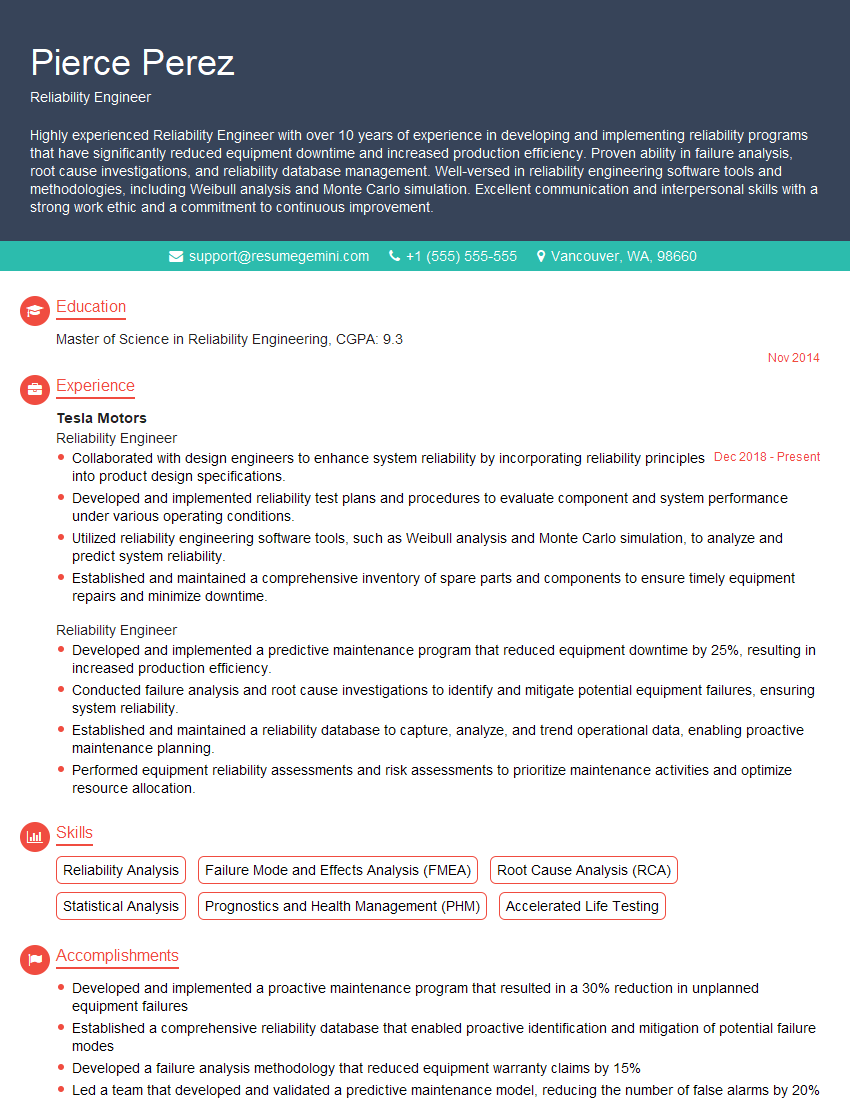
Mastering Reliability Testing opens doors to exciting career opportunities in diverse industries. A strong understanding of these principles significantly enhances your marketability and positions you for advancement. To maximize your job prospects, crafting an ATS-friendly resume is crucial. ResumeGemini is a trusted resource to help you build a professional and effective resume that showcases your skills and experience. Examples of resumes tailored to Reliability Testing are available, demonstrating how to present your qualifications compellingly. Take the next step towards your dream career – build a stand-out resume with ResumeGemini today!
Explore more articles
Users Rating of Our Blogs
Share Your Experience
We value your feedback! Please rate our content and share your thoughts (optional).
What Readers Say About Our Blog
Very informative content, great job.
good