The right preparation can turn an interview into an opportunity to showcase your expertise. This guide to Remote Sensing Imaging Techniques interview questions is your ultimate resource, providing key insights and tips to help you ace your responses and stand out as a top candidate.
Questions Asked in Remote Sensing Imaging Techniques Interview
Q 1. Explain the difference between passive and active remote sensing.
Passive and active remote sensing differ fundamentally in how they acquire data. Passive remote sensing systems detect natural radiation emitted or reflected by the Earth’s surface and atmosphere. Think of it like taking a photograph – you’re relying on existing light to capture an image. Examples include cameras on satellites that capture reflected sunlight. Active remote sensing systems, on the other hand, emit their own radiation and then measure the radiation reflected back. It’s like shining a flashlight and observing how the light bounces back. LiDAR (Light Detection and Ranging) and radar are prime examples. LiDAR uses laser pulses, while radar uses radio waves.
The key difference lies in the source of the energy: passive systems use the sun (or other natural sources), while active systems use their own energy source. This impacts the type of data collected and the applications where each technology excels. Passive systems are generally less expensive and easier to operate, but their data acquisition is dependent on weather and lighting conditions. Active systems, while more complex and costly, can operate day or night and in any weather, offering greater operational flexibility.
Q 2. Describe the electromagnetic spectrum and its relevance to remote sensing.
The electromagnetic spectrum encompasses all types of electromagnetic radiation, ranging from very long radio waves to very short gamma rays. In remote sensing, we’re primarily interested in the portion of the spectrum that interacts with the Earth’s surface and atmosphere. This includes:
- Visible light: The wavelengths we can see with our eyes (red, green, blue). This is essential for creating color images.
- Near-infrared (NIR): Wavelengths slightly longer than visible red light. Crucial for vegetation analysis, as healthy plants reflect strongly in NIR.
- Shortwave infrared (SWIR): Used to identify minerals and moisture content.
- Thermal infrared (TIR): Detects heat emitted by the Earth’s surface, useful for mapping temperatures and detecting heat sources.
- Microwave: Used by radar systems; can penetrate clouds and vegetation, providing data regardless of weather conditions.
Each part of the spectrum provides unique information about the Earth’s surface. By using sensors sensitive to different parts of the spectrum, remote sensing allows us to gather diverse data sets, enabling a comprehensive analysis of various land cover features and processes.
Q 3. What are the various spatial resolutions in remote sensing, and how do they impact image interpretation?
Spatial resolution refers to the size of the smallest ground area represented by a single pixel in a remote sensing image. Higher spatial resolution means smaller pixels, resulting in more detail. Different resolutions have vastly different impacts on image interpretation:
- Very high resolution (VHR): Less than 1 meter. Shows incredible detail, allowing for individual object identification (e.g., cars, buildings). Useful for urban mapping, precise agriculture, and security applications.
- High resolution: 1-10 meters. Excellent detail for identifying land cover types and features, but individual objects might be less distinct. Suitable for land-use planning and environmental monitoring.
- Medium resolution: 10-100 meters. Useful for regional-scale studies and monitoring large areas. Individual objects are not distinguishable, but land cover patterns are evident.
- Low resolution: Greater than 100 meters. Provides a broad overview, suitable for global-scale studies and climate change monitoring. Detail is limited, showing only major land cover features.
The choice of spatial resolution depends entirely on the application. A study focusing on individual tree health would require VHR data, while a climate change impact assessment might use lower resolution data to analyze large-scale vegetation changes.
Q 4. Explain the concept of atmospheric correction in remote sensing.
Atmospheric correction is a crucial preprocessing step in remote sensing. The Earth’s atmosphere interferes with the electromagnetic radiation traveling between the Earth’s surface and the sensor. Gases, aerosols (particles suspended in the air), and clouds scatter and absorb radiation, distorting the signals received by the sensor. Atmospheric correction aims to remove these atmospheric effects, ensuring the data reflects the true spectral properties of the Earth’s surface.
This is done using various techniques, often involving modeling the atmosphere’s impact on the radiation. Some common methods include using atmospheric models (like MODTRAN) or employing empirical methods based on ground measurements. The goal is to produce ‘top-of-atmosphere’ (TOA) reflectance values, representing the reflectance before atmospheric interaction, or ‘surface reflectance’, removing any atmospheric influence.
Without atmospheric correction, analysis results would be inaccurate, leading to flawed conclusions about land cover, vegetation health, and other important parameters.
Q 5. Discuss different types of satellite sensors and their applications (e.g., Landsat, Sentinel, MODIS).
Numerous satellite sensors are used in remote sensing, each with unique capabilities and applications:
- Landsat: A long-running series of satellites providing multispectral and thermal data at moderate resolution. Widely used for land-use change detection, agricultural monitoring, and environmental studies. Landsat’s long archive makes it invaluable for analyzing trends over time.
- Sentinel: A constellation of satellites operated by the European Space Agency (ESA), offering high-resolution data across various spectral bands. Sentinel-2 provides high spatial resolution optical data for land monitoring, while Sentinel-1 uses radar for applications where clouds or darkness are issues.
- MODIS (Moderate Resolution Imaging Spectroradiometer): A sensor aboard NASA’s Terra and Aqua satellites. Offers global coverage at moderate resolution, primarily focused on climate monitoring and large-scale environmental studies. Provides data on vegetation, land surface temperature, and many other parameters.
The choice of sensor depends on the specific application’s spatial and spectral requirements, budget, and temporal resolution needs. For instance, high-resolution data from Sentinel-2 is ideal for detailed urban mapping, while MODIS’s global coverage is essential for tracking deforestation across entire continents.
Q 6. How does geometric correction improve the accuracy of remote sensing data?
Geometric correction is a critical step in improving the accuracy of remote sensing data. Satellite images are often distorted due to various factors including Earth’s curvature, sensor platform movement, and atmospheric effects. These distortions cause misalignment and inaccuracies in spatial measurements.
Geometric correction aims to rectify these distortions, creating images that accurately represent the Earth’s surface. This is achieved using ground control points (GCPs) – known locations on the image that are also identifiable on a map or other reference data (e.g., GPS coordinates). Sophisticated algorithms use these GCPs to mathematically transform the image, correcting for distortions and aligning the pixels to their true geographic locations.
The improved accuracy is essential for many applications. For example, accurate measurements of area, distance, and shape are crucial for land-use planning, environmental impact assessments, and precision agriculture. Without geometric correction, these measurements would be inaccurate and unreliable.
Q 7. What is image classification, and explain different classification techniques (supervised, unsupervised).
Image classification is the process of assigning each pixel in a remote sensing image to a specific category or class, such as forest, water, or urban area. This allows us to create thematic maps depicting the spatial distribution of various land cover types.
There are two main types of image classification techniques:
- Supervised classification: This approach involves training the classification algorithm using labeled samples (training data). You manually identify pixels representing each class and provide this information to the algorithm. The algorithm then learns to distinguish between classes based on their spectral signatures. Common methods include maximum likelihood classification and support vector machines.
- Unsupervised classification: This technique does not require training data. The algorithm automatically groups pixels into classes based on their spectral similarity. K-means clustering is a popular unsupervised classification method. It is useful for exploratory analysis when you don’t have prior knowledge of the classes present.
The choice between supervised and unsupervised classification depends on the availability of training data and the level of prior knowledge about the image. Supervised classification is generally more accurate when training data is available, while unsupervised classification is helpful for initial exploration or when labeled data is scarce.
Q 8. Describe the process of image enhancement and its purpose.
Image enhancement in remote sensing involves processing satellite or aerial imagery to improve its visual quality, clarity, and information content. Think of it like editing a photograph to make it more appealing and informative. The purpose is to make features of interest easier to identify and analyze. This is crucial because raw imagery often suffers from noise, atmospheric effects, or low contrast.
The process typically involves a range of techniques:
- Noise reduction: Filtering techniques remove random variations in pixel values.
- Contrast enhancement: Techniques like histogram equalization or stretching improve the visibility of subtle differences in brightness or color.
- Sharpening: High-pass filtering can enhance edges and fine details.
- Geometric correction: This corrects for distortions caused by sensor geometry or the Earth’s curvature.
- Atmospheric correction: This compensates for the scattering and absorption of light by the atmosphere, revealing the true surface reflectance.
For example, enhancing an image of a forest might involve sharpening to better distinguish individual trees, and atmospheric correction to remove haze, thus allowing for better assessment of tree health.
Q 9. Explain the concept of spectral indices (e.g., NDVI) and their use in remote sensing.
Spectral indices are mathematical combinations of different wavelengths (bands) of electromagnetic radiation captured by a sensor. They are designed to highlight specific features or characteristics of the Earth’s surface. Think of them as specialized filters that reveal hidden information within the data. A prime example is the Normalized Difference Vegetation Index (NDVI).
NDVI uses the red and near-infrared (NIR) bands: NDVI = (NIR - Red) / (NIR + Red). Healthy vegetation strongly absorbs red light and reflects NIR light. Therefore, high NDVI values indicate healthy vegetation, while low values suggest bare soil or unhealthy vegetation. This allows for quick assessments of vegetation health, growth, and biomass across vast areas.
Other common spectral indices include:
- Normalized Difference Water Index (NDWI): Detects water bodies.
- Enhanced Vegetation Index (EVI): Improves upon NDVI for high biomass areas.
- Soil Adjusted Vegetation Index (SAVI): Reduces soil brightness influences.
These indices are used extensively in agriculture monitoring, deforestation detection, and environmental change studies.
Q 10. How do you handle cloud cover in satellite imagery?
Cloud cover is a major challenge in remote sensing because it obscures the Earth’s surface. Several techniques are used to handle this:
- Image selection: Choosing cloud-free images is the simplest approach, but often requires waiting for favorable weather conditions.
- Cloud masking: Algorithms identify cloud pixels based on their spectral characteristics (high reflectance in visible and near-infrared bands) and then mask (remove or flag) them.
- Cloud filling: Advanced techniques use neighboring cloud-free pixels or data from other sources (e.g., different dates) to estimate the surface reflectance under the clouds. This can involve interpolation or sophisticated statistical models.
- Sensor fusion: Combining data from different sensors, such as those with different spectral ranges or acquisition times, can provide more complete coverage by minimizing the impact of clouds.
For instance, in precision agriculture, cloud masking allows for the creation of cloud-free mosaics of agricultural fields which then facilitates efficient crop monitoring.
Q 11. What are the advantages and disadvantages of using LiDAR data?
LiDAR (Light Detection and Ranging) uses laser pulses to measure distances and create highly accurate 3D representations of the Earth’s surface. It is similar to radar but uses light instead of radio waves.
Advantages:
- High accuracy: LiDAR provides precise elevation data, far superior to traditional photogrammetry in many cases.
- Penetration capability: Can penetrate vegetation cover, providing information about the underlying ground surface.
- 3D point cloud data: Creates detailed 3D models that can be used for various applications.
Disadvantages:
- Cost: LiDAR data acquisition is significantly more expensive than traditional imagery.
- Weather sensitivity: Atmospheric conditions (e.g., fog, rain) can affect data quality.
- Data processing: Processing large LiDAR datasets requires specialized software and expertise.
For example, LiDAR is invaluable for creating highly accurate digital elevation models (DEMs) for infrastructure planning, flood risk assessment, and precision agriculture.
Q 12. Explain the principles of photogrammetry and its application in remote sensing.
Photogrammetry is the science of making measurements from photographs. In remote sensing, it uses overlapping images to create 3D models of the Earth’s surface. Imagine reconstructing a 3D puzzle from multiple 2D pictures.
The principles involve:
- Image acquisition: Capturing overlapping images from different angles (aerial or satellite).
- Feature identification: Identifying common features (points, lines, etc.) in multiple images.
- Orientation: Determining the position and orientation of the camera for each image.
- Triangulation: Using geometry to determine the 3D coordinates of points in space.
- Model generation: Creating a 3D surface model or orthorectified image (geographically corrected).
Applications include creating highly accurate maps, digital elevation models, and 3D city models. Photogrammetry is becoming increasingly accessible with the use of consumer-grade drones and readily available software.
Q 13. What are the ethical considerations in using remote sensing data?
Ethical considerations in using remote sensing data are crucial. Because it can collect information without physical access, there are potential privacy and security concerns.
- Privacy violation: High-resolution imagery can reveal sensitive personal information, like individuals’ activities or locations. This necessitates careful data handling and anonymization techniques.
- Data security: Protecting sensitive data from unauthorized access or misuse is essential. Appropriate security protocols and access controls are required.
- Informed consent: Depending on the application, obtaining informed consent from individuals or communities whose data is being collected may be necessary.
- Bias and discrimination: Algorithms used to process remote sensing data can perpetuate existing biases, leading to unfair or discriminatory outcomes. Careful algorithm design and validation are crucial.
- Data ownership and access: Clear guidelines on data ownership and access rights are needed to avoid disputes and ensure equitable access.
For example, using high-resolution imagery for surveillance without proper legal and ethical frameworks could lead to serious privacy violations. Therefore, responsible data governance and ethical frameworks are paramount in this field.
Q 14. How can remote sensing be applied to precision agriculture?
Remote sensing plays a pivotal role in precision agriculture by providing spatially explicit information about crop health, soil conditions, and environmental factors. This allows farmers to optimize resource use and improve yields.
Applications include:
- Crop monitoring: NDVI and other spectral indices derived from satellite imagery can assess crop health, identify stress areas, and guide targeted interventions.
- Yield prediction: Remote sensing data can be used to predict crop yields, aiding in planning for harvest and logistics.
- Irrigation management: Monitoring soil moisture and vegetation water stress helps optimize irrigation scheduling, conserving water and improving efficiency.
- Nutrient management: Analyzing spectral data can reveal nutrient deficiencies in crops, enabling targeted fertilizer application, reducing environmental impact, and improving profitability.
- Weed detection: Remote sensing can assist in identifying weed infestations, helping farmers target herbicide application and reducing weed pressure.
For example, a farmer might use drone-based multispectral imagery to map nutrient deficiencies across a field. This allows precise fertilizer application, reducing fertilizer costs and minimizing environmental impact.
Q 15. Describe the use of remote sensing in urban planning and monitoring.
Remote sensing plays a crucial role in urban planning and monitoring by providing a bird’s-eye view of urban landscapes. Instead of relying solely on ground-level surveys, we can use satellite and aerial imagery to analyze various aspects of a city.
- Urban Sprawl Monitoring: High-resolution imagery helps track the expansion of urban areas over time, aiding in sustainable land-use planning and preventing uncontrolled growth. We can identify patterns and predict future sprawl using techniques like change detection.
- Infrastructure Assessment: Remote sensing data can assess the condition of roads, bridges, and buildings. For example, analyzing multispectral imagery can reveal cracks or damage in road surfaces before they become serious problems, thus saving costs in the long run.
- Population Density Mapping: By analyzing nighttime light imagery, we can estimate population density in different urban areas, helping in resource allocation and urban planning strategies.
- Environmental Monitoring: Remote sensing allows for monitoring of air quality, heat islands, and vegetation cover within urban environments, crucial for creating more sustainable and livable cities. For instance, thermal imagery can identify areas with excessively high temperatures.
Imagine planning a new highway system for a rapidly growing city. Remote sensing data provides the essential information to optimize the route, minimizing disruption to existing infrastructure and environmental impacts.
Career Expert Tips:
- Ace those interviews! Prepare effectively by reviewing the Top 50 Most Common Interview Questions on ResumeGemini.
- Navigate your job search with confidence! Explore a wide range of Career Tips on ResumeGemini. Learn about common challenges and recommendations to overcome them.
- Craft the perfect resume! Master the Art of Resume Writing with ResumeGemini’s guide. Showcase your unique qualifications and achievements effectively.
- Don’t miss out on holiday savings! Build your dream resume with ResumeGemini’s ATS optimized templates.
Q 16. Explain the role of remote sensing in disaster management.
Remote sensing is indispensable in disaster management, providing rapid assessments and crucial information during and after natural disasters.
- Pre-Disaster Risk Assessment: We can identify areas prone to flooding, landslides, or earthquakes using topographic data, elevation models, and historical imagery. This allows for proactive measures and mitigation strategies.
- Damage Assessment: After a disaster like a hurricane or earthquake, high-resolution satellite imagery can quickly assess the extent of damage to infrastructure and residential areas, enabling prioritization of rescue and relief efforts. For instance, we can automatically identify collapsed buildings.
- Search and Rescue: Thermal imagery can detect individuals trapped under rubble or in disaster-stricken areas, aiding rescue operations.
- Post-Disaster Monitoring: Remote sensing helps monitor the recovery process, tracking the rebuilding of infrastructure and the restoration of affected areas over time.
During the 2010 Haiti earthquake, remote sensing played a crucial role in assessing the damage and guiding aid distribution, illustrating its real-world importance in humanitarian emergencies.
Q 17. How can you assess the accuracy of remote sensing data?
Accuracy assessment of remote sensing data is crucial for reliable analysis. It involves comparing the remotely sensed data with ground truth data (obtained through fieldwork) using various statistical measures.
- Ground Truthing: This involves collecting reference data at various points within the study area. For instance, we might physically visit sites to verify land cover types identified in satellite imagery.
- Error Matrix (Confusion Matrix): A common method is to create a confusion matrix showing the comparison between the classified remote sensing data and the ground truth data. From this, we calculate accuracy metrics like overall accuracy, producer’s accuracy, and user’s accuracy.
- Root Mean Square Error (RMSE): For continuous variables like temperature or elevation, RMSE measures the average difference between the remotely sensed values and ground truth values.
- Statistical Tests: We can also utilize statistical tests (e.g., Kappa coefficient) to assess the agreement between the classified image and the ground truth, accounting for random agreement.
The selection of appropriate accuracy assessment methods depends on the type of remote sensing data, the application, and the available resources. A robust accuracy assessment is essential to ensure the reliability of any conclusions drawn from the analysis.
Q 18. Discuss the different data formats used in remote sensing (e.g., GeoTIFF, HDF).
Remote sensing data is stored in various formats, each with its own strengths and weaknesses. The choice depends on the sensor, the application, and the software used.
- GeoTIFF: A widely used format that combines the capabilities of TIFF (Tagged Image File Format) with geospatial referencing information. This means the image is geo-referenced, meaning its location on the earth is explicitly defined. It’s widely supported by various GIS and remote sensing software.
- HDF (Hierarchical Data Format): HDF is a flexible format capable of storing large, complex datasets. It’s particularly useful for storing multispectral imagery with multiple bands and ancillary information (metadata). Commonly used by NASA for satellite data.
- ERDAS Imagine (.img): Proprietary format used by ERDAS Imagine software, known for its efficiency in handling large raster datasets.
- ENVI format (.dat): Another proprietary format used by ENVI software, commonly used for spectral data.
For instance, a Landsat image might be distributed in GeoTIFF format for ease of access, while a complex hyperspectral image might be stored in HDF to accommodate the large volume of spectral data.
Q 19. Explain the concept of spatial autocorrelation and its implications.
Spatial autocorrelation refers to the degree of similarity between nearby observations in spatial data. In simpler terms, it means that values closer together tend to be more similar than values farther apart.
Consider a map of vegetation density. Areas with similar vegetation density are likely to be clustered together. This clustering is a manifestation of spatial autocorrelation.
- Implications: Ignoring spatial autocorrelation can lead to biased statistical analyses and inaccurate conclusions. Traditional statistical methods often assume independence between observations, which is violated in spatially autocorrelated data.
- Addressing Autocorrelation: Techniques like geostatistics and spatial regression models are used to account for spatial autocorrelation. These methods incorporate the spatial relationships between observations in the analysis, leading to more accurate results.
For example, when analyzing soil properties, understanding spatial autocorrelation is essential because soil characteristics often exhibit spatial dependence due to factors like topography and soil formation processes.
Q 20. What are the challenges in processing large volumes of remote sensing data?
Processing large volumes of remote sensing data presents significant challenges. The sheer size of these datasets requires specialized techniques and infrastructure.
- Storage: Storing petabytes of data necessitates robust and scalable storage solutions, often involving cloud computing and distributed storage systems.
- Processing Power: Processing large datasets demands high-performance computing (HPC) resources, including powerful servers and parallel processing capabilities.
- Computational Time: Even with HPC, processing can be time-consuming, especially for complex tasks like image classification or change detection. Efficient algorithms and optimized workflows are crucial.
- Data Management: Managing and organizing large datasets requires a well-defined data management strategy, including metadata management and data organization.
For instance, processing a high-resolution satellite image covering a large area can take days or even weeks on a standard computer, highlighting the need for efficient processing methods and high-performance computing.
Q 21. Describe your experience with different remote sensing software (e.g., ENVI, ArcGIS, QGIS).
I have extensive experience with various remote sensing software packages, including ENVI, ArcGIS, and QGIS.
- ENVI: I’ve used ENVI extensively for image preprocessing, atmospheric correction, spectral analysis, and classification tasks. Its capabilities in handling hyperspectral data are particularly valuable.
- ArcGIS: ArcGIS is my go-to software for geospatial analysis and integration with other geospatial datasets. I frequently use it for image processing, creating maps, performing spatial analysis, and integrating remote sensing data with other geographical information.
- QGIS: QGIS provides a powerful open-source alternative to commercial software like ArcGIS and ENVI. I’ve used QGIS for various tasks, including image processing, analysis, and visualization, benefiting from its flexibility and free availability.
My expertise in these platforms allows me to select the most appropriate tool for specific tasks, maximizing efficiency and accuracy in data processing and analysis. I often find myself integrating workflows across multiple platforms to leverage their unique strengths for a project.
Q 22. How do you handle errors and inconsistencies in remote sensing data?
Handling errors and inconsistencies in remote sensing data is crucial for reliable analysis. It’s a multi-step process starting with data quality assessment. This involves examining metadata for sensor characteristics, atmospheric conditions during acquisition, and potential processing steps. We look for things like striping in imagery (consistent vertical lines of differing brightness), cloud cover, and geometric distortions.
Next, we employ various techniques depending on the nature of the error. For atmospheric effects, we might use atmospheric correction models, such as dark object subtraction or more sophisticated methods like FLAASH (Fast Line-of-sight Atmospheric Analysis of Spectral Hypercubes). Geometric errors are often corrected using ground control points (GCPs) and georeferencing techniques. These GCPs are real-world locations with known coordinates, allowing us to align the imagery to a known map projection.
Furthermore, spatial filtering techniques can smooth out noise and inconsistencies. For example, a median filter can effectively remove salt-and-pepper noise, while a Gaussian filter can smooth out high-frequency variations. Identifying and removing outliers is also essential; this might involve analyzing histograms or using statistical methods to detect and replace anomalous pixel values. For more complex errors, advanced techniques like data fusion (combining data from multiple sensors) or machine learning algorithms (for automated error detection and correction) can be employed.
Finally, rigorous quality control throughout the entire process—from data acquisition to analysis—is essential to minimize errors and uncertainties. A well-documented workflow is paramount for tracing errors back to their source and for reproducibility.
Q 23. Explain your understanding of different projection systems and coordinate reference systems.
Projection systems and coordinate reference systems (CRSs) are fundamental to remote sensing. A projection system is a mathematical transformation that converts the three-dimensional spherical surface of the Earth onto a two-dimensional plane. Because this conversion is impossible without distortion, various projections are designed to minimize distortion for specific applications; some projections preserve area, others preserve shape or direction. Common projections include UTM (Universal Transverse Mercator), Lambert Conformal Conic, and Albers Equal-Area Conic.
A coordinate reference system (CRS) defines the location of points on the Earth’s surface. It comprises a datum (a reference ellipsoid approximating the Earth’s shape) and a projection. For example, WGS 84 is a widely used datum, and combining it with a UTM projection gives a specific CRS. The choice of projection and CRS is crucial. Using an inappropriate CRS can introduce significant geometric distortions, leading to inaccurate measurements and misinterpretations of the data. For instance, a map projected in a cylindrical projection will show significant distortion at higher latitudes.
In practice, selecting the right CRS depends on the study area’s extent and the type of analysis. For large areas spanning several degrees of latitude, a conic projection might be suitable, while a smaller, localized area might be well-represented by a UTM projection. Software like ArcGIS or QGIS provides tools to manage and transform between different CRSs, which is essential when integrating data from various sources.
Q 24. Discuss the importance of metadata in remote sensing data management.
Metadata is the cornerstone of effective remote sensing data management. It’s essentially descriptive information about the data itself, such as acquisition parameters, processing history, and quality assessment details. Think of it as the ‘passport’ for your data, providing essential context for proper use and interpretation.
The importance of metadata stems from its role in several aspects of data management. It ensures data discoverability, allowing users to easily locate and understand data sets relevant to their needs. It also aids in quality control, enabling assessment of data reliability and suitability for specific applications. Metadata helps in traceability, documenting the entire data lifecycle from acquisition to analysis, and enhancing reproducibility. Finally, it’s crucial for legal and ethical considerations, potentially including details regarding data ownership, access restrictions, and licensing agreements. For example, a Landsat image’s metadata includes the date and time of acquisition, sensor settings, cloud cover percentage, and processing steps.
Without proper metadata, finding, understanding, and using remote sensing data would be incredibly difficult and error-prone. It would significantly hamper collaboration, data sharing, and the overall scientific integrity of research involving remote sensing data.
Q 25. Describe your experience with data visualization techniques for remote sensing data.
Data visualization is paramount for effective communication and analysis in remote sensing. It converts complex numerical data into readily interpretable visual representations. My experience spans a range of techniques. For instance, I regularly use standard software like ArcGIS, QGIS, and ENVI for creating thematic maps, displaying spectral indices (like NDVI for vegetation health), and generating image mosaics. These tools allow for visual exploration of spatial patterns and relationships within the data.
Beyond basic mapping, I utilize advanced visualization techniques like 3D surface rendering, for visualizing elevation models or urban landscapes. False-color composites help to enhance specific spectral features, while time-series animations track changes over time, like deforestation or urban sprawl. Interactive dashboards, developed using programming languages such as Python (with libraries like Matplotlib and Plotly), provide a dynamic platform for exploration and analysis.
The choice of visualization technique depends heavily on the specific data and the message being conveyed. For example, a simple thematic map might suffice for communicating land use classifications, while a 3D model might be preferred for visualizing terrain and structures in a detailed urban setting. Clear and effective data visualization ensures that findings are easily communicated to both technical and non-technical audiences.
Q 26. How do you stay updated on the latest advancements in remote sensing technologies?
Keeping abreast of advancements in remote sensing is critical. I employ several strategies to stay updated. Regularly reading peer-reviewed journals like Remote Sensing of Environment and IEEE Transactions on Geoscience and Remote Sensing is essential. Attending international conferences like the IEEE International Geoscience and Remote Sensing Symposium (IGARSS) provides opportunities to learn about cutting-edge research and interact with leading experts in the field. Actively participating in online communities and forums dedicated to remote sensing keeps me connected with the broader community and allows me to learn about new developments.
I also actively follow the websites and publications of major space agencies (NASA, ESA, JAXA) and commercial satellite providers to remain informed about the launch of new satellites and the development of novel sensors and data processing techniques. Online courses (e.g., Coursera, edX) and webinars are valuable for enhancing my skills in specific areas. Staying active in professional organizations, such as the ASPRS (American Society for Photogrammetry and Remote Sensing), provides access to resources, training, and networking opportunities.
Q 27. Explain your experience working with different types of remote sensing platforms (e.g., airborne, satellite).
My experience encompasses both airborne and satellite remote sensing platforms. Airborne platforms, such as manned aircraft and UAVs (Unmanned Aerial Vehicles or drones), offer high-resolution imagery tailored for specific study areas. I’ve utilized airborne LiDAR (Light Detection and Ranging) to generate detailed 3D models for applications like urban planning and infrastructure monitoring. High-resolution aerial photography has been crucial for tasks such as precise mapping and change detection in agricultural fields.
Satellite remote sensing data, with its broader coverage, is invaluable for large-scale projects. I’ve extensively worked with data from Landsat, Sentinel, and MODIS satellites for applications including land cover classification, deforestation monitoring, and climate change research. The ability to access data freely available from Landsat and Sentinel, along with commercially available high-resolution imagery, greatly expands the scope and possibilities of various projects.
The choice between airborne and satellite platforms depends on the project’s scale, required spatial resolution, and budgetary constraints. Often, a combined approach using both airborne and satellite data can be particularly effective in providing a comprehensive dataset.
Q 28. Describe a project where you used remote sensing techniques to solve a problem.
In a recent project, we used remote sensing to assess the impact of a wildfire on forest regeneration. The area was vast, making ground-based surveys impractical. We utilized a combination of pre- and post-fire Landsat imagery to monitor changes in vegetation indices (NDVI) over several years. By analyzing temporal trends in NDVI, we could quantify the extent of vegetation recovery and identify areas that showed slower or no regeneration.
We also integrated high-resolution WorldView imagery to obtain detailed information on post-fire land cover changes. This multi-resolution approach allowed us to analyze both the overall regeneration patterns and the specific characteristics of the vegetation recovery. The results were critical for informing forest management decisions, assisting in prioritizing reforestation efforts, and in assessing the long-term ecological impact of the fire. This project highlighted the power of remote sensing in providing timely and cost-effective solutions for monitoring environmental change and assisting in resource management.
Key Topics to Learn for Remote Sensing Imaging Techniques Interview
- Electromagnetic Spectrum and Sensor Physics: Understand the interaction of electromagnetic radiation with the Earth’s surface and the principles behind different sensor types (e.g., passive vs. active, multispectral vs. hyperspectral).
- Image Acquisition and Preprocessing: Familiarize yourself with various platforms (satellite, airborne, UAV), data formats, and preprocessing techniques like geometric correction, atmospheric correction, and radiometric calibration. Practical application: Describe a scenario where you’d choose a specific sensor and preprocessing workflow based on project requirements.
- Image Enhancement and Analysis: Master image enhancement techniques (e.g., filtering, sharpening) and analysis methods like image classification (supervised, unsupervised), object-based image analysis (OBIA), and change detection. Practical application: Explain how you would analyze imagery to identify deforestation patterns.
- Remote Sensing Applications: Explore diverse applications across various fields like agriculture (crop monitoring), environmental monitoring (pollution detection), urban planning (land use classification), and natural resource management (forestry). Practical application: Discuss a specific project where you applied remote sensing to solve a real-world problem.
- Data Visualization and Interpretation: Develop strong skills in interpreting remotely sensed imagery and presenting findings effectively through maps, charts, and reports. Practical application: Describe how you would communicate complex technical findings to a non-technical audience.
- GIS Integration: Understand how remote sensing data integrates with Geographic Information Systems (GIS) for spatial analysis and modeling. Practical application: Explain your experience working with GIS software and integrating remote sensing data into a GIS project.
- Error Analysis and Uncertainty Quantification: Learn to assess data quality, identify sources of error, and quantify uncertainty in remote sensing measurements and analysis results.
Next Steps
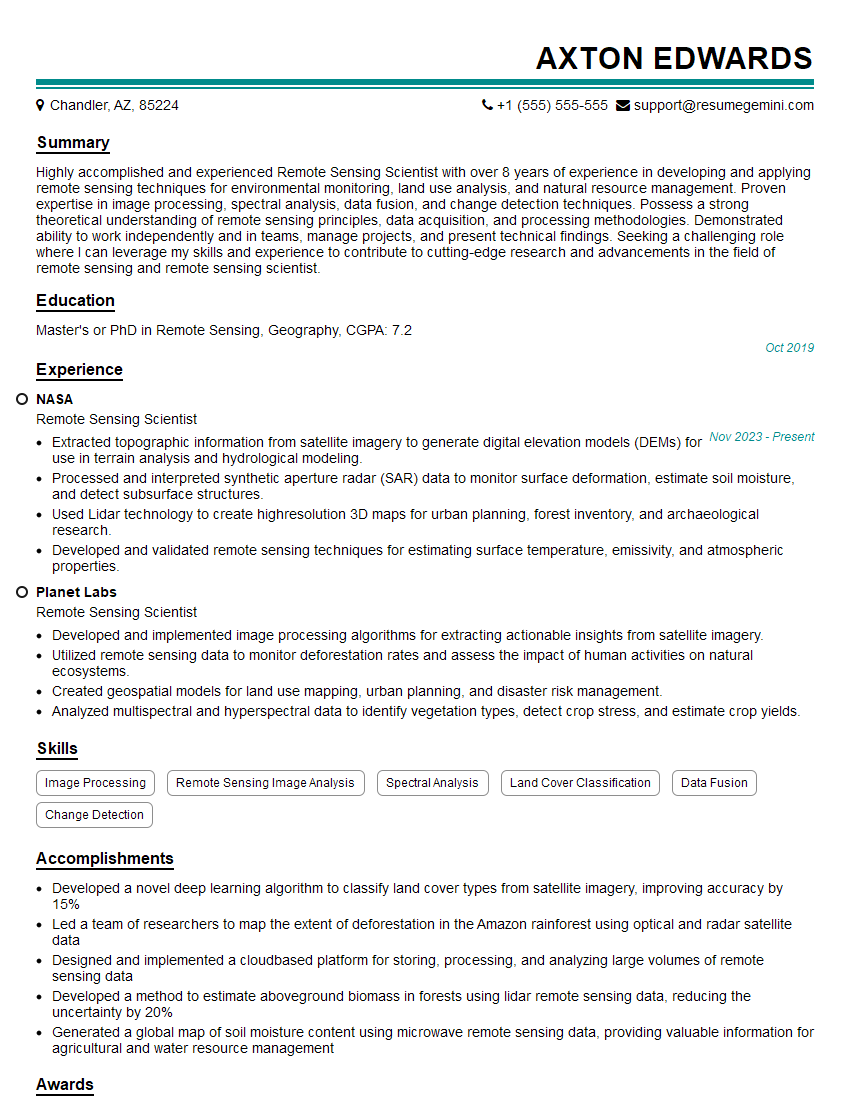
Mastering Remote Sensing Imaging Techniques is crucial for career advancement in a rapidly growing field offering diverse and impactful opportunities. To maximize your job prospects, focus on creating an ATS-friendly resume that effectively showcases your skills and experience. ResumeGemini is a trusted resource to help you build a professional and compelling resume that stands out. We provide examples of resumes tailored to Remote Sensing Imaging Techniques to guide you in this process. Take the next step towards your dream career today!
Explore more articles
Users Rating of Our Blogs
Share Your Experience
We value your feedback! Please rate our content and share your thoughts (optional).
What Readers Say About Our Blog
Very informative content, great job.
good