Unlock your full potential by mastering the most common Rigging and Derricking interview questions. This blog offers a deep dive into the critical topics, ensuring you’re not only prepared to answer but to excel. With these insights, you’ll approach your interview with clarity and confidence.
Questions Asked in Rigging and Derricking Interview
Q 1. Explain the different types of rigging hardware and their applications.
Rigging hardware encompasses a wide array of components crucial for safely lifting and moving heavy objects. Selection depends heavily on the load’s weight, shape, and the specific rigging requirements. Here are some key types:
- Shackles: These are U-shaped metal fasteners with a pin through the bow. They connect various rigging components. Bow shackles are common, but D-shackles offer higher strength and are preferred for high-stress applications. Example: Connecting a sling to a crane hook.
- Slings: These are used to encircle and lift loads. Common types include chain slings (durable, for heavy loads), wire rope slings (flexible, for various shapes), and synthetic web slings (lightweight, easy to handle but susceptible to UV degradation). Example: Lifting a steel beam using a three-legged wire rope sling for stability.
- Hooks: These are used to attach the load to the sling or other rigging hardware. Crane hooks, for instance, are designed to withstand substantial loads and feature safety latches to prevent accidental disengagement. Example: The primary connection point between a crane and the lifting assembly.
- Turnbuckles: These allow for adjusting the length of wire rope or chain slings, ensuring proper tension and load distribution. Example: Fine-tuning the length of a sling to compensate for uneven ground or load shifting.
- Eye Bolts: These are threaded bolts with a loop at one end, providing a secure attachment point for slings or other rigging hardware on a load. Example: Attaching a sling to a pre-drilled hole in a heavy component.
- Load Binders: These are used to secure loads during transport, often employed with ratchet straps. Example: Securing a heavy cargo container onto a flatbed trailer.
Choosing the right hardware is paramount. Incorrect selection can lead to catastrophic equipment failure and serious injury. Always refer to manufacturer specifications and relevant safety standards.
Q 2. Describe the process of calculating the safe working load (SWL) of a rigging assembly.
Calculating the Safe Working Load (SWL) of a rigging assembly is crucial for safe operation. It’s not simply the SWL of the strongest individual component; it involves considering the entire assembly’s capacity. Here’s the process:
- Identify all components: This includes slings, shackles, hooks, and any other hardware used in the lift. Note the SWL of each component as specified by the manufacturer.
- Consider the angle of the lift: Lifting at angles reduces the effective SWL. For example, a sling lifted at 30 degrees from vertical has a significantly lower SWL than one lifted vertically. Many manufacturers provide charts or calculations to adjust the SWL based on the angle.
- Factor in the number of legs in a sling: Multiple-leg slings distribute the load among the legs. A three-leg sling, for example, distributes the load more evenly than a single-leg sling. However, the SWL for each leg still needs to be considered.
- Include safety factors: Always incorporate a significant safety factor (typically 5:1 or greater). This accounts for unforeseen circumstances, wear and tear, and variations in load distribution.
- Calculate the minimum SWL: The SWL of the entire rigging assembly is the lowest SWL among all the components, adjusted for the angle and the number of legs, further reduced by the safety factor. Example: If the lowest component SWL is 10,000 lbs, with a 5:1 safety factor, the actual SWL for the assembly would be 2,000 lbs.
Remember, always err on the side of caution. If unsure about the SWL calculation, consult a qualified rigging expert before proceeding with the lift.
Q 3. What are the critical safety considerations when rigging heavy loads?
Rigging heavy loads demands meticulous attention to safety. Critical considerations include:
- Proper load distribution: Ensure the load is evenly distributed across all attachment points to prevent stress concentrations and component failure. Improper load distribution is a common cause of accidents.
- Using appropriate rigging equipment: Select equipment with an SWL exceeding the load weight, considering all factors described earlier. Inspect each component thoroughly before use.
- Competent personnel: Only trained and qualified personnel should perform rigging operations. Everyone involved must understand the procedure, risks, and communication protocols.
- Clear communication: Establish a clear and consistent communication system between crane operators, riggers, and ground personnel. Hand signals should be pre-determined and understood by everyone.
- Safe working environment: Ensure the area around the lift is clear of obstructions and personnel. Establish exclusion zones and implement traffic control measures.
- Weather conditions: Avoid rigging operations during adverse weather such as high winds or heavy rain, which can compromise stability and control.
- Emergency procedures: Develop and practice emergency procedures for unexpected events, such as load shifting or equipment failure.
Negligence in these areas can have devastating consequences. A thorough risk assessment is essential before starting any rigging operation.
Q 4. How do you identify and mitigate potential hazards during a rigging operation?
Hazard identification and mitigation are paramount. My approach involves a multi-step process:
- Pre-lift inspection: Thoroughly examine the rigging equipment, the load, and the surrounding environment. Check for damage, corrosion, or any other defects. This should include a visual inspection and possibly non-destructive testing if necessary.
- Risk assessment: Identify potential hazards, including environmental factors (wind, rain), load characteristics (weight, shape, stability), and equipment condition. Assess the likelihood and severity of each hazard.
- Develop mitigation strategies: For each identified hazard, develop a strategy to mitigate the risk. This might involve using different rigging equipment, adjusting the lifting technique, implementing additional safety measures (e.g., using tag lines for load control), or postponing the lift.
- Communication and coordination: Clearly communicate the identified hazards and mitigation strategies to all personnel involved. Ensure everyone understands their roles and responsibilities.
- Regular monitoring: Continuously monitor the rigging operation throughout the lift to identify any new hazards or deviations from the plan. Be prepared to stop the operation if a hazard emerges.
For example, if I identify a potential for the load to swing during the lift due to wind, I would use tag lines to control the load’s movement and potentially postpone the lift if wind speeds exceed safe limits.
Q 5. Explain the importance of proper communication and signaling during rigging operations.
Effective communication is critical for safety in rigging. Misunderstandings can have fatal consequences.
We use a combination of verbal communication and standardized hand signals. Before any lift, a pre-lift meeting clarifies the plan, roles, responsibilities, and emergency procedures. During the lift, clear, concise communication is essential. The crane operator relies on signals from the rigger to precisely position the load. The rigger, in turn, communicates with ground personnel to ensure a safe working environment. Standardized hand signals are invaluable, particularly in noisy environments. They are established before commencing any work and clearly understood by all parties.
In addition to visual signals, radio communication is often employed, especially in complex lifts, enabling instantaneous updates on the load’s position, any changes to the plan, or any potential hazards that need attention. Effective communication minimizes errors, enhances coordination, and ensures a safer and more efficient operation.
Q 6. Describe your experience with different types of cranes and their limitations.
My experience encompasses various crane types, each with its own strengths and limitations:
- Tower Cranes: Excellent for high-rise construction, offering a large lifting capacity and extensive reach. However, they are site-specific, requiring significant assembly and disassembly time and a suitable foundation.
- Mobile Cranes: Versatile and easily transportable, these are suitable for a wider range of tasks. Their maneuverability is a key advantage, but their lifting capacity and reach are typically limited compared to tower cranes.
- Overhead Cranes: Common in industrial settings, these provide precise load control within a confined area. Their movement is restricted to the defined track system.
- All-Terrain Cranes: These can operate on uneven terrain, making them suitable for challenging locations. However, their capacity may be reduced compared to mobile cranes.
- Rough Terrain Cranes: Designed for off-road operation, they handle difficult terrains well, but their lifting capacity might be less than All-Terrain Cranes.
Understanding these limitations is crucial for selecting the appropriate crane for a specific job. Improper crane selection can compromise safety and efficiency.
Q 7. How do you inspect rigging equipment for wear and tear?
Rigging equipment inspection is a critical safety procedure, done before every lift and regularly during use. My inspection process includes:
- Visual Inspection: Carefully examine all components for signs of wear, such as kinks, cracks, corrosion, stretching, fraying (in ropes), or any damage to the protective coatings. Pay special attention to wear points.
- Checking for proper function: Ensure all moving parts, like shackles and turnbuckles, operate smoothly and freely. Verify the integrity of safety latches and locking mechanisms.
- Load testing (where applicable): For critical lifts or when there is any doubt about the equipment’s condition, a load test under the supervision of a qualified professional is recommended. This ensures that the equipment can safely support the intended load.
- Documentation: Record all inspection findings, including any damage or deficiencies. This documentation is crucial for tracking the equipment’s history and ensuring compliance with safety regulations.
- Retirement criteria: Establish clear criteria for retiring worn-out or damaged equipment. Do not compromise on safety; replace any component that shows signs of significant wear or damage.
Careful inspection is essential. Ignoring minor damage can lead to a catastrophic failure. The consequences of a rigging failure can be severe; therefore, regular and thorough inspections are a non-negotiable aspect of safe rigging practices.
Q 8. What are the regulations and standards you adhere to when performing rigging tasks?
Rigging and derricking operations are governed by stringent safety regulations and industry standards to minimize risks. These vary slightly depending on location (e.g., OSHA in the US, HSE in the UK), but core principles remain consistent. I always adhere to the relevant national and international standards, such as ASME B30 (for cranes and rigging), and any company-specific safety manuals. These regulations cover aspects like:
- Competency of personnel: Only trained and certified riggers are allowed to perform tasks, ensuring everyone understands the risks and procedures.
- Equipment inspection: Before every lift, a thorough inspection of all equipment—slings, shackles, hooks, cranes, and so on—is mandatory to identify any defects or wear and tear. Defective equipment is immediately removed from service.
- Load calculations: Accurate load calculations are crucial. We use load charts and engineering calculations to ensure that the equipment has a sufficient safety factor to handle the weight and stress.
- Safe working loads (SWL): All equipment has a SWL, which is never exceeded. We always maintain a significant safety margin.
- Risk assessment: A risk assessment is conducted before every operation, identifying potential hazards and implementing appropriate control measures. This includes considering environmental factors like wind speed and ground conditions.
- Emergency procedures: Clear emergency procedures, including communication protocols and evacuation plans, are established and practiced regularly.
For instance, during a recent project involving the lifting of a heavy transformer, a pre-lift inspection revealed slight damage to a sling. Rather than taking a chance, we immediately replaced it, preventing a potential accident. Adherence to these regulations isn’t just about compliance; it’s about safeguarding lives and preventing costly damage.
Q 9. Explain your experience with different types of lifting slings and their proper use.
My experience encompasses a wide range of lifting slings, including:
- Polyester slings: These are strong, lightweight, and relatively inexpensive. They’re ideal for general lifting, but their susceptibility to UV degradation needs careful monitoring.
- Nylon slings: Similar to polyester, but generally more resistant to abrasion. They also stretch more under load, which requires consideration during planning.
- Wire rope slings: These are exceptionally strong and suitable for heavy loads and harsh conditions. They require regular inspection for broken wires or kinking. I prefer these for high-stress applications.
- Chain slings: Robust and durable, excellent for heavy-duty applications. Regular inspection for elongation or damage to links is critical.
Proper use involves understanding the sling’s SWL, its angle of lift (which reduces its effective capacity), and ensuring proper hitching techniques to avoid damage or slippage. Using the wrong sling for the load or improper hitching can lead to catastrophic failure. For example, using a sling with a damaged eye could lead to a load dropping mid-lift. I always ensure that slings are used correctly, within their rated capacity, and regularly inspected for wear and tear.
Q 10. Describe your experience with load charts and how they are used in rigging.
Load charts are essential tools in rigging. They provide critical information on the safe working loads (SWLs) of lifting equipment under various conditions, including sling angles, types of slings, and the number of legs used. They’re manufacturer-specific and should always be consulted before any lift. I use load charts to:
- Determine the appropriate equipment: Based on the weight and dimensions of the load, I choose the right crane, slings, and other equipment that can safely handle it.
- Calculate the required number of slings: Load charts help determine the optimal number of slings and their configuration to distribute the load evenly and avoid overloading any single sling.
- Confirm the safe sling angle: The angle at which the slings attach to the load dramatically affects the load on each sling. Using a load chart, I can calculate the effective load on each sling based on the angle.
- Verify the safety factor: Load charts help ensure that the selected equipment is working well within its capacity, providing an adequate safety factor.
Imagine needing to lift a heavy piece of machinery. I would consult the load chart for the crane, determine the weight of the machinery, and then choose the appropriate slings and hitching method, all while ensuring the load on each component remains within safe limits. Using load charts isn’t merely a formality—it’s a cornerstone of safe rigging practices.
Q 11. How do you ensure the stability of a load during lifting and movement?
Ensuring load stability during lifting and movement requires careful planning and execution. Several key aspects need consideration:
- Proper load securing: The load must be securely fastened to the slings or other lifting devices to prevent shifting or slippage. We use appropriate securing methods tailored to the shape and weight of the load.
- Balanced lifting: The load should be balanced to avoid tilting or swinging. This requires careful placement of the slings and consideration of the load’s center of gravity.
- Appropriate lifting speed: Lifting and moving the load at slow, controlled speeds minimizes the risk of swaying or instability. Sudden movements can easily lead to accidents.
- Environmental considerations: Wind conditions and ground stability greatly impact load stability. Strong winds or unstable ground necessitate modifications to the rigging plan or the postponement of the lift.
- Crane operator communication: Clear and concise communication between the rigger and the crane operator is essential to ensure smooth and controlled movement.
In a recent project involving the lifting of a prefabricated house section, we used multiple slings strategically placed to ensure a balanced lift. We maintained slow and steady lifting speeds to prevent swinging, and communication with the crane operator was impeccable. This prevented any instability or risk.
Q 12. What are the procedures for rigging in confined spaces?
Rigging in confined spaces presents unique challenges that demand extra caution and specialized procedures. These include:
- Space limitations: Limited space restricts equipment maneuverability and access. We often utilize smaller cranes or specialized lifting techniques, like using a gin pole (a type of derrick) if necessary.
- Restricted access: Difficult access points necessitate careful planning of lifting paths and equipment placement to avoid collisions or damage.
- Reduced visibility: Poor visibility necessitates extra attention to coordination and communication among the team.
- Ventilation: In many confined spaces, ventilation is crucial to maintain air quality and prevent exposure to hazardous fumes.
- Emergency egress: Clear escape routes must be established and maintained at all times.
For instance, during the lifting of equipment into a tight elevator shaft, we employed specialized slings and techniques to optimize space utilization and minimize the risk of damage to the shaft. Moreover, we ensured proper ventilation and clear communication protocols among the team to prevent accidents. Thorough planning and risk assessment are vital in such situations.
Q 13. Describe your experience with specialized rigging techniques, such as high-angle rigging.
My experience includes specialized rigging techniques, particularly high-angle rigging, often employed in challenging environments like mountainous terrain or construction of tall structures. This involves using ropes, pulleys, and anchors to lift and move loads at steep angles. Key aspects of high-angle rigging include:
- Anchor selection: Choosing sturdy and reliable anchor points is paramount, considering their strength and ability to withstand the forces involved.
- Rope systems: Complex rope systems, incorporating multiple pulleys, are employed to increase mechanical advantage and safely lift heavier loads.
- Safety considerations: Fall protection and load-control systems are critical, as the risk of falls and load swings is significantly higher compared to conventional rigging.
- Specialized equipment: High-angle rigging often involves specialized equipment, including climbing gear and rescue equipment, to ensure worker safety.
In a high-angle rigging project involving the installation of communication equipment on a mountain peak, we meticulously planned the rigging setup, selecting secure anchor points and implementing multiple safety measures. We used a complex rope system to efficiently lift the equipment, all while prioritizing the safety of the team.
Q 14. How do you handle unexpected situations or emergencies during a rigging operation?
Unexpected situations and emergencies require swift, decisive action. My approach includes:
- Immediate assessment: Rapidly assess the situation, identifying the nature of the problem and the potential risks.
- Initiate emergency procedures: Implement the pre-established emergency procedures, ensuring clear communication and coordination among team members.
- Secure the load: Prioritize securing the load to prevent further accidents or damage.
- Evacuate if necessary: If the situation poses an imminent threat, evacuate the area immediately.
- Post-incident investigation: After the emergency, conduct a thorough investigation to determine the cause of the incident and implement corrective actions to prevent future occurrences.
Once, during a lift, a sling unexpectedly failed. My immediate reaction was to signal the crane operator to stop the lift. We then secured the load using backup slings, and everyone was safely evacuated from the immediate area. A thorough post-incident investigation revealed the cause—a manufacturing defect in the sling. This reinforced the importance of regular equipment inspection and the value of established emergency procedures.
Q 15. Explain your experience with rigging software or planning tools.
My experience with rigging software and planning tools is extensive. I’m proficient in several industry-standard programs, including Rigging Designer and CAD software like AutoCAD and Revit. These tools are crucial for creating detailed rigging plans, calculating load capacities, and simulating lifts before execution. For instance, in a recent project involving the installation of a large HVAC unit on a high-rise building, I used Rigging Designer to model the entire lift, including the crane’s reach, sling angles, and load distribution. This allowed us to identify potential problems, such as excessive stress on the crane boom or insufficient sling capacity, *before* starting the actual lift, significantly improving safety and efficiency. Beyond software, I also utilize spreadsheets and project management software to track materials, timelines, and crew assignments. This ensures everything runs smoothly and on schedule.
Career Expert Tips:
- Ace those interviews! Prepare effectively by reviewing the Top 50 Most Common Interview Questions on ResumeGemini.
- Navigate your job search with confidence! Explore a wide range of Career Tips on ResumeGemini. Learn about common challenges and recommendations to overcome them.
- Craft the perfect resume! Master the Art of Resume Writing with ResumeGemini’s guide. Showcase your unique qualifications and achievements effectively.
- Don’t miss out on holiday savings! Build your dream resume with ResumeGemini’s ATS optimized templates.
Q 16. How do you manage and coordinate multiple rigging crews or teams?
Managing multiple rigging crews requires clear communication, detailed planning, and strong leadership. I establish a hierarchical structure with clear roles and responsibilities. Before any lift, I hold pre-lift meetings to go over the plan, safety protocols, and any potential hazards. I utilize two-way radios for real-time communication during operations, ensuring everyone is on the same page and can respond quickly to changing situations. I also delegate tasks efficiently to team leaders, empowering them to manage their respective crews. Regular check-ins help monitor progress, identify potential bottlenecks, and offer support as needed. For example, on a recent bridge construction project, we had three separate teams working concurrently: one preparing the rigging equipment, one setting up the anchors, and one executing the lifts. Effective communication between these teams was critical for a safe and efficient completion of the project.
Q 17. What is your experience with different types of anchors and their limitations?
My experience encompasses a wide range of anchors, including deadmen, screw anchors, pile anchors, and rock anchors. Each has its own strengths and limitations. Deadmen, for example, are simple and effective in soil, but their holding power depends heavily on soil conditions and proper installation. Screw anchors offer excellent holding power in various soil types, but require suitable ground conditions to be effective. Rock anchors are ideal for solid rock formations but are more complex to install and require specialized equipment. I always assess the site conditions carefully before selecting an anchor type. In one project involving setting up a large crane on a rocky hillside, we had to employ rock anchors due to the unstable soil, and the success of the entire operation hinged on the correct installation and load testing of these anchors. Failure to understand the limitations would have resulted in serious consequences.
Q 18. Describe your understanding of different knotting techniques used in rigging.
Proficiency in knotting is fundamental to rigging. I’m well-versed in various knots, including the bowline (a strong and easily untied loop), clove hitch (quick and easily adjustable), and figure eight (a secure stopper knot). Each knot has its specific application and limitations. For instance, the bowline is perfect for creating a loop at the end of a rope that won’t slip, while the clove hitch is excellent for attaching a rope to a post or ring. Understanding the strengths and weaknesses of each knot is critical for safety. Incorrect knotting can lead to equipment failure, putting lives at risk. We always inspect each knot thoroughly before and during a lift to ensure its security and integrity. This includes checking for proper tension and making sure the knot isn’t overloaded.
Q 19. What are the common causes of rigging accidents and how can they be prevented?
Rigging accidents often stem from human error, inadequate planning, or equipment failure. Common causes include incorrect load calculations, improper knot tying, inadequate inspections, insufficient communication, and failure to follow safety procedures. Prevention involves thorough planning, rigorous risk assessment, comprehensive safety training, regular equipment inspections and maintenance, and strict adherence to safety protocols. For example, a pre-lift meeting that goes over the entire plan, load ratings, and potential hazards is crucial to preventing accidents. We also emphasize continuous communication between team members during the lift. Regular equipment inspections are vital, and using appropriate Personal Protective Equipment (PPE) is a mandatory safety measure.
Q 20. Explain your experience with fall protection and safety harnesses in rigging operations.
Fall protection and safety harnesses are integral to rigging safety. All our personnel working at heights are required to wear full-body harnesses connected to appropriate anchor points. We use various fall arrest systems, including self-retracting lifelines and shock-absorbing lanyards. Regular inspections of the harnesses and safety equipment are conducted to ensure their functionality. Prior to each lift, I ensure that appropriate fall protection measures are in place and that personnel are trained and equipped to use them correctly. This involves training on proper harness fit, anchor point selection, and emergency procedures. Ignoring fall protection significantly increases the risk of catastrophic injuries.
Q 21. How do you plan and execute a complex rigging project from start to finish?
Executing a complex rigging project involves a structured approach. It begins with a thorough risk assessment and detailed planning phase, including load calculations, equipment selection, crew allocation, and a comprehensive safety plan. Next, we procure necessary equipment and materials, ensuring everything meets the project’s specifications. The on-site preparation includes securing anchor points, laying out the working area, and establishing communication systems. The lift itself is carried out meticulously, following the predetermined plan and continuously monitoring the equipment and personnel. After the lift, we carefully de-rig the equipment, inspect it for damage, and conduct a thorough post-operation review to identify areas for improvement. For example, a recent project involving the installation of a large transformer required extensive planning and coordination, including obtaining the necessary permits, securing the site, and coordinating with other contractors. The project’s success depended on a well-structured approach, ensuring safety was our paramount priority at all stages.
Q 22. Describe your experience with load testing and certification of rigging equipment.
Load testing and certification of rigging equipment are crucial for ensuring safety and preventing catastrophic failures. My experience involves conducting both destructive and non-destructive tests, adhering strictly to manufacturer’s specifications and relevant industry standards like ASME B30.
For example, I’ve overseen load tests on wire ropes using calibrated load cells, documenting the results meticulously. We gradually increase the load until the specified proof load or breaking strength is reached (or surpassed in destructive testing). Non-destructive testing might involve visual inspections for wear and tear, checking for corrosion, and using specialized equipment like ultrasonic testing to detect internal flaws. Certification involves confirming that the equipment meets all safety standards, issuing appropriate documentation, and logging the results in a comprehensive database.
This process is critical because it allows us to identify potential issues before they become dangerous hazards during actual lifting operations. A seemingly minor flaw in a sling, for instance, could lead to a catastrophic equipment failure with potentially fatal consequences.
Q 23. How do you ensure compliance with all relevant safety regulations and industry best practices?
Compliance with safety regulations and best practices is paramount in rigging and derricking. My approach is multifaceted and proactive.
- Regular Inspections: I conduct thorough pre-use inspections of all rigging equipment, verifying that it’s free from damage, properly tagged, and within its certified load limits. I follow established checklists and make detailed records of my findings.
- Training and Certification: I ensure that all personnel involved in rigging operations are properly trained and certified to perform their tasks safely. This includes training on safe work practices, hazard recognition, and emergency procedures. Keeping updated on relevant regulations and safety standards is critical.
- Risk Assessment: Before any lift, I conduct a thorough risk assessment, identifying potential hazards and implementing control measures. This may involve using fall protection systems, implementing traffic management plans, and establishing clear communication protocols.
- Adherence to Standards: I meticulously adhere to all relevant safety regulations, including OSHA (in the US), or equivalent standards in other jurisdictions. I’m familiar with ASME B30 standards and other applicable codes and best practices.
For example, during a recent project involving a large crane lift, our pre-lift safety meeting meticulously addressed each hazard – from crane stability to potential for dropped objects – ensuring everyone understood their roles and responsibilities.
Q 24. What is your experience with different types of derricks and their operation?
My experience encompasses a range of derrick types, including:
- Guy derricks: I’m proficient in setting up, operating, and dismantling guy derricks, understanding the importance of proper guying and tensioning to ensure stability.
- Stiff-leg derricks: I’m familiar with the mechanics of stiff-leg derricks and their limitations, carefully considering load capacity and stability based on leg configuration.
- Derrick barges: I have experience working on and with derrick barges, including understanding the unique challenges posed by floating platforms and the importance of marine regulations.
- Crawler mounted derricks: I have experience with their setup, operation, and maintenance procedures while addressing their mobility and stability on various terrains.
Operating these derricks involves a deep understanding of their mechanics, load capacity limitations, and safe operating procedures. This includes understanding the importance of proper rigging techniques, load charts, and emergency procedures.
Q 25. How do you select the appropriate rigging equipment for a given task?
Selecting the right rigging equipment is crucial for a safe and efficient lift. My selection process considers several factors:
- Load Capacity: The most important factor is the weight of the load, ensuring the chosen equipment’s Working Load Limit (WLL) significantly exceeds the load weight, considering safety factors.
- Load Geometry: The shape and dimensions of the load dictate the type of sling or lifting device required, along with appropriate angle considerations to distribute the load evenly.
- Environment: Environmental conditions, such as temperature, weather, and ground conditions, influence equipment selection. For example, using synthetic slings in extreme temperatures or steel slings in corrosive environments requires specific considerations.
- Accessibility: The space available for rigging and the approach to the load influence equipment choices. This includes consideration of reach, swing radius, and maneuverability.
For instance, lifting a delicate piece of equipment would require soft slings and careful planning, while a heavy steel component might necessitate the use of strong steel wire ropes and multiple lifting points. Always consult load charts and relevant standards.
Q 26. Describe your experience with working at heights and using fall protection equipment.
Working at heights is an inherent part of rigging and derricking, and safety is paramount. My experience includes extensive training and practical application of fall protection equipment. I’m proficient in the use of various fall protection systems, including:
- Harnesses: Selecting the appropriate harness for the task, ensuring proper fit and inspection before use.
- Lanyards and Shock Absorbers: Understanding their proper attachment points and limitations to ensure effective fall arrest.
- Fall Arrest Systems: This includes knowledge of anchor points, appropriate connection methods, and regular inspection of equipment.
- Safety Nets and Scaffolding: Utilizing these systems appropriately as supplementary fall protection or as a primary means of access.
Before commencing any work at heights, I always complete a thorough risk assessment, identifying potential fall hazards and implementing appropriate control measures. Regular inspections of all fall protection equipment are a standard part of my routine.
Q 27. Explain your understanding of the principles of leverage and mechanical advantage in rigging.
Leverage and mechanical advantage are fundamental principles in rigging. They’re all about using tools and techniques to move heavy objects with less effort. Leverage involves using a fulcrum point to amplify force, while mechanical advantage refers to the ratio of the output force to the input force.
For instance, a simple block and tackle system uses multiple pulleys to increase the mechanical advantage. By pulling a shorter distance with less force, a much heavier load can be lifted. The number of pulleys directly impacts the mechanical advantage, reducing the effort required. This is vital for efficient and safe lifting operations.
Understanding these principles allows me to optimize rigging configurations for specific tasks, choosing the appropriate equipment and techniques to minimize physical effort and reduce the risk of injury.
Q 28. What are your strategies for maintaining a safe and productive work environment during rigging operations?
Maintaining a safe and productive work environment during rigging operations requires a proactive and multi-faceted approach:
- Pre-task Planning: Meticulous planning, including risk assessment, task breakdown, and resource allocation, is crucial. This includes establishing clear communication channels and responsibilities.
- Communication: Clear and consistent communication among the team is essential. This includes using hand signals, radio communication, and pre-job briefings to ensure everyone understands the plan and potential hazards.
- Housekeeping: Maintaining a clean and organized worksite minimizes trip hazards and prevents equipment damage. This includes proper storage of materials and tools.
- Emergency Procedures: Having clearly defined emergency procedures and well-rehearsed emergency response plans is vital for swift and effective action in case of accidents or equipment failures.
- Continuous Improvement: Regularly reviewing past operations, identifying areas for improvement, and implementing corrective actions to reduce risks and enhance efficiency.
For example, a well-defined signaling system and clear communication during a crane lift prevents miscommunication, ensures smooth operations, and minimizes risk.
Key Topics to Learn for Your Rigging and Derricking Interview
- Fundamental Rigging Principles: Understanding load calculations, center of gravity, and safe working loads. Practical application includes correctly assessing weight and distributing loads for various lifting scenarios.
- Types of Rigging Hardware: Familiarize yourself with different types of slings, shackles, hooks, and other equipment. Practical application involves selecting appropriate hardware for specific job requirements and recognizing potential hazards.
- Knots and Splices: Mastering essential knots for rigging, their applications, and limitations. Practical application includes securing loads effectively and safely, understanding the strengths and weaknesses of different knots.
- Lifting Techniques and Procedures: Safe lifting practices, including pre-lift inspections, communication protocols, and emergency procedures. Practical application covers executing lifts efficiently and safely, including signaling and teamwork.
- Derrick Operations: Understanding the mechanics of derricks, including assembly, disassembly, and operation. Practical application includes safe operation, maintenance, and troubleshooting of derrick systems.
- Safety Regulations and Compliance: Knowledge of relevant safety standards, regulations, and best practices. Practical application includes working within legal and regulatory frameworks to maintain a safe working environment.
- Troubleshooting and Problem-Solving: Identifying and resolving common rigging and derricking problems. Practical application includes diagnosing issues, making sound decisions under pressure, and implementing effective solutions.
- Risk Assessment and Mitigation: Conducting thorough risk assessments and implementing mitigation strategies. Practical application involves identifying potential hazards and proactively preventing accidents.
Next Steps: Launch Your Rigging & Derricking Career
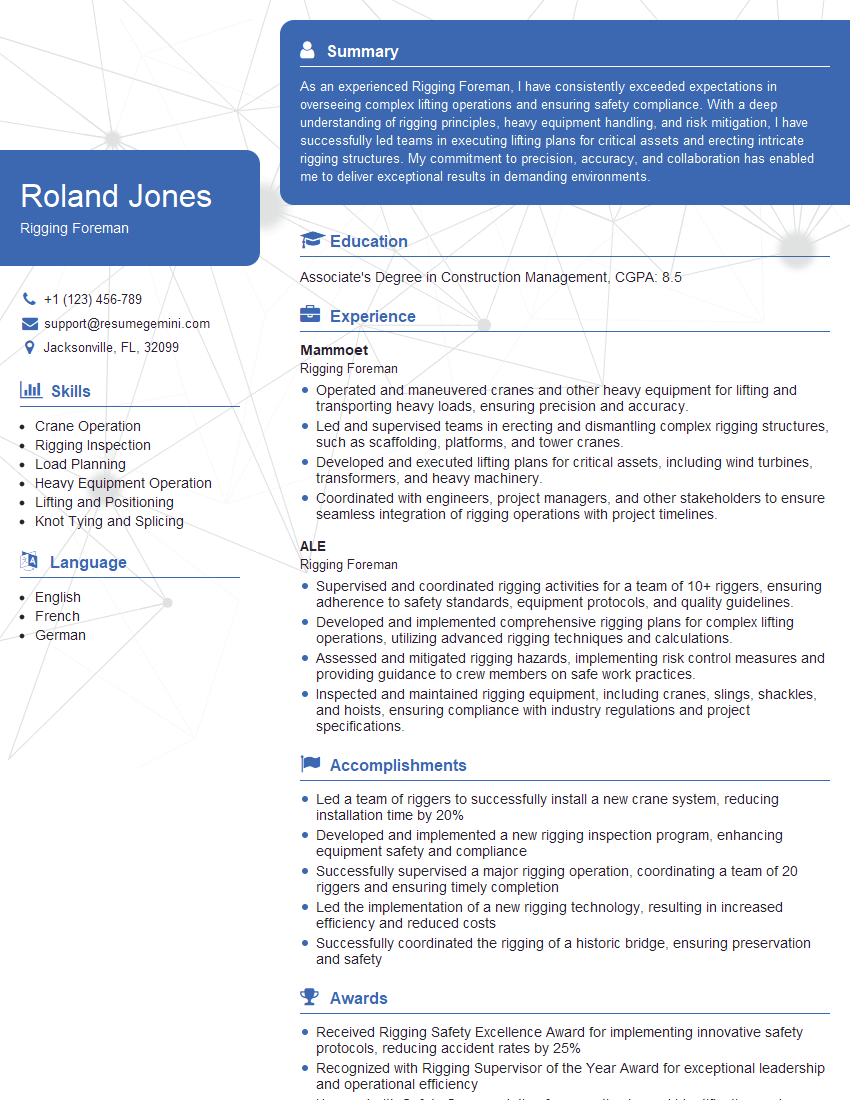
Mastering rigging and derricking is key to unlocking exciting career opportunities in a high-demand field. A strong understanding of these principles will significantly improve your job prospects and allow you to excel in your chosen path. To maximize your chances, focus on creating an ATS-friendly resume that highlights your skills and experience effectively. ResumeGemini is a trusted resource that can help you build a professional and impactful resume tailored to the Rigging and Derricking industry. We provide examples of resumes specifically designed for this field, making it easier for you to showcase your qualifications and land your dream job.




Explore more articles
Users Rating of Our Blogs
Share Your Experience
We value your feedback! Please rate our content and share your thoughts (optional).
What Readers Say About Our Blog
Very informative content, great job.
good