Are you ready to stand out in your next interview? Understanding and preparing for Rigging and Hoisting (if applicable) interview questions is a game-changer. In this blog, we’ve compiled key questions and expert advice to help you showcase your skills with confidence and precision. Let’s get started on your journey to acing the interview.
Questions Asked in Rigging and Hoisting (if applicable) Interview
Q 1. Explain the difference between static and dynamic rigging.
Static rigging involves a stationary setup where the load remains in a fixed position throughout the lifting operation. Think of it like a carefully constructed scaffold supporting a heavy object. Dynamic rigging, on the other hand, involves movement of the load during the lift. This could include the controlled lowering or raising of a component during construction or the movement of heavy materials across a site. The key difference lies in the presence or absence of significant load movement during the operation. Static rigging requires careful planning and precision placement to ensure stability; dynamic rigging necessitates additional consideration of factors such as swing, momentum, and potential impact forces.
Example: Static rigging would be used to support a large section of pre-fabricated building during construction. Dynamic rigging would be employed in the placement of heavy machinery onto a ship’s deck using a crane.
Q 2. Describe the various types of slings and their appropriate applications.
Slings are the critical link between the load and the lifting equipment. Several types exist, each suited to specific applications:
- Polyester/Nylon Web Slings: These are relatively lightweight, flexible, and easy to handle. They’re suitable for general lifting applications, especially where the load has sharp edges, as they distribute the load better than chain or wire rope slings, minimizing edge damage. However, they are susceptible to damage from UV exposure and abrasion.
- Chain Slings: Durable and resistant to abrasion and many chemical agents, chain slings are ideal for heavy-duty applications and handling rough or sharp-edged loads. They are stronger than web slings of the same SWL, but require more careful inspection for elongation, kinking, or damage to individual links.
- Wire Rope Slings: These offer high strength-to-weight ratio, but require more precise handling and inspection, as they are prone to damage through kinking, crushing, or internal wire breakage. They are particularly useful for lifting heavy and irregularly shaped objects. However, the wire rope’s construction limits flexibility and they are less forgiving of sharp edges.
- Round Slings: Typically made of synthetic materials, offer excellent flexibility and can conform to the shape of the load, reducing the risk of slippage. They provide good abrasion resistance and can be used in various applications.
Appropriate Application Example: Web slings for lifting precast concrete panels due to their flexibility and reduced risk of damage to the panels, whereas chain slings would be more suitable for handling heavy steel beams due to their strength and resistance to abrasion.
Q 3. What are the critical safety considerations when rigging heavy loads?
Rigging heavy loads demands meticulous attention to safety. Critical considerations include:
- Proper Load Distribution: Ensure the load is evenly distributed across all lifting points. Improper distribution can lead to overloading of individual slings or points, resulting in failure.
- Correct Sling Angle: Using slings at too wide an angle significantly reduces their effective load-bearing capacity. Ideally, slings should be as vertical as practically possible.
- Safe Working Load (SWL): Never exceed the SWL of any component within the lifting assembly. This includes slings, shackles, hooks, and the lifting equipment itself.
- Pre-Lift Inspection: Thoroughly inspect all equipment, including slings, shackles, hooks, and the lifting device, before each lift. Check for damage, wear, and proper functioning.
- Competent Personnel: Only qualified and trained personnel should handle heavy lifting operations. They should understand rigging principles, the equipment’s limitations, and the potential hazards involved.
- Appropriate Equipment: Ensure that the crane or other lifting machinery has sufficient capacity for the load. Check for proper maintenance and certification.
- Environmental Conditions: Consider weather conditions (wind speed and direction, precipitation) that may affect stability and safety during the lift.
- Clear Communication: Clear communication is essential between the crane operator and the ground crew during the lift.
Ignoring these can have catastrophic consequences, including equipment failure, injury, or even fatality. A comprehensive safety plan is crucial before every lift.
Q 4. How do you calculate the safe working load (SWL) of a lifting assembly?
Calculating the SWL of a lifting assembly is complex and depends on several factors. It is generally not a simple calculation and often requires specialized software or engineering expertise for intricate setups. A simplified example would be for a single sling leg:
The SWL of a single-leg sling is determined by the manufacturer’s rating for that particular sling. This rating must never be exceeded. However, when multiple slings are used, the angle of the slings reduces the effective load capacity of each sling. The SWL is further reduced by factors like sling configuration, load distribution, and any other components in the system. Rigging manuals and load calculation software provide more details and should be consulted for detailed calculations. A simplified approach for parallel slings is to divide the load equally between them and ensure that each sling is sized adequately.
Example: If you are lifting a 10,000 kg load with two vertical slings, each sling must have an SWL of at least 5,000 kg. However, if these slings were angled at 45 degrees, the required SWL for each sling increases significantly. This is because only a component of the sling’s strength is acting vertically to lift the load.
Q 5. Explain the importance of load charts and how to interpret them.
Load charts are essential documents provided by lifting equipment manufacturers that specify the safe working loads (SWL) for different configurations and angles of slings. These charts ensure the safe operation of the equipment by clearly outlining its limitations under varying conditions. They are crucial for determining the correct equipment and configuration for a particular lift.
Interpreting Load Charts: Load charts typically display SWL based on:
- Sling Type: (e.g., wire rope, chain, web)
- Number of Legs: (e.g., one leg, two legs, three legs, four legs)
- Sling Angle: (e.g., 30°, 45°, 60°, vertical)
- Load Capacity: (expressed in kilograms or tons)
Example: A load chart might show that a particular two-leg wire rope sling has an SWL of 10,000kg when used vertically, but only 7,000kg when used at a 45-degree angle. It’s crucial to understand how these charts function and to consult them prior to any lift.
Q 6. What are the different types of knots used in rigging, and when would you use each?
Several knots are used in rigging, each with specific applications. Improper knot selection can compromise safety. Importantly, it’s crucial to avoid using knots that are not explicitly designed for load-bearing applications:
- Bowline: Forms a fixed loop that will not slip under load. Excellent for creating a secure loop at the end of a rope for attaching to a load.
- Clove Hitch: A simple, quick knot often used to secure a rope to a post or ring temporarily, but it is generally not recommended for heavy-duty lifting unless multiple hitches are used and secured.
- Figure Eight Knot: Used primarily as a stopper knot to prevent the rope from running through a device.
When to Use Each: The bowline is used extensively in rigging when creating a reliable loop. The clove hitch has some limited uses but is not suitable for heavy lifts; it’s better suited to lighter, temporary applications like securing a rope to a temporary anchor point. The figure eight is primarily a stopper knot used to secure the end of a rope in a block or shackle, preventing it from passing through and causing an accident.
Crucially, always select the appropriate knot for the specific application and ensure it’s tied correctly and securely. It’s advisable to always double-check the knot before lifting a load.
Q 7. Describe the procedures for inspecting lifting equipment before use.
Thorough inspection of lifting equipment is paramount to preventing accidents. A pre-use inspection should follow a systematic checklist to ensure safety and identify potential hazards before commencing any lifting operation. This procedure should be documented:
- Visual Inspection: Examine the entire lifting assembly for visible signs of damage, wear, corrosion, or deformation. Pay particular attention to hooks, shackles, slings (check for fraying, cuts, or distortion), and the lifting equipment itself (crane or hoist).
- Functional Test (where applicable): Conduct a load test within the SWL to verify mechanical function before a full lift. For cranes, this might involve a load test within rated capacity.
- Certification Checks: Verify that all equipment is appropriately certified and that its certificates are valid. Check for expiry dates.
- Documentation: Record the findings of the inspection, including any identified defects, and ensure corrective actions are taken before use.
Example: During a visual inspection of a wire rope sling, look for broken wires, kinking, or any signs of unusual wear and tear. A damaged sling should be immediately removed from service and replaced.
A pre-lift inspection forms a critical part of a safe lifting operation. Failure to conduct a thorough inspection can have catastrophic consequences.
Q 8. What are the signs of a damaged or worn sling, and what action should be taken?
Identifying a damaged sling is crucial for safety. Think of a sling as a lifeline; a weakened one can lead to catastrophic failure. Signs of damage include fraying, cuts, burns, excessive wear, distortion, or any weakening of the fibers. You should also check for kinks, which concentrate stress and dramatically reduce the sling’s working load limit (WLL). For synthetic slings, look for discoloration, which can indicate chemical degradation. For wire rope slings, check for broken wires, corrosion, or deformation of the wire rope itself.
Action to Take: Any sling showing any of these signs should be immediately removed from service. It’s not worth risking a load failure. The sling should be tagged as ‘damaged’ and sent for inspection or replacement. Never compromise safety by using a damaged sling – the cost of replacement is far less than the cost of an accident.
- Fraying: Imagine a rope ladder with frayed steps; it’s inherently weak and unreliable.
- Cuts: Even a small cut reduces strength significantly.
- Burns: Heat can weaken the internal structure of a sling.
Q 9. Explain the importance of proper communication during a rigging operation.
Effective communication is paramount during rigging operations. It’s like a well-oiled machine – each part needs to work seamlessly with others. A breakdown in communication can lead to accidents. Clear communication involves using a variety of methods to convey information effectively, such as hand signals, radio communication, and written instructions. This ensures everyone understands the plan, the risks, and their roles. For instance, having a designated signal person, who is solely responsible for providing signals to the crane operator, improves precision and safety. This reduces confusion and misinterpretations, preventing mishaps.
Examples of vital communications:
- Before the lift: Confirming the load weight, center of gravity, sling selection, and lift plan with all involved parties.
- During the lift: Communicating the crane’s movements using clear hand signals or radio communication.
- After the lift: Confirming the load’s secure placement and checking for any damage to equipment or the environment.
Q 10. How do you ensure the stability of a load during lifting and movement?
Ensuring load stability is a multifaceted process. It’s similar to balancing a stack of blocks—careful planning and execution are key. Firstly, accurate weight determination is crucial. Underestimating the load can have serious consequences. Next, proper slinging techniques are essential. Using the correct type and size of sling, and distributing the load evenly, minimizes stress on the sling and prevents load instability. Proper hitching and securing the sling to the load and the lifting equipment are crucial. Maintaining a low center of gravity minimizes swaying and potential tipping. Additionally, appropriate load securing devices can prevent load shift during movement. Finally, a qualified rigger overseeing the operation ensures proper procedures are followed.
Examples: Using multiple slings to distribute the weight evenly, using shackles and other securing devices to prevent the load from shifting, and employing load stabilizers, particularly during long horizontal movements, all contribute to a stable lift.
Q 11. Describe your experience with different types of cranes and their limitations.
My experience encompasses a range of cranes, including tower cranes, mobile cranes, overhead cranes, and crawler cranes. Each type possesses unique capabilities and limitations. For instance, tower cranes offer high lifting capacity at significant heights, ideal for building construction, but are fixed in location. Mobile cranes are versatile and mobile but have limitations regarding reach and lifting capacity compared to tower cranes. Overhead cranes are efficient for factory environments but have limited reach outside the facility. Finally, crawler cranes are powerful and stable on uneven terrain, but are slow to maneuver. Understanding these limitations is critical to selecting the right equipment for any job. I have personally overseen projects using each type of crane, adapting my rigging strategies to the unique capabilities and limitations of each.
Q 12. What are the procedures for rigging in confined spaces?
Rigging in confined spaces presents unique challenges. It’s like navigating a maze, demanding precision and careful planning. The first priority is assessing the space itself. Consider headroom, access points, potential obstacles, and the possibility of environmental hazards. Smaller, more maneuverable equipment such as mini cranes or specialized lifting devices might be necessary. Special attention must be given to the slinging points, and selecting the right slings to avoid obstacles and reach the load. Riggers working in confined spaces should undergo appropriate confined-space entry training, and there must be multiple points of contact to avoid entrapment. The use of appropriate Personal Protective Equipment (PPE) is also non-negotiable.
Example: When rigging inside a ship’s hold, the limited space necessitates using smaller slings and carefully planning the lifting path to prevent collisions with walls or other equipment.
Q 13. How do you handle unexpected situations or emergencies during a rigging operation?
Handling unexpected situations requires swift action and a cool head. It’s like a fire drill—knowing the plan and executing it calmly is paramount. The first step is to assess the situation, identifying the problem and potential hazards. Then, communicate the issue immediately to the team, halting operations if necessary. Depending on the nature of the emergency (e.g., sling failure, load instability, equipment malfunction), a pre-determined emergency procedure should be initiated. This might involve lowering the load slowly and safely, securing the area, or contacting emergency services. Post-incident investigation is crucial to determine the root cause of the issue, learn from it, and prevent future occurrences. Detailed documentation of the incident and corrective actions taken is important for legal and safety compliance.
Q 14. What safety regulations and standards are you familiar with (e.g., OSHA, ASME)?
I’m familiar with a wide range of safety regulations and standards, including OSHA (Occupational Safety and Health Administration) regulations in the US and equivalent standards in other jurisdictions. I also have knowledge of relevant sections of the ASME (American Society of Mechanical Engineers) codes and standards related to cranes, hoists, and rigging equipment. These standards cover areas like load capacity, inspection procedures, and safe operating procedures. Compliance is always paramount. I am also well-versed in industry best practices and employer-specific safety rules. Understanding and adhering to these standards ensures safety and minimizes risks during any lifting operation.
Q 15. Explain your understanding of load balancing and its importance.
Load balancing, in the context of rigging and hoisting, refers to the even distribution of weight across multiple lifting points to prevent overloading any single component. Imagine trying to lift a heavy piano with just one rope – it’s likely to snap! But using two ropes, each supporting half the weight, drastically increases safety and stability. This is the essence of load balancing.
Its importance is paramount for safety and preventing equipment failure. Uneven weight distribution can lead to structural damage, component failure, and potentially serious injury or even fatalities. Proper load balancing ensures that each component of the lifting system operates within its safe working load (SWL), prolonging its lifespan and maintaining operational integrity. It’s a crucial factor in any rigging operation, regardless of size or complexity.
For example, when lifting a large steel beam, we might use multiple slings attached to different points along the beam’s length, ensuring each sling bears a proportionate share of the total weight. Careful planning and calculation are essential to achieving effective load balancing, often involving the use of specialized software or experienced engineers.
Career Expert Tips:
- Ace those interviews! Prepare effectively by reviewing the Top 50 Most Common Interview Questions on ResumeGemini.
- Navigate your job search with confidence! Explore a wide range of Career Tips on ResumeGemini. Learn about common challenges and recommendations to overcome them.
- Craft the perfect resume! Master the Art of Resume Writing with ResumeGemini’s guide. Showcase your unique qualifications and achievements effectively.
- Don’t miss out on holiday savings! Build your dream resume with ResumeGemini’s ATS optimized templates.
Q 16. Describe your experience with different types of hoisting equipment.
My experience encompasses a wide range of hoisting equipment, including:
- Overhead cranes: I’m proficient in operating various types, from simple jib cranes to complex gantry cranes, understanding their limitations and maintenance requirements.
- Mobile cranes: I’m familiar with the operation and safety procedures associated with different crane types like tower cranes, rough terrain cranes, and all-terrain cranes. This includes understanding load charts and performing pre-lift inspections.
- Chain hoists: I’ve worked extensively with manual and electric chain hoists, appreciating their versatility and limitations, especially regarding load capacity and speed.
- Winches: I’m knowledgeable about various winch types, including those powered by hydraulics, electric motors, or manually operated. Understanding the importance of proper braking systems and load control is crucial.
- Jacks: From hydraulic to screw jacks, I’m experienced in their safe and effective use for lifting and positioning heavy loads, always adhering to manufacturer specifications and safety protocols.
In each case, I prioritize safe operating practices, regular maintenance, and thorough inspections to ensure the equipment’s reliability and operational safety.
Q 17. How do you plan and execute a complex rigging operation?
Planning and executing a complex rigging operation involves a methodical approach. It starts with a thorough understanding of the project, including the load characteristics, environmental factors, and available equipment.
- Detailed Planning: This involves creating detailed lift plans with drawings, calculations, and risk assessments. We determine the appropriate rigging equipment, lifting points, and procedures.
- Equipment Selection: Choosing the right equipment is critical. We consider the load’s weight, dimensions, center of gravity, and the lifting environment (e.g., indoor or outdoor, confined space, weather conditions).
- Site Survey: A thorough site survey is crucial to identify potential hazards, such as obstructions, overhead power lines, and ground conditions.
- Team Briefing: A pre-lift briefing is conducted with the rigging crew to explain the plan, safety procedures, and emergency protocols.
- Execution and Monitoring: During the lift, constant monitoring is key. Supervisors watch for any deviations from the plan and take corrective action as needed. Effective communication is crucial.
- Post-Lift Review: A post-lift review analyzes the operation, identifying areas for improvement and documenting any lessons learned.
For example, during the installation of a large industrial component, we might employ multiple cranes, specialized slings, and a detailed lifting sequence to ensure precise positioning and avoid damage to the component or the surrounding environment. Meticulous planning and execution minimize risks and ensure a successful outcome.
Q 18. What are your methods for risk assessment in rigging operations?
My risk assessment methodology for rigging operations follows a structured approach:
- Hazard Identification: Identifying potential hazards involves considering factors like the load itself, the environment, the equipment, and the personnel involved. Examples include load instability, equipment failure, environmental hazards (wind, rain), and human error.
- Risk Analysis: We evaluate the likelihood and severity of each identified hazard. This often involves using risk matrices to quantify the risks.
- Risk Control Measures: Developing and implementing control measures to mitigate the identified risks is essential. This could involve using specialized equipment, implementing safety procedures, providing personnel training, or engineering controls.
- Documentation: All aspects of the risk assessment, including the identified hazards, risk analysis, control measures, and responsibilities, are thoroughly documented and reviewed by relevant personnel.
For instance, if we’re working near power lines, our risk assessment would highlight the risk of electrical shock, and control measures would include employing qualified personnel, using insulated equipment, and maintaining a safe distance. This documentation serves as a valuable reference throughout the operation and aids in future planning.
Q 19. Explain your experience with different types of rigging hardware (e.g., shackles, hooks, etc.)
My experience with rigging hardware encompasses a broad range:
- Shackles: I’m familiar with various types, including bow shackles, D-shackles, and screw pin shackles, understanding their load ratings and proper usage. I know when to utilize each type based on the specific application.
- Hooks: I’m experienced with different hook types, including safety hooks, grab hooks, and other specialized hooks, selecting the appropriate hook for the intended load and application while adhering to strict safety regulations.
- Slings: I’m knowledgeable about various sling materials (wire rope, synthetic fiber, chain) and their respective strengths, limitations, and proper inspection methods.
- Wire Rope Clips: I understand the importance of correct wire rope clip placement and the critical implications of improper installation which can lead to catastrophic failure.
- Turnbuckles: I am proficient in utilizing turnbuckles for adjusting tension and alignment in rigging systems, ensuring loads are evenly distributed and secure.
For each piece of hardware, I meticulously inspect for damage before use, ensuring each component is within its safe working load (SWL) and complies with industry standards. Regular inspection and maintenance are paramount.
Q 20. How do you ensure the compatibility of different components in a rigging system?
Ensuring compatibility across components is fundamental to a safe and effective rigging system. This involves several key steps:
- Load Capacity: The SWL of each component must be clearly identified and checked. The weakest link in the chain determines the overall system capacity. We always select components with SWLs exceeding the expected load.
- Material Compatibility: We ensure that materials used are compatible. For example, certain types of slings might be incompatible with specific chemicals or temperatures.
- Component Compatibility: The correct fitting of each component is essential. For example, a shackle must be compatible with the sling and hook it’s connecting. The wrong type of fitting could create a weak point.
- Manufacturer Specifications: Always adhering to manufacturer guidelines and specifications for each component is crucial. These guidelines detail safe operating procedures and load limits.
For instance, when connecting a wire rope sling to a hook, we must use a shackle with a SWL that meets or exceeds the combined strength of the sling and the load. Careless selection or improper fitting of these components can lead to catastrophic failure. Thorough checking and double-checking are imperative.
Q 21. What are the limitations of different rigging techniques?
Different rigging techniques have inherent limitations:
- Overhead Crane Limitations: Overhead cranes have limitations regarding reach, load capacity, and swing radius. They might be unsuitable for lifting in confined spaces or locations with obstructions.
- Sling Angles: Using slings at sharp angles dramatically reduces their effective load capacity. This is a common cause of sling failure.
- Environmental Conditions: Strong winds, rain, or extreme temperatures can severely affect the safety and efficiency of various rigging operations. Adjustments to the plan or postponing the lift might be necessary.
- Load Characteristics: The shape, size, and center of gravity of a load impact rigging technique selection. An irregularly shaped load might require specialized slings or rigging techniques.
- Ground Conditions: Unstable ground conditions necessitate careful consideration of the support and stability of the rigging system and could involve groundwork to ensure stability before commencing operations.
Understanding these limitations is crucial to selecting appropriate techniques and ensuring a safe and successful rigging operation. Adaptability and flexibility are essential, necessitating the use of alternative methods and equipment if initial plans prove unsuitable.
Q 22. Describe your experience with load monitoring devices.
Load monitoring devices are crucial for ensuring the safety and efficiency of rigging operations. They provide real-time data on the weight and tension being applied to a load, preventing overloading and potential accidents. My experience encompasses a wide range of these devices, from simple mechanical load cells to sophisticated digital systems with data logging capabilities.
For instance, I’ve extensively used load pins, which are inserted into the lifting chain or sling to directly measure tension. These are particularly useful for smaller-scale lifting operations. In larger projects, we’ve employed more complex systems that integrate with crane control systems, providing visual and audible warnings if pre-set weight limits are exceeded. One memorable project involved using a wireless load monitoring system on a very large, irregularly shaped component. This system allowed us to monitor the load from a safe distance and make adjustments to the rigging configuration in real-time, guaranteeing its safe movement.
My experience also includes interpreting data from these devices. Understanding the limitations of each device, the potential for error, and how environmental factors like temperature might affect readings is critical for making informed decisions on the job site. I am proficient in using various calibration methods to ensure the accuracy of these instruments.
Q 23. How do you manage the potential hazards associated with wind and weather conditions?
Wind and weather conditions present significant hazards in rigging and hoisting. Managing these risks requires careful planning and execution, beginning with a thorough weather forecast review. We never take chances.
Our mitigation strategies include:
- Rigging inspections: We meticulously inspect all equipment before each lift, paying close attention to wear and tear, especially on critical components like shackles and slings. Any signs of damage or weakening necessitates immediate replacement.
- Wind speed monitoring: We utilise anemometers to monitor wind speed and direction. There are specific wind speed limits for different types of loads and rigging configurations, and work stops immediately if these limits are exceeded.
- Load securing: Additional securing measures are implemented in high-wind conditions. This might involve using extra slings or additional lashing to better control the load’s movement. We might also employ wind brakes or other specialized equipment to minimize the effect of wind gusts.
- Site preparation: Appropriate site preparation is crucial. This includes securing the load’s path, ensuring adequate clearance from obstructions, and identifying suitable anchor points that can withstand both the load and potential wind forces. We also consider the location of personnel and bystanders to minimize exposure.
- Delaying operations: In situations with severe weather, the safest decision is often to delay operations until conditions improve. Safety is always our paramount concern.
For example, during a recent project involving a large prefabricated building section, strong winds were forecast. We delayed the lift until the wind subsided, using the time to reinforce the load-securing and implement secondary safety precautions. This proactive approach ensured the safe and successful completion of the lift.
Q 24. Explain your understanding of different types of rigging hitches.
Rigging hitches are fundamental knots used to secure loads to lifting points. Understanding their strengths and limitations is vital for safety. There’s a hitch for nearly every situation, and selecting the wrong one can be disastrous.
- Bowline: Forms a fixed loop that won’t slip under load. Excellent for attaching slings to a load.
- Clove hitch: A quick and easy hitch that is easily adjustable but should be backed up for critical lifts.
- Running bowline: A slip knot used for running adjustments.
- Figure-eight knot: Used for making a loop at the end of a rope. Usually a component of a more complex system.
- Timber hitch: A simple hitch used for temporarily securing a load to a timber beam.
The selection of a hitch depends on several factors, including the load’s shape, weight, and the type of lifting point available. For example, a bowline might be ideal for lifting a cylindrical object, while a clove hitch could be used for temporarily attaching a load to a hook before securing it more permanently. It’s crucial to understand how each hitch reacts under tension and to never rely on a single hitch for a critical lift. They should always be backed up appropriately.
I regularly conduct training sessions for my team, emphasizing the practical application of these hitches and the importance of double-checking every knot before lifting. This proactive approach ensures we always use the correct and most secure methods for each job.
Q 25. How do you ensure the safe transportation of rigged loads?
Safe transportation of rigged loads demands meticulous planning and execution. Every step, from initial planning to final delivery, must adhere to strict safety protocols.
My approach includes:
- Route planning: Thorough route planning considers weight limits of bridges, overhead obstructions (power lines, trees), and turning radii for the transportation vehicle. We obtain necessary permits well in advance.
- Load securing: Loads are secured using appropriate tie-down systems, ensuring they remain stable throughout transport. The type of securement will vary depending on the nature of the load and the type of vehicle. We never underestimate the importance of this step.
- Escort vehicles: For oversized or heavy loads, escort vehicles provide additional safety and guidance, warning other drivers and ensuring safe passage.
- Communication: Clear and consistent communication among the transport team, drivers, and any necessary regulatory personnel is essential throughout the process.
- Regular inspections: During transport, regular inspections are conducted to ensure the load remains securely fastened and there are no unexpected issues.
In one instance, we transported a large transformer. The route involved navigating a narrow bridge with strict weight limits. We meticulously planned the route, used specialized transport equipment, and arranged for police escorts. The successful and safe transport of the transformer highlighted the critical importance of thorough planning and risk assessment in transporting rigged loads.
Q 26. Describe your experience with using rigging software or planning tools.
Rigging software and planning tools are invaluable for complex projects. They allow for detailed simulations and analysis, helping us optimize rigging configurations and mitigate risks. I’m proficient in several leading software packages, including [Software Name 1] and [Software Name 2].
These tools allow us to:
- Model the load: Create accurate 3D models of the load, considering its center of gravity and any irregular shapes.
- Simulate the lift: Simulate the entire lifting process, visualizing the forces acting on the load and the rigging equipment.
- Analyze stresses: Analyze the stresses on individual components, ensuring they are within safe operating limits.
- Optimize rigging configurations: Experiment with different rigging configurations to find the most efficient and safest approach.
- Generate reports: Produce comprehensive reports documenting the rigging plan, including calculations, diagrams, and risk assessments.
Using these tools in a recent bridge construction project allowed us to simulate different crane placements and rigging configurations, ensuring that the bridge section could be lifted safely and efficiently, saving both time and resources.
Q 27. Explain your experience with working at heights and fall protection protocols related to rigging.
Working at heights is an inherent part of rigging, and adhering to stringent fall protection protocols is non-negotiable. My experience includes extensive training and practical application of various fall arrest systems.
Our safety measures include:
- Harness selection: Choosing appropriate harnesses for each task, ensuring proper fit and functionality.
- Anchor point selection: Carefully selecting strong and reliable anchor points that can withstand the forces involved in a fall.
- Fall arrest systems: Using appropriate fall arrest systems, including lifelines, shock absorbers, and self-retracting lifelines (SRLs), to prevent falls or minimize their impact.
- Regular inspections: Conducting regular inspections of all fall protection equipment to ensure it is in good working order and properly maintained.
- Rescue plans: Developing and practicing rescue plans in case of a fall.
During a recent high-rise building project, we used a sophisticated fall arrest system with a self-retracting lifeline and properly selected anchor points. All workers were equipped with appropriate harnesses and underwent thorough training. This ensured that everyone worked safely and efficiently at height, without compromising safety.
Key Topics to Learn for Rigging and Hoisting Interview
- Fundamental Rigging Principles: Understanding load calculations, center of gravity, and safe working loads.
- Types of Lifting Equipment: Familiarize yourself with different types of cranes, hoists, slings, shackles, and their limitations.
- Rigging Hardware & Inspection: Learn to identify and inspect various rigging components for damage and wear, ensuring safe operation.
- Knots and Hitches: Master the practical application and limitations of essential knots used in rigging.
- Lifting Techniques and Procedures: Understand safe lifting procedures, including pre-lift planning, communication protocols, and emergency response.
- Safety Regulations and Compliance: Be knowledgeable about relevant safety standards and regulations pertaining to rigging and hoisting operations.
- Troubleshooting and Problem-Solving: Develop skills in identifying potential hazards, and devising safe solutions to rigging challenges.
- Practical Applications in Different Industries: Understand the diverse applications of rigging and hoisting across various sectors like construction, entertainment, and manufacturing.
- Risk Assessment and Mitigation: Familiarize yourself with risk assessment methodologies and implement effective mitigation strategies.
Next Steps
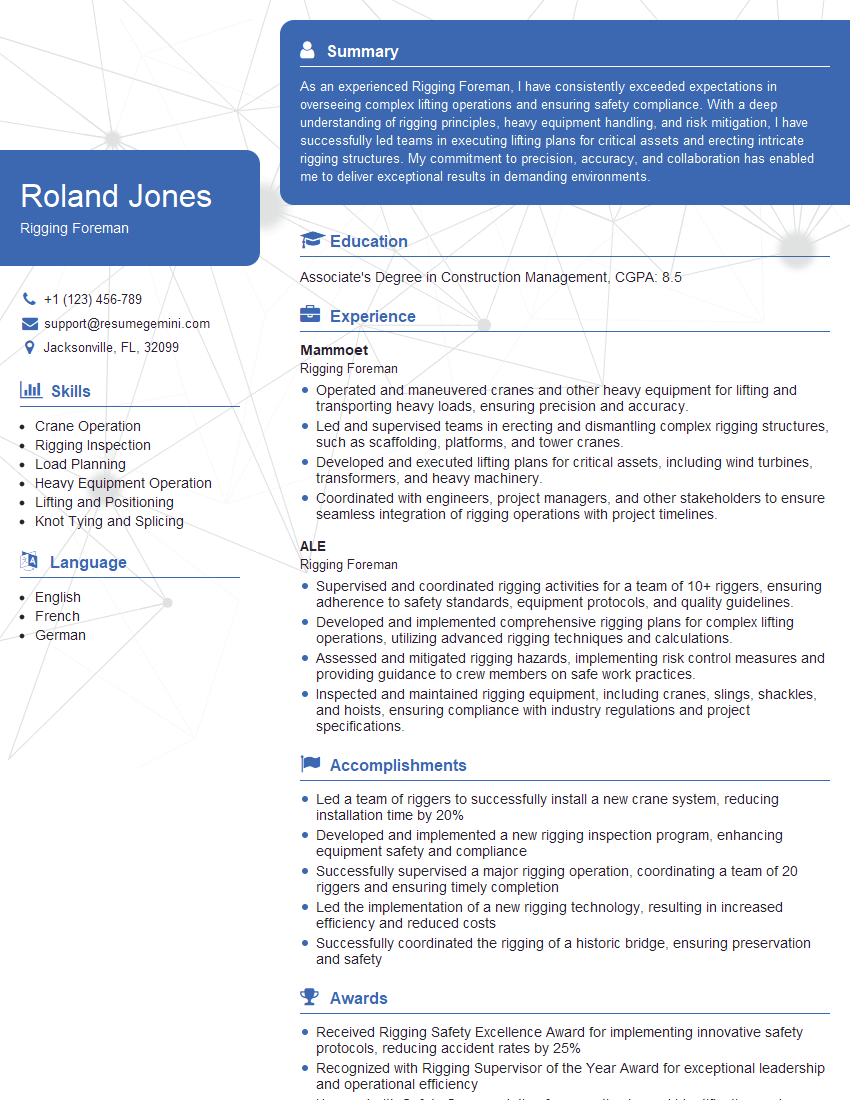
Mastering rigging and hoisting techniques is crucial for career advancement in this demanding and rewarding field. A strong understanding of safety protocols and practical application will set you apart. To maximize your job prospects, it’s vital to create an ATS-friendly resume that highlights your skills and experience effectively. ResumeGemini is a trusted resource that can help you build a professional and impactful resume tailored to the Rigging and Hoisting industry. We provide examples of resumes specifically designed for this field to help you get started. Invest time in crafting a compelling resume – it’s your first impression on potential employers.






Explore more articles
Users Rating of Our Blogs
Share Your Experience
We value your feedback! Please rate our content and share your thoughts (optional).
What Readers Say About Our Blog
Very informative content, great job.
good