Interviews are more than just a Q&A session—they’re a chance to prove your worth. This blog dives into essential Rigging Inspection and Maintenance interview questions and expert tips to help you align your answers with what hiring managers are looking for. Start preparing to shine!
Questions Asked in Rigging Inspection and Maintenance Interview
Q 1. Explain the different types of rigging hardware and their applications.
Rigging hardware encompasses a wide array of components crucial for safe lifting and moving of loads. Understanding their individual applications is paramount for preventing accidents.
- Shackles: These are U-shaped components with a screw pin or bolt, used to connect different rigging elements. They’re incredibly versatile and used in countless configurations. For example, you might use a shackle to connect a wire rope sling to a lifting hook.
- Hooks: These come in various types – including clevis hooks, grab hooks, and eye hooks – each designed for specific applications. A clevis hook is strong but requires a correctly sized shackle. Grab hooks are suitable for grabbing cylindrical objects. Eye hooks are anchored to structures.
- Wire Rope Clips (Clamps): These are used to secure wire rope ends, preventing fraying and ensuring a firm connection. It’s crucial to use the correct number of clips and install them correctly, with the U-bolt facing the load.
- Slings (various types – discussed further in answer 7): These are the main load-bearing components, available in various materials like wire rope, synthetic webbing, and chain. Their selection depends on the load’s characteristics and the environment.
- Turnbuckles: Used to adjust the tension in a rigging system. They are vital for precise load positioning or for compensating for elongation in the rigging.
- Eye Bolts: Provide a secure anchor point for attaching rigging to a structure, but their capacity depends greatly on the type and installation.
Selecting the right hardware depends heavily on the load’s weight, size, shape, and the environment. Each component must be inspected regularly to ensure it is in good working order.
Q 2. Describe the inspection process for wire ropes, including what to look for and how to document findings.
Inspecting wire ropes is a critical safety procedure, and a thorough inspection involves multiple steps. Think of it like a doctor’s checkup – a routine examination helps prevent serious problems.
- Visual Inspection: Check for obvious signs of damage, such as broken wires, corrosion, kinks, or flattened strands. Look along the entire length, including the ends and terminations. A magnifying glass can be useful for detailed examination.
- Diameter Measurement: Measure the rope’s diameter at several points. Significant reduction in diameter indicates wear and potential failure. Use a calibrated measuring device.
- Testing for Broken Wires: Carefully examine each section for broken wires. Too many broken wires in a short length necessitates immediate replacement.
- Checking for Corrosion: Corrosion weakens the rope dramatically. Look for rust or any other signs of deterioration.
- Examination of Terminations: Ensure that wire rope ends are properly secured with swaged fittings, wire rope clips, or other appropriate terminations. Loose or damaged terminations are a major hazard.
Documentation: All inspection findings must be meticulously documented. Use a standardized inspection checklist, including date, time, location, inspector’s name, and detailed descriptions of any damage found. Photographs of any damage are essential.
Example Documentation Entry:
Date: October 26, 2024
Inspector: John Doe
Location: Crane #3 Wire Rope
Findings: 7 broken wires within 10 inches of the end fitting. Surface rust observed along 15% of the rope length. Recommendation: Replace wire rope immediately.
Q 3. What are the safety regulations and standards relevant to rigging and lifting operations?
Rigging and lifting operations are governed by stringent safety regulations and standards to minimize risks. These standards vary by jurisdiction, but several key international standards apply. These regulations aren’t suggestions; they are legally mandated for safety.
- OSHA (Occupational Safety and Health Administration): In the United States, OSHA sets standards for workplace safety, including detailed regulations on rigging. These standards cover everything from proper equipment selection to operator training.
- ASME (American Society of Mechanical Engineers): ASME provides standards for cranes, derricks, and hoists, which are directly relevant to rigging.
- EN (European Norms): In Europe, the EN standards dictate many aspects of rigging and lifting, establishing requirements for equipment and procedures.
- Manufacturer’s Instructions: Always consult the manufacturer’s instructions for all rigging hardware and equipment. These provide vital information on safe working loads and operational limits.
Compliance with these regulations is not just a matter of following rules; it’s about ensuring the safety and well-being of everyone involved in the operation. Failure to comply can lead to severe penalties, including fines and even legal action.
Q 4. How do you calculate safe working loads (SWLs) for different rigging configurations?
Calculating safe working loads (SWLs) for different rigging configurations requires understanding the individual SWLs of each component and how they interact. It’s not a simple addition; it’s much more complex.
The SWL of a rigging assembly is always limited by the weakest link. For example, if you have a sling with an SWL of 10,000 lbs and a shackle with an SWL of 8,000 lbs, the assembly’s SWL is only 8,000 lbs.
Angle Factors: When slings are used at angles other than vertical, their effective load-bearing capacity reduces. Angle factors are used to adjust the SWL according to the angle. These factors are usually provided in manufacturer’s documentation or industry standards.
Example: Let’s say you have two wire rope slings rated at 5,000 lbs each, supporting a load equally. If the slings form a 60-degree angle with the vertical, you will need to consult the angle factor for that configuration before calculating the SWL. The angle factor will likely be less than 1, meaning the effective SWL will be less than 10,000 lbs.
Software and Tables: Many software packages and reference tables are available to assist in calculating SWLs for various configurations. Consulting these resources is highly recommended, especially for complex setups.
Crucially: Always use a safety factor. This reduces the risk of exceeding the SWL even under unexpected conditions.
Q 5. Explain the difference between static and dynamic loading in rigging.
Understanding the difference between static and dynamic loading is essential for safe rigging practices. It’s the difference between a steady pull and a sudden shock.
- Static Loading: This is a gradual, constant load applied to the rigging. Think of slowly lifting a heavy object. The load is relatively predictable and remains consistent over time.
- Dynamic Loading: This involves sudden impacts or rapid changes in load. This could be a result of starting or stopping a hoist suddenly, a load swinging unexpectedly, or a sudden shock during the lifting process. Dynamic loading can exert significantly higher forces than static loading, increasing the risk of equipment failure.
Impact of Loading Types: The same rigging components can handle greater loads statically than dynamically. A sling rated for 10,000 lbs statically might only be able to safely handle 7,000 lbs under dynamic conditions. This is why using correct procedures (slow, steady lifting) and avoiding jerky movements is paramount.
Real-World Example: Imagine lifting a heavy container. Slowly lifting it (static load) is safe. But if the crane operator slams on the brakes (dynamic load), the sudden jolt can far exceed the stated SWL, potentially causing the rigging to fail.
Q 6. What are the common causes of rigging failures and how can they be prevented?
Rigging failures can have catastrophic consequences. Understanding the common causes allows us to implement preventive measures.
- Overloading: Exceeding the SWL is the most common cause of rigging failure. This can happen due to miscalculation, equipment malfunction, or neglecting angle factors.
- Improper Rigging Techniques: Incorrect use of equipment, such as using worn or damaged components, failing to properly secure the load, or neglecting to account for angle factors can lead to catastrophic results.
- Equipment Defects: Using damaged or worn-out equipment, such as slings with broken strands, frayed wire ropes, or damaged shackles, is a significant risk.
- Environmental Factors: Harsh weather conditions (like extreme temperatures or excessive moisture) can compromise the strength of the rigging and lead to failure. Corrosion is a serious concern.
- Lack of Maintenance: Regular inspection and maintenance are vital to identify potential problems early. Neglecting maintenance greatly increases the likelihood of failure.
Prevention:
- Regular Inspections: Implement a rigorous inspection program for all rigging hardware and equipment.
- Proper Training: Riggers should be thoroughly trained in safe rigging practices and understand the limitations of the equipment.
- Load Calculations: Accurately calculate SWLs for all lifting operations, taking into account angles and dynamic loads.
- Equipment Maintenance: Establish a robust maintenance program for regular inspection, repair, or replacement of equipment.
- Compliance with Standards: Adhere strictly to all relevant safety regulations and standards.
Q 7. Describe your experience with different types of slings and their limitations.
Slings are the workhorses of rigging, but different types have distinct strengths and weaknesses. The wrong sling for the job can lead to failure.
- Wire Rope Slings: These are strong and durable, suitable for heavy lifting but can be prone to damage from abrasion or sharp edges. They require careful inspection for broken wires and corrosion. Their stiffness also makes them less suitable for delicate items.
- Synthetic Webbing Slings: These are lightweight, flexible, and easy to handle. They’re less prone to damage from abrasion than wire rope but can be weakened by UV exposure and chemicals. Their elasticity is helpful in some cases, preventing sudden shock loads.
- Chain Slings: These are exceptionally strong and resist abrasion well. They are suitable for heavy loads but are more rigid than webbing slings. Regular inspection for elongation, cracks, and kinks is crucial.
- Round Slings: These offer a good balance of strength, flexibility, and ease of use. They are a popular choice for many applications. However, care needs to be taken to ensure they are not subjected to sharp edges.
Limitations:
- Wire rope slings are susceptible to damage from kinking or crushing.
- Webbing slings degrade under UV exposure and chemical attack.
- Chain slings can be affected by impact loading and need regular inspection for elongation.
The choice of sling depends on the specific application, the load’s characteristics (weight, shape, size), and the working environment. Careful consideration of these factors is crucial for safety.
Q 8. How do you ensure the proper use and maintenance of lifting equipment?
Ensuring the proper use and maintenance of lifting equipment is paramount for safety and operational efficiency. It involves a multi-faceted approach encompassing regular inspections, adherence to manufacturer guidelines, and a robust training program for personnel.
- Regular Inspections: A comprehensive inspection schedule, including daily pre-use checks and more thorough periodic inspections, is crucial. This involves visually checking for wear and tear, damage, corrosion, and proper functioning of all components. Think of it like a car’s regular service – preventing small issues from becoming major problems.
- Adherence to Manufacturer Guidelines: Each piece of lifting equipment comes with a manual detailing safe operating procedures, load limits, and maintenance requirements. Strictly following these guidelines is non-negotiable. Ignoring them can lead to catastrophic failures.
- Operator Training: Riggers and other personnel handling lifting equipment must receive thorough training on safe operating procedures, inspection techniques, and recognizing potential hazards. A well-trained operator is the best defense against accidents.
- Record Keeping: Meticulous record-keeping is essential. Documentation should include inspection reports, maintenance logs, and training certifications. This helps track the equipment’s history and ensures compliance with regulations.
For example, a daily pre-use check of a chain hoist would involve visually inspecting the chain for kinks, wear, or damage, checking the hook for deformities, and testing the hoist’s functionality at a light load before engaging with a heavier lift. Any anomalies would be immediately reported and addressed.
Q 9. What are the critical elements of a pre-lift inspection?
A pre-lift inspection is a crucial step in any lifting operation, ensuring the safety and efficiency of the entire process. It’s a systematic check of all aspects to minimize risks. Think of it as a pre-flight checklist for an airplane – essential for safe operation.
- Equipment Inspection: A thorough visual examination of all rigging components, including slings, shackles, hooks, and the lifting device itself. This includes checking for wear, damage, corrosion, and ensuring all components are rated for the intended load.
- Lifting Point Assessment: Evaluating the structural integrity of the lifting points on the object being lifted. This involves checking for any signs of weakness or damage and ensuring the lifting points are appropriately designed for the load.
- Load Calculation: Accurately calculating the weight of the load to ensure the chosen equipment has a sufficient safety factor. Underestimating the weight can lead to equipment failure.
- Rigging Plan Review: Verifying that the rigging plan is suitable for the specific lift, including the type of rigging hardware, angles, and lifting points. A poorly planned lift can result in instability and accidents.
- Environmental Factors: Considering factors such as weather conditions, ground stability, and surrounding obstructions which might impact the safety and success of the lift. For example, high winds can significantly affect the stability of a suspended load.
- Personnel Briefing: A short briefing with all involved personnel to communicate the plan, identify potential hazards, and clarify roles and responsibilities.
Q 10. How do you handle a rigging incident or near miss?
Handling rigging incidents or near misses requires a structured approach prioritizing safety and preventing future occurrences. The goal is not just to fix the immediate problem but also to understand the root cause and implement corrective actions.
- Immediate Response: Secure the area, ensure the safety of all personnel, and address any immediate hazards. If necessary, evacuate the area.
- Incident Investigation: Conduct a thorough investigation to determine the root cause of the incident or near miss. This should involve gathering information from witnesses, examining damaged equipment, and reviewing relevant documentation.
- Documentation: Document all aspects of the incident or near miss, including details of the event, damage assessments, witness statements, and corrective actions.
- Corrective Actions: Implement corrective actions to prevent similar incidents from occurring in the future. This might involve replacing damaged equipment, revising procedures, or providing additional training.
- Reporting: Report the incident to the appropriate authorities and stakeholders.
- Follow-up: Conduct a follow-up inspection to ensure the implemented corrective actions are effective and maintain a safe work environment.
For example, if a sling failed during a lift, the investigation would determine if the sling was overloaded, damaged, improperly used, or if the lift plan was inadequate. Corrective actions might include retraining riggers on proper sling selection and usage, updating the inspection protocols, and modifying the lift plan.
Q 11. Describe your experience with different types of rigging plans and drawings.
My experience with rigging plans and drawings encompasses a wide range of complexity, from simple lifts to intricate multi-point lifts for heavy equipment or large structures. I’m proficient in interpreting various formats, including hand-drawn sketches, CAD drawings, and specialized rigging software outputs.
- Simple Lift Plans: These plans detail basic lifts using straightforward rigging configurations, typically involving a single load point and simple lifting mechanisms.
- Complex Lift Plans: These plans address more challenging lifts, involving multiple load points, complex rigging configurations, specialized equipment, and detailed calculations to ensure stability and load distribution. These are common for very heavy or awkwardly shaped loads.
- Critical Lift Plans: These plans cover high-risk lifts that may involve substantial safety precautions and detailed risk assessments. They often necessitate detailed calculations, simulations, and input from structural engineers.
- Specialized Drawings: I’m experienced with interpreting drawings including details of lifting points, attachment methods, load distribution diagrams, and equipment specifications. Understanding these is crucial for planning and executing a safe and efficient lift.
I’ve worked on projects involving both 2D and 3D models, allowing me to visualize the lift from various perspectives and identify potential conflicts or limitations early in the planning process. This proactive approach minimizes the risk of accidents and ensures a smoother lifting operation.
Q 12. How do you assess the structural integrity of lifting points?
Assessing the structural integrity of lifting points is a critical aspect of pre-lift inspections. It involves determining whether the designated points can safely support the load without causing damage or failure.
- Visual Inspection: A thorough visual examination to identify any signs of damage, such as cracks, corrosion, deformation, or wear. Any visible defects should be carefully assessed for their potential impact on the lifting point’s strength.
- Documentation Review: Reviewing relevant documentation, such as engineering drawings, load capacity specifications, and previous inspection reports, to confirm the lifting point’s design and rated capacity.
- Non-Destructive Testing (NDT): Employing NDT methods, such as ultrasonic testing or magnetic particle inspection, to detect internal flaws or weaknesses that are not visible to the naked eye. This is particularly important for critical lifts or when there is reason for concern about the integrity of the lifting point.
- Load Testing (when applicable): Conducting a load test to verify the lifting point’s capacity under actual loading conditions. This is often done for new or modified lifting points to confirm their design and strength.
For example, before lifting a heavy piece of machinery, I’d meticulously check the designated lifting lugs for cracks or distortion. If I had any doubt about their integrity, I would recommend a thorough NDT inspection before proceeding.
Q 13. What are the limitations of different types of rigging hardware?
Different types of rigging hardware have specific limitations in terms of load capacity, working load limit (WLL), and suitability for particular applications. Understanding these limitations is essential for safe rigging practices.
- Slings: Slings have limitations related to their material (e.g., steel, nylon), construction (e.g., single-leg, choker hitch), and wear. Improper use or exceeding the WLL can lead to breakage.
- Shackles: Shackles have specific load limits dependent on their size and type (e.g., bow shackle, D-shackle). Using them beyond their capacity or with improper lubrication can lead to failure.
- Hooks: Hooks have load limits and can be damaged by overloading or impact. Deformed hooks should never be used.
- Wire Rope: Wire rope is subject to wear and damage from kinks, crushing, and corrosion. It’s essential to regularly inspect wire rope for signs of wear and replace it as needed.
For instance, a nylon sling might have a lower load capacity than a comparable steel sling. Using a shackle with a damaged pin risks catastrophic failure. Each component must be chosen carefully and inspected regularly to meet the lift requirements without exceeding its limits. Ignoring these limitations can lead to dangerous situations.
Q 14. Explain the importance of load distribution in rigging.
Load distribution in rigging is critical for stability and safety. Unevenly distributed loads can lead to instability, equipment damage, and even accidents. Think of it like balancing a load on a seesaw – evenly distributed weight prevents tipping.
- Even Weight Distribution: The goal is to distribute the load evenly across all lifting points to prevent excessive stress on any single point. This is especially crucial when lifting irregularly shaped or heavy objects.
- Center of Gravity: Understanding the center of gravity of the load is vital for maintaining stability during the lift. Proper rigging techniques are used to ensure the load remains balanced and doesn’t shift during the lift.
- Angle of Lift: The angle of the slings or other lifting components affects load distribution. Extreme angles can significantly increase stress on individual points, making even weight distribution even more critical.
- Rigging Hardware Selection: Selecting the appropriate type and size of rigging hardware is crucial for proper load distribution. The hardware must be rated to handle the forces involved and distributed properly.
For example, when lifting a large, heavy steel plate, using multiple slings at strategic points ensures the weight is evenly distributed, preventing any single sling from being overloaded and potentially failing. Failure to consider load distribution could result in the plate tilting or even dropping.
Q 15. What are your experience with different types of load cells and load monitoring devices?
My experience encompasses a wide range of load cells and load monitoring devices, from simple mechanical load indicators to sophisticated digital systems with data logging capabilities. I’ve worked extensively with hydraulic load cells, which are commonly used for heavier lifts and offer a robust and accurate measurement. I’m also proficient with strain gauge load cells, known for their precision and suitability for a variety of applications, including smaller loads. Furthermore, I have experience using load pins, which are particularly useful for monitoring tension in slings or other lifting components. Finally, I’m familiar with wireless load monitoring systems which allow for remote monitoring of loads, enhancing safety and efficiency, especially in complex or hazardous environments. For instance, during a recent project involving the lifting of a large transformer, we employed a sophisticated wireless system to continuously monitor the load distribution across multiple slings, ensuring safe and controlled lifting.
Beyond the specific types, my experience includes understanding the calibration, maintenance, and limitations of each device. I know how critical proper calibration is for accurate readings and ensuring the safety of the lifting operation. A miscalibrated load cell can lead to catastrophic equipment failure, therefore regular calibration is essential.
Career Expert Tips:
- Ace those interviews! Prepare effectively by reviewing the Top 50 Most Common Interview Questions on ResumeGemini.
- Navigate your job search with confidence! Explore a wide range of Career Tips on ResumeGemini. Learn about common challenges and recommendations to overcome them.
- Craft the perfect resume! Master the Art of Resume Writing with ResumeGemini’s guide. Showcase your unique qualifications and achievements effectively.
- Don’t miss out on holiday savings! Build your dream resume with ResumeGemini’s ATS optimized templates.
Q 16. How do you communicate effectively with other members of a rigging crew?
Effective communication within a rigging crew is paramount to safety and efficiency. It’s not just about speaking clearly; it’s about using a standardized system of communication, including hand signals, verbal cues, and radio communication where appropriate. I firmly believe in pre-lift briefings where we discuss the plan, roles, responsibilities, potential hazards, and emergency procedures. This ensures everyone is on the same page and understands their role in executing the lift safely.
During the lift, clear and concise communication is key. We use a system of hand signals that comply with industry standards to indicate movement commands, stops, and potential issues. This ensures that even in loud environments everyone understands the instructions. For larger, more complex projects, we use two-way radios to enhance communication and ensure timely responses to any issues that may arise. Building trust and rapport with crew members is also crucial. This fosters a culture of open communication where team members feel comfortable reporting potential issues or concerns without fear of reprisal.
Q 17. Describe your experience with risk assessments related to rigging operations.
Risk assessment is an integral part of every rigging operation I undertake. My experience involves conducting thorough risk assessments before any lift, using established methodologies such as HAZOP (Hazard and Operability Study) or a simpler risk matrix approach. This involves identifying potential hazards, assessing the likelihood and severity of each hazard, and implementing control measures to mitigate risks.
For example, in a recent project involving lifting equipment over a public area, we identified the risk of dropped objects causing injury. Our risk assessment led to the implementation of safety nets and exclusion zones to mitigate this risk. The documentation of the risk assessment, including identified hazards, mitigation strategies, and the responsibility of specific crew members, is then meticulously maintained and reviewed before, during, and after the lift.
Q 18. How do you identify and mitigate potential hazards associated with rigging?
Identifying and mitigating potential hazards in rigging is an ongoing process. It starts with a thorough pre-lift inspection of all equipment, including slings, shackles, hooks, and lifting machinery. We check for signs of wear and tear, damage, or defects. This might involve visual inspections, load testing if necessary, and reviewing the equipment’s certification and inspection history.
Once potential hazards are identified, mitigation strategies are implemented. This could range from replacing damaged equipment to using additional safety measures such as tag lines, safety nets, or specialized lifting techniques. For instance, if a sling is found to be damaged, it’s immediately removed from service and replaced with a certified and properly sized sling. Furthermore, environmental factors, such as weather conditions or ground stability, are also considered and factored into the risk mitigation strategy.
Q 19. What are the key factors to consider when selecting appropriate rigging equipment for a specific task?
Selecting appropriate rigging equipment involves several key factors. The most crucial is the weight and dimensions of the load; we must ensure that the chosen equipment has a working load limit (WLL) that significantly exceeds the weight of the load, incorporating a substantial safety factor. The type of load also matters; some loads require specialized slings or attachments to ensure safe handling. Environmental conditions, such as temperature and humidity, can also affect the equipment’s performance and durability, so selection must account for this.
For example, lifting a fragile piece of machinery might require the use of soft slings to prevent damage, while lifting heavy steel beams would necessitate the use of durable wire rope slings with appropriate safety factors. Finally, the working environment needs to be assessed for potential obstacles and limitations that could impact the selection of rigging equipment.
Q 20. Explain the importance of proper documentation in rigging inspections and maintenance.
Proper documentation is vital for maintaining the safety and compliance of rigging operations. Detailed records of inspections, maintenance, repairs, and testing of all equipment are crucial. This includes the date of the inspection, the inspector’s name, the condition of the equipment, and any repairs or replacements made. This documentation serves as a valuable historical record, assisting in identifying patterns of wear, predicting potential equipment failures, and ensuring compliance with regulatory requirements.
Furthermore, accurate records of each lift are also maintained, including the weight of the load, the type of equipment used, and any unusual occurrences or near misses. This enables continuous improvement by identifying areas where procedures or equipment could be enhanced. Comprehensive documentation is critical in case of accidents or incidents, as it aids in investigations and determines the root cause.
Q 21. What are the different types of knots used in rigging and their applications?
Many different knots are used in rigging, each suited to a specific application. The choice of knot depends on factors such as the type of rope, the load being lifted, and the environment. Some common knots include:
- Bowline: Forms a secure loop that won’t slip under load. Excellent for creating a running loop at the end of a rope.
- Clove Hitch: A simple and quick knot for attaching a rope to a post or ring. Often used as a temporary attachment.
- Figure Eight Knot: A stopper knot to prevent a rope from running through a pulley or other attachment point. Provides a secure end.
- Sheet Bend: Used to join two ropes of different diameters.
It’s crucial to use the correct knot for each application and to ensure that all knots are tied correctly and securely. Improper knot tying can lead to serious accidents; therefore, comprehensive training and regular practice are essential.
Q 22. Describe your experience with rigging software or applications.
My experience with rigging software encompasses a range of applications, from basic load calculation tools to sophisticated 3D modeling and simulation programs. I’m proficient in using software like Rigging Designer (a fictional example, replace with actual software used), which allows for detailed analysis of lift plans, including load weight, center of gravity, and sling angles. This helps prevent potential accidents by identifying hazards before they occur. I also have experience with software that integrates with crane control systems, providing real-time feedback on load stability and ensuring compliance with safety limits. Beyond dedicated rigging software, I’m comfortable using CAD software to create detailed rigging diagrams and plans, ensuring clarity and consistency across all project documentation.
For example, on a recent project involving the lifting of a large transformer, Rigging Designer helped us optimize the sling configuration to minimize stress on the transformer and the crane. The software’s simulation capabilities allowed us to virtually test different sling arrangements before executing the lift, significantly reducing risk and ensuring a smooth operation.
Q 23. How do you manage change requests and modifications in a rigging project?
Managing change requests in a rigging project requires a structured approach that prioritizes safety and minimizes disruption. My process begins with a thorough review of the change request, assessing its potential impact on the overall lift plan. This includes considering factors such as load weight, dimensions, center of gravity, and the capabilities of the available lifting equipment. Once the impact is assessed, I consult with the relevant stakeholders – engineers, crane operators, and clients – to discuss the feasibility and implications of the changes. Any modifications are then formally documented, incorporating updated calculations, drawings, and risk assessments. Crucially, all personnel involved in the lift are informed of the changes and retrained as needed. This documented change management process ensures everyone is aware of and understands the updated plan, enhancing safety and minimizing errors.
For instance, if a change request involves increasing the load weight, I’d recalculate the required crane capacity, ensure the slings’ strength is adequate, and reassess the stability of the lift. The updated lift plan would then be reviewed and approved before proceeding.
Q 24. What is your experience with non-destructive testing methods for rigging equipment?
My experience with non-destructive testing (NDT) methods for rigging equipment is extensive. I’m familiar with various techniques, including visual inspection, magnetic particle testing (MPT), dye penetrant testing (DPT), ultrasonic testing (UT), and radiographic testing (RT). Visual inspection is the most common and forms the basis of all inspections. It identifies obvious defects like corrosion, cracks, or damage to the hardware. MPT and DPT are used to detect surface cracks in metallic components like shackles and hooks. UT employs sound waves to detect internal flaws in the rigging components. RT uses X-rays or gamma rays to provide detailed images of internal structures and reveal hidden defects. The choice of NDT method depends on the type of rigging equipment and the level of inspection required. All testing is meticulously documented, with results recorded and archived to track the condition of the equipment over time.
For example, during a routine inspection, we discovered a small crack on a shackle using DPT. This early detection prevented a potential catastrophic failure during a lift. The damaged shackle was immediately replaced, ensuring the continued safety of the operation.
Q 25. Explain your experience with creating and implementing rigging inspection checklists.
Creating and implementing rigging inspection checklists is crucial for maintaining the safety and integrity of lifting equipment. My checklists are tailored to the specific type of rigging equipment being inspected and the operating environment. They cover key aspects like: visual inspection for wear and tear, damage, corrosion; verification of proper markings and certifications; checking for proper functioning of locking mechanisms; and assessment of load capacity. The checklists are designed to be clear, concise, and easy to use, even for personnel with varying levels of experience. They are regularly reviewed and updated to reflect changes in regulations, best practices, and technological advancements. Detailed records are kept of each inspection, including the date, inspector’s name, any identified defects, and the corrective actions taken.
A typical checklist for a wire rope sling would include items such as checking for broken wires, corrosion, kinking, or bird-caging. For shackles, the checklist would focus on checking the pin and its locking mechanism, along with visual assessment of the body for cracks or deformation.
Q 26. Describe a situation where you had to troubleshoot a rigging problem. What was your solution?
During a large-scale construction project, we encountered a problem with a crane’s load-moment indicator (LMI) malfunctioning. The LMI is crucial for ensuring the crane doesn’t exceed its safe working load. The malfunction resulted in a temporary halt to the lift operation. My initial troubleshooting involved verifying the LMI’s power supply and checking for any loose connections. Once these were ruled out, I checked the LMI’s calibration and found it to be out of range. Following the manufacturer’s instructions, I recalibrated the LMI. After successful recalibration and several test lifts under controlled conditions, the crane was cleared to resume operations. Thorough documentation of the malfunction, troubleshooting steps, and resolution was maintained to aid future problem-solving and prevent recurrence.
This situation highlighted the importance of regular maintenance and calibration of critical safety devices like the LMI, emphasizing the need for a proactive, preventative maintenance program.
Q 27. What are the key differences between different types of crane systems, and how does that influence rigging?
Different crane systems, such as tower cranes, mobile cranes, and overhead cranes, have distinct characteristics that significantly influence rigging practices. Tower cranes are typically used for high-rise construction, offering a high lift capacity but limited mobility. Rigging for tower cranes often involves complex arrangements of multiple slings and requires precise planning to ensure stability. Mobile cranes are versatile and mobile, suitable for a wide range of applications. Rigging for mobile cranes involves considerations of ground conditions, crane outrigger placement, and load swing radius. Overhead cranes are stationary and found in industrial settings, offering high precision and repeatable movements. Their rigging typically focuses on efficient load handling within the defined workspace. The type of crane influences the choice of slings, lifting accessories, and the overall lift plan. Understanding these differences is vital for ensuring safe and efficient lifting operations.
For instance, a heavy load being lifted with a tower crane might require specialized rigging techniques and multiple slings to distribute the load evenly. In contrast, a mobile crane might necessitate more careful consideration of the ground’s bearing capacity.
Q 28. How do you stay up-to-date with the latest advancements and best practices in rigging and lifting safety?
Staying current in rigging and lifting safety requires a multifaceted approach. I actively participate in professional organizations like the [Insert relevant professional organization names], attending conferences and workshops to learn about the latest advancements and best practices. I regularly review updated safety regulations and industry standards, such as those published by OSHA (Occupational Safety and Health Administration) or equivalent regulatory bodies. I also engage in continuous professional development through online courses and industry publications. Moreover, I maintain a network of colleagues in the field, exchanging knowledge and experiences. This combination of formal and informal learning ensures I am always aware of the latest safety guidelines and technological advancements, enabling me to continuously improve my practices and expertise.
For example, participation in a recent workshop on advanced rigging techniques exposed me to new slinging methods that improved efficiency and safety on a subsequent project.
Key Topics to Learn for Rigging Inspection and Maintenance Interview
- Rigging Hardware: Understanding various types of rigging hardware (shackles, hooks, slings, wire ropes, etc.), their load limits, and proper inspection techniques. Practical application: Identifying damaged or worn components during a routine inspection.
- Inspection Procedures and Documentation: Mastering standardized inspection checklists, documenting findings accurately, and understanding relevant safety regulations and industry standards. Practical application: Completing a thorough inspection report, highlighting any deficiencies and recommending corrective actions.
- Load Calculations and Safety Factors: Applying engineering principles to calculate safe working loads, understanding safety factors, and assessing potential hazards. Practical application: Determining the appropriate rigging configuration for a specific lift based on weight, geometry, and environmental conditions.
- Maintenance and Repair Techniques: Knowledge of routine maintenance procedures, lubrication techniques, and common repair methods for various rigging components. Practical application: Performing preventative maintenance on slings and wire ropes to extend their lifespan and ensure safety.
- Risk Assessment and Mitigation: Identifying potential hazards associated with rigging operations, implementing appropriate control measures, and understanding emergency procedures. Practical application: Developing a risk assessment plan for a complex lifting operation.
- Regulations and Compliance: Familiarity with relevant safety regulations (OSHA, etc.) and industry best practices for rigging inspection and maintenance. Practical application: Ensuring compliance with all relevant regulations during inspections and maintenance activities.
- Troubleshooting and Problem Solving: Diagnosing and resolving common rigging problems, including damaged components, load imbalances, and unexpected failures. Practical application: Identifying the cause of a rigging failure and implementing corrective actions to prevent future incidents.
Next Steps
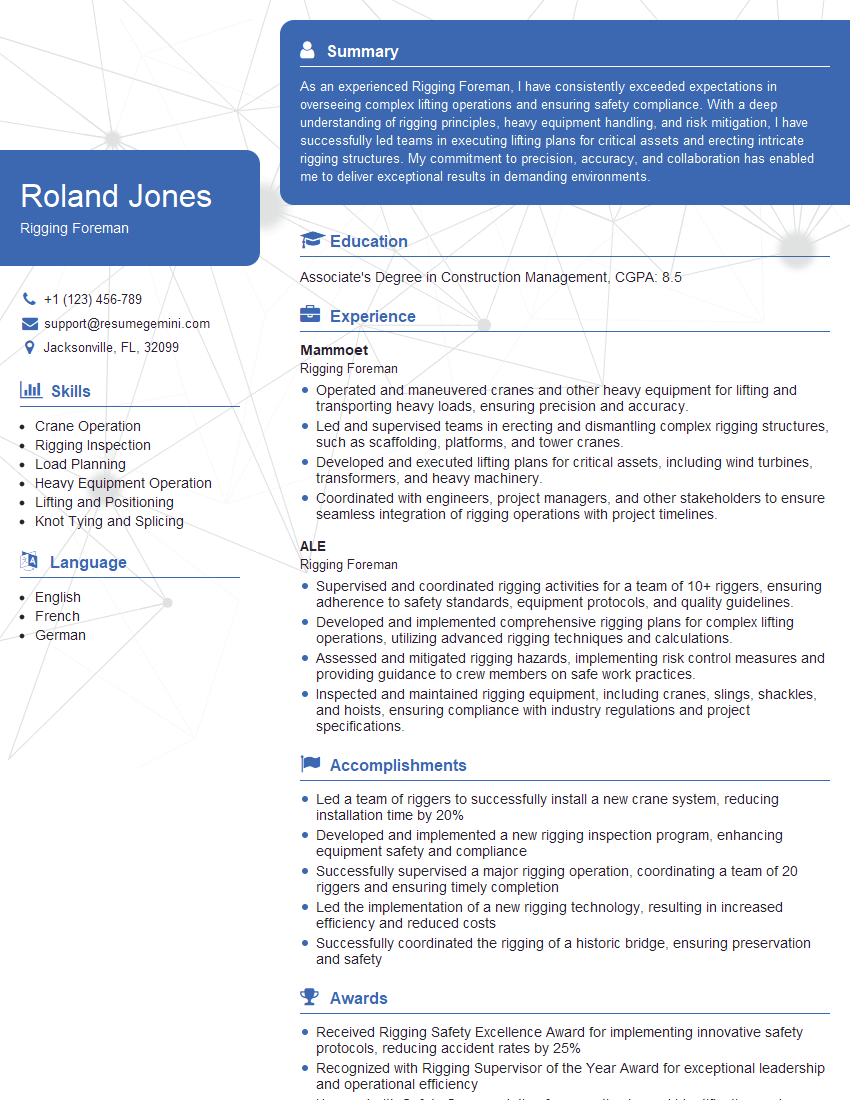
Mastering Rigging Inspection and Maintenance is crucial for career advancement in this vital and growing field. A strong understanding of these principles demonstrates your commitment to safety and efficiency, opening doors to more senior roles and increased earning potential. To maximize your job prospects, create an ATS-friendly resume that highlights your skills and experience effectively. ResumeGemini is a trusted resource to help you build a professional and impactful resume. Examples of resumes tailored to Rigging Inspection and Maintenance are available to guide you through the process, ensuring your application stands out.

Explore more articles
Users Rating of Our Blogs
Share Your Experience
We value your feedback! Please rate our content and share your thoughts (optional).
What Readers Say About Our Blog
Very informative content, great job.
good