Feeling uncertain about what to expect in your upcoming interview? We’ve got you covered! This blog highlights the most important Rigging Setup and Inspection interview questions and provides actionable advice to help you stand out as the ideal candidate. Let’s pave the way for your success.
Questions Asked in Rigging Setup and Inspection Interview
Q 1. Explain the different types of rigging hardware and their applications.
Rigging hardware encompasses a wide array of components crucial for safely lifting and moving loads. Understanding their individual strengths and limitations is paramount for safe operation. Here are some key types:
- Hooks: These are used to connect the sling to the load or lifting point. Different hook types (e.g., eye hooks, clevis hooks) are designed for specific applications and load capacities. It’s critical to inspect hooks for cracks, bends, or deformation before each use.
- Shackles: Used to connect two parts of a rigging assembly, shackles provide a strong, easily adjustable link. Bow shackles and D-shackles are common types, each having its own advantages depending on the load orientation and ease of access.
- Sling Hardware: This includes various fittings and hardware designed to protect slings and improve load distribution. Examples are shackles, links, and eye bolts.
- Wire Rope Clips (Clamps): These secure the end of wire rope slings, preventing unraveling. Correct installation is crucial, following a specific overlap and tightening sequence. Incorrect installation greatly reduces the safe working load.
- Turnbuckles: Allow for adjustment of sling length, useful for precise positioning of loads. They are not load-bearing components and should not be used to bear the load of a lift.
- Eye Bolts: These are used to attach slings to lifting points on equipment or structures, ensuring secure attachment and proper load distribution.
For example, when lifting a heavy engine, you might use a combination of an eye bolt secured to the engine’s lifting point, a chain sling, and a hook attached to the crane hook. The choice of hardware depends on factors like load weight, angle of lift, and environmental conditions.
Q 2. Describe the process of conducting a pre-lift inspection.
A pre-lift inspection is a critical step that prevents accidents and ensures a safe lift. It involves a thorough visual examination of all components of the rigging system before any load is attached. This inspection should always be documented.
The process typically includes:
- Inspecting the Lifting Equipment: This includes the crane, hoist, or other lifting device, checking its operational status, capacity, and any visible damage.
- Checking the Rigging Hardware: Carefully examine all shackles, hooks, slings, and other hardware for any signs of wear, damage (cracks, bends, deformation), corrosion, or misalignment. Pay close attention to the SWL markings.
- Evaluating the Load: Assess the weight, center of gravity, and any potential hazards associated with the load. Check for any sharp edges or points that could damage the slings.
- Verifying the Lifting Plan: Ensure the chosen rigging configuration is appropriate for the load and the lifting environment, considering factors such as clearance, obstructions, and the ground conditions.
- Assessing Environmental Conditions: Consider weather conditions (wind, rain, ice), temperature, and visibility. Adverse conditions might necessitate postponing the lift.
- Documentation: All inspections must be documented, including date, time, inspector’s name, and any observed defects or issues.
Imagine a scenario where a pre-lift inspection reveals a small crack in a shackle. Identifying and replacing this component before the lift prevents a potential catastrophic failure.
Q 3. What are the critical factors to consider when selecting rigging equipment for a specific lift?
Selecting the right rigging equipment is crucial for a safe and efficient lift. Several critical factors need consideration:
- Load Weight: The most obvious factor – the rigging equipment’s SWL must exceed the weight of the load. Always use a safety factor.
- Load Dimensions and Shape: The size and shape of the load determine the type and number of slings required. Unusual shapes might need customized slings or rigging arrangements.
- Lifting Height and Distance: The height and distance of the lift influence the type of rigging equipment needed. Longer lifts might necessitate longer slings or additional support.
- Lifting Angle: The angle at which the load is lifted affects the load on the slings. Reducing the angle can significantly improve safety.
- Environmental Conditions: Temperature, weather (wind, rain), and the work environment (indoors/outdoors) can affect the choice of rigging materials (e.g., choosing corrosion-resistant materials in harsh environments).
- Accessibility: Consider ease of attachment and detachment of the slings to the load and crane.
- SWL of all components: The SWL of the entire rigging assembly is determined by the weakest link. Always select hardware with an SWL exceeding the expected load.
For instance, lifting a long, heavy beam requires multiple slings to distribute the weight evenly and prevent excessive stress on any single point.
Q 4. How do you calculate the safe working load (SWL) of a rigging assembly?
Calculating the SWL of a rigging assembly is not a simple formula but rather a process involving multiple considerations. There’s no single equation, as it depends heavily on the configuration.
The process begins by identifying the SWL of each individual component in the rigging assembly (slings, shackles, hooks, etc.). The SWL of the assembly is then determined by the lowest SWL of any single component. However, other factors influence the SWL:
- Type and Angle of Sling(s): Using slings at angles other than vertical reduces their effective load capacity. Specialized charts and calculations account for the angle and sling configuration.
- Number of Slings: Using multiple slings distributes the load, increasing the effective SWL of the assembly. However, each sling must be capable of supporting its portion of the load.
- Manufacturer’s Data: Always refer to the manufacturer’s specifications for each component’s SWL. They account for material properties and design limitations.
- Safety Factor: An additional safety factor (typically 5:1 or even higher, depending on the application) is applied to account for unforeseen circumstances and to enhance safety.
Example: If you have a rigging assembly with a sling rated at 10,000 lbs and a shackle rated at 8,000 lbs, the assembly’s SWL is 8,000 lbs (the weakest link). Further, using this assembly at a 30-degree angle will further reduce the actual working load. Consult appropriate rigging charts for these calculations.
Q 5. What are the common causes of rigging failures?
Rigging failures can have severe consequences, leading to injuries or fatalities. Common causes include:
- Overloading: Exceeding the SWL of any component in the assembly is the most common cause.
- Improper Inspection: Failure to conduct thorough pre-lift inspections and identify damaged or worn-out equipment.
- Incorrect Rigging Techniques: Using improper angles, knots, or hitches that put excessive stress on certain components.
- Damaged or Worn Equipment: Using equipment with cracks, kinks, corrosion, or other visible damage.
- Environmental Factors: Exposure to extreme temperatures, corrosive environments, or severe weather conditions can weaken equipment over time.
- Improper Maintenance: Neglecting regular maintenance and inspection of the equipment.
- Using Unqualified Personnel: Lack of proper training and experience in rigging practices.
A real-world example is a crane collapse due to an overloaded sling, which emphasizes the importance of careful load calculation and regular inspection.
Q 6. Explain the importance of using proper rigging angles.
Using proper rigging angles is critical for distributing the load evenly across the slings and preventing excessive stress on any single point. The closer the sling angle is to 90 degrees (vertical lift), the more efficient the load distribution and the higher the effective load-bearing capacity of the sling.
As the angle deviates from 90 degrees, the load on each sling increases. This is because the vertical component of the load on each sling is reduced, placing increased stress on the horizontal component, potentially leading to premature failure. Rigging charts provide the derating factors for different angles. For example, a 30-degree angle significantly reduces the effective load capacity compared to a 90-degree angle.
Using slings at extreme angles (close to horizontal) is unsafe and should be avoided. Always aim for the most vertical lift possible to minimize stress and maximize safety. This is critical for both single-sling and multiple-sling lifts.
Q 7. Describe the different types of slings and their appropriate uses.
Several sling types are available, each suited for specific applications:
- Polyester Webbing Slings: These are lightweight, flexible, and easy to handle. They are suitable for lifting loads with relatively smooth surfaces and are less prone to cutting.
- Nylon Webbing Slings: Similar to polyester, but offering slightly higher strength and stretch resistance. They are popular for general-purpose applications.
- Chain Slings: Robust and durable, chain slings can handle heavy loads and harsh environments. They are suitable for applications involving sharp edges or rough surfaces but require careful inspection for wear and stretching.
- Wire Rope Slings: Very strong and resistant to abrasion, wire rope slings are suitable for heavy-duty applications. However, they require careful handling and proper end terminations to prevent unraveling.
- Round Slings: These are typically made from either synthetic webbing or wire rope, and are designed for loads that need to be wrapped around objects or in situations where the load may shift.
Choosing the appropriate sling depends on several factors such as load weight, shape, and surface characteristics. Using a chain sling for a load with sharp edges is safer than using a polyester sling as the chain is less likely to be cut by the edges. Conversely, a webbing sling is preferred for a load with a smooth surface to prevent damage to the sling and the object. Always use the correct sling for the specific application to ensure a safe lift.
Q 8. How do you identify damaged or worn rigging equipment?
Identifying damaged or worn rigging equipment is crucial for safety. It requires a thorough visual inspection and, in some cases, non-destructive testing. I start by looking for obvious signs of damage like fraying, kinking, or cuts in ropes or slings. For chains, I check for excessive wear, stretching, or broken links. Hooks should be inspected for cracks, bends, or deformation. Any signs of corrosion, especially pitting, are major red flags. I pay close attention to the end fittings, ensuring they are securely attached and undamaged. For wire ropes, I look for broken wires, especially if they’re concentrated in one area – this indicates significant weakening. Furthermore, I check for any signs of heat damage, which can weaken the material significantly. Beyond visual inspection, for critical applications, I’d use non-destructive testing methods like ultrasonic testing to assess the internal integrity of the components.
Think of it like this: you wouldn’t drive a car with worn tires; similarly, you shouldn’t use rigging equipment with visible damage. Even minor damage can compromise the structural integrity, leading to catastrophic failures.
Q 9. What safety procedures should be followed during rigging operations?
Safety during rigging operations is paramount. We begin with a pre-lift meeting, outlining the plan, identifying potential hazards, and assigning roles and responsibilities. Everyone involved, from riggers to crane operators, needs to be properly trained and certified. We always use appropriate Personal Protective Equipment (PPE), including hard hats, safety glasses, gloves, and high-visibility vests. A thorough inspection of the rigging equipment and lifting apparatus is mandatory before each lift. Load calculations are crucial to ensure the chosen equipment has the necessary capacity for the load’s weight and configuration. Proper communication is essential throughout the operation, using hand signals and/or radios to coordinate movements precisely. The work area should be secured, with barriers to prevent unauthorized personnel from entering. We establish clear communication channels and emergency procedures, ensuring everyone knows how to react in case of unforeseen circumstances. Finally, regular training and refresher courses are essential to keep our team updated on best practices and safety protocols.
Q 10. Explain the importance of proper communication during a rigging lift.
Effective communication is the backbone of any successful rigging lift. It prevents misunderstandings and ensures everyone is on the same page. Clear communication minimizes the risk of accidents and ensures the smooth execution of the lift. We typically use a combination of hand signals, verbal commands, and radio communication. Hand signals are essential for coordinating the crane operator and ground crew, especially in noisy environments. Clear and concise verbal commands ensure everyone understands the next steps. Radios are critical for maintaining open communication, especially during complex lifts or when personnel are spread across a larger area. Before each lift, we establish a clear communication protocol, outlining who is responsible for giving commands, who is receiving them, and what actions are expected from each team member. A designated signal person is crucial, ensuring everyone interprets signals consistently. The importance of clear, concise, and unambiguous communication is immeasurable. A single miscommunication can lead to a serious incident.
Q 11. Describe your experience with different types of lifting devices (cranes, hoists, etc.).
I have extensive experience with various lifting devices, including different types of cranes (tower cranes, mobile cranes, overhead cranes), hoists (electric chain hoists, air hoists, manual chain hoists), and other specialized lifting equipment. My experience encompasses the safe operation, inspection, and maintenance of these devices. For example, I’ve worked with tower cranes on high-rise construction projects, utilizing my expertise to plan the lift, ensure stability, and coordinate the actions of the crane operator and ground crew. I’m also proficient in using various types of hoists in different industrial settings. My experience includes selecting appropriate lifting gear based on the load’s weight, configuration, and environment. I’m familiar with the operational limitations and safety regulations associated with each type of lifting device. This includes understanding load charts, weight limits, and operational procedures for each piece of equipment.
Q 12. How do you ensure the stability of the load during lifting and movement?
Ensuring load stability is paramount during lifting and movement. It involves several key steps: proper load balancing, secure attachment points, and careful maneuvering. First, we assess the load’s center of gravity and distribute the weight evenly across the lifting points. We use appropriate slings or straps, ensuring they are properly rated for the weight and type of load. The load should be securely attached to avoid shifting or swaying. During the lift, we monitor the load closely, watching for any signs of instability. The crane operator is given clear instructions on slow, controlled movements. We use tag lines to guide the load and maintain stability, particularly during intricate maneuvers. In addition, we account for wind conditions, which can significantly impact load stability, especially for lighter or high-surface-area loads. We would avoid lifting in strong winds if possible and use appropriate wind speed mitigation techniques if the lift is unavoidable.
Q 13. What are your methods for securing a load during transport?
Securing a load during transport involves using appropriate restraints to prevent shifting, tipping, or falling. The method depends on the load’s size, shape, and weight, as well as the mode of transport (truck, rail, etc.). We commonly use chains, straps, or nets to secure the load, ensuring proper tension and placement. For larger or heavier loads, we may use multiple attachment points, strategically positioned to distribute the load evenly. The chosen restraints are rated for the weight and type of load, ensuring adequate strength and durability. We properly document the securing method, including the number of restraints used, their placement, and the tension applied. Proper documentation ensures accountability and traceability. Before transport, we conduct a final inspection to verify the securement method, checking that nothing is loose or could potentially shift during transport.
Q 14. How do you handle unexpected situations during a rigging operation?
Handling unexpected situations during a rigging operation requires quick thinking, decisive action, and a calm approach. My approach involves a series of steps. First, I immediately stop the operation and assess the situation. This includes identifying the nature of the problem and its potential impact. Second, I communicate clearly with the entire team, ensuring everyone is aware of the situation. Third, I develop a plan to address the issue, taking into account safety concerns. This might involve adjusting the lifting plan, requesting additional equipment, or contacting emergency services if necessary. Throughout the process, I prioritize safety, ensuring the well-being of the team and the public. Finally, we conduct a thorough post-incident review to identify the root cause of the problem and implement preventative measures to avoid similar incidents in the future. Documenting every step of the process is crucial for future analysis and improvements.
Q 15. What are the legal and regulatory requirements for rigging in your region?
Rigging regulations vary significantly by region, often dictated by national occupational safety and health agencies and supplemented by local ordinances. In my region, compliance hinges on adherence to [Insert specific regional/national standard, e.g., OSHA (USA), HSE (UK), etc.]. This involves rigorous adherence to safe working load limits (SWL) for all equipment, mandatory inspections and certifications of lifting gear, and detailed risk assessments prior to every lift. For example, we must meticulously document every component’s SWL, including slings, chains, shackles, and the crane itself, ensuring that the combined SWL surpasses the weight of the load and accounts for any potential dynamic forces. Failure to comply results in severe penalties, including fines, operational shutdowns, and even criminal charges.
Specific requirements often address aspects such as:
- Competency of riggers: Riggers must possess the necessary qualifications and certifications.
- Equipment maintenance and inspection: Regular inspections and maintenance records are mandatory for all lifting equipment.
- Safe operating procedures: Detailed procedures are required outlining safe lift planning and execution.
- Emergency procedures: Clear emergency protocols must be in place to handle unforeseen events.
These regulations are not merely bureaucratic hurdles; they are fundamentally important in preventing accidents and safeguarding lives.
Career Expert Tips:
- Ace those interviews! Prepare effectively by reviewing the Top 50 Most Common Interview Questions on ResumeGemini.
- Navigate your job search with confidence! Explore a wide range of Career Tips on ResumeGemini. Learn about common challenges and recommendations to overcome them.
- Craft the perfect resume! Master the Art of Resume Writing with ResumeGemini’s guide. Showcase your unique qualifications and achievements effectively.
- Don’t miss out on holiday savings! Build your dream resume with ResumeGemini’s ATS optimized templates.
Q 16. Describe your experience with rigging documentation and record-keeping.
Rigging documentation is the cornerstone of safe and compliant operations. My experience involves meticulous record-keeping, starting with pre-lift assessments. This includes creating detailed lift plans that specify the load weight, dimensions, center of gravity, lifting points, rigging configuration, and equipment used (including SWLs for each component). We utilize both digital and physical records; digital systems provide centralized access for multiple team members and efficient archiving, while hard copies remain accessible even in case of technological failures. Each inspection—whether pre-use, periodic, or post-incident—is thoroughly documented, noting any damage, wear, or repairs. These records include photographs, inspection checklists, and certificates of compliance from third-party testing agencies. This thorough system allows for tracing the history of equipment and identifying potential weaknesses early, thus preventing costly or dangerous failures. For example, in one project, meticulous documentation of a sling’s previous inspections revealed minute fraying not previously noted, which allowed us to replace it before a catastrophic failure could occur during a critical lift.
Q 17. Explain the concept of load center and its importance.
The load center is the point where the weight of an object is considered to be concentrated. Imagine it as the balance point of the load. Understanding its location is crucial because it directly affects the stability of the lift and the forces acting on the rigging equipment. If the load center isn’t properly identified, there’s a risk of the load swinging, tilting, or even failing during the lift.
For example, consider lifting a long steel beam: if you attach the slings only to the ends, the beam will likely swing, posing a significant safety hazard. However, placing slings around the load’s center of gravity allows for a stable lift, reducing the risk of a dangerous swing. Precise calculation of the load center is essential for determining appropriate sling angles, minimizing stress on the equipment, and ensuring a safe lifting operation. Improper calculation of the load center could lead to unbalanced loads, equipment failure, and potential injury or damage.
Q 18. How do you assess the structural integrity of the lifting points?
Assessing the structural integrity of lifting points is paramount to safety. This begins with a visual inspection for any signs of damage such as cracks, corrosion, deformation, or previous repairs. We then consult the load capacity documentation for each lifting point, verifying it’s sufficient for the intended load. If the lifting point’s structural integrity is questionable, we will conduct Non-Destructive Testing (NDT) methods such as ultrasonic testing or magnetic particle inspection to detect internal flaws. In some situations, we may also require engineering analysis to determine the load capacity if the information isn’t readily available. For instance, if lifting from a custom-fabricated structure, an engineer’s assessment is often necessary. We document all findings meticulously, always erring on the side of caution. A substandard lifting point can easily lead to catastrophic equipment failure, so thorough evaluation is essential.
Q 19. What are the different types of hitches and their applications?
Hitches are different methods of attaching a sling to a load, each designed to optimize lifting for specific scenarios. Incorrect hitching can significantly reduce the sling’s safe working load and lead to failure.
- Basket Hitch: Uses two slings symmetrically placed around the load. Provides good stability and distributes the weight evenly. Common for lifting pallets or uniformly shaped objects.
- Vertical Hitch: A single sling directly beneath the load. Simple and efficient but offers less stability compared to the basket hitch.
- Choker Hitch: A single sling looped around the load with one leg passing through the loop. Requires caution as it concentrates stress on a smaller area of the sling.
- Bridle Hitch: Two or more slings attached to a single point above the load, distributing the weight across multiple attachment points. Excellent for balanced lifting of heavy loads.
Choosing the correct hitch is critical to distributing the load evenly and ensuring the safe working load of the sling is not exceeded. Incorrect hitching can drastically reduce a sling’s load capacity, creating a hazardous situation. The choice depends largely on the load’s shape, weight distribution, and the available lifting points.
Q 20. Describe your experience with different types of knots used in rigging.
My experience encompasses a range of knots, each with specific applications and safety considerations. Using the wrong knot or tying it incorrectly can lead to catastrophic failure. Some common examples include:
- Bowline: Forms a strong loop that doesn’t slip or tighten under load, excellent for making a fixed loop on a rope.
- Clove Hitch: A simple and quick hitch, frequently used for securing a rope to a post or ring. It’s essential to properly double the hitch for security.
- Figure Eight Knot: A stopper knot used to prevent a rope from slipping through a system, useful in various rigging configurations.
- Carrick Bend: A knot used to join two ropes of similar diameter. It’s crucial to ensure proper tension when making this knot.
Proper knot selection and tying are crucial to safety. In addition to knowing the right knots, a rigorous understanding of the load, rope strength, and friction involved is vital to select the right knot and execute the tying process correctly. Improper knot tying is a leading cause of rigging accidents.
Q 21. How do you determine the appropriate size and type of shackle for a given load?
Shackle selection is crucial for ensuring safe rigging. The size and type of shackle are determined by several factors:
- Working Load Limit (WLL): The shackle’s WLL must exceed the load’s weight, including any dynamic forces.
- Shackle Type: Different shackle types (bow, screw pin, etc.) offer varying strengths and ease of use. Screw pin shackles are generally preferred for their better safety features.
- Pin Diameter: The pin diameter must be adequate to handle the load.
- Material: Shackles are made from various materials (steel, stainless steel, etc.), each with differing strength properties. The material selection should match the environmental conditions and load requirements.
For example, a heavy-duty steel screw pin shackle might be selected for lifting a large and heavy piece of equipment, while a lighter-duty stainless steel bow shackle could be suitable for less demanding lifts. Overlooking these aspects could lead to shackle failure, resulting in potentially dangerous consequences.
Always refer to the manufacturer’s specifications to ensure the selected shackle is appropriate for the intended load and application. Using a shackle with a WLL below the load’s weight is extremely dangerous.
Q 22. What are the limitations of different rigging hardware?
Rigging hardware, while incredibly strong, has inherent limitations. These limitations depend heavily on the specific material (steel, synthetic fiber, etc.), the hardware’s design (shackles, hooks, slings, etc.), and its condition.
- Steel hardware can suffer from fatigue failure over time, especially with repeated loading and unloading. Corrosion is another significant concern, weakening the metal and reducing its load-bearing capacity. Improper use, such as overloading or impact loading, can also lead to failure. For example, a shackle improperly loaded can experience a significant reduction in its working load limit.
- Synthetic fiber slings are vulnerable to UV degradation, abrasion, and chemical damage. Their strength diminishes with exposure to the elements, and visible damage (cuts, fraying) indicates a significant reduction in capacity. Overloading, improper hitching, and sharp edges can easily cause premature failure. A sling damaged in this way will need immediate replacement.
- All hardware has a Working Load Limit (WLL), which is crucial to understand and always adhere to. Exceeding the WLL significantly increases the risk of catastrophic failure. Furthermore, all hardware must be inspected regularly for damage before use, with damaged components replaced immediately.
Understanding these limitations requires careful selection of appropriate hardware for the specific job and regular, thorough inspections to ensure safety.
Q 23. How do you account for environmental factors (wind, temperature) in your rigging plans?
Environmental factors like wind and temperature significantly impact rigging operations. Neglecting to account for these can lead to accidents. My approach involves a multi-step process:
- Wind Speed and Direction: I always check local weather forecasts before and during any rigging operation. High winds can exert significant forces on suspended loads, making them unstable. We may need to postpone the lift or employ specialized rigging techniques like reducing the height of the lift or using additional securing points to mitigate the wind’s effect. For example, on a high-rise building project, we might need to use stronger bracing if the wind speed is greater than the specified tolerance in our calculations.
- Temperature: Temperature changes affect the strength properties of materials. Extreme cold can embrittle steel, reducing its ductility and making it more prone to fracture. Heat can weaken synthetic fibers, reducing their strength. We adjust our rigging plans based on the expected temperature, using appropriate materials and safety factors to compensate.
- Precipitation: Rain and snow can increase the weight of the load and reduce the friction between ropes and other components, impacting stability. We often incorporate additional safety measures, such as using waterproof materials and implementing extra precautions against slipping.
- Software and Calculations: I use specialized rigging software that allows me to input environmental data, enabling precise calculations that account for these variables. This ensures that the rigging setup is safe and stable under the expected conditions.
Rigging plans always need to incorporate these factors to make them robust and safe.
Q 24. Describe your experience with fall protection and safety harnesses in rigging.
Fall protection is paramount in rigging. I have extensive experience with various fall protection systems, including safety harnesses, lanyards, and anchor points. My focus is always on ensuring compliance with all relevant safety standards.
- Harness Selection: The choice of harness depends on the specific task. Full-body harnesses offer the best protection, providing secure anchorage points for lanyards. Harnesses must always fit correctly and be inspected regularly for wear and tear.
- Anchor Points: Secure anchor points are critical. They need to be structurally sound and capable of supporting the weight of the worker and any dynamic forces caused by a fall. I verify each anchor point before use, calculating its capacity and confirming its integrity.
- Lanyard Selection and Use: Lanyards must be appropriate for the working environment and the type of fall protection system. They should be inspected for damage and used correctly. I often perform regular checks to ensure proper connection to both the harness and the anchor point.
- Rescue Plans: Every rigging operation has an associated rescue plan. This includes designating rescue personnel, identifying escape routes, and having appropriate rescue equipment available.
My experience includes working at heights using various fall protection systems, emphasizing the importance of a multi-layered approach to fall protection.
Q 25. What is your experience with using rigging software or design tools?
I’m proficient in several rigging software packages, including [mention specific software, e.g., Rigging Calculator Pro, etc.]. These tools allow for accurate calculation of loads, stresses, and angles, ensuring that the rigging design is safe and efficient.
- Load calculations: The software helps calculate the forces acting on each component of the rigging system based on weight, angles, and other factors.
- Stress analysis: I use the software to simulate different scenarios and determine the stresses on each component to ensure they remain within their safe working limits.
- 3D modeling: Many programs offer 3D modeling capabilities that assist in visualizing the rigging setup, making it easier to identify potential hazards and optimize the design.
- Reporting: The software generates detailed reports that can be used for documentation and compliance purposes.
These tools are invaluable in ensuring the accuracy and safety of our rigging plans, minimizing risks, and facilitating efficient project management.
Q 26. Explain your understanding of different types of load-bearing structures.
My understanding of load-bearing structures is extensive, encompassing various types commonly used in rigging operations.
- Beams and Girders: I frequently work with steel beams and girders for supporting heavy loads. Understanding their load capacities and structural integrity is crucial. I always verify the capacity of the supporting structure before rigging any heavy equipment.
- Trusses: Trusses are lightweight yet strong structures used for supporting suspended loads. My experience includes evaluating the design and stability of trusses to ensure they are suitable for the specific load and environmental conditions.
- Frame structures: I’ve worked with various frame structures, ranging from simple scaffolding to complex gantry systems. I assess their stability and load-bearing capacity, ensuring they can safely handle the intended loads.
- Specialized structures: Depending on the project, we might encounter specialized structures like towers, masts, or custom-designed frames. My experience includes assessing these structures, evaluating their suitability and making necessary modifications to enhance safety.
Selecting and assessing load-bearing structures is fundamental to safe rigging. It requires a thorough understanding of structural mechanics and engineering principles.
Q 27. How do you ensure compliance with OSHA or other relevant safety regulations?
Compliance with OSHA (or equivalent international regulations) is non-negotiable. I ensure compliance through several key strategies:
- Pre-Job Planning: Rigging plans are meticulously developed, incorporating all relevant safety regulations and best practices. They include detailed specifications of hardware, procedures, and emergency protocols.
- Regular Inspections: Rigging equipment undergoes thorough inspections before and during each operation. This includes checking for any signs of wear and tear, damage, or corrosion. Any faulty equipment is immediately removed from service.
- Personnel Training: All personnel involved in rigging operations receive comprehensive training on safety procedures, equipment usage, and hazard identification. Regular refresher courses keep everyone up-to-date with best practices and changes in regulations.
- Documentation: Meticulous record-keeping is essential. We maintain detailed records of inspections, training, and any incidents or near-misses. This documentation is critical for audits and demonstrates our commitment to safety.
- Hazard identification and risk assessment: Before every operation, we perform a thorough risk assessment, identifying potential hazards and developing mitigation strategies to minimize risks.
Safety is paramount. Compliance with regulations is not just a matter of procedure; it is a fundamental part of my approach to rigging.
Q 28. Describe a challenging rigging situation you encountered and how you resolved it.
During a recent project involving the installation of a large HVAC unit on a high-rise building, we encountered unexpectedly high winds. The initial rigging plan, while designed to handle moderate winds, was not sufficient for the conditions. The unit started to sway dangerously during the lift.
My immediate response was to halt the operation. We then reassessed the situation, consulting weather reports and performing on-site wind speed measurements. Using our rigging software, we quickly recalculated the forces acting on the load and determined that we needed additional support lines to stabilize the unit.
We communicated the new plan to the team, and following a safety briefing, implemented the changes which involved adding two more secured anchor points. This extra support significantly stabilized the load, allowing us to safely complete the lift. The key was rapid assessment, communication, and the willingness to adapt the rigging plan to overcome the unexpected challenges presented by the adverse weather conditions.
Key Topics to Learn for Rigging Setup and Inspection Interview
- Understanding Rigging Hardware: Become familiar with various types of rigging hardware, their strengths, weaknesses, and appropriate applications. This includes shackles, slings, wire ropes, turnbuckles, and other essential components.
- Safe Rigging Practices: Master the principles of safe rigging procedures, encompassing pre-lift inspections, load calculations, and proper rigging techniques to prevent accidents and ensure structural integrity.
- Load Calculations and Weight Distribution: Develop a strong understanding of load calculations, center of gravity, and how to distribute weight effectively for safe and efficient lifting operations. Be prepared to discuss different load scenarios and appropriate rigging configurations.
- Inspection Procedures and Documentation: Thoroughly understand pre-lift and post-lift inspection procedures, including the use of checklists and detailed documentation of any identified issues or damage. Know how to interpret inspection reports and identify potential hazards.
- Troubleshooting and Problem Solving: Practice analyzing rigging setups and identifying potential problems. Be ready to describe how you would approach troubleshooting common issues encountered during rigging operations.
- Regulations and Safety Standards: Familiarize yourself with relevant industry regulations, safety standards (e.g., OSHA), and best practices related to rigging setup and inspection. Demonstrate your understanding of compliance and risk mitigation.
- Emergency Procedures: Know how to respond to various emergency scenarios, such as equipment failure or unexpected load shifts. Describe your procedures for safe and effective emergency response.
- Communication and Teamwork: Highlight your ability to effectively communicate with crew members, supervisors, and other stakeholders, emphasizing the importance of clear communication in a team-based rigging environment.
Next Steps
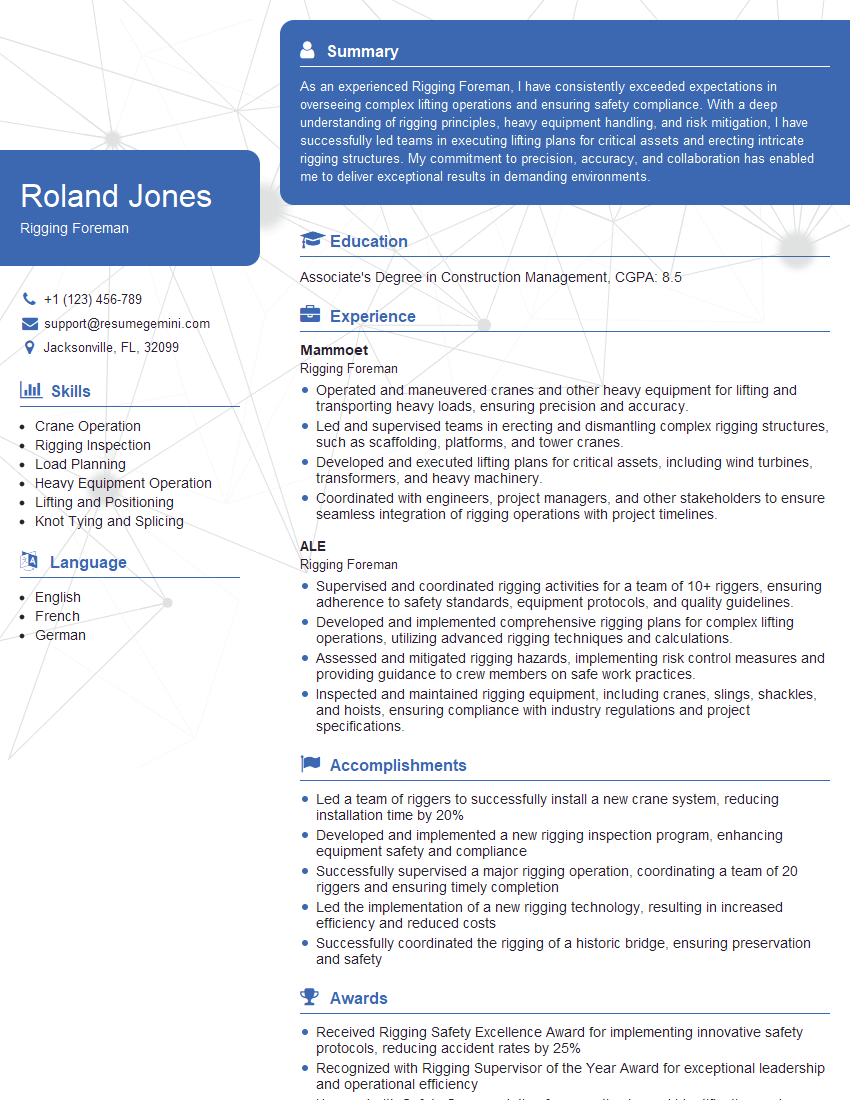
Mastering Rigging Setup and Inspection is crucial for career advancement in this demanding yet rewarding field. A strong understanding of these concepts demonstrates your commitment to safety and efficiency, opening doors to more challenging and higher-paying roles. To significantly boost your job prospects, focus on creating an ATS-friendly resume that highlights your skills and experience effectively. ResumeGemini is a trusted resource that can help you build a professional, impactful resume. Examples of resumes tailored to Rigging Setup and Inspection are available to guide you, ensuring your application stands out from the competition.



Explore more articles
Users Rating of Our Blogs
Share Your Experience
We value your feedback! Please rate our content and share your thoughts (optional).
What Readers Say About Our Blog
Very informative content, great job.
good