Feeling uncertain about what to expect in your upcoming interview? We’ve got you covered! This blog highlights the most important Robotics Operations interview questions and provides actionable advice to help you stand out as the ideal candidate. Let’s pave the way for your success.
Questions Asked in Robotics Operations Interview
Q 1. Explain the different types of robotic systems used in industrial automation.
Industrial robots are categorized based on their configuration, functionality, and application. Here are some key types:
- Articulated Robots: These are the most common type, resembling a human arm with multiple rotating joints. They offer high flexibility and are used in a wide range of tasks, such as welding, painting, and assembly. Think of them as the multi-talented workhorses of the robotic world.
- Cartesian Robots (Gantry Robots): These robots move along three linear axes (X, Y, Z). They are ideal for tasks requiring precise movement in a defined workspace, like pick-and-place operations in a manufacturing line. Imagine them as a highly precise 3D printer for parts.
- SCARA Robots (Selective Compliance Assembly Robot Arm): These robots are known for their speed and precision in assembly applications. They have two parallel rotating joints and a vertical linear joint, making them great for tasks requiring fast and accurate placement of components, such as inserting parts into circuit boards.
- Cylindrical Robots: These robots have a rotating base and a linear arm that moves along a vertical axis. They are suited for tasks involving vertical movements within a cylindrical workspace.
- Polar Robots (Spherical Robots): These robots rotate around a central axis, with a radial arm extending outwards and a rotational wrist. They excel in applications requiring large reach and maneuverability.
- Delta Robots (Parallel Robots): Characterized by their three arms extending from a common base to a single end-effector. These robots are extremely fast and precise, and often used for high-speed pick-and-place operations, like in packaging or food processing.
The choice of robot depends heavily on the specific application’s requirements, including payload capacity, workspace, speed, precision, and cost.
Q 2. Describe your experience with robotic programming languages (e.g., RAPID, KRL).
I have extensive experience programming industrial robots using both RAPID (ABB robots) and KRL (KUKA robots). Both languages are powerful but differ in syntax and structure.
In my previous role, I developed a complex robotic cell using RAPID for an automotive assembly line. This involved programming the robot to perform several intricate tasks, including precise welding and part handling, using advanced functions like path planning and sensor integration. A key challenge was ensuring synchronized movement with conveyor systems, requiring sophisticated timing and coordination within the RAPID code. A simplified example of a RAPID program segment to move a robot to a specific point might look like this:
MoveL p100, v100, z50, fine;This line moves the robot to point ‘p100’ at velocity ‘v100’ with a fine approach. Similarly, I’ve worked extensively with KRL, programming KUKA robots for palletizing and material handling. KRL’s structured approach facilitated efficient error handling and program maintenance for these demanding high-throughput applications.
My experience includes not only programming individual robots but also integrating them with other automation equipment using PLC communication and advanced control strategies, showcasing a holistic understanding of the automation process.
Q 3. How do you troubleshoot robotic malfunctions and downtime?
Troubleshooting robotic malfunctions requires a systematic approach. My process typically follows these steps:
- Safety First: Isolate the robot and ensure power is off before any physical inspection or troubleshooting.
- Identify the Problem: Observe the robot’s behavior – is it not moving, showing error messages, or producing faulty results? Gather data from the robot’s controller, including error logs and sensor readings.
- Review Program Code: Check the robot’s program for any syntax errors or logical flaws that might cause the malfunction. This includes verifying coordinate systems, speed settings, and safety limits.
- Check Sensors and Peripherals: Inspect sensors (vision, proximity, force) and other connected devices (grippers, conveyors) to ensure they are functioning correctly and communicating properly with the robot controller. Sensor calibration can often be a crucial step.
- Inspect Mechanical Components: Look for any physical issues such as loose connections, worn-out parts, or mechanical obstructions. This might involve checking belts, gears, and the robot’s arm structure.
- Systematic Testing: Once a potential cause is identified, test the robot gradually, verifying the resolution at each step.
- Documentation: Meticulously document all troubleshooting steps and solutions to improve future maintenance and problem resolution.
For example, if a robot repeatedly stops during a welding operation, I’d first check the weld quality (is the weld too strong and causing a mechanical jam?), then sensor input (is the arc sensor detecting the weld properly?), and finally, the programmed path (is the robot trying to weld in an impossible location?).
Q 4. What safety protocols are essential when working with industrial robots?
Safety is paramount when working with industrial robots. Essential protocols include:
- Emergency Stop Buttons: Easily accessible and clearly marked emergency stop buttons must be present throughout the robot’s workspace.
- Light Curtains and Safety Scanners: These devices create a safety zone around the robot, automatically stopping it if a person or object enters the zone. Think of them as the robot’s protective bubble.
- Interlocks and Guards: Physical barriers prevent accidental access to hazardous areas during robot operation. These interlocks ensure the robot cannot operate unless all guards are in place.
- Robot Fencing and Restricted Access Zones: Clearly designated areas restrict access to the robot and its workspace to authorized personnel only.
- Proper Training and Certification: All personnel working with industrial robots must receive comprehensive training on safe operating procedures and emergency protocols.
- Risk Assessment and Safety Audits: Regular safety audits and risk assessments identify potential hazards and ensure compliance with safety standards.
- Personal Protective Equipment (PPE): Appropriate PPE, such as safety glasses, gloves, and hearing protection, must be worn at all times when working near industrial robots.
Ignoring these protocols can lead to serious injuries or damage to equipment. A thorough risk assessment, tailored to the specific application and robot, is crucial for establishing effective safety measures.
Q 5. Explain your understanding of robotic vision systems and their applications.
Robotic vision systems use cameras and image processing software to enable robots to ‘see’ their environment. This ‘sight’ allows robots to perform tasks that require visual feedback, increasing their adaptability and intelligence.
Applications are vast. In manufacturing, vision systems guide robots in tasks such as:
- Part Recognition and Location: Identifying and locating parts on a conveyor belt for precise picking and placement. For example, a robotic arm uses a vision system to differentiate between different types of screws and pick the correct one for assembly.
- Quality Inspection: Detecting defects in manufactured products, ensuring consistent quality standards. A vision system can analyze images to identify scratches or imperfections on a painted surface.
- Guided Assembly: Guiding robots in complex assembly operations by visually aligning parts before joining them. This ensures accurate placement and assembly even with parts that are slightly misaligned.
- Navigation and Mapping: Enabling mobile robots to navigate complex environments by identifying obstacles and creating maps. This is essential in areas such as warehouse automation and autonomous vehicles.
The technology typically involves cameras, lighting systems, image processing algorithms, and interfaces to the robot controller. The algorithms process image data to identify features, measure distances, and guide the robot’s actions accordingly. A key advantage is increased flexibility: robots are no longer limited to pre-programmed movements, they can adapt to variations in the environment and objects they handle.
Q 6. Describe your experience with robotic cell design and integration.
Robotic cell design and integration involve creating a dedicated workspace for a robot and its supporting equipment. This includes careful planning and coordination of several elements.
My experience encompasses the entire process: from initial concept and design to final commissioning and testing. This includes:
- Defining Cell Layout: Designing the physical layout of the cell, considering factors such as robot reach, part flow, and worker access.
- Selecting Equipment: Choosing appropriate robots, end-effectors (grippers, tools), sensors, and safety equipment based on the specific application requirements.
- Programming and Control Systems: Developing the robot programs and integrating the cell’s various components using PLC programming and other control systems.
- Safety System Design: Incorporating safety features like light curtains, emergency stops, and guarding to create a safe working environment.
- Simulation and Validation: Using simulation software to test the cell design and robot programs before physical implementation reduces potential errors and downtime.
- Commissioning and Testing: Installing and testing the cell to ensure it operates as intended, meeting performance and safety requirements. This phase usually involves thorough testing and adjustments to optimize performance.
For example, in one project, I designed and integrated a robotic cell for palletizing boxes. This involved selecting the appropriate robot based on payload and reach, designing the pallet layout, programming the robot to move boxes from a conveyor to the pallet, and installing safety features like light curtains to prevent accidents.
Q 7. How do you ensure the accuracy and precision of robotic operations?
Ensuring accuracy and precision in robotic operations is crucial for quality and productivity. Several strategies contribute to this:
- Calibration: Regularly calibrating the robot’s sensors and mechanical components to maintain accuracy and repeatability. This involves precisely adjusting the robot’s internal models to reflect its physical state.
- Precise Programming: Developing accurate robot programs with precise coordinates, speeds, and paths. Careful attention to detail during the programming phase minimizes errors.
- High-Quality Components: Using high-quality components like sensors, end-effectors, and actuators ensures reliable performance and minimal drift over time. This is a critical preventative measure.
- Regular Maintenance: Scheduled maintenance keeps the robot in top condition, preventing unexpected errors caused by wear and tear. This includes lubrication, inspections, and part replacements.
- Environmental Control: Maintaining a stable and controlled environment (temperature, humidity) can significantly improve the accuracy of robotic operations.
- Sensor Integration: Integrating sensors, like force/torque sensors or vision systems, enables real-time feedback and adaptive control, enhancing accuracy and compensating for minor variations.
For instance, in a precision assembly task, regular calibration of the robot’s joint encoders ensures that the robot consistently reaches the target positions with minimal error. Combining this with force/torque sensors allows the robot to adapt its approach to the task, reducing the risk of damaging components.
Q 8. What are the common causes of robotic failures, and how do you prevent them?
Robotic failures can stem from various sources, broadly categorized as mechanical, electrical, software, and environmental issues. Mechanical failures might include worn-out bearings, broken gears, or damaged actuators – think of it like the joints and muscles of a robot wearing down. Electrical problems can arise from faulty wiring, power surges, or sensor malfunctions; imagine a short circuit in the robot’s nervous system. Software glitches, such as programming errors or unexpected input, can cause unpredictable behavior. Finally, environmental factors like extreme temperatures, dust, or vibrations can degrade components and performance.
Preventing these failures requires a multi-pronged approach. Proactive maintenance is key: regular inspections, lubrication, and component replacement based on predicted lifespan significantly reduce the risk of unexpected breakdowns. Robust design incorporates redundancy and failsafe mechanisms. For instance, a robotic arm might have multiple sensors monitoring its position and force, allowing the system to react safely even if one sensor fails. Thorough testing before deployment helps identify and correct software and hardware flaws. Furthermore, a controlled operating environment minimizes exposure to harsh conditions. Think of keeping a delicate instrument, like a robot, away from dust and excessive vibration.
- Example: In a previous role, we implemented a predictive maintenance system using sensor data to anticipate bearing failures on our robotic arms, reducing downtime by 30%.
Q 9. Explain your experience with different types of robotic end-effectors.
My experience encompasses a wide range of robotic end-effectors, each tailored to specific tasks. I’ve worked extensively with grippers, including two-fingered, three-fingered, and vacuum grippers. The choice depends heavily on the object being manipulated: delicate objects need soft, compliant grippers, while heavy or irregularly shaped objects may require a robust, multi-fingered design or a vacuum system. I’ve also utilized welding torches for automated welding processes, requiring precise control and stability. Furthermore, I’ve integrated specialized tools such as paint sprayers, screw drivers, and even small robotic arms as end-effectors, depending on the demands of the robotic application. The key to effective end-effector selection lies in understanding the task requirements and selecting the tool with the optimal combination of dexterity, force, and precision.
Example: In one project involving delicate circuit board assembly, we employed a custom three-fingered soft gripper with integrated force sensors to gently pick and place components without damaging them. In another project, a heavy-duty vacuum gripper was ideal for lifting and placing large automotive parts during the manufacturing process.
Q 10. How do you maintain and calibrate robotic systems?
Maintaining and calibrating robotic systems is an ongoing process that ensures accuracy, safety, and longevity. Maintenance involves regular inspections for wear and tear, lubrication of moving parts, cleaning of sensors, and replacement of worn-out components. Think of it as regularly servicing your car to ensure smooth operation. Calibration focuses on ensuring the robot’s accuracy by aligning its internal coordinate system with the real-world environment. This often involves using precision measuring tools and specialized software to adjust the robot’s kinematics and dynamics. It’s akin to recalibrating a measuring scale to ensure it shows the correct weight.
Calibration procedures usually involve a series of steps: First, we identify the specific component that needs calibrating (e.g., a sensor, end-effector, or joint). Then, using specialized tools and software, we perform a series of measurements to determine the error or deviation. Finally, we use the software to adjust the robot’s parameters to compensate for the error. This is commonly done using software specific to the robot’s controller.
- Example: We regularly calibrate our robotic arms using laser trackers to ensure accuracy within a tolerance of 0.1mm in our precision assembly line.
Q 11. Describe your experience with robotic sensor technologies (e.g., force sensors, proximity sensors).
I have extensive experience integrating and utilizing various robotic sensor technologies. Force sensors are crucial for tasks requiring precise force control, such as assembly or delicate manipulation. They provide feedback on the forces and torques exerted by the robot, allowing for adaptive control strategies. Imagine them as a robot’s sense of touch. Proximity sensors, including ultrasonic, infrared, and laser sensors, detect the presence of objects without physical contact. These are vital for safety and navigation, ensuring the robot doesn’t collide with obstacles. Think of them as a robot’s awareness of its surroundings. Beyond these, I’ve worked with vision systems (cameras and image processing) for object recognition, location, and guidance, providing the robot with the ability to ‘see’.
Example: In a collaborative robot application, we used force sensors to enable safe human-robot interaction; the robot would stop immediately if it sensed excessive force applied by a human operator. In a robotic palletizing system, we used proximity sensors to detect the presence and orientation of boxes, ensuring accurate stacking.
Q 12. How do you manage robotic data acquisition and analysis?
Managing robotic data acquisition and analysis is critical for optimizing performance and troubleshooting issues. Data acquisition involves collecting data from various sensors and the robot controller, including joint positions, velocities, forces, and sensor readings. We utilize dedicated software and hardware interfaces to perform this task efficiently. Data analysis involves processing and interpreting this data to identify trends, anomalies, and areas for improvement. This often involves using statistical methods, data visualization, and machine learning techniques.
We typically use data logging systems and specialized software to collect and store data from robotic systems. This data is then analyzed using various techniques depending on the task at hand. For example, we might use statistical process control (SPC) charts to monitor the consistency of a robotic process, or employ machine learning algorithms to identify patterns and predict potential failures.
- Example: In one project, we analyzed sensor data to optimize the robot’s trajectory, reducing cycle time by 15%.
Q 13. Explain your understanding of PLC programming and its role in robotics.
Programmable Logic Controllers (PLCs) are essential components in many robotic systems. They act as the brains of the operation, managing the robot’s actions based on sensor input and programmed logic. They handle tasks such as controlling the robot’s movements, coordinating multiple robots, monitoring safety systems, and managing input/output signals from external devices. They’re like the central nervous system of a robotic system, receiving and processing information to control its behavior.
My experience with PLC programming involves using ladder logic and structured text to create control programs. This involves defining inputs and outputs, creating control algorithms, and integrating with other systems. We use PLCs to manage various aspects of the robotic system, including safety interlocks, emergency stops, and sequencing of complex operations. For instance, we might use a PLC to ensure that a robot only operates when a safety gate is closed or to coordinate the movement of multiple robots in a synchronized manner.
// Example Ladder Logic (Simplified) // Input: Safety Gate Closed // Output: Robot Enabled // ... Ladder logic code to connect input to output ...
Q 14. Describe your experience with HMI (Human-Machine Interface) design and operation.
Human-Machine Interfaces (HMIs) are crucial for safe and efficient operation of robotic systems. They provide operators with a clear and intuitive way to interact with the robots, monitor their status, and control their actions. A well-designed HMI improves productivity, reduces errors, and enhances safety. It acts as a bridge between human operators and the complex robotic system, making the system user-friendly.
My HMI design experience involves creating user interfaces using industrial HMI software packages, ensuring intuitive layout and clear visual representation of robot status, sensor readings, and control parameters. We use HMIs to display real-time data, allowing operators to visualize the robot’s actions and make necessary adjustments. Safety features are prominently displayed, with clear instructions and emergency stop buttons readily accessible. Effective HMI design requires thorough understanding of user needs and ergonomic considerations.
- Example: In a previous project, we designed an HMI with a simplified graphical representation of the robotic workcell, providing operators with clear visual feedback and intuitive controls, resulting in a significant reduction in operator errors.
Q 15. How do you ensure the efficiency and productivity of robotic systems?
Ensuring efficient and productive robotic systems hinges on a multi-faceted approach. It’s not just about the robot itself, but the entire ecosystem. Think of it like a well-oiled machine – each part needs to work seamlessly.
- Optimized Task Allocation: We need to intelligently assign tasks to robots based on their capabilities and available resources. For example, a heavy-duty robot is better suited for lifting heavy objects than a delicate, precision robot.
- Predictive Maintenance: Regularly scheduled maintenance, combined with data-driven predictive analytics, prevents downtime. We can monitor sensor data to predict potential failures and schedule maintenance before they occur, preventing costly disruptions.
- Efficient Programming and Control: Well-structured and optimized code minimizes execution time and avoids unnecessary movements. This involves techniques like path planning algorithms and efficient data structures. Think of it like mapping out the most efficient route for a delivery driver.
- Human-Robot Collaboration: Designing systems that allow seamless collaboration between humans and robots boosts productivity. This can involve collaborative robots (cobots) that work safely alongside human operators, or robots that automate repetitive tasks, freeing up human workers for more complex assignments.
- Process Optimization: Analyzing the entire workflow, identifying bottlenecks, and streamlining processes, both robotic and human, is critical. This might involve redesigning a production line to reduce the distance a robot needs to travel.
Career Expert Tips:
- Ace those interviews! Prepare effectively by reviewing the Top 50 Most Common Interview Questions on ResumeGemini.
- Navigate your job search with confidence! Explore a wide range of Career Tips on ResumeGemini. Learn about common challenges and recommendations to overcome them.
- Craft the perfect resume! Master the Art of Resume Writing with ResumeGemini’s guide. Showcase your unique qualifications and achievements effectively.
- Don’t miss out on holiday savings! Build your dream resume with ResumeGemini’s ATS optimized templates.
Q 16. What are your strategies for improving robotic system performance?
Improving robotic system performance requires a combination of strategies, focusing on both hardware and software aspects. We tackle this in a systematic way:
- Calibration and Tuning: Regularly calibrating sensors and actuators maintains accuracy and precision. Fine-tuning control algorithms improves responsiveness and efficiency.
- Algorithm Optimization: Employing advanced path planning algorithms (e.g., A*, RRT) and control strategies (e.g., PID, model predictive control) enhances the robot’s speed, accuracy, and smoothness of operation. For example, a more sophisticated path planning algorithm can significantly reduce the time it takes a robot to navigate a complex environment.
- Software Updates and Bug Fixes: Regular software updates incorporate bug fixes, performance enhancements, and new features, akin to updating your phone’s operating system.
- Data Analysis and Feedback: Collecting and analyzing operational data helps identify areas for improvement. This data-driven approach can reveal unexpected bottlenecks or inefficiencies.
- Hardware Upgrades: In some cases, upgrading components like motors or sensors can significantly boost performance. For example, replacing older, less powerful motors with more efficient ones can reduce energy consumption and increase speed.
Q 17. Explain your experience with robotic simulation software.
I have extensive experience with various robotic simulation software packages, including Gazebo, ROS (Robot Operating System) with RViz, and V-REP. These tools are invaluable for:
- Testing and Validation: Simulation allows for testing and validation of algorithms and control strategies in a safe and controlled environment before deployment on real hardware. This avoids costly mistakes and potential damage during physical testing.
- Training and Development: Simulators provide a platform for training robotic operators and developing new robotic skills without risking the physical robot. This is crucial for complex tasks that require substantial practice.
- Design and Prototyping: Simulating robotic systems during the design phase helps identify potential issues and optimize robot designs before they are physically built, reducing development time and costs.
- System Integration: Simulation helps in verifying the seamless integration of various components within a robotic system, ensuring they function correctly together. For example, you can simulate a robotic arm interacting with a conveyor belt to ensure proper synchronization.
For instance, in a recent project, we used Gazebo to simulate a warehouse environment and tested different path planning algorithms for a fleet of mobile robots tasked with navigating obstacles and delivering packages. This simulation helped us optimize the robots’ performance significantly before deployment in the real warehouse.
Q 18. How do you handle unexpected events or errors during robotic operations?
Handling unexpected events requires a robust error handling mechanism that combines proactive measures with reactive responses. This involves:
- Redundancy and Fault Tolerance: Designing systems with redundant components helps mitigate the impact of failures. For instance, having backup sensors or actuators ensures that the system can continue operating even if one component fails.
- Error Detection and Diagnosis: Implementing robust error detection mechanisms using sensors and monitoring software allows for quick identification of problems. Diagnostics tools help pinpoint the root cause.
- Emergency Stop Mechanisms: Safety mechanisms such as emergency stop buttons and sensors are crucial for quickly halting operations in hazardous situations.
- Recovery Strategies: Implementing strategies for automated recovery or graceful degradation allows the robot to recover from minor errors or continue operations at a reduced capacity until repairs can be made. This might involve switching to a backup system or retrying a failed operation.
- Human Intervention: Having procedures in place for human intervention allows for manual recovery from complex errors or situations that automated systems cannot handle.
For example, if a robot encounters an unexpected obstacle during navigation, its software should be able to detect the obstacle, stop safely, and attempt to find an alternate route. If that fails, it should alert a human operator for assistance.
Q 19. Describe your experience with different robotic control architectures (e.g., centralized, decentralized).
I have experience with both centralized and decentralized robotic control architectures. The best choice depends on the specific application and its complexity.
- Centralized Control: In this architecture, a single central controller manages all aspects of the robot’s operation. This simplifies programming and coordination, but it’s susceptible to single points of failure. It’s like having a single manager for an entire team – simple to manage, but if the manager is absent, the team is severely affected.
- Decentralized Control: Here, control is distributed among multiple controllers, making the system more robust and scalable. Each controller manages a specific part of the robot or a subset of tasks. Think of a team where each member is responsible for a particular task, allowing more flexibility and fault tolerance.
- Hybrid Approaches: Many real-world systems employ hybrid approaches, combining aspects of both centralized and decentralized control to balance performance, robustness, and complexity. This might involve a central controller overseeing the overall operation while individual controllers manage specific subsystems.
In a previous project involving a multi-robot system for warehouse automation, we opted for a decentralized control architecture. Each robot had its own controller responsible for local navigation and task execution, while a central coordinator managed task allocation and overall coordination. This approach allowed us to scale the system easily and maintain operation even if some robots malfunctioned.
Q 20. What is your experience with robotic system diagnostics and predictive maintenance?
Robotic system diagnostics and predictive maintenance are crucial for maximizing uptime and preventing costly breakdowns. My experience includes:
- Sensor Data Analysis: Analyzing data from various sensors (e.g., temperature, vibration, current) allows us to identify anomalies indicative of impending failures. This enables predictive maintenance, allowing for scheduled repairs before critical failures occur.
- Model-Based Diagnostics: Using physics-based models or machine learning models to predict the remaining useful life of components allows for proactive maintenance planning.
- Data-Driven Anomaly Detection: Employing machine learning techniques to identify unusual patterns in sensor data helps detect potential issues that might not be readily apparent through traditional methods.
- Fault Tree Analysis: Analyzing potential failure modes and their causes helps identify critical components and develop preventative measures.
- Condition-Based Maintenance: Instead of relying on fixed maintenance schedules, condition-based maintenance uses real-time sensor data to trigger maintenance only when necessary. This reduces unnecessary downtime and maintenance costs.
In a recent project involving industrial robots in a manufacturing plant, we implemented a predictive maintenance system using machine learning algorithms. By analyzing sensor data, we were able to predict potential motor failures several days in advance, allowing for timely repairs and preventing significant production downtime.
Q 21. How do you ensure compliance with relevant safety standards and regulations?
Ensuring compliance with safety standards and regulations is paramount in robotics. We strictly adhere to relevant standards, such as ISO 10218 (safety requirements for industrial robots), ISO/TS 15066 (collaborative robots), and other region-specific regulations. This involves:
- Risk Assessment: Thorough risk assessment identifies potential hazards associated with robotic operations and develops mitigation strategies.
- Safety Design: Incorporating safety features during the design phase, including emergency stop mechanisms, safety sensors, and protective guarding.
- Regular Safety Inspections: Conducting routine inspections and testing of safety equipment to ensure their proper functioning.
- Operator Training: Providing comprehensive training to operators on safe operating procedures and emergency protocols.
- Documentation: Maintaining detailed documentation of safety procedures, risk assessments, and maintenance logs.
- Compliance Audits: Undertaking regular audits to ensure ongoing compliance with relevant standards and regulations.
For example, before deploying a collaborative robot in a manufacturing setting, we conduct a thorough risk assessment, design appropriate safety features, and provide extensive training to operators on how to interact safely with the robot. This ensures that the system meets all relevant safety standards and minimizes the risk of accidents.
Q 22. Describe your experience with collaborative robots (cobots) and their safety considerations.
Collaborative robots, or cobots, are designed to work alongside humans in shared workspaces. My experience involves extensive work with Universal Robots (UR) and Fanuc cobots, integrating them into assembly lines and quality control processes. Safety is paramount. Cobot safety hinges on several key elements:
- Risk Assessment: Before deployment, a thorough risk assessment identifies potential hazards—pinch points, unexpected movements, and potential collisions. This often involves creating safety zones and using collaborative safety features.
- Safety Features: Cobots utilize inherent safety features like force limiting, speed monitoring, and power and force limiting. These ensure that if a collision occurs, the force exerted is minimal, preventing injury.
- Safety Systems Integration: This includes light curtains, safety mats, and emergency stop buttons strategically placed around the work cell. These systems pause robot operation if a human enters a restricted area.
- Training and Procedures: Comprehensive training programs for operators and maintenance personnel are essential to instill safe operating practices. This involves understanding emergency shutdown procedures and proper interaction protocols.
For example, in one project, we integrated a UR5 cobot into a small parts assembly line. We conducted a rigorous risk assessment, implemented speed and force limits, and used a light curtain to create a safety zone. This ensured that the cobot could operate safely and efficiently alongside human workers.
Q 23. Explain your understanding of robotic path planning and motion control.
Robotic path planning and motion control are crucial for efficient and safe robot operation. Path planning involves determining the optimal trajectory for the robot to move from a starting point to a goal, considering obstacles and constraints. Motion control focuses on executing that planned path accurately and smoothly.
Several algorithms are used in path planning, including:
- A* Search: Efficient for finding the shortest path in a known environment.
- RRT (Rapidly-exploring Random Trees): Effective in complex and unknown environments.
- Potential Field Methods: Use attractive and repulsive forces to navigate around obstacles.
Motion control techniques ensure the robot follows the planned path accurately and dynamically adjusts to unforeseen disturbances. This typically involves:
- Feedback Control: Utilizing sensors (e.g., encoders, accelerometers) to measure the robot’s actual position and velocity and compare it to the desired trajectory, making adjustments as needed.
- Feedforward Control: Predicting future robot motion based on the planned trajectory to improve tracking accuracy.
- Trajectory Generation: Creating smooth and continuous trajectories that minimize jerky movements and ensure that the robot’s speed and acceleration remain within safe limits.
Imagine a robotic arm painting a car. Path planning ensures the arm avoids the car’s body and other obstacles, while motion control ensures smooth and consistent paint application without drips or smudges. I’ve extensively used ROS (Robot Operating System) and its MoveIt! library for path planning and motion control in several projects.
Q 24. How do you manage and optimize robotic workflows?
Optimizing robotic workflows involves a systematic approach encompassing several key stages:
- Workflow Analysis: This begins by thoroughly analyzing the existing workflow to pinpoint bottlenecks, inefficiencies, and areas ripe for automation. This could involve time studies, process mapping, or value stream mapping.
- Robot Task Allocation: Identifying which tasks are best suited for robotic automation. This considers factors like task complexity, cycle time, safety requirements, and the robot’s capabilities.
- Cell Design and Layout: Efficiently designing the robotic work cell layout, optimizing material flow, minimizing travel time, and ensuring ergonomic considerations for human workers.
- Programming and Simulation: Developing and testing robot programs, often using simulation software, to fine-tune the workflow before actual deployment.
- Monitoring and Optimization: Implementing data logging and monitoring systems to track key performance indicators (KPIs) like cycle time, throughput, and error rates. This data helps identify areas for continuous improvement.
For example, in a packaging application, we used data analysis to discover that the robot’s gripper design was causing delays. By switching to a different gripper, we reduced cycle time by 15%, significantly increasing throughput. Regular monitoring and data-driven decision-making are essential for long-term optimization.
Q 25. Describe your experience with integrating robotics into existing manufacturing processes.
Integrating robotics into existing manufacturing processes requires careful planning and execution. My experience includes integrating robots into various settings, from automotive assembly lines to food processing facilities. The key steps involve:
- Needs Assessment: Determining the specific needs of the manufacturing process and identifying areas where automation can improve efficiency, quality, or safety.
- Robot Selection: Choosing the right robot type (e.g., articulated arm, SCARA, delta) based on the application’s requirements. This includes considering payload capacity, reach, speed, and precision.
- System Integration: This is often the most complex part, involving integrating the robot with existing equipment like conveyors, sensors, and vision systems. This usually necessitates working with a multidisciplinary team including electricians, programmers and mechanical engineers.
- Testing and Validation: Thorough testing is vital to ensure the robot operates seamlessly within the existing process and meets the desired performance metrics. This often includes validating the safety of the integration.
- Training and Support: Providing comprehensive training to plant personnel on the operation and maintenance of the integrated robotic system.
In one project, we integrated a robotic welding system into an existing automotive assembly line. This involved modifying the line layout, integrating the robot with existing welding equipment and safety systems, and training plant personnel on its operation. The result was a significant improvement in welding quality and consistency.
Q 26. What is your approach to training personnel on robotic system operation and maintenance?
Training personnel on robotic systems is a critical part of successful implementation and safe operation. My approach is multi-faceted:
- Needs Analysis: Determining the specific training needs of the personnel based on their roles and responsibilities (operators, maintenance technicians, programmers).
- Modular Training: Designing training modules that cover various aspects, including safety procedures, basic robot operation, programming concepts, troubleshooting, and maintenance.
- Hands-on Training: Providing ample opportunities for hands-on practice using simulated environments and actual robots. This helps build practical skills and confidence.
- Documented Procedures: Providing clear, concise, and well-illustrated operating procedures and maintenance manuals.
- Ongoing Support: Offering continued support and assistance after the initial training, including access to technical documentation and expert assistance.
We use a combination of classroom instruction, online modules, and hands-on workshops to deliver effective training. Simulations are crucial for allowing trainees to practice in a risk-free environment. Post-training assessments and regular refresher courses are essential to maintain proficiency.
Q 27. How do you stay updated with the latest advancements in robotics technology?
Staying updated with the latest advancements in robotics is crucial. I employ several strategies:
- Industry Publications and Journals: Regularly reading leading robotics publications like IEEE Robotics and Automation Letters and Science Robotics keeps me informed of cutting-edge research.
- Conferences and Workshops: Attending major robotics conferences like ICRA (International Conference on Robotics and Automation) and IROS (International Conference on Intelligent Robots and Systems) allows me to network with peers and learn about new technologies.
- Online Courses and Webinars: Utilizing online learning platforms like Coursera and edX to stay abreast of new algorithms, software, and hardware developments.
- Professional Organizations: Active participation in organizations like the Association for Advancing Automation (A3) provides access to industry insights and networking opportunities.
- Industry News and Blogs: Following industry news sites and blogs provides updates on the latest trends and breakthroughs in the field.
For example, I recently completed a course on deep learning for robotics, which has enhanced my understanding of advanced control and perception techniques. Continuous learning ensures my skills remain current and relevant.
Q 28. Describe your experience with implementing remote monitoring and diagnostics for robotic systems.
Remote monitoring and diagnostics are increasingly important for robotic systems, enabling proactive maintenance and reducing downtime. My experience involves implementing remote monitoring systems using several technologies:
- IoT Platforms: Utilizing platforms like AWS IoT Core or Azure IoT Hub to connect robotic systems to the cloud, allowing for remote data collection and analysis.
- Industrial Communication Protocols: Employing industrial communication protocols like Modbus, Ethernet/IP, or Profinet to transmit sensor data and robot status information.
- Data Analytics and Visualization: Developing dashboards and reports that visualize key performance indicators and provide alerts for potential issues. This allows for proactive maintenance rather than reactive repairs.
- Remote Access and Control: Implementing secure remote access capabilities for troubleshooting and reprogramming robotic systems.
In a recent project involving a fleet of autonomous mobile robots, we implemented a remote monitoring system that alerted us to potential issues like low battery levels or sensor malfunctions before they caused any disruption. This enabled us to proactively address problems and minimize downtime.
Key Topics to Learn for Robotics Operations Interview
- Robotics System Architecture: Understanding the interconnected components (hardware, software, control systems) and their interactions within a robotic system. Practical application: Troubleshooting malfunctions by identifying the failing component within a complex system.
- Programming and Control: Proficiency in relevant programming languages (e.g., Python, ROS) and experience with robotic control algorithms (e.g., PID control, trajectory planning). Practical application: Optimizing robot movements for efficiency and precision in a manufacturing setting.
- Robot Maintenance and Troubleshooting: Knowledge of preventative maintenance procedures, fault detection, and repair techniques for various robotic systems. Practical application: Minimizing downtime and maximizing operational efficiency through proactive maintenance strategies.
- Safety Protocols and Regulations: Familiarity with industrial safety standards and regulations related to robotic operations. Practical application: Ensuring a safe working environment for human-robot collaboration.
- Data Analysis and Reporting: Ability to collect, analyze, and interpret data from robotic systems to identify performance trends and areas for improvement. Practical application: Using data to optimize robotic processes and reduce operational costs.
- Sensor Integration and Perception: Understanding how various sensors (e.g., cameras, lidar, force sensors) contribute to robot perception and decision-making. Practical application: Implementing advanced sensor fusion techniques for improved object recognition and manipulation.
- Human-Robot Interaction (HRI): Knowledge of effective HRI principles and techniques for designing intuitive and safe interfaces for human operators. Practical application: Designing user interfaces that minimize human error and maximize productivity.
Next Steps
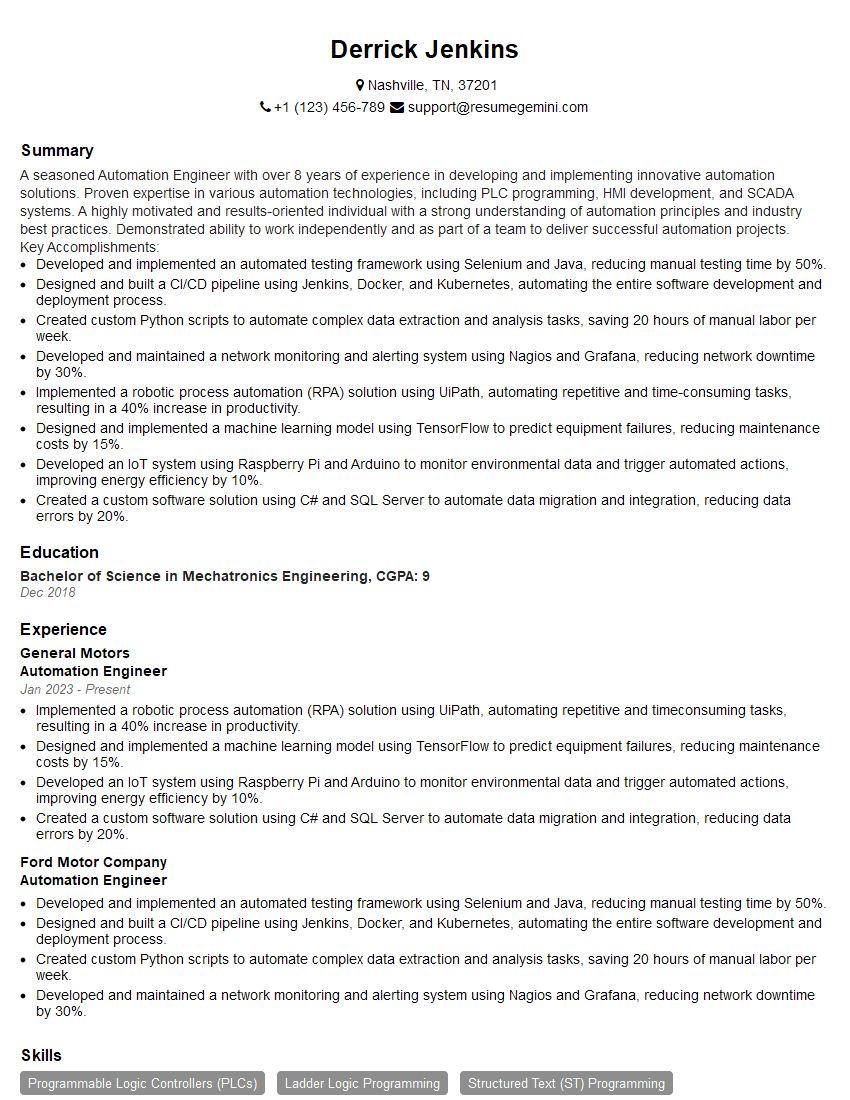
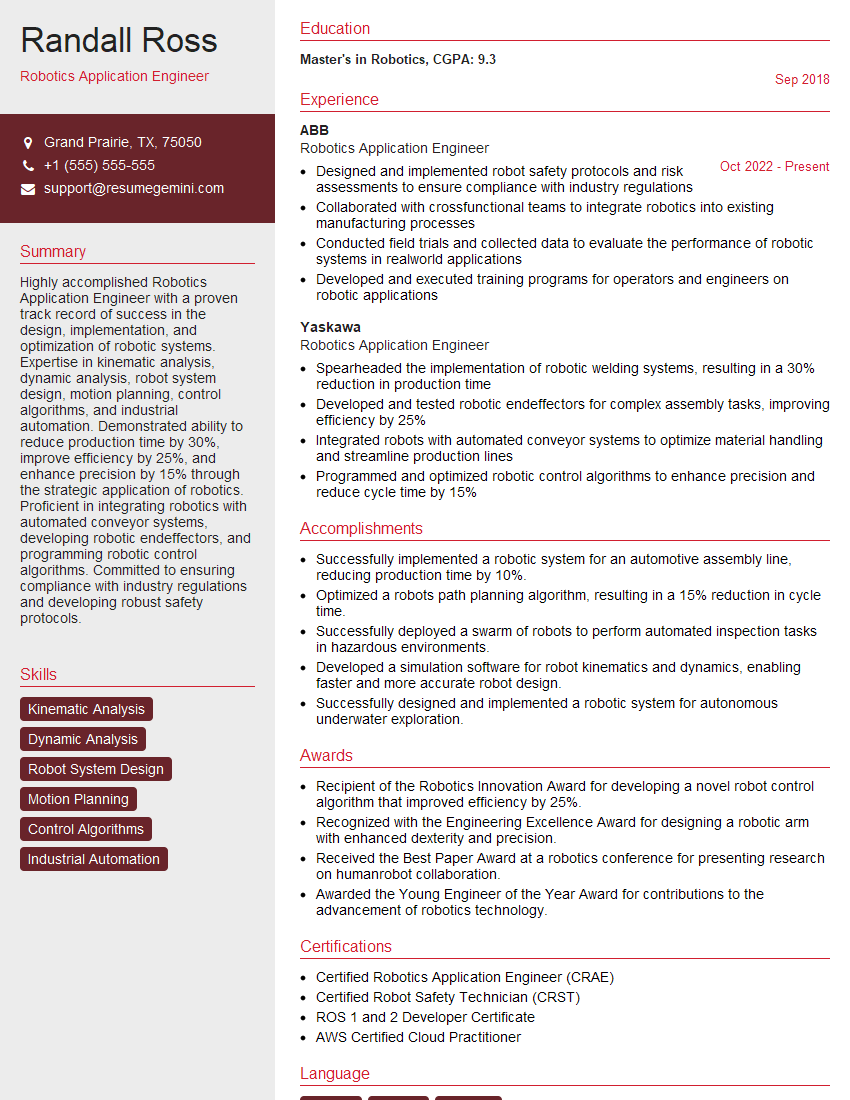
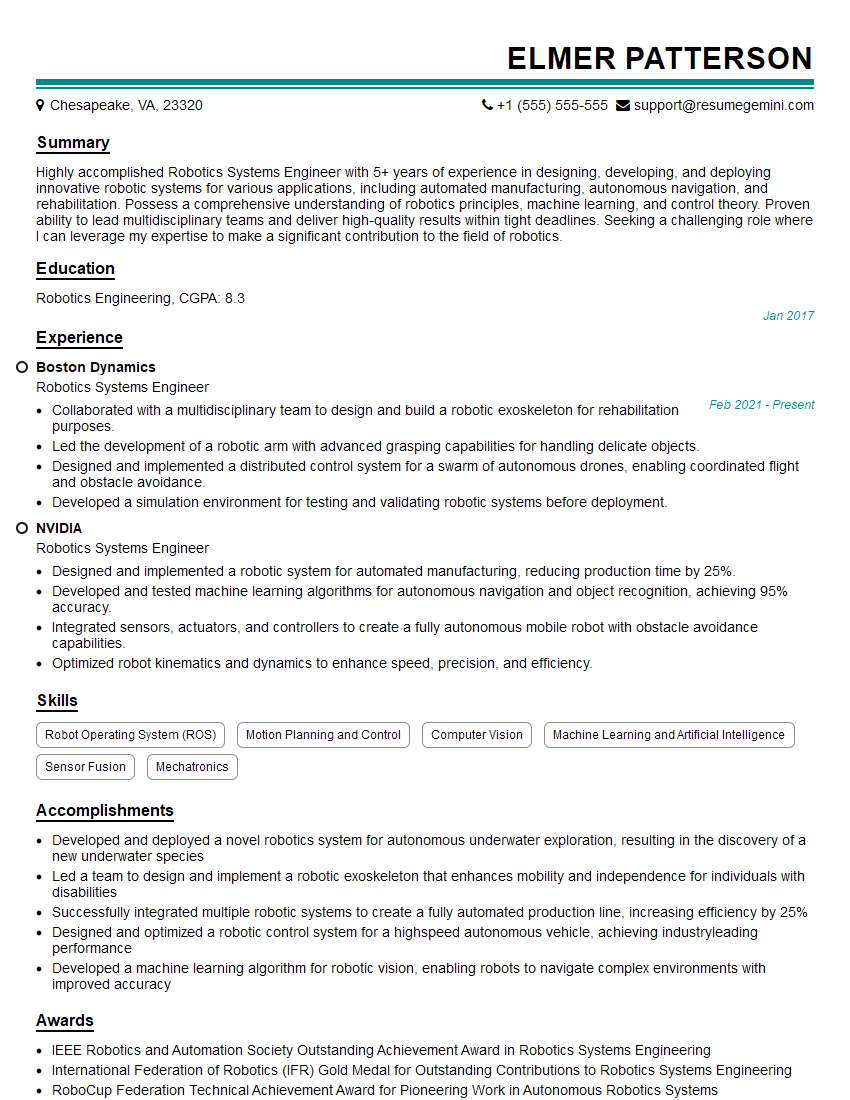
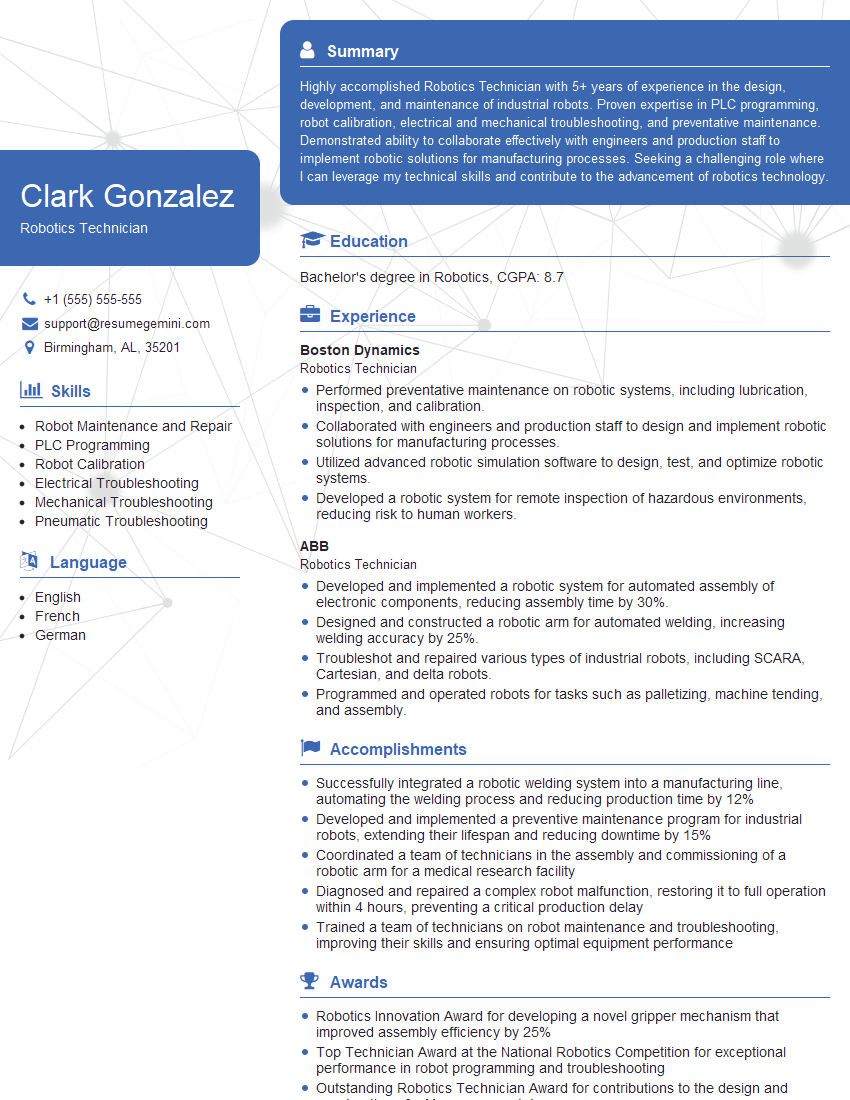
Mastering Robotics Operations opens doors to exciting and rewarding careers in a rapidly growing field. To stand out, a strong resume is crucial. An ATS-friendly resume ensures your application is seen by recruiters. We encourage you to leverage ResumeGemini, a trusted resource for crafting professional and impactful resumes. ResumeGemini provides examples of resumes specifically tailored to Robotics Operations to help you create a compelling application. Invest in your future; invest in your resume.

Explore more articles
Users Rating of Our Blogs
Share Your Experience
We value your feedback! Please rate our content and share your thoughts (optional).
What Readers Say About Our Blog
Very informative content, great job.
good