Preparation is the key to success in any interview. In this post, we’ll explore crucial Rock and Blues Lead Guitar interview questions and equip you with strategies to craft impactful answers. Whether you’re a beginner or a pro, these tips will elevate your preparation.
Questions Asked in Rock and Blues Lead Guitar Interview
Q 1. Explain your approach to improvising a blues solo in the key of E.
Improvising a blues solo in E starts with understanding the E blues scale. Think of it like having a toolbox of sounds. The E blues scale uses the notes E, G, A, Bb, B, D. My approach is to first establish a rhythmic groove, usually based around the 12-bar blues progression. Then, I start by playing the root note (E) to establish the key, followed by some pentatonic phrases (using the E minor pentatonic – E, G, A, B, D) to create a solid foundation. After that, I’ll incorporate the blues notes (Bb and D) for that distinctive bluesy flavor. Think of the Bb as a ‘blue note,’ adding a melancholy feel, and the D providing a resolution. I’ll vary my phrasing, sometimes using legato (smooth, connected notes) and sometimes staccato (short, detached notes) for dynamics and interest. I also frequently use the ‘blues licks’ I’ve learned and developed over the years, weaving them into my improvisation to add character and familiarity. It’s about creating a compelling narrative with your guitar, telling a story through sound. I might start with a simple line, build intensity, and then end with a powerful statement before returning to the groove.
For example, I might start with an E, G, A, B phrase, then add the Bb for a bluesier feel, perhaps sliding into the B from the Bb. I might then incorporate a bending technique to enhance the emotion. It’s all about experimenting and finding what feels and sounds right in that moment.
Q 2. Describe your experience with different blues scales (e.g., minor pentatonic, blues scale).
My experience with blues scales is extensive. The minor pentatonic is a foundational scale – simple, yet incredibly versatile. It’s like the building blocks of blues soloing. The E minor pentatonic (E, G, A, B, D), for example, allows for fluid melodic phrases. But the minor pentatonic alone can sound a little plain. That’s where the blues scale comes in. The blues scale adds that extra color – the ‘blue note.’ In E, that’s the Bb, giving a mournful, expressive quality. This ‘blue note’ creates tension and release, crucial for blues feel. I often switch between the minor pentatonic and the blues scale within a single solo to keep things interesting. I also experiment with other scales, like the major pentatonic, mixing and matching to create unexpected and unique sounds.
In addition to these, I am familiar with and incorporate other modes and scales like the mixolydian mode, the Dorian mode, and the harmonic minor scale to add variety and depth. They add different colors and textures to my playing. It’s about understanding the relationships between these scales and how they can be used to complement each other within a blues context. For instance, I might use a mixolydian mode to add a brighter character to a phrase and then drop back into the minor pentatonic to return to a darker or more soulful sound.
Q 3. How do you incorporate vibrato and bending techniques into your playing?
Vibrato and bending are essential expressive tools. Vibrato, the rapid oscillation of a note, adds warmth and emotion. I use it in several ways. A subtle vibrato can enhance the sustain of a note, making it sing. A wider, more pronounced vibrato can create a sense of urgency or drama. I apply vibrato both before and after a bend, adding depth and character. Bending, on the other hand, involves pushing a string up to a higher pitch. A small bend can add a subtle inflection, while a larger bend can create a powerful vocal-like quality. My experience involves mastering the control and precision needed for bending – achieving consistent pitch and smoothness.
I often combine vibrato and bending. For example, I might bend a note up a half-step and then apply vibrato to sustain the bent note, letting it ‘sing’ before resolving it. It’s like adding vibrato to a vocal phrase. The precision and control in both bending and vibrato are developed over years of practice and dedication.
Q 4. What are your preferred rock guitar effects pedals and how do you use them?
My preferred effects pedals are a combination of overdrive/distortion, a wah pedal, and a delay. I use a Tube Screamer-style overdrive pedal to add warmth and sustain to my clean tone, pushing the amplifier into a slightly overdriven state for a smooth, creamy sound. I use a more aggressive distortion pedal for heavier riffs and solos, bringing in a thicker, more powerful tone. The wah pedal is essential for creating dynamic textures and adding a vocal-like quality to my playing. I use it both rhythmically and melodically, to accentuate notes or phrases. Lastly, the delay pedal is for adding depth and atmosphere to solos or riffs, creating spacious textures that add to the overall sonic experience.
It’s crucial to learn how to blend these effects effectively. The order in which they are placed in the signal chain is key. I typically put the overdrive before the distortion, and the wah before the delay, to optimize the effect of each pedal. The signal chain is a journey and I use each stage to refine the overall tone.
Q 5. Discuss your understanding of different rock guitar styles (e.g., hard rock, blues rock).
My understanding of rock guitar styles is broad. Blues rock, the foundation of much of rock music, emphasizes blues scales and phrasing within a rock context. Think of artists like Eric Clapton or Stevie Ray Vaughan. Their solos are deeply rooted in blues but driven by a rock rhythm and intensity. Hard rock, on the other hand, is characterized by heavier distortion, powerful riffs, and often faster tempos. Think of bands like Led Zeppelin or AC/DC. The focus is on powerful, driving rhythms and aggressive guitar tones.
I find that these styles often overlap. Many hard rock bands incorporate elements of blues, but amplify them through heavy distortion and high gain. I try to adapt and change my approach to suit the musical style in question. The scales and techniques remain fundamentally similar, but the context (the overall style of the music) dictates how those are applied and how they should feel in the song.
Q 6. Describe your experience with different amplifier types and their tonal characteristics.
My experience with amplifiers is extensive. I’ve used various types, each with its own distinct tonal characteristics. Tube amps are known for their warm, dynamic response and natural overdrive. They react to your playing in a more organic way than solid-state amps. A great tube amp will breathe and sing. Solid-state amps, on the other hand, are known for their reliability, consistency, and often lower cost. They generally offer a more ‘clean’ sound, although modern solid-state amps are capable of some incredible high-gain tones.
The type of speaker in the amplifier also significantly impacts the tone. Different speakers have different frequency responses and will color the sound in distinct ways. For example, a speaker designed for rock music will sound different than a jazz speaker. Understanding this allows me to choose an amplifier and speaker combination that suits a specific musical style and sound.
Q 7. How do you approach composing a rock guitar riff?
Composing a rock guitar riff often starts with a simple melodic idea. It might be a single phrase that repeats, building into a longer riff. I will often experiment with different rhythmic variations on the same melodic idea. The rhythm is crucial; a great riff needs a memorable and driving rhythm to hook the listener. I also consider the overall feel and mood of the song. A heavy riff needs to have a powerful feel, while a more subtle riff should complement the song’s dynamics without being overwhelming.
I’ll often experiment with different scales and modes, incorporating those into the riff to add character and complexity. I’ll also try layering different guitar parts, or using octaves to add a thicker sound. Once I have a basic riff, I’ll refine it, experimenting with different voicings and techniques to make it sound as punchy and powerful as possible. Finally, I’ll listen back to it many times to determine if it works well with the rest of the song, making sure it fits the musical context and stands out in a positive way.
Q 8. How do you construct a solo that complements the overall song structure?
Constructing a lead guitar solo that complements a song’s structure is crucial. Think of the solo as a conversation, not a monologue. It needs to respond to the song’s emotional arc and rhythmic feel. I approach this in several steps:
- Listen to the song’s dynamics: Identify the verses, choruses, bridges, and instrumental breaks. Where are the quieter, more introspective moments? Where is the energy building? A solo should reflect these shifts.
- Analyze the song’s melody and harmony: The solo shouldn’t exist in isolation. Use notes and phrases from the song’s melody or riff as a springboard for your improvisation. Consider the underlying chord progression; the solo should complement the harmonic movement.
- Consider phrasing and rhythm: Don’t just play a stream of notes. Use rests, varied rhythmic patterns, and phrasing similar to vocal lines to create a musical narrative. Mimicking the phrasing of the vocals or other instruments adds to the cohesiveness.
- Build and release tension: Start with a simpler, more melodic phrase and gradually build intensity. Introduce more complex techniques, faster tempos, or more adventurous harmonies as the solo progresses. Then, create a resolution by gradually returning to the song’s underlying harmony and tempo.
- Know when to end: Don’t let the solo overstay its welcome. End it before the listener feels it’s dragging. A powerful, concise solo is more effective than a long, meandering one.
For example, in a blues song, I might begin a solo with a simple pentatonic phrase, gradually incorporating blues notes and bends before resolving back to the root note to create a satisfying conclusion. The goal is to enhance, not distract from, the overall song experience.
Q 9. Explain your knowledge of music theory relevant to rock and blues guitar playing.
My understanding of music theory is fundamental to my rock and blues guitar playing. It allows me to move beyond simply memorizing licks and understand the underlying structure and possibilities of improvisation. Here’s what’s critical:
- Scales and Modes: I’m proficient in major, minor, pentatonic, blues, and harmonic minor scales and their modes (Ionian, Dorian, Phrygian, Lydian, Mixolydian, Aeolian, Locrian). Understanding these modes allows me to quickly adapt to different keys and create diverse sounds.
- Chord Progressions: I can identify and analyze chord progressions in different styles, which informs my soloing choices. Knowing the function of each chord (tonic, subdominant, dominant) helps me create meaningful melodic phrases that resolve appropriately.
- Intervallic Relationships: Understanding intervals (e.g., major thirds, minor sevenths) is crucial for creating interesting melodies and harmonies. I can use intervals to build tension and release, create melodic contours, and navigate through different chord changes.
- Harmony: I have a working knowledge of basic harmonic concepts like voice leading, chord inversions, and secondary dominants, which enhances my solo construction, making the phrasing more sophisticated and complementing the overall harmonic structure of the song.
For example, recognizing a 12-bar blues progression in A immediately tells me I can effectively use the A pentatonic and blues scales, incorporating blues bends and passing tones based on the chord changes for soulful expression.
Q 10. Describe your experience with different guitar techniques (e.g., legato, string skipping).
I’ve developed a wide range of guitar techniques over the years, crucial for expressive and dynamic playing in rock and blues. Here are a few examples:
- Legato: This involves smoothly connecting notes without picking each one individually, using hammer-ons, pull-offs, and slides. Legato adds fluidity and a singing quality to a solo, creating a smooth and connected sound. I frequently employ legato phrasing in blues-rock solos to mimic the feeling of a vocal melody.
- String Skipping: This technique involves jumping between strings to create a more dynamic and percussive effect. It allows for a wide range of melodic ideas and can contribute significantly to the overall rhythm and groove of the music. I often use string skipping to add a rhythmic punch in faster, more energetic parts of a solo.
- Vibrato: This adds subtle pitch variation to notes, creating warmth and emotional depth. It’s an essential technique for expressive soloing in many musical genres. I utilize vibrato extensively in blues-rock playing, particularly on sustained notes, to add emotional impact and depth.
- Bends, Slides, and Hammer-ons/Pull-offs: These are fundamental techniques for blues guitar. They allow for incredible expressive power, and I use them to emphasize certain notes and create a distinctive bluesy tone and feel. They help create emotional depth, and the nuances are fundamental to blues guitar.
Mastering these techniques, along with others like sweep picking and tapping, allows for a varied and exciting musical vocabulary. Each technique contributes to shaping the character and emotional impact of a guitar solo.
Q 11. How do you handle stage fright or performance anxiety?
Stage fright is a common experience for musicians. My approach involves a combination of preparation and mental strategies:
- Thorough Rehearsal: This is the most important element. The more familiar I am with the material, the less anxiety I feel. I rehearse not just the technical aspects but also the emotional expression and stage presence.
- Visualization: I mentally rehearse the performance, visualizing myself playing confidently and connecting with the audience. This helps reduce anxiety by familiarizing my mind with the scenario.
- Deep Breathing and Relaxation Techniques: Before going on stage, I use deep breathing exercises to calm my nerves and center myself. Mindfulness meditation also helps in managing performance anxiety.
- Positive Self-Talk: Instead of focusing on negative thoughts, I focus on positive affirmations. I remind myself of my skills and past successes.
- Focus on the Music: Once on stage, I focus on the music itself. Connecting with the music helps me transcend the anxiety and be fully present in the moment. Connecting with other bandmates during the performance creates a supportive environment.
Over the years, the more I perform, the less overwhelming stage fright becomes. It’s become a manageable aspect of performing that is far outweighed by the joy of playing music for an audience.
Q 12. Describe your experience with recording and producing guitar tracks in a studio setting.
My studio experience encompasses various aspects of recording and producing guitar tracks. I understand the importance of microphone placement, amplifier selection, and signal processing to achieve the desired tone and feel.
- Microphone Techniques: I’m familiar with different microphone types (dynamic, condenser) and their applications for recording guitars. I know how to choose the right mic for the desired sound (e.g., a dynamic mic for a raw, powerful tone; a condenser for a brighter, more detailed sound).
- Amplifier Selection: The choice of amplifier is crucial in shaping the guitar’s tone. I’m experienced with various amplifier models and their unique characteristics, enabling me to select the amplifier that best suits the style of music and desired tone.
- Signal Processing: I have extensive experience using various effects pedals and studio processing techniques (EQ, compression, reverb, delay) to refine and enhance the guitar sound. I understand how these tools can be used to shape the tone, add dynamics, and create a professional-sounding recording.
- Track Layering and Editing: I understand the value of layering guitar parts for greater texture and richness. I can effectively edit and refine individual takes to create a cohesive and polished performance.
For example, on a recent project, I used a combination of a dynamic microphone and a condenser microphone to record a guitar track, blending the raw power of the dynamic mic with the detail of the condenser for a rich, full tone. I used a tube amplifier and meticulously selected effects to achieve the desired vintage rock tone.
Q 13. What software or DAWs are you proficient in for recording and editing guitar?
I’m proficient in several Digital Audio Workstations (DAWs) and software for recording and editing guitar. My expertise includes:
- Pro Tools: This is a widely used industry-standard DAW for professional music production. I’m highly comfortable with its features, including recording, editing, mixing, and mastering.
- Logic Pro X: Another powerful DAW known for its intuitive interface and extensive virtual instruments and effects. I use Logic extensively for both recording and composing.
- Ableton Live: Excellent for both live performance and studio recording. Its flexible workflow is well-suited to experimental and improvisational approaches to music creation.
- Amplitube/Guitar Rig: These are virtual amplifier and effects suites that offer a wide range of tones and effects without the need for physical equipment. I use them frequently for experimenting with different sounds and for quick prototyping.
My proficiency extends to using these DAWs to manipulate and enhance guitar tracks, including noise reduction, editing, and applying effects to get the best result. I often combine virtual and real amplifiers and effects to achieve the right sound.
Q 14. How familiar are you with music notation and tablature?
I have a solid understanding of both music notation and tablature. While I primarily rely on ear training and improvisation, the ability to read and write music in both formats is valuable.
- Music Notation: Understanding standard music notation allows me to accurately analyze musical scores, understand complex harmonic structures, and communicate musical ideas effectively with other musicians. I’m comfortable interpreting sheet music for lead guitar parts.
- Tablature (Tab): Tab is a user-friendly way to represent guitar parts, especially for guitarists. I use tab frequently to learn new songs, compose my own music, and share my work with others. It’s an especially useful tool for learning complex fingerings and techniques.
I find that using both notation and tablature enhances my understanding of music and provides different perspectives on the same musical ideas. This allows me to learn more effectively and approach composition from multiple angles.
Q 15. Explain your approach to learning new songs or guitar techniques.
Learning a new song or technique involves a multi-stage process. It begins with careful listening – truly hearing the nuances, the phrasing, the subtle bends and vibrato. I’ll often transcribe sections by ear, focusing on capturing the melodic contour and rhythmic feel first. Then, I break it down into smaller, manageable chunks. For example, a complex solo might be dissected into phrases of four to eight bars. I practice these sections slowly, meticulously, focusing on accuracy and clean execution before gradually increasing speed. Once the technical aspects are solid, I work on shaping the phrasing, adding my own personal interpretation, and making it my own. I might experiment with different tones, voicings, and dynamics. Think of it like learning a language; you start with individual words, then phrases, then sentences, before finally building fluency and expressiveness.
For example, when tackling a Stevie Ray Vaughan solo, I’d first isolate the main riff, learning the individual notes and bends. Then I would move onto the next phrase, adding it to the previous one. Once all phrases are mastered, I practice the full solo at a slower tempo. Then, I work on the speed gradually until the technique flows. This is how I can incorporate improvisation into the piece without losing accuracy.
Career Expert Tips:
- Ace those interviews! Prepare effectively by reviewing the Top 50 Most Common Interview Questions on ResumeGemini.
- Navigate your job search with confidence! Explore a wide range of Career Tips on ResumeGemini. Learn about common challenges and recommendations to overcome them.
- Craft the perfect resume! Master the Art of Resume Writing with ResumeGemini’s guide. Showcase your unique qualifications and achievements effectively.
- Don’t miss out on holiday savings! Build your dream resume with ResumeGemini’s ATS optimized templates.
Q 16. What are your strengths and weaknesses as a lead guitarist?
My strengths lie in my ability to create compelling melodic lines, my understanding of blues phrasing and dynamics, and my proficiency in various guitar techniques, such as vibrato, string bending, and legato. I am also confident in improvising over different chord progressions and can adapt to various styles. I can perform live with a high level of energy and emotional expression, making sure to connect with the audience. However, a weakness of mine is sometimes getting lost in my improvisations. I am still working on streamlining my musical thought processes so I can focus my creative energy even better while keeping the performance tight and focused on the song’s structure.
I’m constantly working on tightening up my technical precision, particularly with fast runs and complex arpeggios. I also aim to broaden my knowledge of different scales and modes to further enhance my improvisational abilities and explore new musical territories.
Q 17. How would you describe your musical influences?
My influences are diverse, spanning the entire spectrum of blues and rock. Early influences include the raw power of Jimi Hendrix, the soulful phrasing of B.B. King, the innovative guitar work of Stevie Ray Vaughan, and the melodic genius of Eric Clapton. Beyond these titans, I draw inspiration from contemporary artists who blend traditional styles with modern sensibilities. I listen widely and my influences evolve as I discover and connect with new artists who challenge and inspire me.
Each artist has contributed something unique to my playing. From Hendrix, I learned the importance of sonic exploration and pushing boundaries; from B.B. King, the power of subtlety and emotional depth; from Stevie Ray Vaughan, a fiery intensity and inventive bending techniques; and from Clapton, a classic tone and melodic sensibilities. This mix of styles creates my unique signature tone.
Q 18. How do you maintain and care for your guitars?
Maintaining my guitars is crucial. Regular cleaning is essential, using a microfiber cloth to gently wipe down the body and neck after each use. I use specialized guitar polish occasionally to maintain the finish. String changes are frequent, typically every few weeks depending on playing time. I inspect my guitars regularly for any signs of damage or wear, ensuring the neck is properly adjusted and the action is comfortable. I also ensure proper storage in a climate-controlled environment to prevent damage from humidity or temperature fluctuations. Protecting your investment and keeping your guitars playing their best is a non-negotiable part of being a professional.
I use a high-quality humidifier to keep my instruments hydrated during dry seasons, preventing cracks in the wood. This protects the integrity and tone of the instrument.
Q 19. Describe your experience working collaboratively with other musicians.
Collaboration is essential in music. I thrive in a band setting, respecting the contributions of each musician and valuing diverse perspectives. Effective collaboration involves clear communication, mutual respect, and a shared vision for the music. It’s about listening actively, understanding each other’s strengths, and finding creative solutions together. A strong collaborative dynamic fosters a supportive environment where individual talents can shine, leading to something greater than the sum of its parts. It’s like a jazz improvisation; we respond to each other’s ideas and create something new in real-time.
In one particular project, working with a drummer who had a strong jazz background helped me explore more complex rhythmic ideas in my solos. His unconventional time signatures pushed my boundaries, forcing me to think outside my usual stylistic comfort zone, and it resulted in a more dynamic and interesting sound.
Q 20. How do you adapt your playing style to different musical contexts?
Adapting my playing to different musical contexts requires versatility and sensitivity. I assess the overall style of the music – whether it’s hard rock, blues, funk, or something else entirely – and adjust my approach accordingly. This includes modifying my tone, phrasing, and technique. In a hard rock context, for instance, my playing will be more aggressive, with heavy distortion and rapid-fire riffs. In a mellow blues setting, I’ll favor a cleaner tone, focusing on nuanced phrasing and emotional delivery. Understanding the song’s dynamics is crucial; a lead break in a quiet ballad will differ dramatically from a solo in an uptempo rocker.
For example, playing lead guitar for a folk-blues band required me to scale back on distortion and focus on clean tone and fingerstyle techniques, while still retaining the emotional depth of blues phrasing. This involved learning new techniques and adapting my existing repertoire for a different setting.
Q 21. What are your career goals as a rock and blues lead guitarist?
My career goals are multifaceted. I aim to continue honing my skills as a lead guitarist, pushing my creative boundaries, and refining my personal style. I want to record and release my own music, showcasing my compositions and individual sound. I also aspire to perform live regularly, connecting with audiences through my music. Beyond personal pursuits, I’m keen to collaborate on various projects, working with diverse musicians and exploring different musical genres. Ultimately, I hope to establish myself as a respected and sought-after musician within the rock and blues community.
Specific goals include performing at major music festivals and securing a record deal. I also envision myself teaching guitar, sharing my knowledge and passion with the next generation of musicians.
Q 22. Describe your experience performing live on stage.
Performing live is an adrenaline rush unlike any other. It’s the culmination of countless hours of practice, the thrill of connecting with an audience, and the pure joy of making music together. My experience spans numerous venues, from intimate clubs to larger festivals. I’ve learned to adapt my playing to different sound systems, lighting, and audience sizes. Early on, I was nervous about making mistakes, but over time, I’ve embraced the imperfections as part of the live experience. The key is to stay present, listen to your bandmates, and let the music flow. A memorable performance for me involved a power outage mid-song – we kept playing acoustically, the audience joined in singing, and it turned into a truly unforgettable moment of shared musical experience.
Q 23. How do you handle feedback from critics or audiences?
Feedback, whether positive or negative, is crucial for growth. I actively seek out constructive criticism, viewing it as an opportunity to refine my skills. Positive feedback fuels my passion and confirms I’m on the right track. Negative feedback, while sometimes tough to hear, allows me to identify areas needing improvement. I dissect the criticism, separating personal opinions from objective observations. For instance, if a critic says my solos lack emotional depth, I might focus on incorporating more dynamic phrasing and emotional nuance in my practice. Audience feedback is equally important. Their energy, their reactions, tell me if the music is connecting. A roaring applause is rewarding, but even silence can be instructive – it prompts me to analyze what might have fallen flat and adjust my approach.
Q 24. What are your preferred types of guitars and why?
My preferred guitars tend to be Les Pauls and Stratocasters, but it’s more about the specific instrument than the model itself. I look for guitars with a comfortable neck profile, resonant tonewood, and pickups that suit my playing style. A Les Paul provides a thick, powerful tone ideal for bluesy riffs and sustained solos; the humbuckers deliver rich harmonics and a strong midrange. The Stratocaster, with its brighter tone and versatility thanks to its single-coil pickups, offers greater articulation and is fantastic for cleaner tones and jazzy licks. I always seek a guitar with a good feel, one that naturally responds to my touch. It’s a very personal relationship. Ultimately, the best guitar is the one that inspires me to create music.
Q 25. Describe your knowledge of different guitar pickups and their tonal qualities.
Understanding guitar pickups is fundamental. Single-coil pickups, like those in a Stratocaster, are known for their bright, clear, and articulate tone. They capture a lot of detail and are responsive to picking dynamics, but can be prone to hum. Humbuckers, used in Les Pauls, are designed to reduce hum and deliver a thicker, more powerful sound with a strong midrange. P90s offer a great middle ground, retaining the clarity of single-coils with slightly more power and less hum. The choice depends heavily on the desired sound. For a cleaner, more articulate tone suitable for blues and jazz, single coils are often preferred. For heavier rock or blues, with a thick, powerful sound, humbuckers are a better choice. Understanding the nuances of these pickup types allows you to tailor your tone precisely to the style of music you’re playing.
Q 26. How do you approach practicing and improving your guitar skills?
Practicing effectively is key. My routine balances technical exercises with musical exploration. I start with warm-ups focusing on scales, arpeggios, and chromatic runs to build dexterity and improve my finger strength and speed. Then, I move on to practicing specific techniques like bending, vibrato, and legato. Next, I focus on learning new songs and solos, breaking down complex passages into smaller, manageable sections. I also dedicate time to improvising, focusing on developing my musical vocabulary and experimenting with different phrasing and rhythms. Consistent, focused practice, even for short durations, is more effective than sporadic long sessions. Regular recording and listening back to my playing helps to identify areas that need work and track my progress.
Q 27. What is your experience with different tuning systems (e.g., open tunings)?
Open tunings offer a whole new world of sonic possibilities. Standard tuning (E A D G B e) is great, but open tunings provide different intervals and voicings that facilitate improvisation and create unique sounds. Open G (D G D G B D), for example, is frequently used in slide guitar and makes creating distinctive bluesy riffs easier. Open D (D A D F# A D) offers a brighter tone. Learning different open tunings requires adjusting your approach to scales and chords, but the payoff is the ability to create distinctive and interesting soundscapes that wouldn’t be as readily available in standard tuning. The process involves relearning familiar shapes and patterns within the context of the new tuning, much like learning a new instrument. Each open tuning provides its own set of challenges and rewards.
Q 28. Describe your experience with transcribing guitar solos.
Transcribing guitar solos is a painstaking but rewarding process. It hones listening skills, improves musical understanding, and expands your vocabulary as a player. It’s about breaking down a solo into its component parts: identifying notes, rhythms, phrasing, and techniques used. I begin by slowing down the recording significantly and repeatedly listen to small sections, trying to identify individual notes. I use tablature software or notation to record what I hear. It’s an iterative process; often I’ll hear a phrase slightly differently on a subsequent listen, which requires adjustments. Transcribing helps understand how guitarists construct their solos, build tension, resolve it, and how they use dynamics and rhythmic variation. It’s a deep dive into the music and often results in greater appreciation and a better understanding of the artistic intent behind the solo.
Key Topics to Learn for Rock and Blues Lead Guitar Interview
- Blues Scales & Modes: Mastering the pentatonic and blues scales in various positions, understanding their modes (minor pentatonic, major pentatonic, etc.), and applying them across different keys.
- Rock Guitar Techniques: Demonstrate proficiency in bending, vibrato, slides, hammer-ons, pull-offs, and other essential rock guitar techniques. Be prepared to showcase clean and controlled execution.
- Improvisation & Soloing: Develop your ability to improvise solos over blues and rock backing tracks, demonstrating phrasing, note choices, and rhythmic variations reflecting a strong understanding of musical theory.
- Chord Voicings & Progressions: Understand common blues and rock chord progressions, including 7th chords, dominant 7th chords, and alterations. Be able to explain how voicings impact the overall sound.
- Ear Training & Transcribing: Demonstrate your ability to transcribe solos by ear, demonstrating a strong understanding of musical notation and theory.
- Music Theory Fundamentals: Showcase your understanding of music theory concepts such as intervals, scales, chords, and rhythm, applying this knowledge to your guitar playing.
- Gear Knowledge & Maintenance: Be prepared to discuss different guitar types, amplification, effects pedals, and basic maintenance techniques.
- Musical Styles & Influences: Articulate your understanding of different subgenres within rock and blues, identifying key artists and their contributions to the genre.
- Performance & Stage Presence: Discuss your experience performing live, focusing on your stage presence, interaction with an audience, and ability to handle performance pressure.
- Problem-solving & Adaptability: Be prepared to discuss situations where you had to overcome technical challenges or adapt to unexpected circumstances during a performance or rehearsal.
Next Steps
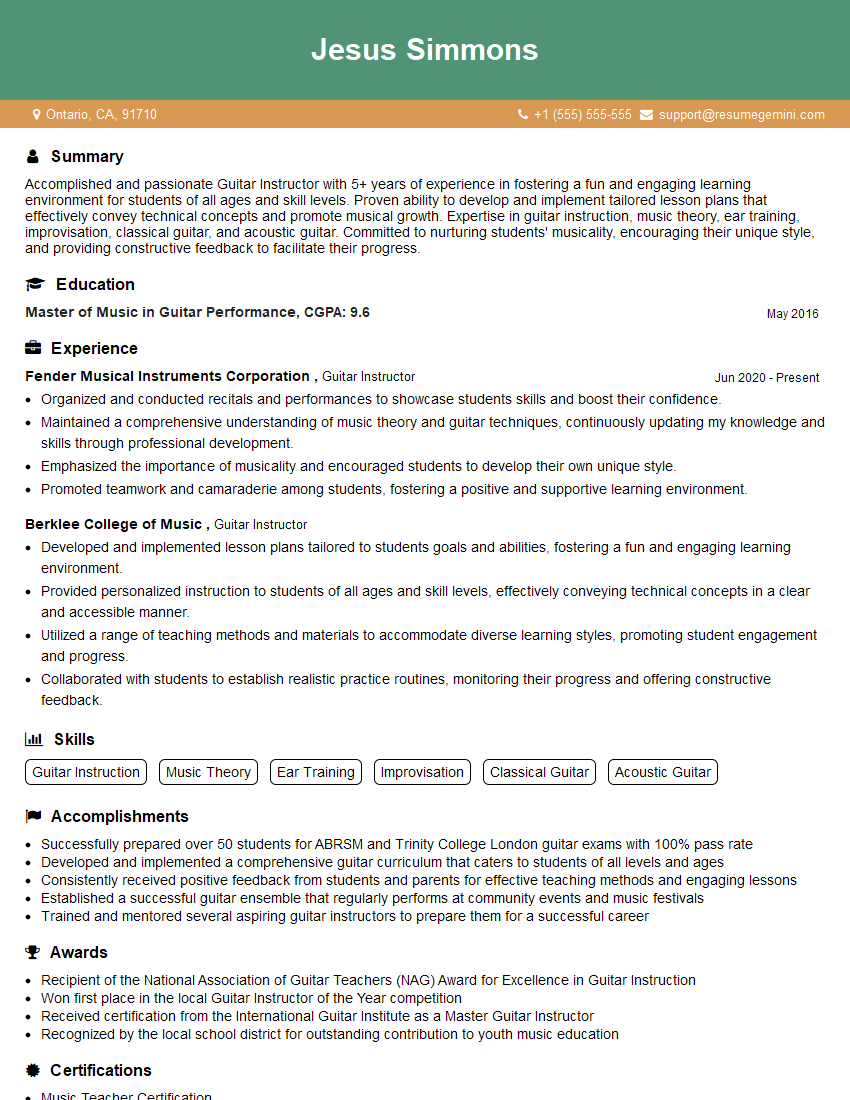
Mastering Rock and Blues Lead Guitar opens doors to exciting career opportunities, from session work and touring to teaching and music production. To maximize your chances, creating a compelling and ATS-friendly resume is crucial. ResumeGemini is a trusted resource that can help you build a professional resume that highlights your skills and experience effectively. ResumeGemini offers examples of resumes tailored to Rock and Blues Lead Guitar professionals, providing you with the templates and inspiration to showcase your talent to potential employers.
Explore more articles
Users Rating of Our Blogs
Share Your Experience
We value your feedback! Please rate our content and share your thoughts (optional).
What Readers Say About Our Blog
Very informative content, great job.
good