Interviews are more than just a Q&A session—they’re a chance to prove your worth. This blog dives into essential Roller Coaster Design and Simulation interview questions and expert tips to help you align your answers with what hiring managers are looking for. Start preparing to shine!
Questions Asked in Roller Coaster Design and Simulation Interview
Q 1. Explain the fundamental principles of roller coaster dynamics.
Roller coaster dynamics are governed by the fundamental principles of physics, primarily Newton’s Laws of Motion and the conservation of energy. Imagine a roller coaster car climbing the lift hill: potential energy is being stored. As the car descends, this potential energy converts into kinetic energy (energy of motion), resulting in speed. Throughout the ride, gravity, friction, and air resistance continuously influence the car’s velocity and trajectory. We use these principles to design exhilarating yet safe rides.
More specifically, we consider:
- Gravity: The primary force driving the coaster’s motion, accelerating the car downwards on inclines.
- Inertia: The tendency of an object to resist changes in its state of motion. This is why the car continues moving even on flat sections of the track.
- Friction: The resistance to motion between the wheels and the track, slowing the coaster down. This is influenced by materials and design choices.
- Air Resistance (Drag): The force opposing the coaster’s motion through the air. It increases with speed and the car’s surface area.
- Centrifugal Force: The apparent outward force experienced by riders as the coaster traverses curves. Careful design ensures that this force doesn’t become uncomfortable or unsafe.
Understanding these forces allows us to precisely calculate the speed, acceleration, and forces experienced by both the coaster and its passengers at every point on the track.
Q 2. Describe different types of roller coaster track designs and their impact on ride experience.
Roller coaster track designs are incredibly varied, each offering a unique ride experience. The key differences lie in the type of elements used and how they’re arranged. Let’s explore some common types:
- Wooden Coasters: Known for their rougher, more intense rides, these coasters use wooden structures. Their inherent flexibility contributes to the unique experience, but also requires more maintenance.
- Steel Coasters: Using steel tracks, these offer smoother, faster, and more complex designs, including inversions (loops, corkscrews). The precision of steel allows for tighter turns and more vertical drops.
- Inverted Coasters: These feature the track above the cars, resulting in unique perspectives and sensations.
- Flying Coasters: The cars hang beneath the track, giving the impression of flight.
- Sit-Down vs. Stand-Up: Different seating arrangements directly influence the forces experienced, with stand-up coasters offering more intense G-forces.
The arrangement of elements is also crucial. A series of tight turns after a drop will generate more lateral G-forces, while a long, sweeping curve will provide a different sensation. We carefully select and arrange elements to create a desired ride profile – thrilling but safe. For example, a family coaster might prioritize gentler curves and drops, while a launched coaster might incorporate intense, rapid acceleration.
Q 3. How do you ensure passenger safety in roller coaster design?
Passenger safety is paramount in roller coaster design. It’s not just about adhering to regulations; it’s about building a culture of safety. We achieve this through a multi-layered approach:
- Restraint Systems: Secure lap bars, shoulder harnesses, and even full-body restraints are crucial. These systems need to withstand immense forces and be easily operated by riders.
- Track Design and Construction: The track itself must be robust and free from defects. Redundant safety features such as emergency brakes are built into the system.
- Regular Inspections and Maintenance: Rigorous inspection protocols and preventive maintenance are vital for identifying and addressing potential issues before they can lead to accidents. This involves visual inspections, non-destructive testing, and detailed record keeping.
- Emergency Procedures: Well-defined procedures for evacuating riders in case of malfunction are crucial. This involves designing tracks that allow for easy access to riders, and training staff on the correct response protocols.
- Safety Devices and Sensors: Many modern coasters incorporate sensors to detect potential issues and automatically engage safety mechanisms, for example if a train exceeds a speed limit.
All designs must meet or exceed relevant safety standards and regulations from organizations like ASTM International. Rigorous testing, both physical and simulated, ensures that every safety system works as expected under various conditions.
Q 4. What are the key considerations for roller coaster structural integrity?
Structural integrity is the cornerstone of roller coaster safety. The structures must withstand immense forces from the moving train, wind loads, and environmental factors. Here’s how we ensure this:
- Material Selection: High-strength steel alloys are typically used for their durability and resistance to fatigue. Wood, while used in some coasters, requires careful selection and treatment.
- Finite Element Analysis (FEA): Sophisticated computer simulations use FEA to model the structure’s behavior under various loading conditions, predicting stress points and potential failure modes. This allows for design optimization and identification of areas needing reinforcement.
- Redundancy: The design often incorporates redundant structural elements to handle unexpected loads or failure of a single component. This means that if one part were to fail, other components will continue to support the load.
- Welding and Fabrication: Precise welding techniques and quality control measures ensure the structural integrity of the joints. These must be carefully inspected and non-destructive testing might be done.
- Regular Inspections: Periodic inspections detect any signs of wear, corrosion, or damage. This proactive approach is vital to prevent catastrophic failure.
The design must account for all potential loading scenarios, including extreme weather events and the worst-case scenario of a full train load.
Q 5. Explain the role of simulation software in roller coaster design and testing.
Simulation software is indispensable in modern roller coaster design. It allows us to test various design parameters and predict the ride experience without physically building the coaster. This reduces costs, minimizes risks and improves efficiency.
Key roles include:
- Track Design and Optimization: The software allows us to create the virtual track, manipulate its shape, and simulate the coaster’s movement. We can test different element configurations and optimize them for thrills and safety.
- Force and G-force Calculations: The software calculates the forces experienced by the coaster and its passengers at every point on the track. This data helps us ensure that the forces remain within safe limits.
- Ride Experience Prediction: Simulations allow us to preview the ride experience and fine-tune the design based on simulated rider feedback. This ensures a thrilling but safe experience.
- Safety System Verification: We can model and test the performance of various safety mechanisms, ensuring they engage correctly in various situations.
Popular software includes packages capable of modeling complex physics and including parameters like air resistance, friction, and other forces.
Q 6. What are the limitations of roller coaster simulation software?
While incredibly powerful, roller coaster simulation software has limitations:
- Model Simplifications: Simulations inevitably involve simplifying the real-world complexities. Factors like track flexibility, exact material properties, and environmental conditions are difficult to perfectly model.
- Unforeseen Events: Simulations struggle to predict unexpected events like human error, equipment failure, or extreme weather conditions that could impact the ride.
- Software Limitations: The accuracy of the simulation depends on the software’s capabilities and the quality of input data. Errors in the model or inaccuracies in the input parameters can affect the results.
- Validation Challenges: While simulations are invaluable, they must always be validated by physical testing and real-world data. It’s impossible to fully replace physical testing.
Therefore, simulations should be viewed as powerful tools to assist design, not as a complete replacement for careful engineering and thorough testing.
Q 7. How do you model friction and air resistance in a roller coaster simulation?
Modeling friction and air resistance in roller coaster simulations is crucial for accurate prediction of speed and forces. It’s typically done using empirical equations and data.
Friction: We often use a simple model where friction force is proportional to the normal force (the force perpendicular to the track) and a friction coefficient (μ). The equation is: Ffriction = μ * Fnormal. The coefficient μ depends on the materials used (steel on steel, steel on wood, etc.) and is often obtained through experiments. This model needs refinement for complex scenarios, such as wheel slippage.
Air Resistance (Drag): Air resistance is a more complex phenomenon, often modeled using the equation: Fdrag = 0.5 * ρ * v2 * Cd * A, where:
ρis the air density.vis the velocity of the coaster.Cdis the drag coefficient (depends on the coaster’s shape and orientation).Ais the frontal area of the coaster.
The drag coefficient needs to be determined through wind tunnel testing or computational fluid dynamics (CFD) simulations. Both friction and drag forces are typically included in the equations of motion that govern the coaster’s simulated movement. Accurate modeling requires carefully determined parameters for each.
Q 8. Describe your experience with different CAD software used in ride design.
My experience with CAD software in ride design spans several industry-standard programs. I’m highly proficient in Autodesk Inventor, a powerful 3D modeling software ideal for creating complex geometries like roller coaster tracks and support structures. Its parametric modeling capabilities allow for efficient design iteration and modification. I also have extensive experience using SolidWorks, another leading 3D CAD package, particularly useful for detailed component design, such as train cars and restraint systems. Finally, I’m familiar with specialized software like 3ds Max and Cinema 4D for visualizing the completed ride and creating engaging marketing renders. Each program offers unique strengths; Inventor excels at mechanical design, SolidWorks in detailed assembly, and 3ds Max/Cinema 4D in visualization. Selecting the right software depends heavily on the project phase and specific design needs.
Q 9. How do you calculate g-forces experienced by passengers on a roller coaster?
Calculating g-forces on a roller coaster involves understanding the relationship between acceleration and gravity. We primarily use physics principles, specifically Newton’s second law (F=ma), where ‘F’ is the net force, ‘m’ is the mass, and ‘a’ is the acceleration. G-force is the ratio of the net force to the force of gravity (mg). Therefore, g-force = a/g, where ‘g’ is the acceleration due to gravity (approximately 9.81 m/s²). To determine acceleration at any point on the track, we utilize the coaster’s velocity and the radius of curvature at that point. For instance, in a sharp turn, the centripetal acceleration (a = v²/r, where ‘v’ is velocity and ‘r’ is the radius) contributes significantly to the g-force. Sophisticated simulation software helps model the complex interplay of forces along the entire track, providing a detailed g-force profile for each passenger seat. This profile is crucial in ensuring rider safety and comfort.
Q 10. What are the common safety mechanisms used in roller coasters?
Roller coaster safety is paramount, and it’s achieved through a multi-layered approach incorporating numerous mechanisms. These include:
- Restraint Systems: Lap bars, shoulder harnesses, and even full-body restraints secure passengers in their seats, preventing ejection during high-g maneuvers. These are designed with redundancy and rigorous testing.
- Track Design and Maintenance: Tracks are meticulously designed and manufactured to withstand immense stresses. Regular inspections and maintenance ensure structural integrity and prevent unexpected failures. Wheel assemblies are also critical, with multiple redundancies and fail-safes.
- Emergency Braking Systems: Multiple braking systems exist, often including magnetic brakes integrated into the track and mechanical brakes on the train itself. These systems are designed to stop the ride swiftly in emergencies.
- Safety Sensors and Controls: Numerous sensors continuously monitor train speed, track position, and other vital parameters. If anomalies are detected, the ride automatically shuts down.
- Train Design: The train itself undergoes rigorous testing to ensure structural integrity and passenger safety. Components are designed to withstand high loads and potentially unexpected situations.
A comprehensive safety plan, including regular inspections and operator training, is also critical for safe operation.
Q 11. How do you design for accessibility in roller coaster design?
Designing for accessibility in roller coasters requires careful consideration of various passenger needs. This starts with providing wheelchair access to loading platforms and ensuring sufficient space for wheelchairs and other mobility devices. Transfer platforms may be required to help passengers move from wheelchairs into the ride vehicles. Train cars should accommodate a variety of body types and sizes, providing comfortable seating and sufficient space for individuals with disabilities. Clear signage and communication systems are crucial to ensure inclusivity and provide instructions in multiple formats. Additionally, designing with appropriate lighting and sound levels reduces sensory overload for passengers with sensory sensitivities. It’s a collaborative process involving experts in accessibility and ride engineering to balance thrilling design with inclusive access.
Q 12. Explain the process of conducting a ride simulation and interpreting the results.
Ride simulation is a crucial step in roller coaster design. It involves using specialized software that models the physics of the ride, allowing engineers to virtually test the design under various conditions. The process begins by importing the 3D CAD model of the track and train into the simulation software (examples include TrackOne or similar proprietary packages). The software then calculates the forces acting on the train at each point along the track, considering factors like gravity, friction, and air resistance. This process uses sophisticated algorithms to solve complex equations of motion. The results are presented as graphs and visualizations showing parameters such as speed, acceleration, g-forces, and passenger comfort metrics. Interpreting these results is key: analyzing the g-force profile helps identify potentially uncomfortable or unsafe sections of the track, allowing for design adjustments. Simulation allows us to refine the design before physical construction, saving time and resources and ensuring a safe and thrilling ride experience.
Q 13. How do you optimize a roller coaster design for thrill and comfort?
Optimizing a roller coaster for both thrill and comfort is a balancing act. The thrill comes from high speeds, intense g-forces, and unexpected elements like inversions. However, excessive g-forces can cause discomfort or even injury. The design process involves carefully shaping the track profile to manage the forces experienced by passengers. Smooth transitions between elements, avoiding abrupt changes in direction or speed, contribute significantly to passenger comfort. Mathematical techniques, such as spline curves, help create smoother and more predictable track profiles. Simulation plays a crucial role, providing data-driven insights into the ride experience. By iteratively adjusting the track design based on simulation results, we can fine-tune the balance between exhilarating moments and comfortable transitions. This iterative approach ensures a thrilling ride that doesn’t compromise passenger safety or enjoyment.
Q 14. Describe your experience with different types of roller coaster lift systems.
My experience encompasses several common lift hill systems. The most traditional is the chain lift, where a chain mechanically pulls the train up the incline. This is a reliable and relatively simple system. Cable lifts are similar, using a cable instead of a chain, often offering higher speeds. Hydraulic lifts use powerful hydraulic rams to lift the train, often providing a more rapid ascent than chain or cable systems. More recently, linear synchronous motors (LSMs) have gained popularity, offering smooth and precise acceleration with less mechanical wear and tear. The choice of lift system depends on several factors, including the desired ride speed, height of the lift hill, environmental conditions, and budgetary constraints. Each system has its own unique advantages and disadvantages in terms of efficiency, cost, maintenance, and ride experience. LSMs, for instance, are more expensive upfront but potentially more efficient and require less maintenance in the long run.
Q 15. How do you manage project timelines and budgets in roller coaster development?
Managing timelines and budgets in roller coaster development requires meticulous planning and robust project management. We use a phased approach, breaking down the project into distinct stages – concept design, detailed engineering, manufacturing, construction, testing, and commissioning. Each phase has a defined timeline and budget allocation, tracked using project management software like MS Project or Primavera P6. We employ Earned Value Management (EVM) to monitor progress against the planned schedule and budget, allowing for early identification and mitigation of potential overruns. For example, in a recent project, we utilized Agile methodologies for the design phase, allowing for iterative improvements and flexibility in response to changing requirements. Regular progress meetings with stakeholders, including engineers, contractors, and clients, are crucial for transparent communication and proactive problem-solving. Contingency planning is vital; we allocate a percentage of the budget to account for unforeseen circumstances, such as material price fluctuations or unexpected site challenges.
Career Expert Tips:
- Ace those interviews! Prepare effectively by reviewing the Top 50 Most Common Interview Questions on ResumeGemini.
- Navigate your job search with confidence! Explore a wide range of Career Tips on ResumeGemini. Learn about common challenges and recommendations to overcome them.
- Craft the perfect resume! Master the Art of Resume Writing with ResumeGemini’s guide. Showcase your unique qualifications and achievements effectively.
- Don’t miss out on holiday savings! Build your dream resume with ResumeGemini’s ATS optimized templates.
Q 16. What are some common challenges in designing and constructing a roller coaster?
Designing and constructing a roller coaster presents a unique set of challenges. One significant hurdle is ensuring structural integrity while creating an exciting and thrilling ride experience. This necessitates sophisticated structural analysis, accounting for dynamic forces, vibrations, and fatigue. Another challenge involves seamlessly integrating the ride into the surrounding landscape and park environment, considering aesthetics, accessibility, and potential environmental impacts. Meeting stringent safety regulations and maintaining the ride’s reliability throughout its operational lifespan is also crucial. For example, the precise alignment of track sections and the design of braking systems require immense precision and expertise. Finally, managing the logistics of transporting and assembling large components on-site, often in challenging terrain, can be complex. For example, we once faced a challenge involving the transportation of a massive lift hill structure to a mountainous site, which required careful planning and specialized equipment.
Q 17. How do you ensure compliance with relevant safety regulations and standards?
Safety is paramount. We adhere strictly to international and national safety standards and regulations, such as those set by ASTM International (American Society for Testing and Materials) and relevant local authorities. Our design process involves rigorous safety analysis, including Finite Element Analysis (FEA) to assess structural integrity under various load conditions. We perform thorough testing and inspection at each stage of the process, including non-destructive testing (NDT) methods like ultrasonic testing and magnetic particle inspection, to detect any potential flaws. Regular maintenance and inspection programs are implemented after the ride opens, employing certified technicians and engineers. Comprehensive safety training is provided to ride operators and park personnel. Documentation of all design, construction, and testing processes is meticulously maintained to ensure compliance and traceability. We frequently consult with safety experts and regulatory bodies throughout the project to ensure full compliance.
Q 18. Describe your experience with different materials used in roller coaster construction.
Roller coasters utilize a variety of materials, each chosen for its specific properties. Steel remains the dominant material for track and support structures due to its high strength-to-weight ratio and durability. Different grades of steel are employed depending on the specific application, with higher-strength steels used in critical areas subjected to high stress. Aluminum alloys are sometimes used for lighter components, such as train bodies, to reduce weight and enhance ride dynamics. Concrete is utilized for foundations and support structures, providing stability and resistance to ground movement. Composite materials, such as fiberglass-reinforced polymers (FRP), are increasingly used for certain applications due to their lightweight and corrosion-resistant properties. The selection of materials also considers factors such as cost, availability, and environmental impact. For instance, we’ve used recycled steel in several projects to reduce our carbon footprint.
Q 19. How do you address potential environmental impacts of roller coaster construction?
Environmental considerations are integrated into every phase of the project. We conduct environmental impact assessments to identify and mitigate potential impacts, such as habitat disruption, water pollution, and noise pollution. Sustainable construction practices are employed, including minimizing waste generation, recycling materials, and using environmentally friendly construction methods. The selection of materials considers their life cycle environmental impact, favoring materials with lower embodied carbon. We strive to minimize land disturbance and incorporate landscaping and habitat restoration efforts to minimize the overall ecological footprint. Energy-efficient technologies, such as LED lighting and optimized ride control systems, are utilized to reduce energy consumption. We also engage with local communities and environmental organizations to ensure transparency and address any environmental concerns proactively. For example, in a recent project, we implemented a rainwater harvesting system to reduce water consumption.
Q 20. What are the ethical considerations in roller coaster design?
Ethical considerations in roller coaster design encompass several key aspects. Safety is the paramount ethical concern, requiring a relentless commitment to minimizing risks and ensuring the well-being of riders. Accessibility is another important aspect; we strive to design rides that are inclusive and accessible to people with disabilities, adhering to relevant accessibility guidelines. Environmental responsibility is paramount, requiring responsible resource management and mitigation of environmental impacts. Fair labor practices throughout the design, construction, and operation phases are also essential, ensuring fair wages and safe working conditions for all involved. Transparency with the public regarding safety measures and potential risks is vital to building trust and fostering a positive experience. We prioritize ethical sourcing of materials and actively seek opportunities to collaborate with suppliers committed to sustainable practices.
Q 21. How do you manage risks associated with extreme weather conditions during operation?
Managing risks associated with extreme weather conditions requires a multi-faceted approach. Robust structural design and materials are chosen to withstand high winds, heavy snowfall, and other weather extremes. Weather monitoring systems, including real-time data feeds and automated alerts, are implemented to provide early warning of impending severe weather. Emergency shutdown procedures and evacuation plans are developed and regularly practiced, ensuring the safety of both riders and park personnel. The ride’s control system is designed to automatically shut down the ride in response to extreme weather conditions. Regular inspections and maintenance are crucial to identify and address any potential weather-related damage or vulnerabilities. Emergency response plans are coordinated with local authorities to ensure effective response and cooperation in the event of a severe weather incident. For example, we’ve installed lightning detection systems and implemented remote shutdown capabilities to enhance safety during thunderstorms.
Q 22. Explain your approach to troubleshooting problems in roller coaster systems.
Troubleshooting roller coaster systems requires a systematic approach combining engineering principles, safety regulations, and practical experience. My methodology involves a multi-stage process:
- Initial Assessment: This begins with identifying the problem’s nature – is it a mechanical issue, a software glitch, or a safety concern? I’d use diagnostic tools to gather data like sensor readings, operational logs, and witness accounts.
- Root Cause Analysis: Once the problem is defined, I move to pinpoint the root cause. This could involve reviewing schematics, inspecting components, running simulations, or conducting controlled tests. I utilize fault tree analysis techniques to systematically explore potential causes and their probabilities.
- Solution Development: After identifying the root cause, I develop and evaluate potential solutions. This may involve repairing a broken part, updating software, modifying a design element, or implementing new safety protocols. Simulations are crucial here to ensure the proposed solution works without creating new problems.
- Implementation and Testing: The chosen solution is implemented carefully, often in a staged manner. Thorough testing follows, both in a simulated environment and, if necessary, on a limited scale in the real system. This ensures the fix is effective and safe.
- Documentation and Preventative Measures: Finally, all troubleshooting steps, solutions implemented, and lessons learned are thoroughly documented. This includes identifying any underlying design weaknesses that contributed to the issue and implementing preventive measures to mitigate recurrence.
For example, if a train repeatedly stalls on a climb, I’d start by checking the motor’s power output, the track’s alignment, the wheel assemblies for friction, and the braking system for anomalies. Simulation software allows me to explore various combinations of these factors to isolate the problem swiftly and effectively.
Q 23. Describe a situation where you had to resolve a conflict related to roller coaster design.
During the design of a new hypercoaster, a conflict arose between the engineering team and the marketing department. Marketing wanted an extremely steep initial drop to create a thrilling experience, emphasizing speed and height. The engineering team, however, expressed concerns about the increased G-forces this would impose on riders, potentially causing discomfort or even injury. This presented a classic design trade-off between thrill and rider safety.
To resolve this, I facilitated a series of meetings involving engineers, marketing personnel, and safety experts. We used simulation software to model different drop angles, analyzing their effect on G-forces, ride comfort, and the overall passenger experience. We presented various scenarios with different drop angles and corresponding rider comfort data – visualized through graphs and simulated videos.
Ultimately, we found a compromise that satisfied both teams. A slightly less steep drop still delivered a significant thrill, but minimized the G-forces to acceptable levels, ensuring both a memorable experience and passenger safety. This compromise involved incorporating a carefully designed curve immediately after the drop to smoothly transition the train, mitigating the impact of high G-forces.
Q 24. How do you incorporate user feedback into the design process?
Incorporating user feedback is critical for creating successful and enjoyable roller coasters. We collect feedback through various channels:
- Riders’ Surveys: Post-ride questionnaires gauge aspects like thrill level, comfort, and overall satisfaction. Open-ended questions give qualitative data for deeper insights.
- Social Media Monitoring: Online platforms such as Twitter, Instagram, and review sites provide real-time feedback. Analyzing this data helps us understand immediate reactions and identify areas for improvement.
- Focus Groups: These allow for direct interaction with potential riders, gathering in-depth feedback on specific design aspects or proposed changes.
- Ride Data Analysis: Sensors onboard the trains capture data like speed, acceleration, and rider movement. This quantitative data offers a detailed view of the rider experience, which is vital in refining designs and adjusting operations.
This feedback is then analyzed to identify trends and areas for improvement. For example, if many riders comment on discomfort during a specific section of the ride, we use simulation to investigate potential causes, such as excessive lateral forces or sudden changes in acceleration. This iterative process allows us to refine the ride to improve the overall rider experience.
Q 25. What are the latest advancements in roller coaster technology?
The roller coaster industry is constantly evolving. Some recent advancements include:
- Improved Simulation Software: More realistic and accurate simulations are helping engineers design safer and more thrilling rides. This includes enhanced modeling of rider dynamics and track interactions, leading to better predictions of forces and comfort levels.
- Advanced Materials: Lighter, stronger, and more durable materials like carbon fiber and advanced composites are being used to create more efficient and aesthetically pleasing designs.
- Interactive Elements and Augmented Reality: Riders now experience augmented reality overlaying the real-world view, enhancing the immersive nature of the ride. This can be through visual effects integrated into the ride’s environment, or through on-board technology.
- Improved Safety Systems: Advances in sensor technology, automated braking systems, and sophisticated control systems contribute to enhanced safety measures, ensuring smooth operation and preventing accidents. For example, more precise sensors can detect potential track issues early on, while smart braking systems offer quicker response times in case of emergencies.
- Personalized Experiences: Future advancements focus on using data and technology to provide tailored experiences to each rider, potentially adjusting the speed or intensity based on their preferences.
Q 26. Explain your understanding of different types of roller coaster inversions.
Roller coaster inversions add a significant element of thrill. Several types exist:
- Loop: A complete vertical circle, putting riders upside down.
- Cobra Roll: A twisting maneuver resulting in a half-loop and then a quick return to an upright position.
- Incline Roll: A half-roll performed while the train is going up an incline.
- Zero-G Roll: A twisting inversion that creates a sensation of weightlessness.
- Immelmann: A combination of a half-loop followed by a half-roll.
- Inverted Vertical Loop: A loop that positions the train’s underside facing upwards during the inversion.
- Corkscrew: A twisting inversion where the train performs a full 360-degree rotation about its longitudinal axis.
The design of these inversions is critical. Factors such as radius, speed, and the rate of rotation all contribute to the G-forces experienced by riders and need careful calculation to ensure both thrill and safety.
Q 27. Describe your experience working collaboratively with engineers from other disciplines.
Collaborative work is essential in roller coaster design. I’ve worked extensively with:
- Structural Engineers: They ensure the structural integrity of the track, supports, and the train itself, using advanced materials and engineering principles to handle the intense forces during operation.
- Mechanical Engineers: They are responsible for designing and maintaining the train’s mechanisms, including the wheels, braking systems, and the lift systems. Their expertise is key for smooth operation and safety.
- Software Engineers: They develop and maintain the ride control systems, including the sensors, data acquisition systems, and operational software, working closely to ensure safety and accuracy.
- Electrical Engineers: They handle the power distribution, lighting systems, and other electrical aspects of the ride, considering energy efficiency and safety regulations.
- Safety Engineers: They play a crucial role in analyzing the entire system from a safety standpoint. They review designs, verify safety measures, and ensure compliance with regulations.
Effective communication and a shared understanding of safety regulations and design objectives are paramount. I rely on clear communication strategies, regular meetings, and shared documentation to foster productive collaboration.
Key Topics to Learn for Roller Coaster Design and Simulation Interview
- Kinematics and Dynamics: Understanding the forces acting on a roller coaster train, including gravity, friction, and inertia. Apply this to calculating speeds, accelerations, and g-forces throughout the ride.
- Structural Analysis: Analyzing the structural integrity of roller coaster tracks and supports under various loads and stresses. This involves practical application of engineering principles to ensure safety and longevity.
- Track Design and Layout: Designing thrilling yet safe track layouts considering passenger comfort, excitement levels, and operational efficiency. Explore different types of elements (e.g., inversions, drops, helixes) and their impact.
- Simulation Software: Proficiency in using simulation software (mention specific software if applicable, otherwise leave general) to model and analyze roller coaster designs, predicting ride characteristics and identifying potential issues.
- Ride Physics and Passenger Experience: Balancing the thrill of the ride with passenger safety and comfort. Consider factors such as jerk, lateral acceleration, and overall ride smoothness.
- Safety Regulations and Standards: Familiarity with relevant safety regulations and industry standards to ensure compliance and minimize risk.
- Optimization Techniques: Employing optimization techniques to minimize construction costs, maximize rider experience, and improve operational efficiency.
- Material Science and Selection: Understanding the properties of different materials used in roller coaster construction and selecting appropriate materials for specific applications.
Next Steps
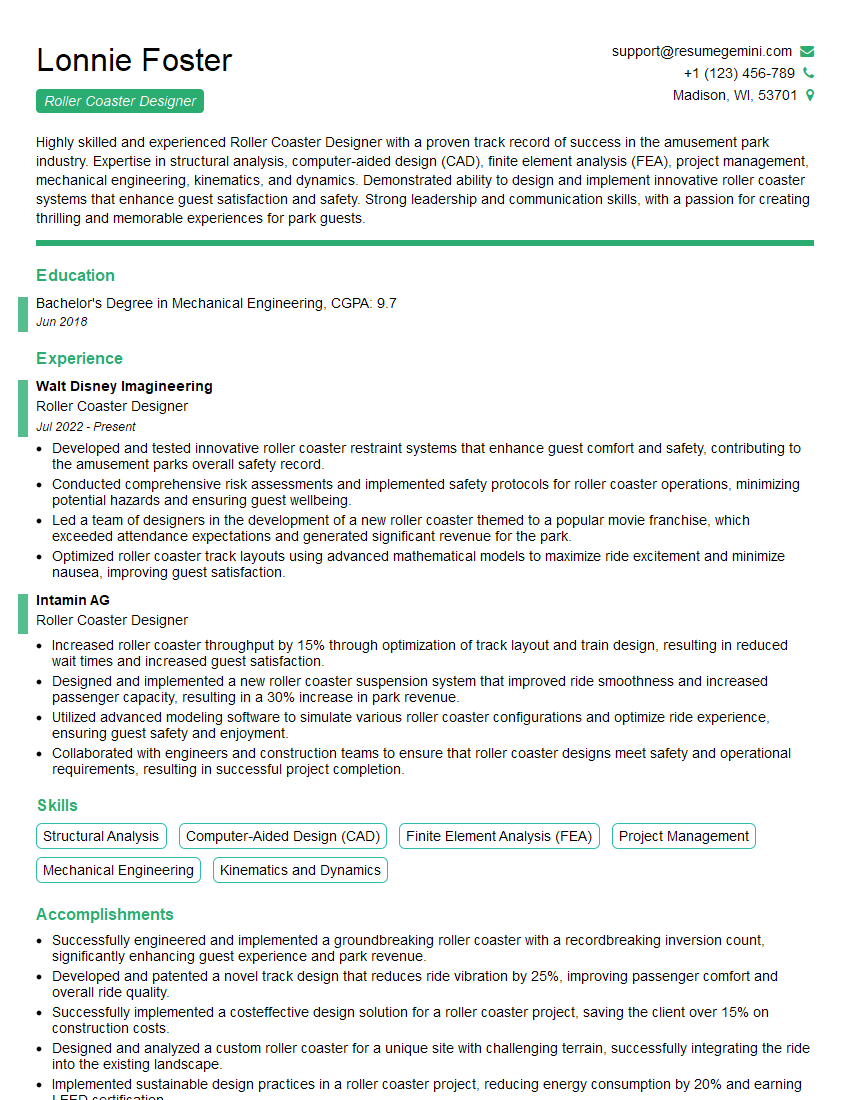
Mastering Roller Coaster Design and Simulation opens doors to exciting careers in theme park engineering, software development, and related fields. A strong grasp of these concepts significantly enhances your job prospects. To maximize your chances, invest time in creating an ATS-friendly resume that highlights your skills and experience effectively. ResumeGemini is a trusted resource to help you build a professional and impactful resume. They even offer examples of resumes tailored to the Roller Coaster Design and Simulation field, providing a valuable head-start in your job search.
Explore more articles
Users Rating of Our Blogs
Share Your Experience
We value your feedback! Please rate our content and share your thoughts (optional).
What Readers Say About Our Blog
Very informative content, great job.
good