Are you ready to stand out in your next interview? Understanding and preparing for Rotor Analysis interview questions is a game-changer. In this blog, we’ve compiled key questions and expert advice to help you showcase your skills with confidence and precision. Let’s get started on your journey to acing the interview.
Questions Asked in Rotor Analysis Interview
Q 1. Explain the concept of critical speed in rotor dynamics.
Critical speed in rotor dynamics refers to the rotational speed at which the rotor’s natural frequency coincides with the excitation frequency, leading to resonance. Imagine a spinning top; at certain speeds, it wobbles violently. This wobble is analogous to resonance in a rotor. When a rotor operates near its critical speed, even small unbalances or external forces can cause large amplitude vibrations, potentially leading to catastrophic failure. The critical speed isn’t a single value; a rotor typically has multiple critical speeds corresponding to different vibration modes (e.g., first critical speed, second critical speed, etc.). These critical speeds depend on the rotor’s stiffness, mass distribution, and bearing support characteristics. Accurate prediction of critical speeds is crucial during the design stage to ensure safe and reliable operation, often involving complex calculations or sophisticated Finite Element Analysis (FEA) simulations.
Q 2. Describe different types of rotor unbalances and their effects.
Rotor unbalance is a condition where the center of gravity of the rotor doesn’t coincide with its axis of rotation. This leads to centrifugal forces that excite vibrations. There are several types:
- Static Unbalance: The center of gravity is offset from the axis of rotation in a plane perpendicular to the axis. Imagine a slightly off-center weight on a spinning wheel. This is the simplest type of unbalance.
- Dynamic Unbalance: This is more complex and occurs when the center of gravity is offset and also has an angular displacement from the axis of rotation. Think of a weight not only off-center but also tilted. This causes both static and dynamic forces.
- Couple Unbalance: This type involves a pair of equal and opposite unbalances offset by 180 degrees, resulting in a pure moment. It is less common but can occur due to manufacturing imperfections or misaligned components.
The effects of unbalance include increased vibration levels, increased bearing loads, premature bearing wear, and potentially catastrophic failures at higher speeds. The severity of these effects depends on the magnitude of the unbalance, the rotor’s speed, and its stiffness.
Q 3. How do you identify and diagnose rotor vibration problems?
Identifying and diagnosing rotor vibration problems involves a systematic approach. It usually starts with:
- Vibration Measurement: Using accelerometers or proximity probes to measure vibration amplitude and frequency at various locations on the machine. This data often reveals dominant frequencies and vibration patterns.
- Spectral Analysis: Applying Fast Fourier Transform (FFT) to the vibration signals to determine the frequencies of the dominant vibrations and identify potential sources such as unbalance, misalignment, or resonance.
- Phase Analysis: Examining the phase relationship between vibrations at different locations helps determine the type and location of the problem (e.g., unbalance usually shows 1x frequency component, misalignment may show 2x frequency).
- Operating Deflection Shape (ODS): Visualizing the rotor’s vibration mode shapes helps pinpoint the location and type of problem. This is often achieved through experimental modal analysis.
- Bearing Condition Monitoring: Checking for signs of wear or damage in the rotor bearings which can be a root cause of vibration.
By carefully analyzing the collected data, engineers can determine the root cause of the vibration problem and recommend appropriate solutions.
Q 4. What are the common methods for balancing rotors?
Several methods are used to balance rotors, aiming to minimize unbalance and reduce vibrations. Common methods include:
- Static Balancing: This method is suitable for relatively short rotors and involves placing the rotor on two knife-edges and adding or removing weight until it balances. It corrects static unbalance but not dynamic unbalance.
- Dynamic Balancing: This method addresses both static and dynamic unbalance, usually performed on longer rotors using specialized balancing machines. These machines measure the unbalance in multiple planes and indicate the amount and location of correction weights needed.
- In-situ Balancing: This method balances the rotor while it is installed in the machine, usually at operating speed. It requires sophisticated instrumentation and analysis techniques.
The choice of method depends on factors such as the rotor’s geometry, length, and operating speed. Advanced techniques like modal balancing are employed for complex rotor systems.
Q 5. Explain the significance of Campbell diagrams in rotor dynamics analysis.
Campbell diagrams, also known as speed-frequency maps, are essential tools in rotor dynamics analysis. They visually represent the natural frequencies of the rotor as a function of its rotational speed. The diagram plots the natural frequencies (vertical axis) against the rotational speed (horizontal axis). Critical speeds are identified where a natural frequency intersects a line representing a multiple of the rotational frequency (e.g., 1x, 2x, etc.). The intersections indicate potential resonance conditions, highlighting operating speed ranges to avoid. Campbell diagrams are essential for assessing the stability and operability of the rotor system over its operating speed range, taking into account various modes of vibration and possible excitation frequencies.
Q 6. Describe different types of rotor bearings and their influence on rotor dynamics.
Rotor bearings play a crucial role in rotor dynamics, significantly influencing the rotor’s stability and vibration characteristics. Different types of bearings exhibit different stiffness and damping properties:
- Plain Journal Bearings: Simple, low-cost bearings, but offer relatively low stiffness and damping. They are susceptible to oil whirl and whip instabilities at high speeds.
- Roller Bearings: Provide higher stiffness and damping than plain bearings but introduce additional stiffness nonlinearities. They are commonly used for high-speed applications.
- Ball Bearings: Similar to roller bearings in terms of stiffness and damping, but the rolling elements are balls instead of rollers. The choice depends on load conditions and required precision.
- Fluid Film Bearings: These bearings use a lubricating fluid film to support the rotor. They offer excellent damping, making them suitable for high-speed and high-precision applications. Types include hydrodynamic, hydrostatic, and hybrid bearings.
- Magnetic Bearings: Non-contact bearings that use magnetic forces to support the rotor. They offer very low friction, high stiffness, and excellent controllability.
The selection of bearing type significantly impacts the rotor’s critical speeds, damping, and overall dynamic behavior. Accurate modeling of bearing characteristics is essential for reliable rotor dynamic analysis.
Q 7. How do you model rotor-bearing systems using finite element analysis (FEA)?
Modeling rotor-bearing systems using FEA involves creating a finite element model of the rotor and its supporting structure, including bearings. The process involves several steps:
- Geometry Creation: Defining the 3D geometry of the rotor, shaft, disks, and other components using CAD software.
- Meshing: Dividing the geometry into smaller elements (e.g., tetrahedral or hexahedral elements) to create a finite element mesh. Mesh density is crucial for accuracy.
- Material Properties: Assigning material properties (e.g., Young’s modulus, Poisson’s ratio, density) to each element.
- Boundary Conditions: Defining the boundary conditions, including support conditions at the bearings. This typically involves specifying stiffness and damping characteristics of the bearings.
- Loads: Applying loads such as centrifugal forces, unbalance forces, and external forces.
- Solving: Using a FEA software package to solve the equations of motion and obtain the rotor’s dynamic response.
- Post-Processing: Analyzing the results to determine critical speeds, mode shapes, vibration amplitudes, and other relevant parameters.
Software packages such as ANSYS, ABAQUS, and COMSOL are commonly used for FEA of rotor-bearing systems. The accuracy of the model depends heavily on the accuracy of the geometry, mesh, material properties, and boundary conditions.
Q 8. Explain the concept of modal analysis in the context of rotor dynamics.
Modal analysis is a crucial technique in rotor dynamics that helps us understand how a rotor system will vibrate at different frequencies. Imagine a guitar string – it vibrates at specific frequencies depending on its length and tension. Similarly, a rotor has several ‘natural frequencies’ at which it vibrates most readily. Modal analysis identifies these natural frequencies (also known as eigenfrequencies) and the corresponding mode shapes – the patterns of vibration the rotor exhibits at each frequency. This is done by solving the equations of motion for the rotor system, often using finite element analysis (FEA) software.
Practically, this means we can determine which frequencies are most likely to cause resonance, leading to excessive vibrations and potential damage. By knowing these modes and frequencies, we can design the rotor system to avoid these critical speeds, or implement damping strategies to mitigate the effects of resonance. For example, during the design phase of a high-speed turbine, modal analysis is used to identify critical speeds and incorporate design changes like changes to shaft stiffness or addition of dampers to avoid resonance during operation.
Q 9. What are the common causes of rotor instability?
Rotor instability, where vibrations grow uncontrollably, can stem from several sources. One major culprit is oil whirl or oil whip in journal bearings, where the oil film interacts with the rotor in a destabilizing way. This is especially problematic at speeds above a critical threshold. Another common cause is internal friction within the rotor itself (hysteresis damping) or in seals. This can create a negative damping effect, feeding energy into the vibrations and causing instability. External forces such as unbalance, misalignment, or aerodynamic forces (like in a compressor blade) can also excite vibrations, potentially leading to instability if not properly controlled.
Finally, critical speeds, where the rotor’s operating speed matches one of its natural frequencies, are a major concern. Even small imbalances can lead to large amplitude vibrations at these speeds. Imagine pushing a child on a swing at its natural frequency – minimal effort results in a big swing. Similarly, at critical speeds small excitation will cause large rotor vibration.
Q 10. How do you address subsynchronous vibration issues in rotating machinery?
Subsynchronous vibrations, occurring at frequencies below the rotor’s rotational speed, are often a sign of instability. Addressing them requires a thorough investigation of potential root causes, as mentioned above. Strategies include:
- Bearing design modifications: Improving bearing stiffness and damping properties, perhaps by using tilting-pad bearings or active magnetic bearings, can significantly reduce subsynchronous vibrations.
- Shaft design optimization: Modifying shaft stiffness and geometry can shift critical speeds away from the operating range and improve stability.
- Damping implementation: Adding dampers, such as squeeze film dampers or tuned viscous dampers, directly absorbs vibrational energy, thus suppressing subsynchronous vibrations.
- System balancing: Precise balancing of the rotor minimizes unbalanced forces, which often excite subsynchronous vibrations.
- Active control systems: Advanced systems use sensors to detect vibrations and actuators to actively counteract them, providing real-time control and stabilization.
Troubleshooting often involves detailed vibration analysis, including spectral analysis to identify the frequency and amplitude of the subsynchronous vibrations and to pinpoint the source. This can help guide the selection of appropriate countermeasures.
Q 11. Describe different types of dampers used in rotor systems.
Various types of dampers are employed in rotor systems to mitigate vibrations and enhance stability. These include:
- Viscous dampers: These use a viscous fluid to dissipate energy through shear forces. Simple, but effective for a broad range of frequencies.
- Squeeze film dampers (SFD): These utilize a thin film of fluid between a moving and stationary surface. The pressure generated within the film provides damping. They’re particularly effective at suppressing subsynchronous vibrations.
- Tuned viscous dampers (TVD): These are designed to maximize damping at specific frequencies, making them highly effective against resonant vibrations.
- Dry friction dampers: These rely on friction between surfaces to dissipate energy, often effective at higher amplitudes.
- Magnetic dampers: These use electromagnetic forces to generate damping forces, often found in high-speed applications.
The choice of damper depends heavily on the specific application, operating speed, and the type of vibration to be controlled. For instance, an SFD might be ideal for a large turbomachinery system prone to subsynchronous whirl, while a viscous damper could be sufficient for smaller, less demanding applications.
Q 12. Explain the role of oil film bearings in rotor stability.
Oil film bearings play a dual role in rotor stability: they support the rotor and influence its dynamic behavior. The oil film’s properties – viscosity, thickness, and pressure distribution – significantly impact the damping and stiffness characteristics of the bearing. Adequate damping is crucial for stability. Insufficient damping can lead to oil whirl or oil whip, forms of self-excited instability. The bearing’s stiffness affects the rotor’s natural frequencies, and improper stiffness can lead to resonance issues.
The design of the oil film bearing, including geometry and operating parameters, is carefully considered to achieve sufficient damping and appropriate stiffness. This is achieved by using finite element analysis and experiments for optimizing the bearing’s design in order to enhance rotor stability and minimize vibration.
Q 13. How do you determine the natural frequencies of a rotor system?
Determining the natural frequencies of a rotor system is a key step in rotor dynamics analysis. This is typically done using either analytical methods or numerical methods such as finite element analysis (FEA).
Analytical methods, such as the Rayleigh-Ritz method or the energy method, can be applied to simpler rotor systems with idealized geometries and boundary conditions. These methods provide approximate solutions. FEA, on the other hand, is a more versatile and powerful technique, suitable for complex rotor systems with intricate geometries and boundary conditions. FEA software packages are used to create a model of the rotor system, define its material properties and boundary conditions, and then solve for the natural frequencies and mode shapes.
Experimental modal analysis is also used. This involves exciting the rotor system using an impact hammer or shaker, and then measuring the resulting vibration response using accelerometers. By analyzing the response data, the natural frequencies and mode shapes can be identified. These results can then be used to validate the model and guide design improvements.
Q 14. What are the effects of gyroscopic moments on rotor dynamics?
Gyroscopic moments, arising from the rotation of a rotor about its spin axis, have a significant effect on rotor dynamics. They introduce a coupling between the rotor’s lateral and torsional vibrations, affecting its natural frequencies and mode shapes. This coupling effect is particularly important in high-speed rotors. Imagine a spinning top – its gyroscopic effect makes it stable; it resists tilting. Similarly, in a rotor system, this effect alters the response to external disturbances, often having a stabilizing influence, but in other instances, making the system more sensitive to certain kinds of excitation.
The gyroscopic effect introduces additional terms into the equations of motion, making the analysis more complex. FEA software is commonly used to include gyroscopic effects in the rotor dynamic model. Failing to consider the gyroscopic moments can lead to inaccurate predictions of rotor behavior, potentially resulting in resonance or instability issues. The inclusion of gyroscopic effects in the model is crucial for accurate dynamic analysis.
Q 15. Explain the difference between synchronous and asynchronous vibrations.
The key difference between synchronous and asynchronous vibrations in rotors lies in their relationship to the rotor’s rotational speed. Synchronous vibrations occur at the same frequency as the rotor’s rotational speed or a multiple of it (e.g., 1x, 2x, 3x running speed). These are often caused by unbalance, misalignment, or other static eccentricities. Imagine a slightly lopsided tire on a car – the vibration will be felt at the same frequency as the tire’s rotation. Asynchronous vibrations, on the other hand, occur at frequencies independent of the rotational speed. These are usually caused by critical speeds, resonance with structural frequencies, or fluid-induced instabilities. Think of a car suspension bouncing at a frequency determined by the spring and damper characteristics – irrespective of the wheel speed.
In practice, distinguishing between them is crucial for effective troubleshooting. Synchronous vibrations are often easier to address through balancing or alignment adjustments. Asynchronous vibrations may require more complex solutions, potentially involving design modifications or active vibration control systems.
Career Expert Tips:
- Ace those interviews! Prepare effectively by reviewing the Top 50 Most Common Interview Questions on ResumeGemini.
- Navigate your job search with confidence! Explore a wide range of Career Tips on ResumeGemini. Learn about common challenges and recommendations to overcome them.
- Craft the perfect resume! Master the Art of Resume Writing with ResumeGemini’s guide. Showcase your unique qualifications and achievements effectively.
- Don’t miss out on holiday savings! Build your dream resume with ResumeGemini’s ATS optimized templates.
Q 16. How do you use experimental modal analysis (EMA) to validate a FEA model?
Validating a Finite Element Analysis (FEA) model with Experimental Modal Analysis (EMA) is a critical step in ensuring the accuracy of the prediction. EMA involves experimentally determining the natural frequencies and mode shapes of the rotor. This is typically done using accelerometers strategically placed on the rotor during a controlled excitation. The acquired data is then processed to extract the FRFs (Frequency Response Functions), revealing the resonant frequencies and mode shapes.
The FEA model is then run, and its predicted natural frequencies and mode shapes are compared to the experimental results obtained through EMA. Close agreement indicates a good model accuracy; discrepancies point to areas needing refinement in the FEA model, such as material properties, boundary conditions, or element mesh density. Graphical comparison of mode shapes, often using animation, is particularly insightful. Quantitative comparison is done using metrics such as Modal Assurance Criterion (MAC) to assess the correlation between the experimental and FEA mode shapes.
For example, a discrepancy in a natural frequency might suggest an error in the material properties used in the FEA model, whereas a large difference in mode shapes might point to an issue with boundary conditions or meshing.
Q 17. Describe the process of performing a rotor balancing procedure.
Rotor balancing aims to minimize vibrations by distributing mass evenly around the rotor’s axis of rotation. The process generally involves these steps:
- Vibration Measurement: The rotor is run at a typical operating speed, and the vibration levels are measured using accelerometers at various locations. This provides a baseline for the imbalance.
- Imbalance Identification: The measured vibrations are analyzed to determine the magnitude and phase angle of the imbalance. This often involves specialized software that calculates the necessary correction weights.
- Correction Weight Addition: Correction weights are added to the rotor at specific locations and angles determined by the analysis. These weights counteract the imbalance forces.
- Re-measurement and Iteration: The vibration levels are re-measured. If the vibrations are not sufficiently reduced, the process is repeated until the acceptable vibration levels are achieved. This iterative approach ensures optimal balance.
Different balancing methods exist, including single-plane balancing (for rotors with imbalance predominantly in one plane) and two-plane balancing (for rotors with imbalance distributed in two planes). The choice of method depends on the rotor geometry and operating conditions. Sophisticated balancing machines automate the measurement and correction process, significantly reducing downtime.
Q 18. What are the limitations of different rotor dynamic analysis techniques?
Rotor dynamic analysis techniques, such as linear and non-linear analysis, have their limitations. Linear analysis, often performed using modal analysis, is computationally efficient and provides valuable insights into the system’s behavior around its operating point, but it fails to accurately predict behavior under large amplitude vibrations or complex non-linear phenomena like rubs or impacts. Non-linear analysis can better handle these situations but requires more computational resources and can be more challenging to interpret.
Simplified models, like the Jeffcott rotor model, are easy to use for preliminary analysis but lack the accuracy to capture the complex geometry and material properties of real-world rotors. Finite element analysis (FEA) provides a more accurate representation, but its accuracy is highly dependent on the quality of the mesh and material models used, and it can be computationally intensive. Experimental techniques like EMA provide valuable validation data but are limited by the accuracy of measurement and the inability to predict behavior in conditions that are difficult to replicate experimentally.
The choice of the technique depends largely on the required accuracy, available resources, and the complexity of the rotor system. Often, a combination of techniques is used to provide a comprehensive understanding of the rotor’s dynamic behavior.
Q 19. How do you interpret frequency response functions (FRFs) in rotor dynamics?
Frequency Response Functions (FRFs) are crucial in rotor dynamics, providing a comprehensive view of the rotor’s dynamic characteristics. The FRF plots the amplitude and phase of the rotor’s response (e.g., displacement, velocity, or acceleration) at various frequencies for a given input force (or excitation). Each peak in the FRF corresponds to a natural frequency (resonance) of the rotor.
The amplitude of the peak indicates the system’s sensitivity to excitation at that frequency – a higher peak implies a greater response and higher risk of resonance. The phase angle at resonance describes the relationship between the input force and the resulting response (e.g., are they in-phase or out of phase?). By analyzing FRFs at different locations on the rotor, we can understand how various modes of vibration are distributed throughout the structure, aiding in identifying the source and nature of vibration problems.
For instance, a high peak in the FRF at a specific frequency suggests that the rotor is prone to large vibrations at that rotational speed, prompting a closer investigation into the system’s design and operating parameters.
Q 20. Explain the concept of logarithmic decrement and its application.
The logarithmic decrement is a measure of the damping in a vibrating system. It quantifies the rate at which the amplitude of free vibrations decays over time. Consider a rotor that is suddenly disturbed; it will oscillate with decreasing amplitude until it comes to rest. The logarithmic decrement (δ) is calculated as the natural logarithm of the ratio of successive amplitudes:
δ = ln(xn / xn+1)
where xn and xn+1 are the amplitudes of two successive oscillations. A higher logarithmic decrement indicates higher damping, meaning the vibrations decay more quickly. The logarithmic decrement can be related to the damping ratio (ζ) through the following equation:
δ = 2πζ / √(1 - ζ²)
This makes it a practical tool for determining the damping characteristics of a rotor system from free decay measurements. Understanding the damping capacity is crucial in assessing the stability and vibration characteristics of rotating machinery, particularly in avoiding damaging resonance.
Q 21. How do you account for the effects of temperature on rotor dynamics?
Temperature significantly impacts rotor dynamics by altering material properties such as stiffness and thermal expansion. Changes in temperature lead to variations in natural frequencies, critical speeds, and overall dynamic behavior. Accounting for thermal effects requires a multi-physics approach, often integrating thermal analysis with rotor dynamic analysis.
Thermal analysis typically involves determining the temperature distribution within the rotor using computational techniques or experimental measurements. This temperature distribution is then used to modify the material properties (Young’s modulus, density, etc.) within the rotor dynamic model. Thermal expansion causes changes in rotor geometry, leading to variations in stiffness and critical speeds. These changes must be incorporated into the rotor dynamic model to accurately predict the system’s behavior under different temperature conditions.
For example, a turbine blade operating at high temperatures may experience significant thermal expansion, which can shift its natural frequencies. Ignoring these effects can lead to inaccurate predictions of critical speeds and susceptibility to resonance, potentially causing significant damage. Therefore, incorporating temperature effects in the analysis is crucial for ensuring the safe and efficient operation of rotating machinery.
Q 22. Describe different types of rotor seals and their influence on rotor dynamics.
Rotor seals are critical components in rotating machinery, preventing leakage and maintaining operational pressures. Their design significantly impacts rotor dynamics because they introduce forces and stiffness that can affect the rotor’s stability and vibration characteristics. Different seal types have varying effects:
- Radial Seals: These seals prevent radial leakage between the rotor and stator. Examples include labyrinth seals, contact seals (like O-rings), and mechanical seals. Labyrinth seals introduce damping due to the pressure drops across the seal teeth, while contact seals can introduce stiffness and friction, potentially leading to increased vibration. Mechanical seals are more complex, involving a dynamic interface which needs careful consideration for its stiffness and damping effect on the rotor.
- Axial Seals: These prevent axial leakage. Common types include face seals and piston rings. Face seals, like mechanical radial seals, introduce complex interactions between the sealing surfaces that influence the dynamic behavior of the rotor.
- Gas Seals: These use pressurized gas to prevent leakage, often employed in high-speed applications. The dynamic forces of the gas film on the rotor surface significantly affect the stability, introducing both stiffness and damping. Their impact needs to be carefully evaluated using specialized computational fluid dynamics (CFD) techniques.
The influence on rotor dynamics is often modeled by incorporating the seal’s stiffness and damping characteristics into the rotor dynamic model. Incorrectly modeling these effects can lead to inaccurate predictions of critical speeds, unbalance response, and stability margins. For instance, neglecting the damping effect of a labyrinth seal might overestimate the rotor’s response to unbalance.
Q 23. How do you model the effects of fluid forces on rotor dynamics?
Modeling fluid forces on rotor dynamics is crucial because fluids (liquids or gases) interacting with the rotor can significantly impact its stability and vibration characteristics. The approach varies based on the type of fluid interaction:
- Fluid Film Bearings: These are typically modeled using Reynolds equation, which relates pressure distribution to fluid viscosity and rotor-bearing geometry. Solving this equation, often numerically, provides the bearing forces as a function of rotor displacement and velocity. This leads to bearing stiffness and damping coefficients that are incorporated in the rotor dynamic model.
- Fluid-Structure Interaction (FSI): For complex geometries or high-speed flows, Computational Fluid Dynamics (CFD) is employed to simulate the fluid flow around the rotor. The resulting pressure forces are then coupled with a structural finite element model (FEM) of the rotor to predict its dynamic behavior. This coupled approach captures intricate flow phenomena and their effect on rotor vibrations.
- Internal Flows: If the rotor operates within a fluid-filled cavity (e.g., a pump impeller), the fluid forces due to internal flow need to be considered. This often involves applying techniques like potential flow theory or more advanced CFD methods, depending on the complexity of the flow pattern.
Software like ANSYS and Abaqus offer tools to perform these analyses. For example, in ANSYS, you can couple a CFD simulation (CFX or Fluent) with a structural analysis (Mechanical APDL) to account for FSI. The key output from such analyses is the frequency response of the rotor-fluid system, which provides insights into potential instability and resonance issues.
Q 24. What are the key considerations for designing a robust rotor system?
Designing a robust rotor system requires careful consideration of several key factors. The goal is to create a system that operates reliably under various conditions, minimizes vibration, and avoids catastrophic failure:
- Critical Speed Analysis: Determining the rotor’s critical speeds (frequencies at which resonance occurs) is paramount. The operating speed should be significantly away from these critical speeds to avoid excessive vibrations and potential failure.
- Modal Analysis: Understanding the rotor’s mode shapes helps identify areas prone to high stress and deformation. Design modifications can then be made to improve the system’s stiffness and reduce vibration.
- Unbalance Response Analysis: This analysis determines the rotor’s response to manufacturing imbalances. It is essential for predicting vibration levels and identifying suitable balancing techniques.
- Stability Analysis: Evaluating the system’s stability is crucial, particularly for high-speed machines and systems involving fluid film bearings. Techniques like Campbell diagrams and eigenvalue analysis are used to assess potential instability issues.
- Material Selection: Choosing appropriate materials with adequate strength, fatigue resistance, and corrosion resistance is crucial for longevity and reliability. This also involves careful consideration of thermal properties and their effect on the rotor’s geometry and stiffness.
- Bearing Selection: Appropriate bearing types (ball, roller, fluid film) significantly impact the rotor’s dynamic performance. The selection should consider factors such as load capacity, damping characteristics, stiffness and operating speed.
Robustness also requires incorporating safety factors, tolerance analysis, and thorough testing to validate the design.
Q 25. Describe your experience with rotor dynamic software (e.g., ANSYS, Abaqus).
I have extensive experience using rotor dynamic software, primarily ANSYS and Abaqus. My expertise involves creating finite element models of rotors and bearings, performing modal, unbalance response, and stability analyses, and interpreting the results to optimize designs.
In ANSYS, I’m proficient in using Mechanical APDL for creating rotor models and using its modal analysis and harmonic response capabilities. For fluid-structure interaction, I have utilized ANSYS CFX or Fluent for CFD modeling coupled with Mechanical APDL. This approach is critical for accurately modeling systems involving fluid film bearings or internal fluid flows.
With Abaqus, I have experience in creating detailed FEA models, accounting for complex material properties and boundary conditions. This experience extends to simulating various loading scenarios (including thermal gradients) and post-processing results to assess stress, strain, and displacement.
Beyond analysis, I’m proficient in using these software packages to automate analysis processes, creating parametric studies to explore the impact of design changes and optimize the rotor system’s performance and robustness.
Q 26. How do you handle uncertainties and tolerances in rotor dynamic analysis?
Uncertainties and tolerances are inherent in manufacturing and material properties, and ignoring them can lead to inaccurate predictions and potential failures. I handle these uncertainties using statistical methods and robust design techniques:
- Monte Carlo Simulation: This involves running multiple analyses with varying parameters (e.g., material properties, dimensions) randomly sampled from their tolerance ranges. The results provide a statistical distribution of the critical speeds, unbalance responses, and stability margins, offering a clearer picture of the system’s behavior under uncertainty.
- Sensitivity Analysis: Identifying parameters with the most significant impact on the system’s response allows focusing efforts on minimizing those uncertainties. This can involve techniques like Design of Experiments (DoE) to efficiently investigate a wide range of parameter variations.
- Robust Design Optimization: Techniques like Taguchi methods are used to optimize the design to be less sensitive to manufacturing variations. The goal is to create a design that maintains acceptable performance over a wide range of tolerances.
The output of these methods is not a single deterministic result but a range of possible behaviors and associated probabilities. This provides a more realistic assessment of the risk associated with the rotor design and helps make informed decisions to ensure robustness.
Q 27. Explain your experience with experimental testing and data acquisition for rotating machinery.
My experience with experimental testing and data acquisition for rotating machinery encompasses various aspects, from test planning and instrumentation to data analysis and interpretation.
I have been involved in setting up and conducting experimental modal analysis (EMA), operational deflection shapes (ODS) measurements, and unbalance response tests on various rotating machinery. This includes selecting appropriate sensors (accelerometers, proximity probes), setting up data acquisition systems, and designing test procedures to excite the rotor system adequately. I am familiar with using signal processing techniques to filter noise and extract relevant information from the measured data.
Data acquisition systems vary, ranging from simple vibration analyzers to more sophisticated systems employing multiple sensors and high-speed data acquisition capabilities. Experience with data processing software is crucial to analyze the acquired data, often applying Fast Fourier Transforms (FFT) to determine frequency response, identify resonance, and quantify vibration levels. The collected experimental data is then compared to the simulation results to validate the analytical model and refine the design if necessary.
A recent project involved testing a high-speed turbocharger rotor. We used multiple accelerometers and proximity probes to measure vibration and displacement across the operational range, comparing these findings against a previously developed finite element model.
Key Topics to Learn for Rotor Analysis Interview
- Rotor Dynamics: Understanding critical speeds, unbalance response, and vibration modes. Practical application: Diagnosing and mitigating vibrations in rotating machinery.
- Modal Analysis: Utilizing Finite Element Analysis (FEA) to predict natural frequencies and mode shapes. Practical application: Optimizing rotor designs to avoid resonance.
- Bearing Dynamics: Analyzing bearing stiffness, damping, and their influence on rotor stability. Practical application: Selecting appropriate bearings for specific rotor applications.
- Rotordynamics Software: Familiarity with industry-standard software packages used for rotor analysis (mentioning specific software names is avoided to encourage independent research).
- Stability Analysis: Investigating the stability of rotor systems, including the effects of various parameters on stability thresholds. Practical application: Ensuring safe and reliable operation of high-speed machinery.
- Balancing Techniques: Understanding different balancing methods and their applications. Practical application: Implementing effective balancing procedures to minimize vibrations.
- Experimental Modal Analysis: Techniques for determining modal parameters from experimental measurements. Practical application: Validating FEA models and identifying sources of vibration.
- Oil Film Dynamics: Understanding the dynamic behavior of fluid film bearings and their interaction with the rotor. Practical application: Optimizing bearing design for improved stability and performance.
Next Steps
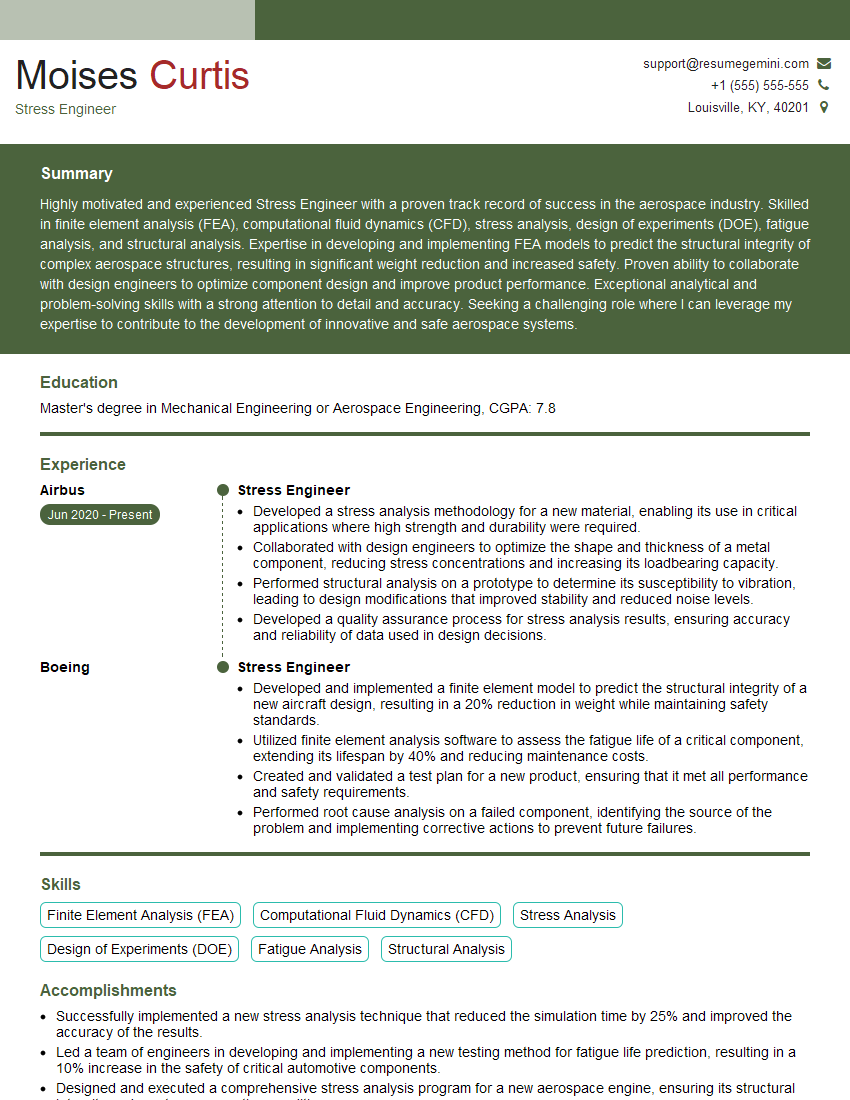
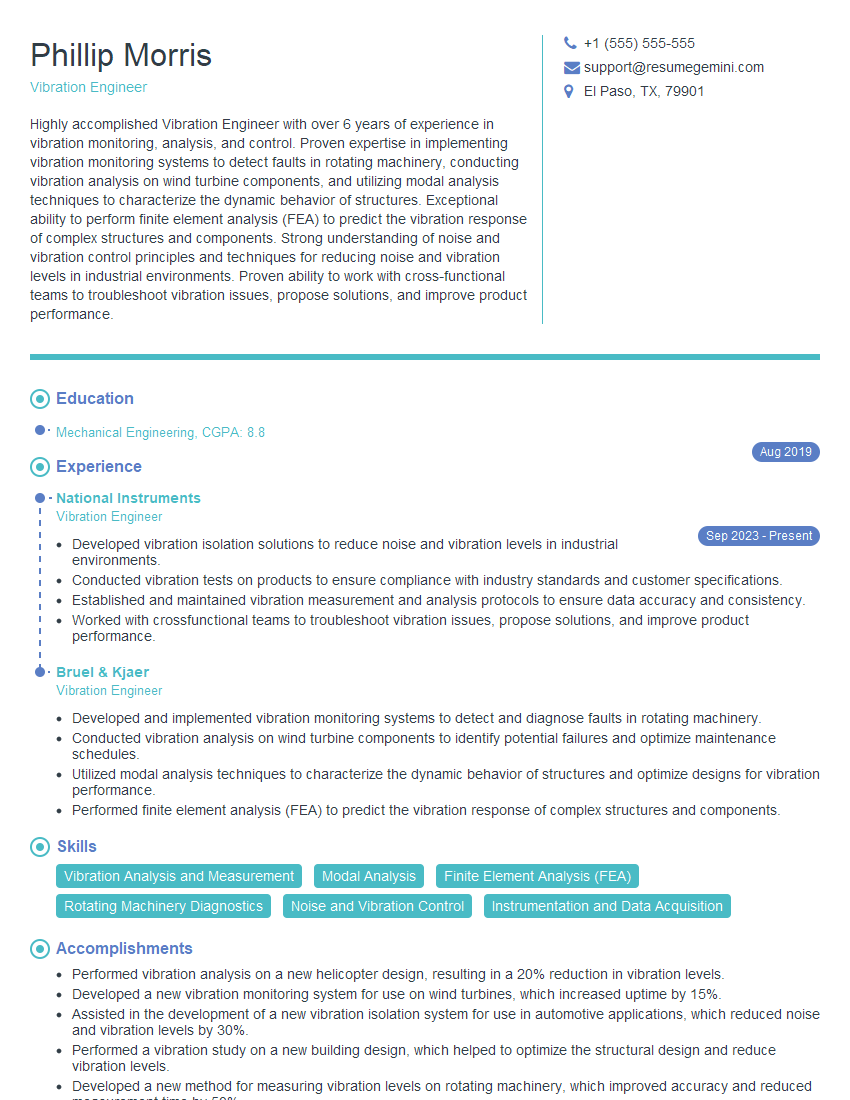
Mastering Rotor Analysis opens doors to exciting career opportunities in diverse industries, from aerospace and power generation to manufacturing and automotive. A strong foundation in these principles is highly sought after, significantly enhancing your job prospects. To maximize your chances of landing your dream role, crafting an ATS-friendly resume is crucial. ResumeGemini is a trusted resource to help you build a professional and impactful resume that gets noticed. We offer examples of resumes tailored to Rotor Analysis to guide you in showcasing your skills and experience effectively.

Explore more articles
Users Rating of Our Blogs
Share Your Experience
We value your feedback! Please rate our content and share your thoughts (optional).
What Readers Say About Our Blog
Very informative content, great job.
good