Unlock your full potential by mastering the most common Saddle Stitcher Operation interview questions. This blog offers a deep dive into the critical topics, ensuring you’re not only prepared to answer but to excel. With these insights, you’ll approach your interview with clarity and confidence.
Questions Asked in Saddle Stitcher Operation Interview
Q 1. What are the different types of saddle stitching machines you have experience with?
Over my career, I’ve gained extensive experience with various saddle stitching machines, ranging from smaller, manual models ideal for short runs to high-speed automated systems capable of producing thousands of booklets per hour. Specifically, I’m proficient with machines from manufacturers such as Muller Martini, Horizon, and Duplo. These machines differ in their features, such as stitch head configurations (single, double, or even triple heads for increased productivity), feeder mechanisms (friction feed, air suction feed, or sheet-fed), and control systems (simple manual controls versus sophisticated computer-aided systems with pre-programmed settings).
- Manual Saddle Stitchers: These are excellent for smaller projects and offer hands-on control, perfect for learning the fundamentals.
- Semi-Automatic Saddle Stitchers: These offer a balance between manual control and automation, streamlining processes for mid-sized runs.
- Fully Automatic Saddle Stitchers: These are high-volume production workhorses, often incorporating features like automatic feeder systems, sophisticated jam detection, and advanced control panels for optimizing production.
My experience spans various models within each category, allowing me to adapt quickly to different machine specifications and optimize production accordingly.
Q 2. Explain the process of setting up a saddle stitcher for a specific job.
Setting up a saddle stitcher for a specific job involves a methodical process to ensure accurate and efficient production. Think of it like preparing a recipe – you need the right ingredients and instructions in the correct order.
- Job Specifications Review: I start by carefully reviewing the job specifications, noting the document size, paper stock, number of pages, desired stitch type, and required output. This forms the foundation of my setup.
- Machine Adjustments: Based on the specifications, I adjust the machine’s settings. This includes setting the correct paper size and format, adjusting the feeder guides for accurate sheet alignment, setting the stitch margin, and selecting the appropriate stitch head based on the number of pages.
- Stitch Head Calibration: The stitch head needs precise calibration to ensure even stitch placement. I meticulously adjust the stitch depth, stitch pitch (distance between stitches), and stitch position to align perfectly with the booklet fold.
- Feeding Mechanism Adjustment: Different paper weights and sizes require adjustments to the feeding mechanism. Air suction strength, friction roller pressure, and the overall paper path need fine-tuning for smooth, consistent feeding.
- Test Run and Adjustments: After making initial adjustments, I conduct a test run, carefully monitoring sheet feeding, stitching accuracy, and overall booklet quality. I make further adjustments as needed to optimize the process.
- Production Run: Once the test run produces satisfactory results, the machine is ready for a full production run.
For example, when working with a heavier stock, I would increase the friction roller pressure on the feeder to ensure the sheets are properly fed without slippage. Similarly, for a booklet with a high page count, I would ensure the stitch head is calibrated correctly to penetrate the entire stack of sheets evenly.
Q 3. How do you ensure accurate sheet feeding in a saddle stitching machine?
Accurate sheet feeding is paramount in saddle stitching; inaccurate feeding leads to misaligned booklets and potential jams. I employ several strategies to ensure this:
- Proper Paper Preparation: Before feeding, I ensure the paper is neatly stacked and free from wrinkles or creases that could cause misfeeds. Properly cutting and handling of sheets is key.
- Correct Feeder Adjustment: The feeder guides must be meticulously adjusted to match the paper size and format. This involves precise alignment and ensuring proper pressure from the feed rollers or air suction.
- Regular Cleaning and Maintenance: Regular cleaning of the feeder rollers and air suction components removes dust and debris that can interfere with accurate feeding.
- Monitoring and Adjustment: I continuously monitor the feeding process during operation, making adjustments as needed to maintain consistency. This involves observing the sheet flow and making minor adjustments to feeding pressure or alignment.
- Use of Vacuum Systems: For high-speed machines, air suction feeding systems are frequently used, requiring consistent airflow and the proper air pressure settings.
Think of it like stacking pancakes: if they aren’t evenly aligned, the whole stack will be uneven. Precise feeding ensures a consistent final product.
Q 4. Describe your experience troubleshooting common saddle stitching machine malfunctions.
Troubleshooting is a significant part of my role. I approach it systematically:
- Identify the Problem: The first step is accurately identifying the type of malfunction. This may involve checking for misfeeds, poor stitch quality, jams, or machine errors displayed on the control panel.
- Check Simple Things First: Often, simple issues like low paper supply, improperly adjusted guides, or clogged debris are easily resolved.
- Consult the Machine Manual: Each machine has a specific manual providing troubleshooting guidance. It is an invaluable resource.
- Systematic Check of Components: If the issue is more complex, I methodically check each component related to the problem. This might involve inspecting the feeder mechanism, the stitch head, the delivery system, and the machine’s electrical components.
- Seek External Support (If Necessary): If I’m unable to resolve the issue, I escalate it to a qualified technician or the machine’s manufacturer for assistance.
For instance, if I notice inconsistent stitch depth, I’d first check the stitch head’s pressure settings and then verify the paper stock’s thickness matches the machine’s settings. If I experience a jam, I’d systematically clear the paper path, check for obstructions, and assess the feeder system.
Q 5. What safety procedures do you follow while operating a saddle stitching machine?
Safety is paramount. I strictly adhere to these procedures:
- Lockout/Tagout Procedures: Before performing any maintenance or repair, I always follow the lockout/tagout procedure to prevent accidental machine operation.
- Personal Protective Equipment (PPE): Appropriate PPE is always worn, including safety glasses and gloves to protect against injury from moving parts or paper dust.
- Machine Guarding: I ensure all machine guards are securely in place to prevent accidental contact with moving parts.
- Proper Handling of Paper: Lifting heavy stacks of paper requires proper lifting techniques to prevent back injuries.
- Awareness of Surroundings: I maintain awareness of my surroundings, ensuring there are no obstructions around the machine that could cause a trip or fall.
- Emergency Stop Button: I’m familiar with the location and operation of the emergency stop button and know when and how to use it.
Following these safety guidelines not only protects me but also ensures consistent, uninterrupted production.
Q 6. How do you handle jams or misfeeds in a saddle stitching machine?
Handling jams and misfeeds requires a calm and methodical approach:
- Safety First: Turn off the machine and engage the lockout/tagout procedure before attempting to clear any jam.
- Locate the Jam: Carefully identify the location of the jam, whether in the feeder, stitching area, or delivery system.
- Clear the Jam: Gently remove the jammed sheets, taking care not to damage the machine or injure myself.
- Check for Obstructions: Once the jam is cleared, inspect the paper path for any obstructions that may have caused the jam.
- Resume Operation: After clearing the jam and checking for obstructions, I restart the machine and monitor the feeding process to ensure smooth operation.
For instance, if a misfeed occurs at the stitching area, I’d carefully remove the misaligned sheets, checking for any bent guides or misaligned paper guides before restarting the machine.
Q 7. What is the importance of maintaining consistent stitch length and position?
Maintaining consistent stitch length and position is crucial for producing professional-looking, high-quality booklets. Inconsistent stitching can lead to unattractive and potentially unusable products.
- Aesthetic Appeal: Consistent stitching results in a neat and professional-looking finish that enhances the overall quality and perception of the booklet.
- Functionality: Consistent stitching ensures the booklet pages remain securely bound, preventing pages from falling out or becoming loose. This is particularly important for booklets that will be handled frequently.
- Brand Consistency: For businesses, consistent stitching contributes to brand consistency, reflecting a commitment to quality and professionalism.
- Reduced Waste: Inconsistent stitching may result in rejects, leading to wasted materials and time. Proper stitch maintenance reduces production waste.
Imagine a beautifully designed book with uneven stitching – it would detract from the overall presentation. Consistent stitching ensures a polished final product that reflects the care put into its creation.
Q 8. How do you adjust the saddle stitching machine for different paper weights and thicknesses?
Adjusting a saddle stitching machine for different paper weights and thicknesses involves modifying several key settings. Think of it like adjusting a sewing machine for different fabric types – heavier fabric needs a stronger stitch and potentially a different needle. The primary adjustments are related to the stitching head pressure and the feed mechanism.
Head Pressure: Heavier paper stacks require more pressure to ensure the needles penetrate cleanly and the stitches are secure. This is usually adjusted via a pressure knob or lever on the stitching head. Insufficient pressure leads to skipped stitches or poorly formed staples, while excessive pressure can damage the paper or the stitching head itself. For instance, a 60lb cover stock will need significantly more pressure than a 20lb bond paper. The correct pressure is often found through trial and error, observing the stitch quality closely.
Feed Mechanism: The feed mechanism controls the rate at which paper is fed into the stitching head. Heavier paper may require a slower feed to avoid jamming and ensure that each sheet is properly positioned for stitching. A faster feed with heavier stock risks misalignment and folded pages leading to skipped stitches. Adjustment is typically done via a dial or lever controlling the feed rollers’ speed. You’ll need to find the optimal balance between feed speed and production rate while maintaining stitch quality.
Needle Size: While not a direct adjustment of the machine, using an appropriate needle size is crucial. Thicker paper might require a heavier-gauge needle to avoid bending or breakage. A finer needle in thick stock may cause the needle to bend and potentially damage the machine.
Always test your settings with a sample of the paper before beginning a large production run. Small adjustments can make a big difference in the quality of the finished product.
Q 9. Explain the importance of regular maintenance on a saddle stitching machine.
Regular maintenance on a saddle stitching machine is paramount for ensuring consistent, high-quality production and preventing costly breakdowns. Think of it as regular servicing for your car – neglecting it leads to bigger problems down the road. Preventive maintenance extends the lifespan of the machine and prevents production delays. Key aspects include:
Lubrication: Moving parts need regular lubrication to prevent friction and wear. Using the correct type of lubricant is essential; the wrong lubricant can attract dust or damage components. Following the manufacturer’s recommendations for lubrication points and frequency is crucial.
Cleaning: Dust, paper scraps, and thread remnants can accumulate and cause malfunctions. Regular cleaning, especially of the stitching head, feed mechanism, and clamping system, is vital to keep the machine running smoothly.
Needle and Stitch Plate Inspection: Regularly inspect the needles for wear, damage, or burrs. A damaged needle can lead to poor stitch quality, paper damage, or even machine damage. The stitch plate also needs periodic inspection for damage or wear. A worn stitch plate affects the consistent placement of stitches.
Tension Adjustments: The correct thread tension is vital for optimal stitching. Regularly check and adjust the thread tension to ensure consistent stitch formation. If not addressed, variations in tension lead to uneven stitches or broken threads.
A regular maintenance schedule, ideally documented and followed, prevents unexpected downtime and enhances the machine’s operational lifespan. Proactive maintenance is far less expensive than reactive repairs.
Q 10. What are the different types of needles and thread used in saddle stitching?
The choice of needles and thread for saddle stitching is crucial for producing quality results. Different materials and thicknesses require different specifications.
Needles: Needles are typically designated by a gauge and length. The gauge refers to the needle’s thickness; lower gauges are thicker. For example, a 14 gauge needle is stronger than an 18 gauge needle and might be suitable for thicker paper. Needle length is chosen based on the paper thickness and the desired stitch depth. Using the incorrect needle can lead to needle breakage or poor stitching quality. The needle type often specifies the material, like a 14/18-gauge, typically meaning it’s suitable for general purpose, lighter to medium paper weights.
Thread: Thread selection depends on the paper weight and the desired stitch strength. Common thread materials include polyester, cotton, and nylon. Polyester is known for its durability and strength and works well for most saddle-stitching applications. A stronger, heavier thread might be selected for thick magazine stock, while a finer thread is suitable for lighter paper. Thread is often described by its ply count and weight. A heavier weight thread is used for thicker paper.
It’s crucial to match needle and thread properties. An incorrectly paired needle and thread can compromise stitch quality and may cause damage to the equipment. Always refer to the machine’s and material manufacturer’s recommendations for optimum results.
Q 11. How do you identify and address stitching inconsistencies?
Stitching inconsistencies can manifest in several ways, such as skipped stitches, uneven stitch spacing, or variations in stitch depth. Addressing these issues requires a systematic approach.
Identifying the Problem: Carefully inspect the stitched product to pinpoint the type of inconsistency. Is it occurring randomly, or is there a pattern? Is it consistently in one location along the spine, pointing to a feed issue, perhaps?
Troubleshooting:
Skipped Stitches: Check the needle condition, the thread tension, and the head pressure. Ensure the paper stack is properly aligned and not too thick.
Uneven Stitch Spacing: Examine the feed mechanism. Are the feed rollers clean and functioning correctly? This is especially important with varied or unusually thick paper stock. The feed roller speed may also need adjustment.
Variations in Stitch Depth: Check the head pressure settings, particularly for varying paper thicknesses within the stack. Also, make sure the needle is properly aligned in the stitch head.
Addressing the Issue: Once identified, adjust the settings accordingly. If the problem persists, further investigation may be needed, potentially involving a check of the machine’s mechanical components or even seeking professional service.
Documenting these issues and their solutions helps improve your troubleshooting skills and prevents recurring problems. Remember that the goal is to identify the root cause, not just apply superficial fixes.
Q 12. How do you calculate the appropriate number of stitches per inch?
The number of stitches per inch (SPI) is crucial for saddle stitching strength and aesthetic appeal. The appropriate SPI depends on the paper weight and thickness and the desired outcome. A thicker document usually needs more stitches per inch. There’s no single formula; it’s a balance of strength and appearance, generally determined through experience and testing.
Paper Weight Considerations: Heavier paper stacks often require higher SPI for better binding strength. Lighter papers can tolerate lower SPI.
Stitch Length Considerations: A shorter stitch length (higher SPI) leads to a denser and stronger stitch, but potentially a larger hole in the paper. Longer stitch lengths (lower SPI) make less of a visual impact on the finished document.
Aesthetic Considerations: In many cases, the SPI might be dictated by a desired look. A low SPI creates a visibly different binding profile.
Testing and Calibration: The best way to determine the correct SPI is through experimentation and observation. Use sample runs with varying SPIs and visually inspect the outcome for balance of stitch strength and appearance. Often, manufacturers provide guidelines for SPI based on paper weight.
It is also important to note that some machines have a fixed SPI that cannot be adjusted. It is advisable to test run and check for any issues or required adjustments.
Q 13. What are the key quality control checks you perform on saddle-stitched products?
Quality control checks are essential for ensuring that the saddle-stitched products meet the required standards. These checks should be performed at various stages of the process.
Pre-Stitching Checks: Verify that the paper is correctly collated and folded. Check for any misalignments, damaged sheets, or inconsistencies in the paper stack before starting the stitching process.
During Stitching Checks: Monitor the machine for any malfunctions or inconsistencies during stitching. This is also a good time to verify that the SPI and head pressure remain consistent throughout the run.
Post-Stitching Checks: After stitching, a thorough inspection is necessary. Check for any skipped stitches, uneven stitch spacing, or misaligned pages. Examine the spine to ensure the stitches are securely fastened and aesthetically pleasing.
Random Sampling: Select a random sample of the finished products for a more comprehensive quality control check.
Thorough quality control checks minimize waste and ensures a high-quality final product. Clear documentation of these checks helps improve efficiency and identify patterns in errors that might need addressing.
Q 14. How do you handle damaged or defective materials during saddle stitching?
Handling damaged or defective materials during saddle stitching requires a careful and efficient approach. The key is to avoid further damage and to minimize waste.
Identification and Segregation: Damaged or defective materials should be identified as early as possible during the process. Separate these items from undamaged materials to prevent further processing of substandard materials.
Repair (if possible): In some cases, minor damage, such as a small tear or crease, might be repairable. This is dependent on the nature and extent of the damage and the acceptable tolerance for the final product.
Disposal or Salvage: If the material is significantly damaged and cannot be repaired, then it needs to be disposed of or salvaged appropriately, adhering to any applicable waste disposal regulations. Depending on the quantity and type of material, recycling might be a viable option.
Process Adjustments: If a recurring problem with the materials is identified, adjustments to the saddle stitching process or the sourcing of materials may need to be considered.
A robust system for handling damaged materials minimizes production downtime and reduces waste, leading to greater efficiency and cost savings. Regular quality checks of raw materials also help mitigate the occurrence of defective materials in the first place.
Q 15. Describe your experience with different types of saddle stitching heads.
My experience encompasses a wide range of saddle stitching heads, from simple, single-needle units ideal for low-volume jobs to sophisticated, high-speed multi-needle heads designed for mass production. I’ve worked with both rotary and reciprocating heads. Rotary heads offer continuous operation for high speed, while reciprocating heads provide more controlled stitching, particularly beneficial for thicker stocks or more delicate papers. For instance, I recall a project involving a high-gloss magazine where a reciprocating head ensured a clean, consistent stitch without puncturing the cover. In contrast, a high-volume paperback book project benefitted greatly from the speed and efficiency of a rotary head. The choice of head always depends on the project’s specific requirements, including page count, paper weight, and desired production speed.
- Single-needle heads: Suitable for low-volume, high-quality work.
- Multi-needle heads: Designed for high-speed production runs.
- Rotary heads: Offer continuous stitching for high speed.
- Reciprocating heads: Provide more precise stitching control, better for thicker paper stocks.
Career Expert Tips:
- Ace those interviews! Prepare effectively by reviewing the Top 50 Most Common Interview Questions on ResumeGemini.
- Navigate your job search with confidence! Explore a wide range of Career Tips on ResumeGemini. Learn about common challenges and recommendations to overcome them.
- Craft the perfect resume! Master the Art of Resume Writing with ResumeGemini’s guide. Showcase your unique qualifications and achievements effectively.
- Don’t miss out on holiday savings! Build your dream resume with ResumeGemini’s ATS optimized templates.
Q 16. What are the limitations of saddle stitching?
Saddle stitching, while efficient and cost-effective for many projects, has limitations. The primary limitation is the page count. It’s generally not suitable for documents exceeding 64-80 pages, depending on paper weight and stitching head capabilities. Thicker paper stocks also present challenges, potentially leading to inconsistent stitching or even damage to the paper. Additionally, saddle stitching produces a less robust binding than other methods like perfect binding, making it unsuitable for heavily used documents. Finally, the spine can be slightly bulky, which may not be aesthetically pleasing for all designs. For example, I once encountered a project requiring a 100-page booklet, and saddle stitching was immediately ruled out due to its limitations in handling that page count. We opted for perfect binding instead.
Q 17. When would you choose saddle stitching over other binding methods?
I choose saddle stitching when the project meets specific criteria. Primarily, it’s the go-to method for documents with a relatively low page count (typically under 64 pages), where cost-effectiveness is a significant factor. It’s ideal for magazines, brochures, booklets, and short-run publications. Saddle stitching offers a quick and economical solution for these kinds of projects. For example, a marketing brochure with vibrant images and a modest page count is a perfect candidate for saddle stitching. Its speed and cost-efficiency make it the preferred choice over more complex methods like perfect binding or wire-O binding for such jobs.
Q 18. How do you determine the appropriate stitch length for a given project?
Determining the appropriate stitch length is crucial for a strong and aesthetically pleasing bind. It depends on several factors, including paper weight, paper type, and the number of pages. Generally, a longer stitch length is better for thicker paper as it reduces the risk of the stitching tearing through the paper. However, excessively long stitches can create a visually undesirable effect. I usually start with the manufacturer’s recommendations for my specific machine and then fine-tune based on trial runs and visual inspection. For thin papers, a shorter stitch length might be optimal. I always conduct test runs to ensure the stitching is secure without causing damage. If the stitching is too loose, the booklet might fall apart easily, whereas if it’s too tight, it could tear or crease the paper. Finding the right balance is key.
Q 19. What is your experience with different types of paper stocks and their impact on saddle stitching?
Experience has taught me that different paper stocks significantly impact saddle stitching performance. Heavier stocks like coated paper or cardstock require a sturdier stitch and potentially a more robust machine. Conversely, thin papers can be easily damaged by aggressive stitching. The moisture content of the paper also plays a role; damp paper can cause problems with machine jams and inconsistent stitching. I’ve learned to adjust stitching parameters according to the paper’s properties. For example, I might use a lower stitch tension for delicate papers to prevent tearing, and a higher tension for thicker, coated stocks to ensure a secure bind. Paper inconsistencies such as uneven thickness can also significantly impact the final product, leading to issues like uneven stitching or misalignment. Pre-press preparation therefore pays a crucial role in addressing potential paper-related issues.
Q 20. Describe your experience with pre-press preparation for saddle stitching.
Pre-press preparation is paramount for successful saddle stitching. This involves ensuring the document is correctly paginated, folded, and collated for efficient machine processing. I meticulously check the imposition to minimize waste and maximize production speed. I’ll verify that the signatures are correctly assembled to ensure proper alignment during stitching. Any discrepancies in the pre-press phase can significantly impact the final outcome, leading to issues like misaligned stitching, or even machine jams that reduce efficiency. I’ve learned that even small errors can lead to significant problems later in the process, hence thorough pre-press checks save time and resources in the long run. Proper bleed and trim marks are essential for achieving clean, professional-looking edges. I also perform thorough quality control checks at each stage to prevent costly mistakes.
Q 21. How do you manage workflow and prioritize tasks in a high-volume saddle stitching environment?
Managing workflow in a high-volume environment demands a structured approach. I utilize a combination of project management tools, job tracking systems, and a clear prioritization strategy. This usually involves assigning job priorities based on deadlines and order volume. I utilize a Kanban-style workflow to visualize tasks and monitor progress. For example, we might prioritize urgent rush orders while allocating less urgent tasks to off-peak times. Efficient communication within the team is essential; regular updates and collaborative problem-solving help maintain a steady workflow. Moreover, preventative maintenance on the stitching machines is crucial for minimizing downtime. Regular checks and timely repairs help to ensure consistent productivity throughout the workday.
Q 22. Describe your experience working with different types of covers and their impact on stitching.
My experience encompasses a wide range of cover materials, each presenting unique challenges and opportunities in saddle stitching. The cover’s thickness, texture, and material significantly impact the stitching process. For instance, a thick, textured cover like linen requires a more robust stitching wire and potentially a slower stitching speed to avoid damaging the needle or causing the stitching to break. Conversely, a thin, smooth cover like glossy paper allows for faster stitching speeds and the use of finer wire, increasing efficiency. I’ve worked with everything from cardstock to heavy board, and for each, I adjust my settings on the saddle stitcher – needle pressure, stitch length, and feed speed – to optimize the process and prevent issues like needle breaks, misaligned stitches, or cover damage. For example, working with a heavy cover stock, I may need to reduce the stitch density to avoid tearing the cover, or increase the needle pressure to ensure proper penetration.
I also consider the cover’s finishing. A cover with embossing or debossing will require more careful handling to prevent damage during the stitching process. I might need to adjust the guide rails or employ specialized techniques to ensure the cover aligns correctly and doesn’t get caught or damaged by the stitching mechanism. My experience enables me to quickly assess the cover type and adjust the saddle stitcher settings accordingly to produce a high-quality finish.
Q 23. What are some common problems encountered in saddle stitching and their solutions?
Common problems in saddle stitching often stem from misaligned signatures, incorrect stitching settings, or faulty equipment. Misaligned signatures lead to uneven stitching or covers that don’t lie flat. This is often solved through careful pre-stitching preparation – ensuring all signatures are precisely aligned and the stack is even. Incorrect settings, such as inappropriate stitch length or needle pressure, can cause stitching to break or damage the material. I meticulously check and adjust settings based on the material and the job specifications. A frequent problem is a jammed machine, usually due to misfed paper, lint build-up, or a malfunctioning part. Regular maintenance – cleaning the machine, lubricating moving parts, and addressing any mechanical issues promptly – is crucial to prevent jams and ensure smooth operation. For example, if the stitching is consistently breaking, I’ll check the wire tension, needle condition, and stitch length; a consistently jammed machine might require a check for paper wrinkles or lint build-up in the stitching area. I troubleshoot methodically, starting with the most common causes and escalating to more complex mechanical repairs if needed.
Q 24. How do you calculate production rates and adjust workflow for maximum efficiency?
Calculating production rates involves understanding the machine’s capabilities and the job’s specifications. I begin by determining the saddle stitcher’s speed in cycles per minute (CPM) for the particular job. I then factor in the number of signatures per piece, the number of stitches per cycle, and the desired output quantity. For example, if the machine runs at 5000 CPM, stitches 20 pieces per cycle, and we need 10,000 pieces, the total stitching time can be roughly estimated. Adjusting the workflow for maximum efficiency involves optimizing the pre-stitching preparation, ensuring a smooth and continuous flow of signatures to the machine, minimizing downtime, and proactively addressing any issues that may slow production. It’s about efficient material handling, proper machine maintenance, and streamlined processes.
I also frequently monitor the production rate during the process. If the actual rate falls below the expected rate, I systematically investigate the reasons and take corrective action. This might involve adjusting machine settings, resolving machine jams, addressing material handling inefficiencies, or even recalculating the rate based on observed variations. Regular monitoring ensures early detection of bottlenecks and allows for timely adjustments to maintain the optimal workflow.
Q 25. How do you maintain accurate records and track production output?
Accurate record-keeping is crucial for tracking production output, monitoring efficiency, and identifying areas for improvement. We utilize a combination of digital and manual systems. I document the job details (material, quantity, stitching specifications) and meticulously record the start and finish times, the number of finished pieces, any downtime, and any encountered problems. This data is then entered into our production management software, which automatically calculates the production rate, identifies potential bottlenecks, and tracks overall performance. Manual records serve as a backup and provide valuable insight into specific machine behavior and potential problems. This comprehensive recording system helps to improve future production estimates, enhance efficiency, and inform decisions regarding machine maintenance and upgrades.
Q 26. How do you ensure the proper alignment of signatures before stitching?
Ensuring proper signature alignment is fundamental to successful saddle stitching. Before stitching, we employ several methods to guarantee precise alignment. This includes using high-quality gathering and collating equipment to ensure all signatures are accurately stacked and neatly aligned. After collating, I visually inspect the stack to check for any misalignment or inconsistencies. The saddle stitcher itself usually has adjustable guides to ensure the signatures are perfectly positioned before they enter the stitching mechanism. I carefully adjust these guides to match the specific dimensions of the job and consistently monitor the alignment throughout the run. Any discrepancies are immediately addressed to prevent errors that lead to crooked or misaligned stitching. This is a critical step in the process, impacting the final quality of the product.
Q 27. What is your experience with different types of stitching wire or thread?
My experience includes working with a variety of stitching wires and threads, each with its own properties and applications. For instance, we use different gauge wires depending on the thickness of the document and the required stitch strength. Finer wires are suitable for lighter documents and provide a more delicate stitch, while thicker wires are necessary for heavier documents or jobs requiring more durability. The choice also considers the type of material being stitched; certain wires are more compatible with certain types of paper or cover stock. Besides wire, we also use thread, particularly for heavier projects and when using covers that require a different type of stitch or reinforcement. The selection depends heavily on the material characteristics and the required quality of the finished product. For example, a wire that works well for thin brochures might be too weak for a thick magazine. Regular assessment and selection of the appropriate stitching material is key to avoiding breakage and achieving optimal results.
Q 28. Describe your experience working within a team in a print finishing environment.
Working in a print finishing environment demands effective teamwork. I’ve consistently worked collaboratively with collators, binders, and quality control personnel. Effective communication is vital for a smooth workflow. I routinely discuss the job specifications, potential challenges, and quality expectations with my colleagues to ensure everyone is on the same page. Collaboration is crucial for identifying and addressing issues promptly, which ensures high-quality output and efficient production. I’ve participated in team problem-solving sessions where we analyze production bottlenecks, implement process improvements, and develop strategies for enhancing overall productivity. My experience highlights the importance of a supportive and collaborative team in achieving excellence in print finishing.
Key Topics to Learn for Saddle Stitcher Operation Interview
- Machine Operation & Maintenance: Understanding the mechanics of a saddle stitcher, including feeder, stitching mechanism, and delivery systems. Knowing preventative maintenance procedures and troubleshooting common malfunctions.
- Paper Handling & Setup: Mastering paper feeding techniques to minimize jams and ensure consistent output. Understanding paper weight limitations and appropriate settings for different paper stocks. Properly setting up the machine for various job specifications (page count, cover stock, etc.).
- Quality Control & Troubleshooting: Identifying and correcting stitching errors such as misaligned staples, missed stitches, and skewed pages. Implementing quality checks throughout the process to maintain high standards of output. Understanding the root causes of common problems and implementing effective solutions.
- Safety Procedures & Regulations: Adhering to safety protocols and operating procedures to prevent accidents. Understanding the importance of proper machine guarding and personal protective equipment (PPE).
- Production Efficiency & Optimization: Strategies for maximizing output while maintaining quality. Identifying bottlenecks in the production process and suggesting improvements. Understanding the importance of efficient workflow and setup time.
- Understanding Job Tickets & Specifications: Accurately interpreting job tickets to ensure correct setup and output. Understanding and adhering to client specifications for various projects.
Next Steps
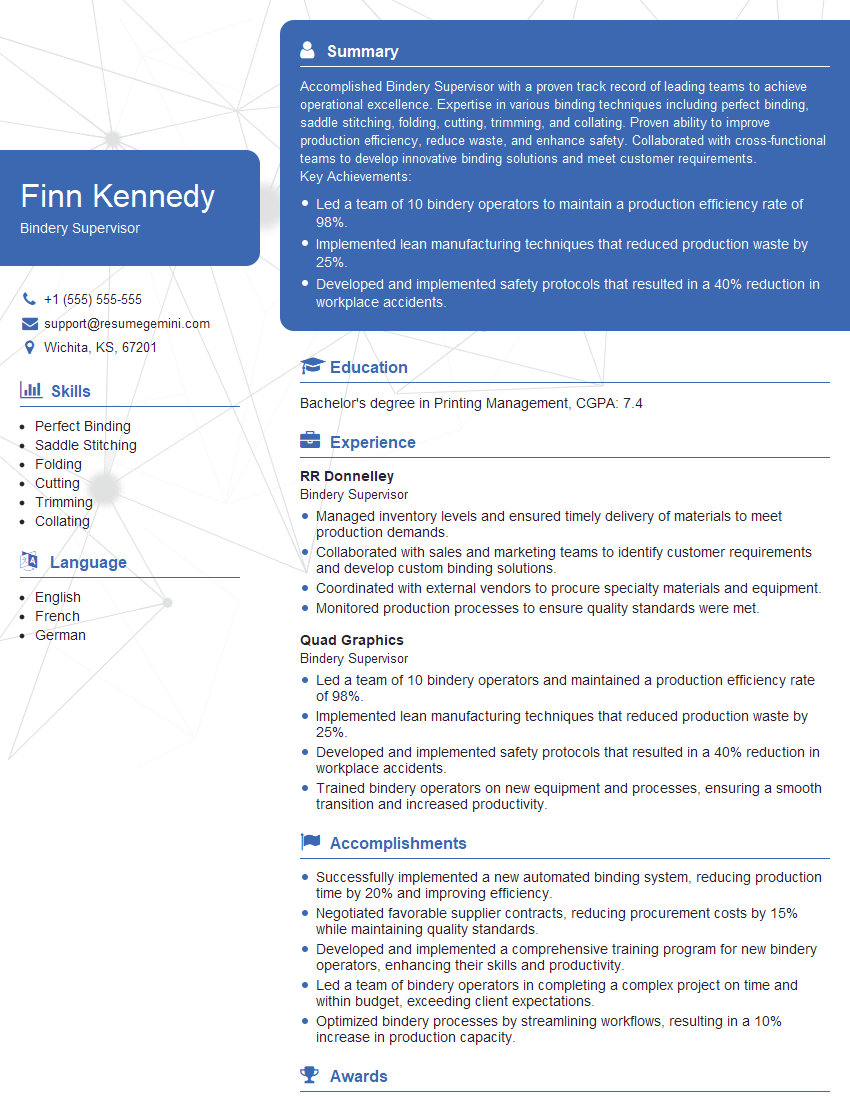
Mastering Saddle Stitcher Operation opens doors to a rewarding career in print finishing, offering opportunities for advancement and specialization. To significantly boost your job prospects, invest time in crafting an ATS-friendly resume that highlights your skills and experience. ResumeGemini is a trusted resource that can help you create a compelling and effective resume. Take advantage of their expertise and the examples of resumes tailored to Saddle Stitcher Operation to showcase your qualifications effectively and land your dream job.


Explore more articles
Users Rating of Our Blogs
Share Your Experience
We value your feedback! Please rate our content and share your thoughts (optional).
What Readers Say About Our Blog
Very informative content, great job.
good